Market Overview
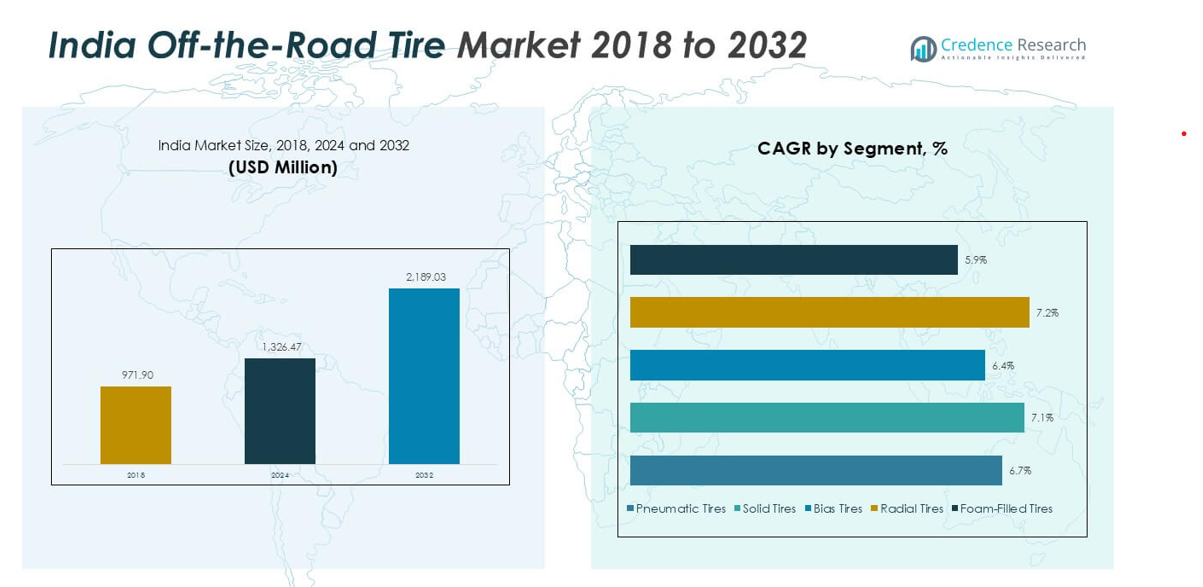
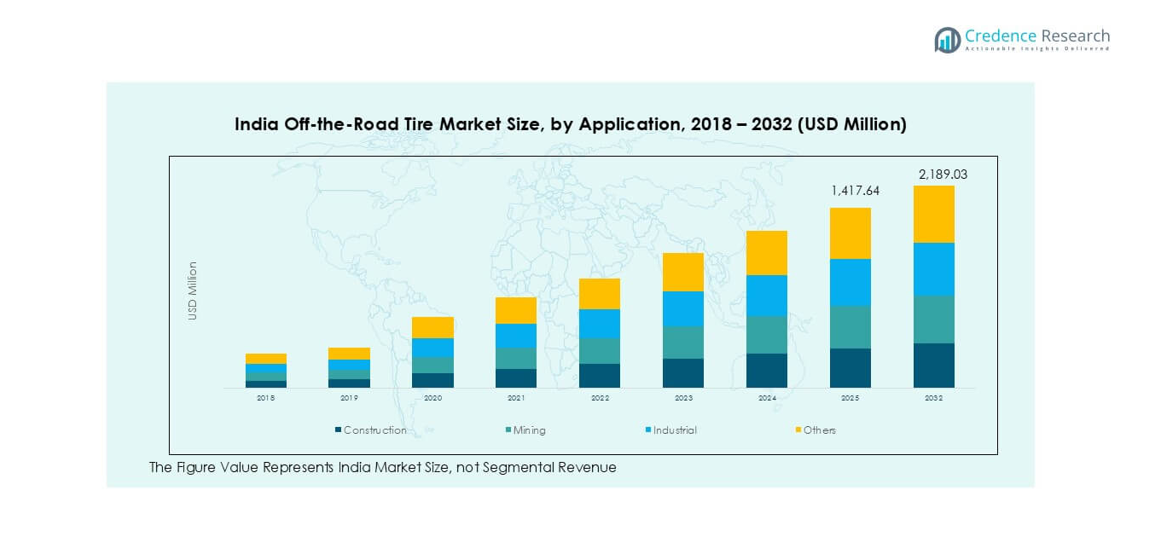
The India Off-the-Road Tire market size was valued at USD 971.90 million in 2018 and grew to USD 1,326.47 million in 2024. It is anticipated to reach USD 2,189.03 million by 2032, expanding at a CAGR of 6.26% during the forecast period.
| REPORT ATTRIBUTE | DETAILS |
|---|---|
| Historical Period | 2020-2023 |
| Base Year | 2024 |
| Forecast Period | 2025-2032 |
| India Off-the-Road Tire Market Size 2024 | USD 1,326.47 million |
| India Off-the-Road Tire Market, CAGR | 6.26% |
| India Off-the-Road Tire Market Size 2032 | USD 2,189.03 million |
The India off-the-road (OTR) tire market is led by key players including Apollo Tyres, Balkrishna Industries (BKT), MRF Limited, JK Tyre & Industries, Bridgestone, Michelin, Continental, Goodyear, and Yokohama, each competing through product innovation, OEM collaborations, and aftermarket expansion. Domestic manufacturers such as Apollo, BKT, and MRF dominate with strong cost efficiency and localized supply chains, while global players focus on advanced radial technologies and premium offerings for construction and mining fleets. Regionally, North India accounted for the largest share at 32% in 2024, driven by rapid urban infrastructure development and mining activities. West India followed with a 25% share, supported by industrial hubs and port infrastructure, while South India contributed 20%, reflecting steady industrial and urban growth.
Market Insights
- The India Off-the-Road Tire market was valued at USD 1,326.47 million in 2024 and is projected to reach USD 2,189.03 million by 2032, expanding at a CAGR of 6.26% during the forecast period.
- Market growth is driven by rising infrastructure development, mining expansion, and industrialization, with construction equipment such as loaders and excavators fueling strong tire demand across the country.
- Key trends include the shift from bias to radial tires for improved durability and fuel efficiency, along with the growing adoption of sustainable rubber compounds and retreading solutions in line with circular economy goals.
- The competitive landscape features Apollo Tyres, Balkrishna Industries, MRF Limited, JK Tyre, and global leaders like Michelin, Bridgestone, and Goodyear, with domestic firms leveraging pricing advantages and global brands focusing on advanced technologies.
- Regionally, North India led with 32% share in 2024, followed by West India at 25%, South India at 20%, East India at 14%, and Central India at 9%, highlighting regional demand diversity.
Market Segmentation Analysis:
By Tire Type
In the India off-the-road tire market, pneumatic tires accounted for the dominant share of over 55% in 2024, supported by their high durability, traction, and cost-effectiveness across construction and mining applications. Their versatility and ability to handle heavy loads in uneven terrains drive widespread adoption. Solid tires and radial tires follow, gaining use in industrial operations where puncture resistance and longevity are critical. Foam-filled tires remain niche but are expanding in specialized applications requiring enhanced safety. Demand is reinforced by large-scale infrastructure projects and increasing mining activity across India.
- For instance, Balkrishna Industries Ltd. (BKT) manufactures off-the-road (OTR) and specialty tires, measuring its capacity in metric tons rather than individual units. The company offers a wide range of more than 3,200 SKUs (stock-keeping units) for various applications.
By Application
The construction segment led the market with a share of more than 40% in 2024, driven by rapid urbanization, government-led infrastructure projects, and strong investments in highways and real estate development. Off-the-road tires are extensively used in loaders, graders, and cranes to support these activities. Mining is another major application, backed by India’s coal and mineral extraction industry, which contributes significantly to tire demand. Industrial applications also show steady growth due to material handling in factories and warehouses. Overall, construction remains the core driver, supported by sustained national infrastructure expansion.
- For instance, Larsen & Toubro likely procured Off-the-Road (OTR) tires from Indian manufacturers BKT and CEAT Specialty during 2022 for its extensive construction equipment fleet.
By Material
Within materials, the rubber compound segment dominated with a market share exceeding 60% in 2024, attributed to its strength, resilience, and suitability for diverse tire designs. Reinforcing materials such as steel and fabric cords provide additional structural support, gaining traction in heavy-duty radial and bias tires for mining operations. Other materials, including specialized fillers, remain in use for niche applications but represent a smaller portion. The dominance of rubber compounds is supported by rising demand for high-performance tires with better grip, longer lifespan, and compliance with safety standards in construction and mining vehicles.
Key Growth Drivers
Expanding Infrastructure and Construction Activities
India’s rapid urbanization and government-led infrastructure investments are driving strong demand for off-the-road (OTR) tires. Large-scale projects such as highways, metro rail, airports, and smart cities require heavy-duty equipment like excavators, loaders, and graders, all of which rely on robust OTR tires. The construction sector alone accounted for over 40% of the application share in 2024, highlighting its dominance. Increasing public-private partnerships and budget allocations for infrastructure development are further fueling this growth. As contractors and equipment operators emphasize efficiency, demand for durable, high-performance pneumatic and radial tires is rising steadily.
- For instance, in the Union Budget for fiscal year (FY) 2022–23, the Government of India increased its total capital expenditure to ₹7.5 lakh crore (over $90 billion at the time), a 35.4% increase from the previous year.
Growth in Mining and Mineral Extraction
India’s mining industry is expanding due to rising demand for coal, iron ore, and other minerals. Mining accounted for a significant share of OTR tire usage, with trucks, loaders, and dozers relying on specialized tires for challenging terrains. The government’s focus on reducing import dependency and boosting domestic mineral production supports steady growth in mining operations. This directly drives demand for tires with high traction, wear resistance, and load capacity. Manufacturers are investing in radial tire designs that improve durability and safety in mining fleets, aligning with the industry’s need for cost efficiency and productivity.
- For instance, Coal India Limited operates a large fleet of heavy earth-moving machinery, including dump trucks and loaders, creating significant recurring OTR tire demand met by domestic suppliers like MRF, JK Tyre, and BKT, among others.
Rising Industrialization and Material Handling Needs
Industrial growth across sectors such as manufacturing, logistics, and warehousing is increasing the adoption of forklifts, cranes, and other material handling vehicles. These vehicles require OTR tires capable of carrying heavy loads in confined operational environments. Solid and foam-filled tires are particularly in demand due to their puncture resistance and long operational life. With India’s logistics and e-commerce industries growing rapidly, the material handling segment is set to boost tire consumption. Additionally, the Make in India initiative and establishment of new industrial corridors are strengthening the demand for OTR tires in supporting infrastructure and intra-logistics applications.
Key Trends & Opportunities
Shift Toward Radialization and Advanced Tire Technologies
A major trend shaping the market is the transition from bias to radial tires. Radial OTR tires offer better traction, fuel efficiency, and longer service life, making them attractive for construction and mining fleets. While pneumatic tires dominate the current market, radial tires are steadily gaining share due to their ability to reduce overall operational costs. Technological advancements such as self-healing compounds, reinforced sidewalls, and pressure monitoring systems also present opportunities for manufacturers. This trend is expected to reshape market dynamics, creating growth opportunities for companies introducing innovative, performance-driven tire solutions.
- For instance, in March 2022, BKT completed a brownfield expansion at its Bhuj plant, which added a new capacity of 50,000 metric tonnes per annum (MTPA) for manufacturing radial agricultural tires. The company also increased its overall capacity at the plant to produce its diverse range of off-the-road (OTR) tires.
Increasing Focus on Sustainability and Recycling
The industry is witnessing a strong push toward sustainability, with emphasis on eco-friendly tire materials, retreading, and recycling. Rubber compound innovations using bio-based and recyclable inputs are gaining traction among OEMs and aftermarket players. Mining and construction operators are also adopting tire retreading solutions to extend lifecycle and reduce costs, supporting circular economy goals. With rising environmental regulations in India, tire makers focusing on sustainable designs and reduced carbon footprint have an opportunity to build stronger customer trust and expand their market presence.
Key Challenges
Volatility in Raw Material Prices
One of the major challenges for the OTR tire market in India is the fluctuating cost of raw materials, particularly natural rubber, synthetic rubber, and reinforcing materials like steel. Price instability directly impacts production costs and squeezes margins for manufacturers. Smaller players in particular face difficulty maintaining profitability when material costs spike. This challenge is amplified by India’s reliance on imports for certain raw materials, making the market vulnerable to global supply chain disruptions. Managing these costs while delivering competitive pricing remains a significant hurdle.
High Replacement Costs and Downtime Issues
OTR tires are high-value components, and their replacement involves significant investment for end-users in construction and mining industries. Downtime during replacement not only increases costs but also disrupts operations, reducing productivity. While premium radial tires offer long-term savings, their upfront cost remains a deterrent for smaller contractors and fleet operators. This cost-sensitive customer base often opts for cheaper alternatives, affecting the adoption rate of advanced tires. Addressing affordability without compromising performance and durability remains a key challenge for tire manufacturers in the Indian market.
Regional Analysis
North India
North India held the largest market share of around 32% in 2024, valued at nearly USD 424.47 million, rising from USD 310.00 million in 2018. Strong infrastructure growth in Delhi NCR, Uttar Pradesh, and Haryana, coupled with highway expansion and real estate projects, is boosting demand for off-the-road tires. Mining activity in states like Rajasthan further contributes to consumption. The region is projected to grow at a CAGR of 6.4%, driven by continued investments in road development, metro networks, and industrial zones. Construction remains the primary demand driver in this region.
West India
West India accounted for about 25% of the market share in 2024, valued at USD 331.62 million, up from USD 242.00 million in 2018. Maharashtra and Gujarat drive this growth with extensive construction, mining, and industrial activities. The region’s strong automobile and port infrastructure sectors also stimulate demand for heavy machinery equipped with OTR tires. Mining operations in states like Goa and Madhya Pradesh add to tire usage. The market in West India is expected to expand at a CAGR of 6.1%, supported by industrial corridors, smart city projects, and demand from logistics hubs.
South India
South India represented nearly 20% of the market share in 2024, valued at USD 265.29 million, increasing from USD 194.38 million in 2018. Tamil Nadu, Karnataka, and Andhra Pradesh drive growth through strong industrial bases, IT parks, and rising urban infrastructure. The construction sector dominates demand, supported by metro rail projects and housing developments. The mining sector, especially in Karnataka, also contributes significantly. With steady industrial expansion and urban growth, South India’s OTR tire market is forecast to grow at a CAGR of 6.0%, maintaining a balanced mix of construction and industrial demand.
East India
East India contributed around 14% of the market share in 2024, valued at USD 185.71 million, rising from USD 138.42 million in 2018. The region is heavily influenced by coal and mineral mining in Jharkhand, Odisha, and Chhattisgarh, which creates strong demand for heavy-duty OTR tires. Infrastructure projects in Bihar and West Bengal further aid growth. Although smaller in size compared to other regions, East India shows strong potential in mining-driven demand. The region is projected to grow at a CAGR of 6.5%, making it one of the fastest-growing markets within the country.
Central India
Central India accounted for 9% of the market share in 2024, valued at USD 119.38 million, up from USD 87.10 million in 2018. The region’s market is driven mainly by mining activities in Madhya Pradesh and Chhattisgarh, along with infrastructure projects in tier-2 and tier-3 cities. While smaller in scale compared to other regions, Central India shows steady growth due to rising industrial activity and expansion of road networks. The market is expected to grow at a CAGR of 6.2%, with mining continuing to act as the core driver of tire demand.
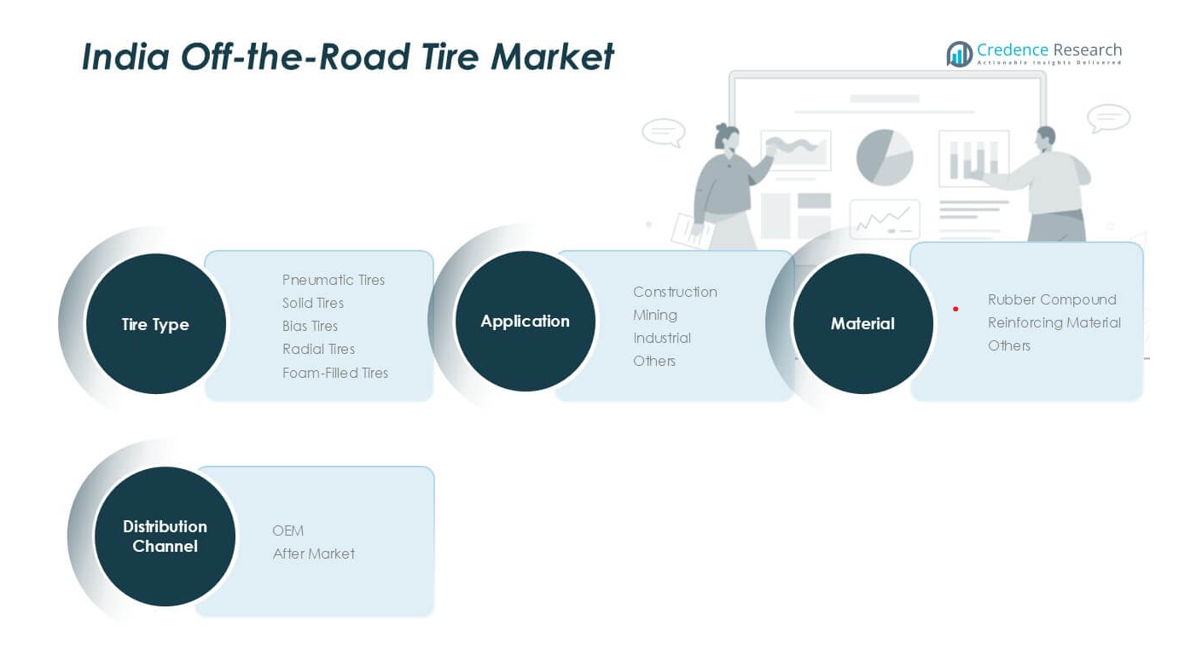
Market Segmentations:
By Tire Type
- Pneumatic Tires
- Solid Tires
- Bias Tires
- Radial Tires
- Foam-Filled Tires
By Application
- Construction
- Mining
- Industrial
- Others
By Material
- Rubber Compound
- Reinforcing Material
- Others
By Distribution Channel
- OEM
- After Market
By Geography
- North India
- West India
- South India
- East India
- Central India
Competitive Landscape
The India off-the-road (OTR) tire market is highly competitive, with both domestic and international players actively shaping the industry. Leading companies such as Apollo Tyres, Balkrishna Industries (BKT), MRF Limited, and JK Tyre & Industries have built strong positions through extensive distribution networks, diversified product portfolios, and a focus on cost-effective solutions tailored to Indian conditions. Global brands including Bridgestone, Michelin, Continental, Goodyear, and Yokohama compete by introducing advanced radial and premium tire technologies aimed at improving durability, safety, and efficiency in construction and mining operations. While multinational firms leverage technological expertise, domestic manufacturers benefit from competitive pricing, localized production, and strong aftermarket presence. Strategic moves such as capacity expansion, partnerships with OEMs, and investments in research for sustainable and high-performance tires are intensifying competition. The balance of affordability and innovation remains the key differentiator, making the market dynamic and growth-oriented for the forecast period.
Key Player Analysis
- Apollo Tyres Limited
- Balkrishna Industries Limited
- Bridgestone Corporation
- CEAT Limited
- Continental AG
- JK Tyre & Industries Limited
- Michelin
- MRF Limited
- The Goodyear Tyre & Rubber Company
- The Yokohama Rubber Co. Ltd.
Recent Developments
- In September 2024, Michelin launched two new tire sizes, VF900/65R46 CFO and VF800/70R46 CFO, as part of an exclusive partnership with New Holland for the CR11 combine harvester. These tires, featuring Michelin's ULTRAFLEX technology, reduce soil compaction, optimize fuel consumption, and improve productivity. The new sizes offer a 23% larger footprint, 7% reduced ground pressure, and a 10 km/h cyclic load bonus.
- In April 2024, Michelin launched the MICHELIN XTRA DEFEND E4** L4** tire range, designed for loaders and articulated dump trucks. This new tire offers an enhanced load capacity of up to 25,400 kg and a speed of up to 14 kph, making it suitable for high-productivity cycles in quarries. The range is available in six sizes, features increased solidity with 50% more metal mass, and improved versatility for loaders and dump trucks. The tire is also retreadable, enhancing its cost-effectiveness.
- In March 2024, Bridgestone Americas launched its new VZT 25" construction tire at the AGG1 Expo in Nashville, Tennessee. The tire, designed for loaders and graders, offers enhanced durability and improved traction. The company also showcased its engineering solutions to boost productivity and reduce operational costs. Bridgestone’s participation at the event supported its commitment to sustainability through its E8 values.
- In March 2024, Pirelli & C. S.p.A. launched a new agriculture OTR tire named Pirelli PHP. This tire was specifically designed for the agriculture industry and leverages Pirelli's extensive experience in the field. It offers higher fuel savings, longer duration, lower land compaction, higher safety and comfort, and improved force transmission. This tire was specifically designed for the European market.
Report Coverage
The research report offers an in-depth analysis based on Tire Type, Application, Material, Distribution Channel and Geography. It details leading market players, providing an overview of their business, product offerings, investments, revenue streams, and key applications. Additionally, the report includes insights into the competitive environment, SWOT analysis, current market trends, as well as the primary drivers and constraints. Furthermore, it discusses various factors that have driven market expansion in recent years. The report also explores market dynamics, regulatory scenarios, and technological advancements that are shaping the industry. It assesses the impact of external factors and global economic changes on market growth. Lastly, it provides strategic recommendations for new entrants and established companies to navigate the complexities of the market.
Future Outlook
- The India off-the-road tire market will grow steadily with rising infrastructure investments.
- Construction activities will continue to drive the largest demand for OTR tires.
- Mining expansion will strengthen the need for durable, high-traction tires.
- Radial tires will gain more market share due to better efficiency and lifespan.
- Domestic manufacturers will expand capacity to meet growing industrial demand.
- Global players will introduce advanced technologies for safety and performance.
- Sustainable tire materials and recycling practices will see wider adoption.
- The aftermarket segment will expand as fleets seek cost-effective replacements.
- Regional growth will be led by North and West India due to strong infrastructure activity.
- Innovation in smart tire monitoring systems will create new opportunities for manufacturers.

Request a Free Sample
Fill in your details and we'll send you a free sample report.
- Sample data tables & charts
- Research methodology
Market Dynamics
Expanding Infrastructure and Construction Activities
India's rapid urbanization and government-led infrastructure investments are fueling demand for OTR tires, as large-scale projects like highways, metro rail, and smart cities require heavy-duty equipment that relies on robust tires.
Growth in Mining and Mineral Extraction
The expansion of India's mining industry, particularly in coal and mineral extraction, is increasing the need for specialized OTR tires with high traction and durability to operate in challenging terrains, directly boosting market demand.
Rising Industrialization and Material Handling Needs
Growth in manufacturing, logistics, and warehousing sectors is driving the adoption of forklifts, cranes, and other material handling vehicles that require OTR tires, especially solid and foam-filled types for puncture resistance and longevity.
Shift Toward Radialization and Advanced Tire Technologies
The market is experiencing a transition from bias to radial tires, which offer improved durability, fuel efficiency, and operational cost savings, encouraging fleets in construction and mining to upgrade and thus expanding the market.
Increasing Focus on Sustainability and Recycling
There is a growing emphasis on eco-friendly tire materials, retreading, and recycling, with both OEMs and aftermarket players adopting sustainable practices to meet regulatory requirements and customer preferences, supporting long-term market growth.
Need a Custom Version of This Report?
Tailor the scope, geography, or segments to your exact requirements.
- Custom geography or segment scope
- Direct access to our analyst team
Frequently Asked Questions
What is the current size of the India Off the Road Tire market?
What factors are driving the growth of the India Off the Road Tire market?
What are the key segments within the India Off the Road Tire market?
What are some challenges faced by the India Off the Road Tire market?
Who are the major players in the India Off the Road Tire market?
Table of Content
Chapter 1 Market Segmentation
- 1.1 Segmentation Framework
- 1.1.1 Product and Service Classification
- 1.1.2 Application and End-Use Classification
- 1.1.3 Technology and Solution Classification
- 1.1.4 Customer and Distribution Channel Classification
- 1.1.5 Geographic Segmentation
- 1.1.6 Market Segment Definitions and Boundaries
- 1.2 By Material
- 1.2.1 Rubber Compound
- 1.2.2 Reinforcing Material
- 1.2.3 Others
- 1.3 By Tire Type
- 1.3.1 Pneumatic Tires
- 1.3.2 Solid Tires
- 1.3.3 Bias Tires
- 1.3.4 Radial Tires
- 1.3.5 Foam-Filled Tires
- 1.4 By Application
- 1.4.1 Construction
- 1.4.2 Mining
- 1.4.3 Industrial
- 1.4.4 Others
Chapter 2 Introduction
- 2.1 Report Objectives and Scope
- 2.2 Product Definition and Industry Terminology
- 2.3 Market Inclusions and Exclusions
- 2.4 Research Process
- 2.4.1 Primary Research and Expert Interviews
- 2.4.2 Secondary Research and Source Review
- 2.4.3 Top-Down and Bottom-Up Estimation
- 2.4.4 Data Triangulation and Verification
- 2.5 Market Size Measurement Basis
- 2.5.1 2024: USD 1,326.47 million → 2032: USD 2,189.03 million
- 2.6 Historical and Forecast Reference Periods
- 2.6.1 Base Year: 2024
- 2.6.2 Forecast Period: 2024-2032
- 2.7 Research Assumptions and Limitations
Chapter 3 Executive Summary
- 3.1 Market Snapshot and Key Findings
- 3.2 Base-Year Market Size, 2024
- 3.3 Forecast Market Size, 2032
- 3.4 Revenue and Volume Growth Outlook
- 3.5 Key Demand and Supply Indicators
- 3.6 Leading Market Segments
- 3.7 Fastest-Growing Market Opportunities
- 3.8 Regional Performance Highlights
- 3.9 Technology and Industry Transformation
- 3.10 Competitive Landscape Summary
- 3.11 Analyst View and Strategic Implications
Chapter 4 India Off-the-Road Tire Market Trends and Developments
- 4.1 Historical Industry Development
- 4.2 Recent Market Trends and Developments
- 4.3 Demand and Customer Behavior Trends
- 4.4 Technology and Product Innovation
- 4.5 Artificial Intelligence, Automation and Digitalization
- 4.6 Local Manufacturing and Supply Chain Realignment
- 4.7 Industry Partnerships, Mergers and Acquisitions
- 4.8 Sustainability and Circular Economy Developments
- 4.9 Government and Private Sector Investment Trends
- 4.10 Emerging Business Models and Commercialization
- 4.11 Industry Developments and Announcements
Chapter 5 India Off-the-Road Tire Market Production, Supply and Demand Analysis
- 5.1 Demand Trend and Consumption Analysis
- 5.2 Demand Forecast, 2024-2032
- 5.3 Production and Output Trend
- 5.4 Production and Output Forecast, 2024-2032
- 5.5 Installed Capacity and Capacity Utilization
- 5.6 Company-Wise Production Plants and Statistics
- 5.6.1 Installed Production Capacity
- 5.6.2 Actual Production
- 5.6.3 Planned Capacity and Expansion Targets
- 5.7 Supply Chain Structure and Procurement Trends
- 5.8 Supply-Demand Gap and Bottlenecks
- 5.9 Import Dependence and Sourcing Structure
- 5.10 Contract Manufacturing and Outsourcing
- 5.11 Regional Supply and Demand Concentration
Chapter 6 India Off-the-Road Tire Market Pricing Analysis
- 6.1 Pricing Structure and Measurement
- 6.2 Historical Pricing Trends
- 6.3 Pricing Outlook, 2024-2032
- 6.4 Average Selling Price and Unit Economics
- 6.5 Pricing by Product and Market Segment
- 6.6 Geographic Pricing Differences
- 6.7 Key Input, Energy, Labor and Logistics Costs
- 6.8 Contract Pricing and Purchasing Models
- 6.9 Pricing Sensitivity and Competitive Positioning
- 6.10 Price, Margin and Profitability Implications
Chapter 7 India Off-the-Road Tire Market Dynamics
- 7.1 Market Growth Drivers
- 7.1.1 Demand-Side Drivers
- 7.1.2 Technology and Innovation Drivers
- 7.1.3 Infrastructure and Investment Drivers
- 7.1.4 Regulatory and Policy Drivers
- 7.2 Market Restraints
- 7.2.1 Cost and Affordability Constraints
- 7.2.2 Technology and Adoption Barriers
- 7.2.3 Supply Chain and Operational Constraints
- 7.3 Market Challenges
- 7.3.1 Competitive Pressure and Margin Erosion
- 7.3.2 Skills, Infrastructure and Implementation Gaps
- 7.4 Emerging Market Opportunities
- 7.5 Market Dynamics Impact and Time-Horizon Assessment
Chapter 8 India Off-the-Road Tire Value Chain Analysis
- 8.1 Industry Value Chain Overview
- 8.2 Upstream Suppliers and Critical Inputs
- 8.3 Technology and Component Providers
- 8.4 Manufacturing or Service Delivery
- 8.5 Distribution, Channel Partners and Integrators
- 8.6 Downstream Applications and End Users
- 8.7 Value Addition and Profit Pools
- 8.8 Vertical Integration and Outsourcing
- 8.9 Supplier Concentration and Risk
- 8.10 Supply Chain Localization and Resilience
Chapter 9 India Off-the-Road Tire Market Regulations and Policies
- 9.1 Relevant Laws, Standards and Compliance Frameworks
- 9.2 Product, Service, Safety and Quality Requirements
- 9.3 Government Policies, Incentives and Subsidies
- 9.4 Imports, Exports and Trade Barriers
- 9.5 Public Procurement and Local Content Requirements
- 9.6 Environmental and Sustainability Compliance
- 9.7 Upcoming Policy Changes and Market Implications
Chapter 10 India Off-the-Road Tire Market Hotspots and Opportunities
- 10.1 Market Opportunity Mapping and Growth Hotspots
- 10.2 High-Growth Applications and Customer Groups
- 10.3 Underserved Markets and White-Space Opportunities
- 10.4 Emerging Technology and Product Opportunities
- 10.5 New Capacity and Investment Hotspots
- 10.6 Market Entry and Expansion Opportunities
- 10.7 Distribution and Partnership Opportunities
- 10.8 Near-Term and Long-Term Commercial Potential
- 10.9 Opportunity Attractiveness and Execution Risks
Chapter 11 India Off-the-Road Tire Market Outlook, 2024-2032
- 11.1 Market Size and Analysis
- 11.1.1 Revenue (Market Measurement: 2024: USD 1,326.47 million → 2032: USD 2,189.03 million)
- 11.1.2 Market Volume and Quantity Sold
- 11.1.3 Historical Market Size
- 11.1.4 Base-Year Market Size, 2024
- 11.2 Market Forecast, 2024-2032
- 11.2.1 Revenue Forecast to 2032
- 11.2.2 Volume Forecast to 2032
- 11.2.3 CAGR and Year-on-Year Growth
- 11.2.4 Incremental Revenue Opportunity
- 11.3 Forecast Assumptions and Scenario Analysis
- 11.3.1 Base-Case Forecast
- 11.3.2 Optimistic and Conservative Scenarios
- 11.3.3 Technology, Pricing and Policy Sensitivities
- 11.4 Market Attractiveness and Growth Outlook
Chapter 12 India Off-the-Road Tire Market Segmentation and Outlook
- 12.1 Segmentation Summary and Market Shares, 2024
- 12.2 Largest and Fastest-Growing Segments
- 12.3 By Material - Market Size and Forecast, 2024-2032
- 12.3.1 Segment Definition and Scope
- 12.3.2 Historical Market Size
- 12.3.3 Revenue Forecast, 2024-2032
- 12.3.4 Volume Forecast, 2024-2032
- 12.3.5 Base-Year Market Share, 2024
- 12.3.6 Segment CAGR and Growth Drivers
- 12.3.7 Subsegment Market Size and Forecast
- 12.3.7.1 Rubber Compound
- 12.3.7.2 Reinforcing Material
- 12.3.7.3 Others
- 12.3.8 Subsegment Pricing and Adoption Trends
- 12.3.9 Leading Suppliers and Competition
- 12.3.10 Regional Demand and Opportunities
- 12.4 By Tire Type - Market Size and Forecast, 2024-2032
- 12.4.1 Segment Definition and Scope
- 12.4.2 Historical Market Size
- 12.4.3 Revenue Forecast, 2024-2032
- 12.4.4 Volume Forecast, 2024-2032
- 12.4.5 Base-Year Market Share, 2024
- 12.4.6 Segment CAGR and Growth Drivers
- 12.4.7 Subsegment Market Size and Forecast
- 12.4.7.1 Pneumatic Tires
- 12.4.7.2 Solid Tires
- 12.4.7.3 Bias Tires
- 12.4.7.4 Radial Tires
- 12.4.7.5 Foam-Filled Tires
- 12.4.8 Subsegment Pricing and Adoption Trends
- 12.4.9 Leading Suppliers and Competition
- 12.4.10 Regional Demand and Opportunities
- 12.5 By Application - Market Size and Forecast, 2024-2032
- 12.5.1 Segment Definition and Scope
- 12.5.2 Historical Market Size
- 12.5.3 Revenue Forecast, 2024-2032
- 12.5.4 Volume Forecast, 2024-2032
- 12.5.5 Base-Year Market Share, 2024
- 12.5.6 Segment CAGR and Growth Drivers
- 12.5.7 Subsegment Market Size and Forecast
- 12.5.7.1 Construction
- 12.5.7.2 Mining
- 12.5.7.3 Industrial
- 12.5.7.4 Others
- 12.5.8 Subsegment Pricing and Adoption Trends
- 12.5.9 Leading Suppliers and Competition
- 12.5.10 Regional Demand and Opportunities
- 12.6 Segment Growth Comparison
- 12.7 Segment Attractiveness and Priority Matrix
Chapter 13 India Off-the-Road Tire End-Use and Application Market Outlook
- 13.1 End-Use Industry and Customer Demand Structure
- 13.2 Leading Applications and Customer Groups
- 13.3 End-Use Market Size, Share and Forecast
- 13.4 Major End-Use Industry Deep Dives
- 13.4.1 Customer Requirements and Use Cases
- 13.4.2 Demand and Replacement Cycles
- 13.4.3 Technical and Regulatory Considerations
- 13.4.4 Purchasing and Procurement Models
- 13.4.5 Leading Vendors and Distribution Channels
- 13.4.6 Forecast and Commercial Opportunities
- 13.5 Emerging Applications and Cross-Segment Demand
- 13.6 End-Use Industry Investment Priorities
Chapter 14 India Off-the-Road Tire Geographic Market Outlook, 2024-2032
- 14.1 Domestic Market Distribution and Demand Clusters
- 14.2 State- or Province-Wise Market Size and Forecast, 2024-2032
- 14.3 City and Metropolitan Market Outlook
- 14.4 Industrial, Manufacturing and Commercial Clusters
- 14.5 Geographic Concentration of Key End Users
- 14.6 Local Pricing and Purchasing Differences
- 14.7 Domestic Production Facilities and Capacity Map
- 14.8 Local Infrastructure and Project Pipeline
- 14.9 State-Level Policy and Incentive Differences
- 14.10 Subnational Investment Hotspots and Opportunities
- 14.11 Distribution and Logistics Networks
- 14.12 Domestic Competitive Footprint
Chapter 15 India Off-the-Road Tire Technology, Innovation and Sustainability Outlook
- 15.1 Technology Landscape and Maturity
- 15.2 Product, Process and Service Innovation
- 15.3 AI, Automation and Digital Tools in the Industry
- 15.4 Technology Adoption and Performance Benchmarking
- 15.5 Innovation Pipeline and R&D Investment
- 15.6 Patent and Intellectual Property Trends
- 15.7 Energy Efficiency and Resource Management
- 15.8 Sustainability, Recycling and Circularity
- 15.9 Technology Roadmap, 2024-2032
- 15.10 Risks of Obsolescence and Technology Substitution
Chapter 16 India Off-the-Road Tire Market Key Strategic Imperatives
- 16.1 Growth and Market Entry Priorities
- 16.2 High-Return Products and Segments
- 16.3 Pricing, Profitability and Cost Optimization
- 16.4 Technology Investment and Product Differentiation
- 16.5 Supply Chain Localization and Resilience
- 16.6 Distribution and Customer Acquisition
- 16.7 Partnership, Acquisition and Capacity Strategy
- 16.8 Regional Expansion Priorities
- 16.9 Short-, Medium- and Long-Term Actions
Chapter 17 Competition Outlook
- 17.1 Industry Competition Characteristics
- 17.2 Market Structure and Concentration
- 17.3 Market Share and Competitive Positioning, 2024
- 17.4 Company-Wise Revenue and Product Benchmarking
- 17.5 Production and Service Capacity Benchmarking
- 17.6 Technology, Pricing and Differentiation
- 17.7 Regional Footprint and Distribution Strength
- 17.8 Mergers, Acquisitions and Strategic Alliances
- 17.9 New Entrants and Competitive Threats
- 17.10 Porter's Five Forces and Industry Attractiveness
- 17.11 Competitive Outlook, 2024-2032
Chapter 18 Company Profiles
- 18.1 Company Coverage and Selection Criteria
- 18.2 Apollo Tyres Limited
- 18.2.1 Business Description
- 18.2.2 Company Ownership and Geographic Presence
- 18.2.3 Product and Service Portfolio
- 18.2.4 Manufacturing and Operating Footprint
- 18.2.5 Production Capacity and Expansion Plans
- 18.2.6 Financial Performance and Investment
- 18.2.7 Market Share and Competitive Position
- 18.2.8 Technology and Innovation Capabilities
- 18.2.9 Strategic Alliances or Partnerships
- 18.2.10 Recent Developments
- 18.2.11 Growth Strategy and Outlook
- 18.3 Balkrishna Industries Limited (BKT)
- 18.4 MRF Limited
- 18.5 JK Tyre & Industries Limited
- 18.6 Bridgestone Corporation
- 18.7 Michelin
- 18.8 Continental AG
- 18.9 The Goodyear Tyre & Rubber Company
- 18.10 The Yokohama Rubber Co. Ltd.
- 18.11 CEAT Limited
- 18.12 Other Relevant Market Participants
Note: Every listed company is profiled on the structure shown under the first company. The company list is preliminary and may change based on research findings, market developments, data availability and client requirements.
Chapter 19 Disclaimer
- 19.1 Research and Forecast Disclaimer
- 19.2 Data Source and Estimation Limitations
Note: The depth of individual sections depends on data availability for this market. Volume, capacity, trade and other unit-based metrics are included where applicable.