
Market Insights
The industrial protocol gateways market will experience rapid expansion over the next decade. Several factors will drive this. The most critical of these are advances in artificial intelligence, of which industrial multiprotocol gateways are a prime component. Hence, advancements in artificial intelligence and its latest trends and developments will have a far-reaching effect on the industrial multiprotocol gateways market.
The global Industrial Multiprotocol Gateways market is expected to provide a cumulative growth opportunity equivalent to USD 3.13 billion between 2022 and 2028. The global Industrial Multiprotocol Gateways market has shown rapid recovery from a sharp decline in 2020 and bounced back with almost 10.82% growth in 2021. As a result, the revenue garnered by the global Industrial Multiprotocol Gateways industry in 2021 stood at USD 269.99 million, which is likely to cross the USD 587.54 million mark by the end of 2028.
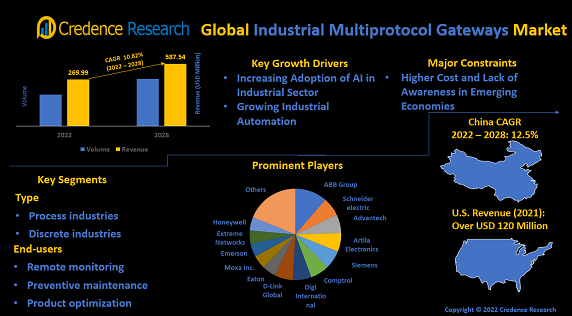
Interesting Facts about Industrial Multiprotocol Gateways Industry
- Industrial Multiprotocol Gateways facilitate communication between the device to device and device to cloud.
- Global IoT node and gateway industry to generate revenue of over USD 750 billion by 2028
- Process industries dominated the Industrial Multiprotocol Gateways market with over 55% share in 2021
- Industrial Multiprotocol Gateways demand is dominated by the Remote monitoring application in 2021, with over 40% share.
- S., Germany, UK, Japan, China, and France are dominating economies in the global Remote monitoring market
- The higher cost of installation of Industrial Multiprotocol Gateways is one of the potential factors holding back the growth of this industry.
Increasing Adoption of AI in the Industrial Sector
The year 2022 will be a critical time frame since this is the time when there will be the most significant advancements in artificial intelligence owing to several factors that are increasing the momentum of AI research. Leading technology company CEOs are already stating that AI progress will have a far greater effect on humankind’s advancement, which will be even greater than that of electricity.
This might seem to be a bold claim, but considering what is being achieved by AI, like cancer treatment developments, space exploration, and climate change mitigation, this is not an overly ambitious prospect.
It is hard to imagine the effects and the scale of the impact that AI will soon have. Very soon, AI-powered algorithms will make accurate decisions that will bring AI systems to par with human intelligence. Not only that, they will be able to make proper decisions much faster than human beings. The implications are very profound, and the ramifications are enormous.
Rising Demand for Augmented Workforce
As it is, AI developments are giving rise to the concept of the augmented workforce. Although it has always been feared that robots will take the place of the human workforce, it is more likely that initially, at least, AI-powered robots and machines will work intelligently beside human beings. That is, AI-powered algorithms will boost workers’ cognitive abilities and performance.
Already, these abilities are being put to the test with impressive results. For example, in marketing, AI systems are helping to identify leads that have a greater likelihood of completing the sale. As a result, marketers can identify and work on valuable tips to boost their sales performance. AI tools even predict the value of sales that prospective customers will create.
Preventive Maintenance to Grow at Rapid Pace
Remote monitoring, Preventive maintenance, and Product optimization are some of the critical application areas for the Industrial Multiprotocol Gateways. In the field of engineering, AI is also creating a solid impact. For example, it helps with predictive maintenance. Consequently, human workers will be able to identify potential issues as they arise in machinery. AI will identify these issues before they become severe problems like mechanical failure or breakdowns. As a result, there will be fewer stoppages and much lower downtime. This will lead to a higher rate of order fulfillment and thus much greater customer satisfaction.
Intelligent tools are emerging in almost every sector, vertical, and industry you can imagine. It is hard to think of any sector that will not be profoundly affected by AI. These developments will have a positive impact on the industrial multiprotocol gateways market.
ABB Group, Accton Technology, Advantech, Artila Electronics, ASUSTeK Computer Inc., Control, Digi International, D-Link Global, Eaton, Elpro technologies, Emerson, Extreme Networks, hejm automation, HMS Networks, Honeywell, Lectronix Inc., Moxa Inc., Multi-Tech Systems, San Telequip Pvt. Ltd., Schneider Electric, Siemens, Valmet, and Wink are some of the leading players in global Industrial Multiprotocol Gateways market.

Request a Free Sample
Fill in your details and we'll send you a free sample report.
- Sample data tables & charts
- Research methodology
Market Dynamics
Advancements in Artificial Intelligence
Rapid progress in AI technologies is enabling smarter, more adaptive industrial multiprotocol gateways, enhancing their ability to manage complex device-to-device and device-to-cloud communications and driving adoption across industries.
Growth of Industrial IoT and Smart Manufacturing
The proliferation of IoT devices and the shift toward smart factories require robust multiprotocol gateways to ensure seamless interoperability between diverse industrial systems, fueling market demand.
Rising Need for Remote Monitoring and Predictive Maintenance
Industries are increasingly relying on remote monitoring and predictive maintenance to minimize downtime and optimize operations, with multiprotocol gateways serving as critical enablers for real-time data collection and analysis.
Dominance of Process Industries
Process industries, which accounted for over 55% of the market in 2021, continue to drive demand for multiprotocol gateways due to their complex automation requirements and need for reliable, integrated communication solutions.
Need a Custom Version of This Report?
Tailor the scope, geography, or segments to your exact requirements.
- Custom geography or segment scope
- Direct access to our analyst team
Frequently Asked Questions
How COVID 19 Impacted Industrial Multiprotocol Gateways Market?
Which is the leading regional market for Industrial Multiprotocol Gateways?
What is the major growth driving factors for global Industrial Multiprotocol Gateways market?
Which is major segment in Industrial Multiprotocol Gateways market by type?
Which is major segment in Industrial Multiprotocol Gateways market by application?
Table of Content
Chapter 1 Market Segmentation
- 1.1 Segmentation Framework
- 1.1.1 Product and Service Classification
- 1.1.2 Application and End-Use Classification
- 1.1.3 Technology and Solution Classification
- 1.1.4 Customer and Distribution Channel Classification
- 1.1.5 Geographic Segmentation
- 1.1.6 Market Segment Definitions and Boundaries
- 1.2 By Industry
- 1.2.1 Process Industries
- 1.2.2 Discrete Manufacturing
- 1.2.3 Energy & Utilities
- 1.2.4 Oil & Gas
- 1.2.5 Transportation & Logistics
- 1.3 By Deployment
- 1.3.1 On-Premise
- 1.3.2 Cloud-Based
- 1.3.3 Hybrid
- 1.4 By Application
- 1.4.1 Remote Monitoring
- 1.4.2 Preventive Maintenance
- 1.4.3 Product Optimization
- 1.4.4 Asset Management
- 1.4.5 Process Automation
- 1.5 By Protocol Support
- 1.5.1 Ethernet/IP
- 1.5.2 PROFINET
- 1.5.3 Modbus
- 1.5.4 DeviceNet
- 1.5.5 Others
Chapter 2 Introduction
- 2.1 Report Objectives and Scope
- 2.2 Product Definition and Industry Terminology
- 2.3 Market Inclusions and Exclusions
- 2.4 Research Process
- 2.4.1 Primary Research and Expert Interviews
- 2.4.2 Secondary Research and Source Review
- 2.4.3 Top-Down and Bottom-Up Estimation
- 2.4.4 Data Triangulation and Verification
- 2.5 Market Size Measurement Basis
- 2.5.1 Base year: USD 430.68 million → Forecast year: USD 916.60 million
- 2.6 Research Assumptions and Limitations
Chapter 3 Executive Summary
- 3.1 Market Snapshot and Key Findings
- 3.2 Base-Year Market Size
- 3.3 Forecast Market Size
- 3.4 Revenue and Volume Growth Outlook
- 3.5 Key Demand and Supply Indicators
- 3.6 Leading Market Segments
- 3.7 Fastest-Growing Market Opportunities
- 3.8 Regional Performance Highlights
- 3.9 Technology and Industry Transformation
- 3.10 Competitive Landscape Summary
- 3.11 Analyst View and Strategic Implications
Chapter 4 Global Industrial Multiprotocol Gateways Market Trends and Developments
- 4.1 Historical Industry Development
- 4.2 Recent Market Trends and Developments
- 4.3 Demand and Customer Behavior Trends
- 4.4 Technology and Product Innovation
- 4.5 Artificial Intelligence, Automation and Digitalization
- 4.6 Local Manufacturing and Supply Chain Realignment
- 4.7 Industry Partnerships, Mergers and Acquisitions
- 4.8 Sustainability and Circular Economy Developments
- 4.9 Government and Private Sector Investment Trends
- 4.10 Emerging Business Models and Commercialization
- 4.11 Industry Developments and Announcements
Chapter 5 Global Industrial Multiprotocol Gateways Market Production, Supply and Demand Analysis
- 5.1 Demand Trend and Consumption Analysis
- 5.2 Demand Forecast
- 5.3 Production and Output Trend
- 5.4 Production and Output Forecast
- 5.5 Installed Capacity and Capacity Utilization
- 5.6 Company-Wise Production Plants and Statistics
- 5.6.1 Installed Production Capacity
- 5.6.2 Actual Production
- 5.6.3 Planned Capacity and Expansion Targets
- 5.7 Supply Chain Structure and Procurement Trends
- 5.8 Supply-Demand Gap and Bottlenecks
- 5.9 Import Dependence and Sourcing Structure
- 5.10 Contract Manufacturing and Outsourcing
- 5.11 Regional Supply and Demand Concentration
Chapter 6 Global Industrial Multiprotocol Gateways Market Pricing Analysis
- 6.1 Pricing Structure and Measurement
- 6.2 Historical Pricing Trends
- 6.3 Pricing Outlook
- 6.4 Average Selling Price and Unit Economics
- 6.5 Pricing by Product and Market Segment
- 6.6 Geographic Pricing Differences
- 6.7 Key Input, Energy, Labor and Logistics Costs
- 6.8 Contract Pricing and Purchasing Models
- 6.9 Pricing Sensitivity and Competitive Positioning
- 6.10 Price, Margin and Profitability Implications
Chapter 7 Global Industrial Multiprotocol Gateways Market Dynamics
- 7.1 Market Growth Drivers
- 7.1.1 Demand-Side Drivers
- 7.1.2 Technology and Innovation Drivers
- 7.1.3 Infrastructure and Investment Drivers
- 7.1.4 Regulatory and Policy Drivers
- 7.2 Market Restraints
- 7.2.1 Cost and Affordability Constraints
- 7.2.2 Technology and Adoption Barriers
- 7.2.3 Supply Chain and Operational Constraints
- 7.3 Market Challenges
- 7.3.1 Competitive Pressure and Margin Erosion
- 7.3.2 Skills, Infrastructure and Implementation Gaps
- 7.4 Emerging Market Opportunities
- 7.5 Market Dynamics Impact and Time-Horizon Assessment
Chapter 8 Global Industrial Multiprotocol Gateways Value Chain Analysis
- 8.1 Industry Value Chain Overview
- 8.2 Upstream Suppliers and Critical Inputs
- 8.3 Technology and Component Providers
- 8.4 Manufacturing or Service Delivery
- 8.5 Distribution, Channel Partners and Integrators
- 8.6 Downstream Applications and End Users
- 8.7 Value Addition and Profit Pools
- 8.8 Vertical Integration and Outsourcing
- 8.9 Supplier Concentration and Risk
- 8.10 Supply Chain Localization and Resilience
Chapter 9 Global Industrial Multiprotocol Gateways Market Regulations and Policies
- 9.1 Relevant Laws, Standards and Compliance Frameworks
- 9.2 Product, Service, Safety and Quality Requirements
- 9.3 Government Policies, Incentives and Subsidies
- 9.4 Imports, Exports and Trade Barriers
- 9.5 Public Procurement and Local Content Requirements
- 9.6 Environmental and Sustainability Compliance
- 9.7 Data Protection, AI and Cybersecurity Compliance
- 9.8 Upcoming Policy Changes and Market Implications
Chapter 10 Global Industrial Multiprotocol Gateways Market Hotspots and Opportunities
- 10.1 Market Opportunity Mapping and Growth Hotspots
- 10.2 High-Growth Applications and Customer Groups
- 10.3 Underserved Markets and White-Space Opportunities
- 10.4 Emerging Technology and Product Opportunities
- 10.5 New Capacity and Investment Hotspots
- 10.6 Market Entry and Expansion Opportunities
- 10.7 Distribution and Partnership Opportunities
- 10.8 Near-Term and Long-Term Commercial Potential
- 10.9 Opportunity Attractiveness and Execution Risks
Chapter 11 Global Industrial Multiprotocol Gateways Market Outlook
- 11.1 Market Size and Analysis
- 11.1.1 Revenue (Market Measurement: Base year: USD 430.68 million → Forecast year: USD 916.60 million)
- 11.1.2 Market Volume and Quantity Sold
- 11.1.3 Historical Market Size
- 11.1.4 Base-Year Market Size
- 11.2 Market Forecast
- 11.2.1 Revenue Forecast
- 11.2.2 Volume Forecast
- 11.2.3 CAGR and Year-on-Year Growth
- 11.2.4 Incremental Revenue Opportunity
- 11.3 Forecast Assumptions and Scenario Analysis
- 11.3.1 Base-Case Forecast
- 11.3.2 Optimistic and Conservative Scenarios
- 11.3.3 Technology, Pricing and Policy Sensitivities
- 11.4 Market Attractiveness and Growth Outlook
Chapter 12 Global Industrial Multiprotocol Gateways Market Segmentation and Outlook
- 12.1 Segmentation Summary and Market Shares
- 12.2 Largest and Fastest-Growing Segments
- 12.3 By Industry - Market Size and Forecast
- 12.3.1 Segment Definition and Scope
- 12.3.2 Historical Market Size
- 12.3.3 Revenue Forecast
- 12.3.4 Volume Forecast
- 12.3.5 Base-Year Market Share
- 12.3.6 Segment CAGR and Growth Drivers
- 12.3.7 Subsegment Market Size and Forecast
- 12.3.7.1 Process Industries
- 12.3.7.2 Discrete Manufacturing
- 12.3.7.3 Energy & Utilities
- 12.3.7.4 Oil & Gas
- 12.3.7.5 Transportation & Logistics
- 12.3.8 Subsegment Pricing and Adoption Trends
- 12.3.9 Leading Suppliers and Competition
- 12.3.10 Regional Demand and Opportunities
- 12.4 By Deployment - Market Size and Forecast
- 12.4.1 Segment Definition and Scope
- 12.4.2 Historical Market Size
- 12.4.3 Revenue Forecast
- 12.4.4 Volume Forecast
- 12.4.5 Base-Year Market Share
- 12.4.6 Segment CAGR and Growth Drivers
- 12.4.7 Subsegment Market Size and Forecast
- 12.4.7.1 On-Premise
- 12.4.7.2 Cloud-Based
- 12.4.7.3 Hybrid
- 12.4.8 Subsegment Pricing and Adoption Trends
- 12.4.9 Leading Suppliers and Competition
- 12.4.10 Regional Demand and Opportunities
- 12.5 By Application - Market Size and Forecast
- 12.5.1 Segment Definition and Scope
- 12.5.2 Historical Market Size
- 12.5.3 Revenue Forecast
- 12.5.4 Volume Forecast
- 12.5.5 Base-Year Market Share
- 12.5.6 Segment CAGR and Growth Drivers
- 12.5.7 Subsegment Market Size and Forecast
- 12.5.7.1 Remote Monitoring
- 12.5.7.2 Preventive Maintenance
- 12.5.7.3 Product Optimization
- 12.5.7.4 Asset Management
- 12.5.7.5 Process Automation
- 12.5.8 Subsegment Pricing and Adoption Trends
- 12.5.9 Leading Suppliers and Competition
- 12.5.10 Regional Demand and Opportunities
- 12.6 By Protocol Support - Market Size and Forecast
- 12.6.1 Segment Definition and Scope
- 12.6.2 Historical Market Size
- 12.6.3 Revenue Forecast
- 12.6.4 Volume Forecast
- 12.6.5 Base-Year Market Share
- 12.6.6 Segment CAGR and Growth Drivers
- 12.6.7 Subsegment Market Size and Forecast
- 12.6.7.1 Ethernet/IP
- 12.6.7.2 PROFINET
- 12.6.7.3 Modbus
- 12.6.7.4 DeviceNet
- 12.6.7.5 Others
- 12.6.8 Subsegment Pricing and Adoption Trends
- 12.6.9 Leading Suppliers and Competition
- 12.6.10 Regional Demand and Opportunities
- 12.7 Segment Growth Comparison
- 12.8 Segment Attractiveness and Priority Matrix
Chapter 13 Global Industrial Multiprotocol Gateways End-Use and Application Market Outlook
- 13.1 End-Use Industry and Customer Demand Structure
- 13.2 Leading Applications and Customer Groups
- 13.3 End-Use Market Size, Share and Forecast
- 13.4 Major End-Use Industry Deep Dives
- 13.4.1 Customer Requirements and Use Cases
- 13.4.2 Demand and Replacement Cycles
- 13.4.3 Technical and Regulatory Considerations
- 13.4.4 Purchasing and Procurement Models
- 13.4.5 Leading Vendors and Distribution Channels
- 13.4.6 Forecast and Commercial Opportunities
- 13.5 Emerging Applications and Cross-Segment Demand
- 13.6 End-Use Industry Investment Priorities
Chapter 14 Global Industrial Multiprotocol Gateways Geographic Market Outlook
- 14.1 Regional Market Size and Share
- 14.2 Regional Market Forecast
- 14.3 Regional Pricing, Production and Demand Differences
- 14.4 North America
- 14.4.1 United States
- 14.4.2 Canada
- 14.4.3 Mexico
- 14.5 Europe
- 14.5.1 Germany
- 14.5.2 France
- 14.5.3 Italy
- 14.5.4 United Kingdom
- 14.5.5 Spain
- 14.5.6 Poland
- 14.5.7 Russia
- 14.5.8 Netherlands
- 14.5.9 Belgium
- 14.5.10 Sweden
- 14.5.11 Denmark
- 14.5.12 Norway
- 14.5.13 Rest of Europe
- 14.6 Asia Pacific
- 14.6.1 China
- 14.6.2 India
- 14.6.3 Japan
- 14.6.4 South Korea
- 14.6.5 Thailand
- 14.6.6 Indonesia
- 14.6.7 Vietnam
- 14.6.8 Malaysia
- 14.6.9 Australia
- 14.6.10 Rest of Asia Pacific
- 14.7 Latin America
- 14.7.1 Brazil
- 14.7.2 Argentina
- 14.7.3 Colombia
- 14.7.4 Chile
- 14.7.5 Rest of Latin America
- 14.8 Middle East
- 14.8.1 Saudi Arabia
- 14.8.2 United Arab Emirates
- 14.8.3 Turkey
- 14.8.4 Israel
- 14.8.5 Iran
- 14.8.6 Rest of the Middle East
- 14.9 Africa
- 14.9.1 South Africa
- 14.9.2 Egypt
- 14.9.3 Nigeria
- 14.9.4 Morocco
- 14.9.5 Rest of Africa
- 14.10 Regional Investment, Policy and Supply Chain Differences
- 14.11 Regional Competitive Landscape
- 14.12 Geographic Growth Hotspots
Chapter 15 Global Industrial Multiprotocol Gateways Technology, Innovation and Sustainability Outlook
- 15.1 Technology Landscape and Maturity
- 15.2 Product, Process and Service Innovation
- 15.3 AI, Automation and Digital Tools in the Industry
- 15.4 Technology Adoption and Performance Benchmarking
- 15.5 Innovation Pipeline and R&D Investment
- 15.6 Patent and Intellectual Property Trends
- 15.7 Energy Efficiency and Resource Management
- 15.8 Sustainability, Recycling and Circularity
- 15.9 Technology Roadmap
- 15.10 Risks of Obsolescence and Technology Substitution
Chapter 16 Global Industrial Multiprotocol Gateways Market Key Strategic Imperatives
- 16.1 Growth and Market Entry Priorities
- 16.2 High-Return Products and Segments
- 16.3 Pricing, Profitability and Cost Optimization
- 16.4 Technology Investment and Product Differentiation
- 16.5 Supply Chain Localization and Resilience
- 16.6 Distribution and Customer Acquisition
- 16.7 Partnership, Acquisition and Capacity Strategy
- 16.8 Regional Expansion Priorities
- 16.9 Short-, Medium- and Long-Term Actions
Chapter 17 Competition Outlook
- 17.1 Industry Competition Characteristics
- 17.2 Market Structure and Concentration
- 17.3 Market Share and Competitive Positioning
- 17.4 Company-Wise Revenue and Product Benchmarking
- 17.5 Production and Service Capacity Benchmarking
- 17.6 Technology, Pricing and Differentiation
- 17.7 Regional Footprint and Distribution Strength
- 17.8 Mergers, Acquisitions and Strategic Alliances
- 17.9 New Entrants and Competitive Threats
- 17.10 Porter's Five Forces and Industry Attractiveness
- 17.11 Competitive Outlook
Chapter 18 Company Profiles
- 18.1 Company Coverage and Selection Criteria
- 18.2 ABB Group
- 18.2.1 Business Description
- 18.2.2 Company Ownership and Geographic Presence
- 18.2.3 Product and Service Portfolio
- 18.2.4 Manufacturing and Operating Footprint
- 18.2.5 Production Capacity and Expansion Plans
- 18.2.6 Financial Performance and Investment
- 18.2.7 Market Share and Competitive Position
- 18.2.8 Technology and Innovation Capabilities
- 18.2.9 Strategic Alliances or Partnerships
- 18.2.10 Recent Developments
- 18.2.11 Growth Strategy and Outlook
- 18.3 Advantech
- 18.4 HMS Networks
- 18.5 Moxa Inc.
- 18.6 Schneider Electric
- 18.7 Siemens
- 18.8 Honeywell
- 18.9 Digi International
- 18.10 Emerson
- 18.11 Accton Technology
- 18.12 Other Relevant Market Participants
Note: Every listed company is profiled on the structure shown under the first company. The company list is preliminary and may change based on research findings, market developments, data availability and client requirements.
Chapter 19 Disclaimer
- 19.1 Research and Forecast Disclaimer
- 19.2 Data Source and Estimation Limitations
Note: The depth of individual sections depends on data availability for this market. Volume, capacity, trade and other unit-based metrics are included where applicable.

