Market Overview
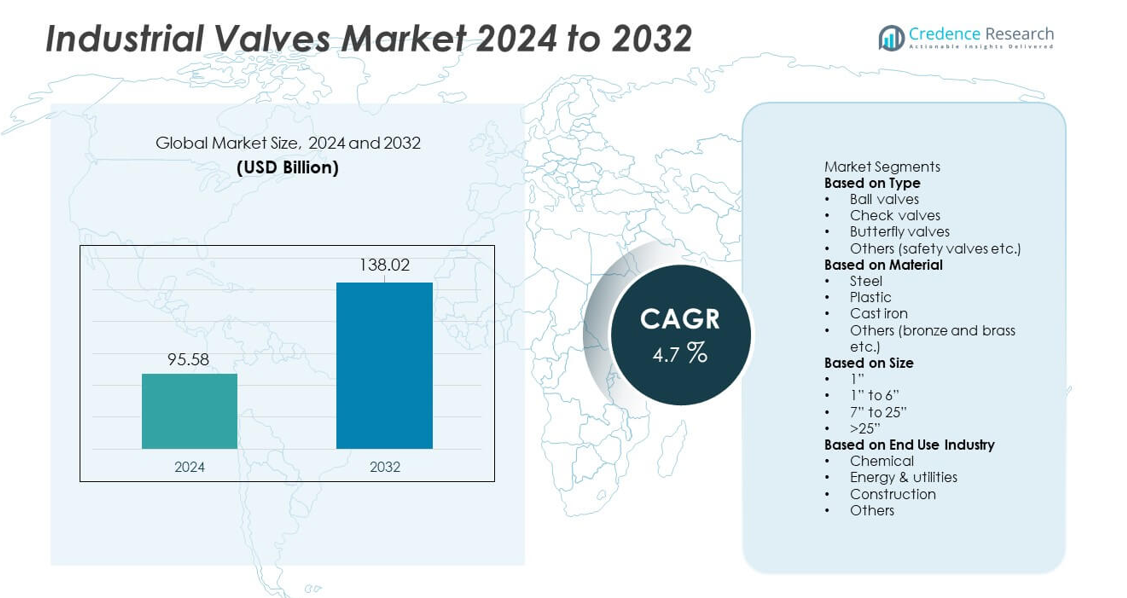
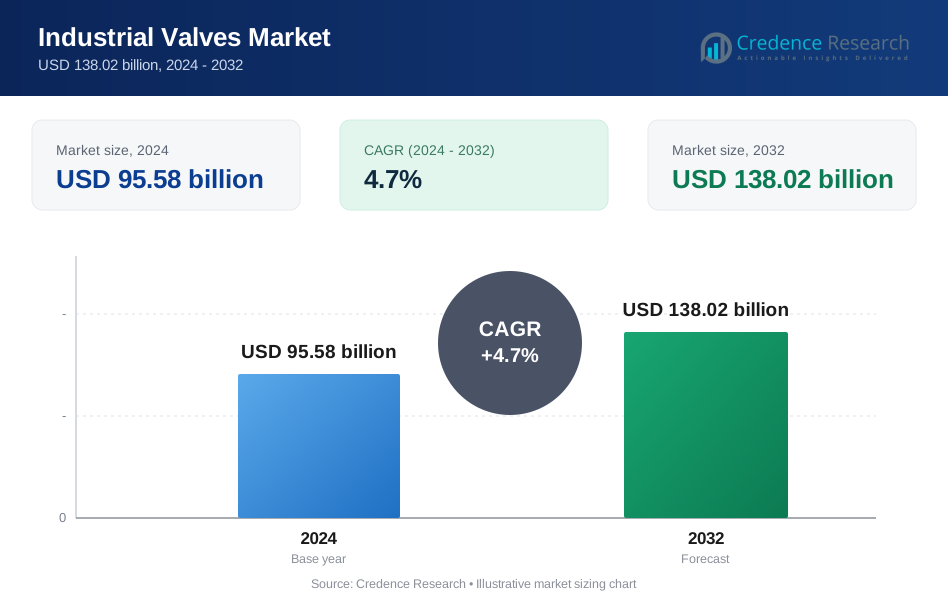
The Industrial Valves market size reached USD 95.58 billion in 2024. The market is projected to reach USD 138.02 billion by 2032, supported by a CAGR of 4.7% during the forecast period.
| REPORT ATTRIBUTE | DETAILS |
|---|---|
| Historical Period | 2020-2023 |
| Base Year | 2024 |
| Forecast Period | 2025-2032 |
| Industrial Valves Market Size 2024 | USD 95.58 billion |
| Industrial Valves Market, CAGR | 4.7% |
| Industrial Valves Market Size 2032 | USD 138.02 billion |
Top players in the Industrial Valves market include Emerson Electric, Honeywell, Baker Hughes, Alfa Laval, CIRCOR, Danfoss, Crane Company, Curtiss-Wright, AVK Holding, and Hitachi, all of which strengthen their positions through advanced valve technologies, automation capabilities, and material innovations. These companies focus on smart monitoring, improved durability, and tailored designs for oil and gas, power, chemical, and water sectors. North America leads the market with a 33% share, driven by strong investments in pipeline upgrades and energy infrastructure. Asia Pacific follows closely as rapid industrialization, refinery expansions, and growing water treatment needs boost large-scale valve deployment across diverse industries.
Market Insights
- The Industrial Valves market reached USD 95.58 billion in 2024 and is set to grow at a 4.7% CAGR, supported by rising upgrades across process industries.
- Strong growth stems from expanding oil and gas activities, power generation upgrades, and rising water treatment investments that boost adoption of durable valve systems across major applications.
- Digital valve technologies, smart monitoring, and corrosion-resistant materials shape market trends, while leading players strengthen portfolios through automation and high-performance designs.
- Market restraints include high maintenance costs, raw material volatility, and operational downtime risks, especially across aging industrial infrastructure.
- North America leads with a 33% share, followed by Asia Pacific at 30% and Europe at 28%, while ball valves dominate the type segment with a 34% share, and the 1” to 6” size category leads with a 46% share, supported by widespread use in pipelines and industrial systems.
Market Segmentation Analysis:
By Type
Ball valves hold the leading position with a 34% share due to strong use in oil and gas pipelines, chemical plants, and power facilities. Their tight shutoff ability and durability support steady demand across high-pressure and high-temperature systems. Check valves follow as industries adopt backflow prevention systems to protect pumps and compressors. Butterfly valves gain traction in water treatment and HVAC due to compact size and easy operation. Safety valves and other types support niche applications in steam and process industries. Rising industrial automation and flow control upgrades help expand adoption across all valve categories.
- For instance, Emerson expanded its ball valve line with designs tested to handle 1,500 psi and 260°C in pipeline service. The company also validated cycle life above 100,000 operations during endurance trials.
By Material
Steel dominates the material segment with a 41% share, driven by its strength, corrosion resistance, and suitability for extreme operating environments. Refineries, offshore platforms, and thermal power plants widely use steel valves for high-stress operations. Cast iron remains preferred in water supply, wastewater systems, and low-pressure industrial settings due to cost efficiency. Plastic valves gain steady adoption in chemical handling, desalination, and food processing thanks to lightweight structure and chemical resistance. Bronze and brass serve specialized marine and HVAC applications. Growth in heavy engineering and fluid handling infrastructure keeps steel-based designs in strong demand.
- For instance, Velan manufactured forged steel valves certified for service up to 425 bar and 620°C. The company also produced more than 60,000 steel gate and globe valves in a single year for global power projects. Velan’s tests confirmed leak rates approaching zero across high-cycle steam applications.
By Size
Valves sized 1” to 6” lead with a 46% share, supported by broad deployment in pipeline networks, industrial machinery, and utility systems. These mid-range sizes offer flexibility, easy installation, and strong compatibility with standard process equipment. The 7” to 25” segment sees increased use in power plants, desalination units, and municipal water systems requiring high-capacity flow control. Valves above 25” serve large transmission pipelines and heavy industrial projects. The 1” segment supports compact equipment and precision flow management. Expansion in water infrastructure and oil and gas transmission drives higher demand for mid- and large-diameter valves.
Key Growth Drivers
Rising Demand from Oil, Gas, and Power Industries
Oil and gas exploration, refinery expansions, and pipeline upgrades create strong demand for advanced flow control systems. Power generation plants, including thermal, nuclear, and renewable facilities, rely on durable valves for high-pressure and high-temperature operations. Industrial operators invest in enhanced safety systems and leak-prevention mechanisms to support regulatory compliance. The shift toward automated valve assemblies and predictive maintenance increases adoption in large processing units. These factors strengthen the need for reliable valves across upstream, midstream, and downstream environments, supporting steady market expansion.
- For instance, Baker Hughes deploys high-performance control valves in global LNG and refinery projects, including severe-service models designed for demanding high pressure applications that can exceed typical industrial ratings.
Growth in Water Treatment and Wastewater Management Projects
Global investment in water infrastructure boosts demand for valves used in distribution networks, desalination units, and sewage plants. Urban expansion increases pressure on water supply systems, prompting governments to upgrade pipelines and control mechanisms. Water scarcity accelerates deployment of reverse osmosis and membrane-based treatment units that rely on corrosion-resistant valve designs. Wastewater recycling and stormwater management further increase usage across municipal projects. Rising sustainability goals drive adoption of energy-efficient flow control components, supporting long-term demand from environmental and utility sectors.
- For instance, companies like Xylem and others supply corrosion-resistant valves and related products made from specialist materials like duplex and super duplex stainless steels to desalination plants. These materials are designed and tested to withstand high salinity levels and the harsh conditions of seawater environments.
Expansion of Chemical, Pharmaceutical, and Food Processing Industries
Chemical plants and pharmaceutical facilities require precise flow regulation and contamination-free operation, boosting adoption of high-performance valves. Growth in specialty chemicals and advanced materials increases deployment of corrosion-resistant and automated valve systems. Food and beverage processing lines adopt hygienic valve designs that support easy cleaning and safe handling of liquid products. Rising global manufacturing output drives investments in new production facilities with modern flow control equipment. These industry expansions help widen the market base for specialized valves across diverse applications.
Key Trends & Opportunities
Automation, Smart Valves, and IIoT Integration
Industrial plants adopt automated and sensor-enabled valves to improve safety, accuracy, and productivity. Smart valves equipped with real-time monitoring, position sensing, and diagnostics support predictive maintenance strategies. IIoT platforms enable remote operation and faster troubleshooting for complex flow networks. Industries transition from manual to electric and pneumatic actuators to enhance operational responsiveness. This shift creates new opportunities for digital valve solutions that reduce downtime and optimize system efficiency across process manufacturing and energy sectors.
- For instance, Siemens deployed digital valve automation modules capable of processing extensive status readings across large process plants. Their SIPART PS2 system is designed for high reliability and a long product lifetime, utilizing features such as advanced diagnostics and integrated pressure sensors to perform routine Partial Stroke Tests (PSTs) to ensure operational integrity and prevent valve sticking without performance degradation.
Rising Need for Corrosion-Resistant and Advanced Materials
Growth in harsh-environment applications increases demand for valves made from stainless steel, duplex alloys, and specialty coatings. Offshore platforms, chemical plants, and high-salinity water treatment units require materials that withstand aggressive conditions. Manufacturers invest in new alloys and surface engineering technologies to extend valve life and reduce maintenance cycles. Plastic and composite valves gain traction in industries seeking lightweight, corrosion-proof options. These material innovations offer strong opportunities for product differentiation and long-term reliability across heavy industrial operations.
- For instance, Flowserve produces robust valves using duplex and super duplex alloys, which offer superior resistance to various corrosive fluids including seawater and chlorides, making them ideal for aggressive offshore systems.
Key Challenges
High Maintenance Costs and Operational Downtime
Valves operating in high-pressure, abrasive, or corrosive environments face frequent wear and leakage issues. Unplanned shutdowns increase repair expenses and disrupt production schedules. Many industries struggle to manage aging pipeline networks that require constant inspection and servicing. Limited availability of skilled technicians further raises maintenance-related risks. These operational pressures push companies to adopt predictive maintenance tools, although upfront costs remain a challenge for smaller facilities.
Supply Chain Constraints and Raw Material Volatility
Fluctuating prices of steel, alloys, and industrial coatings affect production costs for valve manufacturers. Supply disruptions caused by geopolitical issues, shipping delays, or trade restrictions slow project execution. Lead time extensions make it harder for industrial sectors to plan equipment upgrades and replacements. Manufacturers face pressure to maintain competitive pricing while dealing with unstable input costs. These constraints create procurement challenges across major end-use industries, especially in large-scale infrastructure and energy projects.
Regional Analysis
North America
North America leads the Industrial Valves market with a 33% share, driven by strong demand from oil and gas, pipeline modernization, and power generation projects. The region benefits from steady shale development, refinery upgrades, and investment in LNG terminals. Water and wastewater utilities expand valve installations to support urban population growth and stricter environmental regulations. Industrial automation adoption further boosts the use of smart and automated valve systems. The United States accounts for the largest share due to extensive petrochemical capacity and replacement cycles across aging infrastructure. Canada adds steady demand through ongoing midstream expansions.
Europe
Europe holds a 28% share, supported by advanced manufacturing, strict emission norms, and strong investments in chemical processing and district heating networks. Countries like Germany, Italy, and the UK drive demand through energy transition projects and modernization of industrial facilities. The shift toward hydrogen production and carbon-capture systems increases usage of corrosion-resistant valve materials. Water treatment upgrades across Eastern Europe add further momentum. The region also adopts digital valve monitoring solutions to improve efficiency and reduce maintenance costs. Ongoing infrastructure renewal and sustainability-focused policies continue to shape long-term demand.
Asia Pacific
Asia Pacific accounts for a 30% share, backed by rapid industrialization, expanding petrochemical capacity, and major investments in power generation. China and India lead growth through refinery construction, pipeline expansion, and large-scale water treatment projects. Southeast Asian countries contribute through LNG import terminals and manufacturing growth. The region’s strong focus on industrial automation drives wider use of advanced valve technologies. Rising urbanization increases demand for reliable water supply and wastewater systems. Large infrastructure spending and ongoing capacity expansions across energy and process industries reinforce the region’s dominant growth role.
Latin America
Latin America holds an 8% share, driven by oil and gas production in Brazil, Mexico, and Argentina. The region invests in offshore drilling, pipeline rehabilitation, and refinery modernization, supporting demand for high-performance valves. Water management projects grow as governments improve treatment and distribution systems. Mining operations in Chile and Peru increase the need for durable valves suitable for abrasive slurries and high-pressure applications. Industrial modernization across manufacturing and food processing also boosts adoption. Despite economic fluctuations, long-term energy projects and water infrastructure upgrades sustain steady valve demand.
Middle East & Africa
The Middle East & Africa region accounts for a 6% share, supported by strong oil and gas exploration, petrochemical development, and power generation expansion. Gulf countries invest heavily in refinery upgrades, LNG facilities, and desalination plants, driving use of corrosion-resistant and high-capacity valves. Africa contributes through mining growth, water treatment expansion, and industrial development in South Africa and Nigeria. Mega infrastructure projects in the Gulf Cooperation Council enhance adoption of advanced valve systems. Continued investment in energy diversification and industrial clusters supports stable demand across regional markets.
Market Segmentations:
By Type
- Ball valves
- Check valves
- Butterfly valves
- Others (safety valves etc.)
By Material
- Steel
- Plastic
- Cast iron
- Others (bronze and brass etc.)
By Size
- 1”
- 1” to 6”
- 7” to 25”
- >25”
By End Use Industry
- Chemical
- Energy & utilities
- Construction
- Others
By Geography
- North America
- U.S.
- Canada
- Mexico
- Europe
- Germany
- France
- U.K.
- Italy
- Spain
- Rest of Europe
- Asia Pacific
- China
- Japan
- India
- South Korea
- South-east Asia
- Rest of Asia Pacific
- Latin America
- Brazil
- Argentina
- Rest of Latin America
- Middle East & Africa
- GCC Countries
- South Africa
- Rest of the Middle East and Africa
Competitive Landscape
Major players in the Industrial Valves market include Emerson Electric, Honeywell, Baker Hughes, Alfa Laval, CIRCOR, Danfoss, Crane Company, Curtiss-Wright, AVK Holding, and Hitachi. These companies compete through product innovation, expanded portfolios, and advanced flow control technologies that address complex industrial requirements. Many manufacturers invest in smart and automated valve systems that integrate sensors, diagnostics, and IIoT capabilities to support predictive maintenance and reduce operational downtime. Strategic acquisitions strengthen market presence, while partnerships with EPC contractors and energy operators help secure long-term supply contracts. Leading firms also focus on developing corrosion-resistant materials and high-performance valves for harsh environments. Regional expansion remains a priority, especially in Asia Pacific and the Middle East, where large-scale industrial projects continue to drive procurement. Continuous R&D spending, digital upgrades, and customization capabilities shape the competitive edge across global markets.
Key Player Analysis
- Honeywell
- CIRCOR
- Danfoss
- Baker Hughes
- AVK Holding
- Hitachi
- Curtiss-Wright
- Emerson Electric
- Crane Company
- Alfa Laval
Recent Developments
- In June 2025, Crane Company announced an agreement to acquire the precision sensors & instrumentation (PSI) product line from Baker Hughes for about US$ 1.15 billion.
- In November 2024, Crane Company acquired Technifab Products, Inc. - a move noted among recent industrial-valve market developments.
- In February 2023, Emerson Electric launched its ASCO Series 262 and 263 biodiesel-compatible valves for U.S. industrial use.
Report Coverage
The research report offers an in-depth analysis based on Type, Material, Size, End Use Industry and Geography. It details leading market players, providing an overview of their business, product offerings, investments, revenue streams, and key applications. Additionally, the report includes insights into the competitive environment, SWOT analysis, current market trends, as well as the primary drivers and constraints. Furthermore, it discusses various factors that have driven market expansion in recent years. The report also explores market dynamics, regulatory scenarios, and technological advancements that are shaping the industry. It assesses the impact of external factors and global economic changes on market growth. Lastly, it provides strategic recommendations for new entrants and established companies to navigate the complexities of the market.
Future Outlook
- Demand for smart and automated valves will rise as industries adopt digital monitoring.
- Oil and gas pipeline expansions will continue to drive high-pressure valve installations.
- Water and wastewater treatment upgrades will support long-term valve procurement.
- Power generation projects will increase adoption of durable, high-temperature valve designs.
- Chemical and pharmaceutical capacity growth will boost use of corrosion-resistant materials.
- Manufacturers will invest more in predictive maintenance and IIoT-enabled valve systems.
- Sustainability goals will push development of energy-efficient and low-emission valve solutions.
- Urban infrastructure expansion will strengthen demand for mid-size valves in utilities.
- Global refinery modernization will create steady opportunities for advanced flow control systems.
- Regional industrialization, especially in Asia and the Middle East, will accelerate large-scale valve deployments.
Request a Free Sample
Fill in your details and we'll send you a free sample report.
- Sample data tables & charts
- Research methodology
Market Dynamics
Oil, Gas, and Power Industry Expansion
Ongoing investments in oil and gas exploration, refinery upgrades, and power generation projects are driving demand for advanced and durable industrial valves, particularly for high-pressure and high-temperature applications.
Water and Wastewater Infrastructure Upgrades
Global efforts to modernize water distribution, desalination, and wastewater treatment systems are increasing the need for corrosion-resistant and reliable valves, especially as urbanization and water scarcity issues intensify.
Industrial Automation and Smart Valve Adoption
The shift toward automated, sensor-enabled, and IIoT-integrated valve systems is enabling predictive maintenance, reducing downtime, and improving operational efficiency, thus accelerating market growth.
Growth in Chemical, Pharmaceutical, and Food Processing
Expansion of these industries requires precise flow control and contamination-free operations, boosting demand for specialized, corrosion-resistant, and hygienic valve solutions.
Material Innovation for Harsh Environments
The development and adoption of advanced materials such as duplex alloys, stainless steel, and engineered plastics are enabling valves to withstand aggressive chemicals, high salinity, and extreme temperatures, opening new application areas and reducing lifecycle costs.
Need a Custom Version of This Report?
Tailor the scope, geography, or segments to your exact requirements.
- Custom geography or segment scope
- Direct access to our analyst team
Frequently Asked Questions
What is the current market size for the Industrial Valves market, and what is its projected size in 2032?
At what Compound Annual Growth Rate is the Industrial Valves market projected to grow between 2025 and 2032?
Who are the major players in the global Industrial Valve Market?
What are the major market drivers of the Industrial Valve industry?
What are the major market restraints of the Industrial Valve industry?
What are the major market opportunities of the Industrial Valve industry?
Who are the leading companies in the Industrial Valves market?
Table of Content
Chapter 1 Market Segmentation
- 1.1 Segmentation Framework
- 1.1.1 Product and Service Classification
- 1.1.2 Application and End-Use Classification
- 1.1.3 Technology and Solution Classification
- 1.1.4 Customer and Distribution Channel Classification
- 1.1.5 Geographic Segmentation
- 1.1.6 Market Segment Definitions and Boundaries
- 1.2 By Size
- 1.2.1 1”
- 1.2.2 1” to 6”
- 1.2.3 7” to 25”
- 1.2.4 >25”
- 1.3 By Type
- 1.3.1 Ball valves
- 1.3.2 Check valves
- 1.3.3 Butterfly valves
- 1.3.4 Others (safety valves etc.)
- 1.4 By Material
- 1.4.1 Steel
- 1.4.2 Plastic
- 1.4.3 Cast iron
- 1.4.4 Others (bronze and brass etc.)
- 1.5 By End Use Industry
- 1.5.1 Chemical
- 1.5.2 Energy & utilities
- 1.5.3 Construction
- 1.5.4 Others
Chapter 2 Introduction
- 2.1 Report Objectives and Scope
- 2.2 Product Definition and Industry Terminology
- 2.3 Market Inclusions and Exclusions
- 2.4 Research Process
- 2.4.1 Primary Research and Expert Interviews
- 2.4.2 Secondary Research and Source Review
- 2.4.3 Top-Down and Bottom-Up Estimation
- 2.4.4 Data Triangulation and Verification
- 2.5 Market Size Measurement Basis
- 2.5.1 2024: USD 95.58 billion → 2032: USD 138.02 billion
- 2.6 Historical and Forecast Reference Periods
- 2.6.1 Base Year: 2024
- 2.6.2 Forecast Period: 2024-2032
- 2.7 Research Assumptions and Limitations
Chapter 3 Executive Summary
- 3.1 Market Snapshot and Key Findings
- 3.2 Base-Year Market Size, 2024
- 3.3 Forecast Market Size, 2032
- 3.4 Revenue and Volume Growth Outlook
- 3.5 Key Demand and Supply Indicators
- 3.6 Leading Market Segments
- 3.7 Fastest-Growing Market Opportunities
- 3.8 Regional Performance Highlights
- 3.9 Technology and Industry Transformation
- 3.10 Competitive Landscape Summary
- 3.11 Analyst View and Strategic Implications
Chapter 4 Global Industrial Valves Market Trends and Developments
- 4.1 Historical Industry Development
- 4.2 Recent Market Trends and Developments
- 4.3 Demand and Customer Behavior Trends
- 4.4 Technology and Product Innovation
- 4.5 Artificial Intelligence, Automation and Digitalization
- 4.6 Local Manufacturing and Supply Chain Realignment
- 4.7 Industry Partnerships, Mergers and Acquisitions
- 4.8 Sustainability and Circular Economy Developments
- 4.9 Government and Private Sector Investment Trends
- 4.10 Emerging Business Models and Commercialization
- 4.11 Industry Developments and Announcements
Chapter 5 Global Industrial Valves Market Production, Supply and Demand Analysis
- 5.1 Demand Trend and Consumption Analysis
- 5.2 Demand Forecast, 2024-2032
- 5.3 Production and Output Trend
- 5.4 Production and Output Forecast, 2024-2032
- 5.5 Installed Capacity and Capacity Utilization
- 5.6 Company-Wise Production Plants and Statistics
- 5.6.1 Installed Production Capacity
- 5.6.2 Actual Production
- 5.6.3 Planned Capacity and Expansion Targets
- 5.7 Supply Chain Structure and Procurement Trends
- 5.8 Supply-Demand Gap and Bottlenecks
- 5.9 Import Dependence and Sourcing Structure
- 5.10 Contract Manufacturing and Outsourcing
- 5.11 Regional Supply and Demand Concentration
Chapter 6 Global Industrial Valves Market Pricing Analysis
- 6.1 Pricing Structure and Measurement
- 6.2 Historical Pricing Trends
- 6.3 Pricing Outlook, 2024-2032
- 6.4 Average Selling Price and Unit Economics
- 6.5 Pricing by Product and Market Segment
- 6.6 Geographic Pricing Differences
- 6.7 Key Input, Energy, Labor and Logistics Costs
- 6.8 Contract Pricing and Purchasing Models
- 6.9 Pricing Sensitivity and Competitive Positioning
- 6.10 Price, Margin and Profitability Implications
Chapter 7 Global Industrial Valves Market Dynamics
- 7.1 Market Growth Drivers
- 7.1.1 Demand-Side Drivers
- 7.1.2 Technology and Innovation Drivers
- 7.1.3 Infrastructure and Investment Drivers
- 7.1.4 Regulatory and Policy Drivers
- 7.2 Market Restraints
- 7.2.1 Cost and Affordability Constraints
- 7.2.2 Technology and Adoption Barriers
- 7.2.3 Supply Chain and Operational Constraints
- 7.3 Market Challenges
- 7.3.1 Competitive Pressure and Margin Erosion
- 7.3.2 Skills, Infrastructure and Implementation Gaps
- 7.4 Emerging Market Opportunities
- 7.5 Market Dynamics Impact and Time-Horizon Assessment
Chapter 8 Global Industrial Valves Value Chain Analysis
- 8.1 Industry Value Chain Overview
- 8.2 Upstream Suppliers and Critical Inputs
- 8.3 Technology and Component Providers
- 8.4 Manufacturing or Service Delivery
- 8.5 Distribution, Channel Partners and Integrators
- 8.6 Downstream Applications and End Users
- 8.7 Value Addition and Profit Pools
- 8.8 Vertical Integration and Outsourcing
- 8.9 Supplier Concentration and Risk
- 8.10 Supply Chain Localization and Resilience
Chapter 9 Global Industrial Valves Market Regulations and Policies
- 9.1 Relevant Laws, Standards and Compliance Frameworks
- 9.2 Product, Service, Safety and Quality Requirements
- 9.3 Government Policies, Incentives and Subsidies
- 9.4 Imports, Exports and Trade Barriers
- 9.5 Public Procurement and Local Content Requirements
- 9.6 Environmental and Sustainability Compliance
- 9.7 Upcoming Policy Changes and Market Implications
Chapter 10 Global Industrial Valves Market Hotspots and Opportunities
- 10.1 Market Opportunity Mapping and Growth Hotspots
- 10.2 High-Growth Applications and Customer Groups
- 10.3 Underserved Markets and White-Space Opportunities
- 10.4 Emerging Technology and Product Opportunities
- 10.5 New Capacity and Investment Hotspots
- 10.6 Market Entry and Expansion Opportunities
- 10.7 Distribution and Partnership Opportunities
- 10.8 Near-Term and Long-Term Commercial Potential
- 10.9 Opportunity Attractiveness and Execution Risks
Chapter 11 Global Industrial Valves Market Outlook, 2024-2032
- 11.1 Market Size and Analysis
- 11.1.1 Revenue (Market Measurement: 2024: USD 95.58 billion → 2032: USD 138.02 billion)
- 11.1.2 Market Volume and Quantity Sold
- 11.1.3 Historical Market Size
- 11.1.4 Base-Year Market Size, 2024
- 11.2 Market Forecast, 2024-2032
- 11.2.1 Revenue Forecast to 2032
- 11.2.2 Volume Forecast to 2032
- 11.2.3 CAGR and Year-on-Year Growth
- 11.2.4 Incremental Revenue Opportunity
- 11.3 Forecast Assumptions and Scenario Analysis
- 11.3.1 Base-Case Forecast
- 11.3.2 Optimistic and Conservative Scenarios
- 11.3.3 Technology, Pricing and Policy Sensitivities
- 11.4 Market Attractiveness and Growth Outlook
Chapter 12 Global Industrial Valves Market Segmentation and Outlook
- 12.1 Segmentation Summary and Market Shares, 2024
- 12.2 Largest and Fastest-Growing Segments
- 12.3 By Size - Market Size and Forecast, 2024-2032
- 12.3.1 Segment Definition and Scope
- 12.3.2 Historical Market Size
- 12.3.3 Revenue Forecast, 2024-2032
- 12.3.4 Volume Forecast, 2024-2032
- 12.3.5 Base-Year Market Share, 2024
- 12.3.6 Segment CAGR and Growth Drivers
- 12.3.7 Subsegment Market Size and Forecast
- 12.3.7.1 1”
- 12.3.7.2 1” to 6”
- 12.3.7.3 7” to 25”
- 12.3.7.4 >25”
- 12.3.8 Subsegment Pricing and Adoption Trends
- 12.3.9 Leading Suppliers and Competition
- 12.3.10 Regional Demand and Opportunities
- 12.4 By Type - Market Size and Forecast, 2024-2032
- 12.4.1 Segment Definition and Scope
- 12.4.2 Historical Market Size
- 12.4.3 Revenue Forecast, 2024-2032
- 12.4.4 Volume Forecast, 2024-2032
- 12.4.5 Base-Year Market Share, 2024
- 12.4.6 Segment CAGR and Growth Drivers
- 12.4.7 Subsegment Market Size and Forecast
- 12.4.7.1 Ball valves
- 12.4.7.2 Check valves
- 12.4.7.3 Butterfly valves
- 12.4.7.4 Others (safety valves etc.)
- 12.4.8 Subsegment Pricing and Adoption Trends
- 12.4.9 Leading Suppliers and Competition
- 12.4.10 Regional Demand and Opportunities
- 12.5 By Material - Market Size and Forecast, 2024-2032
- 12.5.1 Segment Definition and Scope
- 12.5.2 Historical Market Size
- 12.5.3 Revenue Forecast, 2024-2032
- 12.5.4 Volume Forecast, 2024-2032
- 12.5.5 Base-Year Market Share, 2024
- 12.5.6 Segment CAGR and Growth Drivers
- 12.5.7 Subsegment Market Size and Forecast
- 12.5.7.1 Steel
- 12.5.7.2 Plastic
- 12.5.7.3 Cast iron
- 12.5.7.4 Others (bronze and brass etc.)
- 12.5.8 Subsegment Pricing and Adoption Trends
- 12.5.9 Leading Suppliers and Competition
- 12.5.10 Regional Demand and Opportunities
- 12.6 By End Use Industry - Market Size and Forecast, 2024-2032
- 12.6.1 Segment Definition and Scope
- 12.6.2 Historical Market Size
- 12.6.3 Revenue Forecast, 2024-2032
- 12.6.4 Volume Forecast, 2024-2032
- 12.6.5 Base-Year Market Share, 2024
- 12.6.6 Segment CAGR and Growth Drivers
- 12.6.7 Subsegment Market Size and Forecast
- 12.6.7.1 Chemical
- 12.6.7.2 Energy & utilities
- 12.6.7.3 Construction
- 12.6.7.4 Others
- 12.6.8 Subsegment Pricing and Adoption Trends
- 12.6.9 Leading Suppliers and Competition
- 12.6.10 Regional Demand and Opportunities
- 12.7 Segment Growth Comparison
- 12.8 Segment Attractiveness and Priority Matrix
Chapter 13 Global Industrial Valves End-Use and Application Market Outlook
- 13.1 End-Use Industry and Customer Demand Structure
- 13.2 Leading Applications and Customer Groups
- 13.3 End-Use Market Size, Share and Forecast
- 13.4 Major End-Use Industry Deep Dives
- 13.4.1 Customer Requirements and Use Cases
- 13.4.2 Demand and Replacement Cycles
- 13.4.3 Technical and Regulatory Considerations
- 13.4.4 Purchasing and Procurement Models
- 13.4.5 Leading Vendors and Distribution Channels
- 13.4.6 Forecast and Commercial Opportunities
- 13.5 Emerging Applications and Cross-Segment Demand
- 13.6 End-Use Industry Investment Priorities
Chapter 14 Global Industrial Valves Geographic Market Outlook, 2024-2032
- 14.1 Regional Market Size and Share, 2024
- 14.2 Regional Market Forecast, 2024-2032
- 14.3 Regional Pricing, Production and Demand Differences
- 14.4 North America
- 14.4.1 United States
- 14.4.2 Canada
- 14.4.3 Mexico
- 14.5 Europe
- 14.5.1 Germany
- 14.5.2 France
- 14.5.3 Italy
- 14.5.4 United Kingdom
- 14.5.5 Spain
- 14.5.6 Poland
- 14.5.7 Russia
- 14.5.8 Netherlands
- 14.5.9 Belgium
- 14.5.10 Sweden
- 14.5.11 Denmark
- 14.5.12 Norway
- 14.5.13 Rest of Europe
- 14.6 Asia Pacific
- 14.6.1 China
- 14.6.2 India
- 14.6.3 Japan
- 14.6.4 South Korea
- 14.6.5 Thailand
- 14.6.6 Indonesia
- 14.6.7 Vietnam
- 14.6.8 Malaysia
- 14.6.9 Australia
- 14.6.10 Rest of Asia Pacific
- 14.7 Latin America
- 14.7.1 Brazil
- 14.7.2 Argentina
- 14.7.3 Colombia
- 14.7.4 Chile
- 14.7.5 Rest of Latin America
- 14.8 Middle East
- 14.8.1 Saudi Arabia
- 14.8.2 United Arab Emirates
- 14.8.3 Turkey
- 14.8.4 Israel
- 14.8.5 Iran
- 14.8.6 Rest of the Middle East
- 14.9 Africa
- 14.9.1 South Africa
- 14.9.2 Egypt
- 14.9.3 Nigeria
- 14.9.4 Morocco
- 14.9.5 Rest of Africa
- 14.10 Regional Investment, Policy and Supply Chain Differences
- 14.11 Regional Competitive Landscape
- 14.12 Geographic Growth Hotspots
Chapter 15 Global Industrial Valves Technology, Innovation and Sustainability Outlook
- 15.1 Technology Landscape and Maturity
- 15.2 Product, Process and Service Innovation
- 15.3 AI, Automation and Digital Tools in the Industry
- 15.4 Technology Adoption and Performance Benchmarking
- 15.5 Innovation Pipeline and R&D Investment
- 15.6 Patent and Intellectual Property Trends
- 15.7 Energy Efficiency and Resource Management
- 15.8 Sustainability, Recycling and Circularity
- 15.9 Technology Roadmap, 2024-2032
- 15.10 Risks of Obsolescence and Technology Substitution
Chapter 16 Global Industrial Valves Market Key Strategic Imperatives
- 16.1 Growth and Market Entry Priorities
- 16.2 High-Return Products and Segments
- 16.3 Pricing, Profitability and Cost Optimization
- 16.4 Technology Investment and Product Differentiation
- 16.5 Supply Chain Localization and Resilience
- 16.6 Distribution and Customer Acquisition
- 16.7 Partnership, Acquisition and Capacity Strategy
- 16.8 Regional Expansion Priorities
- 16.9 Short-, Medium- and Long-Term Actions
Chapter 17 Competition Outlook
- 17.1 Industry Competition Characteristics
- 17.2 Market Structure and Concentration
- 17.3 Market Share and Competitive Positioning, 2024
- 17.4 Company-Wise Revenue and Product Benchmarking
- 17.5 Production and Service Capacity Benchmarking
- 17.6 Technology, Pricing and Differentiation
- 17.7 Regional Footprint and Distribution Strength
- 17.8 Mergers, Acquisitions and Strategic Alliances
- 17.9 New Entrants and Competitive Threats
- 17.10 Porter's Five Forces and Industry Attractiveness
- 17.11 Competitive Outlook, 2024-2032
Chapter 18 Company Profiles
- 18.1 Company Coverage and Selection Criteria
- 18.2 Emerson Electric
- 18.2.1 Business Description
- 18.2.2 Company Ownership and Geographic Presence
- 18.2.3 Product and Service Portfolio
- 18.2.4 Manufacturing and Operating Footprint
- 18.2.5 Production Capacity and Expansion Plans
- 18.2.6 Financial Performance and Investment
- 18.2.7 Market Share and Competitive Position
- 18.2.8 Technology and Innovation Capabilities
- 18.2.9 Strategic Alliances or Partnerships
- 18.2.10 Recent Developments
- 18.2.11 Growth Strategy and Outlook
- 18.3 Honeywell
- 18.4 Baker Hughes
- 18.5 Alfa Laval
- 18.6 CIRCOR
- 18.7 Danfoss
- 18.8 Crane Company
- 18.9 Curtiss-Wright
- 18.10 AVK Holding
- 18.11 Hitachi
- 18.12 Other Relevant Market Participants
Note: Every listed company is profiled on the structure shown under the first company. The company list is preliminary and may change based on research findings, market developments, data availability and client requirements.
Chapter 19 Disclaimer
- 19.1 Research and Forecast Disclaimer
- 19.2 Data Source and Estimation Limitations
Note: The depth of individual sections depends on data availability for this market. Volume, capacity, trade and other unit-based metrics are included where applicable.