Market Overview
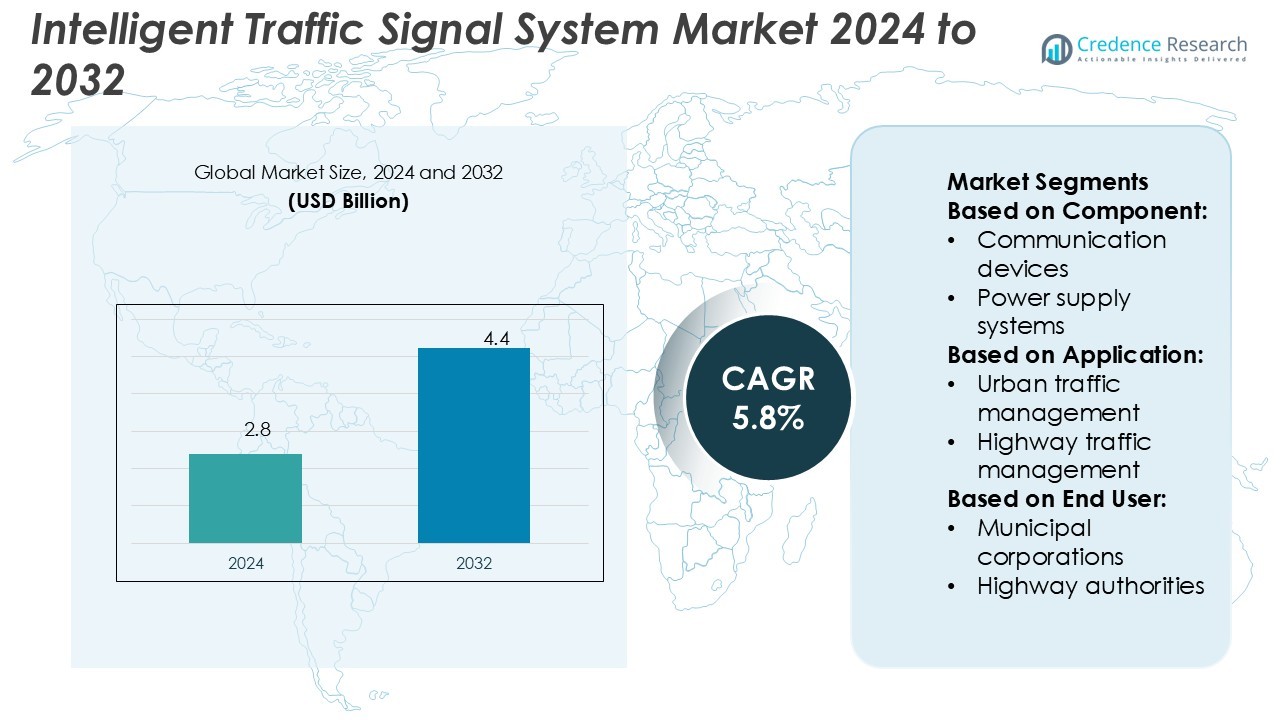
Intelligent Traffic Signal System Market size was valued USD 2.8 billion in 2024 and is anticipated to reach USD 4.4 billion by 2032, at a CAGR of 5.8% during the forecast period.
| REPORT ATTRIBUTE | DETAILS |
|---|---|
| Historical Period | 2020-2023 |
| Base Year | 2024 |
| Forecast Period | 2025-2032 |
| Intelligent Traffic Signal System Market Size 2024 | USD 2.8 Billion |
| Intelligent Traffic Signal System Market, CAGR | 5.8% |
| Intelligent Traffic Signal System Market Size 2032 | USD 4.4 Billion |
The Intelligent Traffic Signal System Market is shaped by top players including Iteris Inc, Cubic, Parsons, LG CNS, Dynniq, AECOM, LITE-ON Technology, Intelligent Traffic Systems, Kapsch, and Econolite. These companies compete through advanced solutions integrating AI, IoT, and cloud technologies to improve urban mobility and safety. Iteris Inc and Econolite focus on adaptive traffic control systems, while Kapsch and Cubic emphasize connected vehicle communication. Parsons and AECOM leverage expertise in large-scale infrastructure, and LG CNS drives digital transformation initiatives. Regionally, Asia-Pacific leads the market with a 34% share, driven by rapid urbanization, government-led smart city projects, and large-scale adoption of intelligent transportation solutions across China, India, and Japan.
Market Insights
- The Intelligent Traffic Signal System Market was valued at USD 2.8 billion in 2024 and is expected to reach USD 4.4 billion by 2032, growing at a CAGR of 5.8%.
- Rising traffic congestion, sustainability goals, and government-led smart city initiatives drive strong demand for adaptive traffic control and connected infrastructure solutions.
- Key trends include the integration of AI, IoT, and cloud platforms, with increasing focus on vehicle-to-infrastructure communication and predictive analytics to enhance efficiency and safety.
- Competitive dynamics are shaped by top players such as Iteris Inc, Cubic, Parsons, LG CNS, Dynniq, AECOM, LITE-ON Technology, Intelligent Traffic Systems, Kapsch, and Econolite, each advancing technology leadership and partnerships.
- Asia-Pacific dominates with a 34% market share, supported by rapid urbanization and large-scale deployments in China, India, and Japan, while North America holds 32% and Europe 28%, highlighting strong adoption across leading regions.
Market Segmentation Analysis:
By Component
The Intelligent Traffic Signal System market is segmented into hardware, software, and services. Hardware holds the dominant share at 47%, led by traffic signal controllers that ensure reliable real-time operations. Growth is driven by rising adoption of advanced sensors, IoT-enabled communication devices, and stable power supply systems that support uninterrupted functionality. Software accounts for strong demand through traffic management platforms and cloud-based analytics, while services like installation and maintenance ensure system integration and lifecycle support. The combination of controllers and sensors reinforces hardware’s leadership due to its central role in system performance.
- For instance, Iteris’ Vantage Apex hybrid sensor monitors vehicle presence up to 600 feet downstream of the stop bar. Software accounts for strong demand through traffic management platforms and cloud-based analytics, while services like installation and maintenance ensure system integration and lifecycle support.
By Application
Urban traffic management dominates with a 42% share, as cities prioritize congestion control and safety. Intelligent systems optimize traffic flow, reduce delays, and enhance pedestrian safety through adaptive signaling. Highway traffic management is expanding as smart corridors emerge to handle freight and long-distance mobility. Smart city initiatives and public transportation management create opportunities for integrated mobility solutions, while emergency vehicle management ensures priority passage. The rise of connected infrastructure and population growth in metropolitan areas sustains urban management as the key driver within this segment.
- For instance, Parsons announced that its updated iNET ingests data streams every 5 seconds to recalibrate signal timing dynamically.In New Jersey, Parsons deployed iNET as a statewide Advanced Traffic Management System (ATMS), replacing legacy systems across 21,000+ ITS devices and coordinating responses across 21 transportation districts.
By End User
Government transportation departments lead with a 38% share, driven by large-scale infrastructure investments and public safety mandates. Municipal corporations and highway authorities follow, focusing on reducing congestion and enhancing commuter convenience. Public transit agencies increasingly deploy these systems to improve scheduling and passenger movement efficiency. Smart city developers and private infrastructure companies contribute to growth by adopting intelligent solutions in urban expansion projects. The dominance of government agencies stems from funding capacity, policy enforcement, and long-term contracts that secure adoption of advanced traffic management systems.
Key Growth Drivers
Rising Urban Traffic Congestion
Increasing vehicle ownership in urban areas drives the adoption of intelligent traffic signal systems. These systems reduce congestion by using adaptive signal control and real-time monitoring. Governments prioritize them to improve mobility and decrease economic losses caused by delays. The adoption rate is highest in megacities where road density is critical. Smart intersections with AI-based algorithms help cut travel times and improve fuel efficiency. As urbanization accelerates globally, demand for optimized traffic management solutions continues to expand rapidly.
- For instance, Dynniq reports that in the Netherlands, 1,000 out of 5,000 traffic light controllers (TLCs) are already smart i-TLCs under its “Talking Traffic” initiative. Its GreenFlow module permits vehicles to request signal priority and receive “time-to-green” data along with speed advice to catch a green wave.
Government Initiatives and Smart City Programs
Governments worldwide are investing heavily in smart city infrastructure, with traffic management as a core focus. Intelligent traffic signal systems align with sustainability goals by lowering emissions and improving road safety. Public funding, coupled with partnerships with technology providers, accelerates deployment across metropolitan areas. Several cities have introduced pilot programs integrating AI, IoT, and cloud platforms into traffic operations. These initiatives enhance public transportation flow and emergency vehicle access. Policy-driven momentum positions government initiatives as a key driver of market growth.
- For instance, AECOM has delivered transportation management center (TMC) operations for more than 40 facilities worldwide, managing real-time data across signals, CCTV, and dynamic message systems.
Integration of AI and IoT in Traffic Management
The integration of AI, IoT, and cloud platforms enhances traffic control efficiency and scalability. AI-enabled predictive analytics allows signals to adjust dynamically to vehicle patterns. IoT sensors deliver real-time data on traffic density, accidents, and weather conditions. Cloud-based traffic platforms support centralized control and seamless interconnection between multiple intersections. This integration significantly reduces waiting times and improves safety for both vehicles and pedestrians. As digital transformation accelerates in infrastructure, intelligent traffic systems become essential for future-ready cities.
Key Trends & Opportunities
Adoption of Connected Vehicle Technologies
The growth of connected and autonomous vehicles creates new opportunities for intelligent signal systems. Vehicle-to-infrastructure (V2I) communication enables smoother traffic flow and supports advanced driver assistance systems. Automakers and infrastructure developers collaborate to create unified platforms that enhance road safety. This trend also supports faster emergency response by prioritizing emergency vehicles through intelligent signals. Expansion of connected vehicle ecosystems presents long-term growth opportunities for system providers.
- For instance, a recent research paper describes a distributed acoustic sensor approach using fiber optics in ITS applications-achieving 92% vehicle classification accuracy and 92–97% accuracy in occupancy detection under controlled conditions.
Shift Toward Sustainability and Green Mobility
Environmental sustainability is shaping investments in intelligent traffic systems. Smart signals reduce idle time, cutting vehicle emissions significantly in congested areas. Cities with climate action plans are adopting these solutions to meet carbon reduction targets. Energy-efficient signal controllers and renewable-powered systems are gaining traction. Sustainability goals encourage partnerships between governments and technology companies, creating fresh market opportunities. As urban areas prioritize green mobility, intelligent signals serve as a critical enabler.
- For instance, Econolite has deployed over 160,000 traffic controllers across more than 60,000 intersections globally. Its newly introduced EPIQ RADAR™ detection solution offers a 110-degree field of view, covers up to 900 feet, and can track 128 objects from 512 detections, integrating lane-by-lane classification and ETA computation.
Key Challenges
High Implementation and Maintenance Costs
Intelligent traffic signal systems require significant upfront investment in hardware, software, and integration. Many municipalities face budget limitations that slow deployment. Ongoing maintenance costs, including sensor calibration and software updates, add financial strain. Smaller cities often struggle to justify the cost against limited budgets. Despite long-term benefits, high expenses remain a major barrier to widespread adoption.
Integration Complexity with Legacy Infrastructure
Many cities still operate traditional traffic control systems that are difficult to integrate with new technologies. Legacy hardware often lacks compatibility with IoT sensors and AI-driven platforms. Upgrading requires extensive infrastructure modifications, which delay adoption timelines. Technical challenges arise in ensuring interoperability between multiple vendors’ solutions. The complexity of transitioning from conventional to intelligent systems continues to hinder seamless deployment in many regions.
Regional Analysis
North America
North America holds a 32% market share, driven by strong adoption of advanced traffic management systems. The United States leads with heavy investments in smart city projects and highway modernization. Federal and state funding supports large-scale deployments, particularly in metropolitan areas with high congestion. Integration of AI-based adaptive traffic control and vehicle-to-infrastructure communication further boosts growth. Canada contributes through sustainability-focused projects, emphasizing reduced emissions and safety improvements. The presence of leading technology providers and robust infrastructure makes North America a pioneer in intelligent traffic solutions.
Europe
Europe accounts for 28% of the global market, with Germany, the UK, and France as frontrunners. The region benefits from well-established transportation infrastructure and strong regulatory focus on road safety and emissions reduction. EU-funded smart mobility initiatives support widespread adoption of intelligent traffic systems. Cities like London and Berlin deploy adaptive signal control to enhance urban mobility and meet sustainability goals. Ongoing development of connected vehicle ecosystems also fuels demand. With its strong emphasis on innovation and policy-driven transformation, Europe maintains a significant position in the market.
Asia-Pacific
Asia-Pacific leads the market with a 34% share, fueled by rapid urbanization and high vehicle ownership. China, India, and Japan drive demand through large-scale smart city programs and infrastructure upgrades. Governments invest heavily in IoT-enabled and AI-powered traffic solutions to address congestion and pollution. Mega cities like Beijing, Tokyo, and Mumbai implement intelligent traffic lights to improve efficiency and safety. Rising focus on green mobility initiatives further strengthens adoption. With expanding urban populations and continuous investments, Asia-Pacific dominates as the fastest-growing region in the market.
Latin America
Latin America captures a 4% market share, with Brazil and Mexico as the leading adopters. Growing urbanization and rising traffic congestion in major cities drive the need for intelligent systems. Governments are gradually investing in modernizing outdated traffic infrastructure to improve road safety and reduce economic losses from delays. Pilot programs introducing adaptive signal control in São Paulo and Mexico City highlight progress. However, limited funding and high implementation costs slow widespread deployment. Despite these challenges, growing smart city initiatives provide strong growth opportunities across the region.
Middle East & Africa
The Middle East & Africa hold a 2% share, representing an emerging market for intelligent traffic solutions. Gulf countries like the UAE and Saudi Arabia invest in smart city initiatives aligned with Vision 2030 programs. Intelligent traffic signals are being integrated into large infrastructure projects, particularly in Dubai and Riyadh. Africa’s adoption remains limited, with South Africa leading due to urban safety concerns. Budgetary constraints and limited technical infrastructure slow adoption across several nations. Nonetheless, ongoing government-led projects and private investments signal steady growth potential in the region.
Market Segmentations:
By Component:
- Communication devices
- Power supply systems
By Application:
- Urban traffic management
- Highway traffic management
By End User:
- Municipal corporations
- Highway authorities
By Geography
- North America
- U.S.
- Canada
- Mexico
- Europe
- Germany
- France
- U.K.
- Italy
- Spain
- Rest of Europe
- Asia Pacific
- China
- Japan
- India
- South Korea
- South-east Asia
- Rest of Asia Pacific
- Latin America
- Brazil
- Argentina
- Rest of Latin America
- Middle East & Africa
- GCC Countries
- South Africa
- Rest of the Middle East and Africa
Competitive Landscape
The competitive landscape of the Intelligent Traffic Signal System Market features leading players such as Iteris Inc, Cubic, Parsons, LG CNS, Dynniq, AECOM, LITE-ON Technology, Intelligent Traffic Systems, Kapsch, and Econolite. The Intelligent Traffic Signal System Market is defined by rapid technological advancements and strong demand for smart mobility solutions. Companies focus on integrating artificial intelligence, IoT, and cloud-based platforms to deliver adaptive traffic control and predictive analytics. Strategic investments in research and development drive innovations such as connected vehicle communication and real-time monitoring systems. Government collaborations and public-private partnerships play a vital role in large-scale deployments, particularly in smart city initiatives. Market competition centers on offering scalable, energy-efficient, and cost-effective solutions that enhance traffic flow, reduce emissions, and improve overall road safety.
Key Player Analysis
- Iteris Inc
- Cubic
- Parsons
- LG CNS
- Dynniq
- AECOM
- LITE-ON Technology
- Intelligent Traffic Systems
- Kapsch
- Econolite
Recent Developments
- In September 2024, FLIR launched the TrafiBot Dual AI camera, an advanced multispectral traffic management solution designed to enhance safety and efficiency in interurban environments, particularly in tunnels and on bridges. This innovative technology aims to improve traffic flow while providing critical incident detection capabilities.
- In August 2024, The GMDA is set to further develop the smart traffic signal project by adding 32 junctions in the Gurugram Sector 58 to 115. This is part of the second phase of the smart traffic control project aimed at improving the level of control over vehicle traffic and the safety of pedestrians within the city as it is ongoing.
- In July 2024, LEOTEK announced its successful acquisition of Dialight’s traffic business, a well-known global LED commercial and industrial luminaire company. These further positions them as one of the key suppliers and manufacturers of traffic signals within the Americas region.
- In December 2023, Yunex Traffic has launched advanced traffic management system (ATMS), a cloud based Traffic Studios, in the U.S. The system is designed to address traffic management challenges quickly, efficiently, and safely with high-quality tools for planning, monitoring, and optimization.
Report Coverage
The research report offers an in-depth analysis based on Component, Application, End-User and Geography. It details leading market players, providing an overview of their business, product offerings, investments, revenue streams, and key applications. Additionally, the report includes insights into the competitive environment, SWOT analysis, current market trends, as well as the primary drivers and constraints. Furthermore, it discusses various factors that have driven market expansion in recent years. The report also explores market dynamics, regulatory scenarios, and technological advancements that are shaping the industry. It assesses the impact of external factors and global economic changes on market growth. Lastly, it provides strategic recommendations for new entrants and established companies to navigate the complexities of the market.
Future Outlook
- The market will expand with growing investments in smart city infrastructure worldwide.
- Adoption of AI-driven adaptive traffic control will enhance efficiency across urban intersections.
- IoT-enabled sensors will gain prominence for real-time monitoring and congestion management.
- Vehicle-to-infrastructure communication will strengthen integration with connected and autonomous vehicles.
- Sustainability goals will drive demand for energy-efficient and eco-friendly traffic signal solutions.
- Cloud-based platforms will support centralized control and scalability in large cities.
- Governments will prioritize intelligent systems to reduce emissions and improve road safety.
- Private-public partnerships will accelerate deployments in developing and emerging economies.
- Data analytics will play a key role in predictive traffic management strategies.
- The market will see stronger competition through innovations and technology collaborations.

Request a Free Sample
Fill in your details and we'll send you a free sample report.
- Sample data tables & charts
- Research methodology
Market Dynamics
Rising Urban Traffic Congestion
Increasing vehicle ownership and urbanization are causing severe congestion in cities, prompting governments and municipalities to adopt intelligent traffic signal systems that optimize flow, reduce delays, and improve commuter experience.
Government Initiatives and Smart City Programs
Significant public investments in smart city infrastructure, with traffic management as a core focus, are accelerating the deployment of intelligent traffic signal systems to enhance mobility, safety, and sustainability.
Integration of AI and IoT in Traffic Management
The adoption of AI-driven analytics and IoT-enabled sensors allows for real-time monitoring and adaptive signal control, improving efficiency, reducing waiting times, and supporting predictive traffic management.
Adoption of Connected Vehicle Technologies
Growth in connected and autonomous vehicles is driving demand for intelligent traffic signals that support vehicle-to-infrastructure communication, enabling smoother traffic flow and prioritization for emergency vehicles.
Shift Toward Sustainability and Green Mobility
Cities are prioritizing eco-friendly solutions to meet emissions reduction targets, and intelligent traffic signal systems help reduce idle times and vehicle emissions, supporting broader climate action and green mobility goals.
Need a Custom Version of This Report?
Tailor the scope, geography, or segments to your exact requirements.
- Custom geography or segment scope
- Direct access to our analyst team
Frequently Asked Questions
What is the current market size for Intelligent Traffic Signal System Market, and what is its projected size in 2032?
At what Compound Annual Growth Rate is the Intelligent Traffic Signal System Market projected to grow between 2025 and 2032?
Which Intelligent Traffic Signal System Market segment held the largest share in 2024?
What are the primary factors fueling the growth of the Intelligent Traffic Signal System Market?
Who are the leading companies in the Intelligent Traffic Signal System Market?
Which region commanded the largest share of the Intelligent Traffic Signal System Market in 2024?
Table of Content
Chapter 1 Market Segmentation
- 1.1 Segmentation Framework
- 1.1.1 Product and Service Classification
- 1.1.2 Application and End-Use Classification
- 1.1.3 Technology and Solution Classification
- 1.1.4 Customer and Distribution Channel Classification
- 1.1.5 Geographic Segmentation
- 1.1.6 Market Segment Definitions and Boundaries
- 1.2 By End User
- 1.2.1 Government transportation departments
- 1.2.2 Municipal corporations
- 1.2.3 Highway authorities
- 1.2.4 Public transit agencies
- 1.2.5 Smart city developers
- 1.2.6 Private infrastructure companies
- 1.3 By Component
- 1.3.1 Hardware
- 1.3.2 Software
- 1.3.3 Services
- 1.3.4 Communication devices
- 1.3.5 Power supply systems
- 1.4 By Application
- 1.4.1 Urban traffic management
- 1.4.2 Highway traffic management
- 1.4.3 Smart city initiatives
- 1.4.4 Public transportation management
- 1.4.5 Emergency vehicle management
Chapter 2 Introduction
- 2.1 Report Objectives and Scope
- 2.2 Product Definition and Industry Terminology
- 2.3 Market Inclusions and Exclusions
- 2.4 Research Process
- 2.4.1 Primary Research and Expert Interviews
- 2.4.2 Secondary Research and Source Review
- 2.4.3 Top-Down and Bottom-Up Estimation
- 2.4.4 Data Triangulation and Verification
- 2.5 Market Size Measurement Basis
- 2.5.1 2024: USD 2.8 billion → 2032: USD 4.4 billion
- 2.6 Historical and Forecast Reference Periods
- 2.6.1 Base Year: 2024
- 2.6.2 Forecast Period: 2024-2032
- 2.7 Research Assumptions and Limitations
Chapter 3 Executive Summary
- 3.1 Market Snapshot and Key Findings
- 3.2 Base-Year Market Size, 2024
- 3.3 Forecast Market Size, 2032
- 3.4 Revenue and Volume Growth Outlook
- 3.5 Key Demand and Supply Indicators
- 3.6 Leading Market Segments
- 3.7 Fastest-Growing Market Opportunities
- 3.8 Regional Performance Highlights
- 3.9 Technology and Industry Transformation
- 3.10 Competitive Landscape Summary
- 3.11 Analyst View and Strategic Implications
Chapter 4 Global Intelligent Traffic Signal System Market Trends and Developments
- 4.1 Historical Industry Development
- 4.2 Recent Market Trends and Developments
- 4.3 Demand and Customer Behavior Trends
- 4.4 Technology and Product Innovation
- 4.5 Artificial Intelligence, Automation and Digitalization
- 4.6 Local Manufacturing and Supply Chain Realignment
- 4.7 Industry Partnerships, Mergers and Acquisitions
- 4.8 Sustainability and Circular Economy Developments
- 4.9 Government and Private Sector Investment Trends
- 4.10 Emerging Business Models and Commercialization
- 4.11 Industry Developments and Announcements
Chapter 5 Global Intelligent Traffic Signal System Market Production, Supply and Demand Analysis
- 5.1 Demand Trend and Consumption Analysis
- 5.2 Demand Forecast, 2024-2032
- 5.3 Production and Output Trend
- 5.4 Production and Output Forecast, 2024-2032
- 5.5 Installed Capacity and Capacity Utilization
- 5.6 Company-Wise Production Plants and Statistics
- 5.6.1 Installed Production Capacity
- 5.6.2 Actual Production
- 5.6.3 Planned Capacity and Expansion Targets
- 5.7 Supply Chain Structure and Procurement Trends
- 5.8 Supply-Demand Gap and Bottlenecks
- 5.9 Import Dependence and Sourcing Structure
- 5.10 Contract Manufacturing and Outsourcing
- 5.11 Regional Supply and Demand Concentration
Chapter 6 Global Intelligent Traffic Signal System Market Pricing Analysis
- 6.1 Pricing Structure and Measurement
- 6.2 Historical Pricing Trends
- 6.3 Pricing Outlook, 2024-2032
- 6.4 Average Selling Price and Unit Economics
- 6.5 Pricing by Product and Market Segment
- 6.6 Geographic Pricing Differences
- 6.7 Key Input, Energy, Labor and Logistics Costs
- 6.8 Contract Pricing and Purchasing Models
- 6.9 Pricing Sensitivity and Competitive Positioning
- 6.10 Price, Margin and Profitability Implications
Chapter 7 Global Intelligent Traffic Signal System Market Dynamics
- 7.1 Market Growth Drivers
- 7.1.1 Demand-Side Drivers
- 7.1.2 Technology and Innovation Drivers
- 7.1.3 Infrastructure and Investment Drivers
- 7.1.4 Regulatory and Policy Drivers
- 7.2 Market Restraints
- 7.2.1 Cost and Affordability Constraints
- 7.2.2 Technology and Adoption Barriers
- 7.2.3 Supply Chain and Operational Constraints
- 7.3 Market Challenges
- 7.3.1 Competitive Pressure and Margin Erosion
- 7.3.2 Skills, Infrastructure and Implementation Gaps
- 7.4 Emerging Market Opportunities
- 7.5 Market Dynamics Impact and Time-Horizon Assessment
Chapter 8 Global Intelligent Traffic Signal System Value Chain Analysis
- 8.1 Industry Value Chain Overview
- 8.2 Upstream Suppliers and Critical Inputs
- 8.3 Technology and Component Providers
- 8.4 Manufacturing or Service Delivery
- 8.5 Distribution, Channel Partners and Integrators
- 8.6 Downstream Applications and End Users
- 8.7 Value Addition and Profit Pools
- 8.8 Vertical Integration and Outsourcing
- 8.9 Supplier Concentration and Risk
- 8.10 Supply Chain Localization and Resilience
Chapter 9 Global Intelligent Traffic Signal System Market Regulations and Policies
- 9.1 Relevant Laws, Standards and Compliance Frameworks
- 9.2 Product, Service, Safety and Quality Requirements
- 9.3 Government Policies, Incentives and Subsidies
- 9.4 Imports, Exports and Trade Barriers
- 9.5 Public Procurement and Local Content Requirements
- 9.6 Environmental and Sustainability Compliance
- 9.7 Upcoming Policy Changes and Market Implications
Chapter 10 Global Intelligent Traffic Signal System Market Hotspots and Opportunities
- 10.1 Market Opportunity Mapping and Growth Hotspots
- 10.2 High-Growth Applications and Customer Groups
- 10.3 Underserved Markets and White-Space Opportunities
- 10.4 Emerging Technology and Product Opportunities
- 10.5 New Capacity and Investment Hotspots
- 10.6 Market Entry and Expansion Opportunities
- 10.7 Distribution and Partnership Opportunities
- 10.8 Near-Term and Long-Term Commercial Potential
- 10.9 Opportunity Attractiveness and Execution Risks
Chapter 11 Global Intelligent Traffic Signal System Market Outlook, 2024-2032
- 11.1 Market Size and Analysis
- 11.1.1 Revenue (Market Measurement: 2024: USD 2.8 billion → 2032: USD 4.4 billion)
- 11.1.2 Market Volume and Quantity Sold
- 11.1.3 Historical Market Size
- 11.1.4 Base-Year Market Size, 2024
- 11.2 Market Forecast, 2024-2032
- 11.2.1 Revenue Forecast to 2032
- 11.2.2 Volume Forecast to 2032
- 11.2.3 CAGR and Year-on-Year Growth
- 11.2.4 Incremental Revenue Opportunity
- 11.3 Forecast Assumptions and Scenario Analysis
- 11.3.1 Base-Case Forecast
- 11.3.2 Optimistic and Conservative Scenarios
- 11.3.3 Technology, Pricing and Policy Sensitivities
- 11.4 Market Attractiveness and Growth Outlook
Chapter 12 Global Intelligent Traffic Signal System Market Segmentation and Outlook
- 12.1 Segmentation Summary and Market Shares, 2024
- 12.2 Largest and Fastest-Growing Segments
- 12.3 By End User - Market Size and Forecast, 2024-2032
- 12.3.1 Segment Definition and Scope
- 12.3.2 Historical Market Size
- 12.3.3 Revenue Forecast, 2024-2032
- 12.3.4 Volume Forecast, 2024-2032
- 12.3.5 Base-Year Market Share, 2024
- 12.3.6 Segment CAGR and Growth Drivers
- 12.3.7 Subsegment Market Size and Forecast
- 12.3.7.1 Government transportation departments
- 12.3.7.2 Municipal corporations
- 12.3.7.3 Highway authorities
- 12.3.7.4 Public transit agencies
- 12.3.7.5 Smart city developers
- 12.3.7.6 Private infrastructure companies
- 12.3.8 Subsegment Pricing and Adoption Trends
- 12.3.9 Leading Suppliers and Competition
- 12.3.10 Regional Demand and Opportunities
- 12.4 By Component - Market Size and Forecast, 2024-2032
- 12.4.1 Segment Definition and Scope
- 12.4.2 Historical Market Size
- 12.4.3 Revenue Forecast, 2024-2032
- 12.4.4 Volume Forecast, 2024-2032
- 12.4.5 Base-Year Market Share, 2024
- 12.4.6 Segment CAGR and Growth Drivers
- 12.4.7 Subsegment Market Size and Forecast
- 12.4.7.1 Hardware
- 12.4.7.2 Software
- 12.4.7.3 Services
- 12.4.7.4 Communication devices
- 12.4.7.5 Power supply systems
- 12.4.8 Subsegment Pricing and Adoption Trends
- 12.4.9 Leading Suppliers and Competition
- 12.4.10 Regional Demand and Opportunities
- 12.5 By Application - Market Size and Forecast, 2024-2032
- 12.5.1 Segment Definition and Scope
- 12.5.2 Historical Market Size
- 12.5.3 Revenue Forecast, 2024-2032
- 12.5.4 Volume Forecast, 2024-2032
- 12.5.5 Base-Year Market Share, 2024
- 12.5.6 Segment CAGR and Growth Drivers
- 12.5.7 Subsegment Market Size and Forecast
- 12.5.7.1 Urban traffic management
- 12.5.7.2 Highway traffic management
- 12.5.7.3 Smart city initiatives
- 12.5.7.4 Public transportation management
- 12.5.7.5 Emergency vehicle management
- 12.5.8 Subsegment Pricing and Adoption Trends
- 12.5.9 Leading Suppliers and Competition
- 12.5.10 Regional Demand and Opportunities
- 12.6 Segment Growth Comparison
- 12.7 Segment Attractiveness and Priority Matrix
Chapter 13 Global Intelligent Traffic Signal System End-Use and Application Market Outlook
- 13.1 End-Use Industry and Customer Demand Structure
- 13.2 Leading Applications and Customer Groups
- 13.3 End-Use Market Size, Share and Forecast
- 13.4 Major End-Use Industry Deep Dives
- 13.4.1 Customer Requirements and Use Cases
- 13.4.2 Demand and Replacement Cycles
- 13.4.3 Technical and Regulatory Considerations
- 13.4.4 Purchasing and Procurement Models
- 13.4.5 Leading Vendors and Distribution Channels
- 13.4.6 Forecast and Commercial Opportunities
- 13.5 Emerging Applications and Cross-Segment Demand
- 13.6 End-Use Industry Investment Priorities
Chapter 14 Global Intelligent Traffic Signal System Geographic Market Outlook, 2024-2032
- 14.1 Regional Market Size and Share, 2024
- 14.2 Regional Market Forecast, 2024-2032
- 14.3 Regional Pricing, Production and Demand Differences
- 14.4 North America
- 14.4.1 United States
- 14.4.2 Canada
- 14.4.3 Mexico
- 14.5 Europe
- 14.5.1 Germany
- 14.5.2 France
- 14.5.3 Italy
- 14.5.4 United Kingdom
- 14.5.5 Spain
- 14.5.6 Poland
- 14.5.7 Russia
- 14.5.8 Netherlands
- 14.5.9 Belgium
- 14.5.10 Sweden
- 14.5.11 Denmark
- 14.5.12 Norway
- 14.5.13 Rest of Europe
- 14.6 Asia Pacific
- 14.6.1 China
- 14.6.2 India
- 14.6.3 Japan
- 14.6.4 South Korea
- 14.6.5 Thailand
- 14.6.6 Indonesia
- 14.6.7 Vietnam
- 14.6.8 Malaysia
- 14.6.9 Australia
- 14.6.10 Rest of Asia Pacific
- 14.7 Latin America
- 14.7.1 Brazil
- 14.7.2 Argentina
- 14.7.3 Colombia
- 14.7.4 Chile
- 14.7.5 Rest of Latin America
- 14.8 Middle East
- 14.8.1 Saudi Arabia
- 14.8.2 United Arab Emirates
- 14.8.3 Turkey
- 14.8.4 Israel
- 14.8.5 Iran
- 14.8.6 Rest of the Middle East
- 14.9 Africa
- 14.9.1 South Africa
- 14.9.2 Egypt
- 14.9.3 Nigeria
- 14.9.4 Morocco
- 14.9.5 Rest of Africa
- 14.10 Regional Investment, Policy and Supply Chain Differences
- 14.11 Regional Competitive Landscape
- 14.12 Geographic Growth Hotspots
Chapter 15 Global Intelligent Traffic Signal System Technology, Innovation and Sustainability Outlook
- 15.1 Technology Landscape and Maturity
- 15.2 Product, Process and Service Innovation
- 15.3 AI, Automation and Digital Tools in the Industry
- 15.4 Technology Adoption and Performance Benchmarking
- 15.5 Innovation Pipeline and R&D Investment
- 15.6 Patent and Intellectual Property Trends
- 15.7 Energy Efficiency and Resource Management
- 15.8 Sustainability, Recycling and Circularity
- 15.9 Technology Roadmap, 2024-2032
- 15.10 Risks of Obsolescence and Technology Substitution
Chapter 16 Global Intelligent Traffic Signal System Market Key Strategic Imperatives
- 16.1 Growth and Market Entry Priorities
- 16.2 High-Return Products and Segments
- 16.3 Pricing, Profitability and Cost Optimization
- 16.4 Technology Investment and Product Differentiation
- 16.5 Supply Chain Localization and Resilience
- 16.6 Distribution and Customer Acquisition
- 16.7 Partnership, Acquisition and Capacity Strategy
- 16.8 Regional Expansion Priorities
- 16.9 Short-, Medium- and Long-Term Actions
Chapter 17 Competition Outlook
- 17.1 Industry Competition Characteristics
- 17.2 Market Structure and Concentration
- 17.3 Market Share and Competitive Positioning, 2024
- 17.4 Company-Wise Revenue and Product Benchmarking
- 17.5 Production and Service Capacity Benchmarking
- 17.6 Technology, Pricing and Differentiation
- 17.7 Regional Footprint and Distribution Strength
- 17.8 Mergers, Acquisitions and Strategic Alliances
- 17.9 New Entrants and Competitive Threats
- 17.10 Porter's Five Forces and Industry Attractiveness
- 17.11 Competitive Outlook, 2024-2032
Chapter 18 Company Profiles
- 18.1 Company Coverage and Selection Criteria
- 18.2 Iteris Inc
- 18.2.1 Business Description
- 18.2.2 Company Ownership and Geographic Presence
- 18.2.3 Product and Service Portfolio
- 18.2.4 Manufacturing and Operating Footprint
- 18.2.5 Production Capacity and Expansion Plans
- 18.2.6 Financial Performance and Investment
- 18.2.7 Market Share and Competitive Position
- 18.2.8 Technology and Innovation Capabilities
- 18.2.9 Strategic Alliances or Partnerships
- 18.2.10 Recent Developments
- 18.2.11 Growth Strategy and Outlook
- 18.3 Cubic
- 18.4 Parsons
- 18.5 LG CNS
- 18.6 Dynniq
- 18.7 AECOM
- 18.8 LITE-ON Technology
- 18.9 Intelligent Traffic Systems
- 18.10 Kapsch
- 18.11 Econolite
- 18.12 Other Relevant Market Participants
Note: Every listed company is profiled on the structure shown under the first company. The company list is preliminary and may change based on research findings, market developments, data availability and client requirements.
Chapter 19 Disclaimer
- 19.1 Research and Forecast Disclaimer
- 19.2 Data Source and Estimation Limitations
Note: The depth of individual sections depends on data availability for this market. Volume, capacity, trade and other unit-based metrics are included where applicable.