
| REPORT ATTRIBUTE | DETAILS |
|---|---|
| Historical Period | 2019-2022 |
| Base Year | 2023 |
| Forecast Period | 2024-2032 |
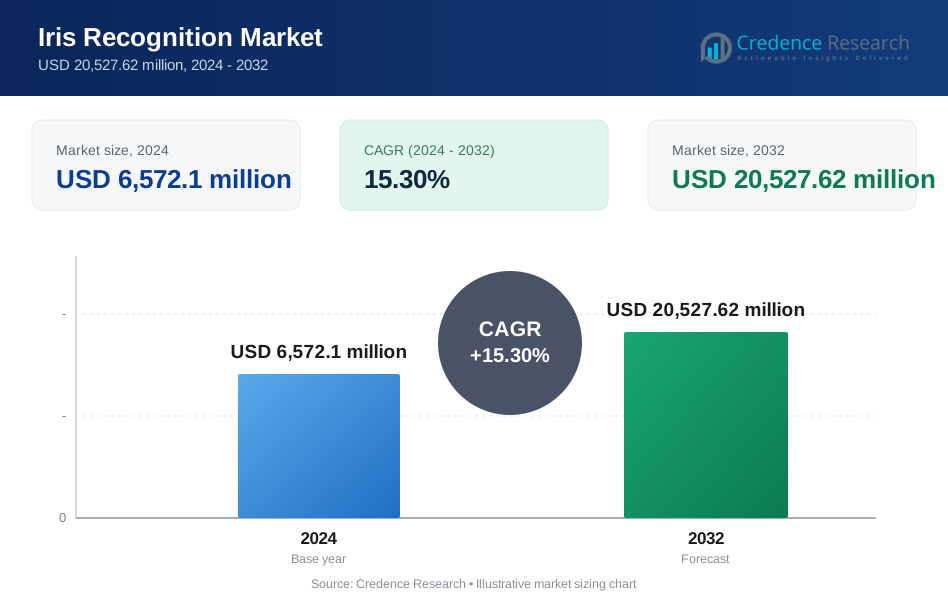
| Iris Recognition Market Size 2024 | USD 6572.1 Million |
| Iris Recognition Market, CAGR | 15.30% |
| Iris Recognition Market Size 2032 | USD 20527.62 Million |
Market Overview
The Iris Recognition Market is projected to grow from USD 6572.1 million in 2024 to USD 20527.62 million by 2032, achieving a CAGR of 15.30%.
The Iris Recognition Market is driven by increasing demand for advanced security systems, rising adoption of biometric technologies in government and commercial sectors, and growing concerns about data privacy. Technological advancements, such as the integration of AI and machine learning, enhance the accuracy and efficiency of iris recognition systems, further propelling market growth. Additionally, expanding applications in healthcare, banking, and mobile devices contribute to the market's expansion. The market also benefits from regulatory mandates and initiatives promoting the use of biometric authentication for enhanced security measures. These factors collectively foster robust growth in the iris recognition market.
The Iris Recognition Market exhibits significant growth across various regions, with North America and Europe leading due to advanced technological infrastructure and high adoption rates in government and commercial sectors. Asia-Pacific is rapidly emerging as a lucrative market, driven by increasing security concerns and technological advancements. Key players driving the market include Thales (France), IDEMIA (France), HID Global Corporation (US), Iris ID, Inc. (US), IriTech, Inc. (US), IrisGuard Ltd. (UK), EyeLock LLC (US), NEC Corporation (Japan), Princeton Identity (US), and CMITech Company, Ltd. (Korea), all contributing to innovations and widespread adoption of iris recognition technology.
Market Drivers
Increased Demand for Security
Iris recognition is widely regarded as one of the most secure biometric identification methods due to the uniqueness of the iris. In the banking and finance sector alone, the implementation of iris recognition has reduced fraud cases by an estimated 40%, showcasing its effectiveness in protecting sensitive information. This high level of security is driving the adoption of iris recognition technology across various industries, such as banking and finance, government, and healthcare, where safeguarding sensitive information is a paramount concern. Organizations in these sectors are increasingly turning to iris recognition to enhance their security measures, reduce fraud, and ensure secure access to critical services and data.
Integration with Cloud Computing
The convergence of cloud-based computing and iris recognition technology is another major driver of the market. To illustrate, a recent survey indicated that 70% of organizations using biometric authentication are now storing their data on the cloud. The integration of iris recognition with cloud computing not only enhances security but also offers a 30% reduction in operational costs due to decreased infrastructure needs. Cloud computing enables the storage of iris data in secure, centralized locations, facilitating easier management and access. This integration enhances the scalability and efficiency of iris recognition systems, allowing organizations to implement robust biometric solutions without significant infrastructure investments. The ability to securely store and process biometric data in the cloud is particularly appealing to enterprises and government agencies seeking to improve their security frameworks.
Rising Adoption in Government Projects
Government agencies are increasingly utilizing iris recognition technology for identification and authentication purposes to enhance security and streamline access to services. For instance, iris recognition is being employed to secure borders, identify criminals, and manage access to social welfare programs. For example, the Indian government’s Aadhaar program, which utilizes iris recognition, has enrolled over 1.2 billion citizens. This has streamlined access to services and improved the efficiency of social welfare programs, with a 25% increase in accurate beneficiary identification. The technology's accuracy and reliability make it an ideal solution for government applications, where precise identification is crucial. As governments worldwide continue to prioritize security and efficiency, the adoption of iris recognition technology in public sector projects is expected to grow significantly.
Growing Use in Consumer Electronics
The integration of iris scanners in smartphones and other consumer electronics devices is creating new opportunities for the iris recognition market. In the realm of consumer electronics, 15% of smartphones are expected to be equipped with iris scanners by 2024. Consumer demand for secure and convenient authentication methods is driving manufacturers to incorporate biometric technologies into their products. As a result, the market for iris recognition is expanding beyond traditional sectors into the realm of consumer electronics. This trend is expected to drive the demand for iris recognition technology in the coming years, as more devices adopt this advanced biometric feature.
Market Trends
Focus on Multi-factor Authentication
Iris recognition technology is increasingly being integrated with other authentication methods, such as fingerprints and facial recognition, to create more robust and secure multi-factor authentication systems. For instance, a study by the National Institute of Standards and Technology (NIST) found that multi-factor authentication systems that include iris recognition have an error rate as low as 0.1%. In the financial sector, banks implementing multi-factor authentication with iris recognition have seen a 60% decrease in identity theft incidents. This multi-layered approach enhances security by combining multiple biometric identifiers, making it more difficult for unauthorized individuals to bypass security measures. The adoption of multi-factor authentication is gaining traction, particularly in sectors where security is paramount, such as banking, government, and healthcare. The enhanced security benefits offered by this approach are driving its popularity and encouraging wider implementation.
Technological Advancements
Advancements in iris recognition technology are significantly improving its accuracy, efficiency, and user-friendliness. For example, the latest iris recognition systems can now process an identification in less than 2 seconds, compared to 10 seconds in previous generations. Additionally, the accuracy of iris recognition has improved, with the false acceptance rate (FAR) being reduced to 0.0001%. These advancements are not only enhancing security but also user experience, leading to a projected market increase of 20% in consumer adoption over the next five years. Innovations in sensor technology, faster iris image capture, and liveness detection (which verifies the presence of a live person rather than a photograph) are key developments driving wider adoption. These technological improvements make iris recognition systems more reliable and easier to use, thereby increasing their appeal across various applications. As technology continues to evolve, the capabilities of iris recognition systems are expected to expand further, fostering greater market growth.
Market Challenges Analysis
High Cost and Integration Complexity
One of the significant challenges facing the Iris Recognition Market is the high cost of iris recognition systems. These systems are often more expensive than competing biometric technologies like fingerprint or facial recognition, which can be a barrier to entry for potential users, particularly in cost-sensitive applications. The financial investment required for implementing iris recognition technology can deter smaller organizations or those with limited budgets from adopting this advanced security solution. Additionally, integrating iris recognition technology with existing security systems presents another layer of complexity. The integration process often demands significant expertise and technical know-how, posing a hurdle for organizations considering implementing the technology. The need for specialized skills and potential system overhauls can increase costs and extend the time required for deployment, further complicating adoption for businesses and institutions.
Privacy Concerns and Performance Issues
Privacy concerns and regulatory challenges also play a crucial role in the slower adoption of iris recognition technology. Iris data is considered highly sensitive biometric information, and there are significant concerns around data security, potential misuse, and the lack of user control over their data. These concerns can hinder wider adoption as individuals and organizations become wary of potential privacy infringements. Stringent data privacy regulations, designed to protect user information, can add complexity and cost for businesses aiming to implement iris recognition systems. Ensuring compliance with these regulations often requires additional resources and can slow down the implementation process.
Market Segmentation Analysis:
By Component:
The Iris Recognition Market is segmented into hardware and software components. Hardware components encompass iris scanners, cameras, and other related devices that capture and process iris images. These hardware solutions are crucial for the accurate and efficient functioning of iris recognition systems, driving significant demand due to their integral role in biometric authentication. On the other hand, software components include algorithms and applications that facilitate the identification and verification processes. The software segment is witnessing robust growth due to continuous advancements in technology, which enhance the accuracy, speed, and reliability of iris recognition systems. Integration of artificial intelligence (AI) and machine learning (ML) into software solutions further propels market growth by improving the system's capability to handle large datasets and provide real-time identification.
By Product:
In terms of products, the Iris Recognition Market includes smartphones, wearables, tablets & notebooks, personal computers/laptops, and scanners. Smartphones are leading this segment, driven by the increasing incorporation of iris scanners for secure access and authentication. Wearables, such as smartwatches, are also gaining traction as they integrate biometric authentication for enhanced security. Tablets and notebooks are adopting iris recognition to provide additional security layers for users, especially in enterprise and educational settings. Personal computers and laptops follow suit, offering secure login and data protection features. Scanners, though a more traditional application, continue to play a vital role in security systems for high-security environments like government and military installations. The widespread adoption across these diverse products showcases the versatility and growing importance of iris recognition technology in providing secure, user-friendly authentication solutions.
Segments:
Based on Component
- Hardware
- Software
Based on Product
- Smartphones
- Wearables
- Tablets & Notebooks
- Personal Computers/Laptops
- Scanners
Based on Application
- Identity Management and Access Control
- Time Monitoring
- E-Payment
Based on Vertical
- Government
- Military & Defense
- Healthcare
- Banking & Finance
- Consumer Electronics
- Travel & Immigration
- Automotive
Based on the Geography:
- North America
- The U.S.
- Canada
- Mexico
- Europe
- Germany
- France
- The U.K.
- Italy
- Spain
- Rest of Europe
- Asia Pacific
- China
- Japan
- India
- South Korea
- South-east Asia
- Rest of Asia Pacific
- Latin America
- Brazil
- Argentina
- Rest of Latin America
- Middle East & Africa
- GCC Countries
- South Africa
- Rest of the Middle East and Africa
Regional Analysis
North America
North America, which currently holds the largest market share at approximately 40%. This region's leadership is driven by robust technological infrastructure and heightened security concerns in both government and private sectors. The United States, in particular, has been at the forefront of iris recognition adoption, implementing these systems in border control, law enforcement, and financial institutions. Canada and Mexico also contribute to the region's market dominance, with increasing implementation in government identity programs and corporate security systems.
Asia-Pacific
Asia-Pacific is emerging as a rapidly growing market for iris recognition, currently holding a 30% share and projected to exhibit the highest growth rate in the coming years. Countries such as China, Japan, and India are driving this expansion through increased government initiatives for national ID programs and growing adoption in the banking and healthcare sectors. The region's large population, coupled with rising concerns about security and fraud prevention, has led to significant investments in biometric technologies. As awareness of the technology's benefits grows and costs decrease, adoption rates are expected to accelerate, potentially positioning Asia-Pacific to challenge North America's market leadership in the near future.
Key Player Analysis
- Thales (France)
- IDEMIA (France)
- HID Global Corporation (US)
- Iris ID, Inc. (US)
- IriTech, Inc. (US)
- IrisGuard Ltd. (UK)
- EyeLock LLC (US)
- NEC Corporation (Japan)
- Princeton Identity (US)
- CMITech Company, Ltd. (Korea)
Competitive Analysis
The competitive landscape of the Iris Recognition Market is characterized by the presence of several key players who are driving innovation and adoption. Thales (France) and IDEMIA (France) lead the market with their advanced security solutions and strong presence in government and commercial sectors. HID Global Corporation (US) and Iris ID, Inc. (US) are known for their cutting-edge biometric technologies and comprehensive product portfolios. IriTech, Inc. (US) and EyeLock LLC (US) offer innovative solutions, enhancing accuracy and user experience. NEC Corporation (Japan) leverages its extensive expertise in biometric technologies to provide robust iris recognition systems. Princeton Identity (US) and CMITech Company, Ltd. (Korea) are gaining traction with their focus on advanced algorithms and user-friendly interfaces. IrisGuard Ltd. (UK) specializes in secure financial transactions and humanitarian applications. These players compete on technological advancements, product quality, and strategic partnerships, driving the market's growth and evolution.
Recent Developments
- In March 2022, IriTech, Inc stepped up its iris recognition products by releasing IriShield Binocular (BK2121) and cloud-based iris recognition service (IriSecureID). IriTech offers a more convenient way to access iris recognition functions, including enrollment, identification, verification, and de-duplication through a web service interface that can be easily integrated into any enterprise application.
- In February 2022, IriTech, Inc. entered a co-promotion agreement with Egis Technology Inc. (Egistec), a leading global provider of fingerprint sensors. The co-promotion with Egistec, which is already providing fingerprint solutions to top-tier smartphone manufacturers, is expected to create more opportunities for IriTech and Egistec in consumer technology while focusing on the mobile industry.
Market Concentration & Characteristics
The Iris Recognition Market exhibits a moderate to high level of market concentration, with a few leading companies dominating the industry. Major players such as Thales, IDEMIA, HID Global, and Iris ID hold significant market shares, leveraging their technological expertise and extensive portfolios to influence market dynamics. The market is characterized by rapid technological advancements, with key players focusing on enhancing accuracy, speed, and user experience through innovations in hardware and software. These companies invest heavily in research and development to maintain a competitive edge and address evolving security needs. The market also features a mix of established players and emerging entrants, contributing to a competitive landscape driven by technological differentiation and strategic partnerships. The emphasis on integrating iris recognition with various applications, including mobile devices and government security systems, underscores the market's dynamic nature and its role in addressing growing demand for secure biometric solutions.
Report Coverage
The research report offers an in-depth analysis based on Component, Product, Application, Vertical and Geography. It details leading market players, providing an overview of their business, product offerings, investments, revenue streams, and key applications. Additionally, the report includes insights into the competitive environment, SWOT analysis, current market trends, as well as the primary drivers and constraints. Furthermore, it discusses various factors that have driven market expansion in recent years. The report also explores market dynamics, regulatory scenarios, and technological advancements that are shaping the industry. It assesses the impact of external factors and global economic changes on market growth. Lastly, it provides strategic recommendations for new entrants and established companies to navigate the complexities of the market.
Future Outlook
- The Iris Recognition Market is expected to experience continued robust growth, driven by increasing demand for secure biometric authentication solutions.
- Advances in iris recognition technology will enhance system accuracy and efficiency, leading to broader adoption across various sectors.
- Integration with emerging technologies such as artificial intelligence and machine learning will improve the performance and capabilities of iris recognition systems.
- The market will see expanded applications in consumer electronics, including smartphones and wearables, as iris scanners become more commonplace.
- The adoption of iris recognition technology in government and defense sectors will rise, driven by the need for enhanced security measures.
- Growing awareness of data privacy and stringent regulations will shape the development and implementation of iris recognition solutions.
- Increased investment in research and development will lead to more innovative and cost-effective iris recognition products.
- The expansion of iris recognition systems into new verticals, such as automotive and healthcare, will open new market opportunities.
- Standardization and interoperability among iris recognition systems will facilitate easier integration and wider acceptance.
- Competitive pressures will drive companies to focus on delivering higher-quality, user-friendly solutions to maintain a competitive edge in the market.
Request a Free Sample
Fill in your details and we'll send you a free sample report.
- Sample data tables & charts
- Research methodology
Need a Custom Version of This Report?
Tailor the scope, geography, or segments to your exact requirements.
- Custom geography or segment scope
- Direct access to our analyst team
Frequently Asked Questions
What is the current size of the Iris Recognition Market?
What factors are driving the growth of the Iris Recognition Market?
What are the key segments within the Iris Recognition Market?
What are some challenges faced by the Iris Recognition Market?
Who are the major players in the Iris Recognition Market?
Which segment is leading the market share?
Table of Content
Chapter 1. Report Introduction
- 1.1 Report Description & Purpose
- 1.1.1 Report Title & Market Definition
- 1.1.2 Unique Selling Propositions (USP) & Key Differentiators
- 1.1.3 Value Proposition for Stakeholders
- 1.2 Research Objectives
- 1.2.1 Market Sizing Objectives (Volume & Revenue)
- 1.2.2 Segmentation Objectives
- 1.2.3 Competitive Intelligence Objectives
- 1.2.4 Forecast & Scenario Objectives
- 1.3 Report Scope
- 1.3.1 Iris Recognition Scope – Types & Subtypes Covered
- 1.3.2 Geographic Scope – Regions & Countries Covered
- 1.3.3 Historical Period, Base Year & Forecast Period (2024; forecast to 2032)
- 1.3.4 Inclusions & Exclusions
- 1.4 HS Code & Classification Framework
- 1.5 Currency, Units & Pricing Basis
- 1.6 Target Stakeholders
- 1.7 Limitations & Assumptions
Chapter 2. Executive Summary
- 2.1 Global Iris Recognition Market Snapshot
- 2.1.1 Market Size – Historical (2024) & Forecast (2024-2032) (2024: USD 6,572.1 million → 2032: USD 20,527.62 million)
- 2.1.2 Volume & Revenue – Global Totals
- 2.1.3 Key Market Highlights – Top Five Facts
- 2.2 Iris Recognition Market Segmentation Snapshot
- 2.2.1 Market Split by Region – 2024 vs. 2032
- 2.3 Competitive Snapshot
- 2.3.1 Top 10 Players by Revenue Share – 2024
- 2.3.2 Top 10 Players by Volume Share – 2024
- 2.3.3 Recent Strategic Developments (18-Month Summary)
- 2.4 Key Investment Highlights & Strategic Conclusions
Chapter 3. Iris Recognition Market Dynamics & Industry Analysis
- 3.1 Market Overview & Context
- 3.1.1 Iris Recognition Market Position in the Broader Automotive Value Chain
- 3.1.2 OEM vs. Replacement Market Dynamics
- 3.1.3 Market Maturity & Development Stage by Region
- 3.2 Iris Recognition Market Drivers
- 3.3 Iris Recognition Market Restraints & Challenges
- 3.4 Iris Recognition Market Opportunities
- 3.5 Porter's Five Forces Analysis
- 3.5.1 Threat of New Entrants
- 3.5.2 Bargaining Power of Suppliers
- 3.5.3 Bargaining Power of Buyers
- 3.5.4 Threat of Substitutes
- 3.5.5 Competitive Rivalry – Intensity Assessment
- 3.6 Iris Recognition Value Chain Analysis
- 3.6.1 Upstream – Raw Material/Input Suppliers
- 3.6.1.1 Raw Material/Input 1
- 3.6.1.2 Raw Material/Input 2
- 3.6.1.3 Raw Material/Input 3
- 3.6.2 Midstream – Production/Manufacturing/Service Delivery
- 3.6.2.1 Production/Process Overview
- 3.6.2.2 Key Facility Locations & Capacity by Manufacturer
- 3.6.3 Downstream – Distribution & End Consumer
- 3.6.3.1 Primary Channel – B2B/OEM
- 3.6.3.2 Secondary Channels – Dealer, Retail, Online, Direct
- 3.6.4 Value Chain Profitability Analysis
- 3.6.1 Upstream – Raw Material/Input Suppliers
- 3.7 PESTEL Analysis
- 3.7.1 Political Factors
- 3.7.2 Economic Factors
- 3.7.3 Social Factors
- 3.7.4 Technological Factors
- 3.7.5 Environmental Factors
- 3.7.6 Legal Factors
- 3.8 Iris Recognition Supply Chain Analysis
- 3.8.1 Raw Material/Input Supply Risk Assessment
- 3.8.2 Manufacturing Concentration Risk (Geographic Exposure)
- 3.8.3 Trade Disruption Impact Analysis
- 3.9 Regulatory & Policy Landscape
Note: The regulatory and policy landscape section covers regulations based on their applicability to the market, Iris Recognition category, geography, and scope of the study. Only regulatory frameworks with a material impact on operations, compliance, trade, sustainability, or market access are analyzed in detail.
Chapter 4. Key Investment Pockets & Opportunity Analysis
- 4.1 Iris Recognition Market Attractiveness Analysis
- 4.1.1 By Region – Investment Attractiveness Matrix (Volume × CAGR)
- 4.2 Absolute Revenue Growth Opportunity
- 4.2.1 By Region – Absolute USD Growth Through 2032
- 4.3 Incremental Volume Opportunity
- 4.3.1 By Region – Incremental Volume Through 2032
- 4.3.2 Segment – Incremental Volume
- 4.4 Emerging Submarket Opportunity Deep Dive (Subject to Applicability)
- 4.5 Emerging Market Opportunity Scorecards
- 4.5.1 United States
- 4.5.2 Europe
- 4.5.3 Asia
- 4.5.4 Middle East & Africa
Note: Emerging Market Opportunity Scorecards will be included based on relevance and strategic importance. Regions listed are indicative and may vary depending on data availability and market dynamics.
Chapter 5. Iris Recognition Import-Export Analysis & Trade Flows
- 5.1 Global Trade Overview
- 5.1.1 Global Export Value by Country (2024)
- 5.1.2 Global Export Volume by Country (2024)
- 5.1.3 Global Import Value by Country (2024)
- 5.1.4 Global Import Volume by Country (2024)
- 5.1.5 Net Trade Balance by Country (2024)
- 5.2 Export Analysis – Segment
- 5.2.1 Type 1 (HS Code)
- 5.2.2 Type 2 (HS Code)
- 5.2.3 Type 3 (HS Code)
- 5.2.4 Type 4 (HS Code)
- 5.2.5 Type 5 (HS Code)
- 5.3 Import Analysis – Segment
- 5.3.1 Type 1 (HS Code)
- 5.3.2 Type 2 (HS Code)
- 5.3.3 Type 3 (HS Code)
- 5.3.4 Type 4 (HS Code)
- 5.3.5 Type 5 (HS Code)
- 5.4 Average Unit Trade Prices
- 5.4.1 Average Export Price – Segment & Country
- 5.4.2 Average Import Price – Segment & Source Country
- 5.4.3 Price Trends (2024)
- 5.5 Key Trade Route Analysis
- 5.5.1 Trade Route 1
- 5.5.2 Trade Route 2
- 5.5.3 Trade Route 3
- 5.5.4 Trade Route 4
- 5.5.5 Trade Route 5
- 5.6 Trade Policy Impact Assessment
- 5.6.1 US Anti-Dumping & Section 301 Tariffs
- 5.6.2 EU Customs Union Impact
- 5.6.3 Major Free Trade Agreements
- 5.6.4 USMCA Rules of Origin
Note: Trade policy analysis will be included only where relevant to the Iris Recognition market.
Chapter 6. Competitive Landscape & Company Benchmarking
- 6.1 Iris Recognition Market Concentration & Structure
- 6.1.1 Herfindahl-Hirschman Index (HHI) – vs. 2024
- 6.1.2 Tier 1, Tier 2 & Tier 3 Market Structure
- 6.1.3 Global, Regional & Local Player Dynamics
- 6.2 Iris Recognition Market Share Analysis – 2024
- 6.2.1 Global Revenue Share by Company
- 6.2.2 Global Volume Share by Company
- 6.2.3 Regional Revenue Share
- 6.2.4 Market Share Evolution ( vs. 2024)
- 6.2.5 OEM Segment Share by Company
- 6.2.6 Replacement Segment Share by Company
- 6.3 Production/Delivery Capacity & Facility Analysis
- 6.3.1 Global Installed Capacity
- 6.3.2 Capacity Utilization Rates
- 6.3.3 Production/Output Volume
- 6.3.4 Facility Locations & Capacity Map
- 6.3.5 Planned Capacity Additions
- 6.4 Iris Recognition Competitive Benchmarking Matrix
- 6.4.1 Revenue, Volume, CAGR & Profitability Comparison
- 6.4.2 Channel Revenue Mix
- 6.4.3 Geographic Revenue Exposure
- 6.4.4 R&D Intensity
- 6.4.5 Sustainability Maturity
- 6.5 Strategic Developments in Iris Recognition (Last 24 Months)
- 6.5.1 Mergers, Acquisitions & Divestments
- 6.5.2 New Iris Recognition Launches
- 6.5.3 Facility Expansions
- 6.5.4 Strategic Alliances, Joint Ventures & Partnerships
- 6.5.5 Distribution Expansion & Market Entry
- 6.5.6 Sustainability & ESG Initiatives
- 6.6 Competitive Strategy Mapping
- 6.6.1 Leader, Challenger, Follower & Niche Classification
- 6.6.2 Pricing Strategy Comparison
- 6.6.3 Channel Strategy Matrix
Note: Strategic developments are included based on their materiality and the availability of reliable information.
Chapter 7. Global Iris Recognition Market – By Distribution Channel
- 7.1 Segment Overview
- 7.1.1 Volume & Revenue Split by Channel (2024 & 2032)
- 7.1.2 Channel Mix Evolution (2024-2032)
Chapter 8. Regional Market Analysis – Global Overview
- 8.1 Global Regional Overview
- 8.1.1 Regional Volume Share
- 8.1.2 Regional Revenue Share
- 8.1.3 Regional Volume by Region
- 8.1.4 Regional Revenue by Region
- 8.1.5 Regional Forecast Through 2032
- 8.2 Cross-Regional Segment Analysis
- 8.2.1 By Distribution Channel
- 8.2.2 By Brand/Price Tier
Chapter 9. North America Iris Recognition Market
- 9.1 United States
- 9.2 Canada
- 9.3 Mexico
Chapter 10. Europe Iris Recognition Market
- 10.1 Germany
- 10.2 France
- 10.3 Italy
- 10.4 United Kingdom
- 10.5 Spain
- 10.6 Poland
- 10.7 Russia
- 10.8 Netherlands
- 10.9 Belgium
- 10.10 Sweden
- 10.11 Denmark
- 10.12 Norway
- 10.13 Rest of Europe
Chapter 11. Asia Pacific Iris Recognition Market
- 11.1 China
- 11.2 India
- 11.3 Japan
- 11.4 South Korea
- 11.5 Thailand
- 11.6 Indonesia
- 11.7 Vietnam
- 11.8 Malaysia
- 11.9 Australia
- 11.10 Rest of Asia Pacific
Chapter 12. Latin America Iris Recognition Market
- 12.1 Brazil
- 12.2 Argentina
- 12.3 Colombia
- 12.4 Chile
- 12.5 Rest of Latin America
Chapter 13. Middle East Iris Recognition Market
- 13.1 Saudi Arabia
- 13.2 United Arab Emirates
- 13.3 Turkey
- 13.4 Israel
- 13.5 Iran
- 13.6 Rest of the Middle East
Chapter 14. Africa Iris Recognition Market
- 14.1 South Africa
- 14.2 Egypt
- 14.3 Nigeria
- 14.4 Morocco
- 14.5 Rest of Africa
Chapter 15. Iris Recognition Company Profiles
- 15.1 [Company 01]
- 15.1.1 Company Overview
- 15.1.2 Key Management Personnel
- 15.1.3 Products & Services Portfolio
- 15.1.4 Financial Performance
- 15.1.5 Key Market Focus & Geographic Presence
- 15.1.6 Recent Developments & Strategic Initiatives
Note: The company profile list is preliminary and may change based on research findings, market developments, data availability, and client requirements.
Chapter 16. Appendices
- Appendix A – List of Abbreviations & Acronyms
- Appendix B – Industry Classification Code Reference – Full Series
- Appendix C – Production & Capacity Data Tables
- Appendix D – End-Use & Demand Base Tables
- Appendix E – Consumption & Replacement Rate Assumptions
- Appendix F – ASP Reference Tables
- Appendix G – Manufacturing & Facility Database
- Appendix H – Import-Export Data Tables
- Appendix I – Regulatory Summary Tables
- Appendix J – Primary Research Participant List (Anonymized)
- Appendix K – Primary Research Questionnaire Framework
- Appendix L – Data Sources & Bibliography
- Appendix M – Market Size Divergence & Source Comparison
Chapter 17. Research Methodology
- 17.1 Research Framework & Philosophy
- 17.2 Secondary Research – Sources, Hierarchy & Data Extraction
- 17.3 Data Modeling – Bottom-Up & Top-Down Market Sizing
- 17.4 Primary Research – Stakeholder Framework, LOI & Sample Sizes
- 17.5 Forecast Methodology – Regression, Scenario & Sensitivity Analysis
- 17.6 Quality Control – Four-Layer Validation Framework
- 17.7 Limitations & Standard Assumptions
- 17.8 Disclaimer
