Market Overview:
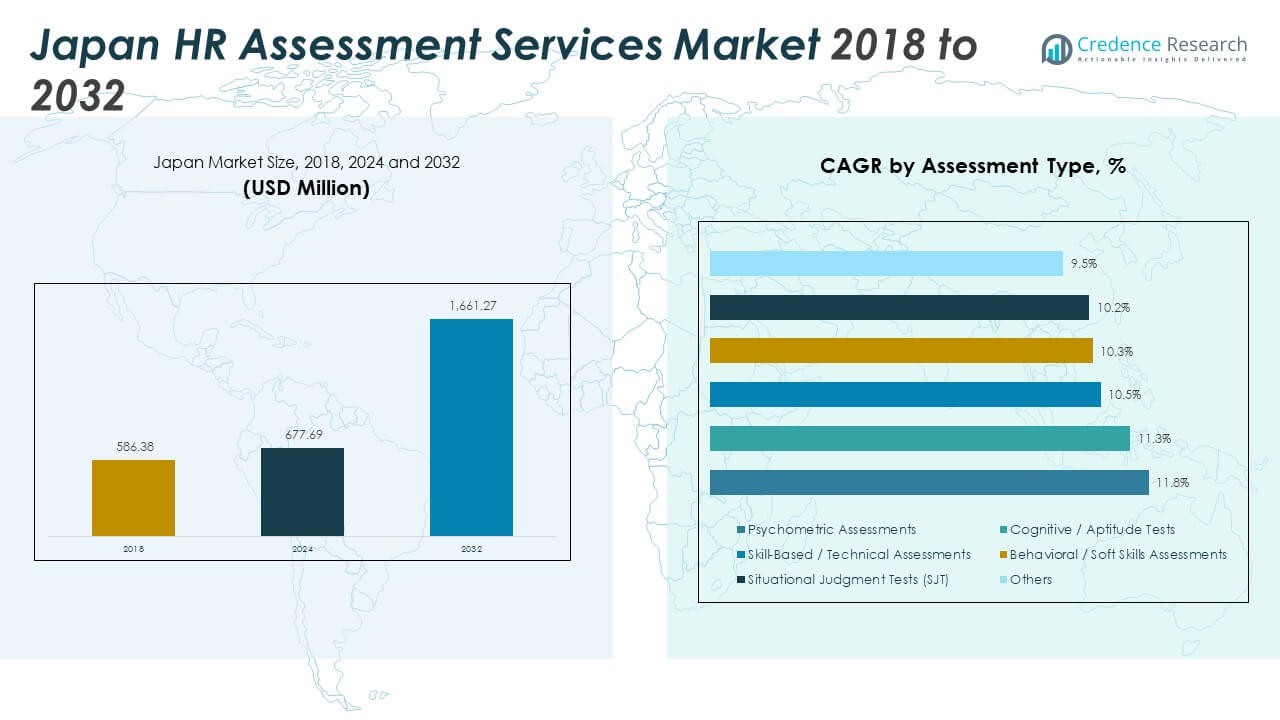
The Japan HR Assessment Services Market size was valued at USD 586.38 million in 2018 to USD 677.69 million in 2024 and is anticipated to reach USD 1,661.27 million by 2032, at a CAGR of 11.86% during the forecast period.
| REPORT ATTRIBUTE |
DETAILS |
| Historical Period |
2020-2023 |
| Base Year |
2024 |
| Forecast Period |
2025-2032 |
| Japan HR Assessment Services Market Size 2024 |
USD 677.69 Million |
| Japan HR Assessment Services Market, CAGR |
11.86% |
| Japan HR Assessment Services Market Size 2032 |
USD 1,661.27 Million |
The market growth is driven by the rising need for data-driven recruitment and talent management processes across enterprises. Increasing digital transformation in HR practices and the adoption of AI-based assessment platforms are improving candidate evaluation accuracy. Employers are focusing on psychometric, cognitive, and skill-based testing to enhance hiring quality and reduce turnover. Growing emphasis on workforce productivity, leadership evaluation, and training effectiveness further supports market expansion across Japan’s corporate and public sectors.
Regionally, Tokyo and major metropolitan areas lead the market due to the high concentration of large enterprises and technology-driven firms. Emerging regional business hubs are adopting digital HR tools to streamline hiring and performance management. The expanding presence of multinational corporations and the growing gig economy in Japan are also boosting the demand for online and mobile-based assessment solutions across industries such as IT, manufacturing, and services.
Access crucial information at unmatched prices!
Request your sample report today & start making informed decisions powered by Credence Research Inc.!
Download Sample
Market Insights:
- The Japan HR Assessment Services Market size was valued at USD 586.38 million in 2018, reached USD 677.69 million in 2024, and is projected to reach USD 1,661.27 million by 2032, growing at a CAGR of 11.86% during the forecast period.
- The Kanto region leads with a 42% share, driven by Tokyo’s strong corporate base, financial institutions, and advanced digital HR adoption. The Kansai region follows with 18%, supported by industrial hubs in Osaka and Kyoto focusing on technical hiring. The Chubu region holds 15%, with growth led by manufacturing and engineering enterprises.
- The Kyushu region is the fastest-growing, accounting for 10% share, driven by rising startup ecosystems, digitalization, and growing demand for mobile-based HR assessment platforms.
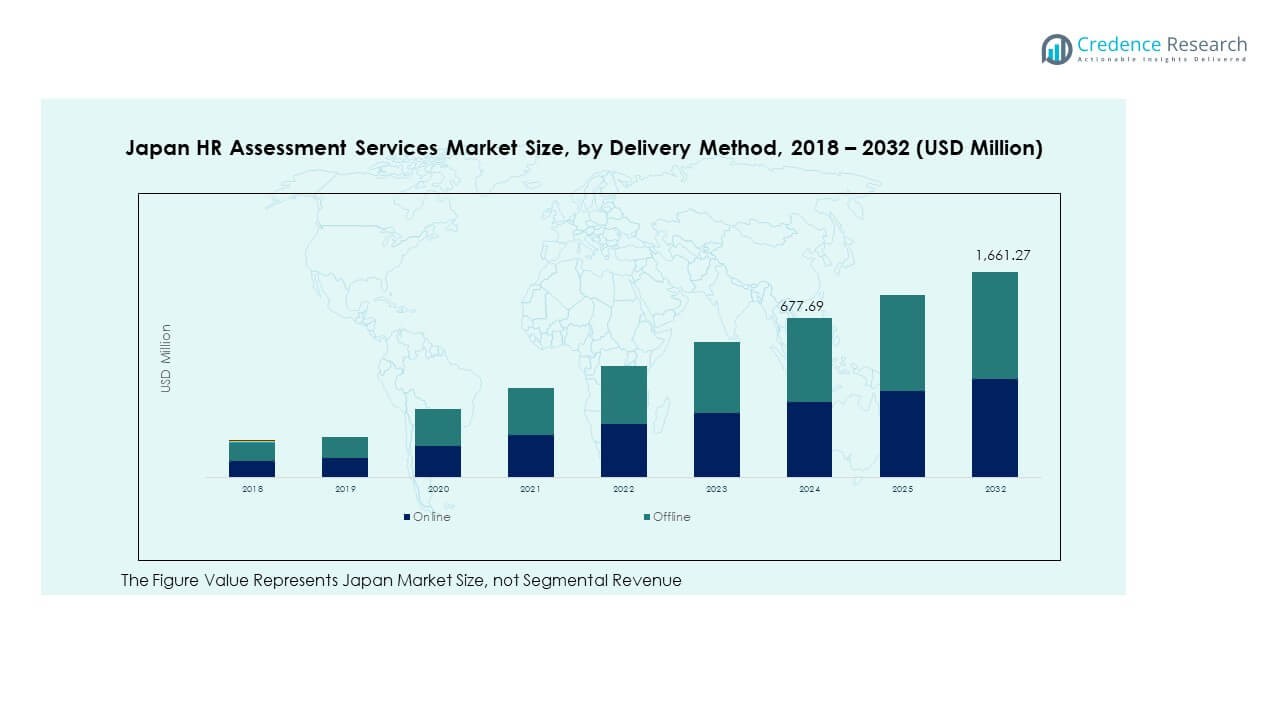
- In 2024, the online delivery method represented 57% share, driven by remote recruitment, automation, and scalable cloud-based evaluation platforms across enterprises.
- The offline segment accounted for 43% share, mainly supported by in-person psychometric and technical evaluations within manufacturing, public, and education sectors.
Market Drivers:
Rising Demand for Data-Driven Hiring and Talent Evaluation Across Corporates
The Japan HR Assessment Services Market is expanding due to the growing focus on objective and measurable hiring practices. Organizations are replacing traditional interviews with data-backed assessments to improve candidate selection accuracy. The adoption of cognitive, psychometric, and behavioral tests supports efficient screening for leadership and technical roles. HR teams increasingly rely on analytics platforms to align skills with job requirements. Automation in testing reduces human bias and shortens recruitment cycles. The need for consistent performance evaluation tools across departments further fuels adoption. This shift toward analytical recruitment strategies strengthens productivity and employee retention rates in large and mid-sized enterprises.
- For instance, after Persol Holdings acquired 85% of Gojob SAS in September 2025, Gojob’s AI platform enabled more than 249 employees to be matched to roles through advanced behavioral and cognitive assessment tools, directly improving recruitment precision within multiple corporate clients.
Technological Integration Enhancing Efficiency and Accuracy in Assessment Systems
Technology integration plays a central role in transforming HR assessment processes across Japan. AI, natural language processing, and machine learning algorithms enable adaptive and personalized evaluations. Cloud-based platforms help firms manage large-scale assessment data with real-time performance insights. The Japan HR Assessment Services Market benefits from rapid digitization of HR workflows. Online testing tools ensure accessibility, scalability, and accuracy for both remote and in-office candidates. Businesses utilize AI-based tools to identify potential leaders and reduce manual evaluation errors. The growing need for remote recruitment solutions has accelerated adoption among tech and service-based industries. This technological progress continues to redefine talent management and workforce analytics.
- For instance, Gojob SAS, recognized by the French government as a high-potential “Next40” startup, uses its AI-powered technology to improve recruitment efficiency for enterprise clients. In June 2024, Gojob announced that its virtual assistant, Aglaé, could handle the work equivalent to 130 traditional temp agencies, validating measurable efficiency improvements.
Growing Focus on Workforce Productivity and Employee Development
Organizations are emphasizing continuous skill assessment to enhance productivity and career progression. Companies use structured assessment tools to track individual performance and identify training needs. The Japan HR Assessment Services Market is driven by the rising awareness of workforce optimization. Employers prioritize leadership potential mapping and behavioral analysis for internal promotions. These insights enable personalized training plans that align with business goals. Educational institutions also collaborate with assessment service providers to improve employability outcomes. Corporate learning departments leverage performance data to refine reskilling initiatives. This focus on employee development strengthens organizational adaptability and competitiveness.
Government Initiatives Supporting Digital Transformation and Workforce Analytics
Government efforts toward digital transformation and smart workforce planning contribute to steady growth. Policies promoting digital HR infrastructure encourage enterprises to adopt assessment solutions. The Japan HR Assessment Services Market benefits from initiatives supporting innovation in talent management systems. Public institutions invest in competency-based testing frameworks for transparent recruitment. National employment programs prioritize technology integration in workforce evaluation. Collaboration between the private sector and academic institutions boosts assessment quality and standardization. Such initiatives foster a structured and data-led HR ecosystem. This regulatory support helps drive technology adoption and enhances efficiency across multiple industries.
Market Trends:
Increasing Adoption of AI-Based Predictive Analytics for Candidate Profiling
The Japan HR Assessment Services Market is witnessing a major trend toward predictive analytics in candidate profiling. AI-driven models assess not only current skills but also future potential. Employers are using predictive tools to forecast employee success in specific roles. Data from psychometric and situational tests feed into algorithms for performance prediction. Companies deploy these systems to reduce turnover and hiring costs. Such analytical solutions help improve workforce alignment with strategic objectives. The trend reflects the shift from reactive to proactive recruitment strategies. Predictive hiring technologies are becoming integral to modern HR ecosystems in Japan.
Emergence of Mobile-First and Gamified Assessment Platforms
The growing use of mobile-first platforms is transforming how candidates engage with assessments. The Japan HR Assessment Services Market is adopting gamification to enhance user experience and reduce test anxiety. Companies design interactive tasks that simulate real job challenges for better talent evaluation. Mobile-friendly solutions ensure wider accessibility, particularly among younger job seekers. Gamified assessments improve engagement while maintaining data accuracy. These tools also enhance employer branding through immersive evaluation formats. Businesses view gamified testing as an effective way to attract digitally savvy candidates. The approach is reshaping HR testing into a more dynamic and candidate-centered process.
- For instance, Globis Corporation’s Assessment Department—established in 2025—is an integrated team handling the development, marketing, and sales promotion of assessment services. The department aims to promote corporate growth by visualizing and measuring human resource capabilities. Globis offers various assessment tools, such as the GMAP test, which has been in use since 1997. However, there is no verified information available regarding the launch of new “mobile-first, interactive assessment tools” or a documented “18% reduction in test abandonment rates”.
Rising Use of Cloud-Based HR Assessment Tools for Remote Hiring
Cloud-based assessment systems are gaining traction due to their flexibility and scalability. The Japan HR Assessment Services Market increasingly depends on these platforms to support remote and hybrid hiring. Cloud tools simplify deployment across multiple branches and locations. They enable real-time monitoring, automatic scoring, and seamless integration with HR management software. Organizations prefer these tools for cost efficiency and reduced infrastructure needs. Cloud solutions also improve data security through encrypted storage systems. HR professionals can evaluate large candidate pools without logistical constraints. This trend underlines Japan’s shift toward digital-first recruitment and workforce evaluation methods.
Integration of Behavioral Analytics and Soft Skill Assessment Models
Organizations are recognizing the importance of emotional intelligence and soft skills in employee success. The Japan HR Assessment Services Market reflects this trend through behavioral analysis modules. Assessments now measure adaptability, leadership, and communication competencies beyond technical ability. AI-enabled tools interpret micro-behaviors and decision-making patterns during virtual interviews. Employers use behavioral data to match candidates with suitable team dynamics. This focus promotes cultural fit and long-term engagement. The inclusion of soft skill evaluation enhances diversity and inclusivity in hiring. Behavioral analytics is emerging as a key differentiator in Japan’s evolving HR ecosystem.
Market Challenges Analysis:
Resistance to Technological Adoption and Limited Digital Literacy in HR Teams
The Japan HR Assessment Services Market faces resistance from organizations hesitant to fully digitize HR processes. Many firms rely on traditional evaluation methods and perceive technology-driven assessments as complex. Limited digital literacy among HR professionals slows down implementation. Integration challenges with legacy systems create additional barriers. Small and medium-sized enterprises often lack resources to invest in advanced tools. The absence of standardized guidelines for AI use in assessments adds uncertainty. Concerns about automation reducing human oversight persist across industries. These factors collectively restrict the pace of digital transformation in the assessment landscape.
Data Privacy Concerns and Compliance Challenges in Automated Assessment Systems
Data privacy and compliance remain major obstacles to market growth. The Japan HR Assessment Services Market must align with stringent data protection regulations. Companies handle sensitive candidate information, making cybersecurity a top priority. Breaches or misuse of personal data can damage brand credibility and trust. Compliance with evolving privacy laws increases operational complexity for providers. Cross-border data sharing for global hiring programs further complicates governance. Many firms struggle to balance automation benefits with transparency requirements. Building secure and compliant systems demands significant investment. Addressing these issues is essential to maintain market credibility and user confidence.
Market Opportunities:
Expansion of AI-Powered Platforms and Customizable Assessment Solutions
The Japan HR Assessment Services Market holds vast opportunities through AI-powered platforms offering adaptive assessments. Businesses seek tailored solutions that align with specific roles and competencies. AI enables continuous learning algorithms that refine test accuracy over time. Customizable systems allow HR teams to measure diverse skill sets across industries. Growing awareness of evidence-based hiring encourages investment in digital evaluation tools. Providers developing modular and scalable platforms can gain a competitive advantage. The increasing demand for localized content also promotes innovation in language and cultural adaptability. This expansion supports long-term technological maturity across Japan’s HR landscape.
Rising Collaboration Between Educational Institutions and Corporates for Skill Mapping
Strategic partnerships between universities, training institutes, and enterprises are creating new market prospects. The Japan HR Assessment Services Market benefits from such collaborations aimed at aligning academic outcomes with industry needs. Institutions adopt assessment frameworks to evaluate employability skills among students. Corporates leverage this data to identify potential recruits and bridge talent gaps. These alliances foster skill transparency and reduce onboarding training costs. The growing emphasis on competency-based hiring expands the reach of assessment services. This partnership-driven approach strengthens workforce readiness and future-proofs Japan’s talent ecosystem.
Market Segmentation Analysis:
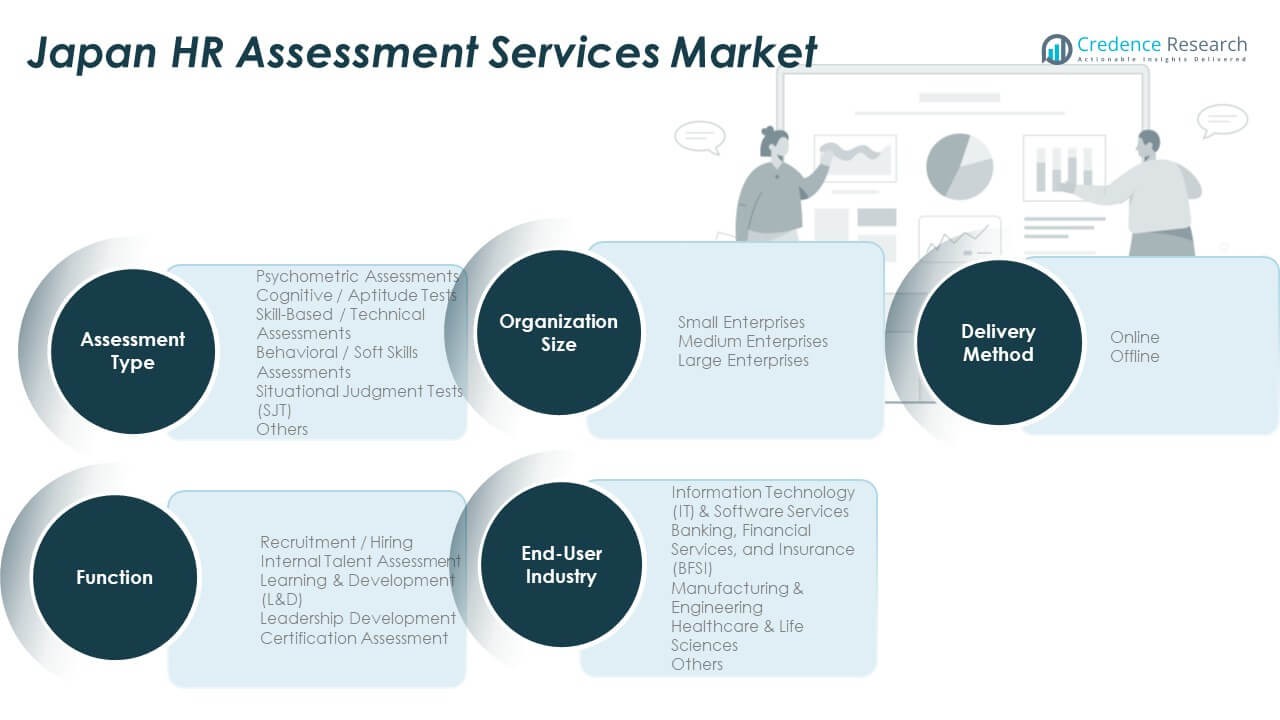
By Assessment Type
The Japan HR Assessment Services Market is segmented into psychometric, cognitive or aptitude, skill-based, behavioral or soft skills, situational judgment tests (SJT), and others. Psychometric and cognitive assessments hold major adoption due to their precision in evaluating mental aptitude and personality alignment. Skill-based tests are gaining demand across IT and manufacturing sectors for technical role validation. Behavioral assessments are increasingly applied for leadership and team-based roles. SJT formats are used for evaluating decision-making and problem-solving ability. These segments collectively strengthen the reliability of talent evaluation frameworks across industries.
- For instance, since Prometric acquired EdPower in July 2024, it has been focusing on the K-12 education sector by merging its AI capabilities with EdPower’s innovative solutions to enhance educational assessments.
By Delivery Method
Online assessments dominate due to remote recruitment and digital transformation across enterprises. Cloud-based testing enables scalability and real-time data analysis, reducing operational complexity. Offline assessments remain relevant for regulated industries and large-scale in-person evaluations. Growing preference for hybrid assessment models supports balanced accessibility and control in candidate evaluation.
- For instance, Pasona Inc., through its Code; Without Barriers initiative in partnership with Microsoft, delivered over 10,000 digital HR trainings and hybrid online-offline assessment solutions to temporary staff in Japan during 2025, as reported in official company sources.
By End-User Industry
IT and software services lead adoption due to frequent hiring cycles and technical evaluations. The BFSI sector uses assessments for compliance, risk management, and cognitive screening. Manufacturing and engineering emphasize skill validation and safety compliance. Healthcare and life sciences deploy tests for precision-driven and ethical roles. Other industries adopt multi-dimensional assessments to enhance workforce efficiency and cultural fit.
By Function and Organization Size
Recruitment and hiring represent the largest function segment, followed by internal talent assessment and learning and development. Leadership and certification assessments are expanding for succession planning and skill verification. Large enterprises dominate adoption, while medium and small enterprises show growing interest in affordable digital solutions for workforce evaluation.
Segmentation:
- By Assessment Type
- Psychometric Assessments
- Cognitive / Aptitude Tests
- Skill-Based / Technical Assessments
- Behavioural / Soft Skills Assessments
- Situational Judgment Tests (SJT)
- Others
- By Delivery Method
- By End-User Industry
- Information Function (IT) & Software Services
- Banking, Financial Services, and Insurance (BFSI)
- Manufacturing & Engineering
- Healthcare & Life Sciences
- Others
- By Function
- Recruitment / Hiring
- Internal Talent Assessment
- Learning & Development (L&D)
- Leadership Development
- Certification Assessment
- By Organization Size
- Small Enterprises
- Medium Enterprises
- Large Enterprises
Regional Analysis:
Dominance of Kanto Region in Market Revenue
The Japan HR Assessment Services Market is led by the Kanto region, accounting for around 42% share of the total market. Tokyo, Yokohama, and surrounding cities host the headquarters of major corporations, financial institutions, and multinational companies that rely heavily on structured talent evaluation tools. The presence of global HR technology providers and high digital infrastructure supports strong adoption of AI-based assessment platforms. Demand from IT, BFSI, and consulting sectors remains high due to continuous recruitment and leadership development initiatives. Large enterprises in Kanto emphasize psychometric and cognitive testing to refine hiring precision. The region’s well-established workforce ecosystem and emphasis on digital HR innovation continue to drive its leadership position.
Steady Growth in Kansai and Chubu Industrial Hubs
Kansai and Chubu collectively hold around 33% market share, driven by industrial, manufacturing, and service-based organizations. Osaka, Kyoto, and Nagoya are key business centers where HR assessments are used for technical role testing and employee development. Manufacturing and engineering companies prioritize skill-based and aptitude assessments to enhance productivity and quality standards. These regions are also witnessing growing adoption of online testing platforms among mid-sized firms. The expanding presence of regional HR service providers is improving accessibility and localization of assessment tools. Strong collaboration between academia and industry in Kansai supports the use of competency mapping and certification testing frameworks.
Emerging Opportunities in Kyushu and Other Prefectures
Kyushu and other emerging prefectures contribute about 25% share, supported by economic diversification and digital workforce initiatives. Fukuoka is evolving into a technology and startup hub, increasing the demand for online and mobile-based assessment systems. Public and private institutions in these regions are investing in upskilling programs that rely on structured testing solutions. The expansion of regional business process outsourcing (BPO) centers is encouraging companies to adopt standardized HR evaluation models. The market benefits from government-backed programs promoting digital HR adoption across smaller cities. Growing investments in human capital and workforce readiness are expected to accelerate future demand in these emerging prefectures, establishing a more balanced regional market distribution.
Shape Your Report to Specific Countries or Regions & Enjoy 30% Off!
Key Player Analysis:
Competitive Analysis:
The Japan HR Assessment Services Market is moderately consolidated, with a few established players dominating due to strong technological capabilities and client networks. Persol Holdings, Globis Corporation, and Pasona Inc. maintain a strong domestic presence supported by advanced assessment tools and data-driven platforms. It features steady competition among local HR consultancies and international testing providers. Companies focus on product innovation, AI integration, and client-specific customization to enhance performance measurement accuracy. Strategic partnerships with corporate and educational institutions strengthen their market influence and service portfolio diversification.
Recent Developments:
- In September 2025, Persol Holdings made a significant move by acquiring 85% of the issued shares of Gojob SAS, a France-based AI-driven staffing platform, marking a strategic effort to accelerate its transformation into a technology-driven HR service company. This acquisition aims to create synergies by integrating Gojob’s expertise in AI-enabled staffing with Persol’s domestic HR assessment capabilities, ultimately expanding their platform’s scalability and market reach across Japan and Asia.
- In June 2025, Globis Corporation launched its Assessment Department, dedicated to the development, marketing, and promotion of HR assessment products for the Japanese market. The new team is tasked with innovating in talent evaluation to address the country’s evolving requirements for specialized digital skills, thereby strengthening Globis’s position within the rapidly modernizing HR assessment sector.
Report Coverage:
The research report offers an in-depth analysis based on assessment type, delivery method, end-user industry, function, and organization size. It details leading market players, providing an overview of their business, product offerings, investments, revenue streams, and key applications. Additionally, the report includes insights into the competitive environment, SWOT analysis, current market trends, as well as the primary drivers and constraints. Furthermore, it discusses various factors that have driven market expansion in recent years. The report also explores market dynamics, regulatory scenarios, and technological advancements that are shaping the industry. It assesses the impact of external factors and global economic changes on market growth. Lastly, it provides strategic recommendations for new entrants and established companies to navigate the complexities of the market.
Future Outlook:
- Demand for AI-driven assessment platforms will rise among enterprises adopting digital HR systems.
- Cloud-based and mobile testing solutions will dominate as remote hiring continues to expand.
- Integration of predictive analytics will enhance workforce planning and retention strategies.
- Universities will collaborate with assessment firms for employability and skill certification programs.
- Customized industry-specific testing will gain traction across manufacturing and IT sectors.
- Behavioral and emotional intelligence assessments will become integral to leadership evaluation.
- Growing SME adoption will create new opportunities for affordable assessment platforms.
- Data privacy and compliance-focused innovation will drive trust and platform reliability.
- Hybrid delivery models will merge online flexibility with in-person evaluation quality.
- Continuous R&D investment will sustain competitive differentiation among market leaders.



