
| REPORT ATTRIBUTE | DETAILS |
|---|---|
| Historical Period | 2019-2022 |
| Base Year | 2023 |
| Forecast Period | 2024-2032 |
| Latin America Artificial Intelligence In Retail Market Size 2024 | USD 497.74 Million |
| Latin America Artificial Intelligence In Retail Market, CAGR | 29.85% |
| Latin America Artificial Intelligence In Retail Market Size 2032 | USD 4,023.77 Million |
Market Overview
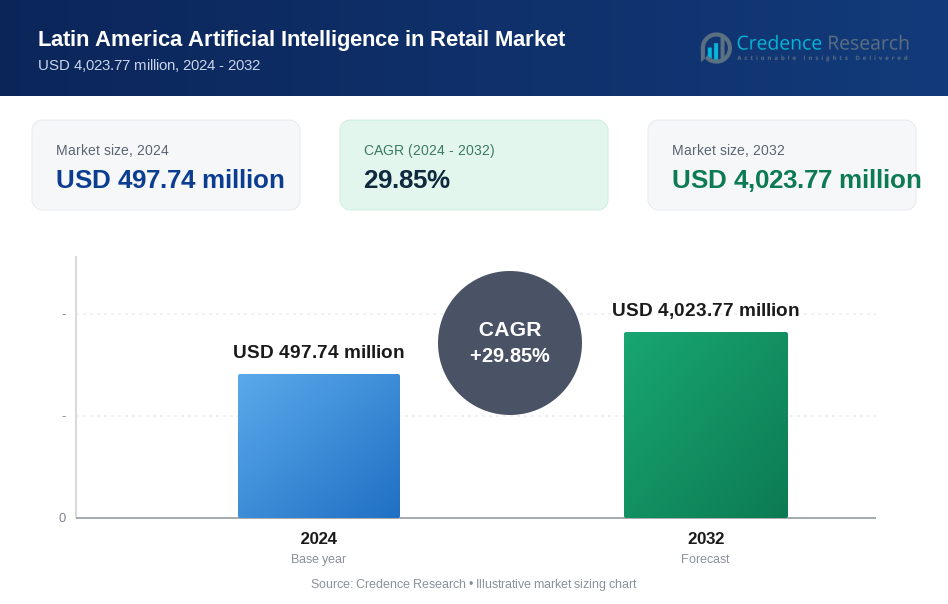
The Latin America Artificial Intelligence In Retail Market is projected to grow from USD 497.74 million in 2024 to USD 4,023.77 million by 2032, reflecting a robust CAGR of 29.85%.
The Latin America Artificial Intelligence in Retail market is driven by increasing demand for personalized customer experiences, operational efficiency, and data-driven decision-making. Retailers are increasingly adopting AI technologies to optimize inventory management, enhance supply chain operations, and provide tailored recommendations, improving customer satisfaction. The growing use of AI-powered chatbots and virtual assistants is transforming customer service, while AI-enabled predictive analytics is helping retailers forecast trends and customer behavior with greater accuracy. Additionally, the rise of e-commerce and the need for seamless omnichannel experiences are fueling AI adoption. Market trends highlight a significant shift towards integrating AI with Internet of Things (IoT) devices for smarter stores and operations. The rapid growth of e-payment systems and mobile technologies also accelerates AI-driven innovations in retail, making it an essential tool for enhancing competitiveness in the region. As the market evolves, AI’s role in shaping retail strategies is expected to expand further.
The Latin America Artificial Intelligence in Retail market is witnessing significant growth across various countries, with Brazil, Argentina, and Mexico leading the way. Brazil’s large consumer base and rapidly growing e-commerce sector have made it a key adopter of AI in retail. Argentina and Mexico are also expanding their AI capabilities, focusing on personalization, supply chain optimization, and customer service enhancement. Key players in the region include global technology giants like Amazon, Google LLC, Microsoft, and IBM, as well as regional players such as Vue.AI and Cresta, which offer AI-driven solutions tailored to retail needs. These companies are helping retailers across Latin America leverage AI for predictive analytics, personalized customer experiences, and operational efficiency. As the retail landscape evolves, these key players are playing a pivotal role in driving innovation and helping businesses adapt to the growing demand for AI-driven solutions in the retail sector.
Market Insights
- The Latin America Artificial Intelligence in Retail market is expected to grow from USD 497.74 million in 2024 to USD 4,023.77 million by 2032, with a CAGR of 29.85%.
- Increasing demand for personalized shopping experiences is driving the adoption of AI technologies in retail across the region.
- Retailers are leveraging AI for improving supply chain efficiency and inventory management.
- AI-driven solutions such as chatbots, recommendation engines, and predictive analytics are key trends transforming retail operations.
- The competition in the market is intensifying with global players like Amazon, Google, and Microsoft, along with regional companies like Vue.AI and Cresta.
- Data privacy concerns and high implementation costs remain significant barriers to AI adoption in the retail sector.
- Brazil leads the market, followed by Argentina, Mexico, and emerging markets in Chile, Peru, and Colombia, which are also expanding AI adoption in retail.
Market Drivers
Growing Demand for Personalization
One of the key drivers of the Latin America Artificial Intelligence (AI) in Retail market is the rising demand for personalized customer experiences. For instance, Magazine Luiza in Brazil uses AI to provide personalized product recommendations and targeted promotions, enhancing customer engagement. AI technologies, such as machine learning and data analytics, enable retailers to offer tailored recommendations, targeted promotions, and customized shopping experiences. By analyzing customer preferences, purchase history, and behavior, AI tools help businesses create more relevant and engaging interactions, enhancing customer satisfaction and loyalty. As consumers seek increasingly personalized products and services, AI’s ability to process vast amounts of data makes it an indispensable tool for retailers aiming to meet these demands.
Operational Efficiency and Cost Reduction
AI is also driving significant improvements in operational efficiency across the retail sector. For example, Grupo Éxito in Colombia uses AI-driven predictive analytics to optimize inventory management and reduce operational costs. AI-driven solutions like predictive analytics, automation, and robotics are helping retailers optimize inventory management, streamline supply chains, and reduce operational costs. For instance, AI-powered inventory management systems enable retailers to predict demand more accurately, ensuring products are available at the right time and reducing stockouts or overstocking. This boosts operational performance, enhances profitability, and allows retailers to allocate resources more effectively, supporting overall business growth.
Advancements in E-commerce and Omnichannel Retail
The rapid expansion of e-commerce and the growing demand for seamless omnichannel experiences are major drivers of AI adoption in retail. AI-powered tools help businesses integrate online and offline channels, ensuring consistency in product offerings, pricing, and customer service across platforms. Retailers can use AI to track customer journeys, improving the alignment of online and physical store experiences. As more consumers shop through multiple touchpoints, AI’s ability to personalize and enhance these interactions is critical for maintaining competitive advantage in the evolving retail landscape.
Increasing Use of AI-Powered Customer Service
AI-powered customer service tools, including chatbots and virtual assistants, are becoming crucial drivers in the retail sector. These technologies enable retailers to provide instant, 24/7 support, enhancing customer satisfaction and reducing response times. AI chatbots leverage natural language processing to engage with customers, resolve issues, and offer personalized assistance. This not only improves the overall shopping experience but also helps businesses manage customer queries more efficiently and at a lower cost. With growing consumer expectations for quick, responsive service, AI’s role in customer support is becoming increasingly vital.
Market Trends
AI-Driven Visual Recognition and Analytics
AI-driven visual recognition and analytics are becoming increasingly popular in Latin American retail, with businesses using image recognition technologies to enhance both customer engagement and security. For example, FieldPro and Yucca Retail have partnered to implement AI-powered image recognition technology in stores across Latin America, helping retailers analyze customer behavior and optimize product placements. Through AI-powered cameras and sensors, retailers can analyze customer behavior, detect product interests, and monitor in-store activities. Visual recognition tools also help in inventory management by automatically tracking product placements and identifying stock levels. As retailers adopt these AI solutions, they gain valuable insights into customer preferences and store performance, driving better decision-making and optimizing product offerings.
Integration of AI with IoT Devices
One of the prominent trends in the Latin America Artificial Intelligence in Retail market is the growing integration of AI with Internet of Things (IoT) devices. Retailers are leveraging AI alongside IoT technologies to create smart stores and improve operational efficiency. IoT sensors track inventory in real time, monitor customer traffic, and enable automated restocking, while AI processes this data to generate insights that help businesses optimize store layouts, personalize shopping experiences, and predict demand. This combination of AI and IoT is transforming traditional retail models, allowing businesses to deliver a more responsive and interactive shopping environment.
Shift Toward Autonomous Shopping Experiences
The trend toward autonomous shopping experiences is gaining momentum in the Latin America retail sector. AI-powered solutions, such as cashier-less checkout systems and automated product scanning, are making it possible for customers to shop without the need for human interaction. Technologies like facial recognition and mobile apps are allowing for seamless, frictionless transactions that speed up the shopping process and enhance convenience. As consumers increasingly seek efficient and contactless shopping experiences, retailers are investing in AI technologies to deliver more autonomous and customer-centric service models.
Emphasis on AI-Powered Predictive Analytics
Another significant trend in the Latin America AI retail market is the growing emphasis on predictive analytics. Retailers are increasingly relying on AI algorithms to forecast customer behavior, demand trends, and market shifts. AI-based predictive tools analyze past purchasing patterns and external factors, allowing businesses to anticipate future trends and adjust their strategies accordingly. This data-driven approach helps retailers make smarter decisions regarding inventory management, product launches, and marketing campaigns. As predictive analytics evolve, their ability to optimize operations and boost profitability becomes an essential trend in the region’s retail sector.
Market Challenges Analysis
Data Privacy and Security Concerns
One of the key challenges facing the Latin America Artificial Intelligence in Retail market is data privacy and security concerns. For instance, Brazil’s General Data Protection Law (LGPD) mandates strict data handling and protection measures, similar to the European Union’s GDPR. As AI technologies rely heavily on consumer data to personalize experiences and optimize operations, ensuring the security of this sensitive information is a critical issue. The region's evolving data protection regulations, such as Brazil’s General Data Protection Law (LGPD), require retailers to implement robust data security measures to prevent breaches and comply with legal frameworks. Failing to adequately protect customer data can lead to severe financial and reputational damage, creating hesitation among businesses to fully embrace AI solutions. This regulatory complexity presents an ongoing challenge for retailers as they strive to balance AI innovation with data privacy requirements.
High Implementation Costs and Skill Gaps
The high costs associated with implementing AI technologies and the lack of skilled professionals present significant barriers to AI adoption in retail across Latin America. Advanced AI solutions require substantial investment in infrastructure, software, and training, which can be a financial burden for smaller retailers or businesses with limited resources. Additionally, there is a growing demand for AI talent in the region, but the scarcity of skilled professionals in fields like machine learning, data science, and AI development creates a skill gap that hampers effective implementation. Retailers may struggle to find qualified personnel to manage and maintain AI systems, limiting the potential for AI-driven growth. Addressing these challenges requires investment in training programs and partnerships with educational institutions to build a stronger AI workforce in the region.
Market Opportunities
Expansion of E-commerce and Omnichannel Strategies
The rapid growth of e-commerce presents a significant opportunity for the adoption of AI in the retail sector across Latin America. As more consumers shift to online shopping, businesses have a prime opportunity to integrate AI technologies to enhance their digital retail platforms. AI can help retailers deliver personalized shopping experiences, optimize product recommendations, and improve customer service through AI-driven chatbots and virtual assistants. Additionally, with the growing demand for seamless omnichannel experiences, AI offers retailers the ability to unify online and offline operations. Retailers can leverage AI to create cohesive customer journeys, ensuring consistent experiences across different touchpoints, and improving customer retention and satisfaction. This shift in shopping habits presents a major opportunity for AI-driven innovation in the region's retail landscape.
Innovation in AI-Powered Supply Chain Management
Another significant opportunity lies in the application of AI to optimize supply chain management in Latin America's retail industry. AI technologies, such as predictive analytics, demand forecasting, and automation, offer retailers the ability to streamline operations, reduce costs, and improve product availability. By using AI to predict demand trends and optimize inventory management, retailers can better align their supply chains with consumer behavior, ensuring timely delivery of products and reducing excess stock. Furthermore, AI can help retailers enhance logistics efficiency, track shipments, and predict potential disruptions, leading to smoother operations and improved customer satisfaction. As Latin American retailers continue to face the challenges of managing growing e-commerce demands, AI provides a powerful tool to drive operational efficiency and create competitive advantages in the supply chain.
Market Segmentation Analysis:
By Component:
The Latin America Artificial Intelligence in Retail market is segmented into two key components: Solutions and Services. Solutions dominate the market, as retailers increasingly invest in AI-driven platforms that provide automation, predictive analytics, and customer personalization capabilities. These AI solutions help businesses enhance operational efficiency, improve customer experiences, and optimize inventory management. With a growing focus on e-commerce and omnichannel retail, solutions such as AI-powered recommendation engines and demand forecasting tools are in high demand. On the other hand, AI Services are experiencing steady growth, with consulting, implementation, and maintenance services helping retailers deploy and manage AI technologies. Retailers seeking to adopt AI are increasingly looking for expert services to guide them through the integration process, ensuring that AI systems align with their specific business needs. The demand for AI solutions will likely continue to outpace services, but the increasing complexity of AI implementation means services will play an important role in the market's overall growth.
By Business Function:
AI adoption in the retail sector is highly influenced by its applications across various business functions, including Marketing & Sales, Human Resources, Finance & Accounting, Operations, and Cybersecurity. The Marketing & Sales segment leads AI adoption, as retailers leverage AI to enhance customer engagement through personalized marketing campaigns, dynamic pricing, and targeted promotions. AI-powered tools such as chatbots, recommendation engines, and customer segmentation models allow businesses to increase conversions and improve customer loyalty. Operations also account for significant AI utilization, focusing on optimizing supply chains, inventory management, and predictive maintenance. While Human Resources, Finance & Accounting, and Cybersecurity are also important, their roles are more supportive in the retail space. AI-driven automation in HR helps streamline recruitment processes, while finance applications optimize budgeting and financial forecasting. Cybersecurity uses AI to detect fraud, protect customer data, and ensure compliance with regulatory standards. As AI continues to evolve, these business functions will expand in adoption, driving growth across the Latin American retail sector.
Segments:
Based on Component:
- Solution
- Services
Based on Business Function:
- Marketing & Sales
- Human Resources
- Finance & Accounting
- Operations
- Cybersecurity
Based on Technology:
- Machine Learning
- Natural Language Processing
- Chatbots
- Image and Video Analytics
- Swarm Intelligence
Based on Sales Channel:
- Omnichannel
- Brick and Mortar
Based on the Geography:
- Brazil
- Argentina
- Peru
- Chile
- Colombia
- Rest of Latin America
Regional Analysis
Brazil
Brazil holds the largest market share in the Latin America Artificial Intelligence in Retail sector, accounting for approximately 38% of the regional market. The country's growing retail industry, supported by its vast consumer base, drives significant AI adoption across various retail segments. Brazil's advanced e-commerce ecosystem and increasing digital penetration make it an ideal environment for AI-driven solutions. Retailers in Brazil are leveraging AI technologies for customer personalization, predictive analytics, and supply chain optimization. Major cities such as São Paulo and Rio de Janeiro are hubs for technological innovation, with AI solutions being integrated into both physical and online stores. The adoption of AI-powered tools like chatbots, recommendation engines, and demand forecasting platforms is helping Brazilian retailers enhance customer experiences and operational efficiency. With continuous advancements in AI technology and a large retail market, Brazil is expected to maintain its leadership in the sector.
Argentina
Argentina, with a market share of around 18%, is emerging as a significant player in the Latin American AI in Retail space. Despite facing economic challenges, such as inflation and currency volatility, Argentina's retail sector is increasingly adopting AI to improve efficiency and competitiveness. Argentine retailers are leveraging AI in marketing and sales strategies, with a focus on personalized promotions and targeted customer engagement. The growing demand for e-commerce solutions in the country has also driven AI adoption in areas like logistics and inventory management. Furthermore, the government's support for digital transformation initiatives has created an environment conducive to AI innovation. As the retail landscape continues to evolve, Argentina’s AI market is expected to grow rapidly, fueled by both local and international investment in AI technologies.
Chile and Peru
Chile and Peru are witnessing promising growth in the AI in Retail market, with Chile holding approximately 12% of the market share and Peru accounting for around 8%. Chile's advanced infrastructure and strong retail industry make it a key player in the region. The adoption of AI solutions is particularly strong in the areas of supply chain management, customer experience, and marketing. Peru, while slightly behind Chile, is experiencing a surge in e-commerce growth, leading to increased adoption of AI-driven technologies in retail. As more retailers in both countries recognize the value of AI in enhancing operational efficiency and driving sales, the markets are poised for significant expansion. With growing interest in digital transformation, these two countries are expected to attract more investments in AI technologies, which will drive the overall growth of the retail sector.
Colombia and Rest of Latin America
Colombia and the rest of Latin America collectively account for approximately 24% of the market share. Colombia's AI adoption is accelerating, particularly in the retail sector's operations and marketing functions. The country’s expanding digital economy and increased consumer spending are driving AI usage in both online and offline retail environments. Retailers in Colombia are focusing on AI applications for inventory management, predictive analytics, and personalized shopping experiences. Meanwhile, the rest of Latin America, including countries like Mexico, Ecuador, and Venezuela, shows promising potential for AI adoption in retail. As the retail markets in these regions evolve, AI technologies are gaining traction to optimize retail operations and improve customer engagement. The collective growth in Colombia and the rest of Latin America highlights the region’s overall potential for AI-driven retail innovation, with expanding opportunities for AI vendors and solution providers.
Key Player Analysis
- Amazon
- Google LLC
- Microsoft Corporation
- Oracle Corporation
- IBM Corporation
- Vue.AI
- Cresta
- Mason
- AMD
- C3.AI
- Symphony AI
- Bloomreach
- Talkdesk
- Daisy Intelligence
- Others
Competitive Analysis
The competitive landscape of the Latin America Artificial Intelligence in Retail market is highly dynamic, with both global and regional players competing for market share. Leading companies such as Amazon, Google LLC, Microsoft Corporation, Oracle Corporation, IBM Corporation, Vue.AI, Cresta, Mason, AMD, C3.AI, Symphony AI, Bloomreach, Talkdesk, Daisy Intelligence, and others are at the forefront of AI innovation in the retail sector. These players offer a range of AI-powered solutions that enhance customer personalization, streamline supply chain management, optimize inventory, and improve customer service. These companies use their established global presence and resources to offer comprehensive AI solutions that appeal to large retailers across the region. Meanwhile, regional players are emerging as strong competitors, offering AI solutions tailored to the unique demands of Latin American retail businesses. For example, Magazine Luiza has incorporated AI into its virtual influencer, Lu, to provide personalized product recommendations to shoppers in Brazil. These companies focus on localizing AI technology to better address challenges such as language preferences, regional customer behaviors, and specific retail trends. Their agility and ability to customize solutions to fit regional needs have positioned them as key players in the market.
As the demand for AI technologies grows in retail, competition intensifies with companies investing in innovation and partnerships. Strategic collaborations and continuous improvements in AI capabilities are becoming essential for companies seeking to expand their market presence and maintain a competitive advantage in the fast-growing AI retail sector in Latin America.
Recent Developments
- In January 2025, NVIDIA announced the NVIDIA AI Blueprint for retail shopping assistants, designed to transform shopping experiences both online and in stores. This blueprint helps developers create AI-powered digital assistants that can deliver personalized shopping experiences, drive higher conversion rates, and lower product return rates.
- In April 2024, Oracle introduced new AI capabilities within Oracle Fusion Cloud Customer Experience (CX) to help marketers, sellers, and service agents accelerate deal cycles. These capabilities automate time-consuming tasks and enable more precise targeting, engagement, and service of buyers.
- In January 2024, Microsoft unveiled new generative AI and data solutions at NRF 2024 to transform shopping experiences. These solutions span the retail shopper journey, from personalized shopping experiences to empowering store associates and unifying retail data.
- In January 2024, Salesforce announced new data and AI-powered tools at NRF 2024 to transform shopping experiences. These tools, powered by the Einstein 1 Platform, include AI content creation, digital storefronts, and shopper insights to enhance customer interactions, increase loyalty, and drive revenue.
- In January 2024, IBM reported at NRF 2024 that generative AI can bridge the consumer expectation gap by creating unified, integrated shopping experiences. The study showed dissatisfaction with current retail experiences and emphasized the role of AI in meeting consumer demands.
Market Concentration & Characteristics
The Latin America Artificial Intelligence in Retail market is moderately concentrated, characterized by the presence of both global technology leaders and emerging regional players. Global firms bring advanced AI solutions, leveraging their extensive expertise and resources to provide scalable and sophisticated platforms that cater to the diverse needs of the retail sector. These companies focus on end-to-end solutions, including predictive analytics, customer engagement, and supply chain optimization. On the other hand, regional players offer niche, localized solutions tailored to the specific challenges faced by Latin American retailers, such as adapting AI to regional languages, cultural preferences, and market dynamics. The market's competitive nature is further defined by rapid innovation and strategic partnerships aimed at expanding the reach and applicability of AI solutions. Retailers increasingly seek AI technologies to enhance operational efficiency, improve customer experience, and gain competitive advantages in the growing e-commerce sector. However, barriers such as high initial investment costs, data privacy concerns, and the need for technical expertise influence market dynamics. Despite these challenges, the adoption of AI is growing steadily, driven by a rising demand for digital transformation across the retail landscape. This mix of global and regional players, along with the increasing adoption of AI, defines the market's unique characteristics and growth potential.
Report Coverage
The research report offers an in-depth analysis based on Component, Business Function, Technology, Sales Channel and Geography. It details leading market players, providing an overview of their business, product offerings, investments, revenue streams, and key applications. Additionally, the report includes insights into the competitive environment, SWOT analysis, current market trends, as well as the primary drivers and constraints. Furthermore, it discusses various factors that have driven market expansion in recent years. The report also explores market dynamics, regulatory scenarios, and technological advancements that are shaping the industry. It assesses the impact of external factors and global economic changes on market growth. Lastly, it provides strategic recommendations for new entrants and established companies to navigate the complexities of the market.
Future Outlook
- The Latin America Artificial Intelligence in Retail market is expected to witness significant growth, driven by advancements in AI technologies and increasing adoption by retailers.
- Retailers will focus on using AI for personalized shopping experiences to meet growing consumer expectations.
- E-commerce platforms are likely to see enhanced integration of AI for inventory management, predictive analytics, and automated customer support.
- Regional players are expected to innovate further, offering localized solutions tailored to language and cultural preferences.
- AI-powered tools for supply chain optimization and logistics are projected to become a standard across the retail sector.
- Increased investment in AI research and development will drive the introduction of advanced AI-based retail applications.
- Data privacy regulations and the need for secure AI solutions will become a focal point for market participants.
- The demand for real-time analytics and AI-driven insights is expected to rise as retailers aim for quicker decision-making processes.
- Smaller retailers are likely to adopt cost-effective AI solutions to compete with larger market players.
- The overall market will see robust growth as AI technologies continue to transform retail operations, enhancing efficiency and customer engagement.
Request a Free Sample
Fill in your details and we'll send you a free sample report.
- Sample data tables & charts
- Research methodology
Market Dynamics
Demand for Personalized Customer Experiences
Retailers in Latin America are leveraging AI to deliver tailored product recommendations, targeted promotions, and customized shopping journeys, which significantly enhance customer engagement and loyalty.
Operational Efficiency and Cost Reduction
AI-driven automation, predictive analytics, and inventory management tools are helping retailers streamline supply chains, reduce operational costs, and optimize resource allocation, making operations more efficient and profitable.
Expansion of E-commerce and Omnichannel Retail
The rapid growth of e-commerce and the need for seamless integration between online and offline channels are pushing retailers to adopt AI solutions that unify customer experiences and improve service consistency across platforms.
AI-Powered Customer Service Transformation
The adoption of AI chatbots and virtual assistants is enabling retailers to provide instant, 24/7 customer support, reducing response times and operational costs while improving overall customer satisfaction.
Integration of AI with IoT and Advanced Analytics
Retailers are increasingly combining AI with IoT devices and advanced analytics to enable real-time inventory tracking, smarter store operations, and data-driven decision-making, further driving AI adoption in the region.
Need a Custom Version of This Report?
Tailor the scope, geography, or segments to your exact requirements.
- Custom geography or segment scope
- Direct access to our analyst team
Frequently Asked Questions
What is the current size of the Latin America Artificial Intelligence in Retail market?
What factors are driving the growth of the Latin America Artificial Intelligence in Retail market?
What are the key segments within the Latin America Artificial Intelligence in Retail market?
What are some challenges faced by the Latin America Artificial Intelligence in Retail market?
Who are the major players in the Latin America Artificial Intelligence in Retail market?
Table of Content
Chapter 1 Market Segmentation
- 1.1 Segmentation Framework
- 1.1.1 Product and Service Classification
- 1.1.2 Application and End-Use Classification
- 1.1.3 Technology and Solution Classification
- 1.1.4 Customer and Distribution Channel Classification
- 1.1.5 Geographic Segmentation
- 1.1.6 Market Segment Definitions and Boundaries
- 1.2 By Component
- 1.2.1 Solution
- 1.2.2 Services
- 1.3 By Technology
- 1.3.1 Machine Learning
- 1.3.2 Natural Language Processing
- 1.3.3 Chatbots
- 1.3.4 Image and Video Analytics
- 1.3.5 Swarm Intelligence
- 1.4 By Sales Channel
- 1.4.1 Omnichannel
- 1.4.2 Brick and Mortar
- 1.5 By Business Function
- 1.5.1 Marketing & Sales
- 1.5.2 Human Resources
- 1.5.3 Finance & Accounting
- 1.5.4 Operations
- 1.5.5 Cybersecurity
Chapter 2 Introduction
- 2.1 Report Objectives and Scope
- 2.2 Product Definition and Industry Terminology
- 2.3 Market Inclusions and Exclusions
- 2.4 Research Process
- 2.4.1 Primary Research and Expert Interviews
- 2.4.2 Secondary Research and Source Review
- 2.4.3 Top-Down and Bottom-Up Estimation
- 2.4.4 Data Triangulation and Verification
- 2.5 Market Size Measurement Basis
- 2.5.1 2024: USD 497.74 million → 2032: USD 4,023.77 million
- 2.6 Historical and Forecast Reference Periods
- 2.6.1 Base Year: 2024
- 2.6.2 Forecast Period: 2024-2032
- 2.7 Research Assumptions and Limitations
Chapter 3 Executive Summary
- 3.1 Market Snapshot and Key Findings
- 3.2 Base-Year Market Size, 2024
- 3.3 Forecast Market Size, 2032
- 3.4 Revenue and Volume Growth Outlook
- 3.5 Key Demand and Supply Indicators
- 3.6 Leading Market Segments
- 3.7 Fastest-Growing Market Opportunities
- 3.8 Regional Performance Highlights
- 3.9 Technology and Industry Transformation
- 3.10 Competitive Landscape Summary
- 3.11 Analyst View and Strategic Implications
Chapter 4 Latin America Artificial Intelligence in Retail Market Trends and Developments
- 4.1 Historical Industry Development
- 4.2 Recent Market Trends and Developments
- 4.3 Demand and Customer Behavior Trends
- 4.4 Technology and Product Innovation
- 4.5 Artificial Intelligence, Automation and Digitalization
- 4.6 Local Manufacturing and Supply Chain Realignment
- 4.7 Industry Partnerships, Mergers and Acquisitions
- 4.8 Sustainability and Circular Economy Developments
- 4.9 Government and Private Sector Investment Trends
- 4.10 Emerging Business Models and Commercialization
- 4.11 Industry Developments and Announcements
Chapter 5 Latin America Artificial Intelligence in Retail Market Production, Supply and Demand Analysis
- 5.1 Demand Trend and Consumption Analysis
- 5.2 Demand Forecast, 2024-2032
- 5.3 Production and Output Trend
- 5.4 Production and Output Forecast, 2024-2032
- 5.5 Installed Capacity and Capacity Utilization
- 5.6 Company-Wise Production Plants and Statistics
- 5.6.1 Installed Production Capacity
- 5.6.2 Actual Production
- 5.6.3 Planned Capacity and Expansion Targets
- 5.7 Supply Chain Structure and Procurement Trends
- 5.8 Supply-Demand Gap and Bottlenecks
- 5.9 Import Dependence and Sourcing Structure
- 5.10 Contract Manufacturing and Outsourcing
- 5.11 Regional Supply and Demand Concentration
Chapter 6 Latin America Artificial Intelligence in Retail Market Pricing Analysis
- 6.1 Pricing Structure and Measurement
- 6.2 Historical Pricing Trends
- 6.3 Pricing Outlook, 2024-2032
- 6.4 Average Selling Price and Unit Economics
- 6.5 Pricing by Product and Market Segment
- 6.6 Geographic Pricing Differences
- 6.7 Key Input, Energy, Labor and Logistics Costs
- 6.8 Contract Pricing and Purchasing Models
- 6.9 Pricing Sensitivity and Competitive Positioning
- 6.10 Price, Margin and Profitability Implications
Chapter 7 Latin America Artificial Intelligence in Retail Market Dynamics
- 7.1 Market Growth Drivers
- 7.1.1 Demand-Side Drivers
- 7.1.2 Technology and Innovation Drivers
- 7.1.3 Infrastructure and Investment Drivers
- 7.1.4 Regulatory and Policy Drivers
- 7.2 Market Restraints
- 7.2.1 Cost and Affordability Constraints
- 7.2.2 Technology and Adoption Barriers
- 7.2.3 Supply Chain and Operational Constraints
- 7.3 Market Challenges
- 7.3.1 Competitive Pressure and Margin Erosion
- 7.3.2 Skills, Infrastructure and Implementation Gaps
- 7.4 Emerging Market Opportunities
- 7.5 Market Dynamics Impact and Time-Horizon Assessment
Chapter 8 Latin America Artificial Intelligence in Retail Value Chain Analysis
- 8.1 Industry Value Chain Overview
- 8.2 Upstream Suppliers and Critical Inputs
- 8.3 Technology and Component Providers
- 8.4 Manufacturing or Service Delivery
- 8.5 Distribution, Channel Partners and Integrators
- 8.6 Downstream Applications and End Users
- 8.7 Value Addition and Profit Pools
- 8.8 Vertical Integration and Outsourcing
- 8.9 Supplier Concentration and Risk
- 8.10 Supply Chain Localization and Resilience
Chapter 9 Latin America Artificial Intelligence in Retail Market Regulations and Policies
- 9.1 Relevant Laws, Standards and Compliance Frameworks
- 9.2 Product, Service, Safety and Quality Requirements
- 9.3 Government Policies, Incentives and Subsidies
- 9.4 Imports, Exports and Trade Barriers
- 9.5 Public Procurement and Local Content Requirements
- 9.6 Environmental and Sustainability Compliance
- 9.7 Data Protection, AI and Cybersecurity Compliance
- 9.8 Upcoming Policy Changes and Market Implications
Chapter 10 Latin America Artificial Intelligence in Retail Market Hotspots and Opportunities
- 10.1 Market Opportunity Mapping and Growth Hotspots
- 10.2 High-Growth Applications and Customer Groups
- 10.3 Underserved Markets and White-Space Opportunities
- 10.4 Emerging Technology and Product Opportunities
- 10.5 New Capacity and Investment Hotspots
- 10.6 Market Entry and Expansion Opportunities
- 10.7 Distribution and Partnership Opportunities
- 10.8 Near-Term and Long-Term Commercial Potential
- 10.9 Opportunity Attractiveness and Execution Risks
Chapter 11 Latin America Artificial Intelligence in Retail Market Outlook, 2024-2032
- 11.1 Market Size and Analysis
- 11.1.1 Revenue (Market Measurement: 2024: USD 497.74 million → 2032: USD 4,023.77 million)
- 11.1.2 Market Volume and Quantity Sold
- 11.1.3 Historical Market Size
- 11.1.4 Base-Year Market Size, 2024
- 11.2 Market Forecast, 2024-2032
- 11.2.1 Revenue Forecast to 2032
- 11.2.2 Volume Forecast to 2032
- 11.2.3 CAGR and Year-on-Year Growth
- 11.2.4 Incremental Revenue Opportunity
- 11.3 Forecast Assumptions and Scenario Analysis
- 11.3.1 Base-Case Forecast
- 11.3.2 Optimistic and Conservative Scenarios
- 11.3.3 Technology, Pricing and Policy Sensitivities
- 11.4 Market Attractiveness and Growth Outlook
Chapter 12 Latin America Artificial Intelligence in Retail Market Segmentation and Outlook
- 12.1 Segmentation Summary and Market Shares, 2024
- 12.2 Largest and Fastest-Growing Segments
- 12.3 By Component - Market Size and Forecast, 2024-2032
- 12.3.1 Segment Definition and Scope
- 12.3.2 Historical Market Size
- 12.3.3 Revenue Forecast, 2024-2032
- 12.3.4 Volume Forecast, 2024-2032
- 12.3.5 Base-Year Market Share, 2024
- 12.3.6 Segment CAGR and Growth Drivers
- 12.3.7 Subsegment Market Size and Forecast
- 12.3.7.1 Solution
- 12.3.7.2 Services
- 12.3.8 Subsegment Pricing and Adoption Trends
- 12.3.9 Leading Suppliers and Competition
- 12.3.10 Regional Demand and Opportunities
- 12.4 By Technology - Market Size and Forecast, 2024-2032
- 12.4.1 Segment Definition and Scope
- 12.4.2 Historical Market Size
- 12.4.3 Revenue Forecast, 2024-2032
- 12.4.4 Volume Forecast, 2024-2032
- 12.4.5 Base-Year Market Share, 2024
- 12.4.6 Segment CAGR and Growth Drivers
- 12.4.7 Subsegment Market Size and Forecast
- 12.4.7.1 Machine Learning
- 12.4.7.2 Natural Language Processing
- 12.4.7.3 Chatbots
- 12.4.7.4 Image and Video Analytics
- 12.4.7.5 Swarm Intelligence
- 12.4.8 Subsegment Pricing and Adoption Trends
- 12.4.9 Leading Suppliers and Competition
- 12.4.10 Regional Demand and Opportunities
- 12.5 By Sales Channel - Market Size and Forecast, 2024-2032
- 12.5.1 Segment Definition and Scope
- 12.5.2 Historical Market Size
- 12.5.3 Revenue Forecast, 2024-2032
- 12.5.4 Volume Forecast, 2024-2032
- 12.5.5 Base-Year Market Share, 2024
- 12.5.6 Segment CAGR and Growth Drivers
- 12.5.7 Subsegment Market Size and Forecast
- 12.5.7.1 Omnichannel
- 12.5.7.2 Brick and Mortar
- 12.5.8 Subsegment Pricing and Adoption Trends
- 12.5.9 Leading Suppliers and Competition
- 12.5.10 Regional Demand and Opportunities
- 12.6 By Business Function - Market Size and Forecast, 2024-2032
- 12.6.1 Segment Definition and Scope
- 12.6.2 Historical Market Size
- 12.6.3 Revenue Forecast, 2024-2032
- 12.6.4 Volume Forecast, 2024-2032
- 12.6.5 Base-Year Market Share, 2024
- 12.6.6 Segment CAGR and Growth Drivers
- 12.6.7 Subsegment Market Size and Forecast
- 12.6.7.1 Marketing & Sales
- 12.6.7.2 Human Resources
- 12.6.7.3 Finance & Accounting
- 12.6.7.4 Operations
- 12.6.7.5 Cybersecurity
- 12.6.8 Subsegment Pricing and Adoption Trends
- 12.6.9 Leading Suppliers and Competition
- 12.6.10 Regional Demand and Opportunities
- 12.7 Segment Growth Comparison
- 12.8 Segment Attractiveness and Priority Matrix
Chapter 13 Latin America Artificial Intelligence in Retail Geographic Market Outlook, 2024-2032
- 13.1 Regional Market Size and Country-Level Shares, 2024
- 13.2 Country Market Size Comparison, 2024
- 13.3 Country Market Forecasts, 2024-2032
- 13.4 Subregional Industrial and Demand Clusters
- 13.5 Intra-Regional Pricing and Cost Differences
- 13.6 Cross-Border Trade and Supply Networks
- 13.7 Regional Supply and Demand Balances
- 13.8 Country Opportunity Comparison and Prioritization
Note: Every listed country is covered on the structure shown under the first country.
Chapter 14 Latin America Artificial Intelligence in Retail Technology, Innovation and Sustainability Outlook
- 14.1 Technology Landscape and Maturity
- 14.2 Product, Process and Service Innovation
- 14.3 AI, Automation and Digital Tools in the Industry
- 14.4 Technology Adoption and Performance Benchmarking
- 14.5 Innovation Pipeline and R&D Investment
- 14.6 Patent and Intellectual Property Trends
- 14.7 Energy Efficiency and Resource Management
- 14.8 Sustainability, Recycling and Circularity
- 14.9 Technology Roadmap, 2024-2032
- 14.10 Risks of Obsolescence and Technology Substitution
Chapter 15 Latin America Artificial Intelligence in Retail Market Key Strategic Imperatives
- 15.1 Growth and Market Entry Priorities
- 15.2 High-Return Products and Segments
- 15.3 Pricing, Profitability and Cost Optimization
- 15.4 Technology Investment and Product Differentiation
- 15.5 Supply Chain Localization and Resilience
- 15.6 Distribution and Customer Acquisition
- 15.7 Partnership, Acquisition and Capacity Strategy
- 15.8 Regional Expansion Priorities
- 15.9 Short-, Medium- and Long-Term Actions
Chapter 16 Competition Outlook
- 16.1 Industry Competition Characteristics
- 16.2 Market Structure and Concentration
- 16.3 Market Share and Competitive Positioning, 2024
- 16.4 Company-Wise Revenue and Product Benchmarking
- 16.5 Production and Service Capacity Benchmarking
- 16.6 Technology, Pricing and Differentiation
- 16.7 Regional Footprint and Distribution Strength
- 16.8 Mergers, Acquisitions and Strategic Alliances
- 16.9 New Entrants and Competitive Threats
- 16.10 Porter's Five Forces and Industry Attractiveness
- 16.11 Competitive Outlook, 2024-2032
Chapter 17 Company Profiles
- 17.1 Company Coverage and Selection Criteria
- 17.2 Amazon
- 17.2.1 Business Description
- 17.2.2 Company Ownership and Geographic Presence
- 17.2.3 Product and Service Portfolio
- 17.2.4 Manufacturing and Operating Footprint
- 17.2.5 Production Capacity and Expansion Plans
- 17.2.6 Financial Performance and Investment
- 17.2.7 Market Share and Competitive Position
- 17.2.8 Technology and Innovation Capabilities
- 17.2.9 Strategic Alliances or Partnerships
- 17.2.10 Recent Developments
- 17.2.11 Growth Strategy and Outlook
- 17.3 Google LLC
- 17.4 Microsoft Corporation
- 17.5 IBM Corporation
- 17.6 Oracle Corporation
- 17.7 Vue.AI
- 17.8 Cresta
- 17.9 Bloomreach
- 17.10 Talkdesk
- 17.11 Symphony AI
- 17.12 Other Relevant Market Participants
Note: Every listed company is profiled on the structure shown under the first company. The company list is preliminary and may change based on research findings, market developments, data availability and client requirements.
Chapter 18 Disclaimer
- 18.1 Research and Forecast Disclaimer
- 18.2 Data Source and Estimation Limitations
Note: The depth of individual sections depends on data availability for this market. Volume, capacity, trade and other unit-based metrics are included where applicable.

