Market Overview:
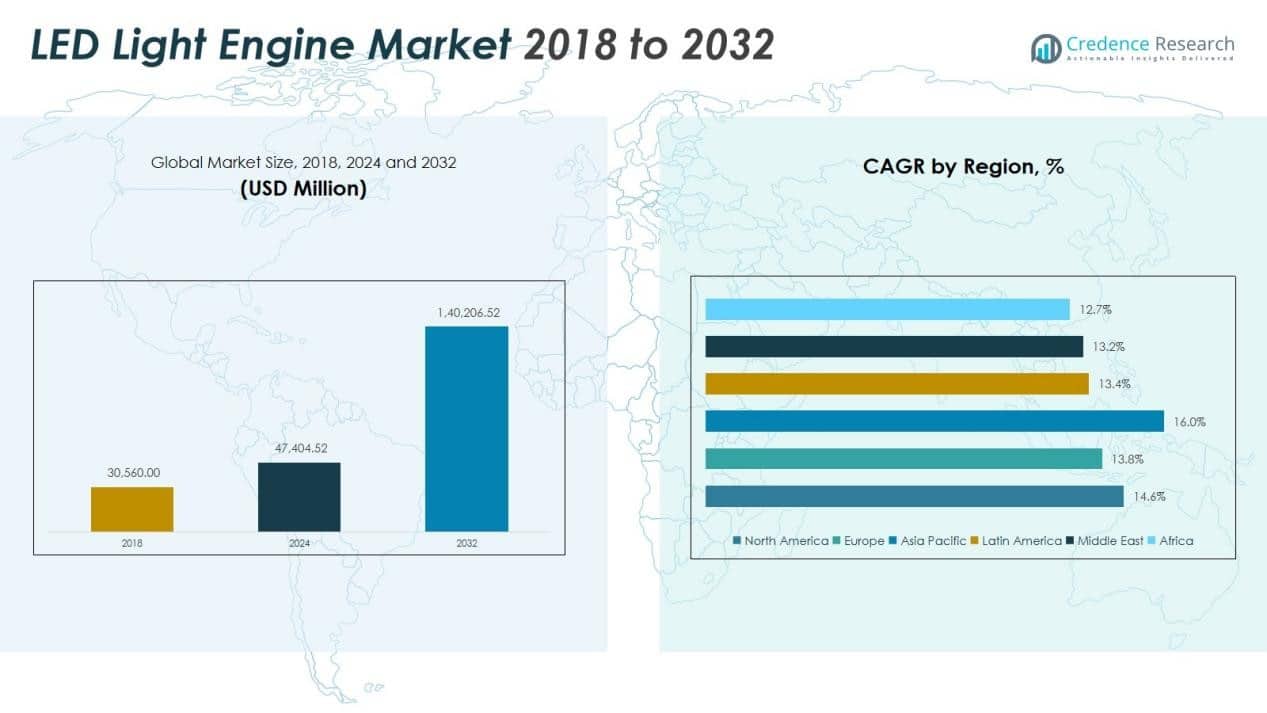
The LED Light Engine Market size was valued at USD 30,560 million in 2018 to USD 47,404.52 million in 2024 and is anticipated to reach USD 1,40,206.52 million by 2032, at a CAGR of 14.61% during the forecast period.
| REPORT ATTRIBUTE | DETAILS |
|---|---|
| Historical Period | 2020-2023 |
| Base Year | 2024 |
| Forecast Period | 2025-2032 |
| LED Light Engine Market Size 2024 | USD 47,404.52 Million |
| LED Light Engine Market, CAGR | 14.61% |
| LED Light Engine Market Size 2032 | USD 1,40,206.52 Million |
The market is driven by rising demand for sustainable lighting solutions, government incentives promoting LED adoption, and advancements in smart lighting technology. Integration of sensors, wireless control systems, and IoT connectivity enhances the efficiency and flexibility of LED light engines. The growing use of LEDs in automotive, industrial, residential, and commercial sectors further strengthens market growth.
Regionally, Asia Pacific dominates the Global LED Light Engine Market due to large-scale manufacturing, urban development, and infrastructure expansion in China, India, and South Korea. North America follows, supported by technological innovation and energy efficiency standards. Europe maintains a significant share driven by sustainability goals and widespread adoption in architectural and outdoor lighting applications. Emerging markets in Latin America and the Middle East are also expected to show steady growth with rising smart city initiatives and renewable energy integration.
Market Insights:
- The Global LED Light Engine Market was valued at USD 30,560 million in 2018 and reached USD 47,404.52 million in 2024, projected to attain USD 1,40,206.52 million by 2032 at a CAGR of 14.61%.
- Smart and connected lighting systems integrated with IoT and motion sensors are transforming building and urban illumination.
- Asia Pacific leads the global market with a 28% share, supported by large-scale manufacturing and infrastructure expansion in China, India, and South Korea.
- North America holds 32% share, driven by advanced technology adoption and strong government initiatives for energy-efficient lighting.
- Europe accounts for 26% share, supported by strict energy regulations and rising architectural and outdoor LED applications.
Market Drivers:
Growing Shift Toward Energy-Efficient and Sustainable Lighting Solutions
The Global LED Light Engine Market is driven by a global shift toward energy efficiency and sustainability. Governments and organizations are implementing strict regulations to phase out traditional lighting sources and promote LED adoption. LED light engines offer higher luminous efficacy and lower power consumption compared to incandescent and fluorescent lights. Their longer lifespan and reduced maintenance costs appeal to both commercial and residential users, supporting widespread market growth.
- For instance, Philips has set a new benchmark in LED innovation with its Ultra Efficient LED bulb, which achieves a luminous efficacy of 210 lumens per watt.
Rising Integration of Smart and Connected Lighting Systems
The increasing adoption of smart lighting technologies is another major growth driver. LED light engines are increasingly integrated with IoT-enabled systems, motion sensors, and wireless control units. This integration enhances energy management and allows for adaptive lighting environments in homes, offices, and industrial spaces. It strengthens the market by aligning with the global trend toward automation and intelligent infrastructure.
Expanding Applications Across Diverse End-Use Sectors
The market benefits from expanding applications in automotive, industrial, architectural, and horticultural lighting. Automotive manufacturers use LED engines for adaptive headlights and ambient lighting features. Industrial and commercial sectors adopt them to improve visibility, reduce operational costs, and comply with energy standards. The versatility of LED light engines makes them suitable for both indoor and outdoor use, driving consistent demand across multiple industries.
- For instance, ams OSRAM's EVIYOS Shape technology for applications like automotive lighting features a micro-LED array with 25,600 individually controllable pixels.
Government Incentives and Supportive Regulatory Frameworks
Government policies promoting energy-efficient lighting play a crucial role in driving adoption. Subsidies, tax incentives, and public infrastructure projects encourage consumers and businesses to transition to LED technology. It supports large-scale replacements of conventional lighting in streets, public buildings, and transportation systems. Such policies reinforce long-term market growth and attract further investment in advanced LED light engine development.
Market Trends:
Advancement in Smart Lighting and IoT Integration
The Global LED Light Engine Market is witnessing a strong trend toward smart lighting integration supported by IoT connectivity. Manufacturers are embedding sensors, wireless modules, and dimming controls into LED systems to enable remote operation and automation. This shift allows users to monitor energy usage and customize lighting conditions through smartphones and centralized control systems. It is driving adoption in commercial buildings, smart homes, and industrial facilities seeking enhanced efficiency and user comfort. The rise of voice-controlled and AI-enabled lighting systems further accelerates this transformation. Leading companies are focusing on interoperability between platforms and developing software-driven lighting ecosystems that improve adaptability and sustainability.
- For instance, Signify’s Philips Hue Flux Ultra Bright Strip Light integrates app and voice control and delivers 6,000 lumens.
Growing Focus on Miniaturization and Advanced Materials
Manufacturers are emphasizing compact, lightweight, and thermally efficient designs to enhance performance and installation flexibility. The trend toward miniaturization supports the development of sleek fixtures and embedded lighting solutions across automotive, consumer electronics, and architectural applications. It also aligns with the rising demand for flexible and modular LED engines that offer easy customization. Advancements in materials such as ceramic substrates and improved phosphor coatings enhance heat dissipation and color stability. It strengthens product reliability under high-power operations and harsh environments. The market is also experiencing a transition toward chip-on-board (COB) and linear light engines, which deliver superior illumination quality and longer operational life. These innovations are shaping the next generation of high-efficiency lighting systems worldwide.
- For instance, Marktech Optoelectronics’ hermetic multichip metal‑can LED packages integrate 7 dies in a single compact emitter to raise density and reliability.
Market Challenges Analysis:
High Initial Costs and Complex Integration Requirements
The Global LED Light Engine Market faces challenges due to high initial investment costs and complex integration processes. Despite long-term savings, the upfront expenses for LED systems, smart controls, and installation remain significant for small and medium enterprises. The integration of drivers, sensors, and control modules also requires skilled professionals and precise calibration. It increases overall project costs and delays adoption in developing regions. Compatibility issues between lighting components from different manufacturers further complicate system implementation, limiting scalability for end users.
Thermal Management and Performance Degradation Issues
Thermal management continues to be a major technical challenge for LED light engines. Excess heat can reduce efficiency, alter color output, and shorten the product’s lifespan. It requires advanced materials and design optimization to maintain consistent performance under high-power operation. Inadequate heat dissipation systems often lead to reliability issues in compact fixtures. Manufacturers must balance miniaturization with effective thermal regulation to meet industry standards. The need for continuous R&D investments to overcome these performance limitations adds pressure on production costs and market competitiveness.
Market Opportunities:
Rising Adoption in Smart Cities and Infrastructure Projects
The Global LED Light Engine Market is gaining opportunities through growing smart city initiatives and infrastructure modernization programs. Governments worldwide are replacing traditional streetlights with networked LED systems that support remote monitoring and adaptive brightness control. It enhances urban energy efficiency while reducing maintenance costs. Public infrastructure projects, including airports, metro stations, and highways, increasingly use LED engines for durable and low-power lighting. The integration of sensors and connectivity features aligns with global sustainability goals and urban digitalization trends. This transition creates a strong demand pipeline for advanced lighting solutions across both developed and emerging economies.
Expanding Demand in Automotive and Horticultural Applications
Automotive lighting and horticultural illumination represent new growth areas for LED light engines. Automakers are adopting LED engines for adaptive headlights, ambient interiors, and energy-efficient signaling systems. In agriculture, controlled-environment farming and vertical cultivation rely on spectrum-tuned LED engines to optimize plant growth and yield. It creates opportunities for specialized manufacturers to develop high-performance, wavelength-specific solutions. The demand for compact, durable, and intelligent lighting modules continues to grow across these sectors. Expanding product customization capabilities and new application development are expected to open profitable avenues for market players.
Market Segmentation Analysis:
By Product
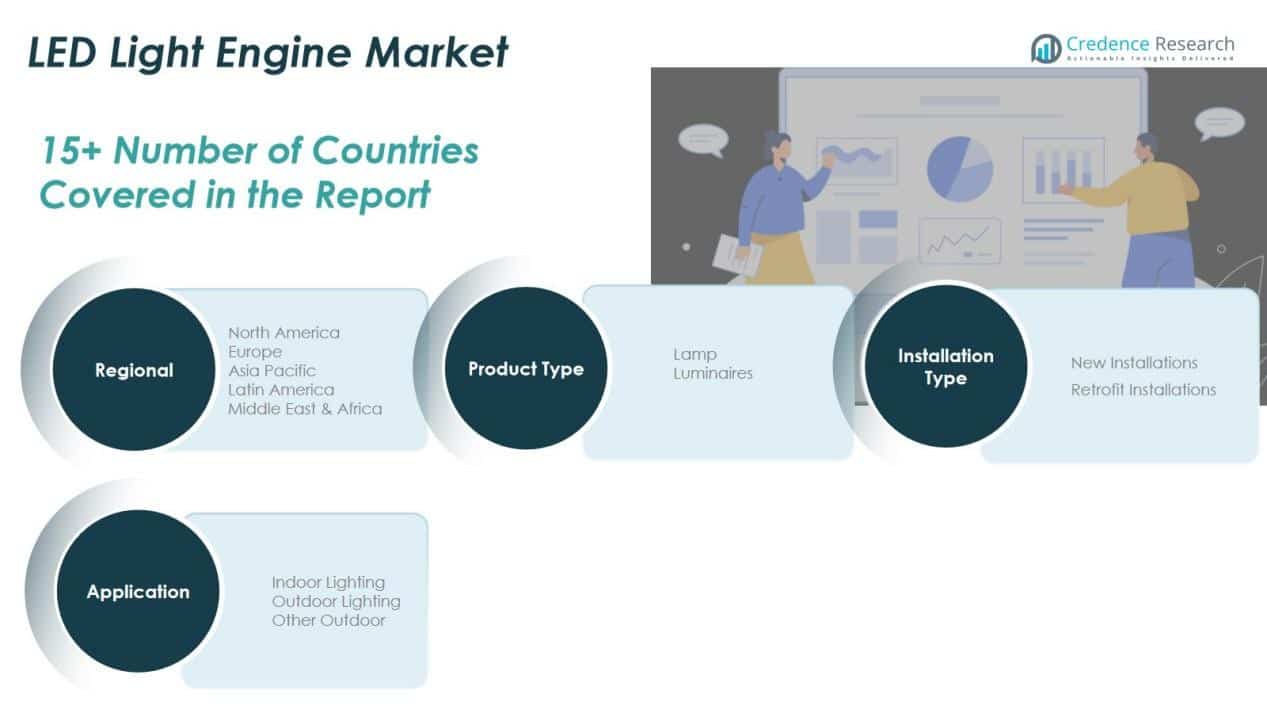
The Global LED Light Engine Market is segmented into lamps and luminaires. Luminaires hold the dominant share due to their extensive use in commercial, residential, and industrial spaces. They offer better efficiency, design flexibility, and compatibility with smart control systems. Lamps continue to serve as a cost-effective solution for retrofit applications and residential lighting. It benefits from the growing replacement of traditional bulbs with LED-based options that provide higher brightness and longer life.
- For instance, Cree LED's J Series® 5050C E Class LEDs showcase a significant technological achievement by delivering an efficacy of 228 lumens per watt.
By Application
The market is classified into indoor lighting, outdoor lighting, and other outdoor uses. Indoor lighting accounts for the largest share due to strong adoption in offices, retail spaces, and homes. The demand for energy-efficient and intelligent lighting solutions drives adoption across commercial and industrial buildings. Outdoor lighting is expanding with rising infrastructure development, road networks, and smart city initiatives. It finds growing use in public spaces, parking areas, and architectural illumination.
- For instance, a city-wide project in Memphis, Tennessee, involved converting over 77,000 streetlights to new LED fixtures, which is projected to result in an annual energy savings of more than 37 million kWh.
By Installation Type
The market is divided into new installations and retrofit installations. New installations dominate due to large-scale infrastructure projects and government programs promoting sustainable lighting systems. The retrofit segment is also expanding as businesses upgrade legacy systems with advanced LED solutions to reduce energy costs. It supports long-term efficiency goals and aligns with global carbon reduction targets. Both segments benefit from falling LED prices and improved product reliability.
Segmentations:
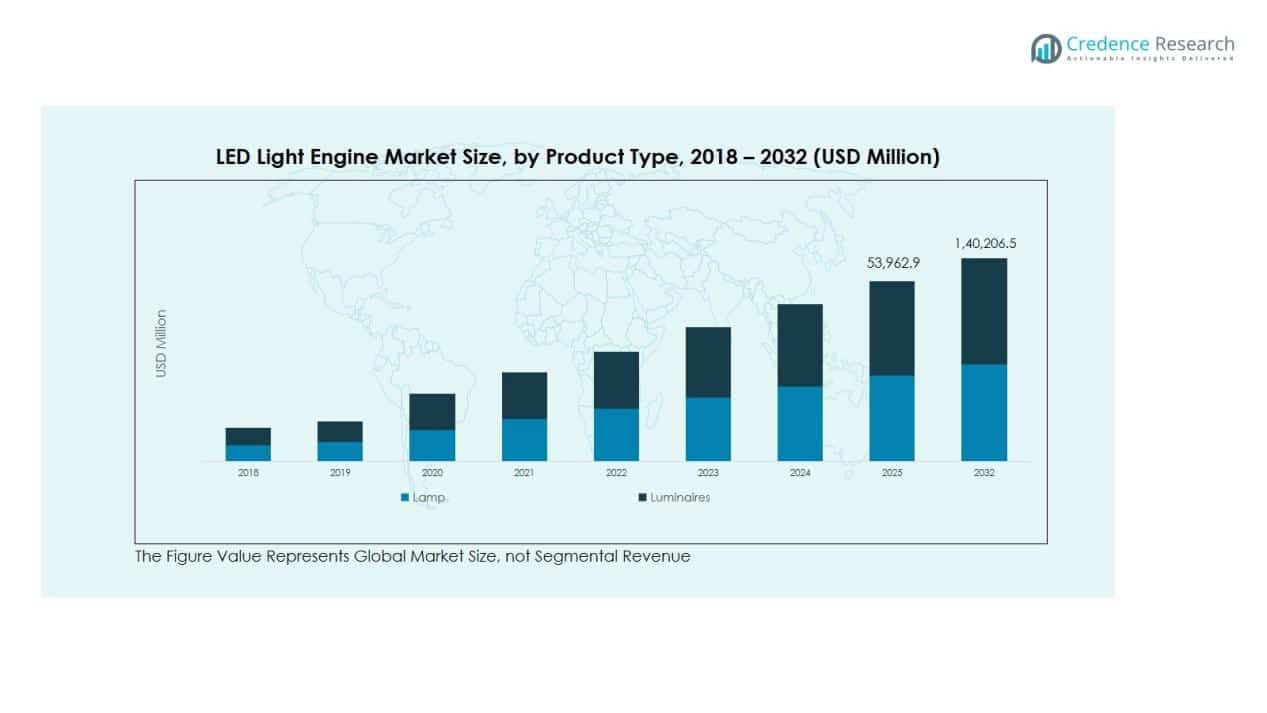
By Product
- Lamp
- Luminaires
By Installation Type
- New Installations
- Retrofit Installations
By Application
- Indoor Lighting
- Outdoor Lighting
- Other Outdoor
By Region
- North America
- Europe
- Asia Pacific
- Latin America
- Middle East
- Africa
- By Country (Regional Breakdown)
North America
- S.
- Canada
- Mexico
Europe
- UK
- France
- Germany
- Italy
- Spain
- Russia
- Rest of Europe
Asia Pacific
- China
- Japan
- South Korea
- India
- Australia
- Southeast Asia
- Rest of Asia Pacific
Latin America
- Brazil
- Argentina
- Rest of Latin America
Middle East
- GCC Countries
- Israel
- Turkey
Rest of Middle East
- Africa
- South Africa
- Egypt
- Rest of Africa
Regional Analysis:
North America
The North America LED Light Engine Market size was valued at USD 10,879.36 million in 2018 to USD 16,667.15 million in 2024 and is anticipated to reach USD 49,226.76 million by 2032, at a CAGR of 14.6% during the forecast period. North America holds 32% of the total share of the Global LED Light Engine Market. The region’s growth is driven by strong technological innovation, government initiatives promoting energy-efficient lighting, and widespread adoption in commercial and residential projects. The United States leads due to advanced manufacturing capabilities and extensive integration of smart lighting in infrastructure. Canada is expanding its LED use in municipal and industrial projects, supported by sustainability mandates. It continues to see growing demand in sectors such as retail, automotive, and outdoor lighting applications.
Europe
The Europe LED Light Engine Market size was valued at USD 8,376.50 million in 2018 to USD 12,508.76 million in 2024 and is anticipated to reach USD 35,030.97 million by 2032, at a CAGR of 13.8% during the forecast period. Europe accounts for 26% of the market share, supported by strong regulatory policies favoring low-emission and energy-saving technologies. The region’s focus on smart city development and architectural lighting boosts LED adoption. Germany, the UK, and France are leading markets due to innovation in lighting design and growing renewable energy integration. It benefits from a mature industrial base and high consumer awareness of energy conservation. The ongoing transition to connected and adaptive lighting systems further supports market expansion across Europe.
Asia Pacific
The Asia Pacific LED Light Engine Market size was valued at USD 7,487.20 million in 2018 to USD 12,128.25 million in 2024 and is anticipated to reach USD 39,580.41 million by 2032, at a CAGR of 16.0% during the forecast period. Asia Pacific represents 28% of the market share, driven by large-scale urbanization and infrastructure development. China, Japan, and South Korea serve as major manufacturing hubs for LEDs, supported by strong government incentives and rapid industrialization. India’s growing construction sector and adoption of energy-efficient technologies also fuel demand. It witnesses significant adoption across commercial, automotive, and public infrastructure applications. The expansion of smart city projects and domestic production capacity continues to accelerate market growth in the region.
Latin America
The Latin America LED Light Engine Market size was valued at USD 1,674.69 million in 2018 to USD 2,568.85 million in 2024 and is anticipated to reach USD 6,964.06 million by 2032, at a CAGR of 13.4% during the forecast period. Latin America holds 7% of the global market share. The region is witnessing steady growth supported by government-led initiatives promoting energy efficiency and modernization of public lighting systems. Brazil and Mexico lead adoption due to rapid urban expansion and smart infrastructure investments. It faces challenges from inconsistent regulatory frameworks but benefits from improving manufacturing capacity and growing retail demand. Increasing use of LEDs in automotive and hospitality sectors strengthens long-term growth potential.
Middle East
The Middle East LED Light Engine Market size was valued at USD 1,176.56 million in 2018 to USD 1,711.00 million in 2024 and is anticipated to reach USD 4,571.50 million by 2032, at a CAGR of 13.2% during the forecast period. The region holds 4% of the global market share. Rapid urbanization, construction of smart cities, and infrastructure projects in Saudi Arabia and the UAE drive adoption. LED systems are increasingly used in architectural lighting, hospitality, and outdoor applications. It benefits from large-scale investments in renewable energy and sustainable city planning. High-temperature performance LED engines are gaining traction due to environmental adaptability across desert regions. The growing focus on luxury developments and public lighting efficiency enhances regional demand.
Africa
The Africa LED Light Engine Market size was valued at USD 965.70 million in 2018 to USD 1,820.53 million in 2024 and is anticipated to reach USD 4,832.81 million by 2032, at a CAGR of 12.7% during the forecast period. Africa accounts for 3% of the total global share. The region’s growth is fueled by expanding electrification projects and government support for low-energy lighting solutions. South Africa and Nigeria are leading adopters due to urban growth and rising awareness of energy costs. It is also seeing demand from the commercial and industrial sectors adopting solar-integrated LED lighting systems. Infrastructure development programs and foreign investments in smart grid projects support future market expansion. The growing focus on affordable and sustainable lighting access is expected to strengthen regional adoption.
Key Player Analysis:
- Signify Lighting NV (Netherlands)
- OSRAM Licht AG (Germany)
- GE Lighting (USA)
- Cree, Inc. (USA)
- Hubbell Inc. (USA)
- Zumtobel Group AG (Austria)
- Wipro Enterprises (India)
- Samsung Electronics (South Korea)
- LG Innotek (South Korea)
- Legrand SA (France)
- Glamox AS (Norway)
- Lutron Electronics Co., Inc. (USA)
Competitive Analysis:
The Global LED Light Engine Market is highly competitive with several established manufacturers focusing on innovation, energy efficiency, and design flexibility. Major players include Signify Lighting NV (Netherlands), OSRAM Licht AG (Germany), GE Lighting (USA), Cree, Inc. (USA), Hubbell Inc. (USA), Zumtobel Group AG (Austria), Wipro Enterprises (India), and Samsung Electronics (South Korea). These companies emphasize product diversification, smart lighting integration, and expansion into emerging markets. It witnesses strong investment in R&D to enhance performance, thermal management, and digital connectivity features. Strategic mergers, partnerships, and regional expansions remain key approaches to strengthen global presence and market share. It continues to evolve with rising competition from local manufacturers offering cost-efficient LED modules and advanced customization options.
Recent Developments:
- In October 2025, Signify partnered with DLL to accelerate the adoption of its LED lighting solutions.
- In March 2025, Signify announced a proposed joint venture with Dixon Technologies in India to manufacture a range of lighting products, including LED bulbs, downlights, and battens.
Report Coverage:
The research report offers an in-depth analysis based on Product, Installation Type, Application and Region. It details leading market players, providing an overview of their business, product offerings, investments, revenue streams, and key applications. Additionally, the report includes insights into the competitive environment, SWOT analysis, current market trends, as well as the primary drivers and constraints. Furthermore, it discusses various factors that have driven market expansion in recent years. The report also explores market dynamics, regulatory scenarios, and technological advancements that are shaping the industry. It assesses the impact of external factors and global economic changes on market growth. Lastly, it provides strategic recommendations for new entrants and established companies to navigate the complexities of the market.
Future Outlook:
- The Global LED Light Engine Market will experience strong growth driven by rising adoption of smart and connected lighting systems.
- Technological innovation in IoT-enabled and sensor-based LED engines will enhance operational efficiency and control.
- Integration of advanced materials will improve thermal management and extend product lifespan.
- The demand for energy-efficient lighting in commercial, residential, and industrial sectors will continue to expand.
- Urbanization and government-led smart city initiatives will fuel large-scale lighting replacements worldwide.
- Manufacturers will focus on miniaturization and modular designs to meet flexible installation needs.
- The automotive sector will drive innovation through adaptive headlights and interior illumination systems.
- Sustainability goals and carbon reduction policies will support global LED adoption across public infrastructure.
- Strategic partnerships and acquisitions among major players will accelerate technological advancements and market consolidation.
- The growing emphasis on cost optimization and digital control solutions will define the next phase of market evolution.

Request a Free Sample
Fill in your details and we'll send you a free sample report.
- Sample data tables & charts
- Research methodology
Need a Custom Version of This Report?
Tailor the scope, geography, or segments to your exact requirements.
- Custom geography or segment scope
- Direct access to our analyst team
Frequently Asked Questions
What is the current market size for the Global LED Light Engine Market, and what is its projected size in 2032?
At what Compound Annual Growth Rate is the Global LED Light Engine Market projected to grow between 2024 and 2032?
Which Global LED Light Engine Market segment held the largest share in 2024?
What are the primary factors fueling the growth of the Global LED Light Engine Market?
Who are the leading companies in the Global LED Light Engine Market?
Which region commanded the largest share of the Global LED Light Engine Market in 2024?
Table of Content
Chapter 1 Market Segmentation
- 1.1 Segmentation Framework
- 1.1.1 Product and Service Classification
- 1.1.2 Application and End-Use Classification
- 1.1.3 Technology and Solution Classification
- 1.1.4 Customer and Distribution Channel Classification
- 1.1.5 Geographic Segmentation
- 1.1.6 Market Segment Definitions and Boundaries
Chapter 2 Introduction
- 2.1 Report Objectives and Scope
- 2.2 Product Definition and Industry Terminology
- 2.3 Market Inclusions and Exclusions
- 2.4 Research Process
- 2.4.1 Primary Research and Expert Interviews
- 2.4.2 Secondary Research and Source Review
- 2.4.3 Top-Down and Bottom-Up Estimation
- 2.4.4 Data Triangulation and Verification
- 2.5 Market Size Measurement Basis
- 2.5.1 2024: USD 47,404.52 million → 2032: USD 1,40,206.52 million
- 2.6 Historical and Forecast Reference Periods
- 2.6.1 Base Year: 2024
- 2.6.2 Forecast Period: 2024-2032
- 2.7 Research Assumptions and Limitations
Chapter 3 Executive Summary
- 3.1 Market Snapshot and Key Findings
- 3.2 Base-Year Market Size, 2024
- 3.3 Forecast Market Size, 2032
- 3.4 Revenue and Volume Growth Outlook
- 3.5 Key Demand and Supply Indicators
- 3.6 Leading Market Segments
- 3.7 Fastest-Growing Market Opportunities
- 3.8 Regional Performance Highlights
- 3.9 Technology and Industry Transformation
- 3.10 Competitive Landscape Summary
- 3.11 Analyst View and Strategic Implications
Chapter 4 Global LED Light Engine Market Trends and Developments
- 4.1 Historical Industry Development
- 4.2 Recent Market Trends and Developments
- 4.3 Demand and Customer Behavior Trends
- 4.4 Technology and Product Innovation
- 4.5 Artificial Intelligence, Automation and Digitalization
- 4.6 Local Manufacturing and Supply Chain Realignment
- 4.7 Industry Partnerships, Mergers and Acquisitions
- 4.8 Sustainability and Circular Economy Developments
- 4.9 Government and Private Sector Investment Trends
- 4.10 Emerging Business Models and Commercialization
- 4.11 Industry Developments and Announcements
Chapter 5 Global LED Light Engine Market Production, Supply and Demand Analysis
- 5.1 Demand Trend and Consumption Analysis
- 5.2 Demand Forecast, 2024-2032
- 5.3 Production and Output Trend
- 5.4 Production and Output Forecast, 2024-2032
- 5.5 Installed Capacity and Capacity Utilization
- 5.6 Company-Wise Production Plants and Statistics
- 5.6.1 Installed Production Capacity
- 5.6.2 Actual Production
- 5.6.3 Planned Capacity and Expansion Targets
- 5.7 Supply Chain Structure and Procurement Trends
- 5.8 Supply-Demand Gap and Bottlenecks
- 5.9 Import Dependence and Sourcing Structure
- 5.10 Contract Manufacturing and Outsourcing
- 5.11 Regional Supply and Demand Concentration
Chapter 6 Global LED Light Engine Market Pricing Analysis
- 6.1 Pricing Structure and Measurement
- 6.2 Historical Pricing Trends
- 6.3 Pricing Outlook, 2024-2032
- 6.4 Average Selling Price and Unit Economics
- 6.5 Pricing by Product and Market Segment
- 6.6 Geographic Pricing Differences
- 6.7 Key Input, Energy, Labor and Logistics Costs
- 6.8 Contract Pricing and Purchasing Models
- 6.9 Pricing Sensitivity and Competitive Positioning
- 6.10 Price, Margin and Profitability Implications
Chapter 7 Global LED Light Engine Market Dynamics
- 7.1 Market Growth Drivers
- 7.1.1 Demand-Side Drivers
- 7.1.2 Technology and Innovation Drivers
- 7.1.3 Infrastructure and Investment Drivers
- 7.1.4 Regulatory and Policy Drivers
- 7.2 Market Restraints
- 7.2.1 Cost and Affordability Constraints
- 7.2.2 Technology and Adoption Barriers
- 7.2.3 Supply Chain and Operational Constraints
- 7.3 Market Challenges
- 7.3.1 Competitive Pressure and Margin Erosion
- 7.3.2 Skills, Infrastructure and Implementation Gaps
- 7.4 Emerging Market Opportunities
- 7.5 Market Dynamics Impact and Time-Horizon Assessment
Chapter 8 Global LED Light Engine Value Chain Analysis
- 8.1 Industry Value Chain Overview
- 8.2 Upstream Suppliers and Critical Inputs
- 8.3 Technology and Component Providers
- 8.4 Manufacturing or Service Delivery
- 8.5 Distribution, Channel Partners and Integrators
- 8.6 Downstream Applications and End Users
- 8.7 Value Addition and Profit Pools
- 8.8 Vertical Integration and Outsourcing
- 8.9 Supplier Concentration and Risk
- 8.10 Supply Chain Localization and Resilience
Chapter 9 Global LED Light Engine Market Regulations and Policies
- 9.1 Relevant Laws, Standards and Compliance Frameworks
- 9.2 Product, Service, Safety and Quality Requirements
- 9.3 Government Policies, Incentives and Subsidies
- 9.4 Imports, Exports and Trade Barriers
- 9.5 Public Procurement and Local Content Requirements
- 9.6 Environmental and Sustainability Compliance
- 9.7 Upcoming Policy Changes and Market Implications
Chapter 10 Global LED Light Engine Market Hotspots and Opportunities
- 10.1 Market Opportunity Mapping and Growth Hotspots
- 10.2 High-Growth Applications and Customer Groups
- 10.3 Underserved Markets and White-Space Opportunities
- 10.4 Emerging Technology and Product Opportunities
- 10.5 New Capacity and Investment Hotspots
- 10.6 Market Entry and Expansion Opportunities
- 10.7 Distribution and Partnership Opportunities
- 10.8 Near-Term and Long-Term Commercial Potential
- 10.9 Opportunity Attractiveness and Execution Risks
Chapter 11 Global LED Light Engine Market Outlook, 2024-2032
- 11.1 Market Size and Analysis
- 11.1.1 Revenue (Market Measurement: 2024: USD 47,404.52 million → 2032: USD 1,40,206.52 million)
- 11.1.2 Market Volume and Quantity Sold
- 11.1.3 Historical Market Size
- 11.1.4 Base-Year Market Size, 2024
- 11.2 Market Forecast, 2024-2032
- 11.2.1 Revenue Forecast to 2032
- 11.2.2 Volume Forecast to 2032
- 11.2.3 CAGR and Year-on-Year Growth
- 11.2.4 Incremental Revenue Opportunity
- 11.3 Forecast Assumptions and Scenario Analysis
- 11.3.1 Base-Case Forecast
- 11.3.2 Optimistic and Conservative Scenarios
- 11.3.3 Technology, Pricing and Policy Sensitivities
- 11.4 Market Attractiveness and Growth Outlook
Chapter 12 Global LED Light Engine Market Segmentation and Outlook
- 12.1 Segmentation Summary and Market Shares, 2024
- 12.2 Largest and Fastest-Growing Segments
- 12.3 Segment Growth Comparison
- 12.4 Segment Attractiveness and Priority Matrix
Chapter 13 Global LED Light Engine Geographic Market Outlook, 2024-2032
- 13.1 Regional Market Size and Share, 2024
- 13.2 Regional Market Forecast, 2024-2032
- 13.3 Regional Pricing, Production and Demand Differences
- 13.4 North America
- 13.4.1 United States
- 13.4.2 Canada
- 13.4.3 Mexico
- 13.5 Europe
- 13.5.1 Germany
- 13.5.2 France
- 13.5.3 Italy
- 13.5.4 United Kingdom
- 13.5.5 Spain
- 13.5.6 Poland
- 13.5.7 Russia
- 13.5.8 Netherlands
- 13.5.9 Belgium
- 13.5.10 Sweden
- 13.5.11 Denmark
- 13.5.12 Norway
- 13.5.13 Rest of Europe
- 13.6 Asia Pacific
- 13.6.1 China
- 13.6.2 India
- 13.6.3 Japan
- 13.6.4 South Korea
- 13.6.5 Thailand
- 13.6.6 Indonesia
- 13.6.7 Vietnam
- 13.6.8 Malaysia
- 13.6.9 Australia
- 13.6.10 Rest of Asia Pacific
- 13.7 Latin America
- 13.7.1 Brazil
- 13.7.2 Argentina
- 13.7.3 Colombia
- 13.7.4 Chile
- 13.7.5 Rest of Latin America
- 13.8 Middle East
- 13.8.1 Saudi Arabia
- 13.8.2 United Arab Emirates
- 13.8.3 Turkey
- 13.8.4 Israel
- 13.8.5 Iran
- 13.8.6 Rest of the Middle East
- 13.9 Africa
- 13.9.1 South Africa
- 13.9.2 Egypt
- 13.9.3 Nigeria
- 13.9.4 Morocco
- 13.9.5 Rest of Africa
- 13.10 Regional Investment, Policy and Supply Chain Differences
- 13.11 Regional Competitive Landscape
- 13.12 Geographic Growth Hotspots
Chapter 14 Global LED Light Engine Technology, Innovation and Sustainability Outlook
- 14.1 Technology Landscape and Maturity
- 14.2 Product, Process and Service Innovation
- 14.3 AI, Automation and Digital Tools in the Industry
- 14.4 Technology Adoption and Performance Benchmarking
- 14.5 Innovation Pipeline and R&D Investment
- 14.6 Patent and Intellectual Property Trends
- 14.7 Energy Efficiency and Resource Management
- 14.8 Sustainability, Recycling and Circularity
- 14.9 Technology Roadmap, 2024-2032
- 14.10 Risks of Obsolescence and Technology Substitution
Chapter 15 Global LED Light Engine Market Key Strategic Imperatives
- 15.1 Growth and Market Entry Priorities
- 15.2 High-Return Products and Segments
- 15.3 Pricing, Profitability and Cost Optimization
- 15.4 Technology Investment and Product Differentiation
- 15.5 Supply Chain Localization and Resilience
- 15.6 Distribution and Customer Acquisition
- 15.7 Partnership, Acquisition and Capacity Strategy
- 15.8 Regional Expansion Priorities
- 15.9 Short-, Medium- and Long-Term Actions
Chapter 16 Competition Outlook
- 16.1 Industry Competition Characteristics
- 16.2 Market Structure and Concentration
- 16.3 Market Share and Competitive Positioning, 2024
- 16.4 Company-Wise Revenue and Product Benchmarking
- 16.5 Production and Service Capacity Benchmarking
- 16.6 Technology, Pricing and Differentiation
- 16.7 Regional Footprint and Distribution Strength
- 16.8 Mergers, Acquisitions and Strategic Alliances
- 16.9 New Entrants and Competitive Threats
- 16.10 Porter's Five Forces and Industry Attractiveness
- 16.11 Competitive Outlook, 2024-2032
Chapter 17 Company Profiles
- 17.1 Company Coverage and Selection Criteria
- 17.2 Leading Market Participants – Standard Profile Structure
- 17.2.1 Business Description
- 17.2.2 Company Ownership and Geographic Presence
- 17.2.3 Product and Service Portfolio
- 17.2.4 Manufacturing and Operating Footprint
- 17.2.5 Production Capacity and Expansion Plans
- 17.2.6 Financial Performance and Investment
- 17.2.7 Market Share and Competitive Position
- 17.2.8 Technology and Innovation Capabilities
- 17.2.9 Strategic Alliances or Partnerships
- 17.2.10 Recent Developments
- 17.2.11 Growth Strategy and Outlook
- 17.3 Other Relevant Market Participants
Note: Every listed company is profiled on the structure shown under the first company. The company list is preliminary and may change based on research findings, market developments, data availability and client requirements.
Chapter 18 Disclaimer
- 18.1 Research and Forecast Disclaimer
- 18.2 Data Source and Estimation Limitations
Note: The depth of individual sections depends on data availability for this market. Volume, capacity, trade and other unit-based metrics are included where applicable.