Market Overview
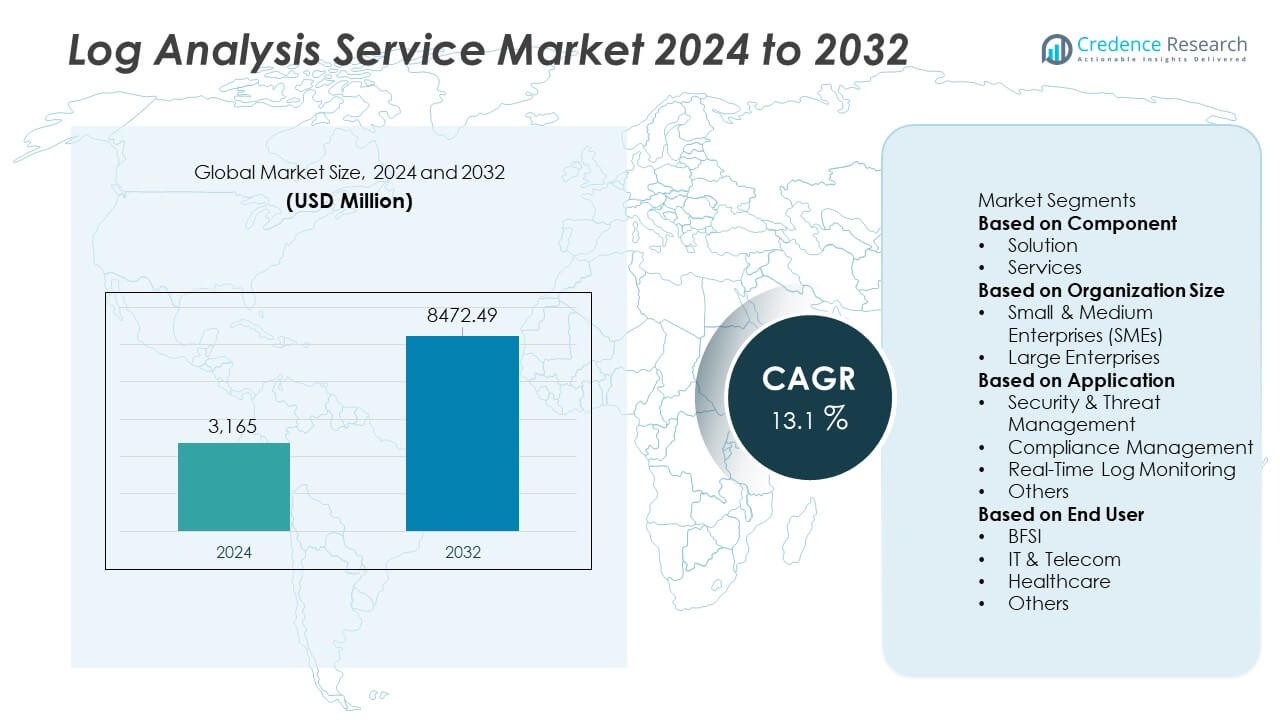
The Log Analysis Service Market was valued at USD 3,165 million in 2024 and is projected to reach USD 8,472.49 million by 2032, expanding at a CAGR of 13.1% during the forecast period.
| REPORT ATTRIBUTE | DETAILS |
|---|---|
| Historical Period | 2020-2023 |
| Base Year | 2024 |
| Forecast Period | 2025-2032 |
| Log Analysis Service Market Size 2024 | USD 3,165 Million |
| Log Analysis Service Market, CAGR | 13.1% |
| Log Analysis Service Market Size 2032 | USD 8,472.49 Million |
The Log Analysis Service market is shaped by leading players such as Splunk, IBM, Microsoft, Elastic, SolarWinds, Datadog, Rapid7, Sumo Logic, LogRhythm, and ManageEngine, each advancing cloud-native analytics, automated threat detection, and real-time monitoring capabilities. These companies strengthen enterprise security by integrating AI-based correlation engines and unified observability features that improve incident response and compliance management. North America leads the global market with 39% share due to strong cloud adoption and high cybersecurity spending. Europe follows with 31% share, supported by strict data-governance frameworks, while Asia Pacific holds 24% share, driven by digital transformation, growing SME adoption, and rising cyber risk exposure across emerging economies.
Market Insights
- The Log Analysis Service market reached USD 3,165 million in 2024 and is projected to grow at a CAGR of 13.1% through 2032.
- Strong drivers include rising demand for automated threat detection, with the solution segment holding a 62% share due to high adoption of cloud-based log analytics platforms.
- Key trends include expansion of AI-enabled log correlation, real-time anomaly detection, and broader integration of observability tools across hybrid and multi-cloud environments.
- Competitive activity is shaped by major players investing in unified security analytics, automation, and SIEM enhancements, increasing differentiation through accuracy, scalability, and faster response capabilities.
- Regionally, North America leads with 39% share, Europe holds 31%, and Asia Pacific accounts for 24%, with SMEs accelerating adoption across all major markets.
Market Segmentation Analysis:
By Component
The solution segment dominated the market with a 63% share, driven by rising adoption of advanced log analytics platforms that support automated detection, anomaly scanning, and centralized log aggregation. Enterprises prefer integrated solutions for their ability to process high-volume, real-time log data across cloud, on-premises, and hybrid environments. Services also gained momentum as businesses sought consulting, implementation, and managed analytics support to streamline security operations. Growing cloud migration, rapid expansion of digital infrastructure, and increasing cyber risks continue to strengthen the demand for high-performance log analysis solutions across industries.
- For instance, Splunk continually optimizes its processing engine for efficiency and has demonstrated in lab environments the capability to ingest over 120,000 events per second (EPS) per indexer in specific optimized configurations, or achieve over 2.45 TB/day per indexer in performance tests.
By Organization Size
Large enterprises held the leading 58% share, supported by their complex IT environments, heavy data workloads, and strong focus on security and compliance management. These organizations deploy enterprise-grade log analysis tools to manage multi-cloud systems, detect advanced threats, and meet strict auditing requirements. SMEs demonstrated growing adoption as cloud-based platforms offered scalable, low-cost analytics capabilities suitable for limited budgets. The rising need for automated monitoring, faster incident response, and simplified operations drives adoption across both segments, with large enterprises maintaining dominance due to broader infrastructure demands.
- For instance, Microsoft processes more than 100 trillion signals from its services every day, using this vast threat intelligence to power security solutions like Microsoft Sentinel and Defender. This intelligence, combined with AI capabilities, is leveraged to improve threat detection, anticipate attacker movements, and automate responses.
By Application
Security and threat management accounted for the largest 49% share, driven by increasing cyberattacks, ransomware incidents, and the need for continuous monitoring across distributed IT systems. Organizations rely on log analytics to detect intrusions, identify suspicious patterns, and improve security posture. Real-time log monitoring also expanded as companies prioritized faster incident response and operational visibility. Compliance management remained essential for regulated sectors such as BFSI, healthcare, and government, where audit trails and governance standards are critical. The dominance of security-focused applications reflects growing enterprise emphasis on proactive risk management and system resilience.
Key Growth Drivers
Rising Cybersecurity Threats and Need for Continuous Monitoring
Growing cyberattacks, ransomware incidents, and insider threats increase demand for advanced log analysis services that provide real-time visibility across IT environments. Enterprises use centralized log monitoring to detect anomalies, block malicious activity, and strengthen incident response. Rising adoption of multi-cloud and hybrid infrastructures creates complex data trails, making automated log analytics essential for threat detection. Industries such as BFSI, healthcare, and government rely on log data to meet regulatory expectations and maintain secure operations. This focus on proactive security strongly accelerates market growth.
- For instance, CrowdStrike integrated log processing modules that analyze more than 1 trillion security events per day across global deployments.
Expansion of Cloud Adoption and Digital Transformation Initiatives
Rapid cloud migration and modernization of IT systems increase the volume of logs generated from applications, networks, and endpoints. Organizations adopt log analysis platforms to manage distributed data and ensure performance visibility across cloud-native environments. Serverless computing, microservices, and containerized workloads further amplify the need for scalable log analytics. Companies leverage these tools to optimize infrastructure, maintain uptime, and support digital transformation goals. Rising demand for cloud-based monitoring solutions drives continuous market expansion.
- For instance, self-managed Elasticsearch clusters have demonstrated the capability to handle ingestion pipelines of over 1 million writes per second in highly optimized, large-scale environments.
Growing Compliance Requirements Across Regulated Industries
Strict regulations such as GDPR, HIPAA, PCI DSS, and SOX increase the need for structured log management to ensure audit readiness and data governance. Enterprises depend on log analysis services to maintain accurate records, detect policy violations, and support compliance reporting. Automated log retention and integrity validation help organizations avoid penalties and strengthen governance frameworks. Sectors handling sensitive data-including finance, healthcare, and telecom-accelerate adoption to meet expanding regulatory obligations. Compliance-driven monitoring remains a major growth engine for the market.
 Key Trends & Opportunities
Integration of AI and Machine Learning in Log Analytics
AI-driven log analysis enhances threat detection, reduces false positives, and accelerates correlation of complex data patterns. Machine learning models identify unusual behavior, provide predictive insights, and automate root-cause analysis. Vendors integrate AI to improve detection speed for both operational and security incidents. As zero-trust architectures expand, AI-powered analytics create strong opportunities for advanced security automation. This trend supports faster decision-making and greater accuracy in highly dynamic digital environments.
- For instance, Google Chronicle (now part of Google Security Operations) leverages Google's speed, scale, and AI-powered protections to ingest and analyze massive volumes of security telemetry data at cloud scale, enabling sub-second search across petabytes of data.
Rising Demand for Cloud-Native and Real-Time Analytics Platforms
Organizations increasingly adopt cloud-native log analysis tools that support scalable ingestion, instant querying, and real-time monitoring across distributed systems. The rise of DevOps, microservices, and container orchestration drives need for continuous log visibility during deployment and operations. Real-time alerts and dashboards strengthen incident response and reduce downtime. Vendors offering multi-cloud compatibility, API-driven integration, and elastic storage gain strong opportunities. This trend aligns with the broader shift toward agile, performance-focused IT ecosystems.
- For instance, Sumo Logic improved its continuous intelligence engine to handle large-scale data analysis, with features such as real-time analytics, machine learning for anomaly detection, and the ability to process diverse data types (logs, metrics, and traces) to provide actionable insights for efficient troubleshooting and incident response.
Key Challenges
High Data Volume and Storage Costs for Large-Scale Log Management
Massive growth in log data from servers, networks, applications, and IoT devices creates storage and processing challenges. Organizations struggle to manage retention policies, index large datasets, and maintain cost-efficient infrastructure. High-volume ingestion increases operational overhead, especially for real-time analytics. Without optimized architectures, performance bottlenecks and rising storage costs limit scalability. These issues slow adoption for cost-sensitive enterprises and require vendors to offer more efficient data compression and tiered storage solutions.
Complexity of Integration Across Multi-Cloud and Hybrid Environments
Enterprises operate across fragmented infrastructures, making unified log collection and analysis difficult. Integrating data from legacy systems, cloud services, and third-party applications requires advanced connectors and security controls. Misaligned formats, inconsistent visibility, and lack of standardization hinder efficient monitoring. Organizations also face challenges in synchronizing logs for compliance and incident response. These integration gaps increase deployment complexity and slow adoption, especially among SMEs with limited technical resources.
Regional Analysis
North America
North America held 38% share, driven by strong adoption of cloud platforms, advanced cybersecurity frameworks, and widespread deployment of digital infrastructure. Enterprises in the U.S. and Canada rely heavily on log analysis services to manage rising cyberattacks, regulatory requirements, and distributed IT environments. High investment in AI-enabled security analytics and real-time monitoring tools further accelerates adoption. Leading technology vendors, robust data protection laws, and mature enterprise IT ecosystems strengthen market growth. The region continues to expand its use of automated log intelligence across sectors such as BFSI, healthcare, government, and telecom.
Europe
Europe accounted for 30% share, supported by stringent data protection regulations such as GDPR and growing demand for centralized log management solutions. Organizations prioritize log analytics to enhance compliance, detect anomalies, and secure critical data across hybrid and multi-cloud environments. Countries including Germany, the UK, and France lead adoption due to strong cybersecurity initiatives and increasing cloud migration. The rise in sophisticated cyber threats and rapid digital transformation across enterprises fuels market expansion. Europe’s regulated business environment ensures steady demand for secure, policy-driven log analysis tools.
Asia Pacific
Asia Pacific captured 24% share, driven by rapid digitalization, expanding cloud adoption, and increasing cybersecurity investments across developing economies. Countries such as China, India, Japan, and South Korea adopt log analysis services to manage rising cyber risks and support large-scale enterprise modernization. Growing SME participation and widespread use of mobile and IoT devices contribute to higher log volumes, increasing the need for real-time monitoring. Government initiatives promoting cybersecurity readiness and cloud infrastructure also support market expansion. Asia Pacific remains one of the fastest-growing regions due to its evolving digital ecosystem.
Latin America
Latin America held 5% share, supported by rising awareness of cybersecurity risks and increasing adoption of cloud-based monitoring tools. Enterprises in Brazil, Mexico, and Argentina implement log analysis services to manage security gaps and enhance operational visibility. Growth in digital banking, e-commerce, and mobile services generates large volumes of log data that require structured analytics. Economic challenges encourage organizations to adopt scalable, subscription-based solutions. While adoption is gradual, rising government cybersecurity programs and expanding IT modernization efforts continue to strengthen demand across the region.
Middle East & Africa
The Middle East & Africa region accounted for 3% share, driven by rising cybersecurity investments and expanding digital transformation initiatives across government, BFSI, and telecom sectors. Gulf countries adopt advanced log analysis solutions to support national cybersecurity strategies and secure critical infrastructure. African markets show increasing demand as enterprises modernize IT systems and combat growing cyber threats. Adoption of cloud platforms and managed security services enables wider use of log analytics. Despite limited technical resources in some areas, the region continues to advance its monitoring capabilities as digital ecosystems grow.
Market Segmentations:
By Component
- Solution
- Services
By Organization Size
- Small & Medium Enterprises (SMEs)
- Large Enterprises
By Application
- Security & Threat Management
- Compliance Management
- Real-Time Log Monitoring
- Others
By End User
- BFSI
- IT & Telecom
- Healthcare
- Others
By Geography
- North America
- U.S.
- Canada
- Mexico
- Europe
- Germany
- France
- U.K.
- Italy
- Spain
- Rest of Europe
- Asia Pacific
- China
- Japan
- India
- South Korea
- South-east Asia
- Rest of Asia Pacific
- Latin America
- Brazil
- Argentina
- Rest of Latin America
- Middle East & Africa
- GCC Countries
- South Africa
- Rest of the Middle East and Africa
Competitive Landscape
Competitive landscape analysis highlights major players such as Splunk, IBM, Microsoft, Elastic, SolarWinds, Datadog, Rapid7, Sumo Logic, LogRhythm, and ManageEngine, all of which drive innovation and shape the Log Analysis Service market. These companies compete by enhancing their cloud-native log analytics platforms, improving threat detection capabilities, and integrating AI-driven correlation engines. Vendors focus on delivering scalable solutions that handle large data volumes across hybrid and multi-cloud environments. Partnerships with cybersecurity firms, cloud providers, and managed service companies strengthen market reach and accelerate product adoption. Continuous investments in automation, real-time monitoring, and machine learning help vendors address rising security threats and compliance needs. As enterprises demand faster insights, reduced false positives, and unified observability tools, competition intensifies among providers developing high-performance platforms that support modern IT operations, DevSecOps workflows, and advanced security analytics.
Key Player Analysis
- Splunk Inc.
- IBM Corporation
- Microsoft Corporation
- Elastic N.V.
- SolarWinds Corporation
- Datadog, Inc.
- Rapid7, Inc.
- Sumo Logic, Inc.
- LogRhythm, Inc.
- ManageEngine (Zoho Corporation)
Recent Developments
- In June 2025, Datadog, Inc. expanded its log-management offering with new long-term retention, search and data-residency capabilities.
- In May 2024, Sumo Logic also announced new AI and security-analytics capabilities for its log-analytics platform to support DevSecOps teams.
- In March 2024, Sumo Logic, Inc. announced its Flex Licensing plan for unlimited log data ingest (log analytics pricing plan).
Report Coverage
The research report offers an in-depth analysis based on Component, Organization Size, Application, End User and Geography. It details leading market players, providing an overview of their business, product offerings, investments, revenue streams, and key applications. Additionally, the report includes insights into the competitive environment, SWOT analysis, current market trends, as well as the primary drivers and constraints. Furthermore, it discusses various factors that have driven market expansion in recent years. The report also explores market dynamics, regulatory scenarios, and technological advancements that are shaping the industry. It assesses the impact of external factors and global economic changes on market growth. Lastly, it provides strategic recommendations for new entrants and established companies to navigate the complexities of the market.
Future Outlook
- Demand for AI-driven log analytics will increase as enterprises prioritize automated threat detection.
- Cloud-native log analysis platforms will gain wider adoption across hybrid and multi-cloud environments.
- Real-time monitoring capabilities will expand as organizations strengthen incident response strategies.
- Integration of log analytics with SIEM and SOAR systems will grow to support unified security operations.
- SMEs will accelerate adoption due to simplified deployment models and lower subscription costs.
- Advanced correlation engines will enhance accuracy in detecting complex attacks and insider threats.
- Compliance-driven logging requirements will rise across regulated industries.
- Predictive analytics will become more common as companies analyze long-term patterns for risk forecasting.
- Edge log processing will expand to support distributed workloads and reduce latency.
- Vendors will focus on automation, scalability, and user-friendly visualization tools to improve market competitiveness.

Request a Free Sample
Fill in your details and we'll send you a free sample report.
- Sample data tables & charts
- Research methodology
Market Dynamics
Rising Cybersecurity Threats and Need for Continuous Monitoring
The increasing frequency and sophistication of cyberattacks, ransomware, and insider threats are driving organizations to adopt advanced log analysis services for real-time visibility and rapid incident response. Centralized log monitoring is essential for detecting anomalies and blocking malicious activity across complex IT environments.
Expansion of Cloud Adoption and Digital Transformation Initiatives
As enterprises migrate to cloud and hybrid infrastructures, the volume and complexity of log data grow, necessitating scalable log analysis platforms. Cloud-native log analytics enable organizations to manage distributed data, optimize infrastructure, and maintain performance visibility during digital transformation.
Growing Compliance Requirements Across Regulated Industries
Strict regulations such as GDPR, HIPAA, and PCI DSS require organizations to maintain detailed audit trails and ensure data governance. Log analysis services help enterprises meet compliance obligations by automating log retention, integrity validation, and compliance reporting, especially in sectors like BFSI and healthcare.
Integration of AI and Machine Learning in Log Analytics
Vendors are embedding AI and machine learning into log analysis platforms to enhance threat detection, reduce false positives, and automate root-cause analysis. These capabilities enable faster, more accurate identification of security incidents and operational issues, supporting proactive risk management.
Rising Demand for Real-Time and Cloud-Native Analytics Platforms
The shift toward DevOps, microservices, and distributed IT environments is increasing the need for real-time log monitoring and cloud-native analytics. Organizations require instant querying, scalable ingestion, and continuous visibility to support agile operations and minimize downtime.
Need a Custom Version of This Report?
Tailor the scope, geography, or segments to your exact requirements.
- Custom geography or segment scope
- Direct access to our analyst team
Frequently Asked Questions
What is the current market size for the Log Analysis Service market, and what is its projected size in 2032?
At what Compound Annual Growth Rate is the Log Analysis Service market projected to grow between 2025 and 2032?
Which Log Analysis Service market segment held the largest share in 2024?
What are the primary factors fueling the growth of the Log Analysis Service market?
Who are the leading companies in the Log Analysis Service market?
Which region commanded the largest share of the Log Analysis Service market in 2024?
Table of Content
Chapter 1 Market Segmentation
- 1.1 Segmentation Framework
- 1.1.1 Product and Service Classification
- 1.1.2 Application and End-Use Classification
- 1.1.3 Technology and Solution Classification
- 1.1.4 Customer and Distribution Channel Classification
- 1.1.5 Geographic Segmentation
- 1.1.6 Market Segment Definitions and Boundaries
- 1.2 By End User
- 1.2.1 BFSI
- 1.2.2 IT & Telecom
- 1.2.3 Healthcare
- 1.2.4 Others
- 1.3 By Component
- 1.3.1 Solution
- 1.3.2 Services
- 1.4 By Application
- 1.4.1 Security & Threat Management
- 1.4.2 Compliance Management
- 1.4.3 Real-Time Log Monitoring
- 1.4.4 Others
- 1.5 By Organization Size
- 1.5.1 Small & Medium Enterprises (SMEs)
- 1.5.2 Large Enterprises
Chapter 2 Introduction
- 2.1 Report Objectives and Scope
- 2.2 Product Definition and Industry Terminology
- 2.3 Market Inclusions and Exclusions
- 2.4 Research Process
- 2.4.1 Primary Research and Expert Interviews
- 2.4.2 Secondary Research and Source Review
- 2.4.3 Top-Down and Bottom-Up Estimation
- 2.4.4 Data Triangulation and Verification
- 2.5 Market Size Measurement Basis
- 2.5.1 2024: USD 3,165 million → 2032: USD 8,472.49 million
- 2.6 Historical and Forecast Reference Periods
- 2.6.1 Base Year: 2024
- 2.6.2 Forecast Period: 2024-2032
- 2.7 Research Assumptions and Limitations
Chapter 3 Executive Summary
- 3.1 Market Snapshot and Key Findings
- 3.2 Base-Year Market Size, 2024
- 3.3 Forecast Market Size, 2032
- 3.4 Revenue and Volume Growth Outlook
- 3.5 Key Demand and Supply Indicators
- 3.6 Leading Market Segments
- 3.7 Fastest-Growing Market Opportunities
- 3.8 Regional Performance Highlights
- 3.9 Technology and Industry Transformation
- 3.10 Competitive Landscape Summary
- 3.11 Analyst View and Strategic Implications
Chapter 4 Global Log Analysis Service Market Trends and Developments
- 4.1 Historical Industry Development
- 4.2 Recent Market Trends and Developments
- 4.3 Demand and Customer Behavior Trends
- 4.4 Technology and Product Innovation
- 4.5 Artificial Intelligence, Automation and Digitalization
- 4.6 Local Manufacturing and Supply Chain Realignment
- 4.7 Industry Partnerships, Mergers and Acquisitions
- 4.8 Sustainability and Circular Economy Developments
- 4.9 Government and Private Sector Investment Trends
- 4.10 Emerging Business Models and Commercialization
- 4.11 Industry Developments and Announcements
Chapter 5 Global Log Analysis Service Market Supply and Demand Analysis
- 5.1 Demand Trend and Consumption Analysis
- 5.2 Demand Forecast, 2024-2032
- 5.3 Supply Chain Structure and Procurement Trends
- 5.4 Supply-Demand Gap and Bottlenecks
- 5.5 Import Dependence and Sourcing Structure
- 5.6 Regional Supply and Demand Concentration
Chapter 6 Global Log Analysis Service Market Pricing Analysis
- 6.1 Pricing Structure and Measurement
- 6.2 Historical Pricing Trends
- 6.3 Pricing Outlook, 2024-2032
- 6.4 Pricing by Product and Market Segment
- 6.5 Geographic Pricing Differences
- 6.6 Key Input, Energy, Labor and Logistics Costs
- 6.7 Contract Pricing and Purchasing Models
- 6.8 Pricing Sensitivity and Competitive Positioning
- 6.9 Price, Margin and Profitability Implications
Chapter 7 Global Log Analysis Service Market Dynamics
- 7.1 Market Growth Drivers
- 7.1.1 Demand-Side Drivers
- 7.1.2 Technology and Innovation Drivers
- 7.1.3 Infrastructure and Investment Drivers
- 7.1.4 Regulatory and Policy Drivers
- 7.2 Market Restraints
- 7.2.1 Cost and Affordability Constraints
- 7.2.2 Technology and Adoption Barriers
- 7.2.3 Supply Chain and Operational Constraints
- 7.3 Market Challenges
- 7.3.1 Competitive Pressure and Margin Erosion
- 7.3.2 Skills, Infrastructure and Implementation Gaps
- 7.4 Emerging Market Opportunities
- 7.5 Market Dynamics Impact and Time-Horizon Assessment
Chapter 8 Global Log Analysis Service Value Chain Analysis
- 8.1 Industry Value Chain Overview
- 8.2 Upstream Suppliers and Critical Inputs
- 8.3 Technology and Component Providers
- 8.4 Manufacturing or Service Delivery
- 8.5 Distribution, Channel Partners and Integrators
- 8.6 Downstream Applications and End Users
- 8.7 Value Addition and Profit Pools
- 8.8 Vertical Integration and Outsourcing
- 8.9 Supplier Concentration and Risk
- 8.10 Supply Chain Localization and Resilience
Chapter 9 Global Log Analysis Service Market Regulations and Policies
- 9.1 Relevant Laws, Standards and Compliance Frameworks
- 9.2 Product, Service, Safety and Quality Requirements
- 9.3 Government Policies, Incentives and Subsidies
- 9.4 Imports, Exports and Trade Barriers
- 9.5 Public Procurement and Local Content Requirements
- 9.6 Data Protection, AI and Cybersecurity Compliance
- 9.7 Upcoming Policy Changes and Market Implications
Chapter 10 Global Log Analysis Service Market Hotspots and Opportunities
- 10.1 Market Opportunity Mapping and Growth Hotspots
- 10.2 High-Growth Applications and Customer Groups
- 10.3 Underserved Markets and White-Space Opportunities
- 10.4 Emerging Technology and Product Opportunities
- 10.5 New Capacity and Investment Hotspots
- 10.6 Market Entry and Expansion Opportunities
- 10.7 Distribution and Partnership Opportunities
- 10.8 Near-Term and Long-Term Commercial Potential
- 10.9 Opportunity Attractiveness and Execution Risks
Chapter 11 Global Log Analysis Service Market Outlook, 2024-2032
- 11.1 Market Size and Analysis
- 11.1.1 Revenue (Market Measurement: 2024: USD 3,165 million → 2032: USD 8,472.49 million)
- 11.1.2 Historical Market Size
- 11.1.3 Base-Year Market Size, 2024
- 11.2 Market Forecast, 2024-2032
- 11.2.1 Revenue Forecast to 2032
- 11.2.2 CAGR and Year-on-Year Growth
- 11.2.3 Incremental Revenue Opportunity
- 11.3 Forecast Assumptions and Scenario Analysis
- 11.3.1 Base-Case Forecast
- 11.3.2 Optimistic and Conservative Scenarios
- 11.3.3 Technology, Pricing and Policy Sensitivities
- 11.4 Market Attractiveness and Growth Outlook
Chapter 12 Global Log Analysis Service Market Segmentation and Outlook
- 12.1 Segmentation Summary and Market Shares, 2024
- 12.2 Largest and Fastest-Growing Segments
- 12.3 By End User - Market Size and Forecast, 2024-2032
- 12.3.1 Segment Definition and Scope
- 12.3.2 Historical Market Size
- 12.3.3 Revenue Forecast, 2024-2032
- 12.3.4 Base-Year Market Share, 2024
- 12.3.5 Segment CAGR and Growth Drivers
- 12.3.6 Subsegment Market Size and Forecast
- 12.3.6.1 BFSI
- 12.3.6.2 IT & Telecom
- 12.3.6.3 Healthcare
- 12.3.6.4 Others
- 12.3.7 Subsegment Pricing and Adoption Trends
- 12.3.8 Leading Suppliers and Competition
- 12.3.9 Regional Demand and Opportunities
- 12.4 By Component - Market Size and Forecast, 2024-2032
- 12.4.1 Segment Definition and Scope
- 12.4.2 Historical Market Size
- 12.4.3 Revenue Forecast, 2024-2032
- 12.4.4 Base-Year Market Share, 2024
- 12.4.5 Segment CAGR and Growth Drivers
- 12.4.6 Subsegment Market Size and Forecast
- 12.4.6.1 Solution
- 12.4.6.2 Services
- 12.4.7 Subsegment Pricing and Adoption Trends
- 12.4.8 Leading Suppliers and Competition
- 12.4.9 Regional Demand and Opportunities
- 12.5 By Application - Market Size and Forecast, 2024-2032
- 12.5.1 Segment Definition and Scope
- 12.5.2 Historical Market Size
- 12.5.3 Revenue Forecast, 2024-2032
- 12.5.4 Base-Year Market Share, 2024
- 12.5.5 Segment CAGR and Growth Drivers
- 12.5.6 Subsegment Market Size and Forecast
- 12.5.6.1 Security & Threat Management
- 12.5.6.2 Compliance Management
- 12.5.6.3 Real-Time Log Monitoring
- 12.5.6.4 Others
- 12.5.7 Subsegment Pricing and Adoption Trends
- 12.5.8 Leading Suppliers and Competition
- 12.5.9 Regional Demand and Opportunities
- 12.6 By Organization Size - Market Size and Forecast, 2024-2032
- 12.6.1 Segment Definition and Scope
- 12.6.2 Historical Market Size
- 12.6.3 Revenue Forecast, 2024-2032
- 12.6.4 Base-Year Market Share, 2024
- 12.6.5 Segment CAGR and Growth Drivers
- 12.6.6 Subsegment Market Size and Forecast
- 12.6.6.1 Small & Medium Enterprises (SMEs)
- 12.6.6.2 Large Enterprises
- 12.6.7 Subsegment Pricing and Adoption Trends
- 12.6.8 Leading Suppliers and Competition
- 12.6.9 Regional Demand and Opportunities
- 12.7 Segment Growth Comparison
- 12.8 Segment Attractiveness and Priority Matrix
Chapter 13 Global Log Analysis Service End-Use and Application Market Outlook
- 13.1 End-Use Industry and Customer Demand Structure
- 13.2 Leading Applications and Customer Groups
- 13.3 End-Use Market Size, Share and Forecast
- 13.4 Major End-Use Industry Deep Dives
- 13.4.1 Customer Requirements and Use Cases
- 13.4.2 Demand and Replacement Cycles
- 13.4.3 Technical and Regulatory Considerations
- 13.4.4 Purchasing and Procurement Models
- 13.4.5 Leading Vendors and Distribution Channels
- 13.4.6 Forecast and Commercial Opportunities
- 13.5 Emerging Applications and Cross-Segment Demand
- 13.6 End-Use Industry Investment Priorities
Chapter 14 Global Log Analysis Service Geographic Market Outlook, 2024-2032
- 14.1 Regional Market Size and Share, 2024
- 14.2 Regional Market Forecast, 2024-2032
- 14.3 Regional Pricing, Production and Demand Differences
- 14.4 North America
- 14.4.1 United States
- 14.4.2 Canada
- 14.4.3 Mexico
- 14.5 Europe
- 14.5.1 Germany
- 14.5.2 France
- 14.5.3 Italy
- 14.5.4 United Kingdom
- 14.5.5 Spain
- 14.5.6 Poland
- 14.5.7 Russia
- 14.5.8 Netherlands
- 14.5.9 Belgium
- 14.5.10 Sweden
- 14.5.11 Denmark
- 14.5.12 Norway
- 14.5.13 Rest of Europe
- 14.6 Asia Pacific
- 14.6.1 China
- 14.6.2 India
- 14.6.3 Japan
- 14.6.4 South Korea
- 14.6.5 Thailand
- 14.6.6 Indonesia
- 14.6.7 Vietnam
- 14.6.8 Malaysia
- 14.6.9 Australia
- 14.6.10 Rest of Asia Pacific
- 14.7 Latin America
- 14.7.1 Brazil
- 14.7.2 Argentina
- 14.7.3 Colombia
- 14.7.4 Chile
- 14.7.5 Rest of Latin America
- 14.8 Middle East
- 14.8.1 Saudi Arabia
- 14.8.2 United Arab Emirates
- 14.8.3 Turkey
- 14.8.4 Israel
- 14.8.5 Iran
- 14.8.6 Rest of the Middle East
- 14.9 Africa
- 14.9.1 South Africa
- 14.9.2 Egypt
- 14.9.3 Nigeria
- 14.9.4 Morocco
- 14.9.5 Rest of Africa
- 14.10 Regional Investment, Policy and Supply Chain Differences
- 14.11 Regional Competitive Landscape
- 14.12 Geographic Growth Hotspots
Chapter 15 Global Log Analysis Service Technology, Innovation and Sustainability Outlook
- 15.1 Technology Landscape and Maturity
- 15.2 Product, Process and Service Innovation
- 15.3 AI, Automation and Digital Tools in the Industry
- 15.4 Technology Adoption and Performance Benchmarking
- 15.5 Innovation Pipeline and R&D Investment
- 15.6 Energy Efficiency and Resource Management
- 15.7 Sustainability, Recycling and Circularity
- 15.8 Technology Roadmap, 2024-2032
- 15.9 Risks of Obsolescence and Technology Substitution
Chapter 16 Global Log Analysis Service Market Key Strategic Imperatives
- 16.1 Growth and Market Entry Priorities
- 16.2 High-Return Products and Segments
- 16.3 Pricing, Profitability and Cost Optimization
- 16.4 Technology Investment and Product Differentiation
- 16.5 Supply Chain Localization and Resilience
- 16.6 Distribution and Customer Acquisition
- 16.7 Partnership, Acquisition and Capacity Strategy
- 16.8 Regional Expansion Priorities
- 16.9 Short-, Medium- and Long-Term Actions
Chapter 17 Competition Outlook
- 17.1 Industry Competition Characteristics
- 17.2 Market Structure and Concentration
- 17.3 Market Share and Competitive Positioning, 2024
- 17.4 Company-Wise Revenue and Product Benchmarking
- 17.5 Production and Service Capacity Benchmarking
- 17.6 Technology, Pricing and Differentiation
- 17.7 Regional Footprint and Distribution Strength
- 17.8 Mergers, Acquisitions and Strategic Alliances
- 17.9 New Entrants and Competitive Threats
- 17.10 Porter's Five Forces and Industry Attractiveness
- 17.11 Competitive Outlook, 2024-2032
Chapter 18 Company Profiles
- 18.1 Company Coverage and Selection Criteria
- 18.2 Splunk Inc.
- 18.2.1 Business Description
- 18.2.2 Company Ownership and Geographic Presence
- 18.2.3 Product and Service Portfolio
- 18.2.4 Manufacturing and Operating Footprint
- 18.2.5 Financial Performance and Investment
- 18.2.6 Market Share and Competitive Position
- 18.2.7 Technology and Innovation Capabilities
- 18.2.8 Strategic Alliances or Partnerships
- 18.2.9 Recent Developments
- 18.2.10 Growth Strategy and Outlook
- 18.3 IBM Corporation
- 18.4 Microsoft Corporation
- 18.5 Elastic N.V.
- 18.6 SolarWinds Corporation
- 18.7 Datadog, Inc.
- 18.8 Rapid7, Inc.
- 18.9 Sumo Logic, Inc.
- 18.10 LogRhythm, Inc.
- 18.11 ManageEngine (Zoho Corporation)
- 18.12 Other Relevant Market Participants
Note: Every listed company is profiled on the structure shown under the first company. The company list is preliminary and may change based on research findings, market developments, data availability and client requirements.
Chapter 19 Disclaimer
- 19.1 Research and Forecast Disclaimer
- 19.2 Data Source and Estimation Limitations
Note: The depth of individual sections depends on data availability for this market. Volume, capacity, trade and other unit-based metrics are included where applicable.