
Market Overview:
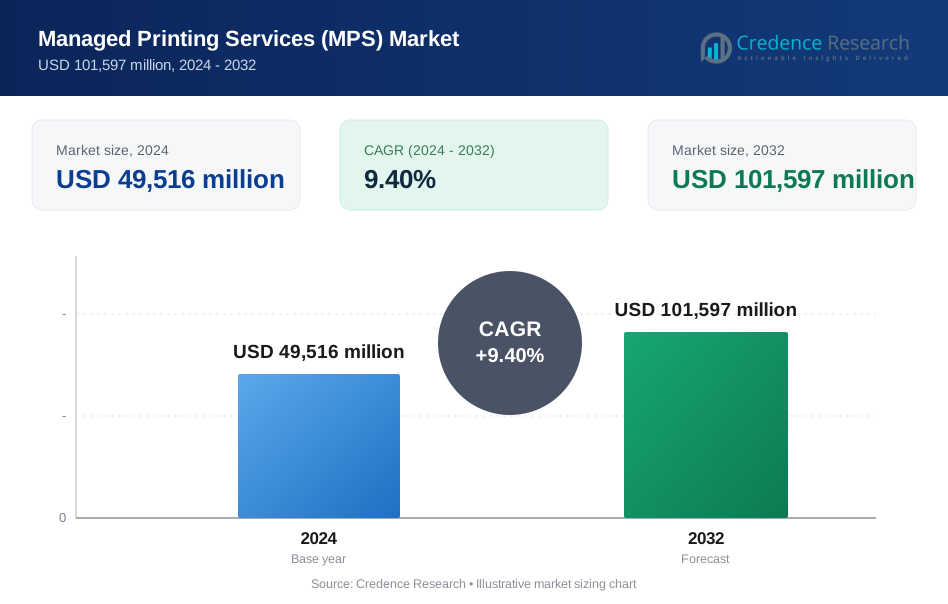
Managed Print Service Market size was valued at USD 49516 million in 2024 and is anticipated to reach USD 101597 million by 2032, at a CAGR of 9.4% during the forecast period (2024-2032).
| REPORT ATTRIBUTE | DETAILS |
|---|---|
| Historical Period | 2020-2023 |
| Base Year | 2024 |
| Forecast Period | 2025-2032 |
| Managed Print Service Market Size 2024 | USD 49516 million |
| Managed Print Service Market, CAGR | 9.4% |
| Managed Print Service Market Size 2032 | USD 101597 million |
Key drivers fueling the MPS market include rising concerns over document security, growing demand for workflow efficiency, and increasing efforts to reduce paper waste and carbon footprints. Enterprises are increasingly outsourcing print infrastructure management to specialized providers to reduce hardware investments and maintenance costs. Moreover, the shift toward hybrid work environments has elevated the need for secure, mobile, and flexible printing solutions. Technological advancements such as predictive analytics, IoT-enabled devices, and AI-driven fleet management are further enhancing the value proposition of managed print services. The growing focus on data governance and compliance is also encouraging organizations to adopt secure and auditable print solutions. As sustainability becomes a boardroom priority, MPS offers a measurable path toward greener operations.
Regionally, North America holds a dominant position in the MPS market, driven by the presence of major providers, high adoption of advanced technologies, and a strong focus on cost efficiency among enterprises. Europe follows closely, fueled by regulatory pressure for environmental sustainability and the widespread adoption of digitized office practices. Meanwhile, the Asia-Pacific region is expected to witness the fastest growth due to rapid industrialization, expanding SMB sector, and increasing awareness of print optimization benefits. Government digitization initiatives and rising adoption of cloud IT services are accelerating MPS deployments in emerging markets. Local vendors are also entering partnerships with global providers to offer tailored solutions at competitive pricing.
Market Insights:
- The Managed Print Service Market was valued at USD 49,516 million in 2024 and is projected to reach USD 101,597 million by 2032, growing at a CAGR of 9.4% during the forecast period.
- Rising document security concerns, growing workflow optimization needs, and pressure to reduce carbon footprints are key drivers accelerating MPS adoption across enterprises.
- Organizations are outsourcing print infrastructure to cut hardware costs, minimize maintenance, and access advanced analytics and automated fleet management tools.
- Cloud-based MPS solutions are enabling secure, mobile, and remote printing capabilities, supporting hybrid work environments and increasing operational flexibility.
- Sustainability objectives are driving demand for green printing practices, with businesses using MPS to track energy consumption, enforce print limits, and align with ESG targets.
- High implementation costs and integration complexities with legacy systems continue to challenge MPS adoption, particularly among small and mid-sized enterprises.
- North America leads the market with 37% share, followed by Europe at 29%, while Asia-Pacific is the fastest-growing region with 22%, driven by digitization and IT infrastructure expansion.
Market Drivers:
Increasing Focus on Cost Efficiency and Operational Optimization
Enterprises are prioritizing solutions that streamline operations and lower costs. The Managed Print Service Market is gaining traction because it enables organizations to reduce capital expenditure on hardware and consumables. Businesses are shifting from traditional print setups to managed services to cut down on energy consumption, print volumes, and maintenance costs. MPS providers offer tools that monitor usage patterns, optimize print fleets, and automate supply replenishment. This structured approach minimizes waste and enhances operational control. Companies benefit from predictable monthly billing models, which simplify budgeting and financial planning.
Rising Demand for Secure and Compliant Printing Infrastructure
Data security is becoming a critical concern across all sectors. The Managed Print Service Market addresses these concerns by offering secure printing solutions with authentication protocols, encrypted transmissions, and audit trails. Industries dealing with sensitive data-such as healthcare, finance, and legal-require compliant document workflows. MPS vendors integrate security features that help businesses meet regulatory standards and prevent data leaks. Centralized print management helps IT teams track and control user access to sensitive files. These features make MPS a strategic tool for ensuring information governance.
- For instance, Ricoh’s Secure Printing Solution for Government enables centralized print management and device access controls, ensuring only authorized workers can print and retrieve sensitive documents, which supports regulatory mandates for safeguarding personally identifiable information in government offices.
Growing Adoption of Cloud-Based and Mobile Printing Solutions
With hybrid work environments becoming mainstream, organizations seek agile and location-independent printing capabilities. The Managed Print Service Market supports this shift by enabling cloud-based print management and mobile access. Employees can securely print documents from any device, regardless of physical location. This flexibility boosts productivity and ensures continuity in remote or distributed work settings. Integration with cloud platforms also enhances scalability and remote monitoring. Businesses value this adaptability in an increasingly digital workplace.
- For instance, Pfizer achieved savings of $4 million after migrating its print infrastructure to a cloud-based environment, eliminating more than 130 print servers.
Sustainability Goals Driving Demand for Green Print Solutions
Environmental responsibility is influencing IT investment decisions. The Managed Print Service Market supports corporate sustainability goals by reducing paper consumption, energy usage, and hardware obsolescence. MPS providers offer tools to track environmental impact and enforce duplex printing, print quotas, and device consolidation. Companies use these insights to align print operations with ESG targets. It promotes long-term sustainability while supporting operational efficiency. This dual benefit positions MPS as a critical component of responsible enterprise IT strategy.
Market Trends:
Integration of Analytics, Artificial Intelligence, and IoT for Enhanced Print Optimization
Technology integration is reshaping the Managed Print Service Market by introducing intelligent automation and predictive capabilities. Businesses are adopting MPS solutions that incorporate analytics to monitor print behavior and identify inefficiencies in real-time. Artificial intelligence is enabling predictive maintenance, reducing device downtime, and improving resource allocation. IoT-enabled printers and multifunction devices are supporting remote diagnostics and usage tracking. These advancements allow service providers to offer proactive support and tailored print strategies. It strengthens the value proposition of MPS by aligning print infrastructure with broader digital transformation initiatives. Organizations are leveraging data-driven insights to reduce waste, lower costs, and enhance service levels.
- For instance, Xerox Corporation implemented IoT-enabled printers that captured 750 real-time data points daily, leading to enhanced predictive maintenance and reduced downtime.
Expansion of Cloud-First Strategies and Hybrid Work Support
The shift to hybrid work models is accelerating cloud adoption across enterprises, impacting the Managed Print Service Market significantly. Businesses are implementing cloud-based MPS platforms to allow secure, location-agnostic print access for remote and mobile employees. This trend is driving demand for software-defined print environments that integrate with collaboration tools and enterprise cloud systems. MPS solutions are evolving to support device-agnostic printing, user authentication, and centralized control across distributed workforces. It enables organizations to maintain productivity and document security beyond traditional office settings. The rise of virtual desktop infrastructure and remote IT support is further reinforcing the shift toward cloud-first print services. This trend reflects a growing need for scalable, flexible, and secure print infrastructure in the modern workplace.
- For instance, BIG W, an Australian retailer, successfully migrated its print environment to PaperCut Mobility Print across all 176 stores, supporting 20,000 users and achieving 500,000 print jobs with zero failures after the transition to cloud-based printing.
Market Challenges Analysis:
High Implementation Costs and Complexity in Integration with Existing Systems
Many organizations hesitate to adopt managed print services due to the initial investment required for infrastructure overhaul and integration. The Managed Print Service Market faces resistance from companies with legacy systems and limited IT budgets. Aligning new MPS platforms with existing document workflows and enterprise applications can be complex and resource-intensive. It often requires tailored solutions, system customization, and staff training. Smaller enterprises may lack the technical capabilities to manage this transition effectively. These challenges slow adoption rates and limit market penetration in cost-sensitive sectors.
- For instance, the City of Fort Worth, Texas, integrated MPS with its document management systems to automate routing and digitize documents, resulting in reduced paper usage and increased efficiency.
Data Security Concerns and Regulatory Compliance Barriers
Security remains a critical concern, especially for sectors handling confidential or regulated data. The Managed Print Service Market must address fears related to data breaches, network vulnerabilities, and unauthorized access. Businesses expect end-to-end encryption, user authentication, and strict access controls, which not all providers consistently deliver. It creates hesitation among enterprises operating under strict compliance mandates such as HIPAA or GDPR. Ensuring secure document transmission and storage requires continuous monitoring and adherence to evolving standards. This demand for high-level security increases the complexity and cost of service delivery, creating a barrier for providers and customers alike.
Market Opportunities:
Rising Demand from Small and Medium Enterprises in Emerging Markets
The growing digitization of small and medium enterprises presents a significant opportunity for the Managed Print Service Market. Many SMEs seek cost-effective, scalable solutions to manage their document infrastructure without large upfront investments. It enables these businesses to access advanced print management tools, reduce waste, and improve security. In emerging economies, rising internet penetration and government-led digital initiatives support MPS adoption. Vendors offering flexible pricing models and cloud-based platforms are well-positioned to capture this expanding customer base. Local partnerships and customized service offerings can further enhance market reach in underserved regions.
Expansion of Industry-Specific Solutions and Vertical Integration
Sector-specific MPS solutions are gaining traction across healthcare, education, manufacturing, and legal industries. The Managed Print Service Market can leverage this trend by tailoring offerings to meet unique regulatory, operational, and document handling requirements. It opens new revenue streams for providers that can deliver compliance-ready, workflow-optimized solutions. Vertical integration with content management and enterprise software platforms can enhance service value and customer retention. Growing demand for secure print environments in critical sectors also strengthens the case for specialized MPS packages. Companies that innovate around vertical needs can establish long-term relationships and competitive differentiation.
Market Segmentation Analysis:
By Channel:
By channel, the Managed Print Service Market is segmented into printer/copier manufacturers and channel partner/core MPS providers. Printer/copier manufacturers command a significant portion of the market, leveraging established hardware portfolios and service integration to offer end-to-end print solutions. Their ability to bundle equipment, software, and services strengthens client retention. Channel partners are expanding their footprint by delivering vendor-neutral, customized solutions with strong local support. It allows businesses to choose flexible service models and manage multi-brand device environments effectively. The growing preference for specialized providers is fueling healthy competition across both segments.
- For example, Ricoh's managed print service helped BDP International achieve estimated annual savings of $200,000 through optimized print operations and tailored workflow solutions.
By Deployment:
By deployment, the market includes on-premise and cloud-based models. On-premise deployment continues to serve industries with strict data sovereignty requirements, particularly in regulated sectors. However, cloud-based deployment is expanding rapidly due to its scalability, ease of access, and remote management capabilities. It supports mobile workforces and enables centralized oversight across locations. Businesses favor cloud models to reduce IT burden, improve cost efficiency, and ensure seamless updates. This shift reflects the increasing alignment of MPS with broader digital transformation goals.
By Enterprise Size:
By enterprise size, the Managed Print Service Market serves both large enterprises and SMEs. Large enterprises hold the dominant share, driven by their complex infrastructure and need for advanced analytics, automation, and compliance. SMEs are showing rising adoption, supported by cost-effective cloud offerings and simplified deployment models. It enables smaller organizations to access enterprise-grade print management without heavy capital investment. The market is evolving to meet diverse needs across business sizes, with scalable solutions designed for flexibility and long-term value.
- For example, Birmingham-based LG Davis implemented a comprehensive print management system with Advanced Services Group, enabling the company to assess client needs, provide fixed unit pricing, and manage stock, which freed up warehouse space and delivered measurable time and cost savings for their SME clients.
Segmentations:
By Channel:- Printer/Copier Manufacturers
- Channel Partners/Core MPS Providers
- On-Premise
- Cloud-Based
- Small and Medium-Sized Enterprises (SMEs)
- Large Enterprises
- BFSI
- Healthcare
- Education
- Legal
- Government
- Retail
- IT and Telecom
- Manufacturing
- Others
- North America
- U.S.
- Canada
- Mexico
- Europe
- Germany
- France
- U.K.
- Italy
- Spain
- Rest of Europe
- Asia Pacific
- China
- Japan
- India
- South Korea
- South-east Asia
- Rest of Asia Pacific
- Latin America
- Brazil
- Argentina
- Rest of Latin America
- Middle East & Africa
- GCC Countries
- South Africa
- Rest of the Middle East and Africa
Regional Analysis:
Strong Adoption and Technological Maturity in North America
North America holds 37% of the global Managed Print Service Market, maintaining its lead due to strong enterprise digitization and advanced IT infrastructure. The U.S. contributes the majority of this share, driven by widespread adoption of secure and automated document workflows. The region benefits from a high concentration of major MPS providers and consistent investment in digital transformation. Businesses across sectors use managed services to improve operational efficiency, reduce costs, and meet compliance requirements. It sees strong demand from government, healthcare, and education sectors, where secure printing is critical. Continuous upgrades in analytics and cloud-based platforms further solidify regional leadership.
Regulatory Compliance and Digital Transformation Fuel Growth in Europe
Europe accounts for 29% of the global Managed Print Service Market, supported by stringent data protection laws and accelerating digital transformation. Countries such as Germany, France, and the UK are leading adopters, prioritizing compliance-ready and sustainable print solutions. Enterprises across the region focus on reducing paper waste, improving productivity, and integrating secure mobile print services. It is also benefiting from the hybrid work culture that demands flexible, remote-access printing infrastructure. MPS vendors are expanding their offerings with cloud support and industry-specific solutions to meet evolving needs. The region’s emphasis on environmental sustainability aligns well with managed print service models.
Accelerating Digitization and Infrastructure Expansion Drive Asia-Pacific Growth
Asia-Pacific holds 22% of the global Managed Print Service Market and is experiencing the fastest growth among all regions. Rapid industrial development, rising IT investments, and government digitalization initiatives are fueling adoption. Countries like China, India, and Japan are key contributors due to expanding business sectors and increasing awareness of print optimization benefits. It is gaining momentum as enterprises seek scalable, cloud-enabled print solutions with strong data security. Local service providers and global vendors are forming strategic alliances to penetrate underserved markets. Customized offerings and affordable service models are driving adoption across small and medium businesses.
Key Player Analysis:
- Sharp Corporation
- HP Inc.
- Canon Inc.
- Xerox Corporation
- Toshiba Tec Corporation
- Ricoh Company, Ltd.
- Konica Minolta, Inc.
- Lexmark International, Inc.
- Brother Industries, Ltd.
- Kyocera Document Solutions Inc.
Competitive Analysis:
The Managed Print Service Market features a competitive landscape led by global players such as HP Inc., Xerox Corporation, Canon Inc., Ricoh Company Ltd., and Konica Minolta. These companies offer comprehensive service portfolios that integrate hardware, software, and support to optimize print environments. The Managed Print Service Market is witnessing increased competition from regional providers and specialized firms that offer flexible, cloud-based, and cost-effective solutions. It encourages innovation in security features, analytics integration, and sustainability initiatives. Key players are investing in AI-driven fleet management, IoT-enabled devices, and predictive maintenance to enhance operational efficiency. Strategic partnerships, acquisitions, and service customization remain core tactics to expand market share and strengthen customer relationships. The ability to support hybrid work models, address compliance needs, and offer scalable services is becoming a key differentiator. As demand grows across enterprise sizes, the market continues to attract new entrants seeking niche opportunities and underserved client segments.
Recent Developments:
- In June 2025, HP launched its latest AI PCs for business users, including the EliteBook X, EliteBook Ultra (announced at CES 2025 in January), and EliteBook 8 (unveiled at HP Amplify in March).
- In June 2025, Ricoh launched the RICOH360 THETA A1, a rugged 360° camera designed for professional use in challenging environments such as construction and industry.
- In May 2025, Ricoh announced the development of a new high-strength, full-color 3D inkjet printing technology, targeting custom manufacturing in sectors like dentistry and eyewear.
Market Concentration & Characteristics:
The Managed Print Service Market is moderately concentrated, with a mix of global corporations and regional specialists shaping its competitive structure. Large vendors such as HP, Xerox, and Ricoh dominate through integrated service offerings and long-term enterprise contracts. It features high entry barriers due to the need for technological expertise, infrastructure, and client trust. The market is characterized by recurring revenue models, strong vendor-client relationships, and a growing emphasis on security, cloud integration, and sustainability. Demand spans across industries, with both large enterprises and SMEs adopting scalable solutions. Service customization, rapid deployment, and analytics-driven insights are critical to vendor differentiation. The market continues to evolve with a shift toward mobile accessibility and hybrid work support.
Report Coverage:
The research report offers an in-depth analysis based on Channel, Deployment, Enterprise Size, End-Use and Region. It details leading market players, providing an overview of their business, product offerings, investments, revenue streams, and key applications. Additionally, the report includes insights into the competitive environment, SWOT analysis, current market trends, as well as the primary drivers and constraints. Furthermore, it discusses various factors that have driven market expansion in recent years. The report also explores market dynamics, regulatory scenarios, and technological advancements that are shaping the industry. It assesses the impact of external factors and global economic changes on market growth. Lastly, it provides strategic recommendations for new entrants and established companies to navigate the complexities of the market.
Future Outlook:
- Expect continued advancement in AI and predictive maintenance tools that enhance device uptime and optimize service efficiency.
- Cloud-native print platforms will support seamless management across multiple office locations and remote workers.
- Vendors will incorporate advanced security protocols, including zero-trust and end-to-end encryption, to meet strict regulatory demands.
- Greater integration with enterprise platforms such as document management, ERP, and collaboration tools will enhance workflow automation.
- Sustainability metrics and carbon reporting will become standard components of MPS offerings.
- Mobile-friendly print solutions will expand to support a growing remote and field-based workforce.
- Subscription-based and pay-per-use models will grow in popularity, offering cost flexibility and predictable budgeting.
- Increased adoption among SMEs in emerging economies will drive demand for scalable, cloud-based models.
- Regional providers will offer localized services through strategic alliances with global vendors.
- Expansion of industry-specific MPS packages will enable vendors to address unique compliance and workflow requirements.
Request a Free Sample
Fill in your details and we'll send you a free sample report.
- Sample data tables & charts
- Research methodology
Need a Custom Version of This Report?
Tailor the scope, geography, or segments to your exact requirements.
- Custom geography or segment scope
- Direct access to our analyst team
Frequently Asked Questions
What is the size of Managed Printing Services (MPS) Market?
What are the key segments within the Managed Print Service Market?
Who are the major players in this market?
Table of Content
Chapter 1. Report Introduction
- 1.1 Report Description & Purpose
- 1.1.1 Report Title & Market Definition
- 1.1.2 Unique Selling Propositions (USP) & Key Differentiators
- 1.1.3 Value Proposition for Stakeholders
- 1.2 Research Objectives
- 1.2.1 Market Sizing Objectives (Volume & Revenue) (Volume Where Applicable)
- 1.2.2 Segmentation Objectives
- 1.2.3 Competitive Intelligence Objectives
- 1.2.4 Forecast & Scenario Objectives
- 1.3 Report Scope
- 1.3.1 Managed Printing Services (MPS) Scope – Segments & Subsegments Covered
- 1.3.2 Geographic Scope – Regions & Countries Covered
- 1.3.3 Historical Period, Base Year & Forecast Period (2024; forecast to 2032)
- 1.3.4 Inclusions & Exclusions
- 1.4 Industry Classification & Applicable Codes
- 1.5 Currency, Measurement Units & Valuation Basis
- 1.6 Target Stakeholders
- 1.7 Limitations & Assumptions
Chapter 2. Executive Summary
- 2.1 Global Managed Printing Services (MPS) Market Snapshot
- 2.1.1 Market Size – Historical (2024) & Forecast (2024-2032) (2024: USD 49,516 million → 2032: USD 101,597 million)
- 2.1.2 Volume & Revenue – Global Totals (Volume Where Applicable)
- 2.1.3 Key Market Highlights – Top Five Facts
- 2.2 Managed Printing Services (MPS) Market Segmentation Snapshot
- 2.2.1 Market Split by Region – 2024 vs. 2032
- 2.3 Competitive Snapshot
- 2.3.1 Top 10 Players by Revenue Share – 2024
- 2.3.2 Top 10 Players by Volume Share – 2024 (Volume Where Applicable)
- 2.3.3 Recent Strategic Developments (18-Month Summary)
- 2.4 Key Investment Highlights & Strategic Conclusions
Chapter 3. Managed Printing Services (MPS) Market Dynamics & Industry Analysis
- 3.1 Market Overview & Context
- 3.1.1 Managed Printing Services (MPS) Market Position in the Broader Industry Value Chain
- 3.1.2 Demand Structure & Purchasing Dynamics
- 3.1.3 Market Maturity & Development Stage by Region
- 3.2 Managed Printing Services (MPS) Market Drivers
- 3.3 Managed Printing Services (MPS) Market Restraints & Challenges
- 3.4 Managed Printing Services (MPS) Market Opportunities
- 3.5 Porter's Five Forces Analysis
- 3.5.1 Threat of New Entrants
- 3.5.2 Bargaining Power of Suppliers
- 3.5.3 Bargaining Power of Buyers
- 3.5.4 Threat of Substitutes
- 3.5.5 Competitive Rivalry – Intensity Assessment
- 3.6 Managed Printing Services (MPS) Value Chain Analysis
- 3.6.1 Upstream – Key Inputs, Resources & Suppliers
- 3.6.1.1 Key Input/Resource 1
- 3.6.1.2 Key Input/Resource 2
- 3.6.1.3 Key Input/Resource 3
- 3.6.2 Midstream – Core Operations & Value Creation
- 3.6.2.1 Operating Model & Process Overview
- 3.6.2.2 Key Operating Locations & Capabilities by Company
- 3.6.3 Downstream – Market Channels & End Users
- 3.6.3.1 Direct Sales & Customer Engagement Channels
- 3.6.3.2 Indirect Sales, Intermediaries & Partner Channels
- 3.6.4 Value Chain Profitability Analysis
- 3.6.1 Upstream – Key Inputs, Resources & Suppliers
- 3.7 PESTEL Analysis
- 3.7.1 Political Factors
- 3.7.2 Economic Factors
- 3.7.3 Social Factors
- 3.7.4 Technological Factors
- 3.7.5 Environmental Factors
- 3.7.6 Legal Factors
- 3.8 Managed Printing Services (MPS) Supply Chain Analysis
- 3.8.1 Critical Input & Resource Availability Risk Assessment
- 3.8.2 Supplier & Operational Concentration Risk (Geographic Exposure)
- 3.8.3 Supply & Service Disruption Impact Analysis
- 3.9 Regulatory & Policy Landscape
Note: The regulatory and policy landscape section covers regulations based on their applicability to the market, Managed Printing Services (MPS) category, geography, and scope of the study. Only regulatory frameworks with a material impact on operations, compliance, trade, sustainability, or market access are analyzed in detail.
Chapter 4. Key Investment Pockets & Opportunity Analysis
- 4.1 Managed Printing Services (MPS) Market Attractiveness Analysis
- 4.1.1 By Region – Investment Attractiveness Matrix (Market Size × CAGR)
- 4.2 Absolute Revenue Growth Opportunity
- 4.2.1 By Region – Absolute Revenue Growth Through 2032
- 4.3 Incremental Demand Opportunity
- 4.3.1 By Region – Incremental Demand Through 2032
- 4.3.2 Segment – Incremental Demand
- 4.4 Emerging Submarket Opportunity Deep Dive (Subject to Applicability)
- 4.5 Priority Market Opportunity Scorecards
- 4.5.1 United States
- 4.5.2 Europe
- 4.5.3 Asia
- 4.5.4 Middle East & Africa
Note: Priority market opportunity scorecards reflect the geographic scope and strategic relevance of the study. Listed markets are indicative and may be adapted to the industry.
Chapter 5. Managed Printing Services (MPS) Cross-Border Trade & Market Access Analysis
- 5.1 International Trade & Cross-Border Activity Overview
- 5.1.1 Global Export Value by Country (2024)
- 5.1.2 Global Export Volume by Country (2024) (Volume Where Applicable)
- 5.1.3 Global Import Value by Country (2024)
- 5.1.4 Global Import Volume by Country (2024) (Volume Where Applicable)
- 5.1.5 Net Trade Balance by Country (2024)
- 5.2 Export Analysis – Segment
- 5.2.1 Category 1 (Applicable Classification Code)
- 5.2.2 Category 2 (Applicable Classification Code)
- 5.2.3 Category 3 (Applicable Classification Code)
- 5.2.4 Category 4 (Applicable Classification Code)
- 5.2.5 Category 5 (Applicable Classification Code)
- 5.3 Import Analysis – Segment
- 5.3.1 Category 1 (Applicable Classification Code)
- 5.3.2 Category 2 (Applicable Classification Code)
- 5.3.3 Category 3 (Applicable Classification Code)
- 5.3.4 Category 4 (Applicable Classification Code)
- 5.3.5 Category 5 (Applicable Classification Code)
- 5.4 Cross-Border Pricing & Transaction Benchmarks
- 5.4.1 Export Pricing – Segment & Country
- 5.4.2 Import Pricing – Segment & Source Country
- 5.4.3 Price Trends (2024)
- 5.5 Key Cross-Border Trade & Delivery Routes
- 5.5.1 Cross-Border Trade/Delivery Route 1
- 5.5.2 Cross-Border Trade/Delivery Route 2
- 5.5.3 Cross-Border Trade/Delivery Route 3
- 5.5.4 Cross-Border Trade/Delivery Route 4
- 5.5.5 Cross-Border Trade/Delivery Route 5
- 5.6 Trade Policy & Market Access Impact Assessment
- 5.6.1 Tariff & Non-Tariff Barriers
- 5.6.2 Regional Trade & Economic Integration Frameworks
- 5.6.3 Bilateral & Multilateral Trade Agreements
- 5.6.4 Cross-Border Operating, Licensing & Localization Requirements
Note: This chapter applies where cross-border trade or delivery is relevant to Managed Printing Services (MPS). Goods, services, and digital offerings are assessed using applicable classifications and transaction measures. Import-export volumes, trade balances, and route analyses are included only where meaningful to the market.
Chapter 6. Competitive Landscape & Company Benchmarking
- 6.1 Managed Printing Services (MPS) Market Concentration & Structure
- 6.1.1 Herfindahl-Hirschman Index (HHI) – vs. 2024
- 6.1.2 Leading, Mid-Sized & Emerging Player Structure
- 6.1.3 Global, Regional & Local Player Dynamics
- 6.2 Managed Printing Services (MPS) Market Share Analysis – 2024
- 6.2.1 Global Revenue Share by Company
- 6.2.2 Global Volume Share by Company (Volume Where Applicable)
- 6.2.3 Regional Revenue Share
- 6.2.4 Market Share Evolution ( vs. 2024)
- 6.2.5 Company Market Share by Key Segment
- 6.2.6 Company Market Share by Customer Group
- 6.3 Operating Scale, Capacity & Infrastructure Analysis
- 6.3.1 Global Operating Scale & Supply Capacity
- 6.3.2 Resource Utilization & Operating Efficiency
- 6.3.3 Output, Service Delivery & Activity Metrics
- 6.3.4 Operating Footprint & Infrastructure Map
- 6.3.5 Planned Operational & Capacity Expansion
- 6.4 Managed Printing Services (MPS) Competitive Benchmarking Matrix
- 6.4.1 Revenue, Growth, Profitability & Operating Metric Comparison
- 6.4.2 Channel Revenue Mix
- 6.4.3 Geographic Revenue Exposure
- 6.4.4 R&D Intensity
- 6.4.5 Sustainability Maturity
- 6.5 Strategic Developments in Managed Printing Services (MPS) (Last 24 Months)
- 6.5.1 Mergers, Acquisitions & Divestments
- 6.5.2 New Products, Services & Solutions in Managed Printing Services (MPS)
- 6.5.3 Operational & Infrastructure Expansions
- 6.5.4 Strategic Alliances, Joint Ventures & Partnerships
- 6.5.5 Distribution Expansion & Market Entry
- 6.5.6 Sustainability & ESG Initiatives
- 6.6 Competitive Strategy Mapping
- 6.6.1 Leader, Challenger, Follower & Niche Classification
- 6.6.2 Pricing Strategy Comparison
- 6.6.3 Channel Strategy Matrix
Note: Strategic developments are included based on their materiality and the availability of reliable information.
Chapter 7. Global Managed Printing Services (MPS) Market – By Sales & Delivery Channel
- 7.1 Segment Overview
- 7.1.1 Volume & Revenue Split by Channel (2024 & 2032) (Volume Where Applicable)
- 7.1.2 Channel Mix Evolution (2024-2032)
Chapter 8. Regional Market Analysis – Global Overview
- 8.1 Global Regional Overview
- 8.1.1 Regional Volume Share (Volume Where Applicable)
- 8.1.2 Regional Revenue Share
- 8.1.3 Regional Volume by Region (Volume Where Applicable)
- 8.1.4 Regional Revenue by Region
- 8.1.5 Regional Forecast Through 2032
- 8.2 Cross-Regional Segment Analysis
- 8.2.1 By Sales & Delivery Channel
- 8.2.2 By Competitive Positioning & Price Tier
Chapter 9. North America Managed Printing Services (MPS) Market
- 9.1 United States
- 9.2 Canada
- 9.3 Mexico
Chapter 10. Europe Managed Printing Services (MPS) Market
- 10.1 Germany
- 10.2 France
- 10.3 Italy
- 10.4 United Kingdom
- 10.5 Spain
- 10.6 Poland
- 10.7 Russia
- 10.8 Netherlands
- 10.9 Belgium
- 10.10 Sweden
- 10.11 Denmark
- 10.12 Norway
- 10.13 Rest of Europe
Chapter 11. Asia Pacific Managed Printing Services (MPS) Market
- 11.1 China
- 11.2 India
- 11.3 Japan
- 11.4 South Korea
- 11.5 Thailand
- 11.6 Indonesia
- 11.7 Vietnam
- 11.8 Malaysia
- 11.9 Australia
- 11.10 Rest of Asia Pacific
Chapter 12. Latin America Managed Printing Services (MPS) Market
- 12.1 Brazil
- 12.2 Argentina
- 12.3 Colombia
- 12.4 Chile
- 12.5 Rest of Latin America
Chapter 13. Middle East Managed Printing Services (MPS) Market
- 13.1 Saudi Arabia
- 13.2 United Arab Emirates
- 13.3 Turkey
- 13.4 Israel
- 13.5 Iran
- 13.6 Rest of the Middle East
Chapter 14. Africa Managed Printing Services (MPS) Market
- 14.1 South Africa
- 14.2 Egypt
- 14.3 Nigeria
- 14.4 Morocco
- 14.5 Rest of Africa
Chapter 15. Managed Printing Services (MPS) Company Profiles
- 15.1 [Company 01]
- 15.1.1 Company Overview
- 15.1.2 Key Management Personnel
- 15.1.3 Products & Services Portfolio
- 15.1.4 Financial Performance
- 15.1.5 Key Market Focus & Geographic Presence
- 15.1.6 Recent Developments & Strategic Initiatives
Note: The company profile list is preliminary and may change based on research findings, market developments, data availability, and client requirements.
Chapter 16. Appendices
- Appendix A – List of Abbreviations & Acronyms
- Appendix B – Industry Classification Code Reference – Full Series
- Appendix C – Supply, Output & Operating Capacity Data Tables
- Appendix D – End-Use & Demand Base Tables
- Appendix E – Demand, Adoption & Usage Assumptions
- Appendix F – Pricing & Revenue Metric Reference Tables
- Appendix G – Company Operations & Infrastructure Database
- Appendix H – Cross-Border Trade & Activity Data Tables (Where Applicable)
- Appendix I – Regulatory Summary Tables
- Appendix J – Primary Research Participant List (Anonymized)
- Appendix K – Primary Research Questionnaire Framework
- Appendix L – Data Sources & Bibliography
- Appendix M – Market Size Divergence & Source Comparison
Chapter 17. Research Methodology
- 17.1 Research Framework & Philosophy
- 17.2 Secondary Research – Sources, Hierarchy & Data Extraction
- 17.3 Data Modeling – Bottom-Up & Top-Down Market Sizing
- 17.4 Primary Research – Stakeholder Framework, LOI & Sample Sizes
- 17.5 Forecast Methodology – Regression, Scenario & Sensitivity Analysis
- 17.6 Quality Control – Four-Layer Validation Framework
- 17.7 Limitations & Standard Assumptions
- 17.8 Disclaimer
