
| REPORT ATTRIBUTE | DETAILS |
|---|---|
| Historical Period | 2019-2022 |
| Base Year | 2023 |
| Forecast Period | 2024-2032 |
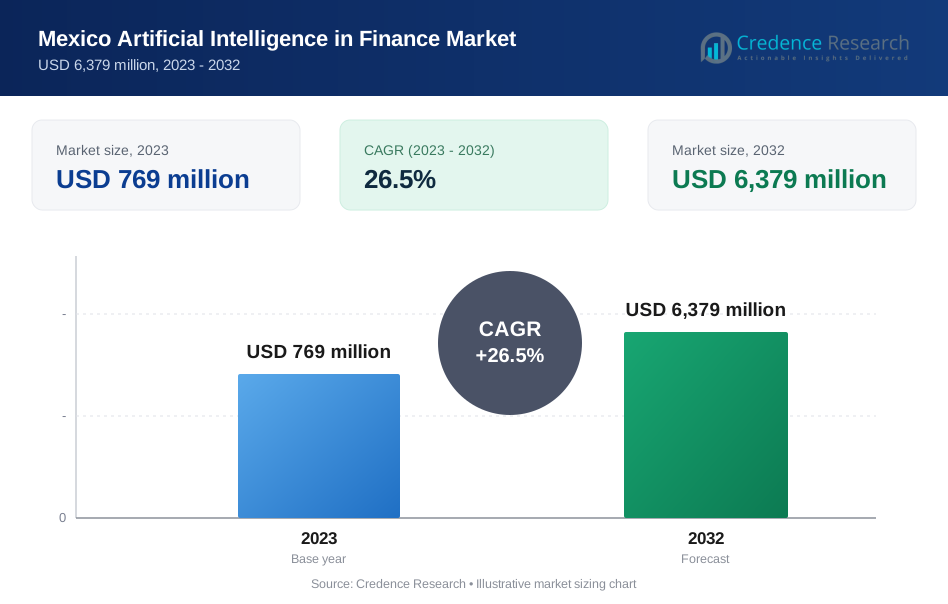
| Mexico AI in Finance Market Size 2023 | USD 769 million |
| Mexico AI in Finance Market, CAGR | 26.5% |
| Mexico AI in Finance Market Size 2032 | USD 6,379 million |
Market Overview
The Mexico AI in Finance Market is projected to grow from USD 769 million in 2023 to an estimated USD 6,379 million by 2032, with a compound annual growth rate (CAGR) of 26.5% from 2024 to 2032. The market’s robust growth is driven by increasing investment in artificial intelligence (AI) technologies, along with the growing adoption of AI-driven solutions by financial institutions to enhance operational efficiency, customer experience, and decision-making processes.
Several drivers are propelling the growth of the Mexico AI in finance market, including the rising demand for automation, fraud detection, and risk management within the financial services sector. The shift towards digitalization and data-driven decision-making is also accelerating AI adoption. In addition, the market is witnessing trends such as the implementation of AI-powered chatbots for customer service, predictive analytics for financial planning, and machine learning for improving compliance and security measures. These innovations are reshaping the landscape of financial services in Mexico.
Geographically, Mexico stands out as a leading player in Latin America, with significant growth potential in the AI in finance sector due to favorable government initiatives, digital transformation efforts, and increased investments in technology infrastructure. Key players in the market include global technology firms, financial institutions, and AI solution providers, with some of the prominent companies being IBM, Microsoft, and Intel, along with local startups driving innovation in AI applications for finance.
Market Insights
- The Mexico AI in Finance Market is projected to grow from USD 769 million in 2023 to USD 6,379 million by 2032, with a CAGR of 26.5% from 2024 to 2032.
- Key drivers include increased AI adoption for automation, fraud detection, risk management, and enhanced customer service in financial institutions.
- Data privacy concerns and a shortage of skilled AI professionals are significant challenges hindering market growth in Mexico.
- Mexico City leads the market, followed by Monterrey and Guadalajara, with significant contributions from emerging fintech ecosystems in secondary cities.
- AI technologies such as machine learning, predictive analytics, and AI-powered chatbots are transforming how financial institutions operate and serve customers.
- Favorable government initiatives and regulatory frameworks are driving investment in AI technologies, particularly in fintech and digital banking.
- AI is helping to improve credit scoring models, facilitating greater financial inclusion by offering services to underserved populations.
Market Drivers
Increasing Adoption of Artificial Intelligence for Automation in Financial Services
The growing need for operational efficiency in Mexico’s financial services sector is driving the adoption of AI solutions. Technologies such as machine learning, natural language processing, and robotic process automation (RPA) are being utilized to automate manual processes, reduce errors, and optimize workflows. By integrating AI, financial institutions can enhance the speed and accuracy of tasks like data entry, transaction processing, compliance monitoring, and fraud detection. For instance, Banorte has implemented AI-driven chatbots to handle customer inquiries, reducing response times and improving satisfaction. This shift enables higher productivity, cost reduction, and improved service quality while allowing operations to scale without proportional increases in workforce size. Automation has thus become a pivotal driver of market growth in Mexico’s financial sector.
Demand for Enhanced Fraud Detection and Security Measures
As the financial industry increasingly adopts digital platforms, the risk of cyber threats and fraud has grown significantly. AI plays a crucial role in enhancing fraud detection through advanced algorithms that analyze vast amounts of data in real-time to identify anomalies indicative of fraudulent activity. For instance, Citibanamex uses AI for real-time fraud detection by analyzing transaction patterns to safeguard customer assets and maintain trust. Additionally, technologies like biometric verification and predictive analytics empower financial institutions to bolster cybersecurity measures and ensure regulatory compliance. This heightened focus on fraud prevention is a key factor accelerating the adoption of AI in Mexico’s financial sector.
Shift Towards Data-Driven Decision Making
In today’s financial ecosystem, data is an invaluable asset for driving business decisions, personalizing offerings, and improving customer engagement. AI-driven analytics tools enable financial institutions to analyze structured and unstructured data at scale, generating actionable insights. For instance, Kueski leverages AI to assess creditworthiness using alternative data sources, allowing it to extend credit to individuals without traditional credit scores and promote financial inclusion. By utilizing AI for credit scoring, risk assessment, and market trend predictions, banks and insurers can offer tailored products while staying competitive in a fast-evolving market. This data-driven approach empowers institutions to make informed decisions critical for growth.
Government Initiatives and Regulatory Support
Government initiatives and regulatory support have been instrumental in fostering AI adoption in Mexico’s financial sector. Policies like the Mexican Financial Technology Law (Ley Fintech) provide a legal foundation for fintech companies to operate while encouraging innovation in digital banking and cybersecurity. For instance, the National Digital Strategy includes efforts such as establishing the Mexican Agency for the Development of Artificial Intelligence to promote AI research and ethical guidelines. These initiatives create an enabling environment for financial institutions to adopt cutting-edge AI technologies that improve efficiency and compliance. Such regulatory measures are pivotal in driving market growth by building trust and transparency in the financial system.
Market Trends
Widespread Adoption of AI-Powered Chatbots and Virtual Assistants
One of the most significant trends in the Mexico AI in finance market is the increasing adoption of AI-powered chatbots and virtual assistants by financial institutions. With customers demanding faster and more personalized services, AI-driven chatbots have emerged as an efficient solution to meet these expectations. These chatbots, powered by natural language processing (NLP) and machine learning algorithms, can handle a wide range of customer queries, assist in transaction processing, and even offer personalized financial advice. For instance, BBVA Bancomer, Mexico's largest financial institution, has launched a virtual assistant that allows clients to interact with the bank via WhatsApp. This assistant provides personalized financial advice and efficiently handles customer queries, showcasing how AI can enhance customer experience. In Mexico, leading banks, insurance companies, and fintech firms are implementing such AI solutions to provide round-the-clock service, reduce wait times, and improve response accuracy. Chatbots are being used for functions like account management, loan assistance, fraud detection, and policy information retrieval. As customers increasingly interact with digital platforms, AI-powered virtual assistants are becoming essential in streamlining communication and improving overall satisfaction. This trend highlights the growing importance of AI in delivering seamless and efficient financial services.
AI in Risk Management and Predictive Analytics
Predictive analytics, powered by AI, is revolutionizing how financial institutions in Mexico assess and manage risks. By using advanced machine learning algorithms, financial institutions can identify potential risks, forecast market trends, and predict financial outcomes with greater accuracy. For example, Citi® Bank employs artificial intelligence to analyze the financial statements of companies during the approval process for corporate loans. This approach enhances the accuracy of credit risk assessments by analyzing vast amounts of data from various sources—such as transaction history and payment behavior—to determine the likelihood of defaults. Additionally, AI models are being used to detect anomalies in transactions and predict potential risks proactively. In investment management, predictive models analyze market data to enable financial analysts to make more informed decisions while reducing portfolio risks. This data-driven approach provides more reliable risk assessments compared to traditional methods. The trend towards AI-driven predictive analytics is allowing financial institutions in Mexico to manage risks more effectively, reduce losses, and improve profitability. By leveraging these technologies, institutions are not only safeguarding their operations but also enhancing their ability to adapt to dynamic market conditions.
Integration of AI in Compliance and Regulatory Reporting
Regulatory compliance is becoming an increasingly complex challenge for financial institutions due to stringent regulatory requirements and evolving laws. As financial institutions in Mexico navigate this landscape, AI has become a vital tool for ensuring compliance and streamlining regulatory reporting processes. For instance, Bajaware—a leading RegTech company in Mexico—automates the generation of regulatory reports for financial institutions. This helps clients comply with local regulations efficiently by leveraging AI technologies such as machine learning and natural language processing (NLP). These tools automate monitoring transactions, analyzing large volumes of legal documents, and flagging potential violations like anti-money laundering (AML) activities. Furthermore, AI assists in managing Know Your Customer (KYC) requirements by automating identity verification and validating customer information in real time. This automation reduces human error while accelerating compliance processes. By adopting AI-driven compliance tools, financial institutions can stay ahead of regulatory demands while mitigating risks associated with non-compliance. As regulatory requirements continue to evolve in Mexico’s financial sector, the integration of AI ensures greater operational efficiency and helps institutions avoid penalties.
Rise of AI-Driven Personalization and Customer-Centric Financial Products
Another important trend in the Mexico AI in finance market is the shift towards personalized financial services driven by AI technologies. In an era where customers expect tailored experiences, financial institutions are increasingly using AI to analyze customer data and offer customized products. For example, Ualá utilizes AI models to determine product attractiveness for both active and inactive clients by analyzing past transactional behavior. This enables them to tailor marketing strategies effectively while meeting unique customer needs. By leveraging advanced algorithms, banks and insurance companies can analyze transaction history, spending patterns, financial goals, and even social media activity to develop personalized offerings such as customized loan options or investment strategies. Moreover, AI helps predict customer needs before they arise—allowing institutions to proactively offer relevant solutions or products. Dynamic pricing models powered by AI also adjust based on a customer's risk profile or payment history. This trend towards personalization enhances customer satisfaction by delivering tailored experiences that foster loyalty and retention. As demand for personalized services grows in Mexico’s finance sector, AI is playing a critical role in transforming how products are designed and delivered for maximum impact.
Market Challenges
Data Privacy and Security Concerns
One of the key challenges facing the Mexico AI in finance market is the increasing concerns around data privacy and security. As AI systems require vast amounts of data to function effectively, financial institutions must ensure they adhere to stringent data protection regulations, such as Mexico’s Federal Law on the Protection of Personal Data Held by Private Parties (LFPDPPP). With the growing reliance on AI for customer-facing applications, including chatbots, credit scoring, and fraud detection, the risk of data breaches or misuse of sensitive customer information becomes a critical issue. Financial institutions need to invest heavily in cybersecurity measures and secure data infrastructure to safeguard against potential threats. Any lapse in data security can result in financial losses, reputational damage, and legal consequences. Additionally, the challenge of ensuring AI algorithms comply with privacy laws while maintaining their effectiveness is a significant hurdle for businesses. The Mexican market, like many others, faces the need to balance the use of data for AI innovation with the responsibility of protecting customer information, making data privacy a pressing challenge for AI adoption in the finance sector.
Lack of Skilled Workforce and AI Expertise
Another major challenge in the Mexico AI in finance market is the shortage of skilled professionals and AI expertise. Despite the increasing demand for AI-powered solutions, there remains a gap in the talent pool capable of designing, implementing, and maintaining AI systems within financial institutions. The complexity of AI technologies and the rapid pace of innovation require a workforce with specialized knowledge in machine learning, data science, and financial services. Mexico faces competition from global markets for top AI talent, which makes it challenging for local financial institutions to hire skilled personnel. The lack of skilled experts in AI also hampers the ability of financial institutions to effectively integrate AI technologies into their operations and fully realize their potential. To overcome this challenge, companies must invest in training and development programs to build in-house capabilities, while also partnering with universities and AI-focused startups to foster a sustainable talent pipeline in Mexico’s financial services industry.
Market Opportunities
Expansion of Fintech Ecosystem and Digital Transformation
The rapidly growing fintech ecosystem in Mexico presents a significant opportunity for AI adoption in the financial sector. As digital transformation accelerates across the country, financial institutions, including banks, insurance companies, and fintech startups, are increasingly turning to AI-driven solutions to enhance their service offerings. The rise of mobile banking, digital payment platforms, and peer-to-peer lending is driving demand for AI technologies to improve customer experience, streamline operations, and provide personalized financial services. AI can assist in automating processes, reducing operational costs, and enabling real-time decision-making, which is crucial for fintech companies looking to scale quickly. Additionally, the Mexican government’s positive stance on digital financial services and the establishment of regulations supporting fintech growth provide a favorable environment for innovation and investment in AI solutions. As the fintech market continues to grow, there is ample opportunity for AI solutions to play a central role in reshaping Mexico’s financial services landscape.
Enhancement of Credit Scoring and Financial Inclusion
Another key market opportunity lies in AI’s potential to enhance credit scoring models and drive financial inclusion in Mexico. Traditional credit scoring models in Mexico have often excluded individuals with limited credit histories, especially in rural areas or lower-income segments. AI can leverage alternative data sources—such as mobile phone usage, utility payments, and social media activity—to build more inclusive credit models that can accurately assess the creditworthiness of individuals and small businesses. By incorporating AI into these processes, financial institutions can offer more tailored and accessible financial products to underserved populations. This not only promotes financial inclusion but also opens up new markets for AI-driven financial services in Mexico, making it a vital opportunity for both traditional banks and emerging fintech players.
Market Segmentation Analysis
By Component
The market is divided into two main components: Solutions and Services. The Solutions segment includes software and platforms powered by AI technologies that enable financial institutions to automate processes, enhance customer service, and optimize decision-making. This segment is expected to dominate due to the growing demand for AI-driven applications such as fraud detection, risk management, and customer relationship management. On the other hand, the Services segment covers consulting, integration, and support services that assist financial institutions in deploying AI solutions effectively. This segment is growing as firms increasingly seek external expertise to integrate AI into their operations.
By Deployment Mode
The Deployment Mode segment is categorized into On-premise and Cloud solutions. Cloud-based AI solutions are experiencing significant growth due to their scalability, cost-effectiveness, and ease of access. With the rising adoption of cloud computing and the need for flexible, remote access to AI tools, the cloud deployment model is expected to dominate the market. On the other hand, On-premise AI solutions remain popular among large financial institutions that prioritize control over their data and systems. However, the trend is shifting towards cloud adoption, particularly among small and medium-sized enterprises (SMEs) seeking lower upfront costs.
Segments
Based on component
- Solution
- Services
Based on deployment mode
- On-premise
- Cloud
Based on technology
- Generative AI
- Other AI Technologies
Based on Application
- Virtual Assistant (Chatbots)
- Business Analytics and Reporting
- Fraud Detection
- Quantitative and Asset Management
- Others
Based on region
- Monterrey
- Guadalajara
- Queretaro
Regional Analysis
Mexico City (45-50%)
As the country’s financial and technological epicenter, Mexico City holds the largest market share in the AI in finance sector, accounting for approximately 45-50% of the total market. This region is home to the largest banks, fintech companies, insurance firms, and technology providers, making it the primary location for AI innovation and deployment. The concentration of financial institutions in Mexico City drives the adoption of AI solutions for fraud detection, customer service automation, and data analytics. Additionally, the presence of technology infrastructure, talent pools, and regulatory support accelerates the implementation of AI-driven financial services in this region.
Monterrey (20-25%)
Monterrey, the capital of Nuevo Leon, is another key region in the AI in finance market, with a market share of approximately 20-25%. As an industrial and commercial hub, Monterrey is attracting significant investments in the financial sector, particularly from fintech startups and mid-sized financial institutions. The region’s growing focus on digital transformation and its proximity to the U.S. market are contributing factors to its adoption of AI technologies. Monterrey’s market share is expected to increase as local companies and international players continue to expand their digital finance offerings, focusing on automation and customer-centric services.
Key players
- Zoho
- NVIDIA
- FIS
- HPE
- Oracle Corporation
- Microsoft Corporation
- IBM Corporation
- Google LLC
- AWS
- SAP SE
Competitive Analysis
The Mexico AI in finance market is highly competitive, with several prominent players dominating the landscape. Companies like Microsoft, IBM, Oracle, and SAP SE bring vast technological resources and AI expertise, offering advanced solutions in data analytics, risk management, and customer service automation. NVIDIA, known for its leading graphics processing units (GPUs), provides the computational power required for large-scale AI applications, particularly in financial modeling and data processing. Zoho and FIS, focusing on customer relationship management and financial solutions, are increasingly catering to the evolving needs of financial institutions through AI-driven products. Google LLC, AWS, and HPE stand out with their cloud-based AI solutions, enabling scalability and flexibility for financial institutions. These key players continue to innovate and collaborate with local financial organizations to deliver AI solutions that enhance operational efficiency, improve customer experiences, and ensure robust security, positioning themselves as dominant forces in the market.
Recent Developments
- In November 2024, Zoho launched "Zoho One Essentials" in Mexico, a streamlined version of its flagship business suite tailored for micro and small businesses. This offering aims to empower smaller enterprises with affordable AI-driven tools for managing their operations and finances. The solution is designed to help these businesses adopt digital transformation and enhance productivity in a cost-effective manner.
- Throughout 2024, NVIDIA strengthened its position in the AI market with advancements in hardware tailored for financial applications. Notably, it launched the Blackwell B100 and B200 GPUs, which significantly enhanced generative AI capabilities. These tools are particularly impactful for financial institutions in Mexico, enabling faster data processing and more accurate predictive analytics. NVIDIA also introduced the Jetson Orin Nano Super Developer Kit, making AI development accessible to smaller players in the finance sector.
- In Q3 2024, HPE reported substantial growth in its AI-driven solutions driven by its edge-to-cloud strategy. The company introduced new AI infrastructure programs that help financial institutions process data at the edge, reducing latency and accelerating workloads. These initiatives are expected to further support Mexico's financial sector as it adopts more scalable AI solutions.
- In December 2024, Oracle announced new generative AI capabilities within its Cloud ERP solutions. These innovations automate end-to-end finance processes, such as predictive forecasting and management reporting narratives. Oracle’s embedded AI tools are helping Mexican financial institutions optimize operations and improve decision-making efficiency.
- In September 2024, Microsoft committed $1.3 billion to expand Mexico's cloud and AI infrastructure over three years. This investment aims to enhance connectivity and promote AI adoption among small and medium-sized businesses (SMBs). Additionally, Microsoft launched an AI skills program targeting 5 million Mexicans and 30,000 SMBs to foster digital transformation across the country.
- In 2024 Banco Afirme partnered with IBM to enhance its digital banking services using IBM’s advanced AI technologies. This collaboration focuses on improving customer experience through automated processes like fraud detection and personalized financial recommendations.
- In November 2024, Google announced initiatives under its "Google for Mexico" program, including the use of generative AI for education and sustainable water management projects. Google also restructured its finance teams globally, including in Mexico City, to focus more on AI-driven innovations that support local businesses and economic growth.
Market Concentration and Characteristics
The Mexico AI in Finance Market is characterized by moderate to high market concentration, with a few major global players such as Microsoft, IBM, Oracle, and SAP SE dominating the landscape. These companies offer comprehensive AI-driven solutions across various segments, including fraud detection, risk management, and business analytics. However, the market also hosts a growing number of fintech startups and local players who are increasingly adopting AI to provide specialized and cost-effective solutions tailored to the unique needs of Mexico’s financial sector. The presence of both large multinational corporations and emerging local innovators creates a dynamic, competitive market characterized by rapid technological advancements, diverse product offerings, and the continuous evolution of AI applications in finance. This hybrid market structure fosters innovation while ensuring that AI solutions are accessible to a wide range of financial institutions, from large banks to smaller fintech firms.
Report Coverage
The research report offers an in-depth analysis based on Component, Deployment Mode, Technology, Application and Region. It details leading market players, providing an overview of their business, product offerings, investments, revenue streams, and key applications. Additionally, the report includes insights into the competitive environment, SWOT analysis, current market trends, as well as the primary drivers and constraints. Furthermore, it discusses various factors that have driven market expansion in recent years. The report also explores market dynamics, regulatory scenarios, and technological advancements that are shaping the industry. It assesses the impact of external factors and global economic changes on market growth. Lastly, it provides strategic recommendations for new entrants and established companies to navigate the complexities of the market.
Future Outlook
- The AI in finance market in Mexico is poised for accelerated growth, with a projected compound annual growth rate (CAGR) of 26.5% from 2024 to 2032. Financial institutions are expected to continue adopting AI technologies for automation, fraud detection, and personalized services.
- Virtual assistants and AI-powered chatbots will become integral to customer service operations, driving significant improvements in customer engagement and reducing operational costs for financial institutions.
- Financial institutions will increasingly leverage AI for advanced risk assessment, improving their ability to predict market trends and mitigate financial risks in real-time.
- Generative AI will play a larger role in creating personalized financial products and services, enabling banks and fintech firms to offer tailored solutions for individual customers.
- As regulatory requirements become more complex, AI tools for compliance automation will grow, helping financial institutions streamline regulatory reporting and enhance transparency.
- The demand for cloud-based AI solutions will continue to rise due to their scalability, cost-effectiveness, and accessibility, making AI-driven tools more affordable for smaller institutions and fintech startups.
- AI will increasingly be used to detect and prevent fraud, with advanced machine learning algorithms helping financial institutions identify suspicious activities and secure customer data more efficiently.
- The demand for personalized financial products will drive the adoption of AI for tailored services such as customized loans, insurance policies, and investment strategies, enhancing customer satisfaction.
- AI’s ability to leverage alternative data for credit scoring will enable greater financial inclusion, providing access to financial products for underserved populations in Mexico.
- Increased investment in AI infrastructure, both by the government and private sector, will support the ongoing growth and adoption of AI solutions in Mexico’s financial services industry, fostering innovation across the market.
Request a Free Sample
Fill in your details and we'll send you a free sample report.
- Sample data tables & charts
- Research methodology
Need a Custom Version of This Report?
Tailor the scope, geography, or segments to your exact requirements.
- Custom geography or segment scope
- Direct access to our analyst team
Frequently Asked Questions
What is the market size of the Mexico AI in Finance Market in 2023 and 2032?
What is the expected growth rate of the Mexico AI in Finance Market?
What are the key drivers of growth in the Mexico AI in Finance Market?
Which regions are contributing to the growth of the Mexico AI in Finance Market?
What role do global companies play in the Mexico AI in Finance Market?
Table of Content
Chapter 1. Report Introduction
- 1.1 Report Description & Purpose
- 1.1.1 Report Title & Market Definition
- 1.1.2 Unique Selling Propositions (USP) & Key Differentiators
- 1.1.3 Value Proposition for Stakeholders
- 1.2 Research Objectives
- 1.2.1 Market Sizing Objectives (Volume & Revenue)
- 1.2.2 Segmentation Objectives
- 1.2.3 Competitive Intelligence Objectives
- 1.2.4 Forecast & Scenario Objectives
- 1.3 Report Scope
- 1.3.1 Mexico Artificial Intelligence in Finance Scope – Types & Subtypes Covered
- 1.3.2 Geographic Scope – Regions & Countries Covered
- 1.3.3 Historical Period, Base Year & Forecast Period (2023; forecast to 2032)
- 1.3.4 Inclusions & Exclusions
- 1.4 HS Code & Classification Framework
- 1.5 Currency, Units & Pricing Basis
- 1.6 Target Stakeholders
- 1.7 Limitations & Assumptions
Chapter 2. Executive Summary
- 2.1 Global Mexico Artificial Intelligence in Finance Market Snapshot
- 2.1.1 Market Size – Historical (2023) & Forecast (2023-2032) (2023: USD 769 million → 2032: USD 6,379 million)
- 2.1.2 Volume & Revenue – Global Totals
- 2.1.3 Key Market Highlights – Top Five Facts
- 2.2 Mexico Artificial Intelligence in Finance Market Segmentation Snapshot
- 2.2.1 Market Split by Region – 2023 vs. 2032
- 2.3 Competitive Snapshot
- 2.3.1 Top 10 Players by Revenue Share – 2023
- 2.3.2 Top 10 Players by Volume Share – 2023
- 2.3.3 Recent Strategic Developments (18-Month Summary)
- 2.4 Key Investment Highlights & Strategic Conclusions
Chapter 3. Mexico Artificial Intelligence in Finance Market Dynamics & Industry Analysis
- 3.1 Market Overview & Context
- 3.1.1 Mexico Artificial Intelligence in Finance Market Position in the Broader Automotive Value Chain
- 3.1.2 OEM vs. Replacement Market Dynamics
- 3.1.3 Market Maturity & Development Stage by Region
- 3.2 Mexico Artificial Intelligence in Finance Market Drivers
- 3.3 Mexico Artificial Intelligence in Finance Market Restraints & Challenges
- 3.4 Mexico Artificial Intelligence in Finance Market Opportunities
- 3.5 Porter's Five Forces Analysis
- 3.5.1 Threat of New Entrants
- 3.5.2 Bargaining Power of Suppliers
- 3.5.3 Bargaining Power of Buyers
- 3.5.4 Threat of Substitutes
- 3.5.5 Competitive Rivalry – Intensity Assessment
- 3.6 Mexico Artificial Intelligence in Finance Value Chain Analysis
- 3.6.1 Upstream – Raw Material/Input Suppliers
- 3.6.1.1 Raw Material/Input 1
- 3.6.1.2 Raw Material/Input 2
- 3.6.1.3 Raw Material/Input 3
- 3.6.2 Midstream – Production/Manufacturing/Service Delivery
- 3.6.2.1 Production/Process Overview
- 3.6.2.2 Key Facility Locations & Capacity by Manufacturer
- 3.6.3 Downstream – Distribution & End Consumer
- 3.6.3.1 Primary Channel – B2B/OEM
- 3.6.3.2 Secondary Channels – Dealer, Retail, Online, Direct
- 3.6.4 Value Chain Profitability Analysis
- 3.6.1 Upstream – Raw Material/Input Suppliers
- 3.7 PESTEL Analysis
- 3.7.1 Political Factors
- 3.7.2 Economic Factors
- 3.7.3 Social Factors
- 3.7.4 Technological Factors
- 3.7.5 Environmental Factors
- 3.7.6 Legal Factors
- 3.8 Mexico Artificial Intelligence in Finance Supply Chain Analysis
- 3.8.1 Raw Material/Input Supply Risk Assessment
- 3.8.2 Manufacturing Concentration Risk (Geographic Exposure)
- 3.8.3 Trade Disruption Impact Analysis
- 3.9 Regulatory & Policy Landscape
Note: The regulatory and policy landscape section covers regulations based on their applicability to the market, Mexico Artificial Intelligence in Finance category, geography, and scope of the study. Only regulatory frameworks with a material impact on operations, compliance, trade, sustainability, or market access are analyzed in detail.
Chapter 4. Key Investment Pockets & Opportunity Analysis
- 4.1 Mexico Artificial Intelligence in Finance Market Attractiveness Analysis
- 4.1.1 By Region – Investment Attractiveness Matrix (Volume × CAGR)
- 4.2 Absolute Revenue Growth Opportunity
- 4.2.1 By Region – Absolute USD Growth Through 2032
- 4.3 Incremental Volume Opportunity
- 4.3.1 By Region – Incremental Volume Through 2032
- 4.3.2 Segment – Incremental Volume
- 4.4 Emerging Submarket Opportunity Deep Dive (Subject to Applicability)
- 4.5 Emerging Market Opportunity Scorecards
- 4.5.1 United States
- 4.5.2 Europe
- 4.5.3 Asia
- 4.5.4 Middle East & Africa
Note: Emerging Market Opportunity Scorecards will be included based on relevance and strategic importance. Regions listed are indicative and may vary depending on data availability and market dynamics.
Chapter 5. Mexico Artificial Intelligence in Finance Import-Export Analysis & Trade Flows
- 5.1 Global Trade Overview
- 5.1.1 Global Export Value by Country (2023)
- 5.1.2 Global Export Volume by Country (2023)
- 5.1.3 Global Import Value by Country (2023)
- 5.1.4 Global Import Volume by Country (2023)
- 5.1.5 Net Trade Balance by Country (2023)
- 5.2 Export Analysis – Segment
- 5.2.1 Type 1 (HS Code)
- 5.2.2 Type 2 (HS Code)
- 5.2.3 Type 3 (HS Code)
- 5.2.4 Type 4 (HS Code)
- 5.2.5 Type 5 (HS Code)
- 5.3 Import Analysis – Segment
- 5.3.1 Type 1 (HS Code)
- 5.3.2 Type 2 (HS Code)
- 5.3.3 Type 3 (HS Code)
- 5.3.4 Type 4 (HS Code)
- 5.3.5 Type 5 (HS Code)
- 5.4 Average Unit Trade Prices
- 5.4.1 Average Export Price – Segment & Country
- 5.4.2 Average Import Price – Segment & Source Country
- 5.4.3 Price Trends (2023)
- 5.5 Key Trade Route Analysis
- 5.5.1 Trade Route 1
- 5.5.2 Trade Route 2
- 5.5.3 Trade Route 3
- 5.5.4 Trade Route 4
- 5.5.5 Trade Route 5
- 5.6 Trade Policy Impact Assessment
- 5.6.1 US Anti-Dumping & Section 301 Tariffs
- 5.6.2 EU Customs Union Impact
- 5.6.3 Major Free Trade Agreements
- 5.6.4 USMCA Rules of Origin
Note: Trade policy analysis will be included only where relevant to the Mexico Artificial Intelligence in Finance market.
Chapter 6. Competitive Landscape & Company Benchmarking
- 6.1 Mexico Artificial Intelligence in Finance Market Concentration & Structure
- 6.1.1 Herfindahl-Hirschman Index (HHI) – vs. 2023
- 6.1.2 Tier 1, Tier 2 & Tier 3 Market Structure
- 6.1.3 Global, Regional & Local Player Dynamics
- 6.2 Mexico Artificial Intelligence in Finance Market Share Analysis – 2023
- 6.2.1 Global Revenue Share by Company
- 6.2.2 Global Volume Share by Company
- 6.2.3 Regional Revenue Share
- 6.2.4 Market Share Evolution ( vs. 2023)
- 6.2.5 OEM Segment Share by Company
- 6.2.6 Replacement Segment Share by Company
- 6.3 Production/Delivery Capacity & Facility Analysis
- 6.3.1 Global Installed Capacity
- 6.3.2 Capacity Utilization Rates
- 6.3.3 Production/Output Volume
- 6.3.4 Facility Locations & Capacity Map
- 6.3.5 Planned Capacity Additions
- 6.4 Mexico Artificial Intelligence in Finance Competitive Benchmarking Matrix
- 6.4.1 Revenue, Volume, CAGR & Profitability Comparison
- 6.4.2 Channel Revenue Mix
- 6.4.3 Geographic Revenue Exposure
- 6.4.4 R&D Intensity
- 6.4.5 Sustainability Maturity
- 6.5 Strategic Developments in Mexico Artificial Intelligence in Finance (Last 24 Months)
- 6.5.1 Mergers, Acquisitions & Divestments
- 6.5.2 New Mexico Artificial Intelligence in Finance Launches
- 6.5.3 Facility Expansions
- 6.5.4 Strategic Alliances, Joint Ventures & Partnerships
- 6.5.5 Distribution Expansion & Market Entry
- 6.5.6 Sustainability & ESG Initiatives
- 6.6 Competitive Strategy Mapping
- 6.6.1 Leader, Challenger, Follower & Niche Classification
- 6.6.2 Pricing Strategy Comparison
- 6.6.3 Channel Strategy Matrix
Note: Strategic developments are included based on their materiality and the availability of reliable information.
Chapter 7. Global Mexico Artificial Intelligence in Finance Market – By Distribution Channel
- 7.1 Segment Overview
- 7.1.1 Volume & Revenue Split by Channel (2023 & 2032)
- 7.1.2 Channel Mix Evolution (2023-2032)
Chapter 8. Regional Market Analysis – Global Overview
- 8.1 Global Regional Overview
- 8.1.1 Regional Volume Share
- 8.1.2 Regional Revenue Share
- 8.1.3 Regional Volume by Region
- 8.1.4 Regional Revenue by Region
- 8.1.5 Regional Forecast Through 2032
- 8.2 Cross-Regional Segment Analysis
- 8.2.1 By Distribution Channel
- 8.2.2 By Brand/Price Tier
Chapter 9. North America Mexico Artificial Intelligence in Finance Market
- 9.1 United States
- 9.2 Canada
- 9.3 Mexico
Chapter 10. Europe Mexico Artificial Intelligence in Finance Market
- 10.1 Germany
- 10.2 France
- 10.3 Italy
- 10.4 United Kingdom
- 10.5 Spain
- 10.6 Poland
- 10.7 Russia
- 10.8 Netherlands
- 10.9 Belgium
- 10.10 Sweden
- 10.11 Denmark
- 10.12 Norway
- 10.13 Rest of Europe
Chapter 11. Asia Pacific Mexico Artificial Intelligence in Finance Market
- 11.1 China
- 11.2 India
- 11.3 Japan
- 11.4 South Korea
- 11.5 Thailand
- 11.6 Indonesia
- 11.7 Vietnam
- 11.8 Malaysia
- 11.9 Australia
- 11.10 Rest of Asia Pacific
Chapter 12. Latin America Mexico Artificial Intelligence in Finance Market
- 12.1 Brazil
- 12.2 Argentina
- 12.3 Colombia
- 12.4 Chile
- 12.5 Rest of Latin America
Chapter 13. Middle East Mexico Artificial Intelligence in Finance Market
- 13.1 Saudi Arabia
- 13.2 United Arab Emirates
- 13.3 Turkey
- 13.4 Israel
- 13.5 Iran
- 13.6 Rest of the Middle East
Chapter 14. Africa Mexico Artificial Intelligence in Finance Market
- 14.1 South Africa
- 14.2 Egypt
- 14.3 Nigeria
- 14.4 Morocco
- 14.5 Rest of Africa
Chapter 15. Mexico Artificial Intelligence in Finance Company Profiles
- 15.1 [Company 01]
- 15.1.1 Company Overview
- 15.1.2 Key Management Personnel
- 15.1.3 Products & Services Portfolio
- 15.1.4 Financial Performance
- 15.1.5 Key Market Focus & Geographic Presence
- 15.1.6 Recent Developments & Strategic Initiatives
Note: The company profile list is preliminary and may change based on research findings, market developments, data availability, and client requirements.
Chapter 16. Appendices
- Appendix A – List of Abbreviations & Acronyms
- Appendix B – Industry Classification Code Reference – Full Series
- Appendix C – Production & Capacity Data Tables
- Appendix D – End-Use & Demand Base Tables
- Appendix E – Consumption & Replacement Rate Assumptions
- Appendix F – ASP Reference Tables
- Appendix G – Manufacturing & Facility Database
- Appendix H – Import-Export Data Tables
- Appendix I – Regulatory Summary Tables
- Appendix J – Primary Research Participant List (Anonymized)
- Appendix K – Primary Research Questionnaire Framework
- Appendix L – Data Sources & Bibliography
- Appendix M – Market Size Divergence & Source Comparison
Chapter 17. Research Methodology
- 17.1 Research Framework & Philosophy
- 17.2 Secondary Research – Sources, Hierarchy & Data Extraction
- 17.3 Data Modeling – Bottom-Up & Top-Down Market Sizing
- 17.4 Primary Research – Stakeholder Framework, LOI & Sample Sizes
- 17.5 Forecast Methodology – Regression, Scenario & Sensitivity Analysis
- 17.6 Quality Control – Four-Layer Validation Framework
- 17.7 Limitations & Standard Assumptions
- 17.8 Disclaimer
