
Market Overview
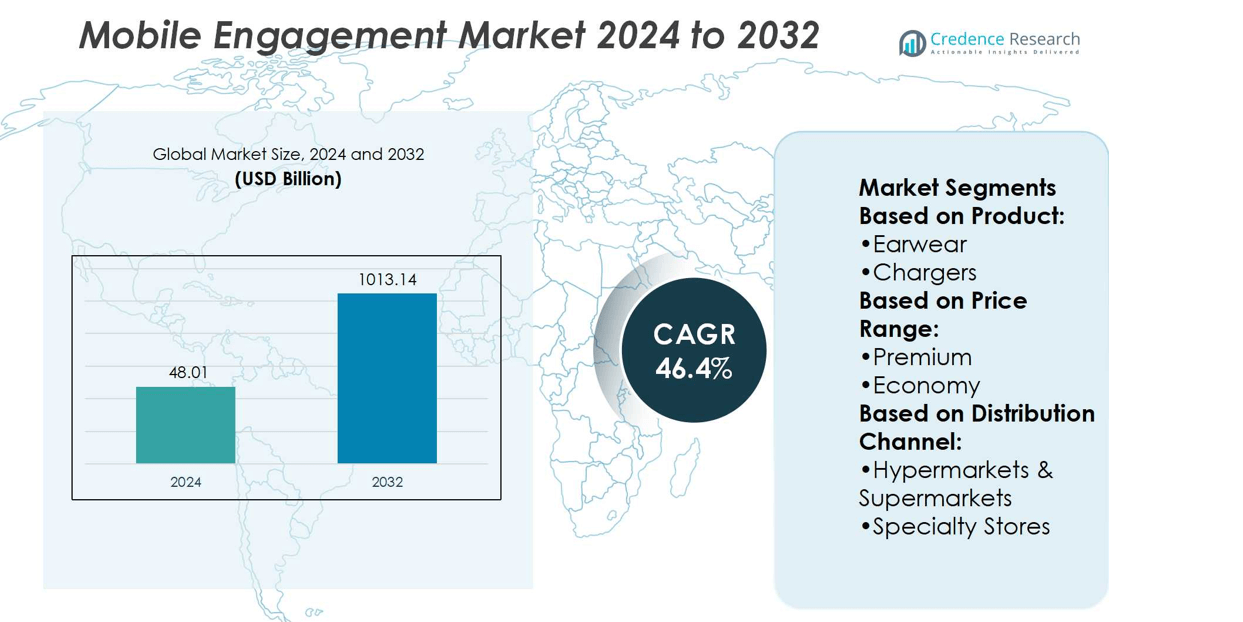
Mobile Engagement Market size was valued at USD 48.01 billion in 2024 and is anticipated to reach USD 1013.14 billion by 2032, at a CAGR of 46.4% during the forecast period.
| REPORT ATTRIBUTE | DETAILS |
|---|---|
| Historical Period | 2020-2023 |
| Base Year | 2024 |
| Forecast Period | 2025-2032 |
| Mobile Engagement Market Size 2024 | USD 48.01 billion |
| Mobile Engagement Market CAGR | 46.4% |
| Mobile Engagement Market Size 2032 | USD 1013.14 billion |
The Mobile Engagement Market grows through rising smartphone penetration, rapid adoption of mobile applications, and demand for personalized customer experiences. Companies use AI, machine learning, and real-time analytics to deliver targeted interactions and improve retention. Expansion of mobile wallets, in-app payments, and loyalty programs further drives adoption across industries. Rich media formats, gamification, and interactive content strengthen user attention and brand connection. Growth in omnichannel strategies ensures seamless communication across apps, SMS, and social platforms. With increasing 5G deployment and cloud-based scalability, the market trends point toward deeper personalization, stronger customer loyalty, and rapid expansion in emerging economies.
The Mobile Engagement Market shows strong regional presence, with North America leading through advanced digital infrastructure, Asia Pacific recording fastest growth from rising smartphone adoption, and Europe focusing on data privacy and compliance. Latin America and the Middle East & Africa display steady opportunities supported by mobile-first strategies. Competition remains intense with global and regional participants investing in AI, real-time analytics, and omnichannel platforms. The landscape continues to evolve as companies expand offerings and strengthen engagement across diverse markets.
Market Insights
- The Mobile Engagement Market size was valued at USD 48.01 billion in 2024 and is expected to reach USD 1013.14 billion by 2032, at a CAGR of 46.4%.
- Rising smartphone penetration, mobile app adoption, and demand for personalized experiences drive strong market growth.
- AI, machine learning, and real-time analytics shape engagement strategies and improve customer retention.
- Expansion of mobile wallets, in-app payments, and loyalty programs strengthens adoption across industries.
- Data privacy regulations and compliance requirements act as restraints, limiting aggressive personalization strategies.
- North America leads with advanced infrastructure, Asia Pacific records fastest growth, and Europe emphasizes data security, while Latin America and the Middle East & Africa show steady opportunities.
- Competition remains intense with global and regional players focusing on AI, omnichannel solutions, and customer-centric innovation.
Market Drivers
Rising Adoption of Smartphones and Mobile Applications Across Industries
The Mobile Engagement Market grows with the surge in smartphone adoption worldwide. Enterprises use mobile apps to reach users with personalized content, offers, and notifications. It helps businesses enhance customer experience and maintain strong brand interactions. Retail, banking, and healthcare sectors prioritize mobile-first strategies to strengthen consumer relationships. Companies invest in engagement platforms that improve retention and drive repeat transactions. The rising dependency on mobile devices ensures steady demand for advanced engagement solutions.
- For instance, Groovemade offers high-quality, aesthetically-focused wireless charging pads and MagSafe stands made from premium materials like walnut. The charging speed and technology are determined by the charging puck or pad used, which often features a standard 5W output, though faster speeds can be achieved using separate official chargers with their MagSafe stands.
Demand for Personalized and Context-Aware Customer Experiences
Organizations focus on delivering tailored interactions that meet individual preferences and needs. The Mobile Engagement Market benefits from AI-powered analytics that segment audiences and predict behaviors. It allows brands to send context-aware messages aligned with location, time, and user activity. Personalization increases customer loyalty and reduces churn for competitive industries. Businesses adopt push notifications, in-app messaging, and chatbots to improve engagement quality. Growth in data-driven strategies reinforces the need for precision targeting.
- For instance, Apple’s on-device foundation model of Apple Intelligence uses a 3-billion-parameter architecture, optimized via 2-bit quantization-aware training, enabling fast, context-aware responses based on user activity and location.
Shift Toward Omnichannel Communication and Real-Time Interaction
Enterprises integrate mobile engagement with email, social media, and web platforms for unified experiences. The Mobile Engagement Market strengthens with rising demand for consistent cross-channel messaging. It enables businesses to maintain real-time interaction and build stronger trust. Retailers and service providers focus on instant updates that drive timely decisions. Integration of SMS, mobile wallets, and in-app offers ensures effective outreach. Real-time capabilities improve customer satisfaction and long-term relationships.
Integration of Advanced Technologies to Optimize Engagement Strategies
AI, machine learning, and automation play a central role in mobile strategies. The Mobile Engagement Market advances through tools that analyze vast data volumes for actionable insights. It enhances personalization, improves campaign performance, and reduces manual effort. Cloud-based platforms support scalability for enterprises managing millions of users. Integration with IoT and voice-enabled devices creates new interaction channels. These innovations drive market expansion by aligning mobile engagement with evolving digital ecosystems.
Market Trends
Growing Use of Artificial Intelligence and Machine Learning for Deeper Insights
The Mobile Engagement Market evolves with AI and machine learning integration. These technologies enable predictive analytics, customer segmentation, and behavior mapping. It allows brands to understand patterns and deliver tailored communication. Businesses rely on algorithms to adjust campaigns based on real-time data. AI chatbots improve responsiveness, reducing customer wait times. Machine learning models refine engagement strategies and strengthen retention rates.
- For instance, RightSight 2 was introduced in CollabOS 1.5, specifically for the Logitech Rally Bar and Rally Bar Mini. It is a key feature of these video conferencing devices, along with other advanced features.
Expansion of Mobile Wallets, Loyalty Apps, and Payment Integration
Mobile payments influence how companies design engagement experiences. The Mobile Engagement Market benefits from growth in mobile wallets and loyalty apps. It creates direct opportunities for cross-selling and upselling through integrated platforms. Payment-linked offers and rewards increase consumer interaction. Retailers and service providers use in-app transactions to boost engagement. It helps businesses connect financial convenience with customer loyalty strategies.
- For instance, Belkin announced it surpassed 1 billion products sold worldwide, including mobile power, audio, and connectivity accessories-supported by over 700 patents, thanks to its in-house R&D and engineering labs.
Rising Popularity of Rich Media and Interactive Content Formats
Enterprises adopt immersive content formats to improve user attention. The Mobile Engagement Market strengthens with video notifications, gamified interfaces, and interactive ads. It supports higher click-through rates compared to traditional messaging formats. Businesses integrate multimedia features into apps for stronger impact. Interactive storytelling fosters emotional connections with customers. It helps brands stand out in highly competitive digital ecosystems.
Adoption of Omnichannel Mobile Strategies Across Global Enterprises
Organizations emphasize seamless communication across multiple channels. The Mobile Engagement Market advances through integration of SMS, push notifications, chat, and social platforms. It ensures consistent brand voice and unified experiences for customers. Omnichannel strategies improve engagement by aligning offline and online interactions. Companies leverage automation to synchronize campaigns across regions. It builds trust and enhances long-term consumer relationships.
Market Challenges Analysis
Data Privacy Regulations and Rising Concerns over Consumer Trust
The Mobile Engagement Market faces growing pressure from strict data privacy laws. Regulations such as GDPR and CCPA demand transparency in data collection and usage. It creates compliance challenges for companies managing vast customer data. Consumers show increasing sensitivity to how personal information is stored and shared. Businesses must balance personalization with privacy to maintain trust. Failure to secure data leads to reputational risks and potential penalties. These concerns slow adoption of aggressive engagement strategies across industries.
High Competition and Barriers in Delivering Seamless User Experiences
Companies struggle to differentiate in a market with many engagement platforms. The Mobile Engagement Market witnesses challenges from fragmented technologies and complex integration needs. It requires constant investment in innovation to meet user expectations. Technical limitations can delay real-time communication or reduce engagement quality. High competition pushes firms to offer low-cost solutions, straining profitability. Delivering seamless experiences across multiple devices and channels remains difficult. These obstacles make sustaining long-term engagement strategies demanding for enterprises.
Market Opportunities
Expansion of 5G Networks and Advanced Mobile Technologies
The Mobile Engagement Market gains significant opportunities from global 5G rollout. Faster connectivity improves delivery of rich media, video, and real-time updates. It supports immersive experiences such as augmented reality campaigns and interactive ads. Enterprises can leverage advanced features to strengthen consumer engagement across sectors. Enhanced network reliability encourages broader adoption of data-heavy applications. The growth of smart devices combined with 5G creates new engagement models. Businesses that adopt early gain stronger competitive positioning.
Rising Demand for Personalization and Emerging Market Potential
Organizations focus on hyper-personalized experiences to improve loyalty and retention. The Mobile Engagement Market benefits from advanced analytics and AI-driven platforms. It enables delivery of tailored offers based on consumer behavior and location. Growth in emerging economies with rising smartphone penetration opens new revenue streams. Companies target untapped rural and semi-urban populations through mobile-first solutions. Expanding digital payment ecosystems further support engagement-driven opportunities. Businesses gain from aligning strategies with local cultural and market needs.
Market Segmentation Analysis:
By Product
The Mobile Engagement Market shows diverse growth across product categories. Earwear leads adoption due to demand for wireless audio devices integrated with smart features. It enhances user experience in entertainment, fitness, and workplace communication. Chargers and power banks register steady demand from rising smartphone usage and longer screen time. Covers dominate the accessories segment by ensuring device protection and personalization. Other products, including screen guards and mounts, support utility-driven consumer needs. The variety of offerings strengthens overall market adoption.
- For instance, Bose’s second-generation QuietComfort Ultra The earbuds provide up to 6 hours of listening time on a single charge with Active Noise Cancellation (ANC) enabled. The included charging case provides up to 3 additional full charges, for a total listening time of up to 24 hours.
By Price Range
Market expansion reflects clear segmentation across premium, economy, and low-price categories. Premium devices gain traction among urban consumers seeking advanced features and durability. It supports growth in regions with high disposable income and preference for brand value. Economy-range products attract middle-income groups with balanced performance and affordability. Low-price segments cater to cost-sensitive consumers in emerging economies. Strong sales in this category highlight demand for functional yet budget-friendly options. Companies target multiple ranges to maximize market reach.
- For instance, Incipio’s premium Forme case for iPhone 16 features dual-layer, one-piece construction with built-in MagSafe magnets and is 10-foot drop tested. The design uses molecularly recycled materials, includes antimicrobial defense, and supports wireless charging and 5G connectivity, all backed by a lifetime warranty.
By Distribution Channel
Distribution plays a critical role in shaping accessibility and sales volume. The Mobile Engagement Market strengthens through hypermarkets and supermarkets offering wide product availability. These outlets provide direct visibility and encourage impulse buying behavior. Specialty stores cater to niche demands with curated product lines and brand-focused experiences. Online platforms record the fastest growth by offering convenience, discounts, and diverse choices. It allows brands to expand reach in rural and semi-urban regions with minimal infrastructure. The blend of physical and digital channels ensures balanced growth and market coverage.
Segments:
Based on Product:
- Earwear
- Chargers
Based on Price Range:
- Premium
- Economy
Based on Distribution Channel:
- Hypermarkets & Supermarkets
- Specialty Stores
Based on the Geography:
- North America
- U.S.
- Canada
- Mexico
- Europe
- UK
- France
- Germany
- Italy
- Spain
- Russia
- Belgium
- Netherlands
- Austria
- Sweden
- Poland
- Denmark
- Switzerland
- Rest of Europe
- Asia Pacific
- China
- Japan
- South Korea
- India
- Australia
- Thailand
- Indonesia
- Vietnam
- Malaysia
- Philippines
- Taiwan
- Rest of Asia Pacific
- Latin America
- Brazil
- Argentina
- Peru
- Chile
- Colombia
- Rest of Latin America
- Middle East
- UAE
- KSA
- Israel
- Turkey
- Iran
- Rest of Middle East
- Africa
- Egypt
- Nigeria
- Algeria
- Morocco
- Rest of Africa
Regional Analysis
North America
North America holds 38% of the Mobile Engagement Market. The region benefits from strong digital infrastructure and high smartphone penetration. Companies in retail, banking, and healthcare use advanced engagement tools to improve customer experience. It leads in adopting AI, automation, and omnichannel strategies. Consumers in the U.S. and Canada expect seamless, real-time interactions. Strong innovation and early adoption keep North America at the top.
Europe
Europe accounts for 18% of the global market. The region emphasizes strict data privacy and regulatory compliance. Businesses adopt mobile platforms with consent-based engagement and secure data handling. Countries like Germany, the U.K., and France invest in advanced messaging and analytics tools. It supports multilingual and cross-border campaigns to reach diverse customers. Focus on transparency and personalization drives steady growth in Europe.
Asia Pacific
Asia Pacific represents 30% of the Mobile Engagement Market and records the fastest growth. Rising smartphone use, 5G expansion, and digital initiatives push adoption. Countries like China, India, and Japan dominate through mobile-first ecosystems. It drives high demand for personalized in-app messaging and mobile payments. Local players and global firms expand operations to capture this fast-growing market. Strong consumer adoption supports Asia Pacific’s rapid rise.
Latin America
Latin America holds 8% of the global market. Brazil and Mexico lead adoption with growing e-commerce and fintech sectors. It relies heavily on SMS, push notifications, and low-cost platforms. Limited connectivity in rural areas slows uniform expansion. Localized content and affordable engagement tools meet consumer needs. The region shows steady opportunities for scalable and budget-friendly solutions.
Middle East & Africa
The Middle East & Africa account for 6% of the market. Gulf countries show strong demand due to high smartphone use and digital services. African nations adopt mobile-first platforms for banking, healthcare, and government programs. It faces challenges of uneven connectivity and regulatory differences. Mobile payments and SMS alerts remain popular engagement methods. With infrastructure improvements, the region offers high potential for future growth.
Key Player Analysis
- Groove Made Walnut
- Apple Inc.
- Anker Power Core
- Logitech International S.A.
- Belkin International Inc.
- Bose Corporation
- Incipio LLC
- Harman International Industries
- Aukey
Competitive Analysis
The Mobile Engagement Market players include Groove Made Walnut, Apple Inc., Anker Power Core, Logitech International S.A., Belkin International Inc., Bose Corporation, Incipio LLC, Harman International Industries, Aukey, and Google. The Mobile Engagement Market is highly competitive, driven by rapid innovation and customer demand for seamless digital experiences. Companies differentiate through advanced personalization, real-time analytics, and integration across multiple channels. Strong ecosystems combining devices, applications, and engagement platforms create long-term customer loyalty. Firms invest in AI, automation, and mobile-first strategies to enhance user interaction and retention. Expansion into emerging markets supports growth, with rising smartphone penetration and digital payment adoption fueling opportunities. The landscape remains dynamic, with success depending on scalability, data-driven insights, and the ability to deliver consistent engagement across diverse regions.
Recent Developments
- In June of 2025, CUE launched a strategic alliance with BIG Creative to enable brands to deliver next-generation activations that blend innovative creative thinking with high-impact mobile engagement. Together, the collaboration seeks to engage audiences, build brand reach, and drive measurable outcomes with compelling, mobile-led experiences.
- In May 2025, Ferrari and IBM partnered to launch an AI-powered mobile app designed to deliver an immersive Formula 1 experience through real-time technology. Developed by IBM in collaboration with Scuderia Ferrari HP, the app blends Ferrari’s rich motorsport legacy with cutting-edge AI and mobile innovations.
- In February 2024, CleverTap partnered with Zoomcar, a car rental company, to leverage CleverTap advanced AI capabilities and TesseractDB to create personalized customer engagement through interactions, targeting re-engagement campaigns, and maximizing customer lifetime value with the help of optimized omnichannel experiences.
- In February 2024, SAP Emarsys collaborated with Annex Cloud, a cloud-based loyalty management platform provider, to integrate SAP Emarsys Customer Engagement Platform and Annex Cloud’s Loyalty Experience Platform to deliver personalized, omnichannel experiences and customer interactions.
Report Coverage
The research report offers an in-depth analysis based on Product, Price Range, Distribution Channel and Geography. It details leading market players, providing an overview of their business, product offerings, investments, revenue streams, and key applications. Additionally, the report includes insights into the competitive environment, SWOT analysis, current market trends, as well as the primary drivers and constraints. Furthermore, it discusses various factors that have driven market expansion in recent years. The report also explores market dynamics, regulatory scenarios, and technological advancements that are shaping the industry. It assesses the impact of external factors and global economic changes on market growth. Lastly, it provides strategic recommendations for new entrants and established companies to navigate the complexities of the market.
Future Outlook
- The Mobile Engagement Market will expand with higher smartphone penetration across all regions.
- AI and machine learning will drive more personalized and predictive engagement strategies.
- 5G rollout will enable richer mobile experiences with faster content delivery.
- Omnichannel platforms will integrate mobile, social, and web into unified engagement systems.
- Mobile wallets and payment-linked rewards will strengthen consumer interaction.
- Data privacy regulations will shape platform design and compliance requirements.
- Cloud-based engagement solutions will gain demand for scalability and cost efficiency.
- Emerging markets will create strong opportunities due to rising mobile-first adoption.
- Voice assistants and IoT devices will add new engagement channels for businesses.
- Real-time analytics will become central to improving customer loyalty and retention.

Request a Free Sample
Fill in your details and we'll send you a free sample report.
- Sample data tables & charts
- Research methodology
Market Dynamics
Rising Adoption of Smartphones and Mobile Applications
The global surge in smartphone usage and mobile app downloads enables businesses to reach larger audiences with personalized content, offers, and notifications, driving the need for advanced mobile engagement solutions across industries such as retail, banking, and healthcare.
Demand for Personalized and Context-Aware Customer Experiences
Organizations are leveraging AI-powered analytics to segment audiences and deliver tailored, context-aware messages based on user behavior, location, and preferences, which increases customer loyalty and reduces churn in competitive markets.
Shift Toward Omnichannel Communication and Real-Time Interaction
Enterprises are integrating mobile engagement with email, social media, and web platforms to provide unified, real-time experiences, ensuring consistent brand messaging and improving customer satisfaction and retention.
Integration of Advanced Technologies
The adoption of AI, machine learning, automation, and cloud-based platforms enables businesses to analyze large data volumes for actionable insights, optimize engagement strategies, and scale their operations efficiently to meet growing user demands.
Expansion of Mobile Wallets, Loyalty Apps, and Payment Integration
The proliferation of mobile wallets and in-app payment solutions allows companies to create seamless, reward-driven engagement experiences, fostering higher transaction volumes and deeper customer relationships.
Need a Custom Version of This Report?
Tailor the scope, geography, or segments to your exact requirements.
- Custom geography or segment scope
- Direct access to our analyst team
Frequently Asked Questions
What is the current market size for Mobile Engagement Market, and what is its projected size in 2032?
At what Compound Annual Growth Rate is the Mobile Engagement Market projected to grow between 2025 and 2032?
Which Mobile Engagement Market segment held the largest share in 2024?
Who are the leading companies in the Mobile Engagement Market?
Table of Content
Chapter 1 Market Segmentation
- 1.1 Segmentation Framework
- 1.1.1 Product and Service Classification
- 1.1.2 Application and End-Use Classification
- 1.1.3 Technology and Solution Classification
- 1.1.4 Customer and Distribution Channel Classification
- 1.1.5 Geographic Segmentation
- 1.1.6 Market Segment Definitions and Boundaries
- 1.2 By Product
- 1.2.1 Earwear
- 1.2.2 Chargers
- 1.2.3 Covers
- 1.2.4 Power Banks
- 1.2.5 Screen Guards
- 1.2.6 Mounts
- 1.3 By Price Range
- 1.3.1 Premium
- 1.3.2 Economy
- 1.3.3 Low-Price
Chapter 2 Introduction
- 2.1 Report Objectives and Scope
- 2.2 Product Definition and Industry Terminology
- 2.3 Market Inclusions and Exclusions
- 2.4 Research Process
- 2.4.1 Primary Research and Expert Interviews
- 2.4.2 Secondary Research and Source Review
- 2.4.3 Top-Down and Bottom-Up Estimation
- 2.4.4 Data Triangulation and Verification
- 2.5 Market Size Measurement Basis
- 2.5.1 2024: USD 48.01 billion → 2032: USD 1013.14 billion
- 2.6 Historical and Forecast Reference Periods
- 2.6.1 Base Year: 2024
- 2.6.2 Forecast Period: 2024-2032
- 2.7 Research Assumptions and Limitations
Chapter 3 Executive Summary
- 3.1 Market Snapshot and Key Findings
- 3.2 Base-Year Market Size, 2024
- 3.3 Forecast Market Size, 2032
- 3.4 Revenue and Volume Growth Outlook
- 3.5 Key Demand and Supply Indicators
- 3.6 Leading Market Segments
- 3.7 Fastest-Growing Market Opportunities
- 3.8 Regional Performance Highlights
- 3.9 Technology and Industry Transformation
- 3.10 Competitive Landscape Summary
- 3.11 Analyst View and Strategic Implications
Chapter 4 Global Mobile Engagement Market Trends and Developments
- 4.1 Historical Industry Development
- 4.2 Recent Market Trends and Developments
- 4.3 Demand and Customer Behavior Trends
- 4.4 Technology and Product Innovation
- 4.5 Artificial Intelligence, Automation and Digitalization
- 4.6 Local Manufacturing and Supply Chain Realignment
- 4.7 Industry Partnerships, Mergers and Acquisitions
- 4.8 Sustainability and Circular Economy Developments
- 4.9 Government and Private Sector Investment Trends
- 4.10 Emerging Business Models and Commercialization
- 4.11 Industry Developments and Announcements
Chapter 5 Global Mobile Engagement Market Production, Supply and Demand Analysis
- 5.1 Demand Trend and Consumption Analysis
- 5.2 Demand Forecast, 2024-2032
- 5.3 Production and Output Trend
- 5.4 Production and Output Forecast, 2024-2032
- 5.5 Installed Capacity and Capacity Utilization
- 5.6 Company-Wise Production Plants and Statistics
- 5.6.1 Installed Production Capacity
- 5.6.2 Actual Production
- 5.6.3 Planned Capacity and Expansion Targets
- 5.7 Supply Chain Structure and Procurement Trends
- 5.8 Supply-Demand Gap and Bottlenecks
- 5.9 Import Dependence and Sourcing Structure
- 5.10 Contract Manufacturing and Outsourcing
- 5.11 Regional Supply and Demand Concentration
Chapter 6 Global Mobile Engagement Market Pricing Analysis
- 6.1 Pricing Structure and Measurement
- 6.2 Historical Pricing Trends
- 6.3 Pricing Outlook, 2024-2032
- 6.4 Average Selling Price and Unit Economics
- 6.5 Pricing by Product and Market Segment
- 6.6 Geographic Pricing Differences
- 6.7 Key Input, Energy, Labor and Logistics Costs
- 6.8 Contract Pricing and Purchasing Models
- 6.9 Pricing Sensitivity and Competitive Positioning
- 6.10 Price, Margin and Profitability Implications
Chapter 7 Global Mobile Engagement Market Dynamics
- 7.1 Market Growth Drivers
- 7.1.1 Demand-Side Drivers
- 7.1.2 Technology and Innovation Drivers
- 7.1.3 Infrastructure and Investment Drivers
- 7.1.4 Regulatory and Policy Drivers
- 7.2 Market Restraints
- 7.2.1 Cost and Affordability Constraints
- 7.2.2 Technology and Adoption Barriers
- 7.2.3 Supply Chain and Operational Constraints
- 7.3 Market Challenges
- 7.3.1 Competitive Pressure and Margin Erosion
- 7.3.2 Skills, Infrastructure and Implementation Gaps
- 7.4 Emerging Market Opportunities
- 7.5 Market Dynamics Impact and Time-Horizon Assessment
Chapter 8 Global Mobile Engagement Value Chain Analysis
- 8.1 Industry Value Chain Overview
- 8.2 Upstream Suppliers and Critical Inputs
- 8.3 Technology and Component Providers
- 8.4 Manufacturing or Service Delivery
- 8.5 Distribution, Channel Partners and Integrators
- 8.6 Downstream Applications and End Users
- 8.7 Value Addition and Profit Pools
- 8.8 Vertical Integration and Outsourcing
- 8.9 Supplier Concentration and Risk
- 8.10 Supply Chain Localization and Resilience
Chapter 9 Global Mobile Engagement Market Regulations and Policies
- 9.1 Relevant Laws, Standards and Compliance Frameworks
- 9.2 Product, Service, Safety and Quality Requirements
- 9.3 Government Policies, Incentives and Subsidies
- 9.4 Imports, Exports and Trade Barriers
- 9.5 Public Procurement and Local Content Requirements
- 9.6 Environmental and Sustainability Compliance
- 9.7 Data Protection, AI and Cybersecurity Compliance
- 9.8 Upcoming Policy Changes and Market Implications
Chapter 10 Global Mobile Engagement Market Hotspots and Opportunities
- 10.1 Market Opportunity Mapping and Growth Hotspots
- 10.2 High-Growth Applications and Customer Groups
- 10.3 Underserved Markets and White-Space Opportunities
- 10.4 Emerging Technology and Product Opportunities
- 10.5 New Capacity and Investment Hotspots
- 10.6 Market Entry and Expansion Opportunities
- 10.7 Distribution and Partnership Opportunities
- 10.8 Near-Term and Long-Term Commercial Potential
- 10.9 Opportunity Attractiveness and Execution Risks
Chapter 11 Global Mobile Engagement Market Outlook, 2024-2032
- 11.1 Market Size and Analysis
- 11.1.1 Revenue (Market Measurement: 2024: USD 48.01 billion → 2032: USD 1013.14 billion)
- 11.1.2 Market Volume and Quantity Sold
- 11.1.3 Historical Market Size
- 11.1.4 Base-Year Market Size, 2024
- 11.2 Market Forecast, 2024-2032
- 11.2.1 Revenue Forecast to 2032
- 11.2.2 Volume Forecast to 2032
- 11.2.3 CAGR and Year-on-Year Growth
- 11.2.4 Incremental Revenue Opportunity
- 11.3 Forecast Assumptions and Scenario Analysis
- 11.3.1 Base-Case Forecast
- 11.3.2 Optimistic and Conservative Scenarios
- 11.3.3 Technology, Pricing and Policy Sensitivities
- 11.4 Market Attractiveness and Growth Outlook
Chapter 12 Global Mobile Engagement Market Segmentation and Outlook
- 12.1 Segmentation Summary and Market Shares, 2024
- 12.2 Largest and Fastest-Growing Segments
- 12.3 By Product - Market Size and Forecast, 2024-2032
- 12.3.1 Segment Definition and Scope
- 12.3.2 Historical Market Size
- 12.3.3 Revenue Forecast, 2024-2032
- 12.3.4 Volume Forecast, 2024-2032
- 12.3.5 Base-Year Market Share, 2024
- 12.3.6 Segment CAGR and Growth Drivers
- 12.3.7 Subsegment Market Size and Forecast
- 12.3.7.1 Earwear
- 12.3.7.2 Chargers
- 12.3.7.3 Covers
- 12.3.7.4 Power Banks
- 12.3.7.5 Screen Guards
- 12.3.7.6 Mounts
- 12.3.8 Subsegment Pricing and Adoption Trends
- 12.3.9 Leading Suppliers and Competition
- 12.3.10 Regional Demand and Opportunities
- 12.4 By Price Range - Market Size and Forecast, 2024-2032
- 12.4.1 Segment Definition and Scope
- 12.4.2 Historical Market Size
- 12.4.3 Revenue Forecast, 2024-2032
- 12.4.4 Volume Forecast, 2024-2032
- 12.4.5 Base-Year Market Share, 2024
- 12.4.6 Segment CAGR and Growth Drivers
- 12.4.7 Subsegment Market Size and Forecast
- 12.4.7.1 Premium
- 12.4.7.2 Economy
- 12.4.7.3 Low-Price
- 12.4.8 Subsegment Pricing and Adoption Trends
- 12.4.9 Leading Suppliers and Competition
- 12.4.10 Regional Demand and Opportunities
- 12.5 Segment Growth Comparison
- 12.6 Segment Attractiveness and Priority Matrix
Chapter 13 Global Mobile Engagement Geographic Market Outlook, 2024-2032
- 13.1 Regional Market Size and Share, 2024
- 13.2 Regional Market Forecast, 2024-2032
- 13.3 Regional Pricing, Production and Demand Differences
- 13.4 North America
- 13.4.1 United States
- 13.4.2 Canada
- 13.4.3 Mexico
- 13.5 Europe
- 13.5.1 Germany
- 13.5.2 France
- 13.5.3 Italy
- 13.5.4 United Kingdom
- 13.5.5 Spain
- 13.5.6 Poland
- 13.5.7 Russia
- 13.5.8 Netherlands
- 13.5.9 Belgium
- 13.5.10 Sweden
- 13.5.11 Denmark
- 13.5.12 Norway
- 13.5.13 Rest of Europe
- 13.6 Asia Pacific
- 13.6.1 China
- 13.6.2 India
- 13.6.3 Japan
- 13.6.4 South Korea
- 13.6.5 Thailand
- 13.6.6 Indonesia
- 13.6.7 Vietnam
- 13.6.8 Malaysia
- 13.6.9 Australia
- 13.6.10 Rest of Asia Pacific
- 13.7 Latin America
- 13.7.1 Brazil
- 13.7.2 Argentina
- 13.7.3 Colombia
- 13.7.4 Chile
- 13.7.5 Rest of Latin America
- 13.8 Middle East
- 13.8.1 Saudi Arabia
- 13.8.2 United Arab Emirates
- 13.8.3 Turkey
- 13.8.4 Israel
- 13.8.5 Iran
- 13.8.6 Rest of the Middle East
- 13.9 Africa
- 13.9.1 South Africa
- 13.9.2 Egypt
- 13.9.3 Nigeria
- 13.9.4 Morocco
- 13.9.5 Rest of Africa
- 13.10 Regional Investment, Policy and Supply Chain Differences
- 13.11 Regional Competitive Landscape
- 13.12 Geographic Growth Hotspots
Chapter 14 Global Mobile Engagement Technology, Innovation and Sustainability Outlook
- 14.1 Technology Landscape and Maturity
- 14.2 Product, Process and Service Innovation
- 14.3 AI, Automation and Digital Tools in the Industry
- 14.4 Technology Adoption and Performance Benchmarking
- 14.5 Innovation Pipeline and R&D Investment
- 14.6 Patent and Intellectual Property Trends
- 14.7 Energy Efficiency and Resource Management
- 14.8 Sustainability, Recycling and Circularity
- 14.9 Technology Roadmap, 2024-2032
- 14.10 Risks of Obsolescence and Technology Substitution
Chapter 15 Global Mobile Engagement Market Key Strategic Imperatives
- 15.1 Growth and Market Entry Priorities
- 15.2 High-Return Products and Segments
- 15.3 Pricing, Profitability and Cost Optimization
- 15.4 Technology Investment and Product Differentiation
- 15.5 Supply Chain Localization and Resilience
- 15.6 Distribution and Customer Acquisition
- 15.7 Partnership, Acquisition and Capacity Strategy
- 15.8 Regional Expansion Priorities
- 15.9 Short-, Medium- and Long-Term Actions
Chapter 16 Competition Outlook
- 16.1 Industry Competition Characteristics
- 16.2 Market Structure and Concentration
- 16.3 Market Share and Competitive Positioning, 2024
- 16.4 Company-Wise Revenue and Product Benchmarking
- 16.5 Production and Service Capacity Benchmarking
- 16.6 Technology, Pricing and Differentiation
- 16.7 Regional Footprint and Distribution Strength
- 16.8 Mergers, Acquisitions and Strategic Alliances
- 16.9 New Entrants and Competitive Threats
- 16.10 Porter's Five Forces and Industry Attractiveness
- 16.11 Competitive Outlook, 2024-2032
Chapter 17 Company Profiles
- 17.1 Company Coverage and Selection Criteria
- 17.2 Apple Inc.
- 17.2.1 Business Description
- 17.2.2 Company Ownership and Geographic Presence
- 17.2.3 Product and Service Portfolio
- 17.2.4 Manufacturing and Operating Footprint
- 17.2.5 Production Capacity and Expansion Plans
- 17.2.6 Financial Performance and Investment
- 17.2.7 Market Share and Competitive Position
- 17.2.8 Technology and Innovation Capabilities
- 17.2.9 Strategic Alliances or Partnerships
- 17.2.10 Recent Developments
- 17.2.11 Growth Strategy and Outlook
- 17.3 Google
- 17.4 Logitech International S.A.
- 17.5 Belkin International Inc.
- 17.6 Bose Corporation
- 17.7 Incipio LLC
- 17.8 Harman International Industries
- 17.9 Aukey
- 17.10 Anker Innovations
- 17.11 Groove Made Walnut
- 17.12 Other Relevant Market Participants
Note: Every listed company is profiled on the structure shown under the first company. The company list is preliminary and may change based on research findings, market developments, data availability and client requirements.
Chapter 18 Disclaimer
- 18.1 Research and Forecast Disclaimer
- 18.2 Data Source and Estimation Limitations
Note: The depth of individual sections depends on data availability for this market. Volume, capacity, trade and other unit-based metrics are included where applicable.

