
Market Overview
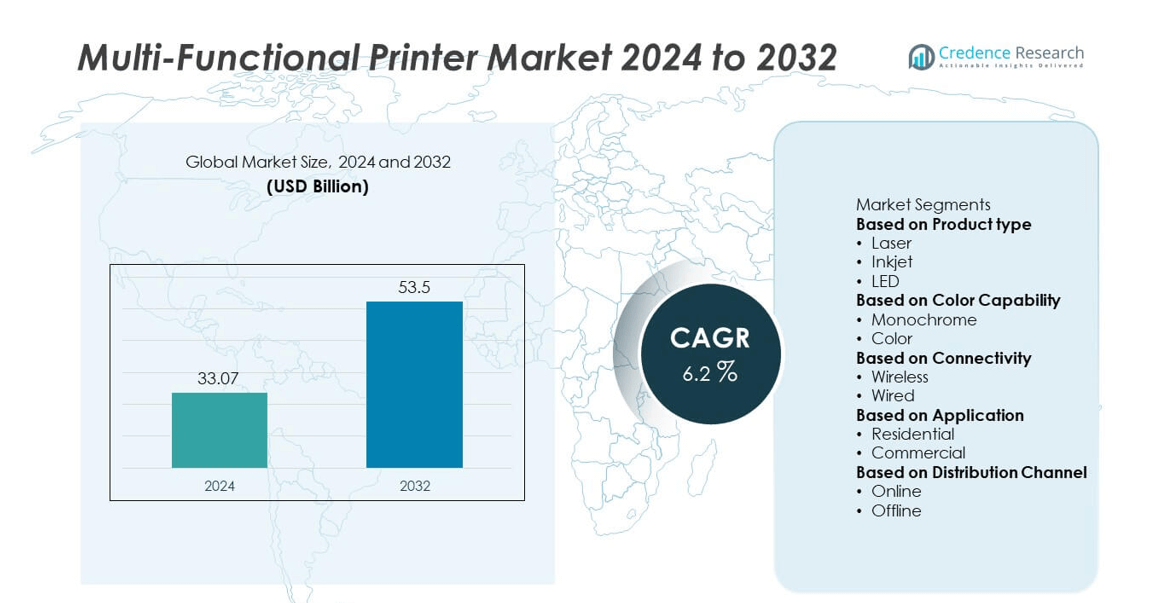
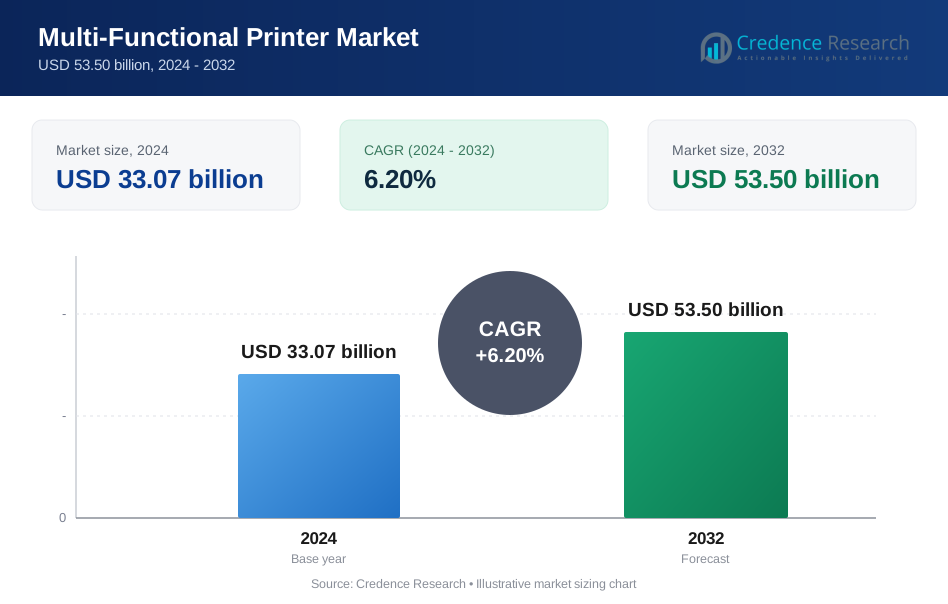
Multi-Functional Printer Market was valued at USD 33.07 billion in 2024 and is expected to reach USD 53.50 billion by 2032, growing at a CAGR of 6.2% during the forecast period.
| REPORT ATTRIBUTE | DETAILS |
|---|---|
| Historical Period | 2020-2023 |
| Base Year | 2024 |
| Forecast Period | 2025-2032 |
| Multi-Functional Printer Market Size 2024 | USD 33.07 billion |
| Multi-Functional Printer Market, CAGR | 6.2% |
| Multi-Functional Printer Market Size 2032 | USD 53.50 billion |
The Multi-Functional Printer Market grows with rising demand for cost-effective office solutions, secure printing, and integrated document management systems. Businesses adopt multifunctional devices to streamline workflows, reduce costs, and enhance productivity across sectors.
The Multi-Functional Printer Market shows strong presence across North America, Europe, Asia-Pacific, Latin America, and the Middle East & Africa. North America leads adoption due to advanced IT infrastructure, strong demand from enterprises, and emphasis on data-secure printing solutions. Europe focuses on sustainability and energy-efficient models aligned with environmental regulations, while Asia-Pacific records the fastest growth driven by digitalization, SME expansion, and rising investments in smart office infrastructure. Latin America and the Middle East & Africa see gradual adoption supported by modernization of office systems and government-led digital initiatives. Key players shaping the market include Ricoh Co. Ltd., recognized for its innovative printing solutions, Konica Minolta Inc., focusing on workflow automation and cloud-enabled platforms, Hewlett Packard Enterprise Co., offering secure and scalable multifunctional devices, and Kyocera Corp., known for eco-friendly and cost-efficient printing technologies. These companies continue to expand through cloud integration, smart technologies, and regional collaborations.
Market Insights
- The Multi-Functional Printer Market was valued at USD 33.07 billion in 2024 and is expected to reach USD 53.50 billion by 2032, growing at a CAGR of 6.2%.
- Rising demand for cost-effective and space-saving office solutions drives adoption of multifunctional printers across enterprises and institutions.
- Market trends focus on cloud connectivity, mobile printing, and AI-enabled features that improve workflow automation and enhance data security.
- Leading companies such as Ricoh Co. Ltd., Konica Minolta Inc., Hewlett Packard Enterprise Co., Kyocera Corp., and Lexmark International Inc. shape the competitive landscape with eco-friendly and smart printing technologies.
- High operational costs, maintenance requirements, and competition from digital document management platforms act as restraints for widespread adoption.
- North America leads with strong IT infrastructure and enterprise adoption, Europe emphasizes sustainability and energy efficiency, and Asia-Pacific grows fastest with digitalization and SME expansion.
- The overall market outlook remains positive as businesses worldwide prioritize hybrid work solutions, secure connectivity, and sustainable multifunctional printing systems to support long-term digital transformation.
Market Drivers
Growing Demand for Cost-Effective Office Solutions
The Multi-Functional Printer Market expands due to the rising preference for cost-efficient office equipment. Businesses seek devices that combine printing, scanning, copying, and faxing into a single platform. It reduces operational costs, minimizes space requirements, and lowers energy consumption. Organizations adopt these devices to streamline workflows and enhance productivity. Small and medium enterprises increasingly rely on such solutions to maximize resource utilization. The growing emphasis on operational efficiency strengthens demand across corporate and institutional environments.
- For instance, Brother Industries Ltd. launched the MFC-J6955DW multifunction printer with INKvestment Tank technology, offering up to 6,000 black and 5,000 color pages per cartridge. This helps offices cut down ink replacement frequency and lowers per-page cost by a wide margin.
Shift Toward Digitization and Document Management
Digital transformation across industries drives stronger adoption of multifunctional devices with integrated document management tools. The Multi-Functional Printer Market benefits from solutions that support cloud connectivity and mobile printing. It enables users to access, store, and share documents securely from multiple devices. Enterprises adopt these systems to improve collaboration across dispersed teams. Features like optical character recognition enhance document search and retrieval. The rising demand for seamless digital workflows drives steady market growth.
- For instance, Canon Inc. introduced the imageRUNNER ADVANCE DX C5800 series, equipped with 270 ipm duplex scanning and secure cloud-based workflows via uniFLOW Online, enabling real-time collaboration and GDPR-compliant document access.
Rising Need for Secure Printing and Data Protection
Enterprises emphasize data security in document handling, creating demand for advanced multi-functional printers. The Multi-Functional Printer Market offers solutions with secure print release, user authentication, and encrypted storage. It ensures compliance with strict regulatory requirements in sectors such as healthcare, banking, and government. Growing concerns about data breaches encourage investments in secure print environments. Organizations implement these features to safeguard sensitive information and improve accountability. This focus on security strengthens the strategic value of multi-functional systems.
Sustainability and Energy Efficiency Priorities
Sustainability initiatives across industries boost demand for energy-efficient multifunctional devices. The Multi-Functional Printer Market aligns with global goals for reduced carbon footprint and resource optimization. It provides eco-friendly features such as duplex printing, low power consumption, and recyclable components. Companies adopt these solutions to meet environmental standards and corporate responsibility goals. Government regulations supporting energy-efficient equipment accelerate adoption further. The growing awareness of sustainability reinforces long-term market expansion for multifunctional printers.
Market Trends
Adoption of Cloud-Enabled Printing Solutions
The Multi-Functional Printer Market is experiencing a strong shift toward cloud-enabled devices. Businesses prioritize remote access to documents, ensuring teams can print, scan, and share from any location. It supports hybrid work models by integrating with cloud storage platforms. Enterprises adopt these solutions to enhance collaboration and reduce dependency on physical servers. Vendors introduce models with seamless cloud compatibility and data synchronization. The trend reflects the growing importance of mobility and flexibility in office environments.
- For instance, HP Inc. launched the HP LaserJet Enterprise MFP M635 series, which supports HP Cloud Connector and enables direct scan-to-cloud operations with authentication using LDAP or Azure Active Directory. The model also allows up to 1200 dpi scanning and 100-sheet automatic document feeding for remote tasks.
Integration of Advanced Workflow Automation
Automation emerges as a key trend, with multifunctional devices increasingly embedded in digital workflows. The Multi-Functional Printer Market benefits from automated document routing, indexing, and scanning functions. It reduces manual tasks and ensures faster document processing. Companies adopt workflow automation to minimize errors and improve efficiency. Integration with enterprise resource planning and document management systems drives adoption. This focus on streamlined processes strengthens the strategic role of multifunctional printers.
- For instance, Ricoh Company, Ltd. integrated its IM C4510A model with its Smart Integration platform, which enables advanced cloud-based document workflows. While the device can route documents to ERP systems, the scanning speed is rated at up to 300 images per minute (ipm) duplex. The system does support custom scan-to-email workflows with metadata tagging for improved document retrieval accuracy.
Expansion of Mobile and Wireless Printing Capabilities
Growing reliance on smartphones and tablets influences product development across the market. The Multi-Functional Printer Market emphasizes wireless connectivity, mobile apps, and secure mobile print options. It provides employees with flexibility to print and share directly from personal devices. Enterprises value mobility as remote and flexible working models expand. Vendors highlight compatibility with major operating systems to meet diverse user needs. This trend underscores the role of multifunctional printers in modern connected workplaces.
Focus on Sustainability and Eco-Friendly Features
Environmental responsibility remains central to product innovation in multifunctional printing. The Multi-Functional Printer Market adopts designs with energy-saving modes, low-emission toner, and recyclable parts. It addresses the rising preference for eco-friendly office equipment among corporations. Governments promote sustainability standards, encouraging organizations to replace outdated devices. Vendors integrate features like duplex printing and energy-efficient standby modes. This commitment to green printing solutions strengthens market positioning and supports long-term growth.
Market Challenges Analysis
High Operational Costs and Maintenance Requirements
The Multi-Functional Printer Market faces challenges due to high operational and maintenance costs. Devices require regular servicing, replacement parts, and consumables such as toner and cartridges, which increase long-term expenses. It creates financial pressure for small and medium enterprises with limited budgets. Downtime during maintenance disrupts workflows and reduces productivity. Organizations also struggle with managing supply chains for consumables, impacting cost efficiency. These operational barriers slow adoption in cost-sensitive sectors.
Rising Competition from Digital Alternatives and Security Risks
The growing adoption of digital document management platforms poses a challenge for the Multi-Functional Printer Market. Enterprises shift toward paperless workflows that reduce reliance on physical printing. It pressures vendors to innovate with integrated digital solutions to remain relevant. At the same time, security risks associated with network-connected devices raise concerns. Data breaches through unsecured printers can expose sensitive information. Ensuring strong cybersecurity measures increases complexity and costs for manufacturers. These factors create obstacles that limit wider adoption across industries.
Market Opportunities
Expansion in Emerging Economies and SME Adoption
The Multi-Functional Printer Market presents strong opportunities in emerging economies with growing office infrastructure and digitalization initiatives. Small and medium enterprises increasingly adopt multifunctional devices to reduce costs and optimize space. It enables businesses to streamline operations by combining print, scan, copy, and fax functions in one system. Expanding government investments in smart office solutions and IT modernization further drive adoption. Vendors offering affordable and energy-efficient models stand to capture rising demand. Emerging economies create a large untapped market for multifunctional printing solutions.
Integration with Smart Technologies and Cloud Platforms
Rapid integration of multifunctional printers with IoT, AI, and cloud systems creates new opportunities for growth. The Multi-Functional Printer Market benefits from solutions that support predictive maintenance, secure cloud printing, and real-time monitoring. It provides enterprises with smarter, more connected devices that enhance workflow efficiency. Hybrid work models fuel demand for printers with mobile and wireless connectivity. Vendors that focus on delivering customizable, eco-friendly, and cloud-ready systems gain a competitive edge. These opportunities strengthen long-term growth and position multifunctional printers as essential office tools.
Market Segmentation Analysis:
By Product Type
The Multi-Functional Printer Market is segmented into laser, inkjet, and dot matrix devices. Laser multifunctional printers dominate due to their speed, durability, and suitability for high-volume office environments. It provides enterprises with cost efficiency in the long run by offering low per-page printing costs. Inkjet multifunctional printers, on the other hand, gain traction in households and small businesses due to affordability and superior image quality. Dot matrix printers retain relevance in specialized sectors such as banking and logistics, where continuous form printing is still required. The varied product range allows the market to meet both high-performance and budget-oriented needs across industries.
- For instance, Lexmark International offers the XM9145 laser MFP, delivering monochrome print speeds up to 45 pages per minute with a standard input capacity of 350 sheets, which can be expanded with optional trays.
By Color Capability
The Multi-Functional Printer Market is categorized into monochrome and color printers. Monochrome multifunctional printers remain widely used in large enterprises where text-based documentation dominates. It ensures lower operating costs and higher print speeds, making it suitable for high-volume workflows. Color multifunctional printers experience rising adoption across marketing, design, and education sectors where quality visuals are essential. These printers provide advanced graphics and vivid output for professional presentations. The balance between monochrome efficiency and color quality reflects evolving workplace requirements.
- For instance, Kyocera Document Solutions launched the TASKalfa 3212i monochrome MFP with 32 ppm output speed, a standard 1,100-sheet paper capacity, and expandability to a maximum of 4,100 sheets.
By Connectivity
Connectivity plays a central role in the adoption of multifunctional printers. The Multi-Functional Printer Market is segmented into wired and wireless models. Wired printers continue to serve traditional office setups requiring secure, stable connections. It supports organizations prioritizing security and uninterrupted workflows. Wireless multifunctional printers record faster growth due to rising reliance on mobile printing and cloud-based collaboration. Features such as Wi-Fi Direct, Bluetooth, and NFC enhance flexibility in modern offices. This shift toward wireless and cloud-ready devices highlights the role of connectivity in driving future market adoption.
Segments:
Based on Product type
- Laser
- Inkjet
- LED
Based on Color Capability
- Monochrome
- Color
Based on Connectivity
- Wireless
- Wired
Based on Application
- Residential
- Commercial
Based on Distribution Channel
- Online
- Offline
Based on the Geography:
- North America
- U.S.
- Canada
- Mexico
- Europe
- UK
- France
- Germany
- Italy
- Spain
- Russia
- Belgium
- Netherlands
- Austria
- Sweden
- Poland
- Denmark
- Switzerland
- Rest of Europe
- Asia Pacific
- China
- Japan
- South Korea
- India
- Australia
- Thailand
- Indonesia
- Vietnam
- Malaysia
- Philippines
- Taiwan
- Rest of Asia Pacific
- Latin America
- Brazil
- Argentina
- Peru
- Chile
- Colombia
- Rest of Latin America
- Middle East
- UAE
- KSA
- Israel
- Turkey
- Iran
- Rest of Middle East
- Africa
- Egypt
- Nigeria
- Algeria
- Morocco
- Rest of Africa
Regional Analysis
North America
North America accounts for 35% of the Multi-Functional Printer Market in 2024, making it the leading region. The growth is fueled by strong adoption across corporate offices, educational institutions, and government agencies. Organizations prioritize multifunctional devices that combine print, scan, copy, and fax features to streamline operations. It supports hybrid work environments by integrating with cloud platforms and mobile printing solutions. Vendors in the region emphasize advanced security features to meet strict data protection regulations, especially in sectors like banking and healthcare. High investments in office automation and IT infrastructure reinforce North America’s leadership in the global market.
Europe
Europe represents 28% of the Multi-Functional Printer Market in 2024, supported by demand across commercial and industrial sectors. Businesses adopt multifunctional printers to reduce operational costs and improve sustainability. It aligns with European Union regulations that encourage energy efficiency and reduced carbon emissions. Enterprises in Germany, the UK, and France prefer models with eco-friendly features such as duplex printing and recyclable materials. Cloud-enabled multifunctional devices gain traction as enterprises expand digital transformation strategies. Strong focus on regulatory compliance and sustainability strengthens Europe’s position as the second-largest regional market.
Asia-Pacific
Asia-Pacific holds 25% of the Multi-Functional Printer Market in 2024 and records the fastest growth. Rising adoption in China, India, and Japan drives expansion as enterprises invest in digital office solutions. It benefits from the rapid rise of small and medium enterprises, which increasingly adopt cost-effective multifunctional devices. Governments across the region invest in digitalization initiatives, expanding demand for cloud-enabled and mobile-ready devices. Vendors gain opportunities by offering affordable models tailored to local business needs. Growing emphasis on remote work and online education further strengthens Asia-Pacific’s growth trajectory.
Latin America
Latin America captures 7% of the Multi-Functional Printer Market in 2024, with Brazil and Mexico leading adoption. Businesses in the region adopt multifunctional printers to modernize offices and improve cost efficiency. It supports increasing demand for secure and flexible document management across industries. Limited IT budgets present challenges, but cloud-enabled solutions create cost-effective alternatives. International vendors collaborate with regional distributors to improve market penetration. Rising digital adoption and investments in education and healthcare contribute to steady regional growth.
Middle East & Africa
The Middle East & Africa region represents 5% of the Multi-Functional Printer Market in 2024. Growth is driven by expanding office infrastructure and rising investment in digital transformation projects, particularly in the Gulf Cooperation Council countries. It supports government-led initiatives promoting smart offices and digital document management. Enterprises adopt multifunctional printers to improve efficiency and meet sustainability goals. Vendors introduce affordable, energy-efficient models to overcome budget constraints in developing economies. Although adoption is gradual, rising corporate activity and infrastructure development enhance long-term growth potential in this region.
Key Player Analysis
- Ricoh Co. Ltd.
- Oki Electric Industry Co. Ltd.
- Konica Minolta Inc.
- Panasonic Holdings Corp.
- Lexmark International Inc.
- Hewlett Packard Enterprise Co.
- Kyocera Corp.
- NEC Corp.
- Eastman Kodak Co.
- Brother Industries Ltd.
Competitive Analysis
The competitive landscape of the Multi-Functional Printer Market is defined by leading players such as Ricoh Co. Ltd., Konica Minolta Inc., Hewlett Packard Enterprise Co., Kyocera Corp., Lexmark International Inc., Brother Industries Ltd., Eastman Kodak Co., NEC Corp., Oki Electric Industry Co. Ltd., and Panasonic Holdings Corp. These companies focus on delivering multifunctional devices that integrate printing, scanning, copying, and faxing with advanced digital features. Vendors invest heavily in research and development to enhance cloud connectivity, workflow automation, and mobile printing capabilities, catering to hybrid work environments and digital-first enterprises. Sustainability and energy efficiency are central to competitive strategies, with eco-friendly models gaining traction across regulated industries. Security-driven innovation remains a priority as enterprises demand solutions that protect sensitive data and comply with strict regulatory standards. Market players strengthen their positions through strategic partnerships, mergers, and regional expansions to increase customer reach. Intense competition fosters continuous product innovation, ensuring multifunctional printers evolve as essential tools for cost efficiency, sustainability, and digital transformation in modern workplaces.
Recent Developments
- In April 2025, Ricoh Co. Ltd. Ricoh Asia Pacific launched three new A3 black-and-white MFPs—the M 2510 (25 ppm), M 2310N (23 ppm), and M 2810N (28 ppm)—featuring faster output, mobile connectivity, and energy-efficient design.
- In February 2025, Ricoh introduced the IM C6010SD, IM C4510SD, and IM C3010SD A3 color MFPs with advanced PFU ADF tech, up to 200 duplex pages per minute, and AI‑powered digitization features.
- In January 2025, Ricoh launched its A4 color MFPs—IM C431 and IM C431F, offering 43 ppm (B/W) and 40 ppm (color) speeds, 1‑pass duplex ADF, 10% recycled plastic, and enhanced security.
- In 2025, Konica Minolta Inc. introduced the AccurioJet 30000, an industrial inkjet printer capable of handling 3,000 sheets per hour with HS‑UV ink and pre‑RIP productivity boost
Report Coverage
The research report offers an in-depth analysis based on Product type, Color Capability, Connectivity, Application, Distribution Channel and Geography. It details leading market players, providing an overview of their business, product offerings, investments, revenue streams, and key applications. Additionally, the report includes insights into the competitive environment, SWOT analysis, current market trends, as well as the primary drivers and constraints. Furthermore, it discusses various factors that have driven market expansion in recent years. The report also explores market dynamics, regulatory scenarios, and technological advancements that are shaping the industry. It assesses the impact of external factors and global economic changes on market growth. Lastly, it provides strategic recommendations for new entrants and established companies to navigate the complexities of the market.
Future Outlook
- The market will expand with growing demand for integrated and cost-efficient office solutions.
- Cloud-enabled multifunctional printers will dominate adoption across enterprises and institutions.
- AI and automation will improve workflow efficiency and reduce manual document handling.
- Mobile and wireless connectivity will become standard features in multifunctional devices.
- Eco-friendly models with energy-saving technologies will gain stronger demand.
- Data security and encrypted printing solutions will remain critical for regulated industries.
- Small and medium enterprises will drive adoption of affordable multifunctional printers.
- Emerging economies will create new growth opportunities with rapid office digitalization.
- Vendors will expand partnerships and collaborations to strengthen global presence.
- Continuous product innovation will position multifunctional printers as key tools in hybrid workplaces.
Request a Free Sample
Fill in your details and we'll send you a free sample report.
- Sample data tables & charts
- Research methodology
Need a Custom Version of This Report?
Tailor the scope, geography, or segments to your exact requirements.
- Custom geography or segment scope
- Direct access to our analyst team
Frequently Asked Questions
What is the current market size for Multi-Functional Printer, and what is its projected size in 2032?
Which Multi-Functional Printer market segment held the largest share in 2024?
What are the primary factors fueling the growth of the Multi-Functional Printer market?
Who are the leading companies in the Multi-Functional Printer market?
Table of Content
Chapter 1. Report Introduction
- 1.1 Report Description & Purpose
- 1.1.1 Report Title & Market Definition
- 1.1.2 Unique Selling Propositions (USP) & Key Differentiators
- 1.1.3 Value Proposition for Stakeholders
- 1.2 Research Objectives
- 1.2.1 Market Sizing Objectives (Volume & Revenue)
- 1.2.2 Segmentation Objectives
- 1.2.3 Competitive Intelligence Objectives
- 1.2.4 Forecast & Scenario Objectives
- 1.3 Report Scope
- 1.3.1 Multi-Functional Printer Scope – Types & Subtypes Covered
- 1.3.2 Geographic Scope – Regions & Countries Covered
- 1.3.3 Historical Period, Base Year & Forecast Period (2024; forecast to 2032)
- 1.3.4 Inclusions & Exclusions
- 1.4 HS Code & Classification Framework
- 1.5 Currency, Units & Pricing Basis
- 1.6 Target Stakeholders
- 1.7 Limitations & Assumptions
Chapter 2. Executive Summary
- 2.1 Global Multi-Functional Printer Market Snapshot
- 2.1.1 Market Size – Historical (2024) & Forecast (2024-2032) (2024: USD 33.07 billion → 2032: USD 53.50 billion)
- 2.1.2 Volume & Revenue – Global Totals
- 2.1.3 Key Market Highlights – Top Five Facts
- 2.2 Multi-Functional Printer Market Segmentation Snapshot
- 2.2.1 Market Split by Region – 2024 vs. 2032
- 2.3 Competitive Snapshot
- 2.3.1 Top 10 Players by Revenue Share – 2024
- 2.3.2 Top 10 Players by Volume Share – 2024
- 2.3.3 Recent Strategic Developments (18-Month Summary)
- 2.4 Key Investment Highlights & Strategic Conclusions
Chapter 3. Multi-Functional Printer Market Dynamics & Industry Analysis
- 3.1 Market Overview & Context
- 3.1.1 Multi-Functional Printer Market Position in the Broader Automotive Value Chain
- 3.1.2 OEM vs. Replacement Market Dynamics
- 3.1.3 Market Maturity & Development Stage by Region
- 3.2 Multi-Functional Printer Market Drivers
- 3.3 Multi-Functional Printer Market Restraints & Challenges
- 3.4 Multi-Functional Printer Market Opportunities
- 3.5 Porter's Five Forces Analysis
- 3.5.1 Threat of New Entrants
- 3.5.2 Bargaining Power of Suppliers
- 3.5.3 Bargaining Power of Buyers
- 3.5.4 Threat of Substitutes
- 3.5.5 Competitive Rivalry – Intensity Assessment
- 3.6 Multi-Functional Printer Value Chain Analysis
- 3.6.1 Upstream – Raw Material/Input Suppliers
- 3.6.1.1 Raw Material/Input 1
- 3.6.1.2 Raw Material/Input 2
- 3.6.1.3 Raw Material/Input 3
- 3.6.2 Midstream – Production/Manufacturing/Service Delivery
- 3.6.2.1 Production/Process Overview
- 3.6.2.2 Key Facility Locations & Capacity by Manufacturer
- 3.6.3 Downstream – Distribution & End Consumer
- 3.6.3.1 Primary Channel – B2B/OEM
- 3.6.3.2 Secondary Channels – Dealer, Retail, Online, Direct
- 3.6.4 Value Chain Profitability Analysis
- 3.6.1 Upstream – Raw Material/Input Suppliers
- 3.7 PESTEL Analysis
- 3.7.1 Political Factors
- 3.7.2 Economic Factors
- 3.7.3 Social Factors
- 3.7.4 Technological Factors
- 3.7.5 Environmental Factors
- 3.7.6 Legal Factors
- 3.8 Multi-Functional Printer Supply Chain Analysis
- 3.8.1 Raw Material/Input Supply Risk Assessment
- 3.8.2 Manufacturing Concentration Risk (Geographic Exposure)
- 3.8.3 Trade Disruption Impact Analysis
- 3.9 Regulatory & Policy Landscape
Note: The regulatory and policy landscape section covers regulations based on their applicability to the market, Multi-Functional Printer category, geography, and scope of the study. Only regulatory frameworks with a material impact on operations, compliance, trade, sustainability, or market access are analyzed in detail.
Chapter 4. Key Investment Pockets & Opportunity Analysis
- 4.1 Multi-Functional Printer Market Attractiveness Analysis
- 4.1.1 By Region – Investment Attractiveness Matrix (Volume × CAGR)
- 4.2 Absolute Revenue Growth Opportunity
- 4.2.1 By Region – Absolute USD Growth Through 2032
- 4.3 Incremental Volume Opportunity
- 4.3.1 By Region – Incremental Volume Through 2032
- 4.3.2 Segment – Incremental Volume
- 4.4 Emerging Submarket Opportunity Deep Dive (Subject to Applicability)
- 4.5 Emerging Market Opportunity Scorecards
- 4.5.1 United States
- 4.5.2 Europe
- 4.5.3 Asia
- 4.5.4 Middle East & Africa
Note: Emerging Market Opportunity Scorecards will be included based on relevance and strategic importance. Regions listed are indicative and may vary depending on data availability and market dynamics.
Chapter 5. Multi-Functional Printer Import-Export Analysis & Trade Flows
- 5.1 Global Trade Overview
- 5.1.1 Global Export Value by Country (2024)
- 5.1.2 Global Export Volume by Country (2024)
- 5.1.3 Global Import Value by Country (2024)
- 5.1.4 Global Import Volume by Country (2024)
- 5.1.5 Net Trade Balance by Country (2024)
- 5.2 Export Analysis – Segment
- 5.2.1 Type 1 (HS Code)
- 5.2.2 Type 2 (HS Code)
- 5.2.3 Type 3 (HS Code)
- 5.2.4 Type 4 (HS Code)
- 5.2.5 Type 5 (HS Code)
- 5.3 Import Analysis – Segment
- 5.3.1 Type 1 (HS Code)
- 5.3.2 Type 2 (HS Code)
- 5.3.3 Type 3 (HS Code)
- 5.3.4 Type 4 (HS Code)
- 5.3.5 Type 5 (HS Code)
- 5.4 Average Unit Trade Prices
- 5.4.1 Average Export Price – Segment & Country
- 5.4.2 Average Import Price – Segment & Source Country
- 5.4.3 Price Trends (2024)
- 5.5 Key Trade Route Analysis
- 5.5.1 Trade Route 1
- 5.5.2 Trade Route 2
- 5.5.3 Trade Route 3
- 5.5.4 Trade Route 4
- 5.5.5 Trade Route 5
- 5.6 Trade Policy Impact Assessment
- 5.6.1 US Anti-Dumping & Section 301 Tariffs
- 5.6.2 EU Customs Union Impact
- 5.6.3 Major Free Trade Agreements
- 5.6.4 USMCA Rules of Origin
Note: Trade policy analysis will be included only where relevant to the Multi-Functional Printer market.
Chapter 6. Competitive Landscape & Company Benchmarking
- 6.1 Multi-Functional Printer Market Concentration & Structure
- 6.1.1 Herfindahl-Hirschman Index (HHI) – vs. 2024
- 6.1.2 Tier 1, Tier 2 & Tier 3 Market Structure
- 6.1.3 Global, Regional & Local Player Dynamics
- 6.2 Multi-Functional Printer Market Share Analysis – 2024
- 6.2.1 Global Revenue Share by Company
- 6.2.2 Global Volume Share by Company
- 6.2.3 Regional Revenue Share
- 6.2.4 Market Share Evolution ( vs. 2024)
- 6.2.5 OEM Segment Share by Company
- 6.2.6 Replacement Segment Share by Company
- 6.3 Production/Delivery Capacity & Facility Analysis
- 6.3.1 Global Installed Capacity
- 6.3.2 Capacity Utilization Rates
- 6.3.3 Production/Output Volume
- 6.3.4 Facility Locations & Capacity Map
- 6.3.5 Planned Capacity Additions
- 6.4 Multi-Functional Printer Competitive Benchmarking Matrix
- 6.4.1 Revenue, Volume, CAGR & Profitability Comparison
- 6.4.2 Channel Revenue Mix
- 6.4.3 Geographic Revenue Exposure
- 6.4.4 R&D Intensity
- 6.4.5 Sustainability Maturity
- 6.5 Strategic Developments in Multi-Functional Printer (Last 24 Months)
- 6.5.1 Mergers, Acquisitions & Divestments
- 6.5.2 New Multi-Functional Printer Launches
- 6.5.3 Facility Expansions
- 6.5.4 Strategic Alliances, Joint Ventures & Partnerships
- 6.5.5 Distribution Expansion & Market Entry
- 6.5.6 Sustainability & ESG Initiatives
- 6.6 Competitive Strategy Mapping
- 6.6.1 Leader, Challenger, Follower & Niche Classification
- 6.6.2 Pricing Strategy Comparison
- 6.6.3 Channel Strategy Matrix
Note: Strategic developments are included based on their materiality and the availability of reliable information.
Chapter 7. Global Multi-Functional Printer Market – By Distribution Channel
- 7.1 Segment Overview
- 7.1.1 Volume & Revenue Split by Channel (2024 & 2032)
- 7.1.2 Channel Mix Evolution (2024-2032)
Chapter 8. Regional Market Analysis – Global Overview
- 8.1 Global Regional Overview
- 8.1.1 Regional Volume Share
- 8.1.2 Regional Revenue Share
- 8.1.3 Regional Volume by Region
- 8.1.4 Regional Revenue by Region
- 8.1.5 Regional Forecast Through 2032
- 8.2 Cross-Regional Segment Analysis
- 8.2.1 By Distribution Channel
- 8.2.2 By Brand/Price Tier
Chapter 9. North America Multi-Functional Printer Market
- 9.1 United States
- 9.2 Canada
- 9.3 Mexico
Chapter 10. Europe Multi-Functional Printer Market
- 10.1 Germany
- 10.2 France
- 10.3 Italy
- 10.4 United Kingdom
- 10.5 Spain
- 10.6 Poland
- 10.7 Russia
- 10.8 Netherlands
- 10.9 Belgium
- 10.10 Sweden
- 10.11 Denmark
- 10.12 Norway
- 10.13 Rest of Europe
Chapter 11. Asia Pacific Multi-Functional Printer Market
- 11.1 China
- 11.2 India
- 11.3 Japan
- 11.4 South Korea
- 11.5 Thailand
- 11.6 Indonesia
- 11.7 Vietnam
- 11.8 Malaysia
- 11.9 Australia
- 11.10 Rest of Asia Pacific
Chapter 12. Latin America Multi-Functional Printer Market
- 12.1 Brazil
- 12.2 Argentina
- 12.3 Colombia
- 12.4 Chile
- 12.5 Rest of Latin America
Chapter 13. Middle East Multi-Functional Printer Market
- 13.1 Saudi Arabia
- 13.2 United Arab Emirates
- 13.3 Turkey
- 13.4 Israel
- 13.5 Iran
- 13.6 Rest of the Middle East
Chapter 14. Africa Multi-Functional Printer Market
- 14.1 South Africa
- 14.2 Egypt
- 14.3 Nigeria
- 14.4 Morocco
- 14.5 Rest of Africa
Chapter 15. Multi-Functional Printer Company Profiles
- 15.1 [Company 01]
- 15.1.1 Company Overview
- 15.1.2 Key Management Personnel
- 15.1.3 Products & Services Portfolio
- 15.1.4 Financial Performance
- 15.1.5 Key Market Focus & Geographic Presence
- 15.1.6 Recent Developments & Strategic Initiatives
Note: The company profile list is preliminary and may change based on research findings, market developments, data availability, and client requirements.
Chapter 16. Appendices
- Appendix A – List of Abbreviations & Acronyms
- Appendix B – Industry Classification Code Reference – Full Series
- Appendix C – Production & Capacity Data Tables
- Appendix D – End-Use & Demand Base Tables
- Appendix E – Consumption & Replacement Rate Assumptions
- Appendix F – ASP Reference Tables
- Appendix G – Manufacturing & Facility Database
- Appendix H – Import-Export Data Tables
- Appendix I – Regulatory Summary Tables
- Appendix J – Primary Research Participant List (Anonymized)
- Appendix K – Primary Research Questionnaire Framework
- Appendix L – Data Sources & Bibliography
- Appendix M – Market Size Divergence & Source Comparison
Chapter 17. Research Methodology
- 17.1 Research Framework & Philosophy
- 17.2 Secondary Research – Sources, Hierarchy & Data Extraction
- 17.3 Data Modeling – Bottom-Up & Top-Down Market Sizing
- 17.4 Primary Research – Stakeholder Framework, LOI & Sample Sizes
- 17.5 Forecast Methodology – Regression, Scenario & Sensitivity Analysis
- 17.6 Quality Control – Four-Layer Validation Framework
- 17.7 Limitations & Standard Assumptions
- 17.8 Disclaimer
