
| REPORT ATTRIBUTE | DETAILS |
|---|---|
| Historical Period | 2019-2022 |
| Base Year | 2023 |
| Forecast Period | 2024-2032 |
| North America Police Modernization Market Size 2023 | USD 723.68 million |
| North America Police Modernization Market, CAGR | 6.42% |
| North America Police Modernization Market Size 2032 | USD 1,190.62 million |
Market Overview
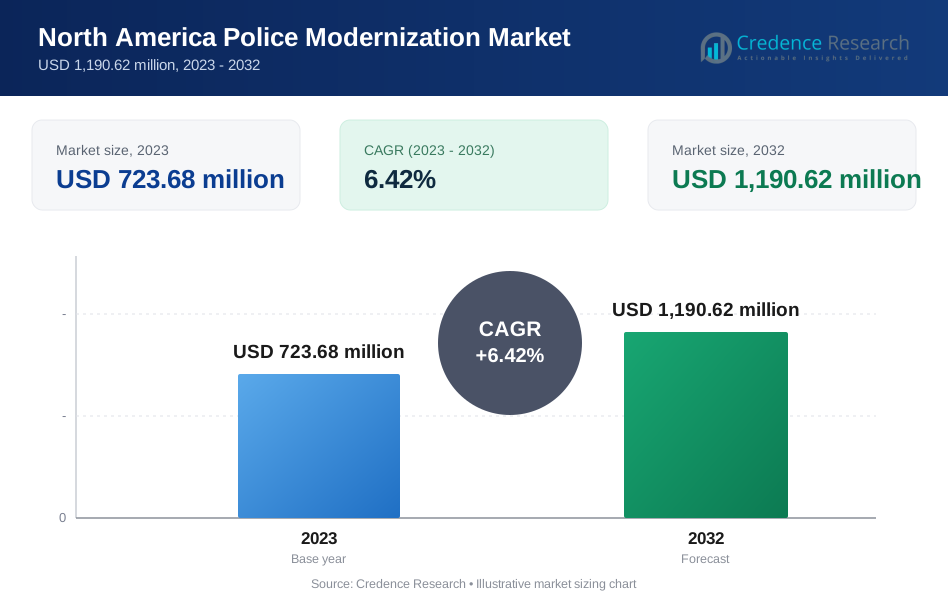
The North America police modernization market is projected to grow from USD 723.68 million in 2023 to USD 1,190.62 million by 2032, registering a CAGR of 6.42% during the forecast period.
The growth of the North America police modernization market is driven by increasing investments in advanced technologies to enhance law enforcement efficiency and public safety. The rising adoption of artificial intelligence, data analytics, and facial recognition systems improves surveillance capabilities and crime detection rates, fueling market demand. Additionally, the proliferation of smart city initiatives and the integration of IoT-based solutions for real-time monitoring bolster the adoption of modern policing equipment. Key trends influencing the market include the growing emphasis on non-lethal weapons, wearable technologies, and mobile-based communication systems to ensure officer safety and operational effectiveness. The shift toward predictive policing solutions and digital forensics tools to combat cybercrime and sophisticated criminal activities further shapes market dynamics. Moreover, supportive government policies and funding for police reforms and modernization accelerate technological advancements and innovation in the sector, creating new opportunities for market players in North America.
The North America police modernization market is primarily driven by the United States, Canada, and Mexico, with each country adopting advanced technologies to enhance law enforcement capabilities. Key players in the region, such as Motorola Solutions, Inc., Axon Enterprise, Inc., and Cisco Systems, Inc., are leading the development and deployment of cutting-edge solutions, including AI-powered surveillance, predictive policing software, and mobile communication systems. Other significant players like Northrop Grumman Corporation, Lockheed Martin Corporation, and L3Harris Technologies, Inc. contribute to the modernization of law enforcement infrastructure through their innovations in hardware, software, and integrated service solutions. These companies focus on providing advanced crime detection tools, non-lethal weapons, and secure communication networks, playing a crucial role in transforming police operations. Government initiatives and collaborations with private technology firms further support the growth of the market, fostering continuous advancements in policing technology across the region.
Market Insights
- The North America police modernization market is valued at USD 723.68 million in 2023 and is projected to reach USD 1,190.62 million by 2032, growing at a CAGR of 6.42%.
- Increasing demand for AI-powered surveillance systems and predictive policing technologies is driving market growth.
- Rising government investments in smart city initiatives and public safety programs are bolstering modernization efforts.
- Adoption of non-lethal weapons and wearable technologies is becoming a key trend in the market.
- Key players like Motorola Solutions, Inc., Axon Enterprise, Inc., and Cisco Systems, Inc. dominate the competitive landscape, providing advanced policing tools.
- Market restraints include high implementation costs and limited budgets for smaller law enforcement agencies.
- The U.S. leads the market, with Canada and Mexico also experiencing growth in police modernization, supported by federal funding and technological advancements.
Market Drivers
Increasing Adoption of Advanced Surveillance Technologies
The rising focus on enhancing public safety and crime prevention drives the adoption of advanced surveillance technologies in police modernization across North America. Law enforcement agencies increasingly deploy artificial intelligence (AI)-enabled solutions, facial recognition systems, and data analytics tools to improve real-time monitoring and decision-making capabilities. For instance, the New York Police Department (NYPD) has implemented AI-powered surveillance systems that have significantly improved crime detection rates. These technologies enhance situational awareness, streamline investigation processes, and boost operational efficiency. The demand for predictive policing systems that utilize big data and machine learning to analyze crime patterns further supports market growth by enabling proactive law enforcement strategies.
Growing Investment in Smart City Initiatives
The expansion of smart city projects across major urban centers in North America is a significant driver of police modernization. Smart cities integrate Internet of Things (IoT) devices, intelligent traffic management systems, and connected communication networks to improve urban infrastructure and safety. For instance, Chicago's smart city initiatives include the deployment of IoT sensors and connected communication networks to enhance public safety and urban management. Law enforcement agencies benefit from these integrated systems by accessing real-time data and automated alerts, enhancing rapid response and crime management. Government funding and public-private partnerships dedicated to smart city initiatives continue to accelerate the adoption of modern policing technologies and systems.
Rising Demand for Non-Lethal and Wearable Technologies
The increasing emphasis on minimizing use-of-force incidents and enhancing officer safety contributes to the rising demand for non-lethal weapons and wearable technologies. Tools such as tasers, body-worn cameras, and advanced protective gear are becoming standard in law enforcement agencies. These technologies not only reduce the risk of fatalities but also improve transparency and accountability through the recording and review of interactions between officers and civilians. The integration of wearable biometric monitoring devices for health and performance tracking further supports the adoption of innovative solutions in modern policing.
Supportive Government Policies and Funding
Government initiatives and regulatory frameworks focused on police reforms and technological advancements significantly drive market expansion. Increased funding for law enforcement agencies to modernize their infrastructure, acquire advanced equipment, and implement community policing programs underpins the market's growth. Policies promoting the use of technology for improving justice delivery and combating sophisticated criminal activities encourage continuous innovation in policing tools, creating robust opportunities for market participants across North America.
Market Trends
Growing Integration of AI and Predictive Policing
A key trend shaping the North America police modernization market is the increasing integration of artificial intelligence (AI) in law enforcement operations. AI-powered systems enhance crime prediction, data analysis, and decision-making processes, enabling proactive policing strategies. For instance, the Los Angeles Police Department (LAPD) has successfully implemented predictive policing tools that analyze historical crime data to identify potential risks and allocate resources more efficiently. The adoption of AI-driven surveillance, including facial recognition and license plate detection, further supports real-time monitoring and quick response to incidents, enhancing public safety measures.
Rising Adoption of Digital Forensics and Cybersecurity Tools
With the growing threat of cybercrime and digital offenses, law enforcement agencies are increasingly investing in digital forensics and advanced cybersecurity tools. Solutions for data extraction, encrypted communication decoding, and evidence management are becoming integral to modern policing strategies. This trend is driven by the need to combat sophisticated cyber threats, including identity theft, financial fraud, and ransomware attacks. Enhanced focus on secure data storage and management systems also aligns with evolving legal standards and privacy regulations, propelling technological innovation in police modernization.
Increased Deployment of Non-Lethal Weapons
The demand for non-lethal weapons continues to rise as police departments prioritize reducing use-of-force incidents and enhancing community relations. Innovations in non-lethal technology, such as advanced tasers, pepper spray devices, and rubber bullets, provide alternatives that improve officer safety while mitigating the risk of fatal encounters. For instance, the Seattle Police Department has adopted advanced tasers and body-worn cameras to improve transparency and accountability. This trend aligns with ongoing calls for police reforms and greater accountability, promoting the widespread adoption of these tools. Additionally, training programs focused on the effective use of non-lethal weapons are gaining traction to ensure proper handling and minimize misuse.
Expansion of Connected and Wearable Technologies
The growing use of connected devices and wearable technologies marks a significant trend in police modernization. Body-worn cameras, smart helmets, and biometric monitoring tools enhance officer performance, accountability, and situational awareness. Wearable technologies integrated with real-time data transmission enable efficient communication and improved field operations. Furthermore, advancements in augmented reality (AR) and heads-up displays (HUDs) are poised to revolutionize tactical training and on-ground decision-making, further advancing the modernization of law enforcement in North America.
Market Challenges Analysis
High Implementation Costs and Budget Constraints
One of the primary challenges facing the North America police modernization market is the significant cost associated with deploying advanced technologies. Modern policing tools, including AI-based predictive systems, IoT-enabled surveillance networks, and cybersecurity solutions, require substantial investment in hardware, software, and infrastructure upgrades. For instance, a report by the Police Executive Research Forum (PERF) highlighted that smaller police departments, which make up about 92% of the 17,541 state and local law enforcement agencies in the U.S., face significant resource constraints. Many law enforcement agencies operate under constrained budgets, limiting their ability to adopt comprehensive modernization programs. The cost of maintaining and updating these technologies further compounds financial pressures. Smaller municipalities, in particular, struggle to balance the need for technological advancement with funding limitations, which may slow the pace of modernization and widen the technological gap between regions.
Privacy Concerns and Regulatory Barriers
The increasing use of surveillance technologies, data analytics, and facial recognition systems raises significant privacy and ethical concerns. Public apprehension about the potential misuse of personal data and unauthorized surveillance has intensified scrutiny on law enforcement practices. Policymakers and regulatory bodies are implementing stricter data privacy laws and guidelines to safeguard citizen rights, which may hinder the adoption of certain technologies. Compliance with evolving legal frameworks presents an ongoing challenge for agencies aiming to leverage modern tools while respecting privacy boundaries. Balancing technological innovation with transparent and responsible use is critical to overcoming these regulatory hurdles and maintaining public trust in modern policing efforts.
Market Opportunities
Advancements in AI and Data-Driven Policing Solutions
The North America police modernization market offers significant opportunities through advancements in artificial intelligence (AI) and data-driven policing solutions. Law enforcement agencies increasingly seek predictive analytics, automated crime mapping, and machine learning algorithms to enhance operational efficiency and proactive decision-making. Companies specializing in AI-based software and big data analytics have the potential to meet growing demand by developing tailored solutions for crime forecasting, pattern recognition, and risk assessment. Additionally, the integration of AI with body-worn cameras and real-time surveillance systems opens avenues for improved situational awareness, reducing response times and enhancing public safety. The continued investment in smart city initiatives further expands opportunities for technology providers offering IoT-enabled devices and connected infrastructure for seamless data management and law enforcement automation.
Demand for Cybersecurity and Digital Forensics Innovations
The rising prevalence of cybercrime creates lucrative opportunities for providers of cybersecurity and digital forensics solutions. Law enforcement agencies increasingly require specialized tools to investigate digital offenses, secure data, and prevent cyber threats. Innovations in blockchain technology, encryption methods, and forensic software are critical for staying ahead of sophisticated criminal tactics. Companies focusing on developing user-friendly, scalable, and compliant cybersecurity platforms are well-positioned to capitalize on this growing market segment. Furthermore, partnerships between technology developers and government agencies present strategic opportunities for expanding service offerings, particularly in training programs for handling cyber-related investigations and implementing robust data protection strategies.
Market Segmentation Analysis:
By Component:
The North America police modernization market is segmented into hardware, software, and services. The hardware segment, comprising surveillance systems, body-worn cameras, drones, and non-lethal weapons, holds a significant market share due to the rising adoption of advanced equipment to enhance law enforcement efficiency. The software segment is witnessing robust growth as predictive policing, data analytics, and facial recognition software become integral to crime prevention strategies. Additionally, cybersecurity and digital forensics software are increasingly utilized to combat cybercrime. The services segment, which includes installation, maintenance, and training, plays a crucial role in supporting the deployment and effective use of modern policing technologies. Increased demand for integrated solutions and continuous technological upgrades drives growth across all component categories.
By Application:
Based on application, the market includes crime prevention, law enforcement operations, emergency response, and traffic management. Crime prevention dominates the segment as predictive analytics, AI-based crime mapping, and surveillance technologies enhance proactive policing. Law enforcement operations benefit from mobile communication systems, digital evidence management, and command-and-control platforms that improve field coordination and operational efficiency. Emergency response systems, including real-time alert networks and advanced dispatch systems, enhance response times and public safety. Traffic management systems, incorporating automated license plate readers and smart traffic monitoring, further modernize urban policing. The increasing complexity of public safety demands drives the adoption of technology across these application areas, supporting comprehensive police modernization.
Segments:
Based on Component:
- Hardware
- Software
- Services
Based on Application:
- Crime Prevention
- Law Enforcement Operations
- Emergency Response
- Traffic Management
Based on End-user:
- National Police Forces
- Local and Regional Law Enforcement Agencies
Based on Technology:
- Communication Systems
- Surveillance Systems
- Cybersecurity Solutions
- Protective Equipment
Based on the Geography:
- US.
- Canada
- Mexico
Regional Analysis
United States
The United States dominates the North America police modernization market, accounting for over 65% of the regional market share in 2023. This significant share is driven by the country’s robust investment in law enforcement technology and advanced surveillance systems. The U.S. government’s initiatives toward adopting artificial intelligence, predictive policing tools, and non-lethal weapon technologies contribute to the market’s growth. Federal and state funding programs further accelerate the modernization of police departments across urban and rural areas. Additionally, the growing emphasis on cybersecurity solutions to combat rising cybercrime and digital offenses strengthens the market position of technology providers serving the law enforcement sector in the United States.
Canada
Canada holds approximately 20% of the market share in North America and demonstrates steady growth in police modernization. The country’s law enforcement agencies are increasingly adopting digital forensics tools, mobile-based communication systems, and AI-powered surveillance solutions to enhance public safety and operational efficiency. Government investments in smart city initiatives, particularly in major metropolitan areas like Toronto and Vancouver, drive demand for IoT-enabled monitoring and real-time data management systems. Additionally, Canada’s focus on improving officer safety has boosted the adoption of body-worn cameras and non-lethal weapons, further contributing to the modernization of its police force.
Mexico
Mexico represents nearly 10% of the market share, with a growing focus on upgrading its law enforcement infrastructure to address rising crime rates and enhance public safety. Investments in surveillance technologies, including drone systems and automated license plate readers, are becoming increasingly prevalent. Mexico’s adoption of smart policing strategies, supported by partnerships between local governments and private technology providers, contributes to market growth. Efforts to improve emergency response systems and traffic management solutions further boost the demand for modernization technologies. Despite budget constraints, the emphasis on combating organized crime and enhancing police accountability drives continued investment in advanced policing tools.
Key Player Analysis
- Motorola Solutions, Inc.
- Axon Enterprise, Inc.
- Cisco Systems, Inc.
- Northrop Grumman Corporation
- Harris Corporation
- Lockheed Martin Corporation
- General Dynamics Corporation
- L3Harris Technologies, Inc.
- Booz Allen Hamilton Holding Corporation
- Dell Technologies
Competitive Analysis
The competitive landscape of the North America police modernization market is shaped by key players such as Motorola Solutions, Inc., Axon Enterprise, Inc., Cisco Systems, Inc., Northrop Grumman Corporation, Harris Corporation, Lockheed Martin Corporation, General Dynamics Corporation, L3Harris Technologies, Inc., Booz Allen Hamilton Holding Corporation, and Dell Technologies. These companies offer a wide range of advanced solutions, including AI-powered surveillance systems, predictive policing software, secure communication networks, and mobile devices tailored for law enforcement. For instance, a survey by the National Law Enforcement Survey (NLES) highlighted the significant impact of AI-powered surveillance systems and predictive policing software on improving crime prevention capabilities. Key drivers of competition include the continuous need for improved crime prevention capabilities, operational efficiency, and enhanced officer safety.
Companies that offer innovative crime detection technologies, real-time monitoring systems, and data analytics platforms are gaining a competitive edge by enabling law enforcement agencies to make more informed decisions and respond quickly to incidents. Additionally, those that provide comprehensive, integrated solutions including hardware, software, and services are well-positioned in the market, as agencies look for end-to-end offerings. The market is also witnessing competition in terms of pricing, product performance, and customer support. Vendors that can offer scalable, cost-effective solutions tailored to the specific needs of law enforcement agencies, while maintaining high performance and security standards, are more likely to succeed. Moreover, as new technological advancements emerge, companies are focused on continuous innovation to meet the evolving needs of modern policing.
Recent Developments
- In January 2025, Airbus delivered two new H225M helicopters to the French Armament General Directorate (DGA), which will be utilized for various law enforcement and military operations. These helicopters are part of a broader modernization effort to enhance aerial capabilities for security missions.
- In December 2024, Axon announced that Loomis US is deploying over 2,000 Axon Body 4 cameras as part of its commitment to enhancing safety and transparency for its armored service technicians across the United States.
- In October 2024, Leonardo announced a contract with the UAE Defense Ministry for a comprehensive upgrade of its secure communications network. This initiative aims to enhance national security through advanced encryption and improved IT infrastructure resilience against cyber threats.
- In October 2024, Motorola Solutions introduced a new real-time crime center solution that integrates 9-1-1 call intelligence into police operations. This technology enhances situational awareness and expedites responses to critical incidents.
- In September 2024, Thales Defense & Security Inc. was awarded a contract by the U.S. Army for an additional 2,705 AN/PRC-148F radios as part of its tactical radio modernization program. This order emphasizes Thales's role in enhancing secure communications within military operations.
- In June 2024, Cisco announced new AI-powered innovations across its security portfolio aimed at enhancing law enforcement capabilities. The introduction of Cisco Security Cloud Control is designed to unify management for security solutions, improving incident response times and overall security posture for police departments.
Market Concentration & Characteristics
The North America police modernization market exhibits moderate to high concentration, with a few key players dominating the landscape, particularly in the areas of AI-powered surveillance systems, predictive policing, and secure communication technologies. These companies hold significant market shares due to their established presence, broad product portfolios, and extensive customer bases across federal, state, and local law enforcement agencies. The market is characterized by strong competition among technology providers offering integrated solutions that combine hardware, software, and services to address the evolving needs of modern policing. Additionally, there is an increasing trend of partnerships and collaborations between law enforcement agencies and private firms to implement advanced solutions in areas like digital forensics, real-time data analytics, and non-lethal weapons. Despite a concentrated player base, the market is also witnessing an influx of small and medium-sized enterprises (SMEs) that bring specialized expertise and niche products, contributing to the diversification of available solutions. This allows agencies to select from a wide range of technologies that cater to specific operational requirements. Moreover, the increasing importance of data privacy and regulatory compliance in law enforcement technologies is driving innovation and prompting companies to continuously enhance their offerings to meet both security and privacy standards. As a result, the market continues to evolve with a mix of dominant players and emerging innovators shaping the future of police modernization.
Report Coverage
The research report offers an in-depth analysis based on Component, Application, End-user, Technology and Geography. It details leading market players, providing an overview of their business, product offerings, investments, revenue streams, and key applications. Additionally, the report includes insights into the competitive environment, SWOT analysis, current market trends, as well as the primary drivers and constraints. Furthermore, it discusses various factors that have driven market expansion in recent years. The report also explores market dynamics, regulatory scenarios, and technological advancements that are shaping the industry. It assesses the impact of external factors and global economic changes on market growth. Lastly, it provides strategic recommendations for new entrants and established companies to navigate the complexities of the market.
Future Outlook
- The North America police modernization market will continue to grow, driven by increasing demand for AI-driven solutions.
- Investments in predictive policing technologies and data analytics will enhance crime prevention and law enforcement efficiency.
- The adoption of body-worn cameras and real-time surveillance systems will rise as agencies prioritize transparency and officer safety.
- Increased government funding will support the expansion of smart city initiatives, contributing to the adoption of IoT-based policing tools.
- Cybersecurity technologies will become more critical as the rise of digital crimes demands advanced protective measures for law enforcement agencies.
- Integration of non-lethal weapons into police operations will increase to enhance officer safety and minimize the risk of fatalities.
- Collaboration between public and private sectors will drive innovation and facilitate the development of tailored solutions for law enforcement.
- The market will see a shift toward cloud-based platforms to enable better data management and real-time decision-making.
- Growth in mobile-based communication systems will improve field operations and enable officers to access critical information on-the-go.
- Regulatory and privacy concerns will shape the development of new technologies, ensuring compliance with data protection standards.
Request a Free Sample
Fill in your details and we'll send you a free sample report.
- Sample data tables & charts
- Research methodology
Need a Custom Version of This Report?
Tailor the scope, geography, or segments to your exact requirements.
- Custom geography or segment scope
- Direct access to our analyst team
Frequently Asked Questions
What is the current size of the North America Police Modernization market?
What factors are driving the growth of the North America Police Modernization market?
What are the key segments within the North America Police Modernization market?
What are some challenges faced by the North America Police Modernization market?
Table of Content
Chapter 1. Report Introduction
- 1.1 Report Description & Purpose
- 1.1.1 Report Title & Market Definition
- 1.1.2 Unique Selling Propositions (USP) & Key Differentiators
- 1.1.3 Value Proposition for Stakeholders
- 1.2 Research Objectives
- 1.2.1 Market Sizing Objectives (Volume & Revenue)
- 1.2.2 Segmentation Objectives
- 1.2.3 Competitive Intelligence Objectives
- 1.2.4 Forecast & Scenario Objectives
- 1.3 Report Scope
- 1.3.1 North America Police Modernization Scope – Types & Subtypes Covered
- 1.3.2 Geographic Scope – Regions & Countries Covered
- 1.3.3 Historical Period, Base Year & Forecast Period (2023; forecast to 2032)
- 1.3.4 Inclusions & Exclusions
- 1.4 HS Code & Classification Framework
- 1.5 Currency, Units & Pricing Basis
- 1.6 Target Stakeholders
- 1.7 Limitations & Assumptions
Chapter 2. Executive Summary
- 2.1 Global North America Police Modernization Market Snapshot
- 2.1.1 Market Size – Historical (2023) & Forecast (2023-2032) (2023: USD 723.68 million → 2032: USD 1,190.62 million)
- 2.1.2 Volume & Revenue – Global Totals
- 2.1.3 Key Market Highlights – Top Five Facts
- 2.2 North America Police Modernization Market Segmentation Snapshot
- 2.2.1 Market Split by Region – 2023 vs. 2032
- 2.3 Competitive Snapshot
- 2.3.1 Top 10 Players by Revenue Share – 2023
- 2.3.2 Top 10 Players by Volume Share – 2023
- 2.3.3 Recent Strategic Developments (18-Month Summary)
- 2.4 Key Investment Highlights & Strategic Conclusions
Chapter 3. North America Police Modernization Market Dynamics & Industry Analysis
- 3.1 Market Overview & Context
- 3.1.1 North America Police Modernization Market Position in the Broader Automotive Value Chain
- 3.1.2 OEM vs. Replacement Market Dynamics
- 3.1.3 Market Maturity & Development Stage by Region
- 3.2 North America Police Modernization Market Drivers
- 3.3 North America Police Modernization Market Restraints & Challenges
- 3.4 North America Police Modernization Market Opportunities
- 3.5 Porter's Five Forces Analysis
- 3.5.1 Threat of New Entrants
- 3.5.2 Bargaining Power of Suppliers
- 3.5.3 Bargaining Power of Buyers
- 3.5.4 Threat of Substitutes
- 3.5.5 Competitive Rivalry – Intensity Assessment
- 3.6 North America Police Modernization Value Chain Analysis
- 3.6.1 Upstream – Raw Material/Input Suppliers
- 3.6.1.1 Raw Material/Input 1
- 3.6.1.2 Raw Material/Input 2
- 3.6.1.3 Raw Material/Input 3
- 3.6.2 Midstream – Production/Manufacturing/Service Delivery
- 3.6.2.1 Production/Process Overview
- 3.6.2.2 Key Facility Locations & Capacity by Manufacturer
- 3.6.3 Downstream – Distribution & End Consumer
- 3.6.3.1 Primary Channel – B2B/OEM
- 3.6.3.2 Secondary Channels – Dealer, Retail, Online, Direct
- 3.6.4 Value Chain Profitability Analysis
- 3.6.1 Upstream – Raw Material/Input Suppliers
- 3.7 PESTEL Analysis
- 3.7.1 Political Factors
- 3.7.2 Economic Factors
- 3.7.3 Social Factors
- 3.7.4 Technological Factors
- 3.7.5 Environmental Factors
- 3.7.6 Legal Factors
- 3.8 North America Police Modernization Supply Chain Analysis
- 3.8.1 Raw Material/Input Supply Risk Assessment
- 3.8.2 Manufacturing Concentration Risk (Geographic Exposure)
- 3.8.3 Trade Disruption Impact Analysis
- 3.9 Regulatory & Policy Landscape
Note: The regulatory and policy landscape section covers regulations based on their applicability to the market, North America Police Modernization category, geography, and scope of the study. Only regulatory frameworks with a material impact on operations, compliance, trade, sustainability, or market access are analyzed in detail.
Chapter 4. Key Investment Pockets & Opportunity Analysis
- 4.1 North America Police Modernization Market Attractiveness Analysis
- 4.1.1 By Region – Investment Attractiveness Matrix (Volume × CAGR)
- 4.2 Absolute Revenue Growth Opportunity
- 4.2.1 By Region – Absolute USD Growth Through 2032
- 4.3 Incremental Volume Opportunity
- 4.3.1 By Region – Incremental Volume Through 2032
- 4.3.2 Segment – Incremental Volume
- 4.4 Emerging Submarket Opportunity Deep Dive (Subject to Applicability)
- 4.5 Emerging Market Opportunity Scorecards
- 4.5.1 United States
- 4.5.2 Europe
- 4.5.3 Asia
- 4.5.4 Middle East & Africa
Note: Emerging Market Opportunity Scorecards will be included based on relevance and strategic importance. Regions listed are indicative and may vary depending on data availability and market dynamics.
Chapter 5. North America Police Modernization Import-Export Analysis & Trade Flows
- 5.1 Global Trade Overview
- 5.1.1 Global Export Value by Country (2023)
- 5.1.2 Global Export Volume by Country (2023)
- 5.1.3 Global Import Value by Country (2023)
- 5.1.4 Global Import Volume by Country (2023)
- 5.1.5 Net Trade Balance by Country (2023)
- 5.2 Export Analysis – Segment
- 5.2.1 Type 1 (HS Code)
- 5.2.2 Type 2 (HS Code)
- 5.2.3 Type 3 (HS Code)
- 5.2.4 Type 4 (HS Code)
- 5.2.5 Type 5 (HS Code)
- 5.3 Import Analysis – Segment
- 5.3.1 Type 1 (HS Code)
- 5.3.2 Type 2 (HS Code)
- 5.3.3 Type 3 (HS Code)
- 5.3.4 Type 4 (HS Code)
- 5.3.5 Type 5 (HS Code)
- 5.4 Average Unit Trade Prices
- 5.4.1 Average Export Price – Segment & Country
- 5.4.2 Average Import Price – Segment & Source Country
- 5.4.3 Price Trends (2023)
- 5.5 Key Trade Route Analysis
- 5.5.1 Trade Route 1
- 5.5.2 Trade Route 2
- 5.5.3 Trade Route 3
- 5.5.4 Trade Route 4
- 5.5.5 Trade Route 5
- 5.6 Trade Policy Impact Assessment
- 5.6.1 US Anti-Dumping & Section 301 Tariffs
- 5.6.2 EU Customs Union Impact
- 5.6.3 Major Free Trade Agreements
- 5.6.4 USMCA Rules of Origin
Note: Trade policy analysis will be included only where relevant to the North America Police Modernization market.
Chapter 6. Competitive Landscape & Company Benchmarking
- 6.1 North America Police Modernization Market Concentration & Structure
- 6.1.1 Herfindahl-Hirschman Index (HHI) – vs. 2023
- 6.1.2 Tier 1, Tier 2 & Tier 3 Market Structure
- 6.1.3 Global, Regional & Local Player Dynamics
- 6.2 North America Police Modernization Market Share Analysis – 2023
- 6.2.1 Global Revenue Share by Company
- 6.2.2 Global Volume Share by Company
- 6.2.3 Regional Revenue Share
- 6.2.4 Market Share Evolution ( vs. 2023)
- 6.2.5 OEM Segment Share by Company
- 6.2.6 Replacement Segment Share by Company
- 6.3 Production/Delivery Capacity & Facility Analysis
- 6.3.1 Global Installed Capacity
- 6.3.2 Capacity Utilization Rates
- 6.3.3 Production/Output Volume
- 6.3.4 Facility Locations & Capacity Map
- 6.3.5 Planned Capacity Additions
- 6.4 North America Police Modernization Competitive Benchmarking Matrix
- 6.4.1 Revenue, Volume, CAGR & Profitability Comparison
- 6.4.2 Channel Revenue Mix
- 6.4.3 Geographic Revenue Exposure
- 6.4.4 R&D Intensity
- 6.4.5 Sustainability Maturity
- 6.5 Strategic Developments in North America Police Modernization (Last 24 Months)
- 6.5.1 Mergers, Acquisitions & Divestments
- 6.5.2 New North America Police Modernization Launches
- 6.5.3 Facility Expansions
- 6.5.4 Strategic Alliances, Joint Ventures & Partnerships
- 6.5.5 Distribution Expansion & Market Entry
- 6.5.6 Sustainability & ESG Initiatives
- 6.6 Competitive Strategy Mapping
- 6.6.1 Leader, Challenger, Follower & Niche Classification
- 6.6.2 Pricing Strategy Comparison
- 6.6.3 Channel Strategy Matrix
Note: Strategic developments are included based on their materiality and the availability of reliable information.
Chapter 7. Global North America Police Modernization Market – By Distribution Channel
- 7.1 Segment Overview
- 7.1.1 Volume & Revenue Split by Channel (2023 & 2032)
- 7.1.2 Channel Mix Evolution (2023-2032)
Chapter 8. Regional Market Analysis – Global Overview
- 8.1 Global Regional Overview
- 8.1.1 Regional Volume Share
- 8.1.2 Regional Revenue Share
- 8.1.3 Regional Volume by Region
- 8.1.4 Regional Revenue by Region
- 8.1.5 Regional Forecast Through 2032
- 8.2 Cross-Regional Segment Analysis
- 8.2.1 By Distribution Channel
- 8.2.2 By Brand/Price Tier
Chapter 9. North America North America Police Modernization Market
- 9.1 United States
- 9.2 Canada
- 9.3 Mexico
Chapter 10. Europe North America Police Modernization Market
- 10.1 Germany
- 10.2 France
- 10.3 Italy
- 10.4 United Kingdom
- 10.5 Spain
- 10.6 Poland
- 10.7 Russia
- 10.8 Netherlands
- 10.9 Belgium
- 10.10 Sweden
- 10.11 Denmark
- 10.12 Norway
- 10.13 Rest of Europe
Chapter 11. Asia Pacific North America Police Modernization Market
- 11.1 China
- 11.2 India
- 11.3 Japan
- 11.4 South Korea
- 11.5 Thailand
- 11.6 Indonesia
- 11.7 Vietnam
- 11.8 Malaysia
- 11.9 Australia
- 11.10 Rest of Asia Pacific
Chapter 12. Latin America North America Police Modernization Market
- 12.1 Brazil
- 12.2 Argentina
- 12.3 Colombia
- 12.4 Chile
- 12.5 Rest of Latin America
Chapter 13. Middle East North America Police Modernization Market
- 13.1 Saudi Arabia
- 13.2 United Arab Emirates
- 13.3 Turkey
- 13.4 Israel
- 13.5 Iran
- 13.6 Rest of the Middle East
Chapter 14. Africa North America Police Modernization Market
- 14.1 South Africa
- 14.2 Egypt
- 14.3 Nigeria
- 14.4 Morocco
- 14.5 Rest of Africa
Chapter 15. North America Police Modernization Company Profiles
- 15.1 [Company 01]
- 15.1.1 Company Overview
- 15.1.2 Key Management Personnel
- 15.1.3 Products & Services Portfolio
- 15.1.4 Financial Performance
- 15.1.5 Key Market Focus & Geographic Presence
- 15.1.6 Recent Developments & Strategic Initiatives
Note: The company profile list is preliminary and may change based on research findings, market developments, data availability, and client requirements.
Chapter 16. Appendices
- Appendix A – List of Abbreviations & Acronyms
- Appendix B – Industry Classification Code Reference – Full Series
- Appendix C – Production & Capacity Data Tables
- Appendix D – End-Use & Demand Base Tables
- Appendix E – Consumption & Replacement Rate Assumptions
- Appendix F – ASP Reference Tables
- Appendix G – Manufacturing & Facility Database
- Appendix H – Import-Export Data Tables
- Appendix I – Regulatory Summary Tables
- Appendix J – Primary Research Participant List (Anonymized)
- Appendix K – Primary Research Questionnaire Framework
- Appendix L – Data Sources & Bibliography
- Appendix M – Market Size Divergence & Source Comparison
Chapter 17. Research Methodology
- 17.1 Research Framework & Philosophy
- 17.2 Secondary Research – Sources, Hierarchy & Data Extraction
- 17.3 Data Modeling – Bottom-Up & Top-Down Market Sizing
- 17.4 Primary Research – Stakeholder Framework, LOI & Sample Sizes
- 17.5 Forecast Methodology – Regression, Scenario & Sensitivity Analysis
- 17.6 Quality Control – Four-Layer Validation Framework
- 17.7 Limitations & Standard Assumptions
- 17.8 Disclaimer
