Market Overview
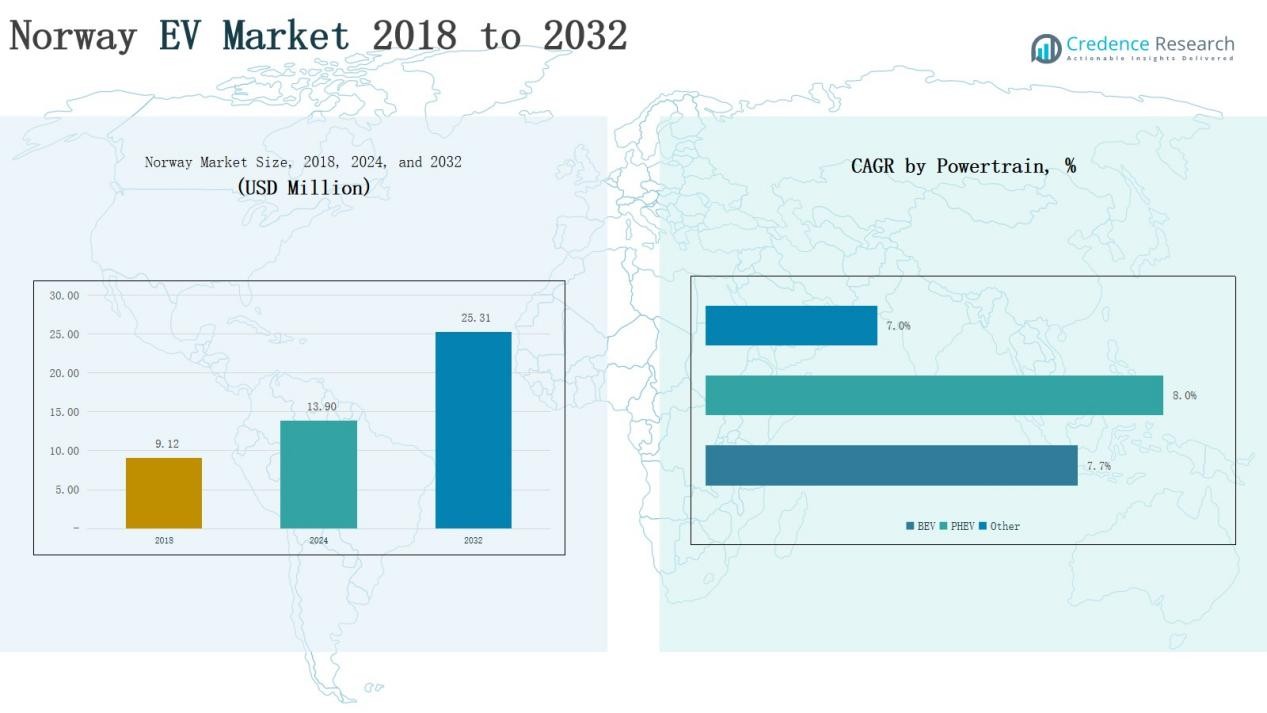
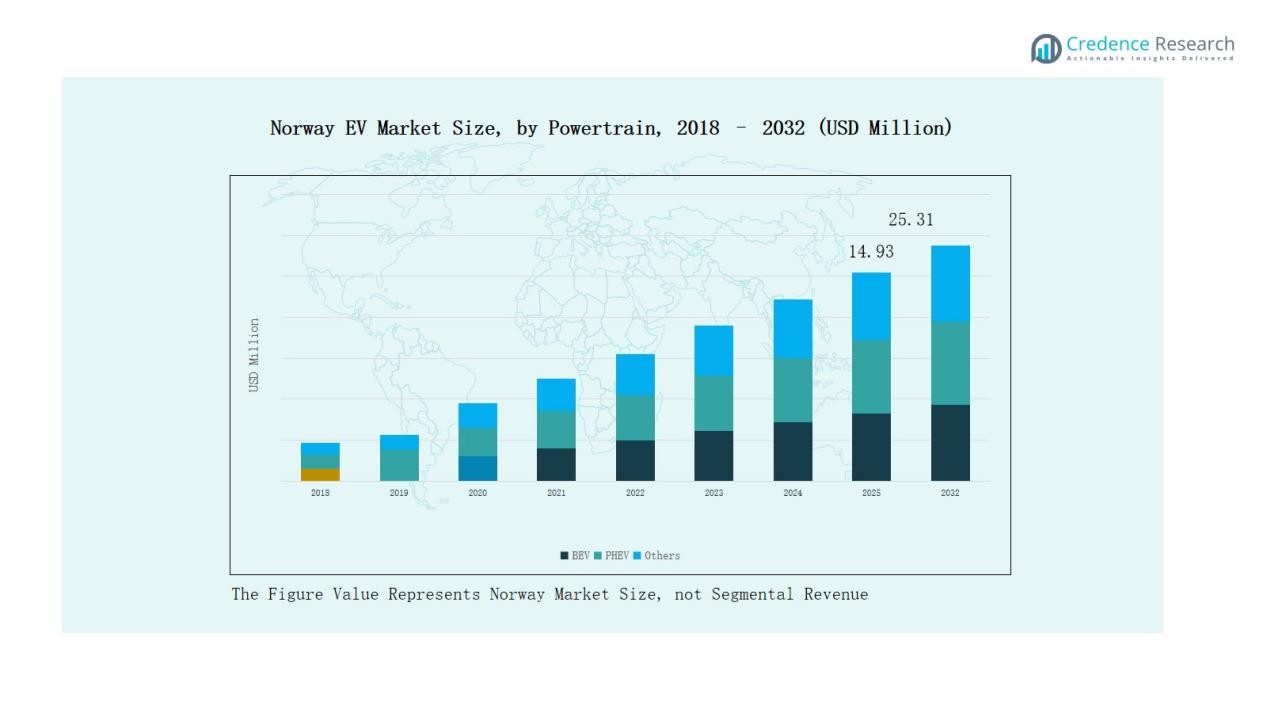
Norway Electric Vehicle (EV) Market size was valued at USD 9.12 million in 2018 to USD 13.90 million in 2024 and is anticipated to reach USD 25.31 million by 2032, at a CAGR of 7.78% during the forecast period.
| REPORT ATTRIBUTE | DETAILS |
|---|---|
| Historical Period | 2020-2023 |
| Base Year | 2024 |
| Forecast Period | 2025-2032 |
| Norway EV Market Size 2024 | USD 13.90 Million |
| Norway EV Market, CAGR | 7.78% |
| Norway EV Market Size 2032 | USD 25.31 Million |
The Norway EV Market is shaped by strong competition among leading automakers including Volkswagen, BMW, Mercedes-Benz, Tesla, Volvo, Audi, Skoda, Nissan, and Geely. Tesla leads the premium BEV category with advanced technology and strong brand positioning, while Volkswagen and Volvo dominate mass-market adoption through diversified product portfolios aligned with government-backed incentives. Luxury brands such as BMW, Mercedes-Benz, and Audi reinforce their presence by offering performance-oriented EVs targeting affluent buyers. Nissan and Geely focus on affordability and fleet-friendly options, expanding accessibility across customer segments. Regionally, Eastern Norway commanded the largest share at 45% in 2024, driven by dense urbanization, extensive charging infrastructure, and Oslo’s leadership in EV penetration.
Market Insights
- The Norway EV Market grew from USD 9.12 million in 2018 to USD 13.90 million in 2024 and is projected to reach USD 25.31 million by 2032.
- Battery Electric Vehicles held 75% share in 2024, supported by incentives, charging availability, and strong consumer preference for zero-emission mobility.
- Private buyers dominated with 70% share in 2024, while corporate buyers contributed 30% through fleet electrification and sustainability-driven adoption.
- Passenger cars led with 85% share in 2024, followed by commercial vehicles at 12% and two- and three-wheelers at 3%.
- Eastern Norway commanded the highest regional share with 45% in 2024, supported by Oslo’s leadership, dense urbanization, and advanced charging infrastructure.
Market Segment Insights
By Powertrain
Battery Electric Vehicles (BEVs) dominate the Norway EV market, accounting for nearly 75% of market share in 2024. Their leadership stems from generous government incentives, widespread charging infrastructure, and consumer preference for zero-emission mobility. Plug-in Hybrid Electric Vehicles (PHEVs) hold around 20% share, catering to buyers seeking range flexibility, while other powertrains such as fuel cell EVs and extended range EVs collectively represent less than 5%, reflecting limited adoption due to cost and infrastructure constraints.
- For instance, Tesla Model Y was Norway’s best-selling car for the third consecutive year in 2024, with 16,858 units registered, reflecting the strong popularity of BEVs.
By End User
Private buyers represent the largest share in Norway’s EV market, holding close to 70% of total sales in 2024. This dominance is driven by strong consumer subsidies, tax exemptions, and an environmentally conscious population. Corporate buyers account for nearly 30% share, supported by fleet electrification programs, company tax benefits, and sustainability targets, which are encouraging businesses to transition to EV fleets.
- For instance, Volkswagen Group announced that more than half of ID. Buzz sales in Norway were to commercial fleet buyers, encouraged by government tax savings on company cars.
By Vehicle Type
Passenger cars lead the market with an overwhelming 85% share in 2024, positioning Norway as a global leader in personal EV adoption. Rising household incomes, high urban adoption, and policy-driven support strengthen this segment. Commercial vehicles, including light and heavy-duty models, hold around 12% share, with growth supported by logistics companies shifting to green fleets.
Key Growth Drivers
Strong Government Incentives and Policies
The Norway EV Market benefits significantly from robust government incentives, making EV adoption highly attractive. Buyers receive exemptions from registration taxes, road tolls, and reduced VAT, which lower upfront costs. In addition, EV drivers enjoy access to bus lanes and discounted parking. These measures have created one of the most supportive policy environments worldwide, ensuring BEVs dominate sales. Continued alignment with Norway’s carbon neutrality targets further strengthens demand, reinforcing the role of government initiatives as the foundation for market expansion.
- For instance, Norwegian Road Federation (OFV) reported that BEVs accounted for 82.3% of all new car sales, with models like the Tesla Model Y leading registrations.
Extensive Charging Infrastructure
Norway has developed one of the most advanced EV charging networks in Europe, providing nationwide accessibility. The country has thousands of fast and ultra-fast charging points strategically placed along highways and in urban centers. This comprehensive infrastructure reduces range anxiety, ensuring both private buyers and corporate fleets can rely on EVs for daily use and long-distance travel. Continuous investments by government agencies and private firms are improving capacity, speed, and coverage, making infrastructure a strong growth catalyst for EV adoption in Norway.
- For instance, Recharge has expanded its network to more than 4,400 charging points across the Nordics, with a significant presence in Norway and strong highway coverage.
Rising Consumer Environmental Awareness
Environmental consciousness plays a vital role in accelerating EV demand in Norway. A growing share of consumers prioritize sustainability and are shifting away from combustion engine vehicles to reduce carbon footprints. High levels of awareness about climate change, combined with the government’s vision of phasing out fossil fuel car sales by 2025, strengthen this behavior. The Norwegian population demonstrates strong readiness to adopt clean mobility solutions, creating a favorable environment where EVs are viewed as both eco-friendly and future-proof investments.
Key Trends & Opportunities
Growth in Corporate Fleet Electrification
Corporate electrification is emerging as a major trend in the Norway EV Market, driven by sustainability commitments. Businesses across logistics, ride-hailing, and corporate mobility are investing heavily in EV fleets to reduce emissions and operating costs. Supportive tax deductions and fleet-targeted incentives make corporate adoption more appealing. This trend creates opportunities for automakers to launch tailored models with higher range, faster charging, and total cost-of-ownership benefits, positioning corporate fleets as a high-growth area in the coming years.
- For instance, Kempower, a leading Finnish supplier, installed over 3,000 DC fast chargers across Norway by mid-2025, including in remote areas, supporting fleet operators with reliable, distributed charging infrastructure crucial for corporate electrification.
Expansion of Vehicle Segments Beyond Passenger Cars
While passenger cars dominate, new opportunities are arising in commercial vehicles and two-wheelers. Logistics firms are electrifying vans and trucks to comply with stricter emission regulations and reduce fuel costs. Similarly, growth in e-mobility solutions is fueling interest in two-wheelers and three-wheelers for last-mile delivery services. These segments, though smaller today, are poised to expand as infrastructure develops further and specialized EV offerings become available, allowing Norway to diversify EV adoption beyond its core passenger car market.
- For instance, Einride launched electric freight mobility services in Norway with PostNord, targeting a reduction of 2,100 tonnes of CO2e emissions over three years, signaling strong interest in electrifying heavy-duty trucks for logistics compliance and cost savings.
Key Challenges
High Upfront Vehicle Costs
Despite subsidies, the Norway EV Market faces challenges from the high upfront cost of EVs compared to conventional vehicles. Premium BEVs dominate the market, limiting affordability for lower-income households. While running costs are lower, the initial purchase price still creates a barrier for broader adoption. Unless manufacturers expand affordable EV models and battery costs decline further, cost sensitivity may slow growth, especially in smaller towns and rural areas where financial incentives alone may not sufficiently offset purchase barriers.
Battery Supply Chain and Raw Material Dependence
The Norway EV Market depends on global supply chains for critical battery materials like lithium, cobalt, and nickel. Price volatility and limited availability of these resources pose risks to production stability and affordability. Norway does not have a strong domestic raw material supply base, making it reliant on imports and international suppliers. This dependency exposes the market to geopolitical tensions and cost fluctuations, creating a significant challenge for sustainable EV growth in the long term.
Charging Infrastructure Load and Grid Capacity
Although Norway has advanced charging coverage, the rapid increase in EV adoption strains the national grid. High demand during peak hours, especially from fast-charging stations, creates pressure on capacity and stability. Grid upgrades require substantial investments and time, and any delay in expansion risks slowing EV adoption momentum. Without continuous modernization and integration of renewable energy sources, charging reliability may face bottlenecks, potentially discouraging consumers and fleet operators from fully transitioning to electric mobility.
Regional Analysis
Eastern Norway
Eastern Norway leads the Norway EV Market with a 45% share in 2024. The region benefits from dense urbanization, high purchasing power, and extensive charging infrastructure. Oslo, the capital, acts as the hub of EV adoption with strong consumer preference for zero-emission vehicles. It demonstrates the highest penetration of passenger BEVs supported by municipal subsidies and environmental goals. Corporate buyers also contribute significantly through fleet electrification. It remains the core growth engine, supported by both government policy and consumer demand.
Western Norway
Western Norway holds a 25% share in 2024, driven by strong environmental awareness and sustainable transport programs. The region features challenging terrains and long commutes, creating a preference for EVs with higher ranges. Bergen and surrounding cities promote clean mobility through regional initiatives and tax exemptions. It benefits from expanding charging networks along coastal highways. The market shows strong adoption among private buyers, while commercial fleets are gradually electrifying. It continues to strengthen demand through eco-conscious consumers and growing tourism-related mobility services.
Northern Norway
Northern Norway accounts for a 15% share in 2024, with adoption supported by national subsidies and infrastructure expansion. Harsh weather conditions and long travel distances make reliability and fast-charging access critical. It still faces barriers due to fewer charging stations compared to the south. The region is gradually improving accessibility through state-backed projects. Private buyers dominate, but fleet adoption is gaining momentum in logistics. It represents a region with untapped potential for growth as infrastructure continues to expand.
Central Norway
Central Norway represents a 15% share in 2024, supported by regional development programs and growing demand for EVs in mid-sized cities. Trondheim plays a leading role, promoting EV adoption through incentives and smart mobility projects. The region benefits from improved road networks and increasing investments in fast-charging stations. Corporate buyers are beginning to transition fleets, while private buyers remain the main contributors. It provides a balanced market with both passenger cars and light commercial EVs gaining share. The region continues to evolve as policies and infrastructure align.
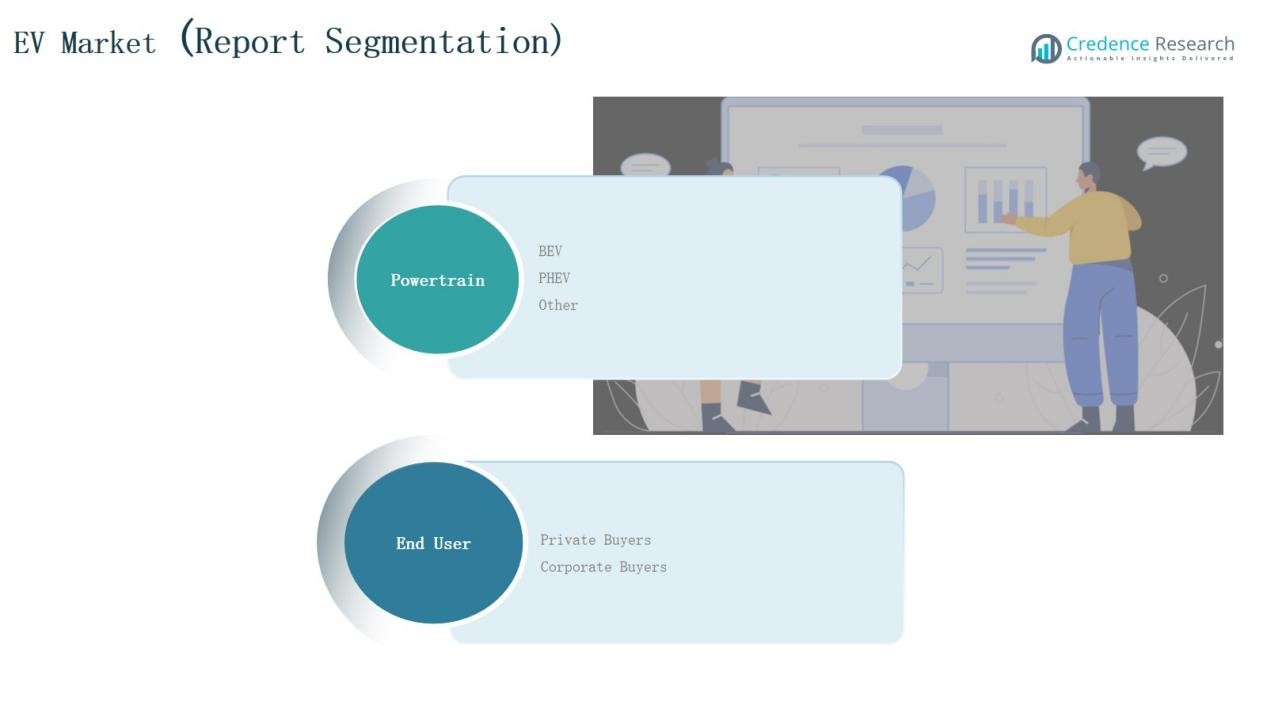
Market Segmentations:
By Powertrain
- Battery Electric Vehicles (BEVs)
- Plug-in Hybrid Electric Vehicles (PHEVs)
- Other Powertrains (Fuel Cell EVs, Extended Range EVs, etc.)
By End User
- Private Buyers
- Corporate Buyers
By Vehicle Type
- Passenger Cars
- Commercial Vehicles (LCVs, HCVs, Buses)
- Two-Wheelers & Three-Wheelers
By Charging Type
- Home Charging
- Public Charging (Slow & Fast)
By Region
- Eastern Norway
- Western Norway
- Northen Norway
- Central Norway
Competitive Landscape
The Norway EV Market is highly competitive, shaped by global automakers and regional players focusing on electrification. Tesla leads the premium BEV category, supported by advanced technology, strong charging ecosystems, and high brand recognition. Volkswagen and Volvo dominate mass-market segments, leveraging broad product portfolios and government-backed programs that support large-scale adoption. BMW, Mercedes-Benz, and Audi strengthen their positions in the luxury segment with performance-driven EV models tailored to affluent buyers. Nissan and Hyundai contribute to accessibility through mid-range, affordable EVs suited for private buyers, while BYD and Geely gain traction with competitively priced models targeting fleet and corporate customers. The market’s competitive intensity is reinforced by frequent product launches, battery innovations, and partnerships aimed at expanding charging networks. It continues to evolve rapidly, with players focusing on range, affordability, and sustainability to capture share in a country where EV penetration outpaces global averages.
Key Players
- Volkswagen AG
- BMW AG
- Mercedes-Benz Group AG
- Tesla, Inc.
- Volvo Car Corporation
- Audi AG
- Skoda Auto
- Nissan Motor Co., Ltd.
- Geely Holding Group
- Others
Recent Developments
- In June 2025, Tesla launched its updated Model Y in Norway, achieving record sales and boosting EV registrations across the country.
- In June 2024, Volkswagen’s charging unit Elli partnered with Norwegian solar firm Otovo to integrate home solar panels, storage solutions, and EV charging services.
- In 2024, Toyota increased its fully electric model portfolio in Norway from one to five to strengthen its EV market presence and compete with Tesla and others.
Report Coverage
The research report offers an in-depth analysis based on Powertrain, End User, Vehicle Type, Charging Type and Region. It details leading market players, providing an overview of their business, product offerings, investments, revenue streams, and key applications. Additionally, the report includes insights into the competitive environment, SWOT analysis, current market trends, as well as the primary drivers and constraints. Furthermore, it discusses various factors that have driven market expansion in recent years. The report also explores market dynamics, regulatory scenarios, and technological advancements that are shaping the industry. It assesses the impact of external factors and global economic changes on market growth. Lastly, it provides strategic recommendations for new entrants and established companies to navigate the complexities of the market.
Future Outlook
- EV adoption will continue to rise as Norway maintains its 2025 zero-emission vehicle target.
- Battery electric vehicles will strengthen dominance, supported by consistent policy incentives.
- Plug-in hybrid sales will remain steady but face pressure from stricter emission regulations.
- Charging infrastructure expansion will focus on ultra-fast stations across highways and remote areas.
- Corporate fleet electrification will accelerate, driven by sustainability commitments and cost advantages.
- Growth in commercial EV adoption will increase, especially in logistics and public transport fleets.
- Innovation in battery technology will reduce costs and improve range for private buyers.
- Competition among global and regional automakers will intensify with frequent new model launches.
- Integration of renewable energy with charging networks will gain importance for grid stability.
- Consumer preference for eco-friendly transport will sustain long-term demand across all vehicle categories.

Request a Free Sample
Fill in your details and we'll send you a free sample report.
- Sample data tables & charts
- Research methodology
Market Dynamics
Strong Government Incentives and Policies
Norway’s robust government incentives, including tax exemptions, reduced VAT, and access to bus lanes, significantly lower the cost of EV ownership and make electric vehicles highly attractive to both private and corporate buyers. These policies are foundational in driving rapid EV adoption and maintaining Norway’s global leadership in EV penetration.
Extensive Charging Infrastructure
Norway has developed one of Europe’s most advanced EV charging networks, with thousands of fast and ultra-fast charging points across urban and rural areas. This widespread infrastructure alleviates range anxiety and supports both daily commuting and long-distance travel, encouraging more consumers and businesses to switch to EVs.
Rising Consumer Environmental Awareness
A highly environmentally conscious population, combined with national goals to phase out fossil fuel vehicles by 2025, drives strong consumer preference for zero-emission mobility. This cultural and regulatory alignment accelerates the shift from combustion engines to electric vehicles.
Growth in Corporate Fleet Electrification
Corporate sustainability commitments and favorable tax deductions are prompting businesses to electrify their fleets. This trend is expanding the market beyond private buyers, creating new opportunities for automakers to supply tailored EV solutions for logistics, ride-hailing, and company mobility needs.
Innovation in Battery Technology
Continuous advancements in battery technology are reducing costs and improving vehicle range, making EVs more accessible and practical for a wider range of consumers. These innovations support market growth by addressing key barriers such as affordability and driving distance.
Need a Custom Version of This Report?
Tailor the scope, geography, or segments to your exact requirements.
- Custom geography or segment scope
- Direct access to our analyst team
Frequently Asked Questions
What is the current market size for Norway EV Market, and what is its projected size in 2032?
At what Compound Annual Growth Rate is the Norway EV Market projected to grow between 2025 and 2032?
Which Norway EV Market segment held the largest share in 2024?
What are the primary factors fueling the growth of the Norway EV Market?
Who are the leading companies in the Norway EV Market?
Which region commanded the largest share of the Norway EV Market in 2024?
Table of Content
Chapter 1 Market Segmentation
- 1.1 Segmentation Framework
- 1.1.1 Product and Service Classification
- 1.1.2 Application and End-Use Classification
- 1.1.3 Technology and Solution Classification
- 1.1.4 Customer and Distribution Channel Classification
- 1.1.5 Geographic Segmentation
- 1.1.6 Market Segment Definitions and Boundaries
- 1.2 By End User
- 1.2.1 Private Buyers
- 1.2.2 Corporate Buyers
- 1.3 By Powertrain
- 1.3.1 Battery Electric Vehicles (BEVs)
- 1.3.2 Plug-in Hybrid Electric Vehicles (PHEVs)
- 1.3.3 Other Powertrains (Fuel Cell EVs, Extended Range EVs, etc.)
- 1.4 By Vehicle Type
- 1.4.1 Passenger Cars
- 1.4.2 Commercial Vehicles (LCVs, HCVs, Buses)
- 1.4.3 Two-Wheelers & Three-Wheelers
- 1.5 By Charging Type
- 1.5.1 Home Charging
- 1.5.2 Public Charging (Slow & Fast)
Chapter 2 Introduction
- 2.1 Report Objectives and Scope
- 2.2 Product Definition and Industry Terminology
- 2.3 Market Inclusions and Exclusions
- 2.4 Research Process
- 2.4.1 Primary Research and Expert Interviews
- 2.4.2 Secondary Research and Source Review
- 2.4.3 Top-Down and Bottom-Up Estimation
- 2.4.4 Data Triangulation and Verification
- 2.5 Market Size Measurement Basis
- 2.5.1 2024: USD 13.90 million → 2032: USD 25.31 million
- 2.6 Historical and Forecast Reference Periods
- 2.6.1 Base Year: 2024
- 2.6.2 Forecast Period: 2024-2032
- 2.7 Research Assumptions and Limitations
Chapter 3 Executive Summary
- 3.1 Market Snapshot and Key Findings
- 3.2 Base-Year Market Size, 2024
- 3.3 Forecast Market Size, 2032
- 3.4 Revenue and Volume Growth Outlook
- 3.5 Key Demand and Supply Indicators
- 3.6 Leading Market Segments
- 3.7 Fastest-Growing Market Opportunities
- 3.8 Regional Performance Highlights
- 3.9 Technology and Industry Transformation
- 3.10 Competitive Landscape Summary
- 3.11 Analyst View and Strategic Implications
Chapter 4 Norway Electric Vehicle (EV) Market Trends and Developments
- 4.1 Historical Industry Development
- 4.2 Recent Market Trends and Developments
- 4.3 Demand and Customer Behavior Trends
- 4.4 Technology and Product Innovation
- 4.5 Artificial Intelligence, Automation and Digitalization
- 4.6 Local Manufacturing and Supply Chain Realignment
- 4.7 Industry Partnerships, Mergers and Acquisitions
- 4.8 Sustainability and Circular Economy Developments
- 4.9 Government and Private Sector Investment Trends
- 4.10 Emerging Business Models and Commercialization
- 4.11 Industry Developments and Announcements
Chapter 5 Norway Electric Vehicle (EV) Market Production, Supply and Demand Analysis
- 5.1 Demand Trend and Consumption Analysis
- 5.2 Demand Forecast, 2024-2032
- 5.3 Production and Output Trend
- 5.4 Production and Output Forecast, 2024-2032
- 5.5 Installed Capacity and Capacity Utilization
- 5.6 Company-Wise Production Plants and Statistics
- 5.6.1 Installed Production Capacity
- 5.6.2 Actual Production
- 5.6.3 Planned Capacity and Expansion Targets
- 5.7 Supply Chain Structure and Procurement Trends
- 5.8 Supply-Demand Gap and Bottlenecks
- 5.9 Import Dependence and Sourcing Structure
- 5.10 Contract Manufacturing and Outsourcing
- 5.11 Regional Supply and Demand Concentration
Chapter 6 Norway Electric Vehicle (EV) Market Pricing Analysis
- 6.1 Pricing Structure and Measurement
- 6.2 Historical Pricing Trends
- 6.3 Pricing Outlook, 2024-2032
- 6.4 Average Selling Price and Unit Economics
- 6.5 Pricing by Product and Market Segment
- 6.6 Geographic Pricing Differences
- 6.7 Key Input, Energy, Labor and Logistics Costs
- 6.8 Contract Pricing and Purchasing Models
- 6.9 Pricing Sensitivity and Competitive Positioning
- 6.10 Price, Margin and Profitability Implications
Chapter 7 Norway Electric Vehicle (EV) Market Dynamics
- 7.1 Market Growth Drivers
- 7.1.1 Demand-Side Drivers
- 7.1.2 Technology and Innovation Drivers
- 7.1.3 Infrastructure and Investment Drivers
- 7.1.4 Regulatory and Policy Drivers
- 7.2 Market Restraints
- 7.2.1 Cost and Affordability Constraints
- 7.2.2 Technology and Adoption Barriers
- 7.2.3 Supply Chain and Operational Constraints
- 7.3 Market Challenges
- 7.3.1 Competitive Pressure and Margin Erosion
- 7.3.2 Skills, Infrastructure and Implementation Gaps
- 7.4 Emerging Market Opportunities
- 7.5 Market Dynamics Impact and Time-Horizon Assessment
Chapter 8 Norway Electric Vehicle (EV) Value Chain Analysis
- 8.1 Industry Value Chain Overview
- 8.2 Upstream Suppliers and Critical Inputs
- 8.3 Technology and Component Providers
- 8.4 Manufacturing or Service Delivery
- 8.5 Distribution, Channel Partners and Integrators
- 8.6 Downstream Applications and End Users
- 8.7 Value Addition and Profit Pools
- 8.8 Vertical Integration and Outsourcing
- 8.9 Supplier Concentration and Risk
- 8.10 Supply Chain Localization and Resilience
Chapter 9 Norway Electric Vehicle (EV) Market Regulations and Policies
- 9.1 Relevant Laws, Standards and Compliance Frameworks
- 9.2 Product, Service, Safety and Quality Requirements
- 9.3 Government Policies, Incentives and Subsidies
- 9.4 Imports, Exports and Trade Barriers
- 9.5 Public Procurement and Local Content Requirements
- 9.6 Environmental and Sustainability Compliance
- 9.7 Upcoming Policy Changes and Market Implications
Chapter 10 Norway Electric Vehicle (EV) Market Hotspots and Opportunities
- 10.1 Market Opportunity Mapping and Growth Hotspots
- 10.2 High-Growth Applications and Customer Groups
- 10.3 Underserved Markets and White-Space Opportunities
- 10.4 Emerging Technology and Product Opportunities
- 10.5 New Capacity and Investment Hotspots
- 10.6 Market Entry and Expansion Opportunities
- 10.7 Distribution and Partnership Opportunities
- 10.8 Near-Term and Long-Term Commercial Potential
- 10.9 Opportunity Attractiveness and Execution Risks
Chapter 11 Norway Electric Vehicle (EV) Market Outlook, 2024-2032
- 11.1 Market Size and Analysis
- 11.1.1 Revenue (Market Measurement: 2024: USD 13.90 million → 2032: USD 25.31 million)
- 11.1.2 Market Volume and Quantity Sold
- 11.1.3 Historical Market Size
- 11.1.4 Base-Year Market Size, 2024
- 11.2 Market Forecast, 2024-2032
- 11.2.1 Revenue Forecast to 2032
- 11.2.2 Volume Forecast to 2032
- 11.2.3 CAGR and Year-on-Year Growth
- 11.2.4 Incremental Revenue Opportunity
- 11.3 Forecast Assumptions and Scenario Analysis
- 11.3.1 Base-Case Forecast
- 11.3.2 Optimistic and Conservative Scenarios
- 11.3.3 Technology, Pricing and Policy Sensitivities
- 11.4 Market Attractiveness and Growth Outlook
Chapter 12 Norway Electric Vehicle (EV) Market Segmentation and Outlook
- 12.1 Segmentation Summary and Market Shares, 2024
- 12.2 Largest and Fastest-Growing Segments
- 12.3 By End User - Market Size and Forecast, 2024-2032
- 12.3.1 Segment Definition and Scope
- 12.3.2 Historical Market Size
- 12.3.3 Revenue Forecast, 2024-2032
- 12.3.4 Volume Forecast, 2024-2032
- 12.3.5 Base-Year Market Share, 2024
- 12.3.6 Segment CAGR and Growth Drivers
- 12.3.7 Subsegment Market Size and Forecast
- 12.3.7.1 Private Buyers
- 12.3.7.2 Corporate Buyers
- 12.3.8 Subsegment Pricing and Adoption Trends
- 12.3.9 Leading Suppliers and Competition
- 12.3.10 Regional Demand and Opportunities
- 12.4 By Powertrain - Market Size and Forecast, 2024-2032
- 12.4.1 Segment Definition and Scope
- 12.4.2 Historical Market Size
- 12.4.3 Revenue Forecast, 2024-2032
- 12.4.4 Volume Forecast, 2024-2032
- 12.4.5 Base-Year Market Share, 2024
- 12.4.6 Segment CAGR and Growth Drivers
- 12.4.7 Subsegment Market Size and Forecast
- 12.4.7.1 Battery Electric Vehicles (BEVs)
- 12.4.7.2 Plug-in Hybrid Electric Vehicles (PHEVs)
- 12.4.7.3 Other Powertrains (Fuel Cell EVs, Extended Range EVs, etc.)
- 12.4.8 Subsegment Pricing and Adoption Trends
- 12.4.9 Leading Suppliers and Competition
- 12.4.10 Regional Demand and Opportunities
- 12.5 By Vehicle Type - Market Size and Forecast, 2024-2032
- 12.5.1 Segment Definition and Scope
- 12.5.2 Historical Market Size
- 12.5.3 Revenue Forecast, 2024-2032
- 12.5.4 Volume Forecast, 2024-2032
- 12.5.5 Base-Year Market Share, 2024
- 12.5.6 Segment CAGR and Growth Drivers
- 12.5.7 Subsegment Market Size and Forecast
- 12.5.7.1 Passenger Cars
- 12.5.7.2 Commercial Vehicles (LCVs, HCVs, Buses)
- 12.5.7.3 Two-Wheelers & Three-Wheelers
- 12.5.8 Subsegment Pricing and Adoption Trends
- 12.5.9 Leading Suppliers and Competition
- 12.5.10 Regional Demand and Opportunities
- 12.6 By Charging Type - Market Size and Forecast, 2024-2032
- 12.6.1 Segment Definition and Scope
- 12.6.2 Historical Market Size
- 12.6.3 Revenue Forecast, 2024-2032
- 12.6.4 Volume Forecast, 2024-2032
- 12.6.5 Base-Year Market Share, 2024
- 12.6.6 Segment CAGR and Growth Drivers
- 12.6.7 Subsegment Market Size and Forecast
- 12.6.7.1 Home Charging
- 12.6.7.2 Public Charging (Slow & Fast)
- 12.6.8 Subsegment Pricing and Adoption Trends
- 12.6.9 Leading Suppliers and Competition
- 12.6.10 Regional Demand and Opportunities
- 12.7 Segment Growth Comparison
- 12.8 Segment Attractiveness and Priority Matrix
Chapter 13 Norway Electric Vehicle (EV) End-Use and Application Market Outlook
- 13.1 End-Use Industry and Customer Demand Structure
- 13.2 Leading Applications and Customer Groups
- 13.3 End-Use Market Size, Share and Forecast
- 13.4 Major End-Use Industry Deep Dives
- 13.4.1 Customer Requirements and Use Cases
- 13.4.2 Demand and Replacement Cycles
- 13.4.3 Technical and Regulatory Considerations
- 13.4.4 Purchasing and Procurement Models
- 13.4.5 Leading Vendors and Distribution Channels
- 13.4.6 Forecast and Commercial Opportunities
- 13.5 Emerging Applications and Cross-Segment Demand
- 13.6 End-Use Industry Investment Priorities
Chapter 14 Norway Electric Vehicle (EV) Geographic Market Outlook, 2024-2032
- 14.1 Domestic Market Distribution and Demand Clusters
- 14.2 State- or Province-Wise Market Size and Forecast, 2024-2032
- 14.3 City and Metropolitan Market Outlook
- 14.4 Industrial, Manufacturing and Commercial Clusters
- 14.5 Geographic Concentration of Key End Users
- 14.6 Local Pricing and Purchasing Differences
- 14.7 Domestic Production Facilities and Capacity Map
- 14.8 Local Infrastructure and Project Pipeline
- 14.9 State-Level Policy and Incentive Differences
- 14.10 Subnational Investment Hotspots and Opportunities
- 14.11 Distribution and Logistics Networks
- 14.12 Domestic Competitive Footprint
Chapter 15 Norway Electric Vehicle (EV) Technology, Innovation and Sustainability Outlook
- 15.1 Technology Landscape and Maturity
- 15.2 Product, Process and Service Innovation
- 15.3 AI, Automation and Digital Tools in the Industry
- 15.4 Technology Adoption and Performance Benchmarking
- 15.5 Innovation Pipeline and R&D Investment
- 15.6 Patent and Intellectual Property Trends
- 15.7 Energy Efficiency and Resource Management
- 15.8 Sustainability, Recycling and Circularity
- 15.9 Technology Roadmap, 2024-2032
- 15.10 Risks of Obsolescence and Technology Substitution
Chapter 16 Norway Electric Vehicle (EV) Market Key Strategic Imperatives
- 16.1 Growth and Market Entry Priorities
- 16.2 High-Return Products and Segments
- 16.3 Pricing, Profitability and Cost Optimization
- 16.4 Technology Investment and Product Differentiation
- 16.5 Supply Chain Localization and Resilience
- 16.6 Distribution and Customer Acquisition
- 16.7 Partnership, Acquisition and Capacity Strategy
- 16.8 Regional Expansion Priorities
- 16.9 Short-, Medium- and Long-Term Actions
Chapter 17 Competition Outlook
- 17.1 Industry Competition Characteristics
- 17.2 Market Structure and Concentration
- 17.3 Market Share and Competitive Positioning, 2024
- 17.4 Company-Wise Revenue and Product Benchmarking
- 17.5 Production and Service Capacity Benchmarking
- 17.6 Technology, Pricing and Differentiation
- 17.7 Regional Footprint and Distribution Strength
- 17.8 Mergers, Acquisitions and Strategic Alliances
- 17.9 New Entrants and Competitive Threats
- 17.10 Porter's Five Forces and Industry Attractiveness
- 17.11 Competitive Outlook, 2024-2032
Chapter 18 Company Profiles
- 18.1 Company Coverage and Selection Criteria
- 18.2 Volkswagen AG
- 18.2.1 Business Description
- 18.2.2 Company Ownership and Geographic Presence
- 18.2.3 Product and Service Portfolio
- 18.2.4 Manufacturing and Operating Footprint
- 18.2.5 Production Capacity and Expansion Plans
- 18.2.6 Financial Performance and Investment
- 18.2.7 Market Share and Competitive Position
- 18.2.8 Technology and Innovation Capabilities
- 18.2.9 Strategic Alliances or Partnerships
- 18.2.10 Recent Developments
- 18.2.11 Growth Strategy and Outlook
- 18.3 BMW AG
- 18.4 Mercedes-Benz Group AG
- 18.5 Tesla, Inc.
- 18.6 Volvo Car Corporation
- 18.7 Audi AG
- 18.8 Skoda Auto
- 18.9 Nissan Motor Co., Ltd.
- 18.10 Geely Holding Group
- 18.11 Toyota Motor Corporation
- 18.12 Other Relevant Market Participants
Note: Every listed company is profiled on the structure shown under the first company. The company list is preliminary and may change based on research findings, market developments, data availability and client requirements.
Chapter 19 Disclaimer
- 19.1 Research and Forecast Disclaimer
- 19.2 Data Source and Estimation Limitations
Note: The depth of individual sections depends on data availability for this market. Volume, capacity, trade and other unit-based metrics are included where applicable.