Market Overview
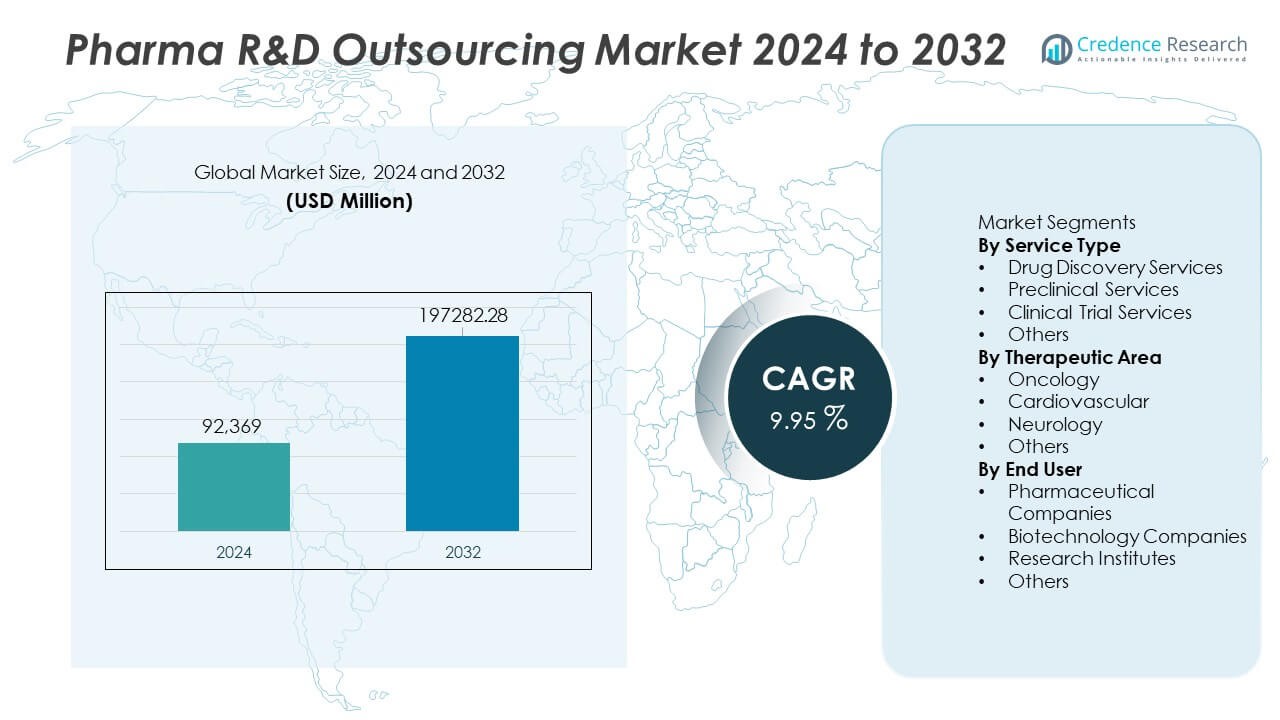
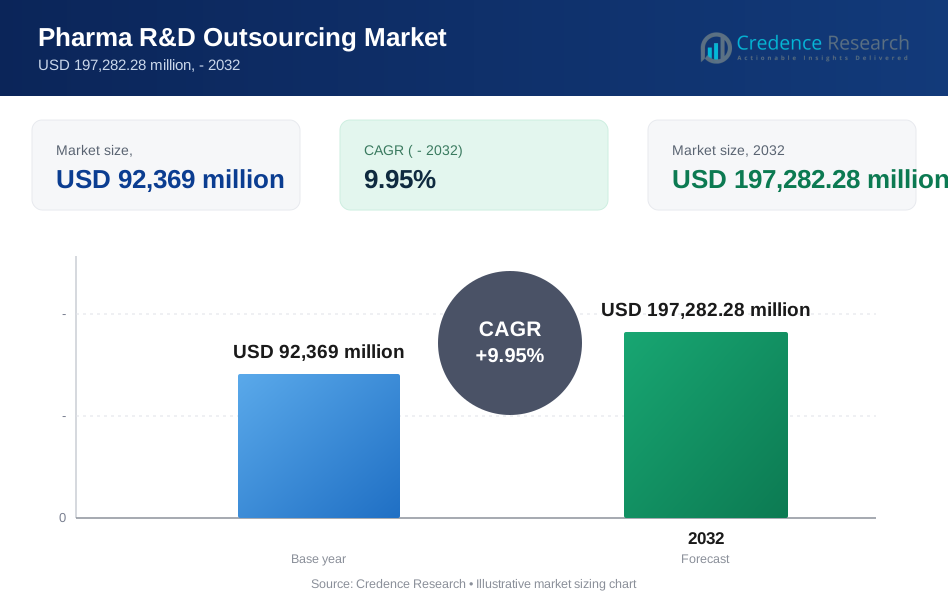
The Pharma R&D Outsourcing Market was valued at USD 92,369 million in 2024 and is projected to reach USD 197,282.28 million by 2032, expanding at a CAGR of 9.95% during the forecast period.
| REPORT ATTRIBUTE | DETAILS |
|---|---|
| Historical Period | 2020-2023 |
| Base Year | 2024 |
| Forecast Period | 2025-2032 |
| Pharma R&D Outsourcing Market Size 2024 | USD 92,369 Million |
| Pharma R&D Outsourcing Market, CAGR | 9.95% |
| Pharma R&D Outsourcing Market Size 2032 | USD 197,282.28 Million |
The Pharma R&D Outsourcing market is led by major companies such as IQVIA, Labcorp Drug Development, Syneos Health, Charles River Laboratories, ICON plc, WuXi AppTec, Parexel International, Lonza, Thermo Fisher Scientific (PPD), and Eurofins Scientific. These firms shape global outsourcing through advanced discovery platforms, large clinical trial networks, and strong regulatory expertise. North America leads the market with 42% share due to mature CRO infrastructure and high R&D spending. Europe follows with 30% share, supported by strong biopharma research activity, while Asia Pacific holds 23% share, driven by rapid expansion of cost-efficient outsourcing hubs and rising investment in clinical development.
Market Insights
- The Pharma R&D Outsourcing market reached USD 92,369 million in 2024 and will grow at a CAGR of 9.95% through 2032.
- Demand rises as drug developers seek faster pipelines, with clinical trial services holding 46% share due to growing complexity and global study expansion.
- Trends strengthen around AI-enabled discovery, real-world evidence, and decentralized trials that improve efficiency and reduce development delays.
- Competition intensifies as leading CROs expand global sites, enhance regulatory capabilities, and invest in integrated platforms while smaller firms face cost and scalability restraints.
- North America leads with 42% share, Europe follows with 30%, and Asia Pacific holds 23%, supported by strong clinical trial activity, cost advantages, and rising oncology research demand across outsourced programs.
 Market Segmentation Analysis:
By Service Type
Clinical trial services lead this segment with 46% share, driven by rising demand for large-scale study management, patient recruitment support, and global trial execution capabilities. Pharmaceutical companies increasingly outsource Phase I–III trials to reduce timelines, improve data quality, and access specialized expertise. CROs strengthen their position by expanding decentralized trial capabilities, advanced analytics, and real-world evidence integration. Preclinical services grow as companies accelerate early-stage development using outsourced toxicology, pharmacology, and formulation studies. Drug discovery services also expand with increased use of AI-driven screening and target identification. Clinical trial dominance reflects the high cost and complexity of late-stage programs.
- For instance, IQVIA expanded its decentralised trial network to support many active DCT programs using its Orchestrated Clinical Trials platform with extensive remote patient connections worldwide.
By Therapeutic Area
Oncology dominates this segment with 39% share, supported by rising cancer prevalence and intensive investment in precision therapies, immuno-oncology, and combination treatment research. Cancer drug development requires complex trials, biomarker-guided studies, and advanced imaging, driving strong outsourcing demand. CROs provide specialized oncology networks, global patient pools, and expertise in rare tumor research. Cardiovascular research follows as companies pursue new therapies for heart failure and metabolic disorders. Neurology grows steadily due to increased focus on Alzheimer’s, Parkinson’s, and rare neurological conditions. Oncology leadership continues as pipelines increasingly shift toward targeted and personalized cancer treatments.
- For instance, ICON plc supported a large number of active oncology trials and expanded its global oncology site network to a vast number of certified cancer research centers.
By End User
Pharmaceutical companies hold the leading 58% share, driven by extensive outsourcing of discovery, preclinical work, and large-scale clinical trials to reduce operational costs and enhance development speed. Large firms rely on CROs for global study execution, regulatory navigation, and advanced research technologies. Biotechnology companies follow, benefiting from outsourced capabilities that support small internal teams and accelerate innovative therapy development. Research institutes contribute steady demand through collaborative studies and government-funded programs. The dominance of pharmaceutical companies remains strong as they continue shifting toward flexible outsourcing models to optimize R&D productivity and manage complex therapeutic pipelines.
Key Growth Drivers
Rising Complexity of Drug Development and Higher R&D Costs
The increasing scientific and regulatory complexity of drug development drives greater reliance on outsourcing partners. Pharmaceutical companies face longer development timelines, higher clinical trial failure rates, and rising operational expenses, making outsourcing a cost-efficient alternative. CROs offer advanced technologies, global patient access, and specialized expertise that streamline each stage of development. This support helps companies reduce overhead, accelerate milestones, and improve trial efficiency. As innovation shifts toward biologics, gene therapies, and precision medicines, outsourcing becomes essential for managing sophisticated research and ensuring faster market entry.
- For instance, Labcorp Drug Development expanded its central laboratory network by adding automation systems, which improved biomarker turnaround time for complex biologics programs.
Growing Demand for Clinical Trials Across Emerging Markets
The expansion of clinical research in Asia, Latin America, and Eastern Europe accelerates outsourcing demand due to larger patient pools, faster recruitment, and lower operational costs. Pharmaceutical companies increasingly partner with CROs that have strong regional networks and regulatory knowledge. Emerging markets offer diverse demographics that support broader therapeutic studies and real-world data generation. This trend strengthens global trial feasibility and reduces development timelines. As healthcare infrastructure improves and governments support clinical research, outsourcing opportunities in these regions continue to rise, boosting overall market growth.
- For instance, Parexel strengthened its Asia-Pacific footprint by adding new clinical trial sites in India and China, enabling enrollment support for trials with a significant number of patients. The company operates many trial locations across various states in India and engages with hundreds of sites across Greater China.
Increased Adoption of AI, Analytics, and Digital Research Technologies
Advancements in AI, big data analytics, and digital platforms transform R&D efficiency and accuracy. CROs adopt predictive modeling, automated data capture, and virtual trial technologies to improve study design, patient monitoring, and decision-making. Digital tools reduce manual processes, enhance data quality, and support risk-based monitoring. This technological shift helps pharmaceutical companies accelerate drug discovery and reduce trial delays. The integration of digital ecosystems enhances collaboration, improves transparency, and strengthens regulatory readiness. As innovation intensifies, outsourcing providers with strong technological capabilities gain significant competitive advantage.
Key Trends & Opportunities
Expansion of Decentralized and Hybrid Clinical Trial Models
The shift toward decentralized trials creates major opportunities for outsourcing providers offering remote monitoring, digital recruitment, and patient-centric technology platforms. These models improve trial accessibility, reduce dropout rates, and minimize site burden. Wearables, telehealth tools, and electronic data capture systems enable continuous monitoring and real-time analysis. Pharmaceutical companies adopt decentralized approaches to reach diverse populations and enhance trial efficiency. As patient expectations evolve toward convenience and remote participation, decentralized trials become a long-term opportunity for CROs driving innovation in clinical research.
- For instance, Syneos Health leverages its patient engagement capabilities to support hybrid trials globally, processing large amounts of digital data through its eClinical platform.
Growth of Specialized R&D Outsourcing for Biologics and Advanced Therapies
Biologics, cell therapies, and gene therapies require specialized research expertise, advanced labs, and sophisticated handling capabilities, driving strong outsourcing demand. CROs expand service portfolios to support complex assays, biomarker development, and high-potency biologic testing. Pharmaceutical and biotech companies rely on outsourcing partners for scalable infrastructure and regulatory compliance. This trend opens significant opportunities as pipelines continue shifting toward personalized and targeted therapies. Specialized outsourcing helps accelerate development while ensuring technical precision and safety.
- For instance, Charles River Laboratories increased its testing capacity, enabling comprehensive testing services including vector potency and residual impurity testing.
Key Challenges
Regulatory Complexity and Evolving Compliance Requirements
Pharma R&D outsourcing faces strict global regulatory frameworks that require extensive documentation, quality control, and data transparency. Frequent updates in clinical trial guidance, safety reporting, and data protection rules create operational burdens for providers. CROs must maintain harmonized processes across regions, increasing complexity in global studies. Failure to meet regulatory expectations can delay approvals or compromise study integrity. Managing multi-country compliance and establishing standardized workflows remain major challenges.
Data Security Risks and Integration Barriers Across Digital Platforms
As digital technologies expand, data security becomes a critical concern for outsourced R&D operations. Clinical studies generate sensitive patient and molecular data, heightening risks of breaches, cyberattacks, and data loss. CROs and sponsors must invest in advanced cybersecurity, encryption, and secure cloud systems to protect confidential information. Integration barriers between legacy systems and modern digital platforms create additional challenges in ensuring seamless data flow. These issues can slow research timelines and impact collaboration across global teams.
Regional Analysis
North America
North America holds 41% share of the Pharma R&D Outsourcing market, driven by strong clinical research infrastructure, high biotech activity, and significant investment in advanced therapies. The region benefits from a large presence of global CROs, robust regulatory frameworks, and high adoption of digital trial technologies. Pharmaceutical companies outsource discovery, preclinical, and clinical services to reduce development time and address rising R&D costs. Growth is supported by expanding biologics pipelines and strong demand for decentralized trial models. Strategic partnerships between CROs and pharma companies further enhance North America’s leadership in outsourced R&D operations.
Europe
Europe accounts for 29% share, supported by well-established research institutions, strong regulatory compliance, and high adoption of outsourcing for complex clinical and preclinical studies. Countries such as Germany, the U.K., and France lead market activity due to strong biotech ecosystems and advanced therapeutic development. Outsourcing demand rises as companies focus on cost efficiency and access to specialized expertise. Growth in personalized medicine, rare-disease research, and biologics strengthens the region’s outsourcing requirements. Collaboration across EU member states and increased cross-border clinical trial harmonization further enhance Europe’s competitive position in the global market.
Asia Pacific
Asia Pacific holds 23% share and remains the fastest-growing region driven by large patient pools, cost-effective research environments, and expanding clinical trial capacity across China, India, Japan, and South Korea. Pharmaceutical companies increasingly outsource to access faster recruitment, diverse populations, and strong government support for clinical research. Regional CROs advance capabilities in biologics, biosimilars, and digital trial technologies. The rise of domestic biotech firms boosts demand for discovery and preclinical outsourcing. As infrastructure modernizes and regulatory frameworks improve, Asia Pacific strengthens its position as a major global hub for outsourced pharma R&D.
Latin America
Latin America captures 4% share, supported by growing clinical trial activity in Brazil, Mexico, and Argentina. The region offers diverse patient populations and competitive costs, attracting pharmaceutical companies seeking accelerated recruitment. Outsourcing demand increases as healthcare systems modernize and regulatory agencies strengthen approval processes. However, variability in regulations and slower infrastructure development pose challenges. CROs expand their regional presence to support multi-country trials and improve operational consistency. Despite barriers, Latin America continues to build its role in global R&D outsourcing through rising investment and increased participation in late-phase clinical studies.
Middle East & Africa
Middle East & Africa hold 3% share, driven by emerging research investments in Gulf countries and rising interest in hosting early-stage and observational studies. The UAE and Saudi Arabia lead adoption due to advanced healthcare infrastructure and strong regulatory modernization. African nations experience gradual growth as clinical trial participation increases and pharmaceutical companies explore new patient pools. Infrastructure limitations and lower digital adoption slow expansion, but government initiatives continue to strengthen research ecosystems. As regional capabilities improve, Middle East & Africa offer long-term opportunities for outsourced R&D, especially in public health and chronic disease studies.
Market Segmentations:
By Service Type
- Drug Discovery Services
- Preclinical Services
- Clinical Trial Services
- Others
By Therapeutic Area
- Oncology
- Cardiovascular
- Neurology
- Others
By End User
- Pharmaceutical Companies
- Biotechnology Companies
- Research Institutes
- Others
By Geography
- North America
- U.S.
- Canada
- Mexico
- Europe
- Germany
- France
- U.K.
- Italy
- Spain
- Rest of Europe
- Asia Pacific
- China
- Japan
- India
- South Korea
- South-east Asia
- Rest of Asia Pacific
- Latin America
- Brazil
- Argentina
- Rest of Latin America
- Middle East & Africa
- GCC Countries
- South Africa
- Rest of the Middle East and Africa
Competitive Landscape
The Pharma R&D Outsourcing market is shaped by leading companies such as IQVIA, Labcorp Drug Development, Syneos Health, Charles River Laboratories, ICON plc, WuXi AppTec, Parexel International, Thermo Fisher Scientific (PPD), Lonza, and Eurofins Scientific. These firms expand their global reach, enhance service depth, and invest in advanced technologies to support end-to-end drug development. Competition intensifies as players strengthen capabilities in AI-enabled discovery, biomarker development, decentralized clinical trials, and integrated data platforms. CROs focus on expanding therapeutic expertise, enhancing regulatory support, and improving trial efficiency through automation and real-world evidence analytics. Strategic partnerships with pharmaceutical and biotechnology companies remain central, enabling faster study execution and scalable development models. Continuous investments in specialized facilities, high-throughput screening, biologics development, and large global trial networks reinforce the competitive advantage of full-service providers in this rapidly growing market.
Key Player Analysis
- IQVIA
- Labcorp Drug Development
- Syneos Health
- Charles River Laboratories
- ICON plc
- WuXi AppTec
- Parexel International
- Thermo Fisher Scientific (PPD)
- Lonza
- Eurofins Scientific
Recent Developments
- In March 2025, IQVIA launched a new platform called Site Lab Navigator to automate and streamline lab workflows for clinical trials.
- In 2025, Charles River Laboratories maintained its position as a top global Contract Research Organization (CRO) in both preclinical and clinical outsourcing markets.
- In 2025, Thermo Fisher Scientific (via PPD) was listed among major contract-research providers dominating the global clinical-trial outsourcing space.
Report Coverage
The research report offers an in-depth analysis based on Service Type, Therapeutic Area, End User and Geography. It details leading market players, providing an overview of their business, product offerings, investments, revenue streams, and key applications. Additionally, the report includes insights into the competitive environment, SWOT analysis, current market trends, as well as the primary drivers and constraints. Furthermore, it discusses various factors that have driven market expansion in recent years. The report also explores market dynamics, regulatory scenarios, and technological advancements that are shaping the industry. It assesses the impact of external factors and global economic changes on market growth. Lastly, it provides strategic recommendations for new entrants and established companies to navigate the complexities of the market.
Future Outlook
- Pharma companies will expand outsourcing to reduce development time and improve efficiency.
- CROs will adopt AI and automation to accelerate discovery and trial execution.
- Oncology research will grow as targeted and precision therapies gain stronger focus.
- Decentralized and hybrid clinical trials will become a standard model worldwide.
- Demand for real-world evidence will rise to support faster regulatory decisions.
- Outsourcing in emerging markets will increase as cost advantages and talent pools expand.
- CRO partnerships will strengthen as companies seek integrated end-to-end development support.
- Biotech firms will rely more on external R&D capabilities to manage limited internal resources.
- Investments in data security and compliance will rise due to stricter global regulations.
- Advanced analytical platforms will boost predictive modeling and improve trial success rates.
Request a Free Sample
Fill in your details and we'll send you a free sample report.
- Sample data tables & charts
- Research methodology
Market Dynamics
Rising Complexity of Drug Development and Higher R&D Costs
Pharmaceutical companies face increasingly complex scientific and regulatory requirements, leading to longer timelines and higher costs. Outsourcing to specialized CROs helps manage these challenges by providing advanced technologies, global patient access, and expert support, thereby reducing overhead and accelerating development.
Growing Demand for Clinical Trials Across Emerging Markets
Expansion of clinical research in regions like Asia, Latin America, and Eastern Europe is driven by larger patient pools, faster recruitment, and lower operational costs. CROs with strong regional networks enable pharmaceutical companies to conduct broader and more efficient trials, boosting outsourcing demand.
Increased Adoption of AI, Analytics, and Digital Research Technologies
Advancements in AI, big data analytics, and digital platforms are transforming R&D efficiency and accuracy. CROs leveraging these technologies can offer predictive modeling, automated data capture, and virtual trials, which accelerate drug discovery and improve trial outcomes.
Expansion of Decentralized and Hybrid Clinical Trial Models
The shift toward decentralized and hybrid clinical trials increases demand for outsourcing providers with remote monitoring and digital recruitment capabilities. These models enhance trial accessibility, reduce dropout rates, and support global study execution, making them attractive to pharmaceutical sponsors.
Growth of Specialized R&D Outsourcing for Biologics and Advanced Therapies
The rise of biologics, cell, and gene therapies requires specialized expertise and infrastructure. CROs expanding their capabilities in these areas enable pharmaceutical and biotech companies to accelerate development of complex therapies while ensuring regulatory compliance and technical precision.
Need a Custom Version of This Report?
Tailor the scope, geography, or segments to your exact requirements.
- Custom geography or segment scope
- Direct access to our analyst team
Frequently Asked Questions
What is the current market size for the Pharma R&D Outsourcing market, and what is its projected size in 2032?
At what Compound Annual Growth Rate is the Pharma R&D Outsourcing market projected to grow between 2025 and 2032?
Which Pharma R&D Outsourcing market segment held the largest share in 2024?
What are the primary factors fueling the growth of the Pharma R&D Outsourcing market?
Who are the leading companies in the Pharma R&D Outsourcing market?
Which region commanded the largest share of the Pharma R&D Outsourcing market in 2024?
Table of Content
Chapter 1 Market Segmentation
- 1.1 Segmentation Framework
- 1.1.1 Product and Service Classification
- 1.1.2 Application and End-Use Classification
- 1.1.3 Technology and Solution Classification
- 1.1.4 Customer and Distribution Channel Classification
- 1.1.5 Geographic Segmentation
- 1.1.6 Market Segment Definitions and Boundaries
- 1.2 By End User
- 1.2.1 Pharmaceutical Companies
- 1.2.2 Biotechnology Companies
- 1.2.3 Research Institutes
- 1.2.4 Others
- 1.3 By Service Type
- 1.3.1 Drug Discovery Services
- 1.3.2 Preclinical Services
- 1.3.3 Clinical Trial Services
- 1.3.4 Others
- 1.4 By Therapeutic Area
- 1.4.1 Oncology
- 1.4.2 Cardiovascular
- 1.4.3 Neurology
- 1.4.4 Others
Chapter 2 Introduction
- 2.1 Report Objectives and Scope
- 2.2 Product Definition and Industry Terminology
- 2.3 Market Inclusions and Exclusions
- 2.4 Research Process
- 2.4.1 Primary Research and Expert Interviews
- 2.4.2 Secondary Research and Source Review
- 2.4.3 Top-Down and Bottom-Up Estimation
- 2.4.4 Data Triangulation and Verification
- 2.5 Market Size Measurement Basis
- 2.5.1 2024: USD 92,369 million → 2032: USD 197,282.28 million
- 2.6 Historical and Forecast Reference Periods
- 2.6.1 Base Year: 2024
- 2.6.2 Forecast Period: 2024-2032
- 2.7 Research Assumptions and Limitations
Chapter 3 Executive Summary
- 3.1 Market Snapshot and Key Findings
- 3.2 Base-Year Market Size, 2024
- 3.3 Forecast Market Size, 2032
- 3.4 Revenue and Volume Growth Outlook
- 3.5 Key Demand and Supply Indicators
- 3.6 Leading Market Segments
- 3.7 Fastest-Growing Market Opportunities
- 3.8 Regional Performance Highlights
- 3.9 Technology and Industry Transformation
- 3.10 Competitive Landscape Summary
- 3.11 Analyst View and Strategic Implications
Chapter 4 Global Pharma R&D Outsourcing Market Trends and Developments
- 4.1 Historical Industry Development
- 4.2 Recent Market Trends and Developments
- 4.3 Demand and Customer Behavior Trends
- 4.4 Technology and Product Innovation
- 4.5 Artificial Intelligence, Automation and Digitalization
- 4.6 Local Manufacturing and Supply Chain Realignment
- 4.7 Industry Partnerships, Mergers and Acquisitions
- 4.8 Sustainability and Circular Economy Developments
- 4.9 Government and Private Sector Investment Trends
- 4.10 Emerging Business Models and Commercialization
- 4.11 Industry Developments and Announcements
Chapter 5 Global Pharma R&D Outsourcing Market Supply and Demand Analysis
- 5.1 Demand Trend and Consumption Analysis
- 5.2 Demand Forecast, 2024-2032
- 5.3 Supply Chain Structure and Procurement Trends
- 5.4 Supply-Demand Gap and Bottlenecks
- 5.5 Import Dependence and Sourcing Structure
- 5.6 Regional Supply and Demand Concentration
Chapter 6 Global Pharma R&D Outsourcing Market Pricing Analysis
- 6.1 Pricing Structure and Measurement
- 6.2 Historical Pricing Trends
- 6.3 Pricing Outlook, 2024-2032
- 6.4 Pricing by Product and Market Segment
- 6.5 Geographic Pricing Differences
- 6.6 Key Input, Energy, Labor and Logistics Costs
- 6.7 Contract Pricing and Purchasing Models
- 6.8 Pricing Sensitivity and Competitive Positioning
- 6.9 Price, Margin and Profitability Implications
Chapter 7 Global Pharma R&D Outsourcing Market Dynamics
- 7.1 Market Growth Drivers
- 7.1.1 Demand-Side Drivers
- 7.1.2 Technology and Innovation Drivers
- 7.1.3 Infrastructure and Investment Drivers
- 7.1.4 Regulatory and Policy Drivers
- 7.2 Market Restraints
- 7.2.1 Cost and Affordability Constraints
- 7.2.2 Technology and Adoption Barriers
- 7.2.3 Supply Chain and Operational Constraints
- 7.3 Market Challenges
- 7.3.1 Competitive Pressure and Margin Erosion
- 7.3.2 Skills, Infrastructure and Implementation Gaps
- 7.4 Emerging Market Opportunities
- 7.5 Market Dynamics Impact and Time-Horizon Assessment
Chapter 8 Global Pharma R&D Outsourcing Value Chain Analysis
- 8.1 Industry Value Chain Overview
- 8.2 Upstream Suppliers and Critical Inputs
- 8.3 Technology and Component Providers
- 8.4 Manufacturing or Service Delivery
- 8.5 Distribution, Channel Partners and Integrators
- 8.6 Downstream Applications and End Users
- 8.7 Value Addition and Profit Pools
- 8.8 Vertical Integration and Outsourcing
- 8.9 Supplier Concentration and Risk
- 8.10 Supply Chain Localization and Resilience
Chapter 9 Global Pharma R&D Outsourcing Market Regulations and Policies
- 9.1 Relevant Laws, Standards and Compliance Frameworks
- 9.2 Product, Service, Safety and Quality Requirements
- 9.3 Government Policies, Incentives and Subsidies
- 9.4 Imports, Exports and Trade Barriers
- 9.5 Public Procurement and Local Content Requirements
- 9.6 Data Protection, AI and Cybersecurity Compliance
- 9.7 Upcoming Policy Changes and Market Implications
Chapter 10 Global Pharma R&D Outsourcing Market Hotspots and Opportunities
- 10.1 Market Opportunity Mapping and Growth Hotspots
- 10.2 High-Growth Applications and Customer Groups
- 10.3 Underserved Markets and White-Space Opportunities
- 10.4 Emerging Technology and Product Opportunities
- 10.5 New Capacity and Investment Hotspots
- 10.6 Market Entry and Expansion Opportunities
- 10.7 Distribution and Partnership Opportunities
- 10.8 Near-Term and Long-Term Commercial Potential
- 10.9 Opportunity Attractiveness and Execution Risks
Chapter 11 Global Pharma R&D Outsourcing Market Outlook, 2024-2032
- 11.1 Market Size and Analysis
- 11.1.1 Revenue (Market Measurement: 2024: USD 92,369 million → 2032: USD 197,282.28 million)
- 11.1.2 Historical Market Size
- 11.1.3 Base-Year Market Size, 2024
- 11.2 Market Forecast, 2024-2032
- 11.2.1 Revenue Forecast to 2032
- 11.2.2 CAGR and Year-on-Year Growth
- 11.2.3 Incremental Revenue Opportunity
- 11.3 Forecast Assumptions and Scenario Analysis
- 11.3.1 Base-Case Forecast
- 11.3.2 Optimistic and Conservative Scenarios
- 11.3.3 Technology, Pricing and Policy Sensitivities
- 11.4 Market Attractiveness and Growth Outlook
Chapter 12 Global Pharma R&D Outsourcing Market Segmentation and Outlook
- 12.1 Segmentation Summary and Market Shares, 2024
- 12.2 Largest and Fastest-Growing Segments
- 12.3 By End User - Market Size and Forecast, 2024-2032
- 12.3.1 Segment Definition and Scope
- 12.3.2 Historical Market Size
- 12.3.3 Revenue Forecast, 2024-2032
- 12.3.4 Base-Year Market Share, 2024
- 12.3.5 Segment CAGR and Growth Drivers
- 12.3.6 Subsegment Market Size and Forecast
- 12.3.6.1 Pharmaceutical Companies
- 12.3.6.2 Biotechnology Companies
- 12.3.6.3 Research Institutes
- 12.3.6.4 Others
- 12.3.7 Subsegment Pricing and Adoption Trends
- 12.3.8 Leading Suppliers and Competition
- 12.3.9 Regional Demand and Opportunities
- 12.4 By Service Type - Market Size and Forecast, 2024-2032
- 12.4.1 Segment Definition and Scope
- 12.4.2 Historical Market Size
- 12.4.3 Revenue Forecast, 2024-2032
- 12.4.4 Base-Year Market Share, 2024
- 12.4.5 Segment CAGR and Growth Drivers
- 12.4.6 Subsegment Market Size and Forecast
- 12.4.6.1 Drug Discovery Services
- 12.4.6.2 Preclinical Services
- 12.4.6.3 Clinical Trial Services
- 12.4.6.4 Others
- 12.4.7 Subsegment Pricing and Adoption Trends
- 12.4.8 Leading Suppliers and Competition
- 12.4.9 Regional Demand and Opportunities
- 12.5 By Therapeutic Area - Market Size and Forecast, 2024-2032
- 12.5.1 Segment Definition and Scope
- 12.5.2 Historical Market Size
- 12.5.3 Revenue Forecast, 2024-2032
- 12.5.4 Base-Year Market Share, 2024
- 12.5.5 Segment CAGR and Growth Drivers
- 12.5.6 Subsegment Market Size and Forecast
- 12.5.6.1 Oncology
- 12.5.6.2 Cardiovascular
- 12.5.6.3 Neurology
- 12.5.6.4 Others
- 12.5.7 Subsegment Pricing and Adoption Trends
- 12.5.8 Leading Suppliers and Competition
- 12.5.9 Regional Demand and Opportunities
- 12.6 Segment Growth Comparison
- 12.7 Segment Attractiveness and Priority Matrix
Chapter 13 Global Pharma R&D Outsourcing End-Use and Application Market Outlook
- 13.1 End-Use Industry and Customer Demand Structure
- 13.2 Leading Applications and Customer Groups
- 13.3 End-Use Market Size, Share and Forecast
- 13.4 Major End-Use Industry Deep Dives
- 13.4.1 Customer Requirements and Use Cases
- 13.4.2 Demand and Replacement Cycles
- 13.4.3 Technical and Regulatory Considerations
- 13.4.4 Purchasing and Procurement Models
- 13.4.5 Leading Vendors and Distribution Channels
- 13.4.6 Forecast and Commercial Opportunities
- 13.5 Emerging Applications and Cross-Segment Demand
- 13.6 End-Use Industry Investment Priorities
Chapter 14 Global Pharma R&D Outsourcing Geographic Market Outlook, 2024-2032
- 14.1 Regional Market Size and Share, 2024
- 14.2 Regional Market Forecast, 2024-2032
- 14.3 Regional Pricing, Production and Demand Differences
- 14.4 North America
- 14.4.1 United States
- 14.4.2 Canada
- 14.4.3 Mexico
- 14.5 Europe
- 14.5.1 Germany
- 14.5.2 France
- 14.5.3 Italy
- 14.5.4 United Kingdom
- 14.5.5 Spain
- 14.5.6 Poland
- 14.5.7 Russia
- 14.5.8 Netherlands
- 14.5.9 Belgium
- 14.5.10 Sweden
- 14.5.11 Denmark
- 14.5.12 Norway
- 14.5.13 Rest of Europe
- 14.6 Asia Pacific
- 14.6.1 China
- 14.6.2 India
- 14.6.3 Japan
- 14.6.4 South Korea
- 14.6.5 Thailand
- 14.6.6 Indonesia
- 14.6.7 Vietnam
- 14.6.8 Malaysia
- 14.6.9 Australia
- 14.6.10 Rest of Asia Pacific
- 14.7 Latin America
- 14.7.1 Brazil
- 14.7.2 Argentina
- 14.7.3 Colombia
- 14.7.4 Chile
- 14.7.5 Rest of Latin America
- 14.8 Middle East
- 14.8.1 Saudi Arabia
- 14.8.2 United Arab Emirates
- 14.8.3 Turkey
- 14.8.4 Israel
- 14.8.5 Iran
- 14.8.6 Rest of the Middle East
- 14.9 Africa
- 14.9.1 South Africa
- 14.9.2 Egypt
- 14.9.3 Nigeria
- 14.9.4 Morocco
- 14.9.5 Rest of Africa
- 14.10 Regional Investment, Policy and Supply Chain Differences
- 14.11 Regional Competitive Landscape
- 14.12 Geographic Growth Hotspots
Chapter 15 Global Pharma R&D Outsourcing Technology, Innovation and Sustainability Outlook
- 15.1 Technology Landscape and Maturity
- 15.2 Product, Process and Service Innovation
- 15.3 AI, Automation and Digital Tools in the Industry
- 15.4 Technology Adoption and Performance Benchmarking
- 15.5 Innovation Pipeline and R&D Investment
- 15.6 Energy Efficiency and Resource Management
- 15.7 Sustainability, Recycling and Circularity
- 15.8 Technology Roadmap, 2024-2032
- 15.9 Risks of Obsolescence and Technology Substitution
Chapter 16 Global Pharma R&D Outsourcing Market Key Strategic Imperatives
- 16.1 Growth and Market Entry Priorities
- 16.2 High-Return Products and Segments
- 16.3 Pricing, Profitability and Cost Optimization
- 16.4 Technology Investment and Product Differentiation
- 16.5 Supply Chain Localization and Resilience
- 16.6 Distribution and Customer Acquisition
- 16.7 Partnership, Acquisition and Capacity Strategy
- 16.8 Regional Expansion Priorities
- 16.9 Short-, Medium- and Long-Term Actions
Chapter 17 Competition Outlook
- 17.1 Industry Competition Characteristics
- 17.2 Market Structure and Concentration
- 17.3 Market Share and Competitive Positioning, 2024
- 17.4 Company-Wise Revenue and Product Benchmarking
- 17.5 Production and Service Capacity Benchmarking
- 17.6 Technology, Pricing and Differentiation
- 17.7 Regional Footprint and Distribution Strength
- 17.8 Mergers, Acquisitions and Strategic Alliances
- 17.9 New Entrants and Competitive Threats
- 17.10 Porter's Five Forces and Industry Attractiveness
- 17.11 Competitive Outlook, 2024-2032
Chapter 18 Company Profiles
- 18.1 Company Coverage and Selection Criteria
- 18.2 IQVIA
- 18.2.1 Business Description
- 18.2.2 Company Ownership and Geographic Presence
- 18.2.3 Product and Service Portfolio
- 18.2.4 Manufacturing and Operating Footprint
- 18.2.5 Financial Performance and Investment
- 18.2.6 Market Share and Competitive Position
- 18.2.7 Technology and Innovation Capabilities
- 18.2.8 Strategic Alliances or Partnerships
- 18.2.9 Recent Developments
- 18.2.10 Growth Strategy and Outlook
- 18.3 Labcorp Drug Development
- 18.4 Syneos Health
- 18.5 Charles River Laboratories
- 18.6 ICON plc
- 18.7 WuXi AppTec
- 18.8 Parexel International
- 18.9 Thermo Fisher Scientific (PPD)
- 18.10 Lonza
- 18.11 Eurofins Scientific
- 18.12 Other Relevant Market Participants
Note: Every listed company is profiled on the structure shown under the first company. The company list is preliminary and may change based on research findings, market developments, data availability and client requirements.
Chapter 19 Disclaimer
- 19.1 Research and Forecast Disclaimer
- 19.2 Data Source and Estimation Limitations
Note: The depth of individual sections depends on data availability for this market. Volume, capacity, trade and other unit-based metrics are included where applicable.