
| REPORT ATTRIBUTE | DETAILS |
|---|---|
| Historical Period | 2019-2022 |
| Base Year | 2023 |
| Forecast Period | 2024-2032 |
| Pharmacy And Drug Store Franchises Market Size 2024 | USD 82,405 Million |
| Pharmacy And Drug Store Franchises Market, CAGR | 14% |
| Pharmacy And Drug Store Franchises Market Size 2032 | USD 235,067.38 Million |
Market overview: -
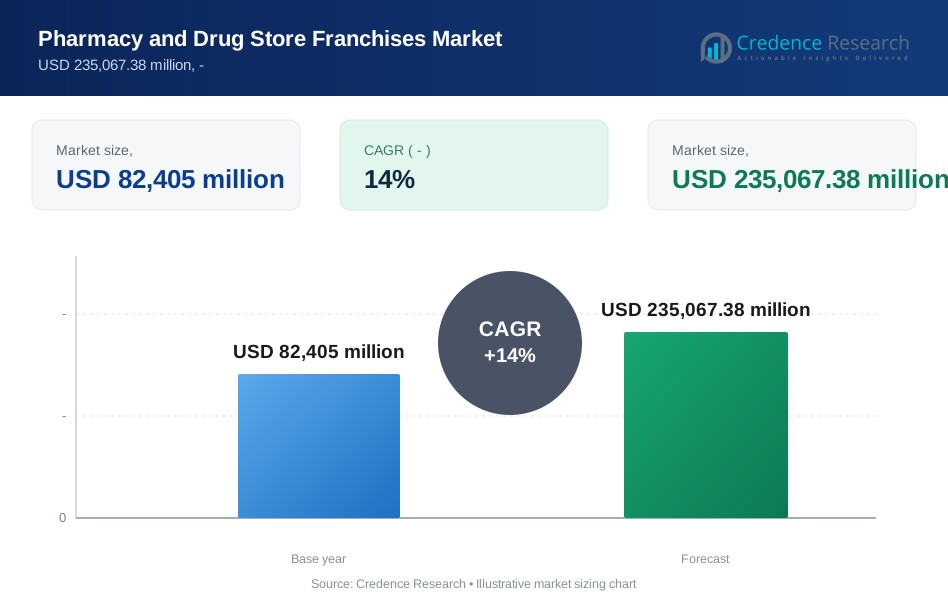
The global Pharmacy And Drug Store Franchises Market is projected to grow from USD 82,405 million in 2024 to USD 235,067.38 million by 2032, at a compound annual growth rate (CAGR) of 14%.
This growth is driven by the increasing demand for accessible healthcare services and over-the-counter (OTC) medications, reflecting a rising consumer reliance on franchised pharmacy models for convenience, cost-effectiveness, and the availability of diverse healthcare products and services under one roof. This growth reflects increasing consumer reliance on franchised pharmacy models for convenience, cost-effectiveness, and the availability of diverse healthcare products and services under one roof.
Key market drivers include the aging global population, growing prevalence of chronic diseases, and increasing consumer awareness regarding preventive healthcare. The rise in healthcare spending, coupled with the expanding middle-class population in emerging economies, fuels market growth. Additionally, pharmacy franchises benefit from technological advancements, including e-commerce platforms and telepharmacy services, which enhance customer engagement and operational efficiency. Government initiatives supporting accessible healthcare infrastructure further bolster market expansion.
Regionally, North America holds the largest market share, accounting for of the global revenue in 2023, due to a well-established healthcare infrastructure, high consumer purchasing power, and the presence of major franchise players. Europe follows closely, driven by regulatory support for healthcare access and the growing focus on personalized medicine. The Asia-Pacific region is anticipated to witness the fastest growth, attributed to rapid urbanization, increasing healthcare investments, and the rising adoption of franchise business models in countries like China and India. Meanwhile, Latin America and the Middle East & Africa regions are gaining traction as emerging markets, presenting untapped opportunities for franchise expansion.
Market Drivers: -
Rising Demand for Accessible Healthcare Services:
The increasing need for accessible and convenient healthcare drives growth in the pharmacy and drug store franchises market. For instance, Pharmacies serve as the first point of care for minor ailments for approximately 80% of the global population, according to the World Health Organization (WHO). In the U.S. alone, over 265 million prescriptions were filled monthly in 2022, highlighting the reliance on these establishments for quick and affordable healthcare solutions. Franchises capitalize on this demand by ensuring uniformity in service delivery and the availability of a broad range of products.
Expanding Prevalence of Chronic Diseases:
The rising burden of chronic diseases is a key growth driver for pharmacy franchises. The International Diabetes Federation (IDF) reported that 537 million adults worldwide were living with diabetes in 2021, with this number projected to exceed 783 million by 2045. Similarly, cardiovascular diseases account for nearly 32% of global deaths, according to the WHO. Pharmacy franchises address these challenges by offering disease management programs and consistent medication availability, contributing to better patient outcomes. For example, chains like Walgreens and CVS have introduced personalized health plans targeting chronic disease patients, driving customer loyalty and revenue.
Technological Integration Enhancing Customer Experience:
The integration of technology into pharmacy operations improves customer engagement and operational efficiency. Telepharmacy services, which grew by 16% globally in 2022, enable remote consultations and prescription management, particularly benefiting rural and underserved areas. Additionally, mobile apps for prescription refills and medication reminders are increasingly popular, with over 58% of pharmacy customers in North America using digital platforms in 2023. For instance, Rite Aid's mobile app recorded over 2 million active users in 2023, showcasing the value of digital adoption in franchise operations.
Favorable Government Policies and Healthcare Spending:
Government initiatives and increased healthcare spending bolster market growth. For example, the U.S. allocated $4.3 trillion to healthcare in 2021, with significant investments in pharmaceutical services. India’s Ayushman Bharat program aims to provide affordable healthcare to 500 million people, creating opportunities for franchise expansion. Additionally, regulatory incentives in emerging economies, such as reduced taxes for pharmacy chains, encourage the growth of organized retail pharmacy franchises, further strengthening the market’s trajectory.
Market Trends: -
Expansion of Health and Wellness Offerings:
A key trend in the pharmacy and drug store franchises market is the expansion of health and wellness product offerings. Traditional pharmacies are evolving into holistic health hubs by incorporating products such as vitamins, supplements, organic skincare, and fitness-related goods. According to a report, the global wellness market was valued at approximately $4.4 trillion in 2022, with pharmacies capturing a significant portion of this growth. For instance, CVS Health saw a 12% increase in sales of wellness products in 2023, driven by growing consumer interest in maintaining health and wellness. This trend reflects pharmacies' ability to diversify beyond pharmaceuticals and attract a broader customer base seeking overall health solutions.
Increasing Focus on Personalized Healthcare:
Pharmacy franchises are increasingly adopting personalized healthcare services to meet the rising demand for customized treatments. A significant number of franchises are offering services like health screenings, chronic disease management, and medication therapy management (MTM). Walgreens, for example, introduced its “Health Corner” initiative, which saw a 25% increase in customer engagement in 2023. Personalized healthcare has become a competitive differentiator, with studies indicating that 30% of pharmacy customers are now seeking tailored health plans. This shift reflects a broader healthcare trend towards individualized care, which helps foster long-term customer loyalty and satisfaction.
Integration of Technology and Digital Services:
The integration of technology continues to reshape pharmacy and drug store franchises, enhancing customer experience and operational efficiency. In 2023, the online pharmacy market saw a 15% growth, with digital platforms facilitating services like prescription refills, home delivery, and virtual consultations. For example, Boots recorded a 20% increase in online orders in 2023, while CVS launched telepharmacy services, expanding access to underserved rural areas. These advancements enable pharmacies to improve customer engagement, enhance service delivery, and reach new markets, particularly those where physical stores are limited.
Strategic Partnerships and Acquisitions:
Strategic partnerships and acquisitions are becoming a key trend for expanding market share and enhancing operational capabilities within the pharmacy franchise sector. Major pharmacy chains are acquiring smaller regional players or forming strategic alliances to bolster their presence and service offerings. In 2023, Walgreens announced its acquisition of Health Horizon, a telemedicine start-up, which helped expand its digital health services by 40%. Such partnerships enable pharmacy franchises to stay competitive and enhance their healthcare offerings, catering to the growing consumer preference for integrated, technology-driven healthcare solutions.
Market Challenges Analysis: -
Intense Competition and Market Saturation:
One of the major challenges faced by the pharmacy and drug store franchises market is intense competition, particularly in saturated markets. As the industry grows, new players are entering the market, increasing the number of pharmacies and drug stores available to consumers. According to a report by IBISWorld, the U.S. pharmacy industry alone is expected to see over 21,000 new pharmacies by 2027. This surge in competition forces established franchises to continually innovate and adapt to differentiate themselves, increasing operational costs. Additionally, price wars and aggressive discounting strategies by competitors can erode profit margins, making it difficult for smaller franchises to maintain profitability.
Regulatory and Compliance Challenges:
Pharmacy franchises face complex regulatory environments that vary by region and country, posing compliance challenges. In the U.S., the Food and Drug Administration (FDA) and the Drug Enforcement Administration (DEA) impose stringent rules on the sale and distribution of pharmaceuticals, requiring constant vigilance and adaptation. Non-compliance can result in hefty fines and reputational damage. Similarly, in Europe, the European Medicines Agency (EMA) enforces rigorous guidelines on drug distribution and patient safety, making it difficult for franchises to navigate the regulatory landscape effectively. The need for ongoing compliance with changing regulations adds layers of complexity to franchise operations.
Rising Operational Costs:
The escalating costs of labor, real estate, and raw materials represent a growing concern for pharmacy franchises. As wages rise, especially in regions with high labor demand, franchises face higher payroll costs. The U.S. Bureau of Labor Statistics reports that pharmacy technician wages have increased by 6% annually over the past five years, directly impacting operating expenses. Additionally, real estate costs, particularly in urban areas, are rising, and securing prime locations for pharmacies has become more expensive. These rising costs affect the profitability and sustainability of franchises, especially those operating on thin margins.
Supply Chain Disruptions:
Pharmacy franchises are also grappling with frequent supply chain disruptions, which affect the timely availability of medications and products. The COVID-19 pandemic highlighted vulnerabilities in global supply chains, and ongoing challenges, such as shortages of key pharmaceuticals and logistical delays, continue to impact the market. The World Health Organization (WHO) has reported that pharmaceutical supply chain disruptions have led to a 25% delay in drug availability in some regions, forcing franchises to implement costly workarounds. These disruptions can impact customer satisfaction and franchise performance, adding another layer of operational complexity.
Market Segmentation Analysis:
By Type
The pharmacy and drug store franchises market can be segmented by type into Independent Pharmacies and Chain Pharmacies. Chain pharmacies dominate the market, accounting for over 70% of the global market share, as they benefit from economies of scale, established brand recognition, and widespread geographic presence. These franchises offer a wide range of products and services, including prescription medications, OTC drugs, and wellness products. Independent pharmacies, while holding a smaller share, continue to play a vital role by providing personalized services and community-based care, particularly in rural and underserved areas.
By Technology
The technology segment in the pharmacy and drug store franchises market is driven by innovations such as Telepharmacy, E-commerce, and Automation. Telepharmacy services, which enable remote consultations with licensed pharmacists, are rapidly gaining traction, particularly in rural regions. The global telepharmacy market is expected to grow at a 16% CAGR over the next five years. E-commerce platforms are also transforming the market, allowing customers to order prescriptions and health products online, enhancing convenience. Additionally, automation technologies, including robotics for prescription dispensing, are improving operational efficiency and reducing human error. These technologies contribute to the increasing digitization of the pharmacy industry, enhancing both customer experience and operational efficiency.
By End User
The end-user segment includes Individual Consumers, Hospitals and Clinics, and Healthcare Institutions. Individual consumers represent the largest segment, driven by the increasing demand for OTC products, prescription medications, and wellness services. The hospital and clinic segment are also significant, as pharmacies play an essential role in healthcare delivery by providing medications and related services. Additionally, healthcare institutions are increasingly partnering with pharmacy franchises to enhance drug accessibility, particularly in developing regions. This diverse range of end-users highlights the importance of pharmacies in both personal and institutional healthcare.
Segmentation: -
By Type
- Independent Pharmacies
- Chain Pharmacies
By Technology
- Telepharmacy
- E-commerce
- Automation and Robotics
By End User
- Individual Consumers
- Hospitals and Clinics
- Healthcare Institutions
By Region
- North America
- U.S.
- Canada
- Mexico
- Europe
- Germany
- France
- U.K.
- Italy
- Spain
- Rest of Europe
- Asia Pacific
- China
- Japan
- India
- South Korea
- South-east Asia
- Rest of Asia Pacific
- Latin America
- Brazil
- Argentina
- Rest of Latin America
- Middle East & Africa
- GCC Countries
- South Africa
- Rest of the Middle East and Africa
Regional Analysis:
North America
North America dominates the pharmacy and drug store franchises market, holding the largest market share of approximately 40% in 2023. The U.S. is the primary contributor, driven by a well-established healthcare infrastructure, high consumer purchasing power, and the presence of major pharmacy chains such as CVS Health, Walgreens, and Rite Aid. For instance, in 2022, the U.S. pharmacy market was valued at $330 billion, with a significant portion attributed to franchise operations. The aging population, rising prevalence of chronic diseases, and increasing demand for wellness products further fuel market expansion in this region. Additionally, technological advancements like telepharmacy and digital health solutions are increasingly being integrated into pharmacy franchises, improving service accessibility and convenience for consumers. For example, Walgreens reported a 40% increase in telehealth consultations in 2023.
Europe
Europe holds the second-largest share in the global pharmacy and drug store franchises market, accounting for around 30% of total revenue in 2023. Key markets within the region include the U.K., Germany, and France, where pharmacy chains benefit from robust healthcare systems and favorable government regulations. In the U.K., the NHS (National Health Service) supports the growth of community pharmacies, and in 2022, the country reported over 14,000 pharmacies operating across the nation. A notable example is Boots, which saw 5% year-over-year growth in 2023 through its integrated health services and retail pharmacy franchises. Europe’s growing focus on preventive care, personalized medicine, and expanding demand for OTC products also contributes to the market’s growth. The increasing integration of e-commerce and digital tools in pharmacies, such as online prescription services, further enhances customer experiences.
Asia-Pacific
The Asia-Pacific region is witnessing the fastest growth in the pharmacy and drug store franchises market, with a projected CAGR of 10% from 2024 to 2032. The region is expected to capture 20% of the global market by 2025. Countries like China, India, and Japan are experiencing rapid urbanization, rising healthcare awareness, and expanding middle-class populations, driving the demand for both prescription medications and wellness products. For instance, in China, the pharmacy market reached $110 billion in 2023, with pharmacy chains like Yunnan Baiyao expanding their footprint in the franchise model. Additionally, the rise of telepharmacy in rural areas is enhancing healthcare access, contributing to the region’s growth.
Latin America
Latin America holds a smaller share of approximately 5% in the global pharmacy and drug store franchises market, but it is showing promising growth. Countries like Brazil, Mexico, and Argentina are seeing a rise in healthcare investments and government initiatives aimed at improving public health access. For example, Brazil’s pharmacy market was valued at $38 billion in 2022 and is expected to continue expanding as consumers seek more affordable and accessible drug options. Franchises are capitalizing on this demand, particularly in urban areas, where pharmacies like Drogarias Pacheco are expanding their operations and offering a combination of prescription and wellness products.
Middle East & Africa
The Middle East and Africa (MEA) region holds a 5% share of the global market but is expected to experience strong growth over the next decade. The rising healthcare investments, government initiatives to improve pharmaceutical access, and increasing adoption of pharmacy franchises in countries like the UAE and South Africa contribute to this growth. For example, in the UAE, the pharmacy market reached $1.2 billion in 2023, with growing consumer demand for accessible healthcare. Franchises like Al-Dawaa Pharmacies are increasing their presence in the region, expanding their networks and services to cater to the rising healthcare needs. The region’s untapped potential and strategic location make it an attractive market for further franchise expansion.
Key Player Analysis:
- CVS Health Corporation
- Walgreens Boots Alliance, Inc.
- Rite Aid Corporation
- Wal-Mart Stores, Inc.
- Boots UK
- Al-Dawaa Pharmacies
- MedPlus
- Drogarias Pacheco
- Pharmacity
- Yunnan Baiyao
Competitive Analysis:
The pharmacy and drug store franchises market is highly competitive, with key players like CVS Health, Walgreens Boots Alliance, and Rite Aid dominating the market. These established players benefit from vast retail networks, brand recognition, and strong customer loyalty. They are investing heavily in digital healthcare solutions, including telepharmacy, e-commerce, and automated dispensing systems, to enhance customer experience and improve operational efficiency. Smaller franchises and independent pharmacies face increasing pressure to compete on pricing, service offerings, and technology adoption. Additionally, the market sees growing consolidation, with major players acquiring smaller chains or forming strategic partnerships to expand their market presence. For instance, Walgreens’ acquisition of VillageMD and CVS Health’s integration of health services illustrate efforts to create a more comprehensive healthcare ecosystem. New entrants focus on niche segments, such as wellness products and telepharmacy services, offering differentiated solutions to capture market share. Competitive differentiation through innovation and customer service is key to success in this market.
Recent Developments:
- In 2023, CVS Health expanded its healthcare offerings by acquiring Signify Health, a leader in home healthcare and telemedicine. This move strengthens CVS’s strategy to become a comprehensive healthcare provider, integrating virtual care and home healthcare services into its pharmacy franchise operations. This acquisition is expected to enhance customer engagement and broaden its service scope.
- Walgreens Boots Alliance continued its push into healthcare services by accelerating the expansion of VillageMD. In 2024, Walgreens increased its investment in primary care services through the opening of more than 700 Village Medical clinics across the U.S. This marks a significant shift towards integrating pharmacy services with healthcare delivery, driving growth in its franchise model
- Boots UK, part of Walgreens Boots Alliance, announced a major expansion of its digital pharmacy services in 2024. This includes enhanced e-commerce offerings for prescription medications, home delivery, and virtual consultations. The move aims to meet the growing demand for convenience and digital healthcare solutions, particularly in response to changing consumer behaviors post-pandemic.
- In 2023, Al-Dawaa Pharmacies, a leading pharmacy chain in Saudi Arabia, went public with an Initial Public Offering (IPO). This development provides the company with additional capital to expand its footprint across the Middle East and invest in advanced technologies such as digital health services and automated pharmacy systems, strengthening its competitive position in the regional market.
Report Coverage:
The research report offers an in-depth analysis based on By Type, By Technology and End User. It details leading market players, providing an overview of their business, product offerings, investments, revenue streams, and key applications. Additionally, the report includes insights into the competitive environment, SWOT analysis, current market trends, as well as the primary drivers and constraints. Furthermore, it discusses various factors that have driven market expansion in recent years. The report also explores market dynamics, regulatory scenarios, and technological advancements that are shaping the industry. It assesses the impact of external factors and global economic changes on market growth. Lastly, it provides strategic recommendations for new entrants and established companies to navigate the complexities of the market.
Future Outlook: -
- The adoption of telepharmacy, online prescription services, and digital health platforms will increase, providing greater convenience and expanding market reach.
- Pharmacy franchises will continue integrating primary care services, offering a broader range of healthcare solutions, including wellness and chronic care management.
- Automation technologies like robotic dispensing systems and AI-driven inventory management will enhance operational efficiency and reduce human error.
- Growing consumer focus on preventive care, wellness products, and nutritional supplements will drive demand for pharmacies that offer health-oriented services.
- Franchises will continue to expand in emerging markets, particularly in Asia-Pacific, Latin America, and the Middle East, where healthcare access is increasing.
- The demand for personalized healthcare and tailored medication solutions will drive pharmacies to adopt more advanced diagnostic tools and customized drug offerings.
- Online pharmacies will see rapid growth, particularly in delivering prescription and OTC products, meeting the demand for convenience and remote access to medications.
- Larger pharmacy chains will continue to consolidate through acquisitions and partnerships, strengthening market positions and expanding service offerings.
- Regulatory advancements and healthcare reforms, particularly around drug pricing and healthcare accessibility, will significantly impact the pharmacy franchise business model.
- Pharmacies will focus on sustainability by reducing packaging waste, offering eco-friendly products, and adopting green operational practices in response to growing environmental concerns.
Request a Free Sample
Fill in your details and we'll send you a free sample report.
- Sample data tables & charts
- Research methodology
Need a Custom Version of This Report?
Tailor the scope, geography, or segments to your exact requirements.
- Custom geography or segment scope
- Direct access to our analyst team
Frequently Asked Questions
What is the current market size of the pharmacy and drug store franchises market?
What are the key drivers contributing to the growth of the pharmacy and drug store franchises market?
Which regions are leading the pharmacy and drug store franchises market?
What are the growth prospects for emerging markets in the pharmacy and drug store franchises market?
Table of Content
Chapter 1. Report Introduction
- 1.1 Report Description & Purpose
- 1.1.1 Report Title & Market Definition
- 1.1.2 Unique Selling Propositions (USP) & Key Differentiators
- 1.1.3 Value Proposition for Stakeholders
- 1.2 Research Objectives
- 1.2.1 Market Sizing Objectives (Volume & Revenue) (Volume Where Applicable)
- 1.2.2 Segmentation Objectives
- 1.2.3 Competitive Intelligence Objectives
- 1.2.4 Forecast & Scenario Objectives
- 1.3 Report Scope
- 1.3.1 Pharmacy and Drug Store Franchises Scope – Segments & Subsegments Covered
- 1.3.2 Geographic Scope – Regions & Countries Covered
- 1.3.3 Historical Period, Base Year & Forecast Period (the historical period; forecast to the forecast period)
- 1.3.4 Inclusions & Exclusions
- 1.4 Industry Classification & Applicable Codes
- 1.5 Currency, Measurement Units & Valuation Basis
- 1.6 Target Stakeholders
- 1.7 Limitations & Assumptions
Chapter 2. Executive Summary
- 2.1 Global Pharmacy and Drug Store Franchises Market Snapshot
- 2.1.1 Market Size – Historical (the historical period) & Forecast (the forecast period) (base year: USD 82,405 million → forecast year: USD 235,067.38 million)
- 2.1.2 Volume & Revenue – Global Totals (Volume Where Applicable)
- 2.1.3 Key Market Highlights – Top Five Facts
- 2.2 Pharmacy and Drug Store Franchises Market Segmentation Snapshot
- 2.2.1 Market Split by Region – vs.
- 2.3 Competitive Snapshot
- 2.3.1 Top 10 Players by Revenue Share –
- 2.3.2 Top 10 Players by Volume Share – (Volume Where Applicable)
- 2.3.3 Recent Strategic Developments (18-Month Summary)
- 2.4 Key Investment Highlights & Strategic Conclusions
Chapter 3. Pharmacy and Drug Store Franchises Market Dynamics & Industry Analysis
- 3.1 Market Overview & Context
- 3.1.1 Pharmacy and Drug Store Franchises Market Position in the Broader Industry Value Chain
- 3.1.2 Demand Structure & Purchasing Dynamics
- 3.1.3 Market Maturity & Development Stage by Region
- 3.2 Pharmacy and Drug Store Franchises Market Drivers
- 3.3 Pharmacy and Drug Store Franchises Market Restraints & Challenges
- 3.4 Pharmacy and Drug Store Franchises Market Opportunities
- 3.5 Porter's Five Forces Analysis
- 3.5.1 Threat of New Entrants
- 3.5.2 Bargaining Power of Suppliers
- 3.5.3 Bargaining Power of Buyers
- 3.5.4 Threat of Substitutes
- 3.5.5 Competitive Rivalry – Intensity Assessment
- 3.6 Pharmacy and Drug Store Franchises Value Chain Analysis
- 3.6.1 Upstream – Key Inputs, Resources & Suppliers
- 3.6.1.1 Key Input/Resource 1
- 3.6.1.2 Key Input/Resource 2
- 3.6.1.3 Key Input/Resource 3
- 3.6.2 Midstream – Core Operations & Value Creation
- 3.6.2.1 Operating Model & Process Overview
- 3.6.2.2 Key Operating Locations & Capabilities by Company
- 3.6.3 Downstream – Market Channels & End Users
- 3.6.3.1 Direct Sales & Customer Engagement Channels
- 3.6.3.2 Indirect Sales, Intermediaries & Partner Channels
- 3.6.4 Value Chain Profitability Analysis
- 3.6.1 Upstream – Key Inputs, Resources & Suppliers
- 3.7 PESTEL Analysis
- 3.7.1 Political Factors
- 3.7.2 Economic Factors
- 3.7.3 Social Factors
- 3.7.4 Technological Factors
- 3.7.5 Environmental Factors
- 3.7.6 Legal Factors
- 3.8 Pharmacy and Drug Store Franchises Supply Chain Analysis
- 3.8.1 Critical Input & Resource Availability Risk Assessment
- 3.8.2 Supplier & Operational Concentration Risk (Geographic Exposure)
- 3.8.3 Supply & Service Disruption Impact Analysis
- 3.9 Regulatory & Policy Landscape
Note: The regulatory and policy landscape section covers regulations based on their applicability to the market, Pharmacy and Drug Store Franchises category, geography, and scope of the study. Only regulatory frameworks with a material impact on operations, compliance, trade, sustainability, or market access are analyzed in detail.
Chapter 4. Key Investment Pockets & Opportunity Analysis
- 4.1 Pharmacy and Drug Store Franchises Market Attractiveness Analysis
- 4.1.1 By Region – Investment Attractiveness Matrix (Market Size × CAGR)
- 4.2 Absolute Revenue Growth Opportunity
- 4.2.1 By Region – Absolute Revenue Growth Through the forecast period
- 4.3 Incremental Demand Opportunity
- 4.3.1 By Region – Incremental Demand Through the forecast period
- 4.3.2 Segment – Incremental Demand
- 4.4 Emerging Submarket Opportunity Deep Dive (Subject to Applicability)
- 4.5 Priority Market Opportunity Scorecards
- 4.5.1 United States
- 4.5.2 Europe
- 4.5.3 Asia
- 4.5.4 Middle East & Africa
Note: Priority market opportunity scorecards reflect the geographic scope and strategic relevance of the study. Listed markets are indicative and may be adapted to the industry.
Chapter 5. Pharmacy and Drug Store Franchises Cross-Border Trade & Market Access Analysis
- 5.1 International Trade & Cross-Border Activity Overview
- 5.1.1 Global Export Value by Country (the historical period)
- 5.1.2 Global Export Volume by Country (the historical period) (Volume Where Applicable)
- 5.1.3 Global Import Value by Country (the historical period)
- 5.1.4 Global Import Volume by Country (the historical period) (Volume Where Applicable)
- 5.1.5 Net Trade Balance by Country (the historical period)
- 5.2 Export Analysis – Segment
- 5.2.1 Category 1 (Applicable Classification Code)
- 5.2.2 Category 2 (Applicable Classification Code)
- 5.2.3 Category 3 (Applicable Classification Code)
- 5.2.4 Category 4 (Applicable Classification Code)
- 5.2.5 Category 5 (Applicable Classification Code)
- 5.3 Import Analysis – Segment
- 5.3.1 Category 1 (Applicable Classification Code)
- 5.3.2 Category 2 (Applicable Classification Code)
- 5.3.3 Category 3 (Applicable Classification Code)
- 5.3.4 Category 4 (Applicable Classification Code)
- 5.3.5 Category 5 (Applicable Classification Code)
- 5.4 Cross-Border Pricing & Transaction Benchmarks
- 5.4.1 Export Pricing – Segment & Country
- 5.4.2 Import Pricing – Segment & Source Country
- 5.4.3 Price Trends (the historical period)
- 5.5 Key Cross-Border Trade & Delivery Routes
- 5.5.1 Cross-Border Trade/Delivery Route 1
- 5.5.2 Cross-Border Trade/Delivery Route 2
- 5.5.3 Cross-Border Trade/Delivery Route 3
- 5.5.4 Cross-Border Trade/Delivery Route 4
- 5.5.5 Cross-Border Trade/Delivery Route 5
- 5.6 Trade Policy & Market Access Impact Assessment
- 5.6.1 Tariff & Non-Tariff Barriers
- 5.6.2 Regional Trade & Economic Integration Frameworks
- 5.6.3 Bilateral & Multilateral Trade Agreements
- 5.6.4 Cross-Border Operating, Licensing & Localization Requirements
Note: This chapter applies where cross-border trade or delivery is relevant to Pharmacy and Drug Store Franchises. Goods, services, and digital offerings are assessed using applicable classifications and transaction measures. Import-export volumes, trade balances, and route analyses are included only where meaningful to the market.
Chapter 6. Competitive Landscape & Company Benchmarking
- 6.1 Pharmacy and Drug Store Franchises Market Concentration & Structure
- 6.1.1 Herfindahl-Hirschman Index (HHI) – vs.
- 6.1.2 Leading, Mid-Sized & Emerging Player Structure
- 6.1.3 Global, Regional & Local Player Dynamics
- 6.2 Pharmacy and Drug Store Franchises Market Share Analysis –
- 6.2.1 Global Revenue Share by Company
- 6.2.2 Global Volume Share by Company (Volume Where Applicable)
- 6.2.3 Regional Revenue Share
- 6.2.4 Market Share Evolution ( vs. )
- 6.2.5 Company Market Share by Key Segment
- 6.2.6 Company Market Share by Customer Group
- 6.3 Operating Scale, Capacity & Infrastructure Analysis
- 6.3.1 Global Operating Scale & Supply Capacity
- 6.3.2 Resource Utilization & Operating Efficiency
- 6.3.3 Output, Service Delivery & Activity Metrics
- 6.3.4 Operating Footprint & Infrastructure Map
- 6.3.5 Planned Operational & Capacity Expansion
- 6.4 Pharmacy and Drug Store Franchises Competitive Benchmarking Matrix
- 6.4.1 Revenue, Growth, Profitability & Operating Metric Comparison
- 6.4.2 Channel Revenue Mix
- 6.4.3 Geographic Revenue Exposure
- 6.4.4 R&D Intensity
- 6.4.5 Sustainability Maturity
- 6.5 Strategic Developments in Pharmacy and Drug Store Franchises (Last 24 Months)
- 6.5.1 Mergers, Acquisitions & Divestments
- 6.5.2 New Products, Services & Solutions in Pharmacy and Drug Store Franchises
- 6.5.3 Operational & Infrastructure Expansions
- 6.5.4 Strategic Alliances, Joint Ventures & Partnerships
- 6.5.5 Distribution Expansion & Market Entry
- 6.5.6 Sustainability & ESG Initiatives
- 6.6 Competitive Strategy Mapping
- 6.6.1 Leader, Challenger, Follower & Niche Classification
- 6.6.2 Pricing Strategy Comparison
- 6.6.3 Channel Strategy Matrix
Note: Strategic developments are included based on their materiality and the availability of reliable information.
Chapter 7. Global Pharmacy and Drug Store Franchises Market – By Sales & Delivery Channel
- 7.1 Segment Overview
- 7.1.1 Volume & Revenue Split by Channel ( & ) (Volume Where Applicable)
- 7.1.2 Channel Mix Evolution (the forecast period)
Chapter 8. Regional Market Analysis – Global Overview
- 8.1 Global Regional Overview
- 8.1.1 Regional Volume Share (Volume Where Applicable)
- 8.1.2 Regional Revenue Share
- 8.1.3 Regional Volume by Region (Volume Where Applicable)
- 8.1.4 Regional Revenue by Region
- 8.1.5 Regional Forecast Through the forecast period
- 8.2 Cross-Regional Segment Analysis
- 8.2.1 By Sales & Delivery Channel
- 8.2.2 By Competitive Positioning & Price Tier
Chapter 9. North America Pharmacy and Drug Store Franchises Market
- 9.1 United States
- 9.2 Canada
- 9.3 Mexico
Chapter 10. Europe Pharmacy and Drug Store Franchises Market
- 10.1 Germany
- 10.2 France
- 10.3 Italy
- 10.4 United Kingdom
- 10.5 Spain
- 10.6 Poland
- 10.7 Russia
- 10.8 Netherlands
- 10.9 Belgium
- 10.10 Sweden
- 10.11 Denmark
- 10.12 Norway
- 10.13 Rest of Europe
Chapter 11. Asia Pacific Pharmacy and Drug Store Franchises Market
- 11.1 China
- 11.2 India
- 11.3 Japan
- 11.4 South Korea
- 11.5 Thailand
- 11.6 Indonesia
- 11.7 Vietnam
- 11.8 Malaysia
- 11.9 Australia
- 11.10 Rest of Asia Pacific
Chapter 12. Latin America Pharmacy and Drug Store Franchises Market
- 12.1 Brazil
- 12.2 Argentina
- 12.3 Colombia
- 12.4 Chile
- 12.5 Rest of Latin America
Chapter 13. Middle East Pharmacy and Drug Store Franchises Market
- 13.1 Saudi Arabia
- 13.2 United Arab Emirates
- 13.3 Turkey
- 13.4 Israel
- 13.5 Iran
- 13.6 Rest of the Middle East
Chapter 14. Africa Pharmacy and Drug Store Franchises Market
- 14.1 South Africa
- 14.2 Egypt
- 14.3 Nigeria
- 14.4 Morocco
- 14.5 Rest of Africa
Chapter 15. Pharmacy and Drug Store Franchises Company Profiles
- 15.1 [Company 01]
- 15.1.1 Company Overview
- 15.1.2 Key Management Personnel
- 15.1.3 Products & Services Portfolio
- 15.1.4 Financial Performance
- 15.1.5 Key Market Focus & Geographic Presence
- 15.1.6 Recent Developments & Strategic Initiatives
Note: The company profile list is preliminary and may change based on research findings, market developments, data availability, and client requirements.
Chapter 16. Appendices
- Appendix A – List of Abbreviations & Acronyms
- Appendix B – Industry Classification Code Reference – Full Series
- Appendix C – Supply, Output & Operating Capacity Data Tables
- Appendix D – End-Use & Demand Base Tables
- Appendix E – Demand, Adoption & Usage Assumptions
- Appendix F – Pricing & Revenue Metric Reference Tables
- Appendix G – Company Operations & Infrastructure Database
- Appendix H – Cross-Border Trade & Activity Data Tables (Where Applicable)
- Appendix I – Regulatory Summary Tables
- Appendix J – Primary Research Participant List (Anonymized)
- Appendix K – Primary Research Questionnaire Framework
- Appendix L – Data Sources & Bibliography
- Appendix M – Market Size Divergence & Source Comparison
Chapter 17. Research Methodology
- 17.1 Research Framework & Philosophy
- 17.2 Secondary Research – Sources, Hierarchy & Data Extraction
- 17.3 Data Modeling – Bottom-Up & Top-Down Market Sizing
- 17.4 Primary Research – Stakeholder Framework, LOI & Sample Sizes
- 17.5 Forecast Methodology – Regression, Scenario & Sensitivity Analysis
- 17.6 Quality Control – Four-Layer Validation Framework
- 17.7 Limitations & Standard Assumptions
- 17.8 Disclaimer
