
Market Overview:
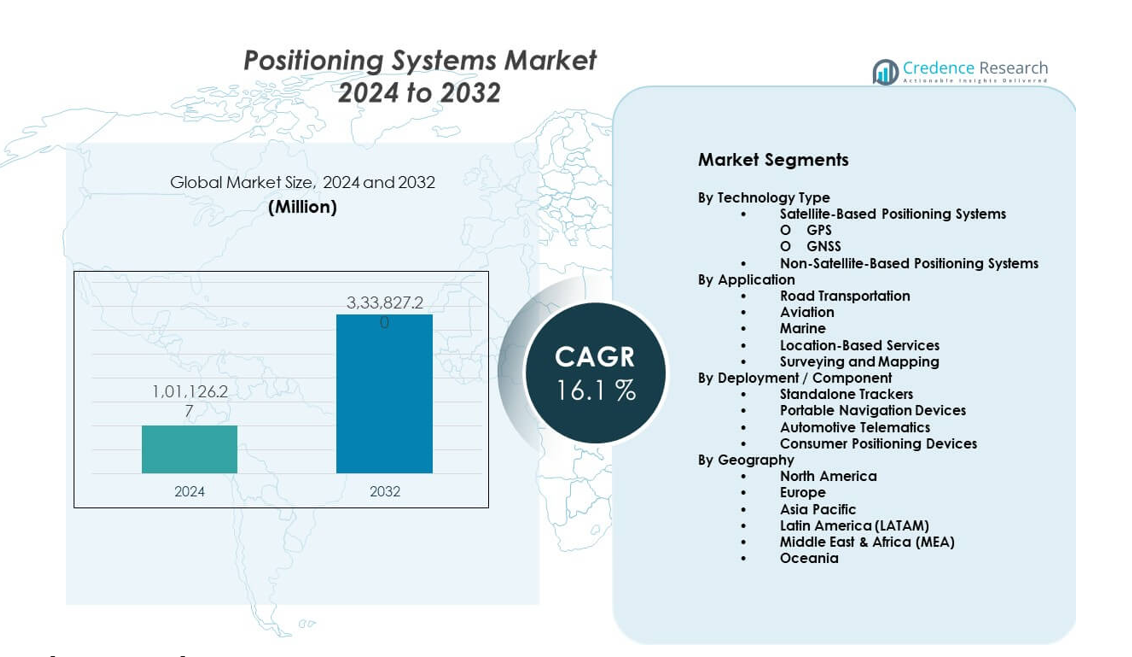
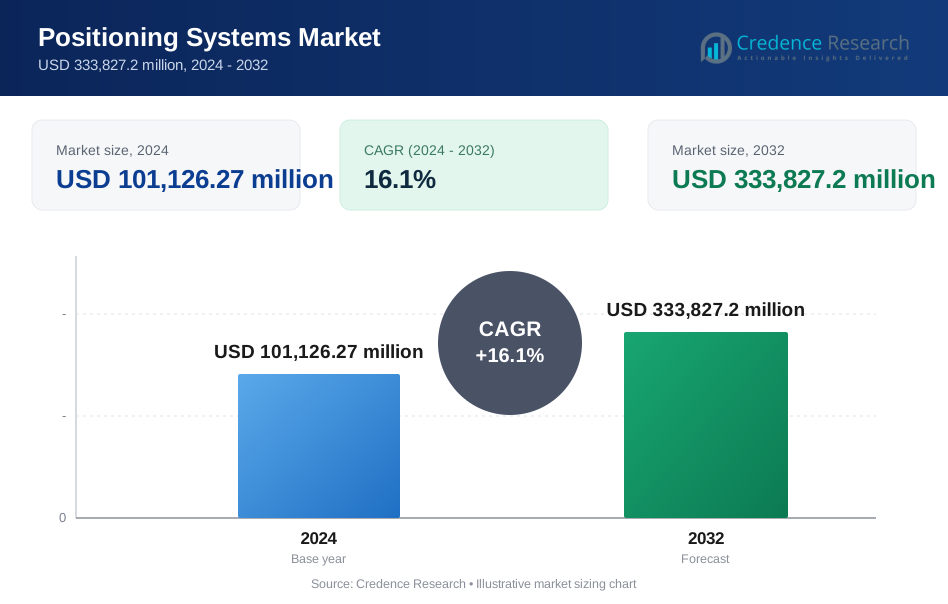
The Positioning Systems Market is projected to grow from USD 101,126.27 million in 2024 to an estimated USD 333,827.2 million by 2032, with a compound annual growth rate (CAGR) of 16.1% from 2024 to 2032.
| REPORT ATTRIBUTE | DETAILS |
|---|---|
| Historical Period | 2020-2023 |
| Base Year | 2024 |
| Forecast Period | 2025-2032 |
| Positioning Systems Market Size 2024 | USD 101,126.27 million |
| Positioning Systems Market, CAGR | 16.1% |
| Positioning Systems Market Size 2032 | USD 333,827.2 million |
Growth drivers include rising demand for precise location data across multiple industries. Navigation, mapping, and asset tracking rely on advanced positioning technologies. Smart transportation systems increase adoption in automotive and rail networks. Defense and aerospace sectors invest in resilient positioning solutions for mission accuracy. Industrial automation uses positioning tools to improve process control and safety. Consumer electronics support steady demand through smartphones and wearables. Integration with IoT and AI platforms enhances system accuracy and reliability. These factors collectively support strong market expansion across commercial and public applications worldwide.
North America leads the Positioning Systems Market due to strong defense spending and early technology adoption. The United States drives innovation through aerospace, automotive, and digital infrastructure investments. Europe follows with high demand from smart mobility and industrial automation projects. Germany and the United Kingdom remain key contributors. Asia Pacific emerges as the fastest-growing region, supported by manufacturing growth and smart city programs. China, Japan, and South Korea expand usage across logistics and transportation. Emerging markets adopt positioning systems to modernize infrastructure and public services.
Market Insights:
- The Positioning Systems Market reached USD 101,126.27 million in 2024 and is projected to hit USD 333,827.2 million by 2032, with a CAGR of 16.1%, driven by transport, defense, and digital services demand.
- North America leads with about 34% share due to defense spending, automotive technology, and strong digital infrastructure, while Asia Pacific follows at around 30% supported by logistics growth, manufacturing scale, and smart city programs.
- Europe holds nearly 26% share, led by Germany, the UK, and France, where automotive production, aviation activity, and regulatory focus on safety sustain adoption of advanced positioning solutions.
- Asia Pacific stands as the fastest-growing region with roughly 30% share, driven by rapid urbanization, expanding transportation networks, and large-scale infrastructure investment across China, Japan, and Southeast Asia.
- By segment, satellite-based positioning systems account for about 65% share due to GPS and GNSS dominance, while applications split mainly between transportation at nearly 40% and location-based services at around 25%, reflecting broad commercial usage.
Market Drivers:
Rising Demand For High-Accuracy Location Data Across Critical Applications
The Positioning Systems Market benefits from rising need for accurate location data. Transportation systems depend on precise positioning for route planning and safety. Aviation and maritime sectors use it to support navigation and collision avoidance. Defense programs rely on secure positioning for mission coordination. Industrial operations apply positioning tools to improve workflow control. Agriculture adopts precision positioning for yield optimization. Emergency services depend on real-time location awareness. Urban planning also supports adoption through smart infrastructure projects.
- For instance, Trimble reports its RTK-enabled GNSS systems achieve centimeter-level accuracy, supporting surveying, construction, and precision farming operations worldwide.
Expansion Of Smart Mobility And Intelligent Transportation Networks Worldwide
Smart mobility programs strongly support demand for advanced positioning solutions. Connected vehicles require reliable location data for navigation systems. Public transport networks use positioning to improve scheduling accuracy. Traffic management platforms depend on real-time vehicle tracking. Rail systems adopt positioning to enhance operational safety. Autonomous vehicle testing further increases system deployment. Government funding accelerates intelligent transport adoption. This shift strengthens long-term demand across transport ecosystems.
- For instance, Qualcomm’s Snapdragon Auto platforms support lane-level positioning accuracy by combining GNSS with sensor fusion for advanced driver assistance systems.
Growing Adoption Of Automation And Digital Systems In Industrial Environments
Industrial automation drives steady demand for positioning technologies. Factories use positioning to track equipment and materials. Robotics systems depend on accurate spatial data for task execution. Warehousing operations apply positioning for inventory optimization. Energy and utilities use location systems for asset monitoring. Mining operations rely on positioning for worker safety. Process industries integrate it with control systems. These uses support consistent market expansion.
Strong Growth In Consumer Electronics And Location-Enabled Services
Consumer electronics continue to support positioning system demand. Smartphones integrate advanced location features for daily use. Wearable devices rely on positioning for fitness tracking. Location-based services improve user engagement across apps. E-commerce platforms depend on accurate delivery tracking. Gaming applications use location features for interactive experiences. Navigation apps sustain daily usage volumes. These trends reinforce volume-driven demand growth.
Market Trends:
Integration Of Positioning Systems With Artificial Intelligence Platforms
Artificial intelligence reshapes how positioning data is processed. AI improves location accuracy through advanced data analysis. Predictive models enhance signal correction capabilities. Smart systems adapt positioning outputs in real time. AI supports anomaly detection in navigation signals. Edge computing enables faster location processing. This integration improves system responsiveness. It strengthens value for advanced applications.
- For instance, Hexagon integrates AI with its positioning solutions to process billions of spatial data points annually across industrial and infrastructure applications.
Shift Toward Multi-Constellation And Hybrid Positioning Architectures
System providers adopt multi-constellation positioning strategies. Hybrid models combine satellite and terrestrial signals. This approach improves reliability in dense urban areas. Indoor positioning gains wider commercial acceptance. Multi-source systems reduce dependency on single networks. Enterprises value resilience against signal disruption. Service providers refine integration capabilities. This trend enhances overall system robustness.
- For instance, u-blox GNSS modules support GPS, GLONASS, Galileo, and BeiDou simultaneously, improving position availability and accuracy in challenging environments.
Rising Focus On Secure And Resilient Positioning Technologies
Security concerns shape positioning system development. Governments prioritize protection against signal interference. Encrypted positioning solutions gain strategic importance. Defense users demand resilient navigation capabilities. Infrastructure operators focus on service continuity. System designs address spoofing and jamming risks. Trusted positioning frameworks gain attention. These needs guide technology roadmaps.
Growth Of Location-Based Analytics For Business Intelligence Use
Enterprises adopt location analytics for decision support. Retail chains analyze movement patterns for store planning. Logistics firms optimize routes using spatial insights. Telecom operators use positioning data for network planning. Smart cities apply analytics for public services. Data platforms convert location data into insights. This trend expands software-driven revenue streams.
Market Challenges Analysis:
High System Complexity And Deployment Cost Across Advanced Applications
The Positioning Systems Market faces complexity challenges. Advanced systems require specialized infrastructure investments. Integration with legacy platforms increases project cost. Skilled workforce shortages affect deployment speed. Calibration and maintenance demand technical expertise. Small enterprises face budget constraints. Long implementation cycles delay returns. These factors limit adoption in cost-sensitive segments.
Signal Reliability Issues In Dense And Interference-Prone Environments
Urban environments pose major positioning challenges. High buildings disrupt satellite signal quality. Indoor locations limit traditional positioning effectiveness. Signal interference affects accuracy and reliability. Environmental conditions create data inconsistencies. Backup systems increase system design complexity. Performance variation concerns enterprise users. These limitations require continuous technology refinement.
Market Opportunities:
Expansion Of Smart City And Infrastructure Modernization Projects
Smart city projects create strong positioning system opportunities. Urban planners deploy location platforms for public services. Traffic optimization relies on accurate positioning data. Utility management uses spatial monitoring tools. Emergency response systems benefit from real-time location access. Digital infrastructure budgets support technology upgrades. Developing regions accelerate smart city investments. This environment opens long-term growth avenues.
Emerging Demand From Robotics, Drones, And Autonomous Platforms
Autonomous platforms expand positioning system applications. Drones require precise navigation for commercial missions. Robotics systems depend on spatial awareness for autonomy. Warehouse automation increases indoor positioning demand. Construction robotics use location data for precision tasks. Delivery drones rely on real-time positioning accuracy. Innovation ecosystems support rapid testing. These segments offer high-growth potential.
Market Segmentation Analysis:
By Technology Type
The Positioning Systems Market shows strong differentiation by technology type. Satellite-based positioning systems hold wide adoption due to global coverage and reliability. GPS supports navigation, tracking, and consumer applications with stable performance. GNSS improves accuracy by combining multiple satellite constellations. Government, defense, and logistics sectors rely on these systems for precise location data. Non-satellite-based positioning systems address indoor and signal-restricted environments. These solutions support factories, warehouses, and urban infrastructure. Technology diversity helps users select systems based on accuracy, coverage, and cost needs.
- For instance, Garmin states its multi-band GNSS receivers improve positioning accuracy by reducing signal interference in urban and mountainous regions.
By Application
Application-based segmentation reflects broad market usage. Road transportation leads demand through navigation, fleet tracking, and traffic management. Aviation depends on positioning for flight navigation and safety systems. Marine applications use location tools for vessel tracking and route planning. Location-based services support smartphones, retail analytics, and digital platforms. Surveying and mapping rely on high-precision positioning for infrastructure and land development. Each application values accuracy, reliability, and real-time data access. Sector-specific requirements shape system design and adoption rates.
- For instance, Topcon Positioning Systems delivers GNSS solutions capable of millimeter-level precision for large-scale construction and land surveying projects.
By Deployment / Component
Deployment segments highlight varied end-user preferences. Standalone trackers serve logistics and asset monitoring needs. Portable navigation devices remain relevant for personal and professional travel. Automotive telematics integrates positioning with vehicle diagnostics and safety features. Consumer positioning devices support fitness, navigation, and smart lifestyle use. Component diversity allows scalable deployment across industries. This structure supports steady demand across enterprise and consumer markets.
Segmentation:
By Technology Type
- Satellite-Based Positioning Systems
- GPS
- GNSS
- Non-Satellite-Based Positioning Systems
By Application
- Road Transportation
- Aviation
- Marine
- Location-Based Services
- Surveying and Mapping
By Deployment / Component
- Standalone Trackers
- Portable Navigation Devices
- Automotive Telematics
- Consumer Positioning Devices
By Geography
- North America
- U.S.
- Canada
- Mexico
- Europe
- Germany
- France
- U.K.
- Italy
- Spain
- Rest of Europe
- Asia Pacific
- China
- Japan
- India
- South Korea
- South-east Asia
- Rest of Asia Pacific
- Latin America
- Brazil
- Argentina
- Rest of Latin America
- Middle East & Africa
- GCC Countries
- South Africa
- Rest of the Middle East and Africa
Regional Analysis:
North America
North America holds a leading share of the Positioning Systems Market, accounting for about 34% of global demand. The United States drives adoption through defense, aerospace, and automotive applications. Strong investment in smart transportation supports sustained system deployment. Technology firms advance innovation in navigation and telematics platforms. Logistics and fleet management sectors rely on accurate positioning tools. Canada contributes through infrastructure and resource management use. Regional maturity supports stable and high-value demand.
Europe
Europe represents nearly 26% of the global market share. Countries such as Germany, the United Kingdom, and France lead regional adoption. Automotive manufacturing drives demand for navigation and telematics systems. Aviation and marine sectors rely on advanced positioning solutions. Public infrastructure projects support surveying and mapping applications. Regulatory focus on safety and efficiency boosts system upgrades. Regional collaboration strengthens technology standards and deployment.
Asia Pacific, Latin America, Middle East & Africa, and Oceania
Asia Pacific accounts for around 30% of the global share and shows the fastest expansion. China, Japan, and South Korea lead due to logistics growth and smart city programs. Manufacturing and infrastructure development increase positioning system usage. Latin America holds about 5% share, supported by transportation and mining sectors. Middle East & Africa contribute nearly 4%, driven by defense and urban infrastructure projects. Oceania represents close to 1%, with demand from navigation and marine activities. These regions offer long-term growth opportunities through modernization initiatives.
Key Player Analysis:
- Trimble Inc.
- Hexagon AB
- Qualcomm Technologies, Inc.
- Garmin Ltd.
- TomTom International BV
- Broadcom Inc.
- Texas Instruments Incorporated
- Topcon Positioning Systems, Inc.
Competitive Analysis:
The Positioning Systems Market features strong competition among global technology providers and specialized solution vendors. Leading companies focus on accuracy, reliability, and system integration capabilities. Product differentiation centers on satellite coverage, hybrid positioning, and software intelligence. Large players leverage scale to serve defense, automotive, and infrastructure clients. Mid-sized firms compete through niche applications and customization. Strategic partnerships support faster market access and technology upgrades. Continuous R&D strengthens signal resilience and precision. Competitive intensity remains high due to rapid technology cycles and diverse end-user requirements.
Recent Developments:
- In November 2025, Texas Instruments announced the opening of its second assembly and test facility in Melaka, Malaysia, featuring advanced factory automation designed to bump, probe, assemble, and test billions of analog and embedded chips annually.
- In October 2025, Topcon Positioning Systems announced a major collaboration with Amberg Technologies, launching fully integrated solutions specifically designed for rail and tunnel applications. The partnership, announced at INTERGEO 2025, focuses on the interoperability of hardware and software platforms to allow professionals to seamlessly combine technologies from both companies. This integration addresses the unique measurement and construction challenges presented by railways and tunnel infrastructure projects, enabling streamlined tasks such as track alignment, tunnel profiling, and volumetric analysis while reducing data translation gaps between different hardware and software platforms.
- In September 2025, Texas Instruments announced the release of the TMAG5134, an in-plane Hall-effect switch that sets a new industry benchmark in sensitivity for position-sensing applications. With an integrated magnetic concentrator enabling detection of magnetic fields as low as 1 mT, this device provides engineers with a practical and cost-effective alternative to magnetoresistive sensors. Its ability to optimize system performance while reducing overall design costs, combined with exceptional energy efficiency consuming only 0.6 µA on average makes it particularly suitable for portable and low-power applications.
- In February 2025, Topcon Positioning Systems and FARO Technologies announced a strategic agreement to develop and distribute innovative solutions in the laser scanning market. The collaboration combines the strengths of both organizations to advance technological capabilities for professionals across multiple industries, with particular focus on construction, surveying, mapping, architecture, forensics, building information modeling (BIM), and industrial plant and process applications. The agreement emphasizes seamless integration of Topcon and Sokkia solutions with FARO's offerings, strengthening both companies' market positions and delivering added value to users.
Report Coverage:
The research report offers an in-depth analysis based on technology type, application, and deployment or component segments. It details leading market players, providing an overview of their business, product offerings, investments, revenue streams, and key applications. Additionally, the report includes insights into the competitive environment, SWOT analysis, current market trends, as well as the primary drivers and constraints. Furthermore, it discusses various factors that have driven market expansion in recent years. The report also explores market dynamics, regulatory scenarios, and technological advancements that are shaping the industry. It assesses the impact of external factors and global economic changes on market growth. Lastly, it provides strategic recommendations for new entrants and established companies to navigate the complexities of the market.
Future Outlook:
- Expansion of hybrid and multi-constellation positioning systems
- Rising adoption across autonomous vehicles and smart mobility
- Growing use of positioning in industrial automation
- Increased focus on secure and resilient navigation technologies
- Wider deployment of indoor positioning solutions
- Strong demand from logistics and fleet management
- Integration with AI and data analytics platforms
- Growth in consumer wearable and mobile applications
- Infrastructure modernization supporting system upgrades
- Continued innovation through partnerships and acquisitions
Request a Free Sample
Fill in your details and we'll send you a free sample report.
- Sample data tables & charts
- Research methodology
Need a Custom Version of This Report?
Tailor the scope, geography, or segments to your exact requirements.
- Custom geography or segment scope
- Direct access to our analyst team
Frequently Asked Questions
What is the current market size for Positioning Systems Market, and what is its projected size in 2032?
At what Compound Annual Growth Rate is the Positioning Systems Market projected to grow between 2025 and 2032?
Which Positioning Systems Market segment held the largest share in 2024?
What are the primary factors fueling the growth of the Positioning Systems Market?
Who are the leading companies in the Positioning Systems Market?
Table of Content
Chapter 1. Report Introduction
- 1.1 Report Description & Purpose
- 1.1.1 Report Title & Market Definition
- 1.1.2 Unique Selling Propositions (USP) & Key Differentiators
- 1.1.3 Value Proposition for Stakeholders
- 1.2 Research Objectives
- 1.2.1 Market Sizing Objectives (Volume & Revenue)
- 1.2.2 Segmentation Objectives
- 1.2.3 Competitive Intelligence Objectives
- 1.2.4 Forecast & Scenario Objectives
- 1.3 Report Scope
- 1.3.1 Positioning Systems Scope – Types & Subtypes Covered
- 1.3.2 Geographic Scope – Regions & Countries Covered
- 1.3.3 Historical Period, Base Year & Forecast Period (2024; forecast to 2032)
- 1.3.4 Inclusions & Exclusions
- 1.4 HS Code & Classification Framework
- 1.5 Currency, Units & Pricing Basis
- 1.6 Target Stakeholders
- 1.7 Limitations & Assumptions
Chapter 2. Executive Summary
- 2.1 Global Positioning Systems Market Snapshot
- 2.1.1 Market Size – Historical (2024) & Forecast (2024-2032) (2024: USD 101,126.27 million → 2032: USD 333,827.2 million)
- 2.1.2 Volume & Revenue – Global Totals
- 2.1.3 Key Market Highlights – Top Five Facts
- 2.2 Positioning Systems Market Segmentation Snapshot
- 2.2.1 Market Split by Region – 2024 vs. 2032
- 2.3 Competitive Snapshot
- 2.3.1 Top 10 Players by Revenue Share – 2024
- 2.3.2 Top 10 Players by Volume Share – 2024
- 2.3.3 Recent Strategic Developments (18-Month Summary)
- 2.4 Key Investment Highlights & Strategic Conclusions
Chapter 3. Positioning Systems Market Dynamics & Industry Analysis
- 3.1 Market Overview & Context
- 3.1.1 Positioning Systems Market Position in the Broader Automotive Value Chain
- 3.1.2 OEM vs. Replacement Market Dynamics
- 3.1.3 Market Maturity & Development Stage by Region
- 3.2 Positioning Systems Market Drivers
- 3.3 Positioning Systems Market Restraints & Challenges
- 3.4 Positioning Systems Market Opportunities
- 3.5 Porter's Five Forces Analysis
- 3.5.1 Threat of New Entrants
- 3.5.2 Bargaining Power of Suppliers
- 3.5.3 Bargaining Power of Buyers
- 3.5.4 Threat of Substitutes
- 3.5.5 Competitive Rivalry – Intensity Assessment
- 3.6 Positioning Systems Value Chain Analysis
- 3.6.1 Upstream – Raw Material/Input Suppliers
- 3.6.1.1 Raw Material/Input 1
- 3.6.1.2 Raw Material/Input 2
- 3.6.1.3 Raw Material/Input 3
- 3.6.2 Midstream – Production/Manufacturing/Service Delivery
- 3.6.2.1 Production/Process Overview
- 3.6.2.2 Key Facility Locations & Capacity by Manufacturer
- 3.6.3 Downstream – Distribution & End Consumer
- 3.6.3.1 Primary Channel – B2B/OEM
- 3.6.3.2 Secondary Channels – Dealer, Retail, Online, Direct
- 3.6.4 Value Chain Profitability Analysis
- 3.6.1 Upstream – Raw Material/Input Suppliers
- 3.7 PESTEL Analysis
- 3.7.1 Political Factors
- 3.7.2 Economic Factors
- 3.7.3 Social Factors
- 3.7.4 Technological Factors
- 3.7.5 Environmental Factors
- 3.7.6 Legal Factors
- 3.8 Positioning Systems Supply Chain Analysis
- 3.8.1 Raw Material/Input Supply Risk Assessment
- 3.8.2 Manufacturing Concentration Risk (Geographic Exposure)
- 3.8.3 Trade Disruption Impact Analysis
- 3.9 Regulatory & Policy Landscape
Note: The regulatory and policy landscape section covers regulations based on their applicability to the market, Positioning Systems category, geography, and scope of the study. Only regulatory frameworks with a material impact on operations, compliance, trade, sustainability, or market access are analyzed in detail.
Chapter 4. Key Investment Pockets & Opportunity Analysis
- 4.1 Positioning Systems Market Attractiveness Analysis
- 4.1.1 By Region – Investment Attractiveness Matrix (Volume × CAGR)
- 4.2 Absolute Revenue Growth Opportunity
- 4.2.1 By Region – Absolute USD Growth Through 2032
- 4.3 Incremental Volume Opportunity
- 4.3.1 By Region – Incremental Volume Through 2032
- 4.3.2 Segment – Incremental Volume
- 4.4 Emerging Submarket Opportunity Deep Dive (Subject to Applicability)
- 4.5 Emerging Market Opportunity Scorecards
- 4.5.1 United States
- 4.5.2 Europe
- 4.5.3 Asia
- 4.5.4 Middle East & Africa
Note: Emerging Market Opportunity Scorecards will be included based on relevance and strategic importance. Regions listed are indicative and may vary depending on data availability and market dynamics.
Chapter 5. Positioning Systems Import-Export Analysis & Trade Flows
- 5.1 Global Trade Overview
- 5.1.1 Global Export Value by Country (2024)
- 5.1.2 Global Export Volume by Country (2024)
- 5.1.3 Global Import Value by Country (2024)
- 5.1.4 Global Import Volume by Country (2024)
- 5.1.5 Net Trade Balance by Country (2024)
- 5.2 Export Analysis – Segment
- 5.2.1 Type 1 (HS Code)
- 5.2.2 Type 2 (HS Code)
- 5.2.3 Type 3 (HS Code)
- 5.2.4 Type 4 (HS Code)
- 5.2.5 Type 5 (HS Code)
- 5.3 Import Analysis – Segment
- 5.3.1 Type 1 (HS Code)
- 5.3.2 Type 2 (HS Code)
- 5.3.3 Type 3 (HS Code)
- 5.3.4 Type 4 (HS Code)
- 5.3.5 Type 5 (HS Code)
- 5.4 Average Unit Trade Prices
- 5.4.1 Average Export Price – Segment & Country
- 5.4.2 Average Import Price – Segment & Source Country
- 5.4.3 Price Trends (2024)
- 5.5 Key Trade Route Analysis
- 5.5.1 Trade Route 1
- 5.5.2 Trade Route 2
- 5.5.3 Trade Route 3
- 5.5.4 Trade Route 4
- 5.5.5 Trade Route 5
- 5.6 Trade Policy Impact Assessment
- 5.6.1 US Anti-Dumping & Section 301 Tariffs
- 5.6.2 EU Customs Union Impact
- 5.6.3 Major Free Trade Agreements
- 5.6.4 USMCA Rules of Origin
Note: Trade policy analysis will be included only where relevant to the Positioning Systems market.
Chapter 6. Competitive Landscape & Company Benchmarking
- 6.1 Positioning Systems Market Concentration & Structure
- 6.1.1 Herfindahl-Hirschman Index (HHI) – vs. 2024
- 6.1.2 Tier 1, Tier 2 & Tier 3 Market Structure
- 6.1.3 Global, Regional & Local Player Dynamics
- 6.2 Positioning Systems Market Share Analysis – 2024
- 6.2.1 Global Revenue Share by Company
- 6.2.2 Global Volume Share by Company
- 6.2.3 Regional Revenue Share
- 6.2.4 Market Share Evolution ( vs. 2024)
- 6.2.5 OEM Segment Share by Company
- 6.2.6 Replacement Segment Share by Company
- 6.3 Production/Delivery Capacity & Facility Analysis
- 6.3.1 Global Installed Capacity
- 6.3.2 Capacity Utilization Rates
- 6.3.3 Production/Output Volume
- 6.3.4 Facility Locations & Capacity Map
- 6.3.5 Planned Capacity Additions
- 6.4 Positioning Systems Competitive Benchmarking Matrix
- 6.4.1 Revenue, Volume, CAGR & Profitability Comparison
- 6.4.2 Channel Revenue Mix
- 6.4.3 Geographic Revenue Exposure
- 6.4.4 R&D Intensity
- 6.4.5 Sustainability Maturity
- 6.5 Strategic Developments in Positioning Systems (Last 24 Months)
- 6.5.1 Mergers, Acquisitions & Divestments
- 6.5.2 New Positioning Systems Launches
- 6.5.3 Facility Expansions
- 6.5.4 Strategic Alliances, Joint Ventures & Partnerships
- 6.5.5 Distribution Expansion & Market Entry
- 6.5.6 Sustainability & ESG Initiatives
- 6.6 Competitive Strategy Mapping
- 6.6.1 Leader, Challenger, Follower & Niche Classification
- 6.6.2 Pricing Strategy Comparison
- 6.6.3 Channel Strategy Matrix
Note: Strategic developments are included based on their materiality and the availability of reliable information.
Chapter 7. Global Positioning Systems Market – By Distribution Channel
- 7.1 Segment Overview
- 7.1.1 Volume & Revenue Split by Channel (2024 & 2032)
- 7.1.2 Channel Mix Evolution (2024-2032)
Chapter 8. Regional Market Analysis – Global Overview
- 8.1 Global Regional Overview
- 8.1.1 Regional Volume Share
- 8.1.2 Regional Revenue Share
- 8.1.3 Regional Volume by Region
- 8.1.4 Regional Revenue by Region
- 8.1.5 Regional Forecast Through 2032
- 8.2 Cross-Regional Segment Analysis
- 8.2.1 By Distribution Channel
- 8.2.2 By Brand/Price Tier
Chapter 9. North America Positioning Systems Market
- 9.1 United States
- 9.2 Canada
- 9.3 Mexico
Chapter 10. Europe Positioning Systems Market
- 10.1 Germany
- 10.2 France
- 10.3 Italy
- 10.4 United Kingdom
- 10.5 Spain
- 10.6 Poland
- 10.7 Russia
- 10.8 Netherlands
- 10.9 Belgium
- 10.10 Sweden
- 10.11 Denmark
- 10.12 Norway
- 10.13 Rest of Europe
Chapter 11. Asia Pacific Positioning Systems Market
- 11.1 China
- 11.2 India
- 11.3 Japan
- 11.4 South Korea
- 11.5 Thailand
- 11.6 Indonesia
- 11.7 Vietnam
- 11.8 Malaysia
- 11.9 Australia
- 11.10 Rest of Asia Pacific
Chapter 12. Latin America Positioning Systems Market
- 12.1 Brazil
- 12.2 Argentina
- 12.3 Colombia
- 12.4 Chile
- 12.5 Rest of Latin America
Chapter 13. Middle East Positioning Systems Market
- 13.1 Saudi Arabia
- 13.2 United Arab Emirates
- 13.3 Turkey
- 13.4 Israel
- 13.5 Iran
- 13.6 Rest of the Middle East
Chapter 14. Africa Positioning Systems Market
- 14.1 South Africa
- 14.2 Egypt
- 14.3 Nigeria
- 14.4 Morocco
- 14.5 Rest of Africa
Chapter 15. Positioning Systems Company Profiles
- 15.1 [Company 01]
- 15.1.1 Company Overview
- 15.1.2 Key Management Personnel
- 15.1.3 Products & Services Portfolio
- 15.1.4 Financial Performance
- 15.1.5 Key Market Focus & Geographic Presence
- 15.1.6 Recent Developments & Strategic Initiatives
Note: The company profile list is preliminary and may change based on research findings, market developments, data availability, and client requirements.
Chapter 16. Appendices
- Appendix A – List of Abbreviations & Acronyms
- Appendix B – Industry Classification Code Reference – Full Series
- Appendix C – Production & Capacity Data Tables
- Appendix D – End-Use & Demand Base Tables
- Appendix E – Consumption & Replacement Rate Assumptions
- Appendix F – ASP Reference Tables
- Appendix G – Manufacturing & Facility Database
- Appendix H – Import-Export Data Tables
- Appendix I – Regulatory Summary Tables
- Appendix J – Primary Research Participant List (Anonymized)
- Appendix K – Primary Research Questionnaire Framework
- Appendix L – Data Sources & Bibliography
- Appendix M – Market Size Divergence & Source Comparison
Chapter 17. Research Methodology
- 17.1 Research Framework & Philosophy
- 17.2 Secondary Research – Sources, Hierarchy & Data Extraction
- 17.3 Data Modeling – Bottom-Up & Top-Down Market Sizing
- 17.4 Primary Research – Stakeholder Framework, LOI & Sample Sizes
- 17.5 Forecast Methodology – Regression, Scenario & Sensitivity Analysis
- 17.6 Quality Control – Four-Layer Validation Framework
- 17.7 Limitations & Standard Assumptions
- 17.8 Disclaimer
