
Market Overview
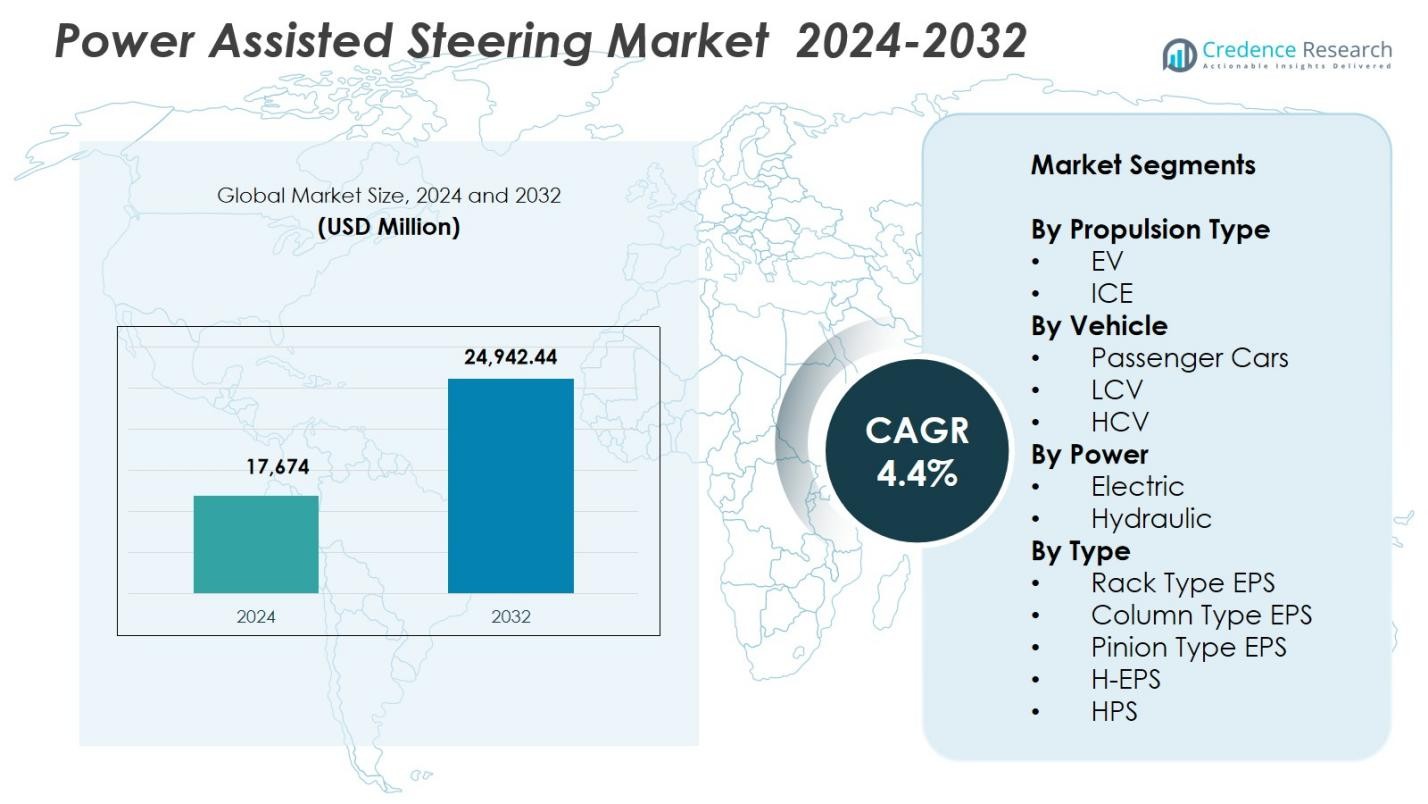
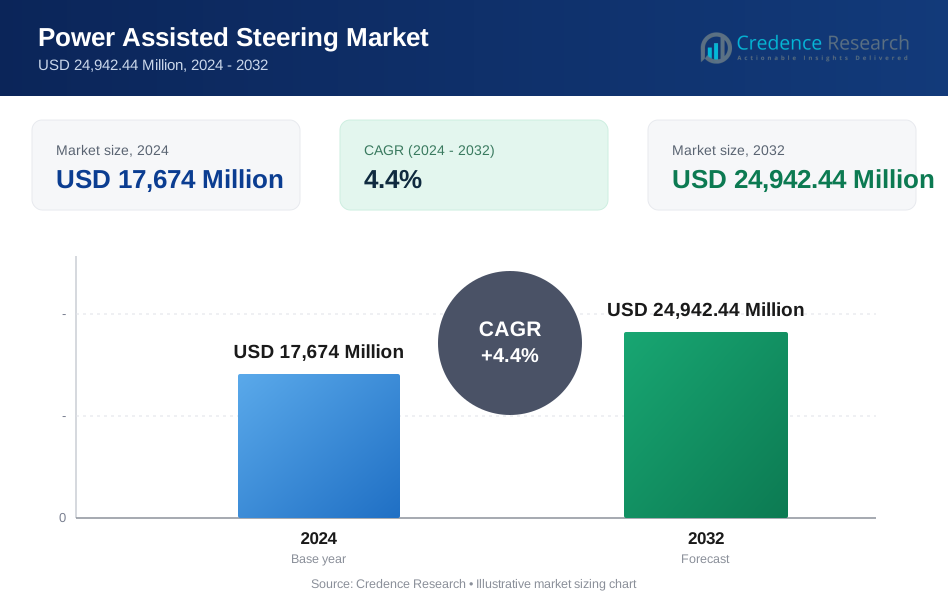
Power Assisted Steering Market size was valued at USD 17,674 Million in 2024 and is anticipated to reach USD 24,942.44 Million by 2032, at a CAGR of 4.4% during the forecast period.
| REPORT ATTRIBUTE | DETAILS |
|---|---|
| Historical Period | 2020-2023 |
| Base Year | 2024 |
| Forecast Period | 2025-2032 |
| Power Assisted Steering Market Size 2024 | USD 17,674 Million |
| Power Assisted Steering Market, CAGR | 4.4% |
| Power Assisted Steering Market Size 2032 | USD 24,942.44 Million |
Power Assisted Steering Market is shaped by leading players such as Robert Bosch GmbH, ZF Friedrichshafen AG, Denso Corporation, Hyundai Mobis, NSK Ltd., Hitachi Astemo, Showa Corporation, Mando Corporation, Thyssenkrupp AG, and GKN Automotive, all driving innovation in electric, hydraulic, and steer-by-wire steering technologies. These companies strengthen their market position through advancements in energy-efficient EPS systems, software-integrated control units, and ADAS-ready architectures. Asia-Pacific leads the Power Assisted Steering Market with a 36.8% share, supported by high vehicle production and rapid electrification, followed by Europe holding 32.1%, driven by strict emission norms and strong EV adoption across major automotive hubs.
Market Insights
- Power Assisted Steering Market stood at USD 17,674 Million in 2024 and will grow at a CAGR of 4.4% through 2032.
- Strong demand for Electric Power Steering drives market expansion, with EPS holding a 71.4% share as OEMs prioritize energy efficiency, ADAS integration, and reduced maintenance.
- Key trends include rising EV adoption, expansion of steer-by-wire systems, and the shift toward lightweight architectures to improve vehicle range, handling, and control precision.
- Major players such as Bosch, ZF, Denso, Hyundai Mobis, and NSK strengthen market presence through innovations in electronic modules, torque management, and software-enabled steering technologies.
- Asia-Pacific leads the market with a 36.8% share, driven by high vehicle production, followed by Europe at 32.1%; Passenger Cars dominate vehicle segmentation with a 67.3% share.
Market Segmentation Analysis:
By Propulsion Type:
The Power Assisted Steering Market shows strong demand across propulsion categories, with ICE vehicles dominating the segment with a 78.6% share in 2024, driven by their large global vehicle parc and sustained production in emerging markets. ICE platforms continue to adopt advanced electric power steering (EPS) systems to meet efficiency and emission norms, supporting steady growth. EVs hold a 21.4% share, expanding rapidly as automakers integrate steer-by-wire and lightweight EPS architectures to enhance range. The shift toward electrification, supported by stricter regulations and OEM electrification commitments, remains the key driver accelerating EV adoption in the steering ecosystem.
- For instance, Nexteer Automotive launched its Modular Pinion-Assist Electric Power Steering (mPEPS) system in 2024, which is designed to be cost-efficient, flexible, and scalable across ICE, EV, and mixed propulsion platforms, helping OEMs reduce development cycles while enhancing steering performance globally, including in Asia-Pacific markets.
By Vehicle Type:
Within the vehicle category, Passenger Cars lead the Power Assisted Steering Market with a 67.3% share, supported by high production volumes and widespread EPS integration for improved fuel economy, comfort, and maneuverability. Passenger vehicles increasingly adopt lightweight steering modules and advanced driver-assistance systems (ADAS), further strengthening segment dominance. LCVs account for a 22.1% share, driven by rising logistics activity and demand for vehicles with improved handling. HCVs hold a 10.6% share, with growth propelled by hydraulic-assist upgrades and the shift to electro-hydraulic systems to support heavier loads and long-haul efficiency.
- For instance, JTEKT Corporation supplies EPS systems integrated into passenger cars for precise electronic steering control to meet regulatory compliance and consumer demands for ADAS features.
By Power Type:
In the power technology segment, Electric Power Steering (EPS) dominates with a 71.4% share, driven by its superior energy efficiency, compatibility with ADAS, and rising adoption in EVs and modern passenger cars. EPS eliminates hydraulic fluid dependence, reducing maintenance costs and enhancing vehicle responsiveness, making it the preferred choice among OEMs. Hydraulic systems retain a 28.6% share, primarily serving commercial and heavy-duty vehicles where high steering forces are required. Growth in hydraulic systems is supported by ongoing demand in construction fleets and the transition toward electro-hydraulic architectures offering better control and reduced energy loss.
Key Growth Drivers
Rising Adoption of Electric Power Steering (EPS) Systems
The Power Assisted Steering Market experiences strong growth due to the widespread transition from hydraulic systems to Electric Power Steering (EPS), driven by global fuel-efficiency standards and lightweighting initiatives. EPS reduces energy loss, enhances maneuverability, and supports integration with ADAS features, making it the preferred solution for modern vehicle platforms. Automakers increasingly adopt EPS to meet regulatory norms and improve driver comfort, creating sustained demand. The rise of steer-by-wire technologies further accelerates adoption, reinforcing EPS as a central driver of market expansion.
- For instance, Knorr-Bremse unveiled its first electric power steering system for buses at Busworld 2025. The system features power-on-demand capability to enhance steering safety and reduce emissions in commercial vehicles.
Expansion of Electric and Hybrid Vehicles
Electrification continues to significantly boost the Power Assisted Steering Market, as EVs and hybrids rely entirely on electric steering systems for optimized energy use and seamless integration with autonomous driving technologies. OEMs prioritize compact, lightweight steering architectures to extend vehicle range and improve system efficiency, fueling strong demand for advanced electric-assist mechanisms. Government incentives, emission regulations, and charging infrastructure development further accelerate EV adoption, directly supporting growth in electric power-assisted steering systems, which play a critical role in enabling next-generation mobility platforms.
- For instance, ZF Automotive Technology ramped up electric power steering production in China to meet demand from local EV makers adopting electronically assisted steering for improved energy management.
Increasing Vehicle Production and Technological Advancements
Global growth in passenger and commercial vehicle production directly strengthens demand for power-assisted steering systems, particularly as OEMs focus on upgrading steering performance, stability, and safety. Technological advancements—such as electronically controlled steering torque, integrated sensors, and real-time diagnostics—enhance driving precision and reduce maintenance requirements. Expansion in logistics, infrastructure development, and urban mobility drives additional need for advanced steering solutions across vehicle categories. Continuous R&D investments by manufacturers to optimize steering architecture and enhance durability further reinforce market growth.
Key Trends & Opportunities
Integration of ADAS and Autonomous Driving Features
A major trend shaping the Power Assisted Steering Market is the integration of steering systems with ADAS and autonomous driving technologies. Power-assisted steering plays a pivotal role in lane-keeping, automated parking, and driver-assist maneuvers, creating opportunities for OEMs and suppliers to innovate in high-precision, sensor-integrated systems. As automakers advance toward Level 2+ and Level 3 automation, demand rises for steering modules capable of supporting over-the-air updates, redundancy, and fail-safe mechanisms, opening new avenues for technological development and differentiation.
- For instance, Hyundai Mobis is developing next-generation electric power steering (EPS) systems with smart actuators that enhance vehicle stability, reduce power consumption, and improve driver feedback through real-time lane-keeping assistance and adaptive torque control.
Shift Toward Steer-by-Wire and Lightweight Architectures
Steer-by-wire technology presents a significant opportunity as manufacturers aim for lightweight, highly efficient steering solutions that eliminate mechanical linkages. This trend allows precise control, reduced vibrations, and enhanced cabin design flexibility while improving compatibility with EV platforms. Lightweight materials and compact electronic modules further support efficiency gains, aligning with global sustainability and performance goals. As regulatory bodies increasingly approve steer-by-wire systems for road use, suppliers are positioned to capitalize on growing demand for next-generation steering solutions.
- For instance, ZF Friedrichshafen AG and Nio launched a steer-by-wire system in the Nio ET9 electric vehicle. The fully electronic setup uses a steering wheel actuator, redundant steering gear actuator, and advanced software to dynamically adjust steering ratio based on speed and conditions, improving maneuverability and safety.
Key Challenges
High Cost of Advanced Steering Technologies
The transition to electric and steer-by-wire systems introduces substantial cost challenges, particularly for price-sensitive vehicle segments. Advanced electronic modules, sensors, actuators, and software integration significantly increase manufacturing expenses, limiting adoption in low-cost and entry-level vehicles. OEMs face pressure to balance performance benefits with cost efficiency while ensuring long-term reliability. Additionally, the need for specialized testing, validation, and safety compliance further elevates development costs, creating barriers for smaller manufacturers and slowing widespread deployment of premium steering technologies.
Complexity in System Integration and Reliability Concerns
Integrating modern power-assisted steering systems with vehicle electronics, ADAS modules, and communication networks creates engineering complexity and raises reliability concerns. Failures in electronic steering components can pose safety risks, requiring robust redundancy, cybersecurity protections, and advanced diagnostic capabilities. Manufacturers must ensure seamless communication between steering systems and onboard control units while preventing signal interference. As vehicle architectures become more software-driven, the burden of maintaining system reliability, safety certification, and compliance with evolving regulatory standards remains a significant operational challenge.
Regional Analysis
North America
North America holds a significant position in the Power Assisted Steering Market, accounting for a 28.4% share in 2024, driven by high adoption of Electric Power Steering (EPS) systems across passenger and commercial vehicles. Strong EV penetration in the U.S. and Canada supports demand for advanced steering architectures integrated with ADAS functions. The region benefits from the presence of major automotive OEMs and suppliers investing in innovative steering technologies, including steer-by-wire and electro-hydraulic systems. Regulatory requirements for fuel efficiency and safety further accelerate the shift toward lightweight, electronically controlled steering solutions, strengthening regional market growth.
Europe
Europe commands a 32.1% share of the Power Assisted Steering Market, driven by strong automotive manufacturing hubs in Germany, France, Italy, and the U.K. The region leads in EPS integration due to stringent emission policies and rapid expansion of hybrid and electric vehicle platforms. European OEMs prioritize precision steering systems to enhance driving dynamics, sustainability, and ADAS compatibility. The push toward autonomous mobility and lightweight vehicle architectures further accelerates adoption of advanced steering modules. Continued investments by premium automotive brands in performance-oriented and software-defined steering systems reinforce Europe’s dominant position in the global market.
Asia-Pacific
Asia-Pacific remains the largest and fastest-growing region, holding a 36.8% share in the Power Assisted Steering Market, supported by high vehicle production in China, India, Japan, and South Korea. Rapid urbanization, rising disposable incomes, and increasing passenger car sales drive strong demand for electric and hydraulic-assisted steering systems. Automakers in the region increasingly integrate EPS into mass-market vehicles to meet efficiency and comfort expectations. Expansion of EV manufacturing and government incentives further boost demand for advanced steering solutions. Continuous technological upgrades and cost-effective production capabilities position Asia-Pacific as the key growth engine of the global market.
Latin America
Latin America accounts for a 5.6% share of the Power Assisted Steering Market, driven by steady growth in passenger car demand in Brazil, Mexico, and Argentina. Rising adoption of EPS in mid-range vehicles and ongoing modernization of automotive manufacturing facilities contribute to market expansion. Although hydraulic systems remain prevalent due to cost considerations, OEMs increasingly shift toward electric solutions to enhance fuel efficiency and reduce maintenance requirements. Economic recovery, growing urban transportation needs, and continued investments by global automakers strengthen the region’s outlook, supporting moderate but consistent demand for advanced steering technologies.
Middle East & Africa
The Middle East & Africa region holds a 7.1% share in the Power Assisted Steering Market, supported by rising vehicle sales in the UAE, Saudi Arabia, and South Africa. Adoption of EPS systems grows steadily as governments implement fuel-efficiency regulations and OEMs expand product portfolios in the region. Commercial vehicle demand, driven by construction and logistics sectors, sustains the need for hydraulic and electro-hydraulic steering systems. Increasing imports of technologically advanced passenger cars and long-term infrastructure development projects further stimulate market growth. However, economic disparities and limited local manufacturing capacity pose ongoing challenges to full-scale adoption.
Market Segmentations:
By Propulsion Type
- EV
- ICE
By Vehicle
- Passenger Cars
- LCV
- HCV
By Power
- Electric
- Hydraulic
By Type
- Rack Type EPS
- Column Type EPS
- Pinion Type EPS
- H-EPS
- HPS
By Geography
- North America
- U.S.
- Canada
- Mexico
- Europe
- Germany
- France
- U.K.
- Italy
- Spain
- Rest of Europe
- Asia Pacific
- China
- Japan
- India
- South Korea
- South-east Asia
- Rest of Asia Pacific
- Latin America
- Brazil
- Argentina
- Rest of Latin America
- Middle East & Africa
- GCC Countries
- South Africa
- Rest of the Middle East and Africa
Competitive Landscape
The Competitive Landscape of the Power Assisted Steering Market features leading players such as Robert Bosch GmbH, ZF Friedrichshafen AG, Denso Corporation, Hyundai Mobis, NSK Ltd., Hitachi Astemo, Showa Corporation, Mando Corporation, Thyssenkrupp AG, and GKN Automotive. These companies actively expand their portfolios through innovations in Electric Power Steering (EPS), steer-by-wire, and electro-hydraulic systems to meet rising demand for efficiency, safety, and ADAS integration. Manufacturers invest in lightweight materials, sensor-embedded modules, and software-defined architectures to enhance steering precision and vehicle handling. Strategic partnerships with EV manufacturers, R&D collaborations, and regional production expansion strengthen their global presence. The market also witnesses continuous technological upgrades, including advanced torque management, integrated diagnostics, and energy-optimized control units. As automakers shift toward electrification and autonomous mobility, leading suppliers intensify competition by focusing on high-performance, cost-efficient steering solutions that align with evolving regulatory standards and next-generation vehicle platforms.
Key Player Analysis
- Mando Corporation (South Korea)
- ZF Friedrichshafen AG (Germany)
- NSK Ltd. (Japan)
- GKN Automotive (United Kingdom)
- Hyundai Mobis (South Korea)
- Showa Corporation (Japan)
- Robert Bosch GmbH (Germany)
- Denso Corporation (Japan)
- Thyssenkrupp AG (Germany)
- Hitachi Astemo (Japan)
Recent Developments
- In January 2025, ZF Rane Automotive India Pvt Ltd announced a collaboration between ZF Friedrichshafen AG and Rane Group to introduce rack-drive Electric Power Steering systems and license column-drive EPS technology for the Indian market.
- In 2025, Astemo Ltd. (formerly Hitachi Astemo) rebranded and expanded its commitment to electrification and steer-by-wire steering systems as part of its global strategy to support EV and autonomous vehicle platforms.
- In June 2024, Hyundai Mobis implemented an Acoustic-AI based quality inspection system at its Changwon EPS manufacturing plant to detect defects in real time.
- In July 2025, NSK Ltd. launched an internal generative-AI powered quality-control application to accelerate product validation and improve reliability across its electric power steering business.
Report Coverage
The research report offers an in-depth analysis based on Propulsion Type, Vehicle, Power, Type and Geography. It details leading market players, providing an overview of their business, product offerings, investments, revenue streams, and key applications. Additionally, the report includes insights into the competitive environment, SWOT analysis, current market trends, as well as the primary drivers and constraints. Furthermore, it discusses various factors that have driven market expansion in recent years. The report also explores market dynamics, regulatory scenarios, and technological advancements that are shaping the industry. It assesses the impact of external factors and global economic changes on market growth. Lastly, it provides strategic recommendations for new entrants and established companies to navigate the complexities of the market.
Future Outlook
- The market will experience strong growth as automakers accelerate the shift toward Electric Power Steering across all vehicle classes.
- EV expansion will drive significant adoption of steer-by-wire systems to support autonomous and energy-efficient mobility.
- Integration of ADAS features will enhance demand for high-precision, sensor-driven steering technologies.
- Lightweight steering architectures will gain traction as OEMs focus on improving vehicle efficiency and performance.
- Software-defined steering systems will emerge as a core focus, enabling advanced control, diagnostics, and over-the-air updates.
- Commercial vehicles will increasingly adopt electro-hydraulic steering to improve load handling and safety.
- Global emission regulations will continue to push OEMs toward fully electric steering solutions.
- Regional manufacturing expansion will support cost optimization and strengthen supply-chain resilience.
- Growing demand for customization and modular steering units will encourage innovation among suppliers.
- Autonomous vehicle development will create long-term opportunities for highly integrated, fail-safe steering technologies.
Request a Free Sample
Fill in your details and we'll send you a free sample report.
- Sample data tables & charts
- Research methodology
Need a Custom Version of This Report?
Tailor the scope, geography, or segments to your exact requirements.
- Custom geography or segment scope
- Direct access to our analyst team
Frequently Asked Questions
What is the current market size for Power Assisted Steering Market, and what is its projected size in 2032?
At what Compound Annual Growth Rate is the Power Assisted Steering Market projected to grow between 2025 and 2032?
Which Power Assisted Steering Market segment held the largest share in 2024?
What are the primary factors fueling the growth of the Power Assisted Steering Market?
Who are the leading companies in the Power Assisted Steering Market?
Which region commanded the largest share of the Power Assisted Steering Market in 2024?
Table of Content
Chapter 1. Report Introduction
- 1.1 Report Description & Purpose
- 1.1.1 Report Title & Market Definition
- 1.1.2 Unique Selling Propositions (USP) & Key Differentiators
- 1.1.3 Value Proposition for Stakeholders
- 1.2 Research Objectives
- 1.2.1 Market Sizing Objectives (Volume & Revenue)
- 1.2.2 Segmentation Objectives
- 1.2.3 Competitive Intelligence Objectives
- 1.2.4 Forecast & Scenario Objectives
- 1.3 Report Scope
- 1.3.1 Power Assisted Steering Scope – Types & Subtypes Covered
- 1.3.2 Geographic Scope – Regions & Countries Covered
- 1.3.3 Historical Period, Base Year & Forecast Period (2024; forecast to 2032)
- 1.3.4 Inclusions & Exclusions
- 1.4 HS Code & Classification Framework
- 1.5 Currency, Units & Pricing Basis
- 1.6 Target Stakeholders
- 1.7 Limitations & Assumptions
Chapter 2. Executive Summary
- 2.1 Global Power Assisted Steering Market Snapshot
- 2.1.1 Market Size – Historical (2024) & Forecast (2024-2032) (2024: USD 17,674 Million → 2032: USD 24,942.44 Million)
- 2.1.2 Volume & Revenue – Global Totals
- 2.1.3 Key Market Highlights – Top Five Facts
- 2.2 Power Assisted Steering Market Segmentation Snapshot
- 2.2.1 Market Split by Region – 2024 vs. 2032
- 2.3 Competitive Snapshot
- 2.3.1 Top 10 Players by Revenue Share – 2024
- 2.3.2 Top 10 Players by Volume Share – 2024
- 2.3.3 Recent Strategic Developments (18-Month Summary)
- 2.4 Key Investment Highlights & Strategic Conclusions
Chapter 3. Power Assisted Steering Market Dynamics & Industry Analysis
- 3.1 Market Overview & Context
- 3.1.1 Power Assisted Steering Market Position in the Broader Automotive Value Chain
- 3.1.2 OEM vs. Replacement Market Dynamics
- 3.1.3 Market Maturity & Development Stage by Region
- 3.2 Power Assisted Steering Market Drivers
- 3.3 Power Assisted Steering Market Restraints & Challenges
- 3.4 Power Assisted Steering Market Opportunities
- 3.5 Porter's Five Forces Analysis
- 3.5.1 Threat of New Entrants
- 3.5.2 Bargaining Power of Suppliers
- 3.5.3 Bargaining Power of Buyers
- 3.5.4 Threat of Substitutes
- 3.5.5 Competitive Rivalry – Intensity Assessment
- 3.6 Power Assisted Steering Value Chain Analysis
- 3.6.1 Upstream – Raw Material/Input Suppliers
- 3.6.1.1 Raw Material/Input 1
- 3.6.1.2 Raw Material/Input 2
- 3.6.1.3 Raw Material/Input 3
- 3.6.2 Midstream – Production/Manufacturing/Service Delivery
- 3.6.2.1 Production/Process Overview
- 3.6.2.2 Key Facility Locations & Capacity by Manufacturer
- 3.6.3 Downstream – Distribution & End Consumer
- 3.6.3.1 Primary Channel – B2B/OEM
- 3.6.3.2 Secondary Channels – Dealer, Retail, Online, Direct
- 3.6.4 Value Chain Profitability Analysis
- 3.6.1 Upstream – Raw Material/Input Suppliers
- 3.7 PESTEL Analysis
- 3.7.1 Political Factors
- 3.7.2 Economic Factors
- 3.7.3 Social Factors
- 3.7.4 Technological Factors
- 3.7.5 Environmental Factors
- 3.7.6 Legal Factors
- 3.8 Power Assisted Steering Supply Chain Analysis
- 3.8.1 Raw Material/Input Supply Risk Assessment
- 3.8.2 Manufacturing Concentration Risk (Geographic Exposure)
- 3.8.3 Trade Disruption Impact Analysis
- 3.9 Regulatory & Policy Landscape
Note: The regulatory and policy landscape section covers regulations based on their applicability to the market, Power Assisted Steering category, geography, and scope of the study. Only regulatory frameworks with a material impact on operations, compliance, trade, sustainability, or market access are analyzed in detail.
Chapter 4. Key Investment Pockets & Opportunity Analysis
- 4.1 Power Assisted Steering Market Attractiveness Analysis
- 4.1.1 By Region – Investment Attractiveness Matrix (Volume × CAGR)
- 4.2 Absolute Revenue Growth Opportunity
- 4.2.1 By Region – Absolute USD Growth Through 2032
- 4.3 Incremental Volume Opportunity
- 4.3.1 By Region – Incremental Volume Through 2032
- 4.3.2 Segment – Incremental Volume
- 4.4 Emerging Submarket Opportunity Deep Dive (Subject to Applicability)
- 4.5 Emerging Market Opportunity Scorecards
- 4.5.1 United States
- 4.5.2 Europe
- 4.5.3 Asia
- 4.5.4 Middle East & Africa
Note: Emerging Market Opportunity Scorecards will be included based on relevance and strategic importance. Regions listed are indicative and may vary depending on data availability and market dynamics.
Chapter 5. Power Assisted Steering Import-Export Analysis & Trade Flows
- 5.1 Global Trade Overview
- 5.1.1 Global Export Value by Country (2024)
- 5.1.2 Global Export Volume by Country (2024)
- 5.1.3 Global Import Value by Country (2024)
- 5.1.4 Global Import Volume by Country (2024)
- 5.1.5 Net Trade Balance by Country (2024)
- 5.2 Export Analysis – Segment
- 5.2.1 Type 1 (HS Code)
- 5.2.2 Type 2 (HS Code)
- 5.2.3 Type 3 (HS Code)
- 5.2.4 Type 4 (HS Code)
- 5.2.5 Type 5 (HS Code)
- 5.3 Import Analysis – Segment
- 5.3.1 Type 1 (HS Code)
- 5.3.2 Type 2 (HS Code)
- 5.3.3 Type 3 (HS Code)
- 5.3.4 Type 4 (HS Code)
- 5.3.5 Type 5 (HS Code)
- 5.4 Average Unit Trade Prices
- 5.4.1 Average Export Price – Segment & Country
- 5.4.2 Average Import Price – Segment & Source Country
- 5.4.3 Price Trends (2024)
- 5.5 Key Trade Route Analysis
- 5.5.1 Trade Route 1
- 5.5.2 Trade Route 2
- 5.5.3 Trade Route 3
- 5.5.4 Trade Route 4
- 5.5.5 Trade Route 5
- 5.6 Trade Policy Impact Assessment
- 5.6.1 US Anti-Dumping & Section 301 Tariffs
- 5.6.2 EU Customs Union Impact
- 5.6.3 Major Free Trade Agreements
- 5.6.4 USMCA Rules of Origin
Note: Trade policy analysis will be included only where relevant to the Power Assisted Steering market.
Chapter 6. Competitive Landscape & Company Benchmarking
- 6.1 Power Assisted Steering Market Concentration & Structure
- 6.1.1 Herfindahl-Hirschman Index (HHI) – vs. 2024
- 6.1.2 Tier 1, Tier 2 & Tier 3 Market Structure
- 6.1.3 Global, Regional & Local Player Dynamics
- 6.2 Power Assisted Steering Market Share Analysis – 2024
- 6.2.1 Global Revenue Share by Company
- 6.2.2 Global Volume Share by Company
- 6.2.3 Regional Revenue Share
- 6.2.4 Market Share Evolution ( vs. 2024)
- 6.2.5 OEM Segment Share by Company
- 6.2.6 Replacement Segment Share by Company
- 6.3 Production/Delivery Capacity & Facility Analysis
- 6.3.1 Global Installed Capacity
- 6.3.2 Capacity Utilization Rates
- 6.3.3 Production/Output Volume
- 6.3.4 Facility Locations & Capacity Map
- 6.3.5 Planned Capacity Additions
- 6.4 Power Assisted Steering Competitive Benchmarking Matrix
- 6.4.1 Revenue, Volume, CAGR & Profitability Comparison
- 6.4.2 Channel Revenue Mix
- 6.4.3 Geographic Revenue Exposure
- 6.4.4 R&D Intensity
- 6.4.5 Sustainability Maturity
- 6.5 Strategic Developments in Power Assisted Steering (Last 24 Months)
- 6.5.1 Mergers, Acquisitions & Divestments
- 6.5.2 New Power Assisted Steering Launches
- 6.5.3 Facility Expansions
- 6.5.4 Strategic Alliances, Joint Ventures & Partnerships
- 6.5.5 Distribution Expansion & Market Entry
- 6.5.6 Sustainability & ESG Initiatives
- 6.6 Competitive Strategy Mapping
- 6.6.1 Leader, Challenger, Follower & Niche Classification
- 6.6.2 Pricing Strategy Comparison
- 6.6.3 Channel Strategy Matrix
Note: Strategic developments are included based on their materiality and the availability of reliable information.
Chapter 7. Global Power Assisted Steering Market – By Distribution Channel
- 7.1 Segment Overview
- 7.1.1 Volume & Revenue Split by Channel (2024 & 2032)
- 7.1.2 Channel Mix Evolution (2024-2032)
Chapter 8. Regional Market Analysis – Global Overview
- 8.1 Global Regional Overview
- 8.1.1 Regional Volume Share
- 8.1.2 Regional Revenue Share
- 8.1.3 Regional Volume by Region
- 8.1.4 Regional Revenue by Region
- 8.1.5 Regional Forecast Through 2032
- 8.2 Cross-Regional Segment Analysis
- 8.2.1 By Distribution Channel
- 8.2.2 By Brand/Price Tier
Chapter 9. North America Power Assisted Steering Market
- 9.1 United States
- 9.2 Canada
- 9.3 Mexico
Chapter 10. Europe Power Assisted Steering Market
- 10.1 Germany
- 10.2 France
- 10.3 Italy
- 10.4 United Kingdom
- 10.5 Spain
- 10.6 Poland
- 10.7 Russia
- 10.8 Netherlands
- 10.9 Belgium
- 10.10 Sweden
- 10.11 Denmark
- 10.12 Norway
- 10.13 Rest of Europe
Chapter 11. Asia Pacific Power Assisted Steering Market
- 11.1 China
- 11.2 India
- 11.3 Japan
- 11.4 South Korea
- 11.5 Thailand
- 11.6 Indonesia
- 11.7 Vietnam
- 11.8 Malaysia
- 11.9 Australia
- 11.10 Rest of Asia Pacific
Chapter 12. Latin America Power Assisted Steering Market
- 12.1 Brazil
- 12.2 Argentina
- 12.3 Colombia
- 12.4 Chile
- 12.5 Rest of Latin America
Chapter 13. Middle East Power Assisted Steering Market
- 13.1 Saudi Arabia
- 13.2 United Arab Emirates
- 13.3 Turkey
- 13.4 Israel
- 13.5 Iran
- 13.6 Rest of the Middle East
Chapter 14. Africa Power Assisted Steering Market
- 14.1 South Africa
- 14.2 Egypt
- 14.3 Nigeria
- 14.4 Morocco
- 14.5 Rest of Africa
Chapter 15. Power Assisted Steering Company Profiles
- 15.1 [Company 01]
- 15.1.1 Company Overview
- 15.1.2 Key Management Personnel
- 15.1.3 Products & Services Portfolio
- 15.1.4 Financial Performance
- 15.1.5 Key Market Focus & Geographic Presence
- 15.1.6 Recent Developments & Strategic Initiatives
Note: The company profile list is preliminary and may change based on research findings, market developments, data availability, and client requirements.
Chapter 16. Appendices
- Appendix A – List of Abbreviations & Acronyms
- Appendix B – Industry Classification Code Reference – Full Series
- Appendix C – Production & Capacity Data Tables
- Appendix D – End-Use & Demand Base Tables
- Appendix E – Consumption & Replacement Rate Assumptions
- Appendix F – ASP Reference Tables
- Appendix G – Manufacturing & Facility Database
- Appendix H – Import-Export Data Tables
- Appendix I – Regulatory Summary Tables
- Appendix J – Primary Research Participant List (Anonymized)
- Appendix K – Primary Research Questionnaire Framework
- Appendix L – Data Sources & Bibliography
- Appendix M – Market Size Divergence & Source Comparison
Chapter 17. Research Methodology
- 17.1 Research Framework & Philosophy
- 17.2 Secondary Research – Sources, Hierarchy & Data Extraction
- 17.3 Data Modeling – Bottom-Up & Top-Down Market Sizing
- 17.4 Primary Research – Stakeholder Framework, LOI & Sample Sizes
- 17.5 Forecast Methodology – Regression, Scenario & Sensitivity Analysis
- 17.6 Quality Control – Four-Layer Validation Framework
- 17.7 Limitations & Standard Assumptions
- 17.8 Disclaimer
