
Market Overview
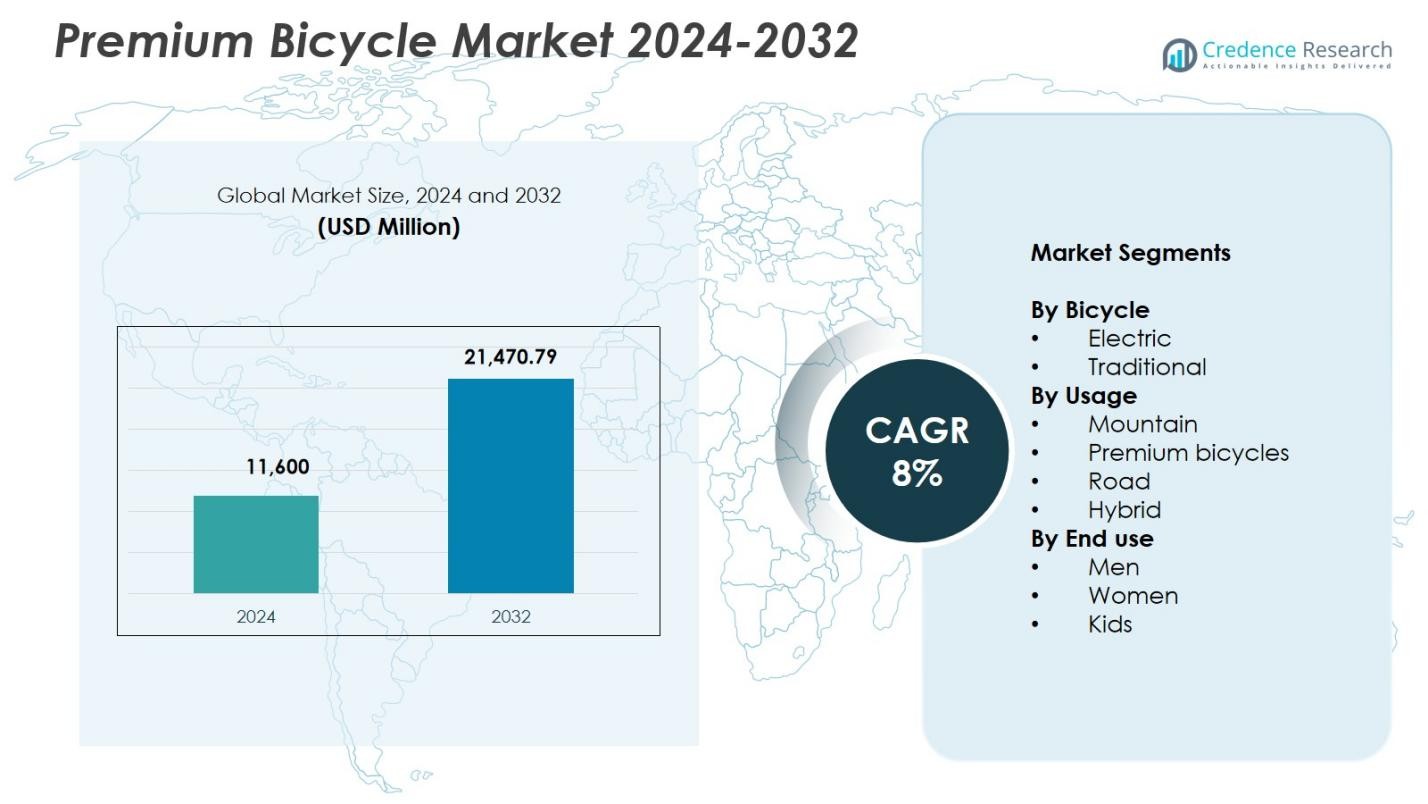
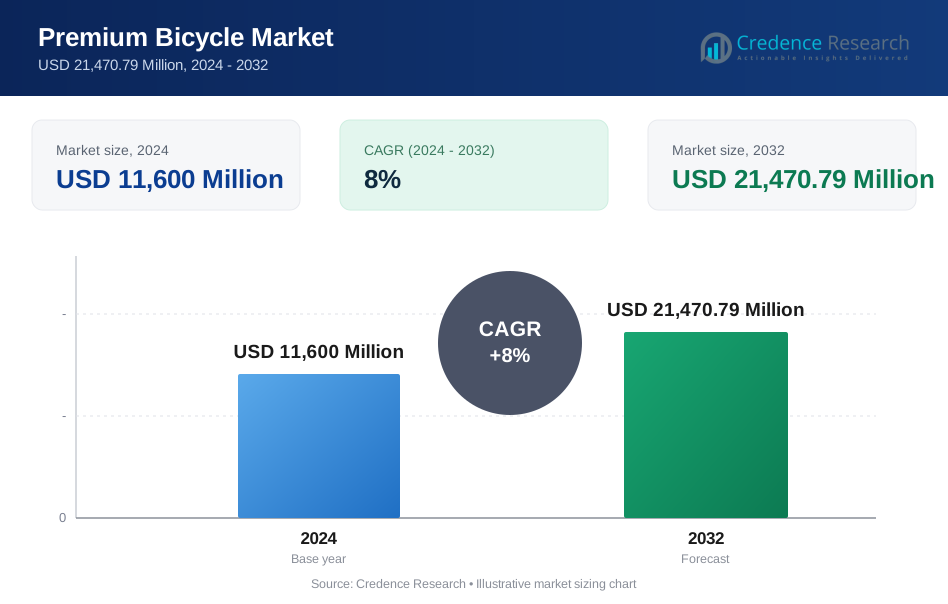
Premium Bicycle Market size was valued at USD 11,600 Million in 2024 and is anticipated to reach USD 21,470.79 Million by 2032, at a CAGR of 8% during the forecast period.
| REPORT ATTRIBUTE | DETAILS |
|---|---|
| Historical Period | 2020-2023 |
| Base Year | 2024 |
| Forecast Period | 2025-2032 |
| Premium Bicycle Market Size 2024 | USD 11,600 Million |
| Premium Bicycle Market, CAGR | 8% |
| Premium Bicycle Market Size 2032 | USD 21,470.79 Million |
Premium Bicycle Market features leading players such as Cervélo Cycles, Giant Manufacturing Co. Ltd., Specialized Bicycle Components, Pon Holdings BV, Cannondale, Accell Group N.V., BMC Switzerland, Merida Industry Co. Ltd., Trek Bicycle Corporation, and Canyon Bicycles, all driving innovation through advanced frame engineering, electronic shifting, and smart-connected technologies. These companies focus on enhancing performance, durability, and rider customization to strengthen global presence across professional and recreational segments. North America led the market with a 34.7% share in 2024, followed by Europe at 29.4%, supported by strong cycling culture, expanding mobility initiatives, and rising adoption of premium electric and high-performance bicycles.
Market Insights
- Premium Bicycle Market reached USD 11,600 Million in 2024 and is projected to hit USD 21,470.79 Million by 2032 at a CAGR of 8%.
- Market growth is driven by rising demand for high-performance bicycles, increasing urban mobility adoption, and expanding interest in fitness, endurance racing, and long-distance cycling.
- Key trends include rapid adoption of premium electric bicycles with a 6% share and strong uptake of road bicycles holding 37.2% as consumers prioritize aerodynamic efficiency and advanced components.
- Major players such as Cervélo Cycles, Giant Manufacturing, Specialized, Pon Holdings, and Trek focus on smart connectivity, carbon-fiber innovation, and DTC sales models, while restraints include high component costs and supply chain disruptions.
- Regionally, North America led with 7%, followed by Europe at 29.4% and Asia-Pacific at 23.8%, supported by cycling infrastructure growth, e-bike incentives, and expanding recreational cycling communities.
 Market Segmentation Analysis:
By Bicycle Type
The electric bicycle segment dominated the Premium Bicycle Market with a 58.6% share in 2024, driven by rising urban commutes, integrated lithium-ion battery systems, and government incentives promoting e-mobility. Consumers increasingly prefer electric models for their extended range, assisted pedaling, and reduced physical strain. Traditional premium bicycles captured 41.4%, supported by demand from fitness enthusiasts and professional cyclists seeking lightweight frames and high-performance drivetrains. The strong shift toward sustainable transportation and advanced motor-assisted technologies continues to strengthen the electric segment’s leadership.
- For instance, Cannondale’s Turbo Vado 4.0 and similar high-end commuter e-bikes offer integrated lithium-ion battery systems and pedal-assist motors that support daily city travel and longer-distance rides, providing extended range and smoother acceleration for urban professionals.
By Usage
Road bicycles held the largest share at 37.2% in 2024, supported by growing interest in endurance riding, competitive racing, and high-precision carbon frame engineering that enhances speed and performance. Mountain bicycles accounted for 28.5%, driven by expanding trail infrastructure and rising adventure sports participation. Hybrid bicycles captured 21.7% as users favored versatile models suitable for both commuting and recreational riding. Premium specialty bicycles secured 12.6%, reflecting the niche demand for custom-built, performance-tuned models. The dominance of road bicycles continues as cyclists prioritize aerodynamic efficiency and long-distance comfort.
- For instance, Specialized's trail bikes like the Stumpjumper integrate FSR rear suspension and Brain technology, which automatically adjusts damping for optimal control on rough terrain.
By End Use
Men accounted for the dominant 49.8% share in 2024, supported by higher participation in competitive cycling, premium sports activities, and greater spending on advanced components like carbon frames and smart-connectivity systems. Women represented 32.6%, driven by increasing adoption of fitness-oriented cycling and the availability of ergonomically designed premium models. Kids held an 17.6% share, with growth fueled by rising awareness of early fitness habits and demand for lightweight, safety-enhanced bicycles. The men’s segment maintains leadership as manufacturers target performance-driven features and broader model variety.
Key Growth Drivers
Rising Demand for High-Performance and Technologically Advanced Bicycles
The Premium Bicycle Market experiences strong growth as consumers increasingly seek high-performance bicycles equipped with advanced drivetrains, carbon-fiber frames, electronic gear shifting, and integrated smart connectivity. Growing participation in endurance racing, long-distance cycling, and recreational sports amplifies demand for bicycles offering precision control and reduced weight. Manufacturers continue to invest in research and development to enhance aerodynamics, durability, and riding efficiency. This shift toward performance-centric biking encourages higher spending on premium models, strengthening market expansion across professional and enthusiast consumer groups.
- For instance, Pinarello's Dogma F incorporates M40X carbon fiber for superior tensile strength and lateral stiffness, paired with a Shimano Dura-Ace Di2 electronic groupset and an optimized Onda fork with 47mm rake for enhanced descent handling.
Expansion of Urban Mobility and Eco-Friendly Transportation Adoption
Urban commuters are driving substantial premium bicycle adoption as cities emphasize sustainable mobility, cycling infrastructure development, and congestion reduction. Premium electric bicycles, in particular, gain momentum due to their assisted pedaling capabilities, extended range, and alignment with low-emission transportation goals. Government incentives, tax benefits, and cycling-friendly policies across North America, Europe, and Asia-Pacific reinforce uptake. Growing awareness of environmental protection and the health benefits of active commuting accelerates replacement of conventional vehicles, positioning premium bicycles as a preferred alternative for urban travel.
- For instance, Aventon launched the Soltera.2, a lightweight Class II commuter e-bike at 46 pounds with a torque sensor for natural pedaling, integrated turn signals, and up to 46 miles of range.
Increasing Health, Fitness, and Lifestyle-Oriented Consumer Spending
Increasing global focus on fitness, preventive healthcare, and active lifestyles significantly boosts premium bicycle demand. Consumers are investing in high-quality bicycles to support endurance training, outdoor recreation, and weight-management activities. Post-pandemic lifestyle shifts have strengthened interest in cycling as a safe, accessible, and engaging form of exercise. Premium brands benefit from rising disposable incomes and willingness to spend on equipment that enhances performance and comfort. This trend is supported by the rapid expansion of cycling clubs, community events, and wellness-driven recreational activities worldwide.
Key Trends & Opportunities
Advancements in Smart, Connected, and Electrified Bicycle Technologies
A major emerging trend in the Premium Bicycle Market is the rapid integration of smart features, including GPS tracking, real-time ride analytics, wireless gear shifting, and app-based performance monitoring. Electric premium bicycles with torque sensors and advanced battery systems create new product differentiation opportunities. Manufacturers integrating IoT-enabled diagnostics, anti-theft technology, and predictive maintenance gain strong competitive advantage. This convergence of digital innovation and high-end engineering opens opportunities for subscription-based services, personalized training insights, and connected mobility ecosystems.
- For instance, SRAM provides the Red eTap AXS groupset with 2x12-speed wireless electronic shifting via shift-brake levers, enabling customizable reach and precise gear changes without cables.
Growth of Customization and Direct-to-Consumer Premium Bicycle Models
Premium bicycle brands increasingly adopt direct-to-consumer (DTC) models, enabling tailored purchasing experiences, competitive pricing, and access to fully customized builds. Consumers are choosing bicycles designed with personalized geometry, specialized components, and unique color schemes to match individual performance needs. This trend supports higher brand loyalty and margin expansion as companies streamline supply chains and build deeper customer engagement. Custom-fit premium bicycles, supported by virtual fitting tools and online configurators, create strong opportunities for market differentiation and attract high-value cycling enthusiasts.
- For instance, Canyon's MyCanyon platform on the Aeroad CFR model offers curated custom paint from collections like Sparkle Stealth or artist collaborations with Felipe Pantone, plus options for stem length adjustments up to 20 mm longer than stock and personalized name stickers.
Key Challenges
High Cost of Premium Components and Limited Affordability for Mass Consumers
Premium bicycles rely heavily on carbon composites, advanced alloy materials, and precision-engineered components, significantly increasing overall product cost. High prices limit accessibility among casual cyclists and price-sensitive consumers, slowing market penetration in developing regions. Additionally, the cost burden extends to electric premium bicycles due to expensive batteries and electronic systems. Manufacturers face continuous pressure to balance innovation with affordability while managing raw material volatility. This challenge restricts large-scale adoption and requires strategic pricing, localized production, and product segmentation to broaden customer reach.
Supply Chain Disruptions and Component Shortages Impacting Production
The Premium Bicycle Market faces ongoing challenges from global supply chain disruptions, particularly shortages of braking systems, drivetrains, and electronic components. High dependency on specialized suppliers increases production bottlenecks and extends delivery times for premium models. Logistics constraints, fluctuating freight costs, and geopolitical tensions further impact inventory planning. These disruptions hinder manufacturers’ ability to meet rising demand and maintain consistent product availability. Strengthening supplier networks, diversifying sourcing regions, and investing in in-house component capabilities are essential to mitigate long-term risks.
Regional Analysis
North America
North America held a 34.7% share of the Premium Bicycle Market in 2024, driven by strong participation in competitive cycling, rapid adoption of premium e-bikes, and expanding recreational cycling culture. The United States leads the region as consumers invest in high-performance bicycles featuring advanced drivetrains and carbon-frame engineering. Growth in cycling infrastructure, rising fitness awareness, and increasing commuter preference for eco-friendly mobility reinforce demand. Canada contributes to market expansion through supportive government incentives and a growing community of endurance cyclists. The region’s strong retail presence and direct-to-consumer sales models further strengthen uptake.
Europe
Europe accounted for a 29.4% share in 2024, supported by a well-established cycling culture, strict emission regulations, and widespread adoption of electric premium bicycles across urban centers. Countries such as Germany, the Netherlands, and Denmark drive significant demand due to extensive cycling networks and strong consumer preference for sustainable transportation. Premium mountain and road bicycles also gain traction due to active participation in outdoor sports and professional racing events. Government incentives for e-mobility, combined with rising tourism-related cycling activities, reinforce Europe’s strong position as a leading market for premium bicycle innovations.
Asia-Pacific
Asia-Pacific captured a 23.8% share in 2024, propelled by strengthening urban mobility trends, expanding cycling communities, and rising disposable incomes in China, Japan, and Southeast Asia. Demand for premium electric bicycles continues to accelerate due to increasing congestion in metropolitan areas and awareness of sustainable commuting. Growth in recreational cycling and professional racing events across the region supports higher adoption of high-end road and mountain bicycles. Manufacturers benefit from large-scale production capabilities in China and Taiwan, enabling competitive pricing and technological advancements that elevate Asia-Pacific as a fast-growing premium bicycle hub.
Latin America
Latin America held a 6.2% share in 2024, influenced by rising health awareness, expanding urban cycling infrastructure, and growing adoption of premium bicycles in Brazil, Mexico, and Colombia. Economic improvements and lifestyle shifts encourage consumers to invest in high-quality fitness and recreational products. Premium mountain bicycles gain traction due to diverse terrain and increasing adventure sports participation. Although price sensitivity remains a challenge, the region’s growing middle-class population and government-backed mobility initiatives support steady market development. Local distributors and specialty bicycle retailers continue to broaden access to premium bicycle brands.
Middle East & Africa
The Middle East & Africa region accounted for a 5.9% share in 2024, supported by rising interest in outdoor sports, expanding cycling clubs, and infrastructure investments in countries such as the UAE, Saudi Arabia, and South Africa. Premium road and mountain bicycles record strong demand due to growing participation in endurance events and desert racing formats. E-bike adoption is increasing in urban centers as cities promote sustainable transportation solutions. Although premium bicycle penetration remains lower than other regions, rising tourism activities, sports investments, and high-income expatriate populations contribute to sustained growth potential.
Market Segmentations:
By Bicycle
- Electric
- Traditional
By Usage
- Mountain
- Premium bicycles
- Road
- Hybrid
By End use
- Men
- Women
- Kids
By Geography
- North America
- U.S.
- Canada
- Mexico
- Europe
- Germany
- France
- U.K.
- Italy
- Spain
- Rest of Europe
- Asia Pacific
- China
- Japan
- India
- South Korea
- South-east Asia
- Rest of Asia Pacific
- Latin America
- Brazil
- Argentina
- Rest of Latin America
- Middle East & Africa
- GCC Countries
- South Africa
- Rest of the Middle East and Africa
Competitive Landscape
The competitive landscape of the Premium Bicycle Market features leading players such as Cervélo Cycles, Giant Manufacturing Co. Ltd., Specialized Bicycle Components, Pon Holdings BV, Cannondale, Accell Group N.V., BMC Switzerland, Merida Industry Co. Ltd., Trek Bicycle Corporation, and Canyon Bicycles. These companies compete through continuous innovation in drivetrain technology, carbon-fiber engineering, electronic shifting systems, and integrated smart connectivity. Manufacturers emphasize performance enhancement, lightweight frame construction, and customization options to meet diverse rider preferences across professional, recreational, and urban mobility segments. Strategic investments in electric premium bicycles strengthen their portfolio differentiation as demand for assisted mobility accelerates. Direct-to-consumer sales models, online configurators, and immersive retail experiences improve customer engagement and brand loyalty. Key players are also expanding geographically through dealer networks, specialty stores, and partnerships with cycling events to enhance global visibility. The market remains innovation-driven, with companies prioritizing R&D, advanced aerodynamics, and sustainability-focused materials to maintain competitive positioning.
Key Player Analysis
- Cervélo Cycles
- Giant Manufacturing Co. Ltd.
- Specialized Bicycle Components
- Pon Holdings BV
- Cannondale
- Accell Group N.V.
- BMC Switzerland
- Merida Industry Co. Ltd.
- Trek Bicycle Corporation
- Canyon Bicycles
Recent Developments
- In September 2025, Trek Bicycle Corporation launched its first-ever electric gravel bike the Checkpoint+ SL expanding its premium e-gravel lineup.
- In March 2024, Canyon Bicycles announced a long-term 10-year commitment agreement with rider Mathieu van der Poel, reinforcing its pro-cycling alliance and brand alignment.
- In October 2022, Trek Bicycle Corporation launched its new e-bike line “Domane+” to expand its premium electric bicycle offerings.
Report Coverage
The research report offers an in-depth analysis based on Bicycle, Usage, End Use and Geography. It details leading market players, providing an overview of their business, product offerings, investments, revenue streams, and key applications. Additionally, the report includes insights into the competitive environment, SWOT analysis, current market trends, as well as the primary drivers and constraints. Furthermore, it discusses various factors that have driven market expansion in recent years. The report also explores market dynamics, regulatory scenarios, and technological advancements that are shaping the industry. It assesses the impact of external factors and global economic changes on market growth. Lastly, it provides strategic recommendations for new entrants and established companies to navigate the complexities of the market.
Future Outlook
- Premium bicycles will witness rising adoption as consumers increasingly prioritize high-performance mobility, fitness, and recreational cycling.
- Electric premium bicycles will continue to expand rapidly as battery efficiency, torque sensors, and lightweight motor systems improve.
- Smart connectivity features such as GPS tracking, performance analytics, and wireless shifting will become standard in premium models.
- Custom-built and direct-to-consumer bicycle models will grow as riders seek personalized geometry and component configurations.
- Carbon-fiber and advanced alloy frame technologies will evolve to offer greater durability, aerodynamics, and weight reduction.
- Urban mobility initiatives and cycling infrastructure expansion will strengthen demand across major global cities.
- Health and wellness trends will drive consistent interest in high-end road, hybrid, and mountain bicycles.
- Supply chain localization and in-house component manufacturing will gain importance to reduce production delays.
- Sustainability-focused materials and eco-designed components will become central to premium bicycle development.
- Competitive differentiation will increasingly depend on digital integration, after-sales services, and enhanced customer experiences.
Request a Free Sample
Fill in your details and we'll send you a free sample report.
- Sample data tables & charts
- Research methodology
Need a Custom Version of This Report?
Tailor the scope, geography, or segments to your exact requirements.
- Custom geography or segment scope
- Direct access to our analyst team
Frequently Asked Questions
What is the current market size for the Premium Bicycle Market, and what is its projected size in 2032?
At what Compound Annual Growth Rate is the Premium Bicycle Market projected to grow between 2025 and 2032?
Which Premium Bicycle Market segment held the largest share in 2024?
What are the primary factors fueling the growth of the Premium Bicycle Market?
Who are the leading companies in the Premium Bicycle Market?
Which region commanded the largest share of the Premium Bicycle Market in 2024?
Table of Content
Chapter 1. Report Introduction
- 1.1 Report Description & Purpose
- 1.1.1 Report Title & Market Definition
- 1.1.2 Unique Selling Propositions (USP) & Key Differentiators
- 1.1.3 Value Proposition for Stakeholders
- 1.2 Research Objectives
- 1.2.1 Market Sizing Objectives (Volume & Revenue) (Volume Where Applicable)
- 1.2.2 Segmentation Objectives
- 1.2.3 Competitive Intelligence Objectives
- 1.2.4 Forecast & Scenario Objectives
- 1.3 Report Scope
- 1.3.1 Premium Bicycle Scope – Segments & Subsegments Covered
- 1.3.2 Geographic Scope – Regions & Countries Covered
- 1.3.3 Historical Period, Base Year & Forecast Period (2024; forecast to 2032)
- 1.3.4 Inclusions & Exclusions
- 1.4 Industry Classification & Applicable Codes
- 1.5 Currency, Measurement Units & Valuation Basis
- 1.6 Target Stakeholders
- 1.7 Limitations & Assumptions
Chapter 2. Executive Summary
- 2.1 Global Premium Bicycle Market Snapshot
- 2.1.1 Market Size – Historical (2024) & Forecast (2024-2032) (2024: USD 11,600 Million → 2032: USD 21,470.79 Million)
- 2.1.2 Volume & Revenue – Global Totals (Volume Where Applicable)
- 2.1.3 Key Market Highlights – Top Five Facts
- 2.2 Premium Bicycle Market Segmentation Snapshot
- 2.2.1 Market Split by Region – 2024 vs. 2032
- 2.3 Competitive Snapshot
- 2.3.1 Top 10 Players by Revenue Share – 2024
- 2.3.2 Top 10 Players by Volume Share – 2024 (Volume Where Applicable)
- 2.3.3 Recent Strategic Developments (18-Month Summary)
- 2.4 Key Investment Highlights & Strategic Conclusions
Chapter 3. Premium Bicycle Market Dynamics & Industry Analysis
- 3.1 Market Overview & Context
- 3.1.1 Premium Bicycle Market Position in the Broader Industry Value Chain
- 3.1.2 Demand Structure & Purchasing Dynamics
- 3.1.3 Market Maturity & Development Stage by Region
- 3.2 Premium Bicycle Market Drivers
- 3.3 Premium Bicycle Market Restraints & Challenges
- 3.4 Premium Bicycle Market Opportunities
- 3.5 Porter's Five Forces Analysis
- 3.5.1 Threat of New Entrants
- 3.5.2 Bargaining Power of Suppliers
- 3.5.3 Bargaining Power of Buyers
- 3.5.4 Threat of Substitutes
- 3.5.5 Competitive Rivalry – Intensity Assessment
- 3.6 Premium Bicycle Value Chain Analysis
- 3.6.1 Upstream – Key Inputs, Resources & Suppliers
- 3.6.1.1 Key Input/Resource 1
- 3.6.1.2 Key Input/Resource 2
- 3.6.1.3 Key Input/Resource 3
- 3.6.2 Midstream – Core Operations & Value Creation
- 3.6.2.1 Operating Model & Process Overview
- 3.6.2.2 Key Operating Locations & Capabilities by Company
- 3.6.3 Downstream – Market Channels & End Users
- 3.6.3.1 Direct Sales & Customer Engagement Channels
- 3.6.3.2 Indirect Sales, Intermediaries & Partner Channels
- 3.6.4 Value Chain Profitability Analysis
- 3.6.1 Upstream – Key Inputs, Resources & Suppliers
- 3.7 PESTEL Analysis
- 3.7.1 Political Factors
- 3.7.2 Economic Factors
- 3.7.3 Social Factors
- 3.7.4 Technological Factors
- 3.7.5 Environmental Factors
- 3.7.6 Legal Factors
- 3.8 Premium Bicycle Supply Chain Analysis
- 3.8.1 Critical Input & Resource Availability Risk Assessment
- 3.8.2 Supplier & Operational Concentration Risk (Geographic Exposure)
- 3.8.3 Supply & Service Disruption Impact Analysis
- 3.9 Regulatory & Policy Landscape
Note: The regulatory and policy landscape section covers regulations based on their applicability to the market, Premium Bicycle category, geography, and scope of the study. Only regulatory frameworks with a material impact on operations, compliance, trade, sustainability, or market access are analyzed in detail.
Chapter 4. Key Investment Pockets & Opportunity Analysis
- 4.1 Premium Bicycle Market Attractiveness Analysis
- 4.1.1 By Region – Investment Attractiveness Matrix (Market Size × CAGR)
- 4.2 Absolute Revenue Growth Opportunity
- 4.2.1 By Region – Absolute Revenue Growth Through 2032
- 4.3 Incremental Demand Opportunity
- 4.3.1 By Region – Incremental Demand Through 2032
- 4.3.2 Segment – Incremental Demand
- 4.4 Emerging Submarket Opportunity Deep Dive (Subject to Applicability)
- 4.5 Priority Market Opportunity Scorecards
- 4.5.1 United States
- 4.5.2 Europe
- 4.5.3 Asia
- 4.5.4 Middle East & Africa
Note: Priority market opportunity scorecards reflect the geographic scope and strategic relevance of the study. Listed markets are indicative and may be adapted to the industry.
Chapter 5. Premium Bicycle Cross-Border Trade & Market Access Analysis
- 5.1 International Trade & Cross-Border Activity Overview
- 5.1.1 Global Export Value by Country (2024)
- 5.1.2 Global Export Volume by Country (2024) (Volume Where Applicable)
- 5.1.3 Global Import Value by Country (2024)
- 5.1.4 Global Import Volume by Country (2024) (Volume Where Applicable)
- 5.1.5 Net Trade Balance by Country (2024)
- 5.2 Export Analysis – Segment
- 5.2.1 Category 1 (Applicable Classification Code)
- 5.2.2 Category 2 (Applicable Classification Code)
- 5.2.3 Category 3 (Applicable Classification Code)
- 5.2.4 Category 4 (Applicable Classification Code)
- 5.2.5 Category 5 (Applicable Classification Code)
- 5.3 Import Analysis – Segment
- 5.3.1 Category 1 (Applicable Classification Code)
- 5.3.2 Category 2 (Applicable Classification Code)
- 5.3.3 Category 3 (Applicable Classification Code)
- 5.3.4 Category 4 (Applicable Classification Code)
- 5.3.5 Category 5 (Applicable Classification Code)
- 5.4 Cross-Border Pricing & Transaction Benchmarks
- 5.4.1 Export Pricing – Segment & Country
- 5.4.2 Import Pricing – Segment & Source Country
- 5.4.3 Price Trends (2024)
- 5.5 Key Cross-Border Trade & Delivery Routes
- 5.5.1 Cross-Border Trade/Delivery Route 1
- 5.5.2 Cross-Border Trade/Delivery Route 2
- 5.5.3 Cross-Border Trade/Delivery Route 3
- 5.5.4 Cross-Border Trade/Delivery Route 4
- 5.5.5 Cross-Border Trade/Delivery Route 5
- 5.6 Trade Policy & Market Access Impact Assessment
- 5.6.1 Tariff & Non-Tariff Barriers
- 5.6.2 Regional Trade & Economic Integration Frameworks
- 5.6.3 Bilateral & Multilateral Trade Agreements
- 5.6.4 Cross-Border Operating, Licensing & Localization Requirements
Note: This chapter applies where cross-border trade or delivery is relevant to Premium Bicycle. Goods, services, and digital offerings are assessed using applicable classifications and transaction measures. Import-export volumes, trade balances, and route analyses are included only where meaningful to the market.
Chapter 6. Competitive Landscape & Company Benchmarking
- 6.1 Premium Bicycle Market Concentration & Structure
- 6.1.1 Herfindahl-Hirschman Index (HHI) – vs. 2024
- 6.1.2 Leading, Mid-Sized & Emerging Player Structure
- 6.1.3 Global, Regional & Local Player Dynamics
- 6.2 Premium Bicycle Market Share Analysis – 2024
- 6.2.1 Global Revenue Share by Company
- 6.2.2 Global Volume Share by Company (Volume Where Applicable)
- 6.2.3 Regional Revenue Share
- 6.2.4 Market Share Evolution ( vs. 2024)
- 6.2.5 Company Market Share by Key Segment
- 6.2.6 Company Market Share by Customer Group
- 6.3 Operating Scale, Capacity & Infrastructure Analysis
- 6.3.1 Global Operating Scale & Supply Capacity
- 6.3.2 Resource Utilization & Operating Efficiency
- 6.3.3 Output, Service Delivery & Activity Metrics
- 6.3.4 Operating Footprint & Infrastructure Map
- 6.3.5 Planned Operational & Capacity Expansion
- 6.4 Premium Bicycle Competitive Benchmarking Matrix
- 6.4.1 Revenue, Growth, Profitability & Operating Metric Comparison
- 6.4.2 Channel Revenue Mix
- 6.4.3 Geographic Revenue Exposure
- 6.4.4 R&D Intensity
- 6.4.5 Sustainability Maturity
- 6.5 Strategic Developments in Premium Bicycle (Last 24 Months)
- 6.5.1 Mergers, Acquisitions & Divestments
- 6.5.2 New Products, Services & Solutions in Premium Bicycle
- 6.5.3 Operational & Infrastructure Expansions
- 6.5.4 Strategic Alliances, Joint Ventures & Partnerships
- 6.5.5 Distribution Expansion & Market Entry
- 6.5.6 Sustainability & ESG Initiatives
- 6.6 Competitive Strategy Mapping
- 6.6.1 Leader, Challenger, Follower & Niche Classification
- 6.6.2 Pricing Strategy Comparison
- 6.6.3 Channel Strategy Matrix
Note: Strategic developments are included based on their materiality and the availability of reliable information.
Chapter 7. Global Premium Bicycle Market – By Sales & Delivery Channel
- 7.1 Segment Overview
- 7.1.1 Volume & Revenue Split by Channel (2024 & 2032) (Volume Where Applicable)
- 7.1.2 Channel Mix Evolution (2024-2032)
Chapter 8. Regional Market Analysis – Global Overview
- 8.1 Global Regional Overview
- 8.1.1 Regional Volume Share (Volume Where Applicable)
- 8.1.2 Regional Revenue Share
- 8.1.3 Regional Volume by Region (Volume Where Applicable)
- 8.1.4 Regional Revenue by Region
- 8.1.5 Regional Forecast Through 2032
- 8.2 Cross-Regional Segment Analysis
- 8.2.1 By Sales & Delivery Channel
- 8.2.2 By Competitive Positioning & Price Tier
Chapter 9. North America Premium Bicycle Market
- 9.1 United States
- 9.2 Canada
- 9.3 Mexico
Chapter 10. Europe Premium Bicycle Market
- 10.1 Germany
- 10.2 France
- 10.3 Italy
- 10.4 United Kingdom
- 10.5 Spain
- 10.6 Poland
- 10.7 Russia
- 10.8 Netherlands
- 10.9 Belgium
- 10.10 Sweden
- 10.11 Denmark
- 10.12 Norway
- 10.13 Rest of Europe
Chapter 11. Asia Pacific Premium Bicycle Market
- 11.1 China
- 11.2 India
- 11.3 Japan
- 11.4 South Korea
- 11.5 Thailand
- 11.6 Indonesia
- 11.7 Vietnam
- 11.8 Malaysia
- 11.9 Australia
- 11.10 Rest of Asia Pacific
Chapter 12. Latin America Premium Bicycle Market
- 12.1 Brazil
- 12.2 Argentina
- 12.3 Colombia
- 12.4 Chile
- 12.5 Rest of Latin America
Chapter 13. Middle East Premium Bicycle Market
- 13.1 Saudi Arabia
- 13.2 United Arab Emirates
- 13.3 Turkey
- 13.4 Israel
- 13.5 Iran
- 13.6 Rest of the Middle East
Chapter 14. Africa Premium Bicycle Market
- 14.1 South Africa
- 14.2 Egypt
- 14.3 Nigeria
- 14.4 Morocco
- 14.5 Rest of Africa
Chapter 15. Premium Bicycle Company Profiles
- 15.1 [Company 01]
- 15.1.1 Company Overview
- 15.1.2 Key Management Personnel
- 15.1.3 Products & Services Portfolio
- 15.1.4 Financial Performance
- 15.1.5 Key Market Focus & Geographic Presence
- 15.1.6 Recent Developments & Strategic Initiatives
Note: The company profile list is preliminary and may change based on research findings, market developments, data availability, and client requirements.
Chapter 16. Appendices
- Appendix A – List of Abbreviations & Acronyms
- Appendix B – Industry Classification Code Reference – Full Series
- Appendix C – Supply, Output & Operating Capacity Data Tables
- Appendix D – End-Use & Demand Base Tables
- Appendix E – Demand, Adoption & Usage Assumptions
- Appendix F – Pricing & Revenue Metric Reference Tables
- Appendix G – Company Operations & Infrastructure Database
- Appendix H – Cross-Border Trade & Activity Data Tables (Where Applicable)
- Appendix I – Regulatory Summary Tables
- Appendix J – Primary Research Participant List (Anonymized)
- Appendix K – Primary Research Questionnaire Framework
- Appendix L – Data Sources & Bibliography
- Appendix M – Market Size Divergence & Source Comparison
Chapter 17. Research Methodology
- 17.1 Research Framework & Philosophy
- 17.2 Secondary Research – Sources, Hierarchy & Data Extraction
- 17.3 Data Modeling – Bottom-Up & Top-Down Market Sizing
- 17.4 Primary Research – Stakeholder Framework, LOI & Sample Sizes
- 17.5 Forecast Methodology – Regression, Scenario & Sensitivity Analysis
- 17.6 Quality Control – Four-Layer Validation Framework
- 17.7 Limitations & Standard Assumptions
- 17.8 Disclaimer
