
Market Overview
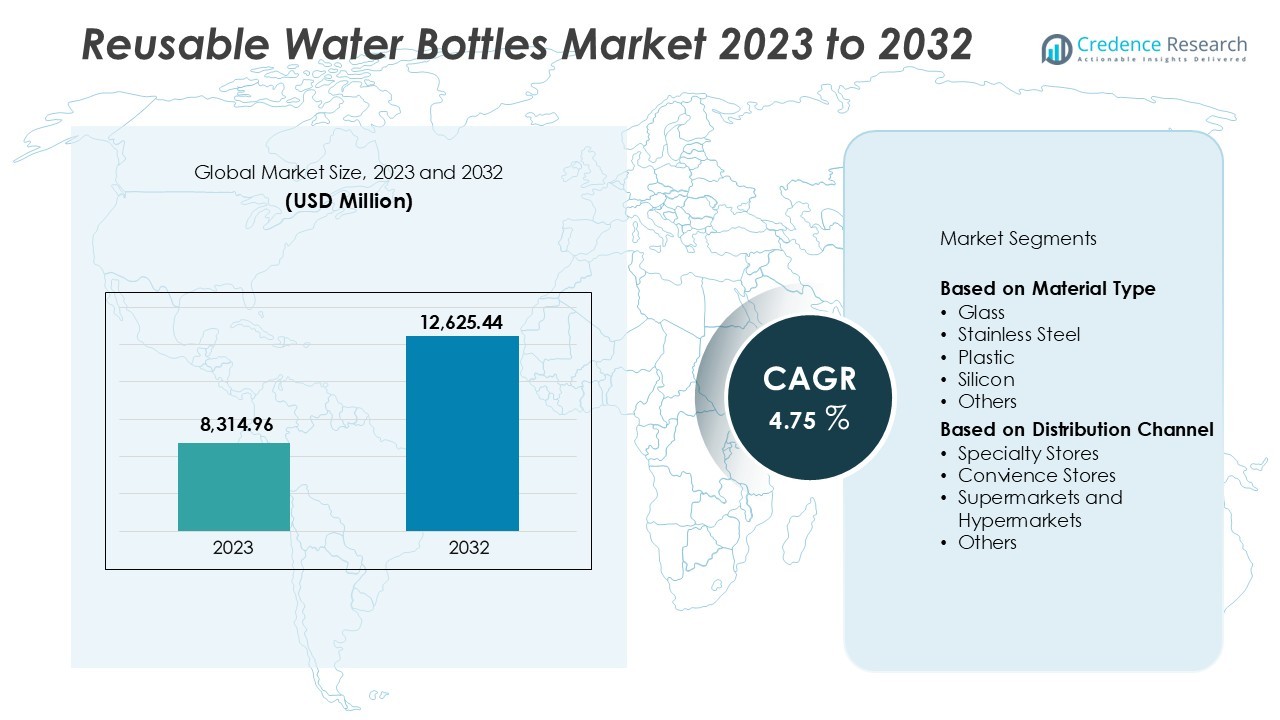
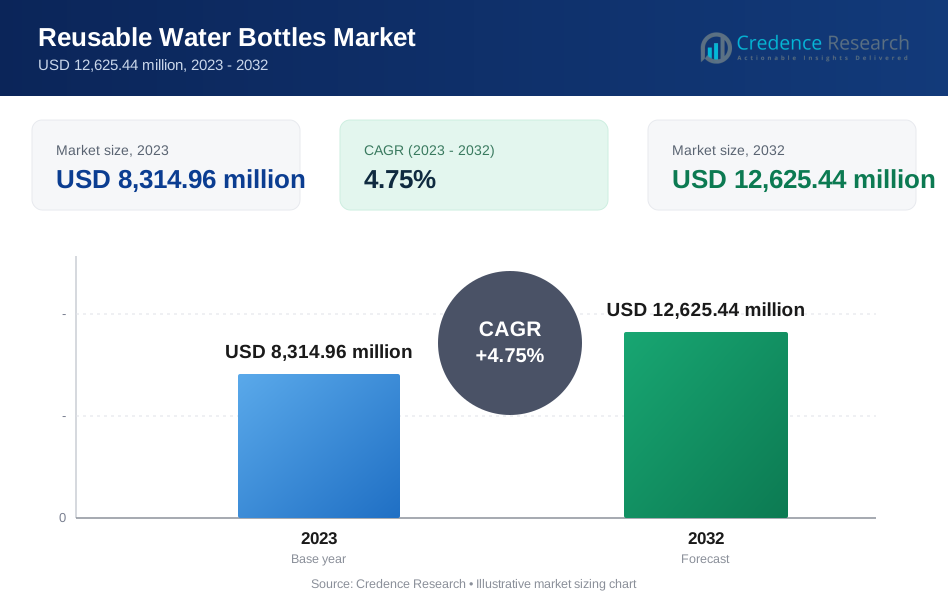
The Reusable Water Bottles Market size was valued at USD 8,314.96 million in 2023 and is anticipated to reach USD 12,625.44 million by 2032, growing at a compound annual growth rate (CAGR) of 4.75% during the forecast period.
| REPORT ATTRIBUTE | DETAILS |
|---|---|
| Historical Period | 2020-2023 |
| Base Year | 2024 |
| Forecast Period | 2025-2032 |
| Reusable Water Bottles Market Size 2023 | USD 8,314.96 Million |
| Reusable Water Bottles Market, CAGR | 4.75% |
| Reusable Water Bottles Market Size 2032 | USD 12,625.44 Million |
The Reusable Water Bottles Market is characterized by strong competition among global and regional players emphasizing sustainability and innovation. Key companies such as Tupperware Corporation, SIGG Switzerland AG, CamelBak Products LLC, Klean Kanteen, Contigo, Aquasana Inc., Hydaway, Nalgene, and S’well dominate the industry through extensive product portfolios and advanced materials. These players focus on ergonomic design, insulation technology, and eco-friendly production to strengthen brand loyalty. North America leads the global market with a 34% share, supported by sustainability awareness and premium product demand, followed by Europe with 29%, driven by strict environmental regulations and consumer preference for reusable, high-quality bottles.
Market Insights
- The Reusable Water Bottles Market was valued at USD 8,314.96 million in 2023 and is projected to reach USD 12,625.44 million by 2032, growing at a CAGR of 4.75% during the forecast period.
- Rising environmental awareness and strict regulations against single-use plastics are major drivers promoting reusable and sustainable hydration products.
- Smart hydration tracking, eco-friendly materials, and customizable bottle designs are emerging as key market trends driving product innovation and consumer appeal.
- The market is moderately competitive, with leading players like Tupperware Corporation, CamelBak Products LLC, and SIGG Switzerland AG focusing on advanced insulation, design, and brand partnerships.
- North America led with a 34% share in 2024, followed by Europe (29%) and Asia-Pacific (27%), while stainless steel bottles dominated material type with a 42% share, reflecting strong consumer preference for durability and sustainability.
Market Segmentation Analysis:
By Material Type
Stainless Steel dominated the reusable water bottles market in 2024, accounting for nearly 42% of the total share. Its leadership is driven by high durability, temperature retention, and resistance to corrosion, making it ideal for daily and outdoor use. The growing awareness of plastic-free and sustainable materials has accelerated the shift toward stainless-steel bottles across both premium and mid-range categories. Leading brands are introducing insulated and vacuum-sealed variants with ergonomic designs to meet consumer demand for performance and aesthetics, further strengthening stainless steel’s dominance in global markets.
- For instance, Stanley, a brand owned by PMI Worldwide, produces stainless-steel insulated bottles using verifiable features such as 18/8 food-grade steel and double-wall vacuum insulation.
By Distribution Channel
Supermarkets and hypermarkets held the largest share of around 48% in 2024, driven by the wide availability of branded and private-label reusable bottles. These retail outlets provide consumers with product variety, promotional discounts, and easy product comparison, enhancing purchase convenience. Expanding retail networks in urban regions and partnerships between bottle manufacturers and large retailers have supported strong growth in this channel. The visibility of eco-friendly and premium designs on physical shelves continues to boost consumer adoption, making supermarkets and hypermarkets the most preferred distribution platform globally.
- For instance, in 2024, Walmart continued its efforts to reduce waste through its private-brand packaging, but the company also faced a major product recall related to its reusable water bottles.
Key Growth Drivers
Rising Environmental Awareness and Plastic Waste Reduction Initiatives
Growing global concern over plastic pollution remains a major catalyst for the reusable water bottles market. Governments and organizations are implementing regulations and campaigns to reduce single-use plastic consumption, driving consumers toward sustainable alternatives. Programs like the EU Single-Use Plastics Directive and corporate sustainability goals from major beverage brands are promoting refillable packaging and reusable containers. Consumers increasingly prefer eco-friendly bottles made from stainless steel, glass, or BPA-free plastic to minimize environmental impact. This shift is transforming consumption behavior, with lifestyle changes supporting consistent market expansion across urban centers worldwide.
- For instance, as part of its ongoing "World Without Waste" initiative in 2024, Coca-Cola reported that approximately 14% of its total beverage volume was served in reusable packaging. During the year, the company also replaced its reusable packaging targets, and its overall collection rate for bottles and cans was updated to 70–75% by 2035.
Expanding Health and Wellness Trends
Health-conscious consumers are fueling the adoption of reusable bottles for hydration and wellness monitoring. The global rise in fitness culture, coupled with growing awareness about water intake, has boosted demand for personalized, safe, and non-toxic bottles. Many reusable models now feature smart technologies such as hydration tracking sensors and UV-C sterilization. Brands like LARQ and HidrateSpark are integrating digital monitoring and antimicrobial surfaces to attract tech-savvy users. These innovations, combined with increasing gym memberships and outdoor activity participation, are positioning reusable bottles as essential health accessories.
- For instance, HidrateSpark produces Bluetooth-enabled smart bottles capable of tracking daily hydration levels through mobile app integration and automatic LED alerts.
Corporate and Institutional Sustainability Programs
Enterprises and educational institutions are increasingly adopting sustainable practices, which directly support reusable bottle demand. Many workplaces and universities are banning disposable plastics and encouraging refill stations to promote eco-conscious behavior. Global brands are also offering customized, branded stainless-steel or glass bottles to employees as part of green initiatives. This movement aligns with Environmental, Social, and Governance (ESG) objectives, influencing both procurement policies and consumer purchasing patterns. The adoption of corporate sustainability standards is thus reinforcing long-term market growth and creating strong demand across bulk and institutional channels.
Key Trends and Opportunities
Integration of Smart Hydration Technologies
The fusion of IoT and consumer hydration habits is reshaping product innovation in the reusable water bottle market. Smart bottles that sync with mobile apps to track water intake and remind users to hydrate are gaining traction, particularly among health-focused consumers. Advanced features like LED indicators, temperature sensors, and Bluetooth connectivity are becoming mainstream. Start-ups and established players are investing in sensor-enabled bottles to cater to digital lifestyle preferences. This trend not only supports health awareness but also opens premium pricing opportunities in tech-integrated hydration solutions.
- For instance, LARQ launched its Bottle PureVis 2.0 in 2024, equipped with UV-C LED purification capable of neutralizing up to 99.99% of bio-contaminants in 60 seconds, while tracking hydration data through a connected app.
Growth of Eco-Friendly and Customizable Product Lines
The rise in eco-conscious consumerism is pushing brands toward recyclable, biodegradable, and aesthetically customizable bottle designs. Companies are introducing variants made from bamboo fiber, recycled plastics, and food-grade silicone to appeal to environmentally aware users. Additionally, personalization options such as color choices, engravings, and logo printing enhance customer engagement. The trend of “green gifting” and lifestyle personalization is accelerating sales through e-commerce platforms and brand-owned stores. Manufacturers focusing on sustainability-driven design and personalization stand to gain a strong competitive edge in emerging markets.
Key Challenges
Intense Market Competition and Price Pressure
The reusable water bottle market faces increasing competition from both global and regional brands. Low-cost imports and counterfeit products, especially in developing regions, create strong price pressure for established players. While premium brands focus on quality and innovation, consumers in price-sensitive markets often opt for cheaper alternatives. This challenge affects profitability and brand differentiation. Companies must balance affordability with durability and eco-friendly value propositions to maintain market share while sustaining product quality and innovation.
Material Sustainability and Supply Chain Constraints
Although the demand for eco-friendly materials is rising, supply chain limitations for stainless steel, glass, and recycled plastics pose challenges. Fluctuating raw material prices and limited access to sustainable sourcing can affect production costs. Moreover, recycling infrastructure remains underdeveloped in many countries, restricting the circular economy potential of reusable bottles. Manufacturers must invest in local sourcing, efficient logistics, and closed-loop material systems to mitigate these risks. Addressing these constraints is essential to ensure consistent product availability and sustainability credibility in global markets.
Regional Analysis
North America
North America held the dominant share of around 34% in 2024, driven by strong consumer preference for sustainable and health-oriented products. The U.S. leads regional demand due to widespread adoption of stainless-steel and smart hydration bottles. Major brands are expanding through retail and e-commerce platforms, supported by green initiatives and workplace sustainability programs. Increasing outdoor and fitness activities continue to boost reusable bottle sales. Canada’s emphasis on reducing single-use plastics and implementing refill station networks further strengthens market penetration across both urban and suburban regions.
Europe
Europe accounted for approximately 29% of the global market in 2024, supported by strict environmental regulations and consumer awareness. Countries such as Germany, France, and the U.K. are key contributors, driven by policies like the EU Plastic Waste Directive. The presence of eco-conscious consumers and established brands offering premium glass and stainless-steel bottles enhance regional dominance. Growing sustainability movements and refill campaigns across schools and offices promote long-term adoption. Expansion of zero-waste retail outlets and partnerships with fitness and travel brands continue to reinforce Europe’s leadership in reusable hydration solutions.
Asia-Pacific
Asia-Pacific captured nearly 27% of the total share in 2024, showing rapid expansion due to rising health awareness and lifestyle changes. China, Japan, and India represent the largest growth opportunities with increasing urban populations and youth engagement in sports and fitness. Affordable plastic and stainless-steel bottles dominate, while regional brands introduce localized designs and eco-friendly materials. Government-led plastic bans and public hydration programs are also driving market growth. E-commerce platforms and social media marketing have amplified consumer reach, establishing Asia-Pacific as the fastest-growing region for reusable water bottle adoption.
Latin America
Latin America held about 6% of the global share in 2024, supported by the growing middle-class population and interest in sustainable lifestyle products. Brazil and Mexico lead the region, with expanding retail networks and fitness trends fueling reusable bottle demand. Regional governments are launching anti-plastic campaigns, encouraging reusable alternatives in daily consumption. Local manufacturers are introducing cost-effective stainless-steel and silicone bottles to meet affordability needs. The shift toward eco-friendly products across supermarkets and online platforms continues to strengthen Latin America’s position in the global market.
Middle East & Africa
Middle East & Africa accounted for nearly 4% of the total market share in 2024, with rising awareness of hydration and sustainability driving slow but steady growth. The UAE and South Africa lead demand through corporate wellness programs and tourism-linked consumption. Increasing participation in sports and outdoor activities is also supporting market adoption. However, limited recycling infrastructure and higher product costs constrain faster expansion. International brands are focusing on premium retail and hospitality sectors, while local players are promoting affordable, durable options to enhance accessibility and regional presence.
Market Segmentations:
By Material Type
- Glass
- Stainless Steel
- Plastic
- Silicon
- Others
By Distribution Channel
- Specialty Stores
- Convience Stores
- Supermarkets and Hypermarkets
- Others
By Geography
- North America
- U.S.
- Canada
- Europe
- Germany
- France
- U.K.
- Italy
- Spain
- Rest of Europe
- Asia Pacific
- China
- Japan
- India
- South Korea
- South-east Asia
- Rest of Asia Pacific
- Latin America
- Brazil
- Mexico
- Rest of Latin America
- Middle East & Africa
- GCC Countries
- South Africa
- Rest of the Middle East and Africa
Competitive Landscape
The reusable water bottles market is moderately fragmented, with competition driven by innovation, sustainability, and brand differentiation. Leading players such as Tupperware Corporation, SIGG Switzerland AG, CamelBak Products LLC, Klean Kanteen, and S’well dominate through premium product lines and global retail reach. These companies focus on eco-friendly materials, ergonomic design, and insulation technology to attract environmentally conscious consumers. Emerging brands like Hydaway and Aquasana Inc. are emphasizing collapsible, filter-equipped, and smart hydration bottles to capture niche markets. Strategic collaborations with sports, travel, and lifestyle brands enhance visibility across digital and retail channels. Continuous innovation in design, customization, and sustainability remains central to maintaining competitiveness, while expanding e-commerce networks strengthen direct consumer engagement and market penetration globally.
Key Player Analysis
- Tupperware Corporation
- SIGG Switzerland AG, GmbH
- CamelBak Products, LLC
- Klean Kanteen
- Contigo
- Aquasana Inc.
- Hydaway
- Nalgene
- S’well
Recent Developments
- In April 2023, Nalgene revealed that it has switched its reusable bottle production process to Eastman’s Tritan Renew, a certified 50% recycled material using the mass balance technique of determination. The conversion process from copolyester to Tritan Renew began in 2020 and was completed by January 2023. The company repurposed over 2.35 million pounds of plastic waste during the conversion process.
- In February 2023, SIGG Switzerland AG took part in the ABN AMRO Open tennis tournament to provide all players with reusable drinking bottles which took place at Rotterdam Ahoy in the Dutch city of Rotterdam. The bottles provided were made out of Tritan Renew, a super high impact- and scratch-resistant material. The Tritan used for these bottles is certified by the ISCC – International Sustainability and Carbon Certification
- In December 2022, Klean Kanteen and other outdoor drinkware companies like MiiR, Stanley, and YETI joined forces to create the Drinkware CoLab. They aim to decrease carbon emissions in their supply chain and support the Outdoor Industry Association’s (OIA) goal to become the first climate-positive industry by 2030. The four brands are part of OIA’s Climate Action Corps, which seeks to generate a net-positive benefit, going beyond net zero
- In August 2022, S’well launched its Elements Collection of bottles which consists of three high-gloss bottles named ‘Blue Marble’, ‘Charcoal Granite’, and ‘Opal Marble’. The collection features earthy shades and tones. These double-walled, stainless steel insulated bottles can keep the contents cold for 24 hours and hot for 12 hours. The design prevents condensation, features drip-free sipping, and has a wide mouth that accommodates the addition of ice.
Report Coverage
The research report offers an in-depth analysis based on Type, Application, End-User and Geography. It details leading market players, providing an overview of their business, product offerings, investments, revenue streams, and key applications. Additionally, the report includes insights into the competitive environment, SWOT analysis, current market trends, as well as the primary drivers and constraints. Furthermore, it discusses various factors that have driven market expansion in recent years. The report also explores market dynamics, regulatory scenarios, and technological advancements that are shaping the industry. It assesses the impact of external factors and global economic changes on market growth. Lastly, it provides strategic recommendations for new entrants and established companies to navigate the complexities of the market.
Future Outlook
- The market will continue expanding due to global sustainability and anti-plastic initiatives.
- Demand for smart, app-connected bottles with hydration tracking will grow steadily.
- Stainless steel and glass materials will dominate due to durability and health safety.
- Corporate sustainability programs will boost large-scale adoption across workplaces.
- Customizable and aesthetically designed bottles will attract younger, lifestyle-focused consumers.
- E-commerce platforms will remain the primary growth channel for premium brands.
- Technological innovations in insulation and filtration will enhance product value.
- Emerging markets in Asia-Pacific will experience the fastest consumption growth.
- Collaborations between fitness, travel, and lifestyle brands will strengthen brand visibility.
- Increasing awareness of personal health and hydration will sustain long-term market demand.
Request a Free Sample
Fill in your details and we'll send you a free sample report.
- Sample data tables & charts
- Research methodology
Need a Custom Version of This Report?
Tailor the scope, geography, or segments to your exact requirements.
- Custom geography or segment scope
- Direct access to our analyst team
Frequently Asked Questions
What is the current market size for the Reusable Water Bottles Market, and what is its projected size in 2032?
At what Compound Annual Growth Rate is the Reusable Water Bottles Market projected to grow between 2025 and 2032?
Which Reusable Water Bottles Market segment held the largest share in 2024?
What are the primary factors fueling the growth of the Reusable Water Bottles Market?
Who are the leading companies in the Reusable Water Bottles Market?
Which region commanded the largest share of the Reusable Water Bottles Market in 2024?
Table of Content
Chapter 1. Report Introduction
- 1.1 Report Description & Purpose
- 1.1.1 Report Title & Market Definition
- 1.1.2 Unique Selling Propositions (USP) & Key Differentiators
- 1.1.3 Value Proposition for Stakeholders
- 1.2 Research Objectives
- 1.2.1 Market Sizing Objectives (Volume & Revenue)
- 1.2.2 Segmentation Objectives
- 1.2.3 Competitive Intelligence Objectives
- 1.2.4 Forecast & Scenario Objectives
- 1.3 Report Scope
- 1.3.1 Reusable Water Bottles Scope – Types & Subtypes Covered
- 1.3.2 Geographic Scope – Regions & Countries Covered
- 1.3.3 Historical Period, Base Year & Forecast Period (2023; forecast to 2032)
- 1.3.4 Inclusions & Exclusions
- 1.4 HS Code & Classification Framework
- 1.5 Currency, Units & Pricing Basis
- 1.6 Target Stakeholders
- 1.7 Limitations & Assumptions
Chapter 2. Executive Summary
- 2.1 Global Reusable Water Bottles Market Snapshot
- 2.1.1 Market Size – Historical (2023) & Forecast (2023-2032) (2023: USD 8,314.96 million → 2032: USD 12,625.44 million)
- 2.1.2 Volume & Revenue – Global Totals
- 2.1.3 Key Market Highlights – Top Five Facts
- 2.2 Reusable Water Bottles Market Segmentation Snapshot
- 2.2.1 Market Split by Region – 2023 vs. 2032
- 2.3 Competitive Snapshot
- 2.3.1 Top 10 Players by Revenue Share – 2023
- 2.3.2 Top 10 Players by Volume Share – 2023
- 2.3.3 Recent Strategic Developments (18-Month Summary)
- 2.4 Key Investment Highlights & Strategic Conclusions
Chapter 3. Reusable Water Bottles Market Dynamics & Industry Analysis
- 3.1 Market Overview & Context
- 3.1.1 Reusable Water Bottles Market Position in the Broader Automotive Value Chain
- 3.1.2 OEM vs. Replacement Market Dynamics
- 3.1.3 Market Maturity & Development Stage by Region
- 3.2 Reusable Water Bottles Market Drivers
- 3.3 Reusable Water Bottles Market Restraints & Challenges
- 3.4 Reusable Water Bottles Market Opportunities
- 3.5 Porter's Five Forces Analysis
- 3.5.1 Threat of New Entrants
- 3.5.2 Bargaining Power of Suppliers
- 3.5.3 Bargaining Power of Buyers
- 3.5.4 Threat of Substitutes
- 3.5.5 Competitive Rivalry – Intensity Assessment
- 3.6 Reusable Water Bottles Value Chain Analysis
- 3.6.1 Upstream – Raw Material/Input Suppliers
- 3.6.1.1 Raw Material/Input 1
- 3.6.1.2 Raw Material/Input 2
- 3.6.1.3 Raw Material/Input 3
- 3.6.2 Midstream – Production/Manufacturing/Service Delivery
- 3.6.2.1 Production/Process Overview
- 3.6.2.2 Key Facility Locations & Capacity by Manufacturer
- 3.6.3 Downstream – Distribution & End Consumer
- 3.6.3.1 Primary Channel – B2B/OEM
- 3.6.3.2 Secondary Channels – Dealer, Retail, Online, Direct
- 3.6.4 Value Chain Profitability Analysis
- 3.6.1 Upstream – Raw Material/Input Suppliers
- 3.7 PESTEL Analysis
- 3.7.1 Political Factors
- 3.7.2 Economic Factors
- 3.7.3 Social Factors
- 3.7.4 Technological Factors
- 3.7.5 Environmental Factors
- 3.7.6 Legal Factors
- 3.8 Reusable Water Bottles Supply Chain Analysis
- 3.8.1 Raw Material/Input Supply Risk Assessment
- 3.8.2 Manufacturing Concentration Risk (Geographic Exposure)
- 3.8.3 Trade Disruption Impact Analysis
- 3.9 Regulatory & Policy Landscape
Note: The regulatory and policy landscape section covers regulations based on their applicability to the market, Reusable Water Bottles category, geography, and scope of the study. Only regulatory frameworks with a material impact on operations, compliance, trade, sustainability, or market access are analyzed in detail.
Chapter 4. Key Investment Pockets & Opportunity Analysis
- 4.1 Reusable Water Bottles Market Attractiveness Analysis
- 4.1.1 By Region – Investment Attractiveness Matrix (Volume × CAGR)
- 4.2 Absolute Revenue Growth Opportunity
- 4.2.1 By Region – Absolute USD Growth Through 2032
- 4.3 Incremental Volume Opportunity
- 4.3.1 By Region – Incremental Volume Through 2032
- 4.3.2 Segment – Incremental Volume
- 4.4 Emerging Submarket Opportunity Deep Dive (Subject to Applicability)
- 4.5 Emerging Market Opportunity Scorecards
- 4.5.1 United States
- 4.5.2 Europe
- 4.5.3 Asia
- 4.5.4 Middle East & Africa
Note: Emerging Market Opportunity Scorecards will be included based on relevance and strategic importance. Regions listed are indicative and may vary depending on data availability and market dynamics.
Chapter 5. Reusable Water Bottles Import-Export Analysis & Trade Flows
- 5.1 Global Trade Overview
- 5.1.1 Global Export Value by Country (2023)
- 5.1.2 Global Export Volume by Country (2023)
- 5.1.3 Global Import Value by Country (2023)
- 5.1.4 Global Import Volume by Country (2023)
- 5.1.5 Net Trade Balance by Country (2023)
- 5.2 Export Analysis – Segment
- 5.2.1 Type 1 (HS Code)
- 5.2.2 Type 2 (HS Code)
- 5.2.3 Type 3 (HS Code)
- 5.2.4 Type 4 (HS Code)
- 5.2.5 Type 5 (HS Code)
- 5.3 Import Analysis – Segment
- 5.3.1 Type 1 (HS Code)
- 5.3.2 Type 2 (HS Code)
- 5.3.3 Type 3 (HS Code)
- 5.3.4 Type 4 (HS Code)
- 5.3.5 Type 5 (HS Code)
- 5.4 Average Unit Trade Prices
- 5.4.1 Average Export Price – Segment & Country
- 5.4.2 Average Import Price – Segment & Source Country
- 5.4.3 Price Trends (2023)
- 5.5 Key Trade Route Analysis
- 5.5.1 Trade Route 1
- 5.5.2 Trade Route 2
- 5.5.3 Trade Route 3
- 5.5.4 Trade Route 4
- 5.5.5 Trade Route 5
- 5.6 Trade Policy Impact Assessment
- 5.6.1 US Anti-Dumping & Section 301 Tariffs
- 5.6.2 EU Customs Union Impact
- 5.6.3 Major Free Trade Agreements
- 5.6.4 USMCA Rules of Origin
Note: Trade policy analysis will be included only where relevant to the Reusable Water Bottles market.
Chapter 6. Competitive Landscape & Company Benchmarking
- 6.1 Reusable Water Bottles Market Concentration & Structure
- 6.1.1 Herfindahl-Hirschman Index (HHI) – vs. 2023
- 6.1.2 Tier 1, Tier 2 & Tier 3 Market Structure
- 6.1.3 Global, Regional & Local Player Dynamics
- 6.2 Reusable Water Bottles Market Share Analysis – 2023
- 6.2.1 Global Revenue Share by Company
- 6.2.2 Global Volume Share by Company
- 6.2.3 Regional Revenue Share
- 6.2.4 Market Share Evolution ( vs. 2023)
- 6.2.5 OEM Segment Share by Company
- 6.2.6 Replacement Segment Share by Company
- 6.3 Production/Delivery Capacity & Facility Analysis
- 6.3.1 Global Installed Capacity
- 6.3.2 Capacity Utilization Rates
- 6.3.3 Production/Output Volume
- 6.3.4 Facility Locations & Capacity Map
- 6.3.5 Planned Capacity Additions
- 6.4 Reusable Water Bottles Competitive Benchmarking Matrix
- 6.4.1 Revenue, Volume, CAGR & Profitability Comparison
- 6.4.2 Channel Revenue Mix
- 6.4.3 Geographic Revenue Exposure
- 6.4.4 R&D Intensity
- 6.4.5 Sustainability Maturity
- 6.5 Strategic Developments in Reusable Water Bottles (Last 24 Months)
- 6.5.1 Mergers, Acquisitions & Divestments
- 6.5.2 New Reusable Water Bottles Launches
- 6.5.3 Facility Expansions
- 6.5.4 Strategic Alliances, Joint Ventures & Partnerships
- 6.5.5 Distribution Expansion & Market Entry
- 6.5.6 Sustainability & ESG Initiatives
- 6.6 Competitive Strategy Mapping
- 6.6.1 Leader, Challenger, Follower & Niche Classification
- 6.6.2 Pricing Strategy Comparison
- 6.6.3 Channel Strategy Matrix
Note: Strategic developments are included based on their materiality and the availability of reliable information.
Chapter 7. Global Reusable Water Bottles Market – By Distribution Channel
- 7.1 Segment Overview
- 7.1.1 Volume & Revenue Split by Channel (2023 & 2032)
- 7.1.2 Channel Mix Evolution (2023-2032)
Chapter 8. Regional Market Analysis – Global Overview
- 8.1 Global Regional Overview
- 8.1.1 Regional Volume Share
- 8.1.2 Regional Revenue Share
- 8.1.3 Regional Volume by Region
- 8.1.4 Regional Revenue by Region
- 8.1.5 Regional Forecast Through 2032
- 8.2 Cross-Regional Segment Analysis
- 8.2.1 By Distribution Channel
- 8.2.2 By Brand/Price Tier
Chapter 9. North America Reusable Water Bottles Market
- 9.1 United States
- 9.2 Canada
- 9.3 Mexico
Chapter 10. Europe Reusable Water Bottles Market
- 10.1 Germany
- 10.2 France
- 10.3 Italy
- 10.4 United Kingdom
- 10.5 Spain
- 10.6 Poland
- 10.7 Russia
- 10.8 Netherlands
- 10.9 Belgium
- 10.10 Sweden
- 10.11 Denmark
- 10.12 Norway
- 10.13 Rest of Europe
Chapter 11. Asia Pacific Reusable Water Bottles Market
- 11.1 China
- 11.2 India
- 11.3 Japan
- 11.4 South Korea
- 11.5 Thailand
- 11.6 Indonesia
- 11.7 Vietnam
- 11.8 Malaysia
- 11.9 Australia
- 11.10 Rest of Asia Pacific
Chapter 12. Latin America Reusable Water Bottles Market
- 12.1 Brazil
- 12.2 Argentina
- 12.3 Colombia
- 12.4 Chile
- 12.5 Rest of Latin America
Chapter 13. Middle East Reusable Water Bottles Market
- 13.1 Saudi Arabia
- 13.2 United Arab Emirates
- 13.3 Turkey
- 13.4 Israel
- 13.5 Iran
- 13.6 Rest of the Middle East
Chapter 14. Africa Reusable Water Bottles Market
- 14.1 South Africa
- 14.2 Egypt
- 14.3 Nigeria
- 14.4 Morocco
- 14.5 Rest of Africa
Chapter 15. Reusable Water Bottles Company Profiles
- 15.1 [Company 01]
- 15.1.1 Company Overview
- 15.1.2 Key Management Personnel
- 15.1.3 Products & Services Portfolio
- 15.1.4 Financial Performance
- 15.1.5 Key Market Focus & Geographic Presence
- 15.1.6 Recent Developments & Strategic Initiatives
Note: The company profile list is preliminary and may change based on research findings, market developments, data availability, and client requirements.
Chapter 16. Appendices
- Appendix A – List of Abbreviations & Acronyms
- Appendix B – Industry Classification Code Reference – Full Series
- Appendix C – Production & Capacity Data Tables
- Appendix D – End-Use & Demand Base Tables
- Appendix E – Consumption & Replacement Rate Assumptions
- Appendix F – ASP Reference Tables
- Appendix G – Manufacturing & Facility Database
- Appendix H – Import-Export Data Tables
- Appendix I – Regulatory Summary Tables
- Appendix J – Primary Research Participant List (Anonymized)
- Appendix K – Primary Research Questionnaire Framework
- Appendix L – Data Sources & Bibliography
- Appendix M – Market Size Divergence & Source Comparison
Chapter 17. Research Methodology
- 17.1 Research Framework & Philosophy
- 17.2 Secondary Research – Sources, Hierarchy & Data Extraction
- 17.3 Data Modeling – Bottom-Up & Top-Down Market Sizing
- 17.4 Primary Research – Stakeholder Framework, LOI & Sample Sizes
- 17.5 Forecast Methodology – Regression, Scenario & Sensitivity Analysis
- 17.6 Quality Control – Four-Layer Validation Framework
- 17.7 Limitations & Standard Assumptions
- 17.8 Disclaimer
