
Market Overview
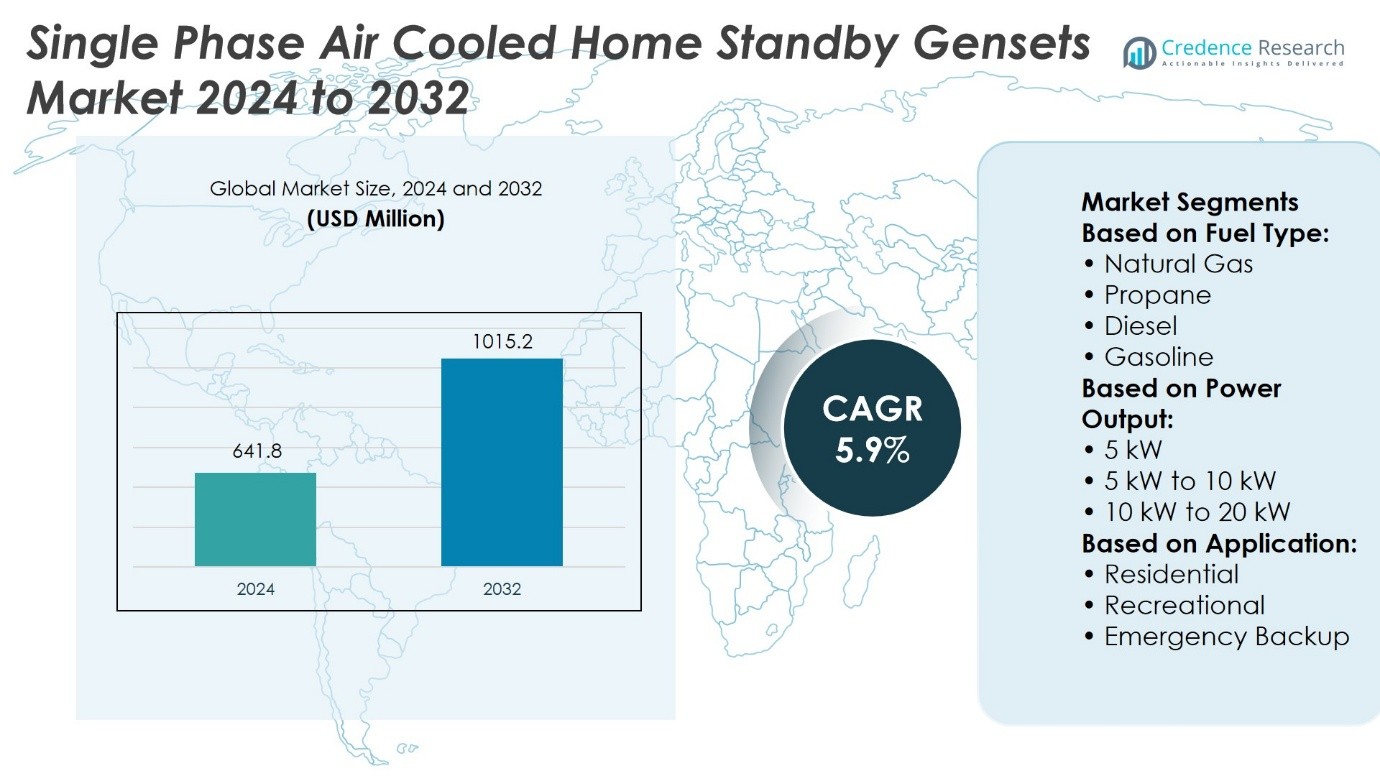
Single-Phase Air-Cooled Home Standby Gensets Market size was valued at USD 641.8 million in 2024 and is anticipated to reach USD 1015.2 million by 2032, at a CAGR of 5.9% during the forecast period.
| REPORT ATTRIBUTE | DETAILS |
|---|---|
| Historical Period | 2020-2024 |
| Base Year | 2024 |
| Forecast Period | 2025-2032 |
| Single-Phase Air-Cooled Home Standby Gensets Market Size 2024 | USD 641.8 Million |
| Single-Phase Air-Cooled Home Standby Gensets Market, CAGR | 5.9% |
| Single-Phase Air-Cooled Home Standby Gensets Market Size 2032 | USD 1015.2 Million |
The Single-Phase Air-Cooled Home Standby Gensets Market grows through strong drivers such as rising residential demand for reliable backup power, frequent grid disruptions, and the need for energy security in storm-prone regions. Consumers value its cost-effectiveness, compact size, and suitability for household applications. The market also benefits from trends in smart home integration, where gensets feature digital monitoring, automated load management, and remote control. Manufacturers focus on improving fuel efficiency, reducing noise, and ensuring regulatory compliance. Expanding adoption in emerging economies and wider distribution networks further shape its evolution, making standby gensets an essential household energy solution.
The Single-Phase Air-Cooled Home Standby Gensets Market shows strong presence across North America, Europe, Asia-Pacific, Latin America, and the Middle East & Africa, with North America leading adoption due to frequent outages and advanced infrastructure. Europe emphasizes regulatory compliance, while Asia-Pacific records rapid growth from urbanization and unstable grids. Latin America and MEA provide emerging opportunities through residential electrification. Key players shaping the market include Generac Power Systems, Briggs & Stratton, Kohler, Cummins, Caterpillar, Eaton, Kirloskar, HIMOINSA, Champion Power Equipment, and Ashok Leyland.
Market Insights
- The Single-Phase Air-Cooled Home Standby Gensets Market size was valued at USD 641.8 million in 2024 and is projected to reach USD 1015.2 million by 2032, at a CAGR of 5.9%.
- Strong drivers include rising residential demand for reliable backup power, frequent grid failures, and the need for energy security in storm-prone regions.
- Key trends highlight smart home integration, digital monitoring, automated load management, and remote operation features.
- Competitive analysis shows leading players focusing on fuel efficiency, noise reduction, emission compliance, and strong service networks.
- Market restraints include high installation costs, regulatory challenges, and fuel availability issues in certain regions.
- Regional analysis shows North America leading adoption, Europe focusing on regulatory standards, Asia-Pacific witnessing fastest growth, and Latin America with Middle East & Africa offering emerging opportunities.
- Major players influencing the market include Generac Power Systems, Briggs & Stratton, Kohler, Cummins, Caterpillar, Eaton, Kirloskar, HIMOINSA, Champion Power Equipment, and Ashok Leyland.
Market Drivers
Rising Dependence on Reliable Backup Power in Residential Sector
The Single-Phase Air-Cooled Home Standby Gensets Market grows on heightened consumer demand for uninterrupted power supply during outages. Homeowners seek dependable systems that maintain essential appliances, security devices, and medical equipment during grid failures. Increasing frequency of weather-related disruptions reinforces adoption across suburban and semi-urban households. It provides a cost-effective alternative compared to three-phase units, making it practical for small to medium homes. Rising urbanization and greater reliance on electrical devices strengthen consumer preference. The shift toward energy resilience continues to accelerate the need for standby power solutions.
- For instance, Kohler expanded its home standby generator line in 2023 with models delivering up to 20 kW single-phase output, incorporating PowerBoost™ technology that handles up to load instantly without voltage drop, ensuring uninterrupted operation of HVAC systems and critical household circuits.
Expansion of Smart Home Integration and Automated Control Features
The Single-Phase Air-Cooled Home Standby Gensets Market benefits from integration with smart home technologies that enable remote monitoring and automatic start functions. Manufacturers design units with digital controllers and Wi-Fi connectivity, improving ease of use for households. It allows homeowners to track performance metrics and fuel levels in real time through mobile applications. Advanced load management capabilities ensure efficient distribution of power across appliances. Rising consumer preference for automated and connected solutions supports wider market acceptance. This alignment with modern home technologies makes standby gensets more appealing to tech-savvy consumers.
- For instance, Eaton’s EWFSW15 Wi-Fi smart decorator switch-integrated into smart home ecosystems-operates at 120 V/AC, supports 15 A (1/2 HP motor loads), and requires no hub for installation.
Government Support for Energy Security and Infrastructure Preparedness
The Single-Phase Air-Cooled Home Standby Gensets Market receives support from policies encouraging household-level preparedness for grid instability. Governments promote backup power adoption to reduce dependency on centralized infrastructure during emergencies. It aligns with programs that emphasize disaster readiness and protection of residential communities. Energy agencies recommend gensets for regions prone to severe storms, hurricanes, or long-duration blackouts. Policy-driven awareness campaigns improve consumer understanding of benefits. Incentives and supportive guidelines further enhance household adoption rates.
Competitive Product Innovation and Cost-Effective Manufacturing Practices
The Single-Phase Air-Cooled Home Standby Gensets Market advances through innovation in compact design, noise reduction, and fuel efficiency. Manufacturers introduce models with simplified installation processes and longer service intervals, improving consumer convenience. It enables households to adopt reliable standby systems without major space or maintenance constraints. Lower production costs achieved through modular assembly contribute to affordability. Enhanced distribution networks ensure product availability across developed and emerging markets. Ongoing innovation sustains the competitive edge and fosters consistent market expansion.
Market Trends
Increasing Adoption of Compact and Space-Efficient Designs
The Single-Phase Air-Cooled Home Standby Gensets Market shows a clear shift toward compact models tailored for residential use. Consumers prefer systems that require minimal installation space and blend with home environments. It supports demand from suburban households where available outdoor area is limited. Manufacturers focus on lightweight enclosures and simplified layouts without compromising performance. Improved portability enhances consumer convenience and broadens appeal across varied housing types. Compact design innovations strengthen the role of gensets in modern residential settings.
- For instance, Generac Power Systems introduced its Guardian Series 10 kW air-cooled standby generator with a footprint of just 48 × 25 inches and a weight of 338 kg, making it 20% smaller than earlier models while still delivering full-rated power output.
Rising Focus on Fuel Efficiency and Environmental Compliance
The Single-Phase Air-Cooled Home Standby Gensets Market trends toward models that balance reliable output with reduced fuel consumption. Manufacturers adopt advanced combustion systems and improved cooling technologies to meet strict emission norms. It ensures compliance with regional air quality standards while maintaining dependable power supply. Consumers prioritize generators that minimize operating costs and environmental impact. Product lines increasingly highlight eco-friendly certifications to enhance brand competitiveness. The emphasis on sustainable performance positions gensets as responsible household energy solutions.
- For instance, Caterpillar’s D125 GC standby genset-powered by a C7.1 four-cycle diesel engine-consumes 21.9 liters of fuel per hour at 50% rated load, 30.3 liters per hour at 75% load, and 37.8 liters per hour at full load while operating with its cooling fan engaged.
Integration of Digital Monitoring and Smart Control Systems
The Single-Phase Air-Cooled Home Standby Gensets Market incorporates advanced control features that improve user experience. Smart panels and wireless connectivity enable homeowners to oversee generator operation from remote locations. It allows monitoring of runtime, maintenance schedules, and performance metrics through mobile applications. Manufacturers design systems with automated load transfer switches for seamless power restoration. Rising consumer preference for connected devices strengthens demand for digitally enabled gensets. This integration aligns with broader smart home technology adoption across residential markets.
Expansion of Distribution Networks and After-Sales Services
The Single-Phase Air-Cooled Home Standby Gensets Market benefits from improved accessibility through expanded retail and service networks. Manufacturers invest in dealership partnerships and e-commerce platforms to reach a wider customer base. It ensures timely availability of products in both developed and emerging regions. Service offerings such as extended warranties and maintenance packages improve customer confidence. Reliable after-sales support strengthens brand loyalty and market competitiveness. Expanded distribution channels reinforce consistent adoption of home standby gensets worldwide.
Market Challenges Analysis
High Installation Costs and Limited Consumer Awareness
The Single-Phase Air-Cooled Home Standby Gensets Market faces constraints from the upfront expense of equipment and installation. Many households hesitate to invest due to the need for professional setup, fuel connections, and compliance with safety codes. It creates a cost barrier for middle-income consumers, particularly in emerging regions. Limited awareness of long-term benefits further restricts adoption, with some homeowners relying on portable alternatives. Marketing efforts and educational programs remain uneven across geographies, reducing penetration. The combination of high entry costs and low awareness continues to challenge growth potential.
Regulatory Pressures and Fluctuating Fuel Availability
The Single-Phase Air-Cooled Home Standby Gensets Market encounters challenges linked to emission regulations and fuel supply volatility. Governments enforce strict standards on noise and exhaust emissions, requiring costly technological upgrades by manufacturers. It increases production expenses and lengthens development cycles. Fuel availability presents another challenge, with regions dependent on inconsistent supply of natural gas or propane. Rising fuel costs impact consumer willingness to operate gensets during frequent outages. Regulatory constraints combined with supply uncertainties create significant hurdles for sustained market expansion.
Market Opportunities
Rising Demand for Residential Energy Resilience and Safety
The Single-Phase Air-Cooled Home Standby Gensets Market holds strong opportunity in households that prioritize energy security during frequent power disruptions. Growing reliance on home medical devices, digital equipment, and climate control systems increases the need for reliable backup. It offers an efficient solution for families seeking uninterrupted comfort and safety. Expansion of suburban housing in regions prone to storms and outages supports wider adoption. Demand is further reinforced by consumer preference for systems that require minimal maintenance while ensuring consistent performance. The focus on residential resilience positions gensets as a critical household investment.
Technological Advancements and Expansion into Emerging Economies
The Single-Phase Air-Cooled Home Standby Gensets Market benefits from innovation in fuel efficiency, automation, and noise reduction technologies. Manufacturers introduce models with smart connectivity and advanced load management, appealing to modern households. It creates opportunities for differentiation in a competitive landscape. Emerging economies with unstable grid infrastructure present strong prospects, as consumers seek affordable backup power. Rising urbanization and increasing disposable incomes in Asia and Africa broaden the customer base. Enhanced product features combined with geographic expansion open significant growth pathways for market participants.
Market Segmentation Analysis:
By Fuel Type
The Single-Phase Air-Cooled Home Standby Gensets Market segments by fuel type into natural gas, propane, diesel, and gasoline. Natural gas units dominate due to stable supply through municipal pipelines and lower maintenance requirements. Propane gensets follow closely, preferred in rural regions where gas connections remain limited. It provides clean combustion and longer shelf life, supporting consistent residential adoption. Diesel units hold niche demand in areas with limited access to other fuels, offering high reliability during long outages. Gasoline gensets remain less common for standby use, but they appeal to households seeking low initial cost and simple refueling.
- For instance, Generac’s Guardian Series 22 kW natural gas standby generator records a fuel consumption of 6.9 m³/hr at half load and 12.9 m³/hr at full load while meeting U.S. EPA emission standards.
By Power Output
Power output segments include less than 5 kW, 5 kW to 10 kW, 10 kW to 20 kW, and above 20 kW. Less than 5 kW units address small households and recreational users, offering backup for essential appliances. The 5 kW to 10 kW category holds strong traction, balancing affordability with capacity to run multiple household systems. It supports typical residential needs including lighting, refrigeration, and climate control. The 10 kW to 20 kW segment appeals to larger homes, delivering capacity for extended power outages with higher load coverage. Above 20 kW units remain limited but serve premium homes requiring complete household backup. Manufacturers continue to diversify output ranges to address household variations.
- For instance, Kirloskar’s iGreen 15 kVA single-phase air-cooled genset for homes delivers a rated output of 12 kW with fuel consumption of 3.8 liters per hour at 75% load, equipped with a remote monitoring system for urban households.
By Application
Applications divide into residential, recreational, and emergency backup. The residential segment leads adoption, driven by rising demand for uninterrupted household power supply in storm-prone and urbanizing regions. Recreational applications include use in cabins, off-grid homes, and leisure properties where stable energy access is valued. It expands adoption beyond conventional household settings and strengthens market appeal. Emergency backup applications remain critical, addressing households that depend on medical equipment or operate in regions with fragile grid infrastructure. Each application underscores the role of gensets in reinforcing safety, convenience, and energy independence.
Segments:
Based on Fuel Type:
- Natural Gas
- Propane
- Diesel
- Gasoline
Based on Power Output:
- 5 kW
- 5 kW to 10 kW
- 10 kW to 20 kW
Based on Application:
- Residential
- Recreational
- Emergency Backup
Based on the Geography:
- North America
- U.S.
- Canada
- Mexico
- Europe
- Germany
- France
- U.K.
- Italy
- Spain
- Rest of Europe
- Asia Pacific
- China
- Japan
- India
- South Korea
- South-east Asia
- Rest of Asia Pacific
- Latin America
- Brazil
- Argentina
- Rest of Latin America
- Middle East & Africa
- GCC Countries
- South Africa
- Rest of the Middle East and Africa
Regional Analysis
North America
North America holds the largest share in the Single-Phase Air-Cooled Home Standby Gensets Market, accounting for about 38% of the global market. Strong demand comes from frequent storms, grid failures, and the high need for home energy security. It benefits from advanced dealer networks, strong after-sales services, and innovation in smart, quiet, and fuel-efficient genset designs. The United States dominates regional adoption, followed by Canada.
Europe
Europe represents about 27% of the market share, with steady growth supported by strict emission norms and preference for eco-friendly genset models. It sees consistent demand in colder countries where winter outages are common. Regulatory compliance drives technological improvements in efficiency and cleaner operation. Germany, the UK, and Nordic countries account for major adoption.
Asia-Pacific
Asia-Pacific holds around 25% share and records the fastest growth. Rising urbanization, unstable grids, and higher power needs in India, China, and Southeast Asia fuel adoption. It attracts consumers with affordable and compact units suitable for dense housing areas. Local partnerships, government focus on energy resilience, and e-commerce channels expand accessibility.
Latin America
Latin America contributes nearly 6% of the Single-Phase Air-Cooled Home Standby Gensets Market. Brazil and Mexico lead adoption, supported by increasing residential energy demand and unstable grid supply. It shows rising interest in compact gensets for households and small properties. Manufacturers target the region with affordable models and regional distributor networks.
Middle East & Africa
The Middle East & Africa account for about 4% of global share. Frequent outages in parts of Africa and high reliance on backup power in Gulf countries support demand. It highlights opportunities for propane and diesel-based gensets suited to local fuel availability. South Africa, Saudi Arabia, and the UAE are key growth hubs. Service partnerships and financing programs help increase consumer adoption.
Key Player Analysis
- Kohler
- Ashok Leyland
- Cummins
- HIMOINSA
- Briggs & Stratton
- Champion Power Equipment
- Generac Power Systems
- Eaton
- Caterpillar
- Kirloskar
Competitive Analysis
The competitive landscape of the Single-Phase Air-Cooled Home Standby Gensets Market features include Ashok Leyland, Briggs & Stratton, Caterpillar, Champion Power Equipment, Cummins, Eaton, Generac Power Systems, HIMOINSA, Kirloskar, and Kohler. The Single-Phase Air-Cooled Home Standby Gensets Market reflects a highly competitive environment shaped by continuous innovation and expanding consumer expectations. Companies focus on developing gensets with improved fuel efficiency, quieter operation, and advanced automation features to meet residential needs. Emphasis on smart connectivity and remote monitoring strengthens product appeal in modern households. The market also experiences competition around cost-effectiveness, as manufacturers streamline production and distribution to deliver affordable solutions without compromising reliability. Service networks and maintenance support play a crucial role in building customer trust and long-term loyalty. Global and regional players alike prioritize regulatory compliance, particularly in emission standards, while targeting growth opportunities in both developed and emerging economies. This combination of technological advancement, service quality, and geographic expansion drives the intensity of competition across the market.
Recent Developments
- In May 2024, Briggs & Stratton Energy Solutions expanded its 26 kW PowerProtect Home Standby Generator by making it more powerful than ever before. It has 65.6 kVA of motor starting capability and the new model delivers 68% more starting power than its leading competitor, ensuring smooth operation of large appliances such as air conditioners and refrigerators.
- In January 2024, Champion Power Equipment introduced its 22 kW home standby generator, engineered for exceptional reliability and continuous power during storms and outages. This advanced system features automatic operation, including a seamless Automatic Transfer Switch (ATS) for smooth power transitions.
- In January 2023, Generac Power Systems joined forces with ecobee smart thermostats to improve their home standby generators by adding cellular and Wi-Fi functionalities. With this partnership, now homeowners can easily manage their generators and propane tanks in the case of an outage.
Market Concentration & Characteristics
The Single-Phase Air-Cooled Home Standby Gensets Market shows moderate concentration with a mix of global leaders and regional manufacturers competing across developed and emerging economies. It is characterized by steady technological innovation, strong distribution networks, and a focus on residential reliability. Leading companies differentiate through advancements in fuel efficiency, digital monitoring, and low-noise operation, while regional players emphasize affordability and service accessibility. It reflects high consumer preference for compact and easy-to-install systems that ensure consistent backup during power outages. Competitive intensity is reinforced by regulatory compliance pressures, with manufacturers aligning products to meet emission and safety standards. It continues to expand through growing demand for energy resilience, creating a balanced structure where established brands dominate premium segments while local producers address cost-sensitive markets.
Report Coverage
The research report offers an in-depth analysis based on Fuel Type, Power Output, Application and Geography. It details leading market players, providing an overview of their business, product offerings, investments, revenue streams, and key applications. Additionally, the report includes insights into the competitive environment, SWOT analysis, current market trends, as well as the primary drivers and constraints. Furthermore, it discusses various factors that have driven market expansion in recent years. The report also explores market dynamics, regulatory scenarios, and technological advancements that are shaping the industry. It assesses the impact of external factors and global economic changes on market growth. Lastly, it provides strategic recommendations for new entrants and established companies to navigate the complexities of the market.
Future Outlook
- The Single-Phase Air-Cooled Home Standby Gensets Market will see higher adoption in residential households due to increasing power outages.
- Demand will rise for compact and fuel-efficient models suited to urban and suburban housing.
- Smart connectivity and remote monitoring features will become standard offerings in new genset models.
- Regulatory pressure on noise and emission levels will push manufacturers toward cleaner technologies.
- Expanding service networks and maintenance support will strengthen customer trust and retention.
- Emerging economies will drive growth with rising urbanization and unstable grid infrastructure.
- Manufacturers will focus on modular designs that simplify installation and reduce operating costs.
- E-commerce and digital sales channels will expand product availability and consumer reach.
- Partnerships with utility providers and distributors will support wider market penetration.
- Innovation in dual-fuel and fuel-flexible gensets will enhance adaptability across diverse regions.

Request a Free Sample
Fill in your details and we'll send you a free sample report.
- Sample data tables & charts
- Research methodology
Market Dynamics
Rising Dependence on Reliable Backup Power in Residential Sector
Frequent grid disruptions and increasing reliance on electrical appliances drive homeowners to invest in standby gensets for uninterrupted power during outages, especially in storm-prone and suburban areas.
Expansion of Smart Home Integration and Automated Control Features
Integration with smart home technologies, such as digital monitoring and remote control, makes gensets more attractive to tech-savvy consumers and enhances ease of use, supporting broader market adoption.
Government Support for Energy Security and Infrastructure Preparedness
Policies and incentives promoting household-level energy resilience encourage adoption of standby gensets, particularly in regions vulnerable to severe weather and grid instability.
Competitive Product Innovation and Cost-Effective Manufacturing
Manufacturers are introducing more compact, fuel-efficient, and quieter genset models with simplified installation, making them more accessible and appealing to a wider range of residential customers.
Rapid Urbanization and Grid Instability in Emerging Economies
Growing urban populations and unstable power infrastructure in Asia-Pacific, Latin America, and Africa are increasing demand for affordable and reliable home standby gensets as essential energy solutions.
Need a Custom Version of This Report?
Tailor the scope, geography, or segments to your exact requirements.
- Custom geography or segment scope
- Direct access to our analyst team
Frequently Asked Questions
What is the current market size for Single-Phase Air-Cooled Home Standby Gensets Market, and what is its projected size in 2032?
At what Compound Annual Growth Rate is the Single-Phase Air-Cooled Home Standby Gensets Market projected to grow between 2025 and 2032?
Which Single-Phase Air-Cooled Home Standby Gensets Market segment held the largest share in 2024?
What are the primary factors fueling the growth of the Single-Phase Air-Cooled Home Standby Gensets Market?
Who are the leading companies in the Single-Phase Air-Cooled Home Standby Gensets Market?
Which region commanded the largest share of the Single-Phase Air-Cooled Home Standby Gensets Market in 2024?
Table of Content
Chapter 1 Market Segmentation
- 1.1 Segmentation Framework
- 1.1.1 Product and Service Classification
- 1.1.2 Application and End-Use Classification
- 1.1.3 Technology and Solution Classification
- 1.1.4 Customer and Distribution Channel Classification
- 1.1.5 Geographic Segmentation
- 1.1.6 Market Segment Definitions and Boundaries
- 1.2 By Fuel Type
- 1.2.1 Natural Gas
- 1.2.2 Propane
- 1.2.3 Diesel
- 1.2.4 Gasoline
- 1.3 By Application
- 1.3.1 Residential
- 1.3.2 Recreational
- 1.3.3 Emergency Backup
- 1.4 By Power Output
- 1.4.1 Less than 5 kW
- 1.4.2 5 kW to 10 kW
- 1.4.3 10 kW to 20 kW
- 1.4.4 Above 20 kW
Chapter 2 Introduction
- 2.1 Report Objectives and Scope
- 2.2 Product Definition and Industry Terminology
- 2.3 Market Inclusions and Exclusions
- 2.4 Research Process
- 2.4.1 Primary Research and Expert Interviews
- 2.4.2 Secondary Research and Source Review
- 2.4.3 Top-Down and Bottom-Up Estimation
- 2.4.4 Data Triangulation and Verification
- 2.5 Market Size Measurement Basis
- 2.5.1 2024: USD 641.8 million → 2032: USD 1015.2 million
- 2.6 Historical and Forecast Reference Periods
- 2.6.1 Base Year: 2024
- 2.6.2 Forecast Period: 2024-2032
- 2.7 Research Assumptions and Limitations
Chapter 3 Executive Summary
- 3.1 Market Snapshot and Key Findings
- 3.2 Base-Year Market Size, 2024
- 3.3 Forecast Market Size, 2032
- 3.4 Revenue and Volume Growth Outlook
- 3.5 Key Demand and Supply Indicators
- 3.6 Leading Market Segments
- 3.7 Fastest-Growing Market Opportunities
- 3.8 Regional Performance Highlights
- 3.9 Technology and Industry Transformation
- 3.10 Competitive Landscape Summary
- 3.11 Analyst View and Strategic Implications
Chapter 4 Global Single-Phase Air-Cooled Home Standby Gensets Market Trends and Developments
- 4.1 Historical Industry Development
- 4.2 Recent Market Trends and Developments
- 4.3 Demand and Customer Behavior Trends
- 4.4 Technology and Product Innovation
- 4.5 Artificial Intelligence, Automation and Digitalization
- 4.6 Local Manufacturing and Supply Chain Realignment
- 4.7 Industry Partnerships, Mergers and Acquisitions
- 4.8 Sustainability and Circular Economy Developments
- 4.9 Government and Private Sector Investment Trends
- 4.10 Emerging Business Models and Commercialization
- 4.11 Industry Developments and Announcements
Chapter 5 Global Single-Phase Air-Cooled Home Standby Gensets Market Production, Supply and Demand Analysis
- 5.1 Demand Trend and Consumption Analysis
- 5.2 Demand Forecast, 2024-2032
- 5.3 Production and Output Trend
- 5.4 Production and Output Forecast, 2024-2032
- 5.5 Installed Capacity and Capacity Utilization
- 5.6 Company-Wise Production Plants and Statistics
- 5.6.1 Installed Production Capacity
- 5.6.2 Actual Production
- 5.6.3 Planned Capacity and Expansion Targets
- 5.7 Supply Chain Structure and Procurement Trends
- 5.8 Supply-Demand Gap and Bottlenecks
- 5.9 Import Dependence and Sourcing Structure
- 5.10 Contract Manufacturing and Outsourcing
- 5.11 Regional Supply and Demand Concentration
Chapter 6 Global Single-Phase Air-Cooled Home Standby Gensets Market Pricing Analysis
- 6.1 Pricing Structure and Measurement
- 6.2 Historical Pricing Trends
- 6.3 Pricing Outlook, 2024-2032
- 6.4 Average Selling Price and Unit Economics
- 6.5 Pricing by Product and Market Segment
- 6.6 Geographic Pricing Differences
- 6.7 Key Input, Energy, Labor and Logistics Costs
- 6.8 Contract Pricing and Purchasing Models
- 6.9 Pricing Sensitivity and Competitive Positioning
- 6.10 Price, Margin and Profitability Implications
Chapter 7 Global Single-Phase Air-Cooled Home Standby Gensets Market Dynamics
- 7.1 Market Growth Drivers
- 7.1.1 Demand-Side Drivers
- 7.1.2 Technology and Innovation Drivers
- 7.1.3 Infrastructure and Investment Drivers
- 7.1.4 Regulatory and Policy Drivers
- 7.2 Market Restraints
- 7.2.1 Cost and Affordability Constraints
- 7.2.2 Technology and Adoption Barriers
- 7.2.3 Supply Chain and Operational Constraints
- 7.3 Market Challenges
- 7.3.1 Competitive Pressure and Margin Erosion
- 7.3.2 Skills, Infrastructure and Implementation Gaps
- 7.4 Emerging Market Opportunities
- 7.5 Market Dynamics Impact and Time-Horizon Assessment
Chapter 8 Global Single-Phase Air-Cooled Home Standby Gensets Value Chain Analysis
- 8.1 Industry Value Chain Overview
- 8.2 Upstream Suppliers and Critical Inputs
- 8.3 Technology and Component Providers
- 8.4 Manufacturing or Service Delivery
- 8.5 Distribution, Channel Partners and Integrators
- 8.6 Downstream Applications and End Users
- 8.7 Value Addition and Profit Pools
- 8.8 Vertical Integration and Outsourcing
- 8.9 Supplier Concentration and Risk
- 8.10 Supply Chain Localization and Resilience
Chapter 9 Global Single-Phase Air-Cooled Home Standby Gensets Market Regulations and Policies
- 9.1 Relevant Laws, Standards and Compliance Frameworks
- 9.2 Product, Service, Safety and Quality Requirements
- 9.3 Government Policies, Incentives and Subsidies
- 9.4 Imports, Exports and Trade Barriers
- 9.5 Public Procurement and Local Content Requirements
- 9.6 Environmental and Sustainability Compliance
- 9.7 Upcoming Policy Changes and Market Implications
Chapter 10 Global Single-Phase Air-Cooled Home Standby Gensets Market Hotspots and Opportunities
- 10.1 Market Opportunity Mapping and Growth Hotspots
- 10.2 High-Growth Applications and Customer Groups
- 10.3 Underserved Markets and White-Space Opportunities
- 10.4 Emerging Technology and Product Opportunities
- 10.5 New Capacity and Investment Hotspots
- 10.6 Market Entry and Expansion Opportunities
- 10.7 Distribution and Partnership Opportunities
- 10.8 Near-Term and Long-Term Commercial Potential
- 10.9 Opportunity Attractiveness and Execution Risks
Chapter 11 Global Single-Phase Air-Cooled Home Standby Gensets Market Outlook, 2024-2032
- 11.1 Market Size and Analysis
- 11.1.1 Revenue (Market Measurement: 2024: USD 641.8 million → 2032: USD 1015.2 million)
- 11.1.2 Market Volume and Quantity Sold
- 11.1.3 Historical Market Size
- 11.1.4 Base-Year Market Size, 2024
- 11.2 Market Forecast, 2024-2032
- 11.2.1 Revenue Forecast to 2032
- 11.2.2 Volume Forecast to 2032
- 11.2.3 CAGR and Year-on-Year Growth
- 11.2.4 Incremental Revenue Opportunity
- 11.3 Forecast Assumptions and Scenario Analysis
- 11.3.1 Base-Case Forecast
- 11.3.2 Optimistic and Conservative Scenarios
- 11.3.3 Technology, Pricing and Policy Sensitivities
- 11.4 Market Attractiveness and Growth Outlook
Chapter 12 Global Single-Phase Air-Cooled Home Standby Gensets Market Segmentation and Outlook
- 12.1 Segmentation Summary and Market Shares, 2024
- 12.2 Largest and Fastest-Growing Segments
- 12.3 By Fuel Type - Market Size and Forecast, 2024-2032
- 12.3.1 Segment Definition and Scope
- 12.3.2 Historical Market Size
- 12.3.3 Revenue Forecast, 2024-2032
- 12.3.4 Volume Forecast, 2024-2032
- 12.3.5 Base-Year Market Share, 2024
- 12.3.6 Segment CAGR and Growth Drivers
- 12.3.7 Subsegment Market Size and Forecast
- 12.3.7.1 Natural Gas
- 12.3.7.2 Propane
- 12.3.7.3 Diesel
- 12.3.7.4 Gasoline
- 12.3.8 Subsegment Pricing and Adoption Trends
- 12.3.9 Leading Suppliers and Competition
- 12.3.10 Regional Demand and Opportunities
- 12.4 By Application - Market Size and Forecast, 2024-2032
- 12.4.1 Segment Definition and Scope
- 12.4.2 Historical Market Size
- 12.4.3 Revenue Forecast, 2024-2032
- 12.4.4 Volume Forecast, 2024-2032
- 12.4.5 Base-Year Market Share, 2024
- 12.4.6 Segment CAGR and Growth Drivers
- 12.4.7 Subsegment Market Size and Forecast
- 12.4.7.1 Residential
- 12.4.7.2 Recreational
- 12.4.7.3 Emergency Backup
- 12.4.8 Subsegment Pricing and Adoption Trends
- 12.4.9 Leading Suppliers and Competition
- 12.4.10 Regional Demand and Opportunities
- 12.5 By Power Output - Market Size and Forecast, 2024-2032
- 12.5.1 Segment Definition and Scope
- 12.5.2 Historical Market Size
- 12.5.3 Revenue Forecast, 2024-2032
- 12.5.4 Volume Forecast, 2024-2032
- 12.5.5 Base-Year Market Share, 2024
- 12.5.6 Segment CAGR and Growth Drivers
- 12.5.7 Subsegment Market Size and Forecast
- 12.5.7.1 Less than 5 kW
- 12.5.7.2 5 kW to 10 kW
- 12.5.7.3 10 kW to 20 kW
- 12.5.7.4 Above 20 kW
- 12.5.8 Subsegment Pricing and Adoption Trends
- 12.5.9 Leading Suppliers and Competition
- 12.5.10 Regional Demand and Opportunities
- 12.6 Segment Growth Comparison
- 12.7 Segment Attractiveness and Priority Matrix
Chapter 13 Global Single-Phase Air-Cooled Home Standby Gensets End-Use and Application Market Outlook
- 13.1 End-Use Industry and Customer Demand Structure
- 13.2 Leading Applications and Customer Groups
- 13.3 End-Use Market Size, Share and Forecast
- 13.4 Major End-Use Industry Deep Dives
- 13.4.1 Customer Requirements and Use Cases
- 13.4.2 Demand and Replacement Cycles
- 13.4.3 Technical and Regulatory Considerations
- 13.4.4 Purchasing and Procurement Models
- 13.4.5 Leading Vendors and Distribution Channels
- 13.4.6 Forecast and Commercial Opportunities
- 13.5 Emerging Applications and Cross-Segment Demand
- 13.6 End-Use Industry Investment Priorities
Chapter 14 Global Single-Phase Air-Cooled Home Standby Gensets Geographic Market Outlook, 2024-2032
- 14.1 Regional Market Size and Share, 2024
- 14.2 Regional Market Forecast, 2024-2032
- 14.3 Regional Pricing, Production and Demand Differences
- 14.4 North America
- 14.4.1 United States
- 14.4.2 Canada
- 14.4.3 Mexico
- 14.5 Europe
- 14.5.1 Germany
- 14.5.2 France
- 14.5.3 Italy
- 14.5.4 United Kingdom
- 14.5.5 Spain
- 14.5.6 Poland
- 14.5.7 Russia
- 14.5.8 Netherlands
- 14.5.9 Belgium
- 14.5.10 Sweden
- 14.5.11 Denmark
- 14.5.12 Norway
- 14.5.13 Rest of Europe
- 14.6 Asia Pacific
- 14.6.1 China
- 14.6.2 India
- 14.6.3 Japan
- 14.6.4 South Korea
- 14.6.5 Thailand
- 14.6.6 Indonesia
- 14.6.7 Vietnam
- 14.6.8 Malaysia
- 14.6.9 Australia
- 14.6.10 Rest of Asia Pacific
- 14.7 Latin America
- 14.7.1 Brazil
- 14.7.2 Argentina
- 14.7.3 Colombia
- 14.7.4 Chile
- 14.7.5 Rest of Latin America
- 14.8 Middle East
- 14.8.1 Saudi Arabia
- 14.8.2 United Arab Emirates
- 14.8.3 Turkey
- 14.8.4 Israel
- 14.8.5 Iran
- 14.8.6 Rest of the Middle East
- 14.9 Africa
- 14.9.1 South Africa
- 14.9.2 Egypt
- 14.9.3 Nigeria
- 14.9.4 Morocco
- 14.9.5 Rest of Africa
- 14.10 Regional Investment, Policy and Supply Chain Differences
- 14.11 Regional Competitive Landscape
- 14.12 Geographic Growth Hotspots
Chapter 15 Global Single-Phase Air-Cooled Home Standby Gensets Technology, Innovation and Sustainability Outlook
- 15.1 Technology Landscape and Maturity
- 15.2 Product, Process and Service Innovation
- 15.3 AI, Automation and Digital Tools in the Industry
- 15.4 Technology Adoption and Performance Benchmarking
- 15.5 Innovation Pipeline and R&D Investment
- 15.6 Patent and Intellectual Property Trends
- 15.7 Energy Efficiency and Resource Management
- 15.8 Sustainability, Recycling and Circularity
- 15.9 Technology Roadmap, 2024-2032
- 15.10 Risks of Obsolescence and Technology Substitution
Chapter 16 Global Single-Phase Air-Cooled Home Standby Gensets Market Key Strategic Imperatives
- 16.1 Growth and Market Entry Priorities
- 16.2 High-Return Products and Segments
- 16.3 Pricing, Profitability and Cost Optimization
- 16.4 Technology Investment and Product Differentiation
- 16.5 Supply Chain Localization and Resilience
- 16.6 Distribution and Customer Acquisition
- 16.7 Partnership, Acquisition and Capacity Strategy
- 16.8 Regional Expansion Priorities
- 16.9 Short-, Medium- and Long-Term Actions
Chapter 17 Competition Outlook
- 17.1 Industry Competition Characteristics
- 17.2 Market Structure and Concentration
- 17.3 Market Share and Competitive Positioning, 2024
- 17.4 Company-Wise Revenue and Product Benchmarking
- 17.5 Production and Service Capacity Benchmarking
- 17.6 Technology, Pricing and Differentiation
- 17.7 Regional Footprint and Distribution Strength
- 17.8 Mergers, Acquisitions and Strategic Alliances
- 17.9 New Entrants and Competitive Threats
- 17.10 Porter's Five Forces and Industry Attractiveness
- 17.11 Competitive Outlook, 2024-2032
Chapter 18 Company Profiles
- 18.1 Company Coverage and Selection Criteria
- 18.2 Generac Power Systems
- 18.2.1 Business Description
- 18.2.2 Company Ownership and Geographic Presence
- 18.2.3 Product and Service Portfolio
- 18.2.4 Manufacturing and Operating Footprint
- 18.2.5 Production Capacity and Expansion Plans
- 18.2.6 Financial Performance and Investment
- 18.2.7 Market Share and Competitive Position
- 18.2.8 Technology and Innovation Capabilities
- 18.2.9 Strategic Alliances or Partnerships
- 18.2.10 Recent Developments
- 18.2.11 Growth Strategy and Outlook
- 18.3 Briggs & Stratton
- 18.4 Kohler
- 18.5 Cummins
- 18.6 Caterpillar
- 18.7 Eaton
- 18.8 Kirloskar
- 18.9 HIMOINSA
- 18.10 Champion Power Equipment
- 18.11 Ashok Leyland
- 18.12 Other Relevant Market Participants
Note: Every listed company is profiled on the structure shown under the first company. The company list is preliminary and may change based on research findings, market developments, data availability and client requirements.
Chapter 19 Disclaimer
- 19.1 Research and Forecast Disclaimer
- 19.2 Data Source and Estimation Limitations
Note: The depth of individual sections depends on data availability for this market. Volume, capacity, trade and other unit-based metrics are included where applicable.

