
Market Overview
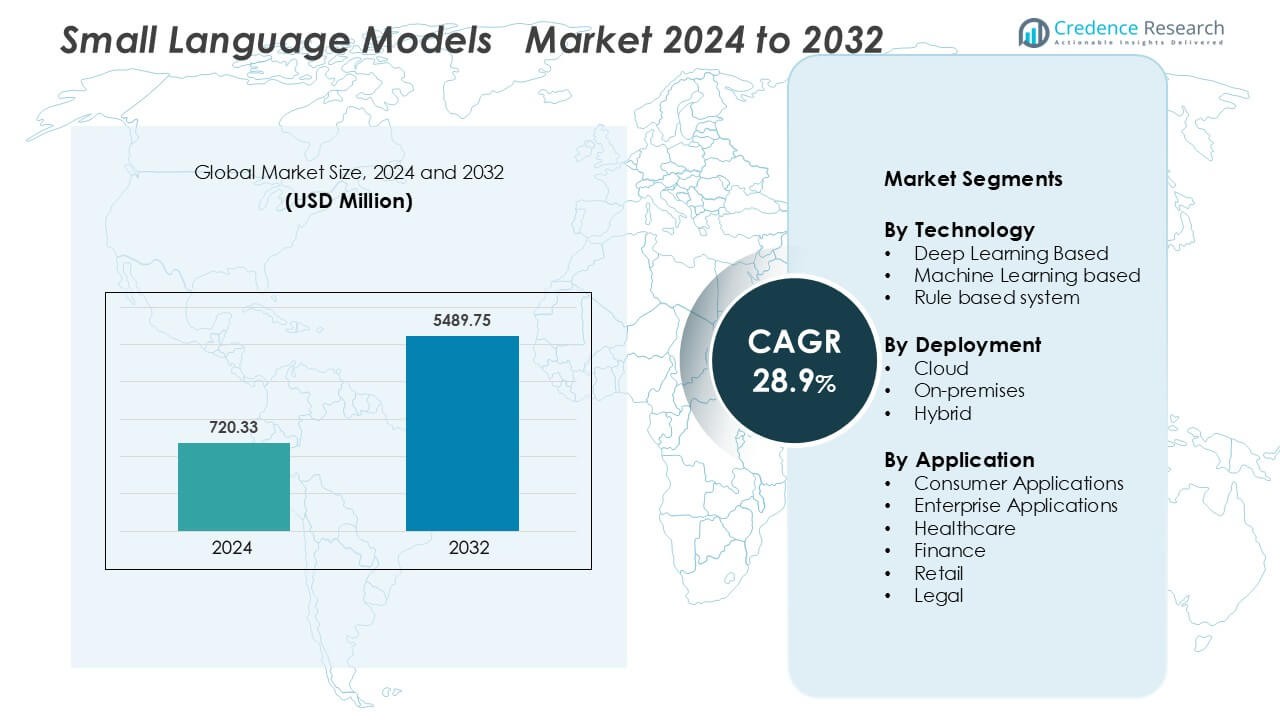
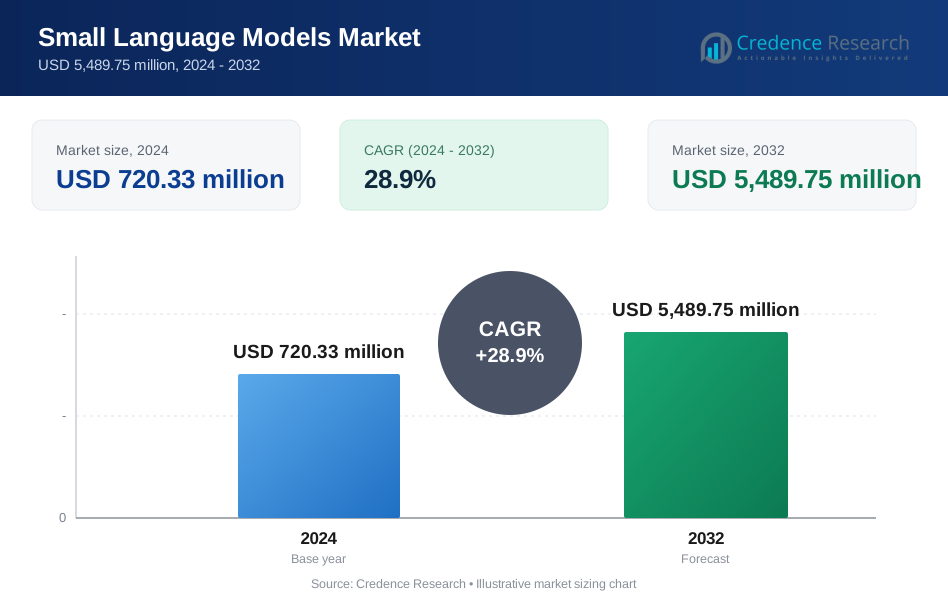
Small Language Models Market was valued at USD 720.33 million in 2024 and is anticipated to reach USD 5489.75 million by 2032, growing at a CAGR of 28.9 % during the forecast period.
| REPORT ATTRIBUTE | DETAILS |
|---|---|
| Historical Period | 2020-2023 |
| Base Year | 2024 |
| Forecast Period | 2025-2032 |
| Small Language Models Market Size 2024 | USD 720.33 Million |
| Small Language Models Market, CAGR | 28.9 % |
| Small Language Models Market Size 2032 | USD 5489.75 Million |
The Small Language Models (SLM) market is highly competitive, with leading players such as Meta, Databricks, IBM Watson AI, Amazon AWS AI, Cohere, Nvidia, Microsoft, Cerebras Systems, Apple AI, and Google driving innovation through model efficiency, scalability, and domain specialization. These companies focus on optimizing smaller architectures for on-device processing, cloud integration, and enterprise deployment. North America dominates the global market, accounting for approximately 48% of total market share, supported by advanced AI infrastructure, strong investment in R&D, and widespread enterprise adoption. Strategic collaborations, edge computing advancements, and open AI ecosystems continue to shape competitive differentiation and future growth trajectories in this evolving landscape.
Market Insights
- The Small Language Models (SLM) market was valued at USD 720.33 million in 2024 and is projected to grow at a CAGR of around 28.9% during the forecast period, driven by increasing demand for efficient and scalable AI solutions across industries.
- Key market drivers include the growing adoption of edge AI, rising data privacy concerns, and the cost efficiency of deploying compact models for real-time applications.
- Emerging trends highlight the shift toward domain-specific and multilingual SLMs, along with advancements in model compression, quantization, and on-device optimization.
- The competitive landscape features major players such as Meta, Microsoft, Google, Amazon AWS AI, IBM Watson AI, Nvidia, Apple AI, Cohere, Databricks, and Cerebras Systems, focusing on innovation and strategic collaborations.
- North America leads with approximately 48% market share, followed by Europe (24%) and Asia Pacific (18%), while the machine learning-based segment holds the dominant share by technology type.
Market Segmentation Analysis:
By Technology
In the technology segmentation, the machine learning-based sub-segment stands out as dominant, commanding approximately 55.1% of market revenue. This prominence is driven by its relative ease of implementation, lower computational demands compared to deep learning, and broad applicability across tasks such as classification, summarisation and translation. Meanwhile, deep learning-based systems are projected to grow rapidly as architectures become more efficient and capable of handling complex language patterns.
- For instance, Microsoft’s Phi-3-mini model operates with just 3.8 billion parameters while delivering instruction-tuned performance on benchmarks for language understanding, math and code reasoning.
By Deployment
Within the deployment segmentation, the cloud sub-segment emerged as the dominant deployment mode, capturing around 44.8% of global revenue. The growth here is propelled by scalable infrastructure, rapid time-to-market, and integration with existing cloud services, which reduce upfront investment in physical hardware. On-premises and hybrid deployments are gaining traction, especially where data privacy, latency or regulatory constraints make enterprises prefer local or mixed arrangements.
- For instance, AWS's Graviton3 processors, built on the Arm Neoverse platform, are specifically optimized for machine learning (ML) workloads. They feature bfloat16 support and wider Single Instruction Multiple Data (SIMD) vector units, delivering up to 3 times the ML performance of Graviton2 instances.
By Application
In the application segmentation, consumer applications such as virtual assistants, chatbots and personalised content generation hold the largest market share in recent years. This dominance arises from high user demand, the relatively lower technical barrier for deployment and broad appeal across devices and platforms. Meanwhile, vertical-specific applications in healthcare, finance, retail and legal are gaining momentum driven by the need for domain-specific language understanding, regulatory compliance and improved customer engagement.
- For instance, Meta Platforms’s “Meta AI” reached 1 billion monthly active users across its apps by mid-2025, showcasing the scale of mainstream consumer engagement.
Key Growth Drivers
Edge deployment, latency reduction and data privacy
Enterprises and device-makers increasingly adopt small language models (SLMs) to enable real-time, on-device language capabilities that reduce latency and preserve data locality. SLMs deliver practical inference on edge CPUs, mobile SoCs and constrained servers, allowing applications (virtual assistants, customer kiosks, and industrial agents) to operate offline or with intermittent connectivity while keeping sensitive data on-premises. This demand is propelled by tighter privacy regulations and enterprise risk policies that favor data minimization and local processing over routing text to third-party cloud APIs. Advances in efficient architectures and hardware optimization further lower the barrier to edge deployment, accelerating integration across consumer electronics and regulated verticals.
- For instance, NVIDIA is actively developing and promoting small language models (SLMs) specifically for edge and on-device deployment. In August 2024, NVIDIA introduced its first on-device SLM, Nemotron-4 4B Instruct, designed for low memory usage and quick response times on devices like the Jetso.
Cost efficiency, scalability and enterprise economics
Cost and compute efficiency drive SLM adoption where enterprises require scalable, predictable AI without the expense of giant models. Small models reduce infrastructure, inference and monitoring costs while enabling horizontal rollout across thousands of endpoints — an important economic advantage for mid-sized firms and cost-sensitive SaaS providers. Providers and cloud vendors have introduced compact “mini” variants to address price-performance gaps, encouraging migration from expensive large models for many routine tasks such as summarization, extraction and conversational interfaces. Combined with rising availability of managed deployment frameworks and model catalogs, the lower TCO and faster time-to-value position SLMs as a pragmatic choice for production systems.
- For instance, Nvidia released its Nematron-4-Mini-Hindi-4B model with 4 billion parameters tailored for Hindi language and edge inference workflows, reducing hardware requirements for regional deployments.
Verticalization and regulatory/compliance imperatives
Industry-specific demand and regulatory constraints are driving investments in domain-adapted SLMs. Sectors such as healthcare, finance and legal require models tuned for domain vocabulary, provenance, auditability and explicit privacy controls; SLMs facilitate fine-grained governance because they are easier to validate, log and certify than sprawling LLM stacks. Regulators and corporate compliance functions favor deployable, explainable models that can be hosted on-premises or within approved clouds, prompting vendors to offer domain-specialized SLMs and curated datasets. This verticalization increases purchasing momentum as firms prioritize models that meet both technical requirements and compliance checklists.
- For instance, NVIDIA introduced its BioNeMo platform optimized for life sciences, enabling on-premises fine-tuning of small models for drug discovery under HIPAA compliance frameworks.
Key Trend & Opportunity
Model compression, distillation and efficient architectures
The maturing toolbox for compression pruning, quantization, knowledge distillation and architecture search continues to shrink model footprints while retaining task accuracy, creating a direct opportunity to expand SLM use across embedded and low-power devices. These techniques let developers trade parameter count for operational cost reductions without linear accuracy loss, enabling new product form factors and offline features. Vendors who productize robust compression pipelines and provide pre-compressed, validated models for common tasks stand to gain rapid adoption. The convergence of software optimizations and specialized runtimes opens monetizable opportunities in tooling, benchmarking and certification for compressed models.
- For instance, Qualcomm introduced the AI Model Efficiency Toolkit (AIMET), which supports pruning and quantization workflows validated on over 40 edge devices, enabling real-time performance in Snapdragon platforms.
Domain adaptation and localized language capabilities
Demand for regionally and industry-specific language support is creating a market for compact, localized SLMs that handle vernaculars, dialects and professional jargon with limited compute. Regional models (e.g., language models optimized for Hindi and other non-English languages) and vertical fine-tuning enable more relevant outputs and higher user acceptance in emerging markets. This presents an opportunity for vendors to partner with local platforms, telcos and OEMs to deploy lightweight models tailored for language coverage, regulatory needs and cultural nuance driving both revenue and market penetration outside major Anglophone markets.
Tooling, open ecosystems and democratization of AI
The rise of open-model releases, community toolchains and cloud model catalogs is democratizing access to production-ready SLMs and associated MLOps capabilities. As vendors publish mini variants and toolkits for deployment and monitoring, smaller teams can deliver conversational features and automation without heavy research investments. This democratization creates business opportunities for middleware providers (model registries, optimized runtimes, privacy wrappers) and for consultancies that help enterprises adapt SLMs into regulated workflows. Firms that bundle governance, monitoring and retraining pathways with SLM offerings will capture a growing portion of adoption that values turnkey reliability.
Key Challenge
Accuracy, hallucination and bias in constrained models
Despite efficiency gains, SLMs face pronounced risks around factual accuracy, hallucination and biased outputs when operating with reduced parameter budgets or narrow training data. Constrained models often trade generalization capacity for compactness, which can amplify errors on edge or niche tasks and complicate trust in automated decisions. For regulated domains, even rare hallucinations can have material consequences; thus organizations must invest in verification layers, retrieval-augmented pipelines, and post-inference checks. Developing robust evaluation metrics, domain-specific validation sets and mitigation processes increases deployment complexity and cost, slowing adoption where reliability is mandatory.
Fragmentation, interoperability and lifecycle management
The ecosystem for SLMs risks fragmentation across model formats, runtime engines and deployment targets, creating interoperability and maintenance challenges for enterprises that manage mixed fleets of edge and cloud models. Different quantization schemes, inference runtimes and tuning artifacts complicate CI/CD for models and raise operational overhead for versioning, security patching and performance tuning. Moreover, ensuring consistent governance, explainability and audit trails across distributed deployments requires integrated MLOps investments. These friction points increase total cost of ownership and lengthen procurement cycles, particularly for organizations without mature ML engineering practices.
Regional Analysis
North America
North America leads the small language models market with approximately 48% share, driven by concentrated R&D investment, a dense cluster of hyperscalers, and strong enterprise adoption across technology, finance and healthcare verticals. U.S. and Canadian firms prioritize low-latency, privacy-preserving deployments and readily integrate SLMs into production pipelines, accelerating commercial uptake. Robust venture capital, plentiful AI talent and close partnerships between cloud providers and chip makers lower time-to-market for optimized models. These structural advantages sustain leadership while competition intensifies from well-funded APAC players.
Europe
Europe accounts for roughly 24% of the SLM market, where adoption emphasizes data protection, explainability and sectoral compliance. Enterprises in the U.K., Germany, France and the Nordics favor on-premises and hybrid SLM deployments that meet GDPR and industry standards, encouraging vendors to provide audit-friendly, certifiable models. Strong public and private research programs support localized language capabilities and domain adaptation for finance, legal and healthcare. While growth remains steady, regulatory scrutiny shapes procurement cycles and vendor selection, prompting deeper investment in governance, model validation and local partnerships.
Asia Pacific
Asia Pacific holds around 18% of the market but exhibits the fastest compound growth as China, India, Japan and Southeast Asian markets scale SLM adoption across consumer devices, enterprise SaaS and telecom edge use cases. Demand for vernacular language support, lower-cost on-device inference and telco partnerships drives regional customization of compact models. Government initiatives, localized datasets and expanding AI talent pools accelerate commercial deployments, while cloud-to-edge solutions bridge infrastructure gaps. Market entrants focused on multilingual support and hardware-aware optimization find high growth potential across both urban and emerging markets.
Latin America
Latin America comprises approximately 6% of the SLM market, characterized by selective adoption within BFSI, contact centers and mobile consumer services. Brazil, Mexico and Argentina lead regional demand, where cost sensitivity and the need for Portuguese and Spanish vernacular models drive preference for lightweight, deployable solutions. Local system integrators and regional cloud partners enable pilots and rollouts, but limited AI infrastructure and variable regulatory frameworks slow broad enterprise adoption. Opportunities center on affordable edge deployments, multilingual offerings and managed services that reduce integration overhead for mid-market customers.
Middle East & Africa
Middle East & Africa represent about 4% of the SLM market, with adoption concentrated in government services, telecom and oil & gas sectors where privacy, latency and localized Arabic language support matter. Wealthier Gulf states invest in AI hubs and sovereign cloud capabilities, supporting pilots for domain-adapted SLMs, while North African markets focus on multilingual customer-facing applications. Infrastructure variability and skills gaps limit scale, but strategic national AI programs and partnerships with global vendors create a pathway for steady growth and targeted vertical deployments.
Market Segmentations:
By Technology
- Deep Learning Based
- Machine Learning based
- Rule based system
By Deployment
- Cloud
- On-premises
- Hybrid
By Application
- Consumer Applications
- Enterprise Applications
- Healthcare
- Finance
- Retail
- Legal
By Geography
- North America
- U.S.
- Canada
- Mexico
- Europe
- Germany
- France
- U.K.
- Italy
- Spain
- Rest of Europe
- Asia Pacific
- China
- Japan
- India
- South Korea
- South-east Asia
- Rest of Asia Pacific
- Latin America
- Brazil
- Argentina
- Rest of Latin America
- Middle East & Africa
- GCC Countries
- South Africa
- Rest of the Middle East and Africa
Competitive Landscape
The small language models (SLM) market is rapidly evolving, with major technology leaders focusing on efficiency, scalability, and domain-specific intelligence. Google and Microsoft lead the market through compact AI architectures optimized for on-device processing and low-latency applications. Meta and Amazon AWS AI emphasize open-weight and cloud-native models designed to enhance accessibility and developer integration. IBM Watson AI and Databricks strengthen enterprise adoption through model fine-tuning tools and seamless data integration within analytics platforms. Nvidia and Cerebras Systems provide hardware acceleration and AI infrastructure solutions that significantly reduce training time and computational costs for small models. Cohere and Apple AI specialize in privacy-centric and energy-efficient SLMs, enabling secure deployment on mobile and edge devices. Companies are prioritizing multimodal capability, adaptive learning, and cost-efficient inference to meet growing demand across sectors such as finance, healthcare, and customer engagement while maintaining responsible AI standards.
Key Player Analysis
- Meta
- Databricks
- IBM Watson AI
- Amazon AWS AI
- Cohere
- Nvidia
- Microsoft
- Cerebras Systems
- Apple AI
Recent Developments
- In April 2024, Microsoft has unveiled ‘Phi-3-mini,’ a lightweight AI model designed to deliver advanced AI capabilities at a reduced cost. This small language model will be accessible through the Microsoft Azure AI Model Catalog, Hugging Face, Ollama, and NVIDIA NIM. Phi-3-mini is the inaugural model in a series of open small language models that Microsoft has introduced.
- In April 2023, Alibaba Cloud, the digital technology and intelligence division of Alibaba Group, has announced the launch of its latest large language model, Tongyi Qianwen. This new AI model will be incorporated across Alibaba’s various businesses to enhance user experiences in the near future. Customers and developers will also be able to access the model to develop customized AI features in a cost-effectively.
Report Coverage
The research report offers an in-depth analysis based on Technology, Deployment, Application and Geography. It details leading market players, providing an overview of their business, product offerings, investments, revenue streams, and key applications. Additionally, the report includes insights into the competitive environment, SWOT analysis, current market trends, as well as the primary drivers and constraints. Furthermore, it discusses various factors that have driven market expansion in recent years. The report also explores market dynamics, regulatory scenarios, and technological advancements that are shaping the industry. It assesses the impact of external factors and global economic changes on market growth. Lastly, it provides strategic recommendations for new entrants and established companies to navigate the complexities of the market.
Future Outlook
- The market will experience rapid expansion as enterprises prioritize efficient and privacy-preserving AI solutions.
- Advancements in model compression and quantization will make SLMs more accessible for edge and mobile devices.
- Cloud providers will integrate optimized SLM services to enable scalable deployment across industries.
- Domain-specific and multilingual models will gain traction to meet regional and sectoral needs.
- Open-source frameworks will accelerate innovation and reduce development barriers for smaller organizations.
- Partnerships between hardware vendors and AI developers will enhance inference performance and energy efficiency.
- Regulatory compliance and explainability will drive adoption in finance, healthcare, and legal sectors.
- The integration of SLMs into enterprise workflows will boost automation and decision-support systems.
- Continuous improvements in training data quality and bias mitigation will strengthen model reliability.
- Competitive pricing and flexible deployment models will expand market penetration across emerging economies
Request a Free Sample
Fill in your details and we'll send you a free sample report.
- Sample data tables & charts
- Research methodology
Need a Custom Version of This Report?
Tailor the scope, geography, or segments to your exact requirements.
- Custom geography or segment scope
- Direct access to our analyst team
Frequently Asked Questions
What is the current market size for the Small Language Models Market, and what is its projected size in 2032?
At what Compound Annual Growth Rate is the Small Language Models Market projected to grow between 2025 and 2032?
Which segment held the largest share in 2024?
What are the primary factors fueling the growth of the Small Language Models Market?
Who are the leading companies in the Small Language Models Market?
Which region commanded the largest share of the Small Language Models Market in 2024?
Table of Content
Chapter 1. Report Introduction
- 1.1 Report Description & Purpose
- 1.1.1 Report Title & Market Definition
- 1.1.2 Unique Selling Propositions (USP) & Key Differentiators
- 1.1.3 Value Proposition for Stakeholders
- 1.2 Research Objectives
- 1.2.1 Market Sizing Objectives (Volume & Revenue)
- 1.2.2 Segmentation Objectives
- 1.2.3 Competitive Intelligence Objectives
- 1.2.4 Forecast & Scenario Objectives
- 1.3 Report Scope
- 1.3.1 Small Language Models Scope – Types & Subtypes Covered
- 1.3.2 Geographic Scope – Regions & Countries Covered
- 1.3.3 Historical Period, Base Year & Forecast Period (2024; forecast to 2032)
- 1.3.4 Inclusions & Exclusions
- 1.4 HS Code & Classification Framework
- 1.5 Currency, Units & Pricing Basis
- 1.6 Target Stakeholders
- 1.7 Limitations & Assumptions
Chapter 2. Executive Summary
- 2.1 Global Small Language Models Market Snapshot
- 2.1.1 Market Size – Historical (2024) & Forecast (2024-2032) (2024: USD 720.33 million → 2032: USD 5,489.75 million)
- 2.1.2 Volume & Revenue – Global Totals
- 2.1.3 Key Market Highlights – Top Five Facts
- 2.2 Small Language Models Market Segmentation Snapshot
- 2.2.1 Market Split by Region – 2024 vs. 2032
- 2.3 Competitive Snapshot
- 2.3.1 Top 10 Players by Revenue Share – 2024
- 2.3.2 Top 10 Players by Volume Share – 2024
- 2.3.3 Recent Strategic Developments (18-Month Summary)
- 2.4 Key Investment Highlights & Strategic Conclusions
Chapter 3. Small Language Models Market Dynamics & Industry Analysis
- 3.1 Market Overview & Context
- 3.1.1 Small Language Models Market Position in the Broader Automotive Value Chain
- 3.1.2 OEM vs. Replacement Market Dynamics
- 3.1.3 Market Maturity & Development Stage by Region
- 3.2 Small Language Models Market Drivers
- 3.3 Small Language Models Market Restraints & Challenges
- 3.4 Small Language Models Market Opportunities
- 3.5 Porter's Five Forces Analysis
- 3.5.1 Threat of New Entrants
- 3.5.2 Bargaining Power of Suppliers
- 3.5.3 Bargaining Power of Buyers
- 3.5.4 Threat of Substitutes
- 3.5.5 Competitive Rivalry – Intensity Assessment
- 3.6 Small Language Models Value Chain Analysis
- 3.6.1 Upstream – Raw Material/Input Suppliers
- 3.6.1.1 Raw Material/Input 1
- 3.6.1.2 Raw Material/Input 2
- 3.6.1.3 Raw Material/Input 3
- 3.6.2 Midstream – Production/Manufacturing/Service Delivery
- 3.6.2.1 Production/Process Overview
- 3.6.2.2 Key Facility Locations & Capacity by Manufacturer
- 3.6.3 Downstream – Distribution & End Consumer
- 3.6.3.1 Primary Channel – B2B/OEM
- 3.6.3.2 Secondary Channels – Dealer, Retail, Online, Direct
- 3.6.4 Value Chain Profitability Analysis
- 3.6.1 Upstream – Raw Material/Input Suppliers
- 3.7 PESTEL Analysis
- 3.7.1 Political Factors
- 3.7.2 Economic Factors
- 3.7.3 Social Factors
- 3.7.4 Technological Factors
- 3.7.5 Environmental Factors
- 3.7.6 Legal Factors
- 3.8 Small Language Models Supply Chain Analysis
- 3.8.1 Raw Material/Input Supply Risk Assessment
- 3.8.2 Manufacturing Concentration Risk (Geographic Exposure)
- 3.8.3 Trade Disruption Impact Analysis
- 3.9 Regulatory & Policy Landscape
Note: The regulatory and policy landscape section covers regulations based on their applicability to the market, Small Language Models category, geography, and scope of the study. Only regulatory frameworks with a material impact on operations, compliance, trade, sustainability, or market access are analyzed in detail.
Chapter 4. Key Investment Pockets & Opportunity Analysis
- 4.1 Small Language Models Market Attractiveness Analysis
- 4.1.1 By Region – Investment Attractiveness Matrix (Volume × CAGR)
- 4.2 Absolute Revenue Growth Opportunity
- 4.2.1 By Region – Absolute USD Growth Through 2032
- 4.3 Incremental Volume Opportunity
- 4.3.1 By Region – Incremental Volume Through 2032
- 4.3.2 Segment – Incremental Volume
- 4.4 Emerging Submarket Opportunity Deep Dive (Subject to Applicability)
- 4.5 Emerging Market Opportunity Scorecards
- 4.5.1 United States
- 4.5.2 Europe
- 4.5.3 Asia
- 4.5.4 Middle East & Africa
Note: Emerging Market Opportunity Scorecards will be included based on relevance and strategic importance. Regions listed are indicative and may vary depending on data availability and market dynamics.
Chapter 5. Small Language Models Import-Export Analysis & Trade Flows
- 5.1 Global Trade Overview
- 5.1.1 Global Export Value by Country (2024)
- 5.1.2 Global Export Volume by Country (2024)
- 5.1.3 Global Import Value by Country (2024)
- 5.1.4 Global Import Volume by Country (2024)
- 5.1.5 Net Trade Balance by Country (2024)
- 5.2 Export Analysis – Segment
- 5.2.1 Type 1 (HS Code)
- 5.2.2 Type 2 (HS Code)
- 5.2.3 Type 3 (HS Code)
- 5.2.4 Type 4 (HS Code)
- 5.2.5 Type 5 (HS Code)
- 5.3 Import Analysis – Segment
- 5.3.1 Type 1 (HS Code)
- 5.3.2 Type 2 (HS Code)
- 5.3.3 Type 3 (HS Code)
- 5.3.4 Type 4 (HS Code)
- 5.3.5 Type 5 (HS Code)
- 5.4 Average Unit Trade Prices
- 5.4.1 Average Export Price – Segment & Country
- 5.4.2 Average Import Price – Segment & Source Country
- 5.4.3 Price Trends (2024)
- 5.5 Key Trade Route Analysis
- 5.5.1 Trade Route 1
- 5.5.2 Trade Route 2
- 5.5.3 Trade Route 3
- 5.5.4 Trade Route 4
- 5.5.5 Trade Route 5
- 5.6 Trade Policy Impact Assessment
- 5.6.1 US Anti-Dumping & Section 301 Tariffs
- 5.6.2 EU Customs Union Impact
- 5.6.3 Major Free Trade Agreements
- 5.6.4 USMCA Rules of Origin
Note: Trade policy analysis will be included only where relevant to the Small Language Models market.
Chapter 6. Competitive Landscape & Company Benchmarking
- 6.1 Small Language Models Market Concentration & Structure
- 6.1.1 Herfindahl-Hirschman Index (HHI) – vs. 2024
- 6.1.2 Tier 1, Tier 2 & Tier 3 Market Structure
- 6.1.3 Global, Regional & Local Player Dynamics
- 6.2 Small Language Models Market Share Analysis – 2024
- 6.2.1 Global Revenue Share by Company
- 6.2.2 Global Volume Share by Company
- 6.2.3 Regional Revenue Share
- 6.2.4 Market Share Evolution ( vs. 2024)
- 6.2.5 OEM Segment Share by Company
- 6.2.6 Replacement Segment Share by Company
- 6.3 Production/Delivery Capacity & Facility Analysis
- 6.3.1 Global Installed Capacity
- 6.3.2 Capacity Utilization Rates
- 6.3.3 Production/Output Volume
- 6.3.4 Facility Locations & Capacity Map
- 6.3.5 Planned Capacity Additions
- 6.4 Small Language Models Competitive Benchmarking Matrix
- 6.4.1 Revenue, Volume, CAGR & Profitability Comparison
- 6.4.2 Channel Revenue Mix
- 6.4.3 Geographic Revenue Exposure
- 6.4.4 R&D Intensity
- 6.4.5 Sustainability Maturity
- 6.5 Strategic Developments in Small Language Models (Last 24 Months)
- 6.5.1 Mergers, Acquisitions & Divestments
- 6.5.2 New Small Language Models Launches
- 6.5.3 Facility Expansions
- 6.5.4 Strategic Alliances, Joint Ventures & Partnerships
- 6.5.5 Distribution Expansion & Market Entry
- 6.5.6 Sustainability & ESG Initiatives
- 6.6 Competitive Strategy Mapping
- 6.6.1 Leader, Challenger, Follower & Niche Classification
- 6.6.2 Pricing Strategy Comparison
- 6.6.3 Channel Strategy Matrix
Note: Strategic developments are included based on their materiality and the availability of reliable information.
Chapter 7. Global Small Language Models Market – By Distribution Channel
- 7.1 Segment Overview
- 7.1.1 Volume & Revenue Split by Channel (2024 & 2032)
- 7.1.2 Channel Mix Evolution (2024-2032)
Chapter 8. Regional Market Analysis – Global Overview
- 8.1 Global Regional Overview
- 8.1.1 Regional Volume Share
- 8.1.2 Regional Revenue Share
- 8.1.3 Regional Volume by Region
- 8.1.4 Regional Revenue by Region
- 8.1.5 Regional Forecast Through 2032
- 8.2 Cross-Regional Segment Analysis
- 8.2.1 By Distribution Channel
- 8.2.2 By Brand/Price Tier
Chapter 9. North America Small Language Models Market
- 9.1 United States
- 9.2 Canada
- 9.3 Mexico
Chapter 10. Europe Small Language Models Market
- 10.1 Germany
- 10.2 France
- 10.3 Italy
- 10.4 United Kingdom
- 10.5 Spain
- 10.6 Poland
- 10.7 Russia
- 10.8 Netherlands
- 10.9 Belgium
- 10.10 Sweden
- 10.11 Denmark
- 10.12 Norway
- 10.13 Rest of Europe
Chapter 11. Asia Pacific Small Language Models Market
- 11.1 China
- 11.2 India
- 11.3 Japan
- 11.4 South Korea
- 11.5 Thailand
- 11.6 Indonesia
- 11.7 Vietnam
- 11.8 Malaysia
- 11.9 Australia
- 11.10 Rest of Asia Pacific
Chapter 12. Latin America Small Language Models Market
- 12.1 Brazil
- 12.2 Argentina
- 12.3 Colombia
- 12.4 Chile
- 12.5 Rest of Latin America
Chapter 13. Middle East Small Language Models Market
- 13.1 Saudi Arabia
- 13.2 United Arab Emirates
- 13.3 Turkey
- 13.4 Israel
- 13.5 Iran
- 13.6 Rest of the Middle East
Chapter 14. Africa Small Language Models Market
- 14.1 South Africa
- 14.2 Egypt
- 14.3 Nigeria
- 14.4 Morocco
- 14.5 Rest of Africa
Chapter 15. Small Language Models Company Profiles
- 15.1 [Company 01]
- 15.1.1 Company Overview
- 15.1.2 Key Management Personnel
- 15.1.3 Products & Services Portfolio
- 15.1.4 Financial Performance
- 15.1.5 Key Market Focus & Geographic Presence
- 15.1.6 Recent Developments & Strategic Initiatives
Note: The company profile list is preliminary and may change based on research findings, market developments, data availability, and client requirements.
Chapter 16. Appendices
- Appendix A – List of Abbreviations & Acronyms
- Appendix B – Industry Classification Code Reference – Full Series
- Appendix C – Production & Capacity Data Tables
- Appendix D – End-Use & Demand Base Tables
- Appendix E – Consumption & Replacement Rate Assumptions
- Appendix F – ASP Reference Tables
- Appendix G – Manufacturing & Facility Database
- Appendix H – Import-Export Data Tables
- Appendix I – Regulatory Summary Tables
- Appendix J – Primary Research Participant List (Anonymized)
- Appendix K – Primary Research Questionnaire Framework
- Appendix L – Data Sources & Bibliography
- Appendix M – Market Size Divergence & Source Comparison
Chapter 17. Research Methodology
- 17.1 Research Framework & Philosophy
- 17.2 Secondary Research – Sources, Hierarchy & Data Extraction
- 17.3 Data Modeling – Bottom-Up & Top-Down Market Sizing
- 17.4 Primary Research – Stakeholder Framework, LOI & Sample Sizes
- 17.5 Forecast Methodology – Regression, Scenario & Sensitivity Analysis
- 17.6 Quality Control – Four-Layer Validation Framework
- 17.7 Limitations & Standard Assumptions
- 17.8 Disclaimer
