Market Overview
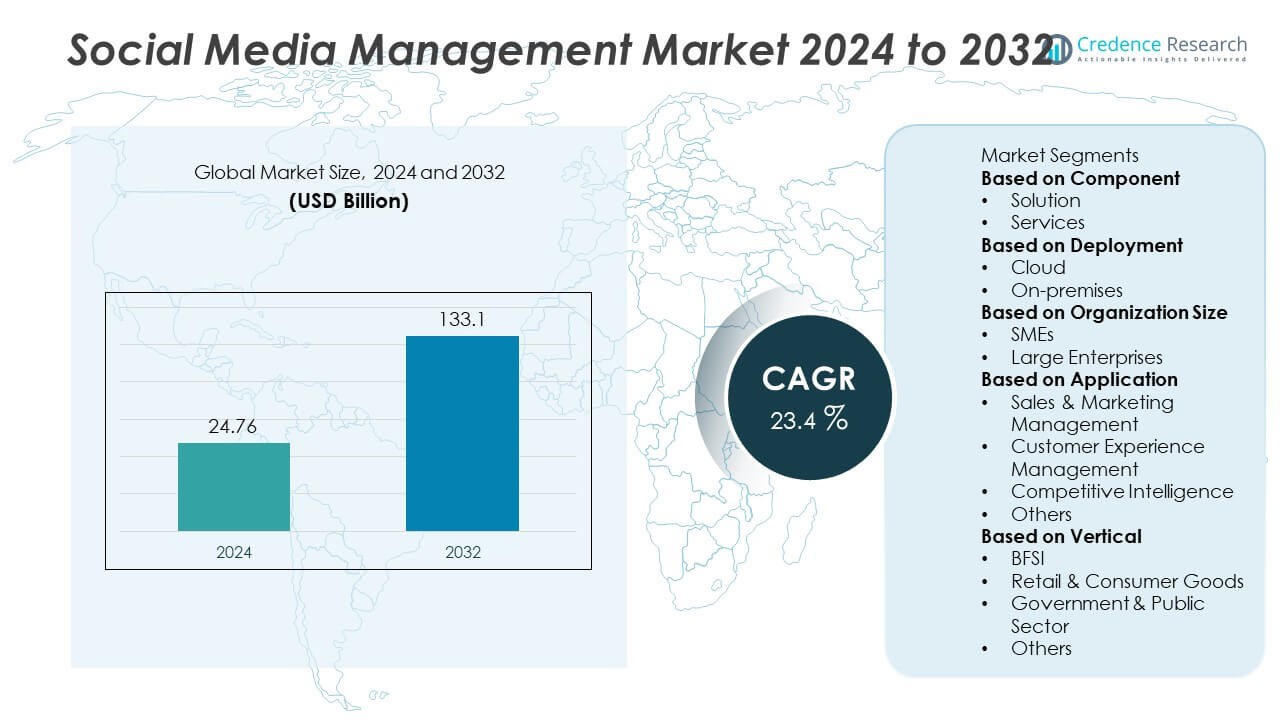
The Social Media Management market was valued at USD 24.76 billion in 2024 and is projected to reach USD 133.1 billion by 2032, growing at a CAGR of 23.4% during the forecast period.
| REPORT ATTRIBUTE | DETAILS |
|---|---|
| Historical Period | 2020-2023 |
| Base Year | 2024 |
| Forecast Period | 2025-2032 |
| Social Media Management Market Size 2024 | USD 24.76 Billion |
| Social Media Management Market, CAGR | 23.4% |
| Social Media Management Market Size 2032 | USD 133.1 Billion |
The social media management market is led by prominent companies such as Zoho Corporation Pvt. Ltd., International Business Machines Corporation, Sprinklr Inc., Digimind, Oracle Corporation, HubSpot, Inc., Adobe, Salesforce, Inc., Meltwater, and Google. These players dominate through innovations in AI-powered analytics, automation, and cloud-based campaign management solutions. They focus on improving customer engagement, content optimization, and cross-platform integration. Asia Pacific emerged as the leading region with a 34.8% share in 2024, driven by the rapid rise in digital marketing adoption, expanding e-commerce activity, and strong social media penetration. The region’s growing investment in cloud technologies and AI-enabled marketing tools continues to fuel its leadership.
Market Insights
- The social media management market was valued at USD 24.76 billion in 2024 and is projected to reach USD 133.1 billion by 2032, growing at a CAGR of 23.4% during the forecast period.
- Increasing demand for real-time audience engagement, content automation, and data-driven marketing is driving market growth across industries.
- Integration of AI, machine learning, and cloud-based analytics is a key trend enhancing campaign efficiency and predictive performance tracking.
- Major players such as Salesforce, Adobe, Oracle, and HubSpot are focusing on innovation, mergers, and partnerships to expand their product portfolios and global reach.
- Asia Pacific led the market with a 34.8% share in 2024, followed by North America at 32.5%, supported by strong adoption of cloud deployment models and dominance of the solution segment with a 64.2% share in overall market revenue.
Market Segmentation Analysis:
By Component
The solution segment dominated the social media management market with a 64.2% share in 2024, driven by the rising adoption of integrated platforms that streamline content creation, publishing, and analytics. Businesses are increasingly using automated tools for campaign management, brand monitoring, and audience engagement to enhance marketing efficiency. The growing need for data-driven insights and real-time performance tracking supports demand for comprehensive solutions. Vendors are expanding their offerings with AI and machine learning capabilities to improve personalization and automate repetitive social media processes.
- For instance, Sprinklr Inc.'s unified AI-driven customer experience platform processes billions of data points daily, making over 10 billion AI predictions. The company's AI tools, including its GenAI capabilities, augment various customer experience functions, such as automating sentiment tagging, which has achieved high accuracy rates and helps enterprises manage high-volume social engagement.
By Deployment
The cloud segment held the largest share of 72.8% in 2024, supported by its scalability, cost-effectiveness, and ease of integration across multiple platforms. Organizations are rapidly transitioning from on-premises systems to cloud-based models for greater flexibility in remote collaboration and real-time campaign tracking. The rise of SaaS-based tools enables small and large enterprises to manage multiple social accounts efficiently. Continuous innovation in cloud analytics and API integrations further strengthens the dominance of cloud deployment in the social media management market.
- For instance, Salesforce Marketing Cloud uses AI-powered tools through its Einstein suite, which provides predictive and generative insights for marketing campaigns. While its Social Studio platform was retired in 2024, Salesforce continues to offer social media management and engagement capabilities through partnerships with third-party applications on the AppExchange, including Sprout Social and Agorapulse.
By Organization Size
The large enterprises segment accounted for a 59.7% share in 2024, owing to their extensive use of social media channels for brand marketing, customer engagement, and reputation management. Large organizations rely on advanced social media management tools to handle large-scale campaigns, analyze audience behavior, and monitor multiple brand accounts simultaneously. The growing focus on customer experience and competitive benchmarking also drives adoption. Meanwhile, SMEs are increasingly embracing affordable, cloud-based tools, but large enterprises continue to dominate due to higher budgets and greater digital marketing investments.
Key Growth Drivers
Rising Demand for Data-Driven Marketing
The growing emphasis on data analytics in marketing strategies is a major driver of the social media management market. Businesses are increasingly using analytics tools to track engagement, measure campaign performance, and identify audience trends. Real-time insights help marketers optimize content, enhance customer targeting, and improve return on investment. As social platforms become key communication channels, data-driven decision-making is transforming brand engagement, encouraging widespread adoption of advanced social media management solutions across industries.
- For instance, Adobe Sensei, the AI engine within Adobe Experience Cloud, is used to help optimize marketing campaigns through features like personalized content delivery and predictive analytics. It provides data-driven insights and can automate tasks to improve efficiency, such as creating content variations for targeted audiences and automatically tagging digital assets.
Expansion of Digital Advertising and E-Commerce
The surge in digital advertising and online retail activities is fueling the adoption of social media management platforms. Brands are leveraging social networks to promote products, attract customers, and improve conversions. The rise of influencer marketing and social commerce further boosts the need for efficient campaign tracking and content automation tools. Companies are investing in AI-powered management systems to enhance visibility, streamline operations, and deliver personalized customer experiences across digital ecosystems.
- For instance, HubSpot, Inc. offers an AI-powered Marketing Hub with an integrated social media management suite and AI ad management tools. Its ad tools can track conversions using first-party data and CRM-powered audiences. The platform provides reporting and analytics to help businesses improve efficiency and campaign performance.
Integration of AI and Automation in Marketing Tools
Artificial intelligence and automation are revolutionizing social media management by enabling predictive analytics, automated content scheduling, and sentiment analysis. AI-driven tools allow businesses to identify consumer intent, monitor trends, and optimize engagement strategies in real time. Automated systems reduce manual workload and improve efficiency in managing multi-platform campaigns. The integration of chatbots, NLP, and machine learning capabilities is further enhancing response time, personalization, and overall campaign effectiveness for brands worldwide.
Key Trends & Opportunities
Growing Adoption of Cloud-Based Management Platforms
Cloud-based social media management solutions are gaining popularity due to their flexibility, scalability, and cost-effectiveness. These platforms enable teams to collaborate remotely, monitor campaigns in real time, and access data analytics across devices. The increasing preference for SaaS-based models allows businesses of all sizes to manage multiple accounts efficiently. This trend is creating opportunities for vendors to introduce secure, integrated, and customizable cloud offerings tailored to diverse business needs.
- For instance, Oracle's Customer Experience (CX) platform, built on its global cloud infrastructure, includes AI-powered marketing and service tools to help businesses manage campaigns and engage customers across multiple channels.
Rising Influence of AI-Driven Customer Insights
The demand for AI-powered analytics is expanding as brands seek to understand audience behavior and sentiment. Predictive analytics tools use machine learning to assess engagement trends and forecast campaign outcomes. This capability helps organizations personalize content, improve targeting, and build stronger customer relationships. The growing integration of AI with CRM and marketing automation systems creates significant opportunities for enhancing customer experience and optimizing marketing investments.
- For instance, Meltwater's AI-driven Consumer Intelligence platform analyzes billions of social and digital data points daily using natural language processing across hundreds of languages. The system uses AI to detect changes in sentiment, although an 80% accuracy benchmark is more realistic, given the challenges of analyzing human language like sarcasm.
Key Challenges
Data Privacy and Compliance Concerns
Data privacy regulations such as GDPR and CCPA pose major challenges to the social media management market. Platforms must ensure compliance while managing sensitive user information collected through analytics and engagement tracking. Unauthorized data access and security breaches can harm brand reputation and result in heavy penalties. Companies are investing in advanced encryption, consent management, and secure API integrations to address these concerns and maintain customer trust.
Content Saturation and Market Competition
The increasing volume of digital content across social media channels creates intense competition for audience attention. Managing brand visibility and engagement amid content overload remains a significant challenge. Businesses struggle to differentiate their messaging and maintain consistency across platforms. As algorithms evolve and organic reach declines, brands must adopt more strategic, data-informed approaches to stay competitive, requiring continuous innovation and content optimization.
Regional Analysis
North America
North America held a 32.5% share in 2024, driven by strong adoption of social media analytics and marketing automation tools. The United States leads due to high digital marketing investments and widespread use of AI-driven platforms for content management. Businesses in the region prioritize omnichannel communication, data analytics, and personalized customer engagement. The presence of major software providers and high social media penetration enhance growth. Increasing focus on influencer marketing and brand monitoring across industries further strengthens North America’s leading position in the global social media management market.
Europe
Europe accounted for a 27.1% share in 2024, supported by the growing adoption of data-driven marketing strategies and compliance-focused digital solutions. Countries such as the United Kingdom, Germany, and France are investing in advanced tools to improve campaign performance and brand engagement. Rising emphasis on GDPR compliance drives demand for secure social media management systems. Enterprises are focusing on customer experience, sentiment tracking, and real-time analytics. The region’s expanding digital ecosystem and corporate marketing transformation continue to enhance its market contribution.
Asia Pacific
Asia Pacific dominated the market with a 34.8% share in 2024, fueled by rapid digitalization, growing e-commerce, and rising social media usage. Countries like China, India, Japan, and South Korea are driving adoption through large-scale marketing automation and AI-based analytics. Expanding smartphone penetration and online consumer engagement are accelerating investments in content management tools. SMEs and large enterprises are actively adopting cloud-based social media management solutions to optimize marketing operations. The region’s strong social commerce ecosystem and influencer marketing trends further propel its market leadership.
Middle East & Africa
The Middle East & Africa region captured a 3.2% share in 2024, driven by increasing digital transformation and the rising role of social media in business communication. Countries such as the UAE and Saudi Arabia are investing heavily in social media analytics to support brand promotion and public engagement. Growing internet penetration and the expansion of e-commerce platforms stimulate market demand. Enterprises in the region are focusing on integrating AI tools to improve consumer interaction and content delivery, supporting steady growth in social media management adoption.
Latin America
Latin America represented a 2.4% share in 2024, supported by expanding digital marketing activities across Brazil, Mexico, and Argentina. The region’s rising social media user base and growing preference for cloud-based management tools are driving adoption. Businesses are increasingly leveraging analytics to track audience engagement and enhance content strategies. Marketing agencies and retailers are investing in automated tools to strengthen brand visibility and campaign efficiency. Although infrastructure limitations remain, the growing focus on digital transformation and influencer partnerships continues to support steady market growth.
Market Segmentations:
By Component
- Solution
- Services
By Deployment
- Cloud
- On-premises
By Organization Size
- SMEs
- Large Enterprises
By Application
- Sales & Marketing Management
- Customer Experience Management
- Competitive Intelligence
- Others
By Vertical
- BFSI
- Retail & Consumer Goods
- Government & Public Sector
- Others
By Geography
- North America
- U.S.
- Canada
- Mexico
- Europe
- Germany
- France
- U.K.
- Italy
- Spain
- Rest of Europe
- Asia Pacific
- China
- Japan
- India
- South Korea
- South-east Asia
- Rest of Asia Pacific
- Latin America
- Brazil
- Argentina
- Rest of Latin America
- Middle East & Africa
- GCC Countries
- South Africa
- Rest of the Middle East and Africa
Competitive Landscape
The competitive landscape of the social media management market features leading players such as Zoho Corporation Pvt. Ltd., International Business Machines Corporation, Sprinklr Inc., Digimind, Oracle Corporation, HubSpot, Inc., Adobe, Salesforce, Inc., Meltwater, and Google. These companies compete by offering advanced AI-powered tools, analytics, and automation capabilities to enhance social media engagement and marketing efficiency. Key players focus on expanding product portfolios through cloud-based solutions, real-time data monitoring, and multi-platform integration. Strategic mergers, partnerships, and technological innovation remain central to maintaining market leadership. Continuous investment in predictive analytics, machine learning, and customer experience optimization helps strengthen their competitive positioning. With increasing demand for personalized content and data-driven marketing, vendors are emphasizing user-centric features and scalable solutions to support enterprises and SMEs globally.
Key Player Analysis
- Zoho Corporation Pvt. Ltd.
- International Business Machines Corporation
- Sprinklr Inc.
- Digimind
- Oracle Corporation
- HubSpot, Inc.
- Adobe
- Salesforce, Inc.
- Meltwater
Recent Developments
- In May 2025, Adobe Inc. integrated the Metricool analytics and planning tool into Adobe Express, enabling creators to design, schedule, and track social-media posts across Instagram, LinkedIn and TikTok without switching platforms.
- In April 2025, Sprinklr Inc. launched its “20.4 Spring ’25 Release” of the Sprinklr Social platform, adding AI-powered asset duplicate detection and contextual image search capabilities across social-media campaigns.
- In November 2024, Zoho Corporation Pvt. Ltd. introduced WhatsApp and Telegram integrations into its Zoho Social platform, extending support to two new messaging-channels and enabling users to manage templates and responses for both.
- In April 2024, Digimind launched AI Sentinel and released Digimind Social 10.0. The platform is designed to address the distinct needs of PR, communications, and marketing professionals, offering support in crucial areas, including Crisis Detection, Brand Reputation, Consumer Insights, and Campaign Performance.
Report Coverage
The research report offers an in-depth analysis based on Component, Deployment, Organization Size, Application, Vertical and Geography. It details leading market players, providing an overview of their business, product offerings, investments, revenue streams, and key applications. Additionally, the report includes insights into the competitive environment, SWOT analysis, current market trends, as well as the primary drivers and constraints. Furthermore, it discusses various factors that have driven market expansion in recent years. The report also explores market dynamics, regulatory scenarios, and technological advancements that are shaping the industry. It assesses the impact of external factors and global economic changes on market growth. Lastly, it provides strategic recommendations for new entrants and established companies to navigate the complexities of the market.
Future Outlook
- The market will expand rapidly with growing adoption of AI-driven content automation and analytics tools.
- Cloud-based deployment will continue to dominate as businesses seek flexibility and scalability in managing campaigns.
- Brands will invest more in omnichannel engagement strategies to enhance customer experience and brand visibility.
- Integration of social media management tools with CRM and marketing automation systems will accelerate.
- Personalization and real-time audience insights will become central to marketing strategies across industries.
- The solution segment will retain leadership due to its wide application in campaign tracking and content scheduling.
- Data privacy regulations and compliance will influence platform design and security features.
- Asia Pacific will remain the leading region, driven by expanding e-commerce and mobile engagement.
- North America will maintain strong growth supported by advanced digital infrastructure and high marketing spend.
- Innovation in AI, predictive analytics, and sentiment analysis will shape the market’s long-term evolution.

Request a Free Sample
Fill in your details and we'll send you a free sample report.
- Sample data tables & charts
- Research methodology
Need a Custom Version of This Report?
Tailor the scope, geography, or segments to your exact requirements.
- Custom geography or segment scope
- Direct access to our analyst team
Frequently Asked Questions
What is the current market size for the Social Media Management market, and what is its projected size in 2032?
At what Compound Annual Growth Rate is the Social Media Management market projected to grow between 2025 and 2032?
Which Social Media Management market segment held the largest share in 2024?
What are the primary factors fueling the growth of the Social Media Management market?
Who are the leading companies in the Social Media Management market?
Which region commanded the largest share of the Social Media Management market in 2024?
Table of Content
Chapter 1 Market Segmentation
- 1.1 Segmentation Framework
- 1.1.1 Product and Service Classification
- 1.1.2 Application and End-Use Classification
- 1.1.3 Technology and Solution Classification
- 1.1.4 Customer and Distribution Channel Classification
- 1.1.5 Geographic Segmentation
- 1.1.6 Market Segment Definitions and Boundaries
Chapter 2 Introduction
- 2.1 Report Objectives and Scope
- 2.2 Product Definition and Industry Terminology
- 2.3 Market Inclusions and Exclusions
- 2.4 Research Process
- 2.4.1 Primary Research and Expert Interviews
- 2.4.2 Secondary Research and Source Review
- 2.4.3 Top-Down and Bottom-Up Estimation
- 2.4.4 Data Triangulation and Verification
- 2.5 Market Size Measurement Basis
- 2.5.1 2024: USD 24.76 billion → 2032: USD 133.1 billion
- 2.6 Historical and Forecast Reference Periods
- 2.6.1 Base Year: 2024
- 2.6.2 Forecast Period: 2024-2032
- 2.7 Research Assumptions and Limitations
Chapter 3 Executive Summary
- 3.1 Market Snapshot and Key Findings
- 3.2 Base-Year Market Size, 2024
- 3.3 Forecast Market Size, 2032
- 3.4 Revenue and Volume Growth Outlook
- 3.5 Key Demand and Supply Indicators
- 3.6 Leading Market Segments
- 3.7 Fastest-Growing Market Opportunities
- 3.8 Regional Performance Highlights
- 3.9 Technology and Industry Transformation
- 3.10 Competitive Landscape Summary
- 3.11 Analyst View and Strategic Implications
Chapter 4 Global Social Media Management Market Trends and Developments
- 4.1 Historical Industry Development
- 4.2 Recent Market Trends and Developments
- 4.3 Demand and Customer Behavior Trends
- 4.4 Technology and Product Innovation
- 4.5 Artificial Intelligence, Automation and Digitalization
- 4.6 Local Manufacturing and Supply Chain Realignment
- 4.7 Industry Partnerships, Mergers and Acquisitions
- 4.8 Sustainability and Circular Economy Developments
- 4.9 Government and Private Sector Investment Trends
- 4.10 Emerging Business Models and Commercialization
- 4.11 Industry Developments and Announcements
Chapter 5 Global Social Media Management Market Production, Supply and Demand Analysis
- 5.1 Demand Trend and Consumption Analysis
- 5.2 Demand Forecast, 2024-2032
- 5.3 Production and Output Trend
- 5.4 Production and Output Forecast, 2024-2032
- 5.5 Installed Capacity and Capacity Utilization
- 5.6 Company-Wise Production Plants and Statistics
- 5.6.1 Installed Production Capacity
- 5.6.2 Actual Production
- 5.6.3 Planned Capacity and Expansion Targets
- 5.7 Supply Chain Structure and Procurement Trends
- 5.8 Supply-Demand Gap and Bottlenecks
- 5.9 Import Dependence and Sourcing Structure
- 5.10 Contract Manufacturing and Outsourcing
- 5.11 Regional Supply and Demand Concentration
Chapter 6 Global Social Media Management Market Pricing Analysis
- 6.1 Pricing Structure and Measurement
- 6.2 Historical Pricing Trends
- 6.3 Pricing Outlook, 2024-2032
- 6.4 Average Selling Price and Unit Economics
- 6.5 Pricing by Product and Market Segment
- 6.6 Geographic Pricing Differences
- 6.7 Key Input, Energy, Labor and Logistics Costs
- 6.8 Contract Pricing and Purchasing Models
- 6.9 Pricing Sensitivity and Competitive Positioning
- 6.10 Price, Margin and Profitability Implications
Chapter 7 Global Social Media Management Market Dynamics
- 7.1 Market Growth Drivers
- 7.1.1 Demand-Side Drivers
- 7.1.2 Technology and Innovation Drivers
- 7.1.3 Infrastructure and Investment Drivers
- 7.1.4 Regulatory and Policy Drivers
- 7.2 Market Restraints
- 7.2.1 Cost and Affordability Constraints
- 7.2.2 Technology and Adoption Barriers
- 7.2.3 Supply Chain and Operational Constraints
- 7.3 Market Challenges
- 7.3.1 Competitive Pressure and Margin Erosion
- 7.3.2 Skills, Infrastructure and Implementation Gaps
- 7.4 Emerging Market Opportunities
- 7.5 Market Dynamics Impact and Time-Horizon Assessment
Chapter 8 Global Social Media Management Value Chain Analysis
- 8.1 Industry Value Chain Overview
- 8.2 Upstream Suppliers and Critical Inputs
- 8.3 Technology and Component Providers
- 8.4 Manufacturing or Service Delivery
- 8.5 Distribution, Channel Partners and Integrators
- 8.6 Downstream Applications and End Users
- 8.7 Value Addition and Profit Pools
- 8.8 Vertical Integration and Outsourcing
- 8.9 Supplier Concentration and Risk
- 8.10 Supply Chain Localization and Resilience
Chapter 9 Global Social Media Management Market Regulations and Policies
- 9.1 Relevant Laws, Standards and Compliance Frameworks
- 9.2 Product, Service, Safety and Quality Requirements
- 9.3 Government Policies, Incentives and Subsidies
- 9.4 Imports, Exports and Trade Barriers
- 9.5 Public Procurement and Local Content Requirements
- 9.6 Environmental and Sustainability Compliance
- 9.7 Data Protection, AI and Cybersecurity Compliance
- 9.8 Upcoming Policy Changes and Market Implications
Chapter 10 Global Social Media Management Market Hotspots and Opportunities
- 10.1 Market Opportunity Mapping and Growth Hotspots
- 10.2 High-Growth Applications and Customer Groups
- 10.3 Underserved Markets and White-Space Opportunities
- 10.4 Emerging Technology and Product Opportunities
- 10.5 New Capacity and Investment Hotspots
- 10.6 Market Entry and Expansion Opportunities
- 10.7 Distribution and Partnership Opportunities
- 10.8 Near-Term and Long-Term Commercial Potential
- 10.9 Opportunity Attractiveness and Execution Risks
Chapter 11 Global Social Media Management Market Outlook, 2024-2032
- 11.1 Market Size and Analysis
- 11.1.1 Revenue (Market Measurement: 2024: USD 24.76 billion → 2032: USD 133.1 billion)
- 11.1.2 Market Volume and Quantity Sold
- 11.1.3 Historical Market Size
- 11.1.4 Base-Year Market Size, 2024
- 11.2 Market Forecast, 2024-2032
- 11.2.1 Revenue Forecast to 2032
- 11.2.2 Volume Forecast to 2032
- 11.2.3 CAGR and Year-on-Year Growth
- 11.2.4 Incremental Revenue Opportunity
- 11.3 Forecast Assumptions and Scenario Analysis
- 11.3.1 Base-Case Forecast
- 11.3.2 Optimistic and Conservative Scenarios
- 11.3.3 Technology, Pricing and Policy Sensitivities
- 11.4 Market Attractiveness and Growth Outlook
Chapter 12 Global Social Media Management Market Segmentation and Outlook
- 12.1 Segmentation Summary and Market Shares, 2024
- 12.2 Largest and Fastest-Growing Segments
- 12.3 Segment Growth Comparison
- 12.4 Segment Attractiveness and Priority Matrix
Chapter 13 Global Social Media Management Geographic Market Outlook, 2024-2032
- 13.1 Regional Market Size and Share, 2024
- 13.2 Regional Market Forecast, 2024-2032
- 13.3 Regional Pricing, Production and Demand Differences
- 13.4 North America
- 13.4.1 United States
- 13.4.2 Canada
- 13.4.3 Mexico
- 13.5 Europe
- 13.5.1 Germany
- 13.5.2 France
- 13.5.3 Italy
- 13.5.4 United Kingdom
- 13.5.5 Spain
- 13.5.6 Poland
- 13.5.7 Russia
- 13.5.8 Netherlands
- 13.5.9 Belgium
- 13.5.10 Sweden
- 13.5.11 Denmark
- 13.5.12 Norway
- 13.5.13 Rest of Europe
- 13.6 Asia Pacific
- 13.6.1 China
- 13.6.2 India
- 13.6.3 Japan
- 13.6.4 South Korea
- 13.6.5 Thailand
- 13.6.6 Indonesia
- 13.6.7 Vietnam
- 13.6.8 Malaysia
- 13.6.9 Australia
- 13.6.10 Rest of Asia Pacific
- 13.7 Latin America
- 13.7.1 Brazil
- 13.7.2 Argentina
- 13.7.3 Colombia
- 13.7.4 Chile
- 13.7.5 Rest of Latin America
- 13.8 Middle East
- 13.8.1 Saudi Arabia
- 13.8.2 United Arab Emirates
- 13.8.3 Turkey
- 13.8.4 Israel
- 13.8.5 Iran
- 13.8.6 Rest of the Middle East
- 13.9 Africa
- 13.9.1 South Africa
- 13.9.2 Egypt
- 13.9.3 Nigeria
- 13.9.4 Morocco
- 13.9.5 Rest of Africa
- 13.10 Regional Investment, Policy and Supply Chain Differences
- 13.11 Regional Competitive Landscape
- 13.12 Geographic Growth Hotspots
Chapter 14 Global Social Media Management Technology, Innovation and Sustainability Outlook
- 14.1 Technology Landscape and Maturity
- 14.2 Product, Process and Service Innovation
- 14.3 AI, Automation and Digital Tools in the Industry
- 14.4 Technology Adoption and Performance Benchmarking
- 14.5 Innovation Pipeline and R&D Investment
- 14.6 Patent and Intellectual Property Trends
- 14.7 Energy Efficiency and Resource Management
- 14.8 Sustainability, Recycling and Circularity
- 14.9 Technology Roadmap, 2024-2032
- 14.10 Risks of Obsolescence and Technology Substitution
Chapter 15 Global Social Media Management Market Key Strategic Imperatives
- 15.1 Growth and Market Entry Priorities
- 15.2 High-Return Products and Segments
- 15.3 Pricing, Profitability and Cost Optimization
- 15.4 Technology Investment and Product Differentiation
- 15.5 Supply Chain Localization and Resilience
- 15.6 Distribution and Customer Acquisition
- 15.7 Partnership, Acquisition and Capacity Strategy
- 15.8 Regional Expansion Priorities
- 15.9 Short-, Medium- and Long-Term Actions
Chapter 16 Competition Outlook
- 16.1 Industry Competition Characteristics
- 16.2 Market Structure and Concentration
- 16.3 Market Share and Competitive Positioning, 2024
- 16.4 Company-Wise Revenue and Product Benchmarking
- 16.5 Production and Service Capacity Benchmarking
- 16.6 Technology, Pricing and Differentiation
- 16.7 Regional Footprint and Distribution Strength
- 16.8 Mergers, Acquisitions and Strategic Alliances
- 16.9 New Entrants and Competitive Threats
- 16.10 Porter's Five Forces and Industry Attractiveness
- 16.11 Competitive Outlook, 2024-2032
Chapter 17 Company Profiles
- 17.1 Company Coverage and Selection Criteria
- 17.2 Leading Market Participants – Standard Profile Structure
- 17.2.1 Business Description
- 17.2.2 Company Ownership and Geographic Presence
- 17.2.3 Product and Service Portfolio
- 17.2.4 Manufacturing and Operating Footprint
- 17.2.5 Production Capacity and Expansion Plans
- 17.2.6 Financial Performance and Investment
- 17.2.7 Market Share and Competitive Position
- 17.2.8 Technology and Innovation Capabilities
- 17.2.9 Strategic Alliances or Partnerships
- 17.2.10 Recent Developments
- 17.2.11 Growth Strategy and Outlook
- 17.3 Other Relevant Market Participants
Note: Every listed company is profiled on the structure shown under the first company. The company list is preliminary and may change based on research findings, market developments, data availability and client requirements.
Chapter 18 Disclaimer
- 18.1 Research and Forecast Disclaimer
- 18.2 Data Source and Estimation Limitations
Note: The depth of individual sections depends on data availability for this market. Volume, capacity, trade and other unit-based metrics are included where applicable.