
Market Overview:
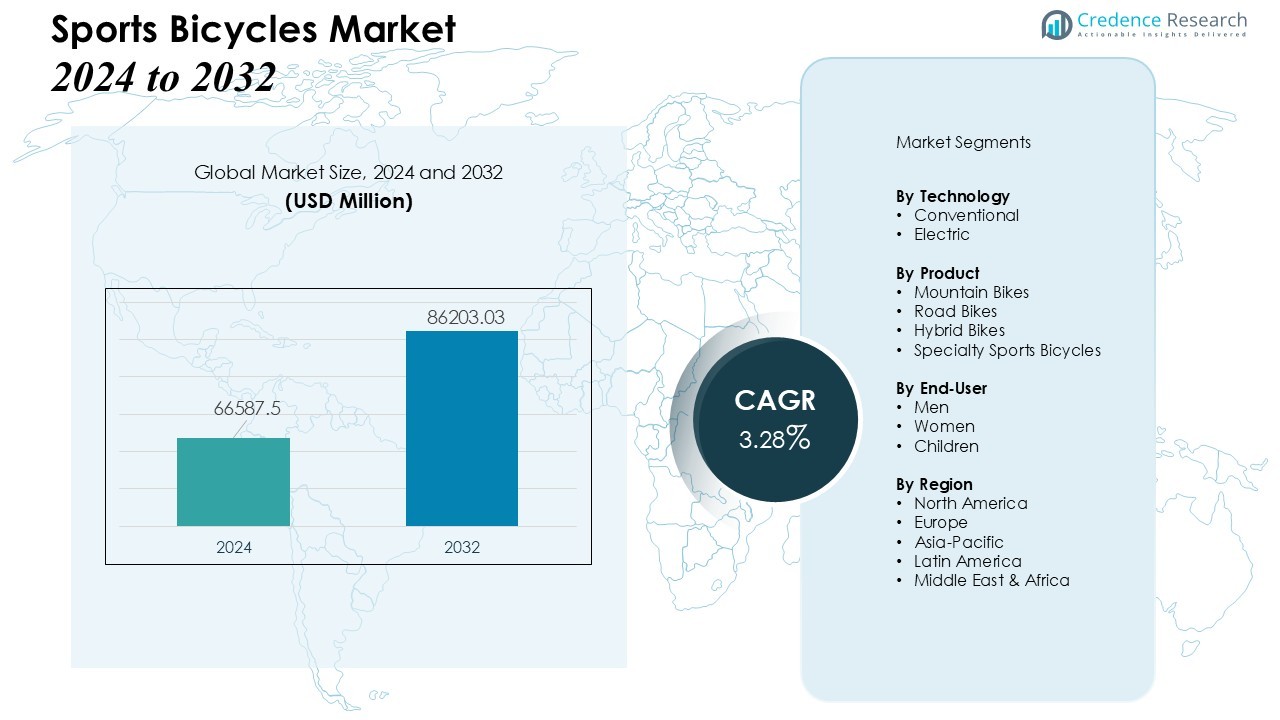
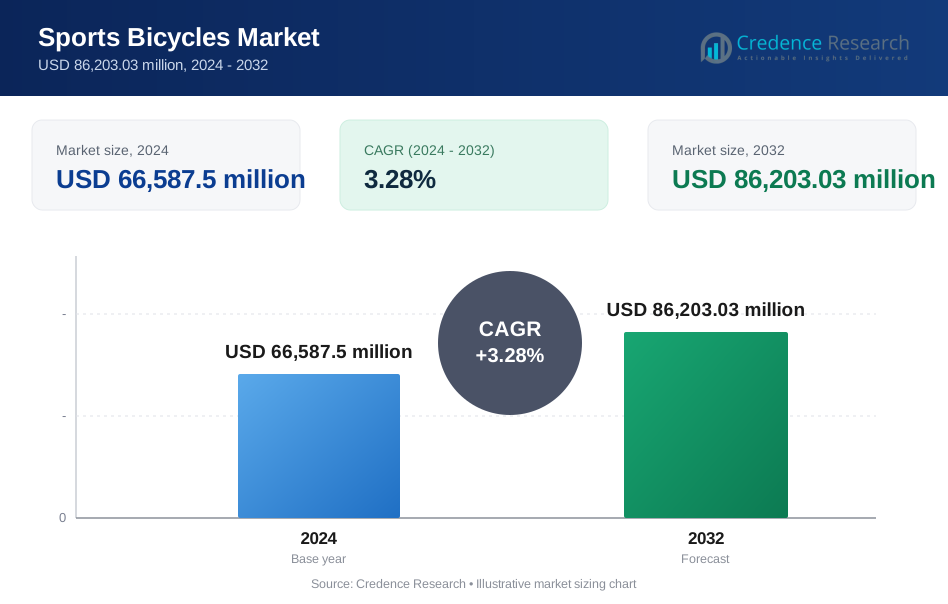
The Sports Bicycles Market size was valued at USD 66587.5 million in 2024 and is anticipated to reach USD 86203.03 million by 2032, at a CAGR of 3.28% during the forecast period (2024-2032).
| REPORT ATTRIBUTE | DETAILS |
|---|---|
| Historical Period | 2020-2023 |
| Base Year | 2024 |
| Forecast Period | 2025-2032 |
| Sports Bicycles Market Size 2024 | USD 66587.5 Million |
| Sports Bicycles Market, CAGR | 3.28% |
| Sports Bicycles Market Size 2032 | USD 86203.03 Million |
Key drivers include the surge in health consciousness, growing adoption of cycling for daily commutes, and advancements in lightweight materials and aerodynamic designs. Manufacturers introduce innovative models integrating enhanced suspension systems, electric assistance, and smart connectivity features to attract a broader consumer base. Expanding investments in biking infrastructure and government initiatives promoting sustainable mobility further stimulate demand.
Regionally, Europe holds the dominant share, driven by strong cycling culture, supportive policies, and well-developed infrastructure. North America shows steady growth due to rising interest in mountain biking, recreational sports, and fitness activities. The Asia-Pacific region is poised for the fastest expansion, supported by urbanization, increasing disposable incomes, and government programs encouraging eco-friendly transportation. Emerging markets in Latin America and the Middle East also present new opportunities due to expanding sports participation and improving retail availability.
Market Insights:
- The Sports Bicycles Market was valued at USD 66,587.5 million in 2024 and is projected to reach USD 86,203.03 million by 2032, growing at a CAGR of 3.28% during the forecast period.
- Rising health consciousness and growing adoption of cycling for daily commutes and fitness activities drive strong demand across global markets.
- Technological innovations in lightweight materials, aerodynamic frames, advanced suspension systems, and smart connectivity enhance performance and attract both professional and recreational cyclists.
- Government support through dedicated cycling lanes, bike-sharing programs, and sustainable mobility policies promotes adoption and improves safety for riders.
- Europe leads the market with the largest share due to strong cycling culture and infrastructure, while North America and Asia-Pacific demonstrate high growth potential, supported by adventure sports, urbanization, and increasing disposable incomes.
 Market Drivers:
Rising Focus on Health and Fitness Boosts Product Demand
The Sports Bicycles Market gains strong momentum from the global shift toward healthier lifestyles. Consumers prioritize activities that improve cardiovascular strength and overall wellness, increasing their preference for sports bicycles. It benefits from growing participation in cycling events and recreational outdoor activities. Urban consumers show higher adoption as they seek convenient and sustainable fitness options.
- For instance, the Trek Bicycle Corporation 'Trek Century Challenge' virtual fitness event on Strava has historically demonstrated massive engagement. A representative challenge instance saw approximately 247,000 riders join the event over the full month-long period, who collectively logged over 78 million miles (more than 126 million kilometers) of riding focused on endurance and fitness goals.
Technological Advancements Enhance Performance and User Experience
Innovations in lightweight materials, advanced suspension systems, and aerodynamic frame designs elevate product value in the Sports Bicycles Market. Manufacturers invest in R&D to improve durability, riding comfort, and speed efficiency. It integrates smart features such as GPS tracking, performance analytics, and electric assistance to attract a wider consumer base. These advancements encourage both professional athletes and casual riders to upgrade to high-performance models.
- For instance, Specialized’s S-Works Tarmac SL8 uses a refined FACT 12r carbon layup to deliver a frame weight of about 685 g in a size 56 while maintaining WorldTour-level stiffness, enabling pro riders to sustain higher average speeds with improved power transfer.
Government Initiatives Strengthen Market Growth Outlook
Policies that promote sustainable transportation and recreational sports continue to support demand in the Sports Bicycles Market. Governments invest in dedicated cycling lanes, public bike-sharing programs, and awareness campaigns to influence adoption. It benefits from subsidies and incentives that encourage cycling as a cleaner mobility alternative. Improved infrastructure increases safety and motivates consumers to incorporate cycling into their daily routines.
Expanding Popularity of Adventure and Competitive Sports Drives Adoption
Growth in mountain biking, road racing, and off-road adventure activities fuels steady progress for the Sports Bicycles Market. Sports culture expands through organized events, professional leagues, and community cycling groups. It attracts younger demographics seeking performance-driven experiences and outdoor challenges. Rising interest in competitive sports supports demand for specialized bicycles designed for endurance, speed, and advanced terrain handling.
Market Trends:
Growing Shift Toward High-Performance and Smart Bicycle Technologies
The Sports Bicycles Market experiences a steady transition toward advanced, performance-oriented models. Consumers seek bicycles with lightweight frames, enhanced aerodynamics, and improved suspension systems to elevate speed and ride quality. Manufacturers focus on carbon fiber, alloy composites, and precision engineering to meet these expectations. Smart integration through GPS navigation, fitness tracking, and mobile connectivity strengthens product appeal among tech-savvy users. Electrified sports bicycles gain traction due to their ability to support longer rides and challenging terrains. It benefits from rising consumer preference for premium and feature-rich models. The trend aligns with broader demand for efficient outdoor fitness solutions.
- For instance, Specialized’s S-Works Tarmac SL8 uses a FACT 12r carbon frame under 700 grams (specifically, a claimed 685g for a 56cm size), making it one of the lightest on the World Tour.
Rising Interest in Sustainable Mobility and Organized Cycling Activities
The Sports Bicycles Market observes strong growth influenced by increasing environmental awareness and expanding recreational sports culture. Urban consumers adopt sports bicycles to support eco-friendly commuting and reduce dependency on motor vehicles. Government investments in cycling lanes and infrastructure enhance safety and accessibility, encouraging wider participation. Competitive events, endurance races, and community cycling clubs accelerate interest among younger and fitness-oriented groups. It experiences higher demand for specialized models tailored to mountain biking, road racing, and gravel riding. Rental and subscription-based bicycle platforms gain popularity, offering consumers flexible access to quality equipment. The trend reinforces long-term adoption across both professional and recreational user segments.
- For Instance, Paris city authorities, under their ambitious 'Plan Vélo: Act 2' (2021-2026), committed to adding 180 km of new, permanent, segregated cycle lanes to their existing network of over 1,000 km, alongside approximately 130,000 new bicycle parking spots to boost urban cycling networks.
Market Challenges Analysis:
High Manufacturing Costs and Price Sensitivity Limit Adoption
The Sports Bicycles Market faces challenges driven by the high cost of advanced raw materials, precision components, and technological integrations. Consumers in price-sensitive regions hesitate to invest in premium models, affecting overall sales momentum. Manufacturers struggle to balance innovation with affordability while maintaining quality and performance. It encounters fluctuations in supply chains, leading to increased production expenses and delayed product availability. Limited access to specialized components further constrains scalability. These factors create barriers for new entrants and restrict wider consumer adoption.
Infrastructure Gaps and Safety Concerns Reduce Market Potential
The Sports Bicycles Market experiences constraints due to inadequate cycling infrastructure in several developing regions. Many cities lack dedicated cycling lanes, signaling systems, and safe riding environments, discouraging daily or recreational use. It encounters safety concerns related to accidents, traffic congestion, and limited public awareness of cycling norms. Low penetration of organized sporting facilities restricts opportunities for training and competitive activities. Weather-related challenges also affect regular cycling habits in certain regions. These limitations reduce long-term market expansion prospects.
Market Opportunities:
Expansion of Electric Sports Bicycles and Smart Technology Integration
The Sports Bicycles Market gains new opportunities through rising demand for electric sports bicycles equipped with advanced assistance features. Consumers show strong interest in models that support longer distances, improved speed control, and enhanced riding comfort. Manufacturers can expand product lines by integrating GPS navigation, performance analytics, and IoT-enabled components. It benefits from increasing acceptance of connected fitness devices among urban and tech-focused users. Advancements in battery efficiency and lightweight materials further strengthen the potential for premium electric variants. Growing interest in smart mobility platforms also supports wider adoption.
Growth Potential in Adventure Sports and Emerging Markets
The Sports Bicycles Market captures significant opportunities from the expanding popularity of mountain biking, gravel riding, and endurance sports. Adventure tourism encourages consumers to explore specialized bicycles designed for varied terrains. It gains traction in emerging markets where rising incomes and fitness awareness boost interest in performance-oriented models. Governments investing in cycling infrastructure create favorable conditions for long-term growth. Retailers can expand through e-commerce platforms that improve accessibility and product reach. These developments support sustained demand across both professional and recreational user groups.Top of Form
Market Segmentation Analysis:
By Technology
The Sports Bicycles Market is segmented by conventional and electric technologies, with electric models gaining strong traction due to rising demand for assisted performance and longer-distance capability. Conventional bicycles continue to hold a solid base among professional athletes and cycling enthusiasts who prioritize manual control and speed efficiency. It benefits from technological improvements in battery efficiency, lightweight materials, and integrated digital features. Manufacturers focus on enhancing durability and ride comfort across both segments to meet evolving consumer expectations.
- For instance, Paris city authorities sanctioned 180 km of new permanent, segregated cycle lanes as part of their 2021–2026 'Plan Vélo' to expand the existing network (which already exceeded 1,000 km in total length), and are also adding around 130,000 new secure bicycle parking spots to boost urban cycling networks and combat theft
By Product
Product segmentation includes mountain bikes, road bikes, hybrid bikes, and specialty sports bicycles. Mountain bikes lead demand due to growing interest in adventure sports and trail-based activities. Road bikes maintain steady adoption among fitness-focused users and competitive racers. Hybrid models gain attention for offering versatility across urban and recreational environments. The Sports Bicycles Market sees rising demand for specialty products that cater to gravel riding, endurance events, and high-performance use cases. Manufacturers introduce models with improved suspension, aerodynamics, and frame strength to expand product reach.
- For Instance, a typical Giant FastRoad features a rigid, advanced-grade composite (carbon) or aluminum fork (not a 100mm suspension fork), providing no assisted speed as it is a standard bicycle. However, the 40mm tire clearance is correct for models in the FastRoad AR lineup (which can accommodate up to 42mm tires), giving them all-road versatility.
By End-User
End-user segmentation covers men, women, and children, each showing unique purchasing preferences and usage patterns. Men represent a major share driven by strong participation in adventure sports and fitness activities. Women’s adoption increases steadily with growing interest in recreational cycling and wellness-focused routines. It also records rising demand from children as awareness of outdoor physical activity grows among parents. Manufacturers invest in ergonomically designed frames and size-specific variants to support comfort and safety across all age groups.
Segmentations:
By Technology
- Conventional
- Electric
By Product
- Mountain Bikes
- Road Bikes
- Hybrid Bikes
- Specialty Sports Bicycles
By End-User
- Men
- Women
- Children
By Region
- North America
- U.S.
- Canada
- Mexico
- Europe
- Germany
- France
- U.K.
- Italy
- Spain
- Rest of Europe
- Asia Pacific
- China
- Japan
- India
- South Korea
- South-east Asia
- Rest of Asia Pacific
- Latin America
- Brazil
- Argentina
- Rest of Latin America
- Middle East & Africa
- GCC Countries
- South Africa
- Rest of the Middle East and Africa
Regional Analysis:
Strong Market Presence Across Europe Supported by Cycling Culture
Europe holds 40% share of the Sports Bicycles Market, reflecting its leadership in cycling infrastructure and adoption. The region maintains a dominant position with sustained demand across recreational and competitive segments. Countries such as Germany, the Netherlands, and Denmark support cycling through extensive lane networks and safety initiatives. Consumers actively participate in commuting, endurance events, and tourism-focused cycling. It benefits from government policies that encourage sustainable mobility and healthy lifestyles. Continuous infrastructure investments strengthen long-term regional growth.
Growing Adoption in North America Driven by Fitness and Adventure Trends
North America accounts for 30% share of the Sports Bicycles Market, supported by strong interest in high-performance and adventure-oriented models. The region records consistent growth driven by demand across the United States and Canada. Consumers seek bicycles designed for mountain trails, endurance activities, and fitness-focused recreation. It gains momentum through expanding outdoor programs and access to diverse cycling terrains. Retailers use e-commerce platforms to improve product reach across urban and suburban markets. Rising participation in organized cycling events fuels further adoption.
Rapid Market Growth in Asia-Pacific Fueled by Urbanization and Mobility Initiatives
Asia-Pacific represents 20% share of the Sports Bicycles Market, supported by rising adoption in densely populated urban centers. The region exhibits strong growth potential driven by mobility reforms and health-awareness programs. Countries such as China, Japan, and India invest in smart-city initiatives and cycling-friendly infrastructure to reduce congestion. The Sports Bicycles Market gains traction among younger consumers seeking practical and fitness-oriented mobility. It benefits from expanding interest in competitive and recreational cycling activities. Manufacturers increase investment in innovative models tailored to diverse performance needs.
Key Player Analysis:
- Bianchi
- Cannondale Bicycle Corporation
- Cube Bikes
- Giant Manufacturing Co., Ltd.
- GT Bicycles
- Jenson USA
- Merida Industry Co., Ltd.
- Scott Sports SA
- Specialized Bicycle Components, Inc
- Trek Bicycle Corporation
Competitive Analysis:
The Sports Bicycles Market features a competitive landscape shaped by global brands, regional manufacturers, and emerging innovators. Leading companies focus on advanced materials, aerodynamic designs, and technology-integrated models to strengthen their product portfolios. It sees strong investment in R&D as manufacturers work to enhance performance, durability, and rider comfort. Companies expand distribution networks through e-commerce channels, specialty stores, and strategic partnerships to reach diverse consumer groups. Competitive strategies include launching premium electric variants, upgrading suspension systems, and offering customized frame options. Brands also position themselves through sponsorship of cycling events and collaborations with professional athletes to reinforce market visibility.
Recent Developments:
- In January 2025, Bianchi partnered with Santini Cycling for the production and distribution of the Bianchi Milano apparel brand, marking a five-year agreement focused on technical cycling gear for various disciplines, with initial collections launching in April.
- In September 2025, Cannondale's Synapse Carbon 2 SmartSense was named Road Bike of the Year and top endurance bike by BikeRadar, praised for setting new standards in integrated tech and performance.
Report Coverage:
The research report offers an in-depth analysis based on Technology, Product, End-User and Region. It details leading market players, providing an overview of their business, product offerings, investments, revenue streams, and key applications. Additionally, the report includes insights into the competitive environment, SWOT analysis, current market trends, as well as the primary drivers and constraints. Furthermore, it discusses various factors that have driven market expansion in recent years. The report also explores market dynamics, regulatory scenarios, and technological advancements that are shaping the industry. It assesses the impact of external factors and ITALY economic changes on market growth. Lastly, it provides strategic recommendations for new entrants and established companies to navigate the complexities of the market.
Future Outlook:
- Demand for performance-driven and technology-enhanced bicycles will strengthen as consumers prioritize fitness and outdoor activities.
- Electric sports bicycles will gain wider acceptance due to improved battery efficiency, enhanced speed support, and longer-range capability.
- Smart features such as GPS navigation, ride analytics, and connectivity tools will become standard across mid-range and premium models.
- Manufacturers will expand product lines with lightweight materials and aerodynamic frames to meet professional and recreational needs.
- Urban mobility initiatives will support higher adoption, especially in regions promoting cycling-friendly infrastructure.
- Adventure sports, including mountain biking and gravel riding, will continue to boost demand for specialized models.
- E-commerce platforms will play a larger role in product distribution, offering broader reach and improved customer engagement.
- Sustainability-focused consumers will drive interest in eco-friendly manufacturing practices and recyclable components.
- Collaborations with professional athletes and sports organizations will influence brand visibility and product innovation.
- The Sports Bicycles Market will evolve with higher customization options, catering to individual riding styles and ergonomic preferences.
Request a Free Sample
Fill in your details and we'll send you a free sample report.
- Sample data tables & charts
- Research methodology
Need a Custom Version of This Report?
Tailor the scope, geography, or segments to your exact requirements.
- Custom geography or segment scope
- Direct access to our analyst team
Frequently Asked Questions
What is the current market size for the Sports Bicycles Market, and what is its projected size in 2032?
At what Compound Annual Growth Rate is the Sports Bicycles Market projected to grow between 2024 and 2032?
Which Sports Bicycles Market segment held the largest share in 2024?
What are the primary factors fueling the growth of the Sports Bicycles Market?
Who are the leading companies in the Sports Bicycles Market?
Which region commanded the largest share of the Sports Bicycles Market in 2024?
Table of Content
Chapter 1. Report Introduction
- 1.1 Report Description & Purpose
- 1.1.1 Report Title & Market Definition
- 1.1.2 Unique Selling Propositions (USP) & Key Differentiators
- 1.1.3 Value Proposition for Stakeholders
- 1.2 Research Objectives
- 1.2.1 Market Sizing Objectives (Volume & Revenue) (Volume Where Applicable)
- 1.2.2 Segmentation Objectives
- 1.2.3 Competitive Intelligence Objectives
- 1.2.4 Forecast & Scenario Objectives
- 1.3 Report Scope
- 1.3.1 Sports Bicycles Scope – Segments & Subsegments Covered
- 1.3.2 Geographic Scope – Regions & Countries Covered
- 1.3.3 Historical Period, Base Year & Forecast Period (2024; forecast to 2032)
- 1.3.4 Inclusions & Exclusions
- 1.4 Industry Classification & Applicable Codes
- 1.5 Currency, Measurement Units & Valuation Basis
- 1.6 Target Stakeholders
- 1.7 Limitations & Assumptions
Chapter 2. Executive Summary
- 2.1 Global Sports Bicycles Market Snapshot
- 2.1.1 Market Size – Historical (2024) & Forecast (2024-2032) (2024: USD 66,587.5 million → 2032: USD 86,203.03 million)
- 2.1.2 Volume & Revenue – Global Totals (Volume Where Applicable)
- 2.1.3 Key Market Highlights – Top Five Facts
- 2.2 Sports Bicycles Market Segmentation Snapshot
- 2.2.1 Market Split by Region – 2024 vs. 2032
- 2.3 Competitive Snapshot
- 2.3.1 Top 10 Players by Revenue Share – 2024
- 2.3.2 Top 10 Players by Volume Share – 2024 (Volume Where Applicable)
- 2.3.3 Recent Strategic Developments (18-Month Summary)
- 2.4 Key Investment Highlights & Strategic Conclusions
Chapter 3. Sports Bicycles Market Dynamics & Industry Analysis
- 3.1 Market Overview & Context
- 3.1.1 Sports Bicycles Market Position in the Broader Industry Value Chain
- 3.1.2 Demand Structure & Purchasing Dynamics
- 3.1.3 Market Maturity & Development Stage by Region
- 3.2 Sports Bicycles Market Drivers
- 3.3 Sports Bicycles Market Restraints & Challenges
- 3.4 Sports Bicycles Market Opportunities
- 3.5 Porter's Five Forces Analysis
- 3.5.1 Threat of New Entrants
- 3.5.2 Bargaining Power of Suppliers
- 3.5.3 Bargaining Power of Buyers
- 3.5.4 Threat of Substitutes
- 3.5.5 Competitive Rivalry – Intensity Assessment
- 3.6 Sports Bicycles Value Chain Analysis
- 3.6.1 Upstream – Key Inputs, Resources & Suppliers
- 3.6.1.1 Key Input/Resource 1
- 3.6.1.2 Key Input/Resource 2
- 3.6.1.3 Key Input/Resource 3
- 3.6.2 Midstream – Core Operations & Value Creation
- 3.6.2.1 Operating Model & Process Overview
- 3.6.2.2 Key Operating Locations & Capabilities by Company
- 3.6.3 Downstream – Market Channels & End Users
- 3.6.3.1 Direct Sales & Customer Engagement Channels
- 3.6.3.2 Indirect Sales, Intermediaries & Partner Channels
- 3.6.4 Value Chain Profitability Analysis
- 3.6.1 Upstream – Key Inputs, Resources & Suppliers
- 3.7 PESTEL Analysis
- 3.7.1 Political Factors
- 3.7.2 Economic Factors
- 3.7.3 Social Factors
- 3.7.4 Technological Factors
- 3.7.5 Environmental Factors
- 3.7.6 Legal Factors
- 3.8 Sports Bicycles Supply Chain Analysis
- 3.8.1 Critical Input & Resource Availability Risk Assessment
- 3.8.2 Supplier & Operational Concentration Risk (Geographic Exposure)
- 3.8.3 Supply & Service Disruption Impact Analysis
- 3.9 Regulatory & Policy Landscape
Note: The regulatory and policy landscape section covers regulations based on their applicability to the market, Sports Bicycles category, geography, and scope of the study. Only regulatory frameworks with a material impact on operations, compliance, trade, sustainability, or market access are analyzed in detail.
Chapter 4. Key Investment Pockets & Opportunity Analysis
- 4.1 Sports Bicycles Market Attractiveness Analysis
- 4.1.1 By Region – Investment Attractiveness Matrix (Market Size × CAGR)
- 4.2 Absolute Revenue Growth Opportunity
- 4.2.1 By Region – Absolute Revenue Growth Through 2032
- 4.3 Incremental Demand Opportunity
- 4.3.1 By Region – Incremental Demand Through 2032
- 4.3.2 Segment – Incremental Demand
- 4.4 Emerging Submarket Opportunity Deep Dive (Subject to Applicability)
- 4.5 Priority Market Opportunity Scorecards
- 4.5.1 United States
- 4.5.2 Europe
- 4.5.3 Asia
- 4.5.4 Middle East & Africa
Note: Priority market opportunity scorecards reflect the geographic scope and strategic relevance of the study. Listed markets are indicative and may be adapted to the industry.
Chapter 5. Sports Bicycles Cross-Border Trade & Market Access Analysis
- 5.1 International Trade & Cross-Border Activity Overview
- 5.1.1 Global Export Value by Country (2024)
- 5.1.2 Global Export Volume by Country (2024) (Volume Where Applicable)
- 5.1.3 Global Import Value by Country (2024)
- 5.1.4 Global Import Volume by Country (2024) (Volume Where Applicable)
- 5.1.5 Net Trade Balance by Country (2024)
- 5.2 Export Analysis – Segment
- 5.2.1 Category 1 (Applicable Classification Code)
- 5.2.2 Category 2 (Applicable Classification Code)
- 5.2.3 Category 3 (Applicable Classification Code)
- 5.2.4 Category 4 (Applicable Classification Code)
- 5.2.5 Category 5 (Applicable Classification Code)
- 5.3 Import Analysis – Segment
- 5.3.1 Category 1 (Applicable Classification Code)
- 5.3.2 Category 2 (Applicable Classification Code)
- 5.3.3 Category 3 (Applicable Classification Code)
- 5.3.4 Category 4 (Applicable Classification Code)
- 5.3.5 Category 5 (Applicable Classification Code)
- 5.4 Cross-Border Pricing & Transaction Benchmarks
- 5.4.1 Export Pricing – Segment & Country
- 5.4.2 Import Pricing – Segment & Source Country
- 5.4.3 Price Trends (2024)
- 5.5 Key Cross-Border Trade & Delivery Routes
- 5.5.1 Cross-Border Trade/Delivery Route 1
- 5.5.2 Cross-Border Trade/Delivery Route 2
- 5.5.3 Cross-Border Trade/Delivery Route 3
- 5.5.4 Cross-Border Trade/Delivery Route 4
- 5.5.5 Cross-Border Trade/Delivery Route 5
- 5.6 Trade Policy & Market Access Impact Assessment
- 5.6.1 Tariff & Non-Tariff Barriers
- 5.6.2 Regional Trade & Economic Integration Frameworks
- 5.6.3 Bilateral & Multilateral Trade Agreements
- 5.6.4 Cross-Border Operating, Licensing & Localization Requirements
Note: This chapter applies where cross-border trade or delivery is relevant to Sports Bicycles. Goods, services, and digital offerings are assessed using applicable classifications and transaction measures. Import-export volumes, trade balances, and route analyses are included only where meaningful to the market.
Chapter 6. Competitive Landscape & Company Benchmarking
- 6.1 Sports Bicycles Market Concentration & Structure
- 6.1.1 Herfindahl-Hirschman Index (HHI) – vs. 2024
- 6.1.2 Leading, Mid-Sized & Emerging Player Structure
- 6.1.3 Global, Regional & Local Player Dynamics
- 6.2 Sports Bicycles Market Share Analysis – 2024
- 6.2.1 Global Revenue Share by Company
- 6.2.2 Global Volume Share by Company (Volume Where Applicable)
- 6.2.3 Regional Revenue Share
- 6.2.4 Market Share Evolution ( vs. 2024)
- 6.2.5 Company Market Share by Key Segment
- 6.2.6 Company Market Share by Customer Group
- 6.3 Operating Scale, Capacity & Infrastructure Analysis
- 6.3.1 Global Operating Scale & Supply Capacity
- 6.3.2 Resource Utilization & Operating Efficiency
- 6.3.3 Output, Service Delivery & Activity Metrics
- 6.3.4 Operating Footprint & Infrastructure Map
- 6.3.5 Planned Operational & Capacity Expansion
- 6.4 Sports Bicycles Competitive Benchmarking Matrix
- 6.4.1 Revenue, Growth, Profitability & Operating Metric Comparison
- 6.4.2 Channel Revenue Mix
- 6.4.3 Geographic Revenue Exposure
- 6.4.4 R&D Intensity
- 6.4.5 Sustainability Maturity
- 6.5 Strategic Developments in Sports Bicycles (Last 24 Months)
- 6.5.1 Mergers, Acquisitions & Divestments
- 6.5.2 New Products, Services & Solutions in Sports Bicycles
- 6.5.3 Operational & Infrastructure Expansions
- 6.5.4 Strategic Alliances, Joint Ventures & Partnerships
- 6.5.5 Distribution Expansion & Market Entry
- 6.5.6 Sustainability & ESG Initiatives
- 6.6 Competitive Strategy Mapping
- 6.6.1 Leader, Challenger, Follower & Niche Classification
- 6.6.2 Pricing Strategy Comparison
- 6.6.3 Channel Strategy Matrix
Note: Strategic developments are included based on their materiality and the availability of reliable information.
Chapter 7. Global Sports Bicycles Market – By Sales & Delivery Channel
- 7.1 Segment Overview
- 7.1.1 Volume & Revenue Split by Channel (2024 & 2032) (Volume Where Applicable)
- 7.1.2 Channel Mix Evolution (2024-2032)
Chapter 8. Regional Market Analysis – Global Overview
- 8.1 Global Regional Overview
- 8.1.1 Regional Volume Share (Volume Where Applicable)
- 8.1.2 Regional Revenue Share
- 8.1.3 Regional Volume by Region (Volume Where Applicable)
- 8.1.4 Regional Revenue by Region
- 8.1.5 Regional Forecast Through 2032
- 8.2 Cross-Regional Segment Analysis
- 8.2.1 By Sales & Delivery Channel
- 8.2.2 By Competitive Positioning & Price Tier
Chapter 9. North America Sports Bicycles Market
- 9.1 United States
- 9.2 Canada
- 9.3 Mexico
Chapter 10. Europe Sports Bicycles Market
- 10.1 Germany
- 10.2 France
- 10.3 Italy
- 10.4 United Kingdom
- 10.5 Spain
- 10.6 Poland
- 10.7 Russia
- 10.8 Netherlands
- 10.9 Belgium
- 10.10 Sweden
- 10.11 Denmark
- 10.12 Norway
- 10.13 Rest of Europe
Chapter 11. Asia Pacific Sports Bicycles Market
- 11.1 China
- 11.2 India
- 11.3 Japan
- 11.4 South Korea
- 11.5 Thailand
- 11.6 Indonesia
- 11.7 Vietnam
- 11.8 Malaysia
- 11.9 Australia
- 11.10 Rest of Asia Pacific
Chapter 12. Latin America Sports Bicycles Market
- 12.1 Brazil
- 12.2 Argentina
- 12.3 Colombia
- 12.4 Chile
- 12.5 Rest of Latin America
Chapter 13. Middle East Sports Bicycles Market
- 13.1 Saudi Arabia
- 13.2 United Arab Emirates
- 13.3 Turkey
- 13.4 Israel
- 13.5 Iran
- 13.6 Rest of the Middle East
Chapter 14. Africa Sports Bicycles Market
- 14.1 South Africa
- 14.2 Egypt
- 14.3 Nigeria
- 14.4 Morocco
- 14.5 Rest of Africa
Chapter 15. Sports Bicycles Company Profiles
- 15.1 [Company 01]
- 15.1.1 Company Overview
- 15.1.2 Key Management Personnel
- 15.1.3 Products & Services Portfolio
- 15.1.4 Financial Performance
- 15.1.5 Key Market Focus & Geographic Presence
- 15.1.6 Recent Developments & Strategic Initiatives
Note: The company profile list is preliminary and may change based on research findings, market developments, data availability, and client requirements.
Chapter 16. Appendices
- Appendix A – List of Abbreviations & Acronyms
- Appendix B – Industry Classification Code Reference – Full Series
- Appendix C – Supply, Output & Operating Capacity Data Tables
- Appendix D – End-Use & Demand Base Tables
- Appendix E – Demand, Adoption & Usage Assumptions
- Appendix F – Pricing & Revenue Metric Reference Tables
- Appendix G – Company Operations & Infrastructure Database
- Appendix H – Cross-Border Trade & Activity Data Tables (Where Applicable)
- Appendix I – Regulatory Summary Tables
- Appendix J – Primary Research Participant List (Anonymized)
- Appendix K – Primary Research Questionnaire Framework
- Appendix L – Data Sources & Bibliography
- Appendix M – Market Size Divergence & Source Comparison
Chapter 17. Research Methodology
- 17.1 Research Framework & Philosophy
- 17.2 Secondary Research – Sources, Hierarchy & Data Extraction
- 17.3 Data Modeling – Bottom-Up & Top-Down Market Sizing
- 17.4 Primary Research – Stakeholder Framework, LOI & Sample Sizes
- 17.5 Forecast Methodology – Regression, Scenario & Sensitivity Analysis
- 17.6 Quality Control – Four-Layer Validation Framework
- 17.7 Limitations & Standard Assumptions
- 17.8 Disclaimer
