Market Overview
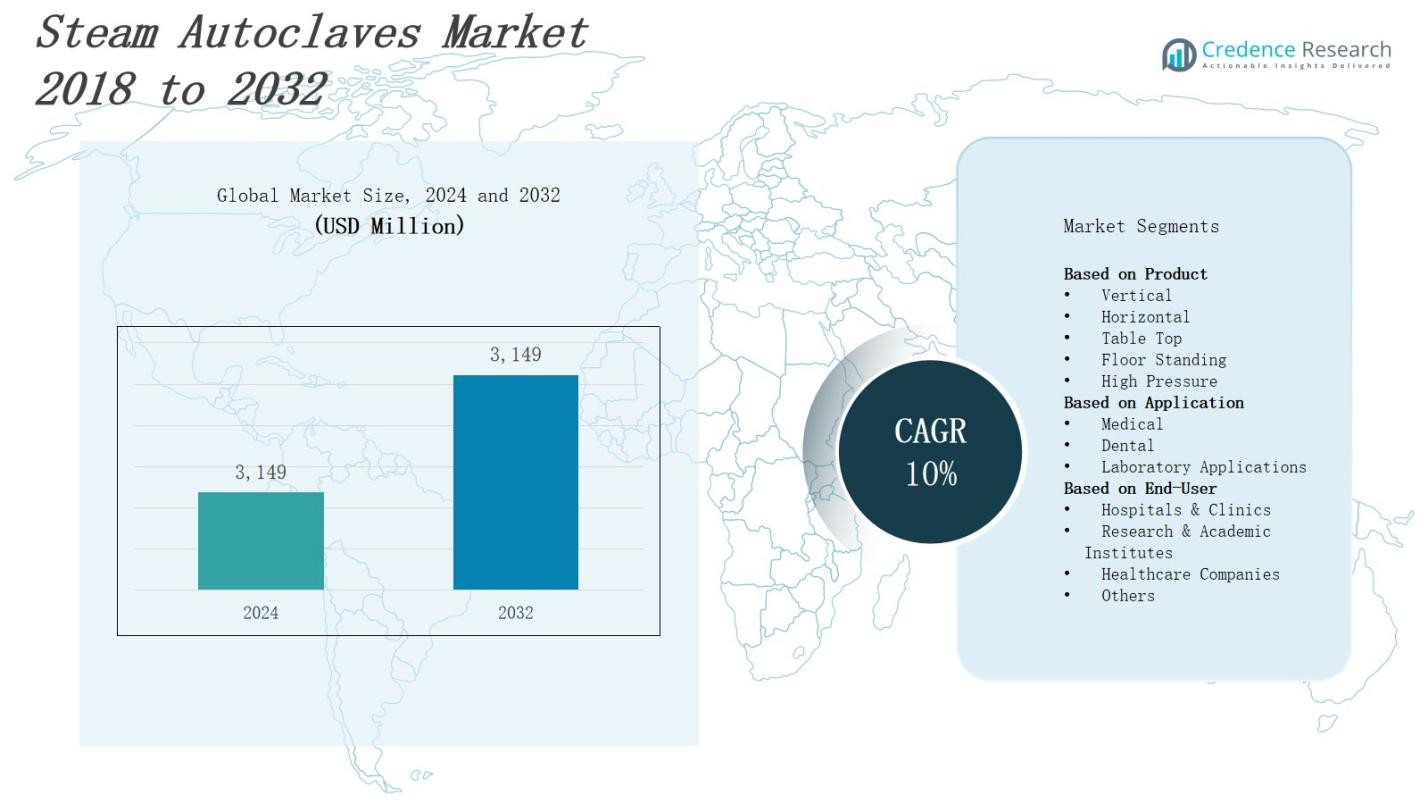
The Steam Autoclaves Market is projected to grow from USD 3,149 million in 2024 to USD 6,750.1 million by 2032, registering a compound annual growth rate (CAGR) of 10% during the forecast period.
| REPORT ATTRIBUTE | DETAILS |
|---|---|
| Historical Period | 2020-2024 |
| Base Year | 2024 |
| Forecast Period | 2025-2032 |
| Steam Autoclaves Market Size 2024 | USD 3,149 Million |
| Steam Autoclaves Market, CAGR | 10% |
| Steam Autoclaves Market Size 2032 | USD 6,750.1 Million |
The steam autoclaves market experiences robust growth driven by increasing demand for sterilization in healthcare, pharmaceuticals, and biotechnology sectors. Rising awareness of infection control and stringent regulatory standards propel adoption across hospitals and laboratories. Technological advancements enhance autoclave efficiency, safety, and automation, meeting the needs of high-throughput sterilization. Growing use in food processing and research institutions further expands market reach. Trends include integration of IoT-enabled smart autoclaves for real-time monitoring and predictive maintenance, along with the development of compact, energy-efficient models that reduce operational costs. These factors collectively reinforce the market’s upward trajectory.
The steam autoclaves market demonstrates strong geographical diversity, with North America leading at 35%, followed by Europe at 28%, and Asia-Pacific capturing 25% of the market share. The Rest of the World accounts for the remaining 12%, driven by growth in Latin America, the Middle East, and Africa. Key players such as Belimed Deutschland, Getinge, Tuttnauer, Panasonic, and Matachana actively compete across these regions by offering innovative, energy-efficient, and customizable sterilization solutions. Their strategic expansions and focus on regulatory compliance reinforce their global market presence.
Market Insights
- The steam autoclaves market is projected to grow from USD 3,149 million in 2024 to USD 6,750.1 million by 2032, registering a CAGR of 10% during the forecast period.
- Increasing demand for sterilization in healthcare, pharmaceuticals, and biotechnology drives market growth, supported by rising infection control awareness and stringent regulations.
- Technological advancements improve autoclave efficiency, safety, and automation, addressing high-throughput sterilization requirements in hospitals and laboratories.
- Expansion into food processing and research applications broadens market reach, with autoclaves ensuring microbial safety and contamination control.
- North America leads with 35% market share, followed by Europe at 28%, Asia-Pacific at 25%, and the Rest of the World holding 12%.
- Key players such as Belimed Deutschland, Getinge, Tuttnauer, Panasonic, and Matachana compete by offering innovative, energy-efficient, and customizable sterilization solutions.
- Challenges include high initial investment, operational costs, strict regulatory requirements, and complex validation processes that may slow adoption in cost-sensitive regions.
Market Drivers
Rising Demand for Sterilization in Healthcare and Pharmaceutical Sectors
The steam autoclaves market benefits from heightened demand for reliable sterilization solutions in healthcare and pharmaceutical industries. Hospitals and clinics require effective methods to eliminate pathogens from surgical instruments and medical devices to prevent infections. Pharmaceutical manufacturers depend on autoclaves for sterilizing equipment and products, ensuring compliance with stringent quality standards. Increasing hospital infrastructure and expanding pharmaceutical production globally directly drive market growth. Strict government regulations reinforce the need for standardized sterilization practices, boosting autoclave adoption. It remains essential for maintaining safety and hygiene across healthcare environments.
- For instance, Enbio AG, a Swiss company, launched B Class autoclaves in 2023 that sterilize microsurgical instruments within 7-9 minutes, rapidly improving sterilization efficiency in hospitals.
Expansion into Food Processing and Research Applications
Beyond healthcare, steam autoclaves find growing applications in food processing and scientific research sectors. The food industry uses autoclaves for sterilizing packaging and ensuring microbial safety, extending product shelf life. Research laboratories depend on them for sterilizing culture media, labware, and biohazardous waste. Increasing investments in biotechnology and life sciences research drive demand for efficient sterilization equipment. It supports stringent contamination control measures required in these fields. This diversification broadens market opportunities and fosters sustained revenue growth.
- For instance, Nestlé employs autoclave sterilization to maintain the safety and freshness of its ready-to-eat meals. Research laboratories depend on them for sterilizing culture media, labware, and biohazardous waste.
Regulatory Compliance and Focus on Infection Control Protocols
The steam autoclaves market expands under the influence of evolving regulatory frameworks emphasizing infection control. Healthcare authorities impose strict guidelines for sterilization to reduce hospital-acquired infections and improve patient outcomes. Pharmaceutical and biotech industries adhere to Good Manufacturing Practices (GMP) that mandate validated sterilization processes. Institutions implement rigorous sterilization protocols to comply with accreditation standards. It ensures consistent product safety and regulatory approval. Compliance requirements motivate end users to upgrade or adopt advanced autoclave systems, reinforcing market demand.
Market Trends
Increasing Adoption of IoT-Enabled and Smart Autoclave Systems
The steam autoclaves market embraces digital transformation through the integration of IoT and smart technologies. Manufacturers incorporate sensors, real-time monitoring, and remote control capabilities to enhance process transparency and operational efficiency. It enables users to track sterilization cycles, receive alerts, and perform predictive maintenance, reducing downtime and errors. The adoption of data-driven sterilization processes supports compliance with regulatory requirements and quality assurance. These smart systems gain traction across hospitals, pharmaceutical plants, and research labs, elevating market growth and innovation.
- For instance, Tuttnauer has developed the T-Connect system, a cloud-based IoT solution that connects multiple sterilization devices, allowing laboratories to monitor cycle data in real time remotely, ensuring uninterrupted sterilization and automated documentation storage.
Development of Compact and Energy-Efficient Autoclaves
Compact and energy-efficient steam autoclaves attract attention due to growing demand for space-saving and sustainable sterilization solutions. Manufacturers focus on reducing footprint and power consumption while maintaining sterilization efficacy. It suits small clinics, mobile healthcare units, and laboratories with limited space or energy resources. Energy-efficient designs lower operational costs and environmental impact, aligning with global sustainability goals. This trend meets user expectations for economical and eco-friendly sterilization, expanding the market in emerging and developed regions.
- For instance, Priorclave autoclaves with cylindrical front-loading vessels consume one-sixth to one-tenth the water and energy compared to similar rectangular models, emphasizing the impact of compact, optimized vessel shapes on resource efficiency.
Integration of Advanced Automation and User-Friendly Interfaces
Automation advances play a significant role in shaping the steam autoclaves market by simplifying operation and enhancing reliability. Automatic cycle selection, self-diagnosis, and fault detection reduce manual intervention and operator errors. It improves throughput and consistency, especially in high-volume sterilization environments. User-friendly touchscreens and intuitive interfaces facilitate ease of use and training. These features drive preference for advanced autoclaves in healthcare and pharmaceutical sectors, supporting operational excellence and compliance with sterilization protocols.
Expansion of Service and Maintenance Offerings Supporting Market Growth
The steam autoclaves market witnesses increased focus on after-sales service and maintenance programs to ensure system longevity and performance. Providers offer preventive maintenance, remote diagnostics, and timely repair services to minimize downtime. It enhances customer satisfaction and builds long-term relationships, encouraging repeat purchases. Comprehensive support addresses technical challenges and regulatory audits, strengthening user confidence. Service expansion boosts market competitiveness and fosters adoption of sophisticated autoclave models across diverse end-use industries.
Market Challenges Analysis
High Initial Investment and Operational Costs Hindering Market Penetration
The steam autoclaves market faces challenges due to the significant upfront investment required for advanced sterilization equipment. High costs limit accessibility for small healthcare facilities, laboratories, and emerging markets with budget constraints. Operating expenses, including energy consumption and maintenance, further strain organizational budgets. It requires specialized technical expertise to ensure optimal performance and compliance with safety standards, adding to operational complexity. These financial barriers slow adoption rates and encourage reliance on alternative sterilization methods in cost-sensitive regions.
Strict Regulatory Requirements and Complex Validation Processes
Compliance with rigorous regulatory standards poses a considerable challenge for the steam autoclaves market. Healthcare and pharmaceutical industries must adhere to detailed validation protocols to ensure sterilization efficacy and safety. It involves extensive documentation, regular audits, and adherence to evolving guidelines, increasing operational workload. Failure to comply can result in penalties, product recalls, or reputational damage. Complex validation and certification processes deter new entrants and delay equipment deployment, affecting market expansion and innovation pace.
Market Opportunities
Growing Demand for Sterilization in Emerging Markets Presents Expansion Opportunities
The steam autoclaves market holds significant growth potential in emerging economies due to expanding healthcare infrastructure and rising awareness of infection control. Increasing government investments in hospital modernization and pharmaceutical manufacturing create strong demand for reliable sterilization solutions. It offers opportunities to introduce cost-effective, scalable autoclave models tailored to regional needs. Rising public and private sector initiatives aimed at improving healthcare standards further drive market penetration. Expanding presence in these markets can yield substantial revenue growth and long-term customer loyalty.
Advancements in Smart and Eco-Friendly Autoclave Technologies Enable Market Differentiation
Innovation in automation, connectivity, and energy-efficient designs opens new avenues for the steam autoclaves market to enhance product offerings. It allows manufacturers to develop smart autoclaves that support remote monitoring, predictive maintenance, and data analytics, improving user experience and operational efficiency. Growing emphasis on sustainability encourages the adoption of low-energy consumption models that reduce environmental impact and operating costs. Capitalizing on these technological trends can differentiate market players and capture demand from environmentally conscious and tech-savvy customers across healthcare and industrial sectors.
Market Segmentation Analysis:
By Product
The steam autoclaves market segments into vertical, horizontal, table top, floor standing, and high-pressure autoclaves, each catering to specific user needs. Vertical and horizontal models dominate due to their versatility and capacity for different load sizes. Table top autoclaves appeal to small clinics and laboratories requiring compact sterilization units. Floor standing and high-pressure autoclaves serve high-volume facilities needing robust performance and enhanced sterilization capabilities. It continues to innovate product designs to improve efficiency, user convenience, and adaptability across various settings.
- For instance, the AES Series vertical autoclaves by Raypa, designed without drying functions, offer efficient sterilization for laboratories with chamber capacities between 33 to 169 liters, providing cost-effective and easy-to-use units ideal for microbiology labs.
By Application
Medical, dental, and laboratory applications constitute the primary segments in the steam autoclaves market. Medical sterilization remains the largest application due to high demand from hospitals and surgical centers. Dental autoclaves address the specific requirements of dental practices for instrument sterilization. Laboratory applications focus on sterilizing culture media, glassware, and biohazardous waste in research and diagnostic facilities. It supports diverse sterilization protocols tailored to these distinct applications, ensuring safety and compliance with industry standards.
- For example, Midmark’s Statim autoclaves are widely adopted in dental clinics for their rapid cycle times and compact design catering to small practice environments.
By End-User
Hospitals and clinics represent the largest end-user segment in the steam autoclaves market, driven by stringent infection control protocols. Research and academic institutes require autoclaves for experimental and educational purposes, contributing to steady demand. Healthcare companies, including pharmaceutical and biotech firms, utilize autoclaves for manufacturing and quality assurance processes. Other end-users encompass veterinary clinics and food processing units seeking reliable sterilization solutions. It addresses varied end-user needs by offering customizable features and scalable capacities.
Segments:
Based on Product
- Vertical
- Horizontal
- Table Top
- Floor Standing
- High Pressure
Based on Application
- Medical
- Dental
- Laboratory Applications
Based on End-User
- Hospitals & Clinics
- Research & Academic Institutes
- Healthcare Companies
- Others
Based on the Geography:
- North America
- U.S.
- Canada
- Mexico
- Europe
- Germany
- France
- U.K.
- Italy
- Spain
- Rest of Europe
- Asia Pacific
- China
- Japan
- India
- South Korea
- South-east Asia
- Rest of Asia Pacific
- Latin America
- Brazil
- Argentina
- Rest of Latin America
- Middle East & Africa
- GCC Countries
- South Africa
- Rest of the Middle East and Africa
Regional Analysis
North America
North America leads the steam autoclaves market with a market share of 35%. The region benefits from advanced healthcare infrastructure, high adoption of cutting-edge sterilization technologies, and stringent regulatory standards. It experiences strong demand from hospitals, pharmaceutical companies, and research institutions prioritizing infection control and compliance. Continuous investments in healthcare modernization and growing awareness of sterilization benefits further drive market expansion. Manufacturers focus on innovation and after-sales support to capture this lucrative market. It remains a key region for technological advancements and smart autoclave adoption.
Europe
Europe holds a 28% market share in the steam autoclaves market, supported by established healthcare systems and regulatory frameworks emphasizing patient safety. The region emphasizes quality and standardization, driving demand for validated sterilization equipment across medical and dental applications. Growth in biotechnology and pharmaceutical manufacturing contributes to market development. It benefits from government initiatives encouraging sustainability and energy-efficient technologies in healthcare facilities. The presence of major autoclave manufacturers in Europe fosters product innovation and competitive pricing. Strong R&D activities also support market growth.
Asia-Pacific
Asia-Pacific commands a 25% market share, fueled by rapid expansion of healthcare infrastructure and rising investments in pharmaceutical and research sectors. Emerging economies in the region increase spending on modern sterilization technologies to improve healthcare outcomes. It faces growing demand from hospitals, clinics, and academic institutes upgrading sterilization practices. The rise in infectious diseases and government health initiatives support autoclave adoption. Market players focus on cost-effective and compact models tailored to regional requirements. The expanding middle class and increasing healthcare access further propel growth.
Rest of the World
The Rest of the World holds a 12% share in the steam autoclaves market, driven by growing healthcare services in Latin America, the Middle East, and Africa. The region witnesses increasing awareness about infection control and expanding hospital networks. It faces challenges such as limited infrastructure and budget constraints but presents opportunities through international aid programs and private sector investments. Manufacturers target these markets with affordable and scalable sterilization solutions. Expansion of research and diagnostic laboratories in these regions supports market demand, contributing to steady growth.
Key Player Analysis
- LTE Scientific Ltd
- Medi safe International
- CELITRON Medical Technologies
- Tuttnauer
- PRIORCLAVE LTD.
- Belimed Deutschland
- Getinge
- Panasonic
- Consolidated Sterilizer Systems
- Boekel Scientific
- BMM Weston Ltd
- Matachana
Competitive Analysis
The steam autoclaves market features intense competition among key global players focusing on innovation, quality, and customer service to maintain market leadership. Leading companies invest in research and development to introduce advanced autoclave models with smart features such as IoT connectivity, automated controls, and energy-efficient designs. It drives differentiation and meets evolving regulatory and end-user requirements. Market participants also expand their geographic presence through strategic partnerships, acquisitions, and distribution network enhancements to capture emerging markets. Competitive pricing and comprehensive after-sales support play crucial roles in securing customer loyalty and repeat business. Companies emphasize product customization to cater to diverse application needs in healthcare, pharmaceuticals, and research sectors. The market also witnesses increased focus on sustainability initiatives, with manufacturers developing eco-friendly sterilization solutions to align with global environmental goals. It creates opportunities for market players to strengthen their position by offering reliable, cost-effective, and technologically advanced autoclaves. Continuous innovation and aggressive marketing remain essential strategies for success in this highly dynamic market environment.
Recent Developments
- In January 2025, Tuttnauer USA received a Technology Breakthrough designation from Premier, Inc. for its T-Top Autoclaves. This recognition highlights features such as Wi-Fi connectivity, cloud documentation, and upgradeable pre-/post-vacuum functionality, setting a new standard in sterilization technology.
- In November 2024, Vance Street Capital partnered with Prince Sterilization Services to support its expansion in pharmaceutical and medical device sterilization, enhancing eco-friendly sterilization services and ready-to-use products.
- In June 2024, Belimed and Steelco officially launched a joint venture named SteelcoBelimed.
- In June 2025, Solventum launched the Attest™ Super Rapid VH₂O₂ Clear Challenge Pack, a preassembled test kit integrating biological and chemical indicators for streamlined sterilization monitoring across multiple sterilizer brands.
Market Concentration & Characteristics
The steam autoclaves market demonstrates a moderately concentrated competitive landscape characterized by the presence of several established global players alongside numerous regional manufacturers. It features intense competition driven by continuous innovation, technological advancements, and strong customer focus. Market leaders differentiate themselves through advanced product portfolios incorporating automation, IoT integration, and energy-efficient designs. It also witnesses strategic collaborations, partnerships, and geographic expansion to enhance market reach and service capabilities. The market demands high-quality, reliable, and customizable sterilization solutions tailored to diverse end-user requirements across healthcare, pharmaceuticals, and research sectors. Price competitiveness, regulatory compliance, and after-sales support play significant roles in shaping customer preferences. While barriers to entry exist due to high technical standards and regulatory requirements, emerging players find opportunities by offering cost-effective and niche products. Overall, the steam autoclaves market balances innovation and accessibility, fostering steady growth and sustained competition.
Report Coverage
The research report offers an in-depth analysis based on Product, Application, End-User and Geography. It details leading market players, providing an overview of their business, product offerings, investments, revenue streams, and key applications. Additionally, the report includes insights into the competitive environment, SWOT analysis, current market trends, as well as the primary drivers and constraints. Furthermore, it discusses various factors that have driven market expansion in recent years. The report also explores market dynamics, regulatory scenarios, and technological advancements that are shaping the industry. It assesses the impact of external factors and global economic changes on market growth. Lastly, it provides strategic recommendations for new entrants and established companies to navigate the complexities of the market.
Future Outlook
- The steam autoclaves market will expand due to increasing demand for effective sterilization in healthcare and pharmaceuticals.
- Technological advancements will drive development of smarter, automated autoclave systems with real-time monitoring.
- Energy-efficient and compact designs will gain popularity among small and medium healthcare facilities.
- Growing focus on infection control protocols will stimulate adoption across hospitals and laboratories.
- Expansion into food processing and biotechnology sectors will diversify market applications.
- Emerging economies will present new growth opportunities as healthcare infrastructure improves.
- Manufacturers will invest in after-sales service and maintenance programs to enhance customer satisfaction.
- Integration of IoT and data analytics will optimize sterilization processes and reduce downtime.
- Regulatory compliance will continue to influence product innovation and market entry strategies.
- Competitive pressure will encourage product customization to meet specific end-user needs.

Request a Free Sample
Fill in your details and we'll send you a free sample report.
- Sample data tables & charts
- Research methodology
Market Dynamics
Stringent Regulatory Standards and Infection Control Protocols
Increasingly strict regulations in healthcare and pharmaceutical sectors require validated sterilization processes to prevent hospital-acquired infections and ensure patient safety, driving adoption of advanced steam autoclaves.
Technological Advancements in Automation and IoT Integration
The integration of IoT-enabled monitoring, automation, and user-friendly interfaces enhances operational efficiency, reliability, and compliance, making steam autoclaves more attractive to hospitals, labs, and manufacturers.
Expansion into Food Processing and Research Sectors
Beyond healthcare, steam autoclaves are increasingly used in food processing for microbial safety and in research laboratories for sterilizing equipment and waste, broadening the market’s application base and fueling growth.
Healthcare Infrastructure Growth in Emerging Markets
Rising investments in hospital modernization and pharmaceutical manufacturing in emerging economies are creating new demand for reliable, scalable sterilization solutions, expanding the global reach of steam autoclave manufacturers.
Focus on Energy Efficiency and Compact Designs
Growing emphasis on sustainability and cost reduction is driving demand for compact, energy-efficient autoclaves, particularly among small and medium healthcare facilities and in regions with limited resources.
Need a Custom Version of This Report?
Tailor the scope, geography, or segments to your exact requirements.
- Custom geography or segment scope
- Direct access to our analyst team
Frequently Asked Questions
What is the current market size for steam autoclaves market, and what is its projected size in 2032?
At what Compound Annual Growth Rate is the steam autoclaves market projected to grow between 2025 and 2032?
Which steam autoclaves market segment held the largest share in 2024?
What are the primary factors fueling the growth of the steam autoclaves market?
Who are the leading companies in the steam autoclaves market?
Which region commanded the largest share of the steam autoclaves market in 2024?
Table of Content
Chapter 1 Market Segmentation
- 1.1 Segmentation Framework
- 1.1.1 Product and Service Classification
- 1.1.2 Application and End-Use Classification
- 1.1.3 Technology and Solution Classification
- 1.1.4 Customer and Distribution Channel Classification
- 1.1.5 Geographic Segmentation
- 1.1.6 Market Segment Definitions and Boundaries
- 1.2 By Product
- 1.2.1 Vertical
- 1.2.2 Horizontal
- 1.2.3 Table Top
- 1.2.4 Floor Standing
- 1.2.5 High Pressure
- 1.3 By End-User
- 1.3.1 Hospitals & Clinics
- 1.3.2 Research & Academic Institutes
- 1.3.3 Healthcare Companies
- 1.3.4 Others
- 1.4 By Application
- 1.4.1 Medical
- 1.4.2 Dental
- 1.4.3 Laboratory Applications
Chapter 2 Introduction
- 2.1 Report Objectives and Scope
- 2.2 Product Definition and Industry Terminology
- 2.3 Market Inclusions and Exclusions
- 2.4 Research Process
- 2.4.1 Primary Research and Expert Interviews
- 2.4.2 Secondary Research and Source Review
- 2.4.3 Top-Down and Bottom-Up Estimation
- 2.4.4 Data Triangulation and Verification
- 2.5 Market Size Measurement Basis
- 2.5.1 2024: USD 3,149 million → 2032: USD 6,750.1 million
- 2.6 Historical and Forecast Reference Periods
- 2.6.1 Base Year: 2024
- 2.6.2 Forecast Period: 2024-2032
- 2.7 Research Assumptions and Limitations
Chapter 3 Executive Summary
- 3.1 Market Snapshot and Key Findings
- 3.2 Base-Year Market Size, 2024
- 3.3 Forecast Market Size, 2032
- 3.4 Revenue and Volume Growth Outlook
- 3.5 Key Demand and Supply Indicators
- 3.6 Leading Market Segments
- 3.7 Fastest-Growing Market Opportunities
- 3.8 Regional Performance Highlights
- 3.9 Technology and Industry Transformation
- 3.10 Competitive Landscape Summary
- 3.11 Analyst View and Strategic Implications
Chapter 4 Global Steam Autoclaves Market Trends and Developments
- 4.1 Historical Industry Development
- 4.2 Recent Market Trends and Developments
- 4.3 Demand and Customer Behavior Trends
- 4.4 Technology and Product Innovation
- 4.5 Artificial Intelligence, Automation and Digitalization
- 4.6 Local Manufacturing and Supply Chain Realignment
- 4.7 Industry Partnerships, Mergers and Acquisitions
- 4.8 Sustainability and Circular Economy Developments
- 4.9 Government and Private Sector Investment Trends
- 4.10 Emerging Business Models and Commercialization
- 4.11 Industry Developments and Announcements
Chapter 5 Global Steam Autoclaves Market Production, Supply and Demand Analysis
- 5.1 Demand Trend and Consumption Analysis
- 5.2 Demand Forecast, 2024-2032
- 5.3 Production and Output Trend
- 5.4 Production and Output Forecast, 2024-2032
- 5.5 Installed Capacity and Capacity Utilization
- 5.6 Company-Wise Production Plants and Statistics
- 5.6.1 Installed Production Capacity
- 5.6.2 Actual Production
- 5.6.3 Planned Capacity and Expansion Targets
- 5.7 Supply Chain Structure and Procurement Trends
- 5.8 Supply-Demand Gap and Bottlenecks
- 5.9 Import Dependence and Sourcing Structure
- 5.10 Contract Manufacturing and Outsourcing
- 5.11 Regional Supply and Demand Concentration
Chapter 6 Global Steam Autoclaves Market Pricing Analysis
- 6.1 Pricing Structure and Measurement
- 6.2 Historical Pricing Trends
- 6.3 Pricing Outlook, 2024-2032
- 6.4 Average Selling Price and Unit Economics
- 6.5 Pricing by Product and Market Segment
- 6.6 Geographic Pricing Differences
- 6.7 Key Input, Energy, Labor and Logistics Costs
- 6.8 Contract Pricing and Purchasing Models
- 6.9 Pricing Sensitivity and Competitive Positioning
- 6.10 Price, Margin and Profitability Implications
Chapter 7 Global Steam Autoclaves Market Dynamics
- 7.1 Market Growth Drivers
- 7.1.1 Demand-Side Drivers
- 7.1.2 Technology and Innovation Drivers
- 7.1.3 Infrastructure and Investment Drivers
- 7.1.4 Regulatory and Policy Drivers
- 7.2 Market Restraints
- 7.2.1 Cost and Affordability Constraints
- 7.2.2 Technology and Adoption Barriers
- 7.2.3 Supply Chain and Operational Constraints
- 7.3 Market Challenges
- 7.3.1 Competitive Pressure and Margin Erosion
- 7.3.2 Skills, Infrastructure and Implementation Gaps
- 7.4 Emerging Market Opportunities
- 7.5 Market Dynamics Impact and Time-Horizon Assessment
Chapter 8 Global Steam Autoclaves Value Chain Analysis
- 8.1 Industry Value Chain Overview
- 8.2 Upstream Suppliers and Critical Inputs
- 8.3 Technology and Component Providers
- 8.4 Manufacturing or Service Delivery
- 8.5 Distribution, Channel Partners and Integrators
- 8.6 Downstream Applications and End Users
- 8.7 Value Addition and Profit Pools
- 8.8 Vertical Integration and Outsourcing
- 8.9 Supplier Concentration and Risk
- 8.10 Supply Chain Localization and Resilience
Chapter 9 Global Steam Autoclaves Market Regulations and Policies
- 9.1 Relevant Laws, Standards and Compliance Frameworks
- 9.2 Product, Service, Safety and Quality Requirements
- 9.3 Government Policies, Incentives and Subsidies
- 9.4 Imports, Exports and Trade Barriers
- 9.5 Public Procurement and Local Content Requirements
- 9.6 Environmental and Sustainability Compliance
- 9.7 Upcoming Policy Changes and Market Implications
Chapter 10 Global Steam Autoclaves Market Hotspots and Opportunities
- 10.1 Market Opportunity Mapping and Growth Hotspots
- 10.2 High-Growth Applications and Customer Groups
- 10.3 Underserved Markets and White-Space Opportunities
- 10.4 Emerging Technology and Product Opportunities
- 10.5 New Capacity and Investment Hotspots
- 10.6 Market Entry and Expansion Opportunities
- 10.7 Distribution and Partnership Opportunities
- 10.8 Near-Term and Long-Term Commercial Potential
- 10.9 Opportunity Attractiveness and Execution Risks
Chapter 11 Global Steam Autoclaves Market Outlook, 2024-2032
- 11.1 Market Size and Analysis
- 11.1.1 Revenue (Market Measurement: 2024: USD 3,149 million → 2032: USD 6,750.1 million)
- 11.1.2 Market Volume and Quantity Sold
- 11.1.3 Historical Market Size
- 11.1.4 Base-Year Market Size, 2024
- 11.2 Market Forecast, 2024-2032
- 11.2.1 Revenue Forecast to 2032
- 11.2.2 Volume Forecast to 2032
- 11.2.3 CAGR and Year-on-Year Growth
- 11.2.4 Incremental Revenue Opportunity
- 11.3 Forecast Assumptions and Scenario Analysis
- 11.3.1 Base-Case Forecast
- 11.3.2 Optimistic and Conservative Scenarios
- 11.3.3 Technology, Pricing and Policy Sensitivities
- 11.4 Market Attractiveness and Growth Outlook
Chapter 12 Global Steam Autoclaves Market Segmentation and Outlook
- 12.1 Segmentation Summary and Market Shares, 2024
- 12.2 Largest and Fastest-Growing Segments
- 12.3 By Product - Market Size and Forecast, 2024-2032
- 12.3.1 Segment Definition and Scope
- 12.3.2 Historical Market Size
- 12.3.3 Revenue Forecast, 2024-2032
- 12.3.4 Volume Forecast, 2024-2032
- 12.3.5 Base-Year Market Share, 2024
- 12.3.6 Segment CAGR and Growth Drivers
- 12.3.7 Subsegment Market Size and Forecast
- 12.3.7.1 Vertical
- 12.3.7.2 Horizontal
- 12.3.7.3 Table Top
- 12.3.7.4 Floor Standing
- 12.3.7.5 High Pressure
- 12.3.8 Subsegment Pricing and Adoption Trends
- 12.3.9 Leading Suppliers and Competition
- 12.3.10 Regional Demand and Opportunities
- 12.4 By End-User - Market Size and Forecast, 2024-2032
- 12.4.1 Segment Definition and Scope
- 12.4.2 Historical Market Size
- 12.4.3 Revenue Forecast, 2024-2032
- 12.4.4 Volume Forecast, 2024-2032
- 12.4.5 Base-Year Market Share, 2024
- 12.4.6 Segment CAGR and Growth Drivers
- 12.4.7 Subsegment Market Size and Forecast
- 12.4.7.1 Hospitals & Clinics
- 12.4.7.2 Research & Academic Institutes
- 12.4.7.3 Healthcare Companies
- 12.4.7.4 Others
- 12.4.8 Subsegment Pricing and Adoption Trends
- 12.4.9 Leading Suppliers and Competition
- 12.4.10 Regional Demand and Opportunities
- 12.5 By Application - Market Size and Forecast, 2024-2032
- 12.5.1 Segment Definition and Scope
- 12.5.2 Historical Market Size
- 12.5.3 Revenue Forecast, 2024-2032
- 12.5.4 Volume Forecast, 2024-2032
- 12.5.5 Base-Year Market Share, 2024
- 12.5.6 Segment CAGR and Growth Drivers
- 12.5.7 Subsegment Market Size and Forecast
- 12.5.7.1 Medical
- 12.5.7.2 Dental
- 12.5.7.3 Laboratory Applications
- 12.5.8 Subsegment Pricing and Adoption Trends
- 12.5.9 Leading Suppliers and Competition
- 12.5.10 Regional Demand and Opportunities
- 12.6 Segment Growth Comparison
- 12.7 Segment Attractiveness and Priority Matrix
Chapter 13 Global Steam Autoclaves End-Use and Application Market Outlook
- 13.1 End-Use Industry and Customer Demand Structure
- 13.2 Leading Applications and Customer Groups
- 13.3 End-Use Market Size, Share and Forecast
- 13.4 Major End-Use Industry Deep Dives
- 13.4.1 Customer Requirements and Use Cases
- 13.4.2 Demand and Replacement Cycles
- 13.4.3 Technical and Regulatory Considerations
- 13.4.4 Purchasing and Procurement Models
- 13.4.5 Leading Vendors and Distribution Channels
- 13.4.6 Forecast and Commercial Opportunities
- 13.5 Emerging Applications and Cross-Segment Demand
- 13.6 End-Use Industry Investment Priorities
Chapter 14 Global Steam Autoclaves Geographic Market Outlook, 2024-2032
- 14.1 Regional Market Size and Share, 2024
- 14.2 Regional Market Forecast, 2024-2032
- 14.3 Regional Pricing, Production and Demand Differences
- 14.4 North America
- 14.4.1 United States
- 14.4.2 Canada
- 14.4.3 Mexico
- 14.5 Europe
- 14.5.1 Germany
- 14.5.2 France
- 14.5.3 Italy
- 14.5.4 United Kingdom
- 14.5.5 Spain
- 14.5.6 Poland
- 14.5.7 Russia
- 14.5.8 Netherlands
- 14.5.9 Belgium
- 14.5.10 Sweden
- 14.5.11 Denmark
- 14.5.12 Norway
- 14.5.13 Rest of Europe
- 14.6 Asia Pacific
- 14.6.1 China
- 14.6.2 India
- 14.6.3 Japan
- 14.6.4 South Korea
- 14.6.5 Thailand
- 14.6.6 Indonesia
- 14.6.7 Vietnam
- 14.6.8 Malaysia
- 14.6.9 Australia
- 14.6.10 Rest of Asia Pacific
- 14.7 Latin America
- 14.7.1 Brazil
- 14.7.2 Argentina
- 14.7.3 Colombia
- 14.7.4 Chile
- 14.7.5 Rest of Latin America
- 14.8 Middle East
- 14.8.1 Saudi Arabia
- 14.8.2 United Arab Emirates
- 14.8.3 Turkey
- 14.8.4 Israel
- 14.8.5 Iran
- 14.8.6 Rest of the Middle East
- 14.9 Africa
- 14.9.1 South Africa
- 14.9.2 Egypt
- 14.9.3 Nigeria
- 14.9.4 Morocco
- 14.9.5 Rest of Africa
- 14.10 Regional Investment, Policy and Supply Chain Differences
- 14.11 Regional Competitive Landscape
- 14.12 Geographic Growth Hotspots
Chapter 15 Global Steam Autoclaves Technology, Innovation and Sustainability Outlook
- 15.1 Technology Landscape and Maturity
- 15.2 Product, Process and Service Innovation
- 15.3 AI, Automation and Digital Tools in the Industry
- 15.4 Technology Adoption and Performance Benchmarking
- 15.5 Innovation Pipeline and R&D Investment
- 15.6 Patent and Intellectual Property Trends
- 15.7 Energy Efficiency and Resource Management
- 15.8 Sustainability, Recycling and Circularity
- 15.9 Technology Roadmap, 2024-2032
- 15.10 Risks of Obsolescence and Technology Substitution
Chapter 16 Global Steam Autoclaves Market Key Strategic Imperatives
- 16.1 Growth and Market Entry Priorities
- 16.2 High-Return Products and Segments
- 16.3 Pricing, Profitability and Cost Optimization
- 16.4 Technology Investment and Product Differentiation
- 16.5 Supply Chain Localization and Resilience
- 16.6 Distribution and Customer Acquisition
- 16.7 Partnership, Acquisition and Capacity Strategy
- 16.8 Regional Expansion Priorities
- 16.9 Short-, Medium- and Long-Term Actions
Chapter 17 Competition Outlook
- 17.1 Industry Competition Characteristics
- 17.2 Market Structure and Concentration
- 17.3 Market Share and Competitive Positioning, 2024
- 17.4 Company-Wise Revenue and Product Benchmarking
- 17.5 Production and Service Capacity Benchmarking
- 17.6 Technology, Pricing and Differentiation
- 17.7 Regional Footprint and Distribution Strength
- 17.8 Mergers, Acquisitions and Strategic Alliances
- 17.9 New Entrants and Competitive Threats
- 17.10 Porter's Five Forces and Industry Attractiveness
- 17.11 Competitive Outlook, 2024-2032
Chapter 18 Company Profiles
- 18.1 Company Coverage and Selection Criteria
- 18.2 Belimed Deutschland
- 18.2.1 Business Description
- 18.2.2 Company Ownership and Geographic Presence
- 18.2.3 Product and Service Portfolio
- 18.2.4 Manufacturing and Operating Footprint
- 18.2.5 Production Capacity and Expansion Plans
- 18.2.6 Financial Performance and Investment
- 18.2.7 Market Share and Competitive Position
- 18.2.8 Technology and Innovation Capabilities
- 18.2.9 Strategic Alliances or Partnerships
- 18.2.10 Recent Developments
- 18.2.11 Growth Strategy and Outlook
- 18.3 Getinge
- 18.4 Tuttnauer
- 18.5 Panasonic
- 18.6 Matachana
- 18.7 PRIORCLAVE LTD.
- 18.8 CELITRON Medical Technologies
- 18.9 LTE Scientific Ltd
- 18.10 Consolidated Sterilizer Systems
- 18.11 BMM Weston Ltd
- 18.12 Other Relevant Market Participants
Note: Every listed company is profiled on the structure shown under the first company. The company list is preliminary and may change based on research findings, market developments, data availability and client requirements.
Chapter 19 Disclaimer
- 19.1 Research and Forecast Disclaimer
- 19.2 Data Source and Estimation Limitations
Note: The depth of individual sections depends on data availability for this market. Volume, capacity, trade and other unit-based metrics are included where applicable.