Market Overview
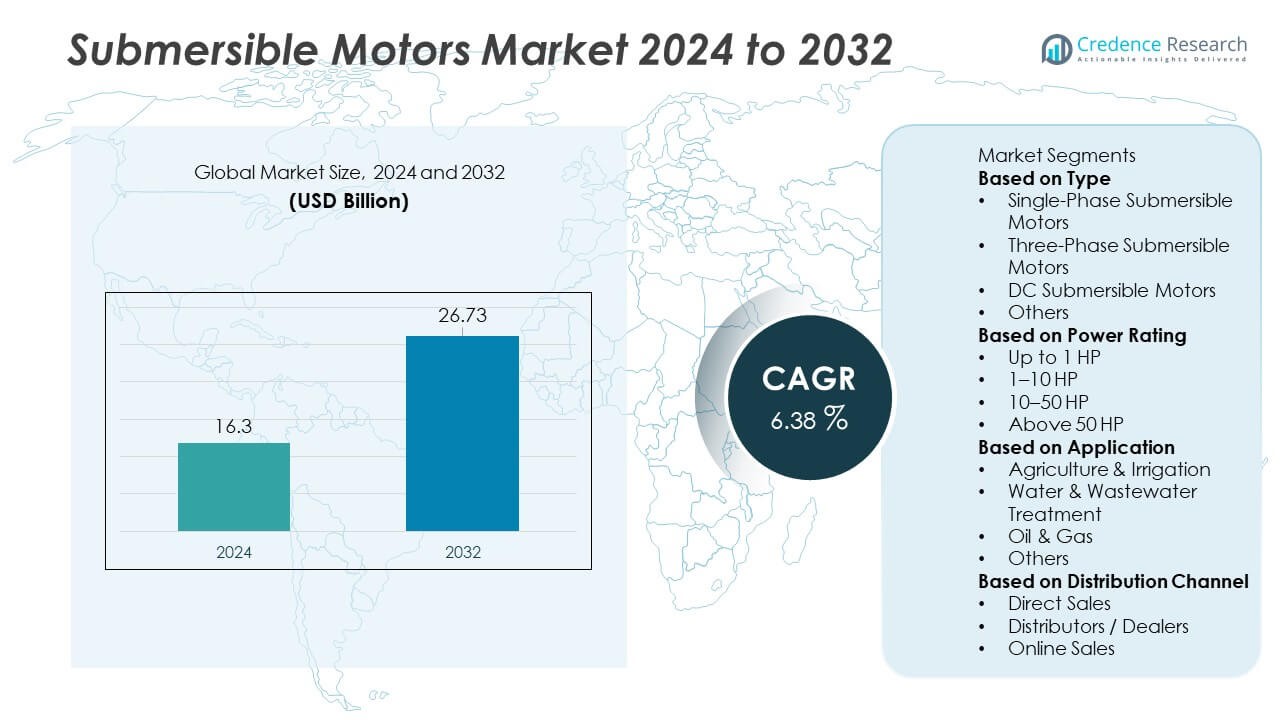
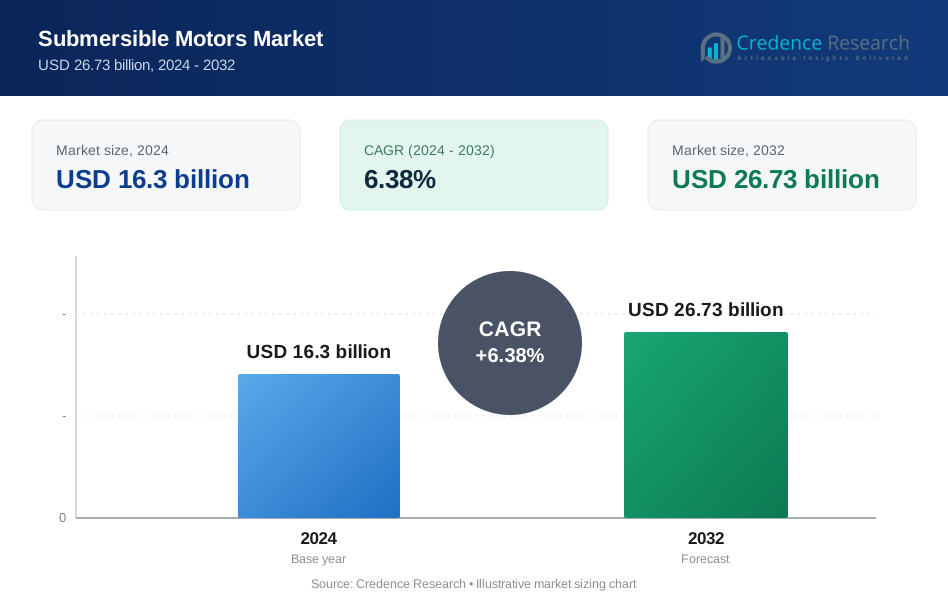
The Submersible Motors Market was valued at USD 16.3 billion in 2024 and is projected to reach USD 26.73 billion by 2032, expanding at a CAGR of 6.38% during the forecast period.
| REPORT ATTRIBUTE | DETAILS |
|---|---|
| Historical Period | 2020-2023 |
| Base Year | 2024 |
| Forecast Period | 2025-2032 |
| Submersible Motors Market Size 2024 | USD 16.3 Billion |
| Submersible Motors Market, CAGR | 6.38% |
| Submersible Motors Market Size 2032 | USD 26.73 Billion |
The Submersible Motors market is driven by leading players such as Franklin Electric Co., Inc., Grundfos Holding A/S, WEG S.A., Flowserve Corporation, Xylem Inc., Hitachi Industrial Equipment Systems Co., Ltd., Toshiba Corporation, Siemens AG, KSB SE & Co. KGaA, and Sulzer Ltd. These companies strengthen market presence through high-efficiency motor designs, corrosion-resistant materials, and smart monitoring technologies suited for demanding pumping environments. Asia Pacific leads the global market with a 38% share, supported by large-scale irrigation, rapid industrialization, and expanding water infrastructure. North America follows with a 27% share, driven by strong municipal and industrial applications, while Europe holds a 24% share, supported by strict efficiency standards and advanced wastewater treatment networks.
Market Insights
- The Submersible Motors market reached USD 16.3 billion in 2024 and will grow to USD 26.73 billion by 2032 at a CAGR of 6.38%.
- Demand rises due to expanding irrigation needs and groundwater extraction, with three-phase submersible motors leading the type segment at 52% share because of their high efficiency and load-handling capacity.
- Key trends include increasing adoption of 1–10 HP motors holding 44% share, driven by strong use in agriculture, borewell installations, and small industrial systems.
- Competition intensifies as Franklin Electric, Grundfos, WEG, Flowserve, Xylem, Hitachi, Toshiba, Siemens, KSB, and Sulzer invest in corrosion-resistant designs, smart monitoring, and solar-compatible solutions.
- Asia Pacific leads with a 38% share, followed by North America at 27% and Europe at 24%, while agriculture and irrigation dominate applications with 47% share due to rising demand for reliable deep-well pumping systems.
 Market Segmentation Analysis:
By Type
Three-phase submersible motors lead this segment with a market share of 52%, driven by their higher efficiency, stronger load-handling capability, and suitability for continuous heavy-duty operations. These motors support large-scale pumping in agriculture, municipal utilities, and industrial facilities. Single-phase motors remain relevant for small residential and light commercial applications, while DC motors gain traction in solar-powered pumping systems across remote locations. Growing demand for high-performance pumping in deep wells and energy-intensive sectors continues to strengthen the dominance of three-phase motors. Manufacturers enhance insulation systems, corrosion resistance, and thermal protection to support long operational life.
- For instance, Franklin Electric introduced a three-phase submersible motor model featuring a Class F insulation system rated for 155°C and stainless-steel rotor components with a 35,000-hour tested lifespan under continuous load.
By Power Rating
The 1–10 HP category leads with a 44% market share, supported by strong adoption in agriculture, borewell installations, and small industrial operations. This range offers the right balance between affordability, efficiency, and suitability for medium-depth pumping. Motors below 1 HP serve residential and small water supply needs but hold a smaller share due to lower capacity. The 10–50 HP and above 50 HP ranges gain momentum in heavy-duty applications such as mining, municipal water supply, and oil extraction. Rising investments in rural water infrastructure and irrigation networks continue to reinforce demand for the 1–10 HP segment.
- For instance, Grundfos developed a 7.5 HP submersible motor integrated with a copper-wound stator tested at approximately 2800-2900 rpm. The motor features a built-in protection module and robust Michell-type thrust bearings and carbon pads designed to handle significant axial thrust loads.
By Application
Agriculture and irrigation dominate the application segment with a market share of 47%, driven by expanding farmland irrigation needs and government-supported rural water initiatives. Submersible motors offer reliable deep-well pumping performance, making them essential for crop watering systems. Water and wastewater treatment facilities adopt higher-capacity motors for sewage lifting, treatment cycles, and continuous-flow operations. The oil and gas sector relies on robust motors for dewatering, crude extraction, and well management. Growing water scarcity, rising agricultural mechanization, and increasing emphasis on groundwater extraction continue to drive strong adoption across the agriculture and irrigation segment.
Key Growth Drivers
Rising Demand for Groundwater Extraction and Irrigation
Growing dependence on groundwater for agriculture drives strong demand for submersible motors. Farmers adopt these motors for deep-well pumping due to their efficiency, durability, and ability to operate in harsh environments. Government programs supporting rural irrigation, electrification, and water conservation further accelerate adoption. Expanding agricultural activities in developing economies increases the need for reliable water supply systems. As farms shift toward mechanized irrigation, demand for high-performance submersible motors continues to rise, especially in regions facing water scarcity and fluctuating rainfall patterns.
- For instance, Kirloskar Brothers Limited offers high-lift submersible pump models, such as those in the KS6 series, which feature a stainless-steel construction and NEMA-standard dimensions.
Expansion of Water and Wastewater Treatment Infrastructure
Rapid urbanization and rising municipal water needs strengthen demand for submersible motors in water and wastewater management. These motors support sewage lifting, drainage, treatment plant operations, and flood control systems. Governments increase investments in sanitation, groundwater recharge, and smart water management, driving the need for energy-efficient pumping equipment. Industrial facilities also rely on submersible motors for effluent handling and process water management. As environmental regulations tighten, the market benefits from growing upgrades to wastewater networks and modern treatment systems.
- For instance, Xylem's Flygt N-technology pumps are known for reliable, clog-free operation in tough wastewater applications, handling up to 8% solids concentration. Motors are specifically engineered for submersible use, featuring Class H insulation and an advanced internal closed-loop cooling system that concentrates heat losses around the stator for enhanced cooling and extended life.
Growth in Oil, Gas, and Mining Operations
Submersible motors play an essential role in dewatering, crude extraction, and well operations across oil, gas, and mining sites. Their ability to operate at great depths and withstand corrosive environments boosts adoption in energy-intensive fields. Rising exploration activities and redevelopment of mature wells increase demand for high-horsepower and heavy-duty submersible systems. Mining operations use submersible motors for slurry pumping, groundwater removal, and pit drainage. As global energy and mineral extraction activities expand, the need for durable and high-efficiency motors continues to grow.
Key Trends & Opportunities
Increasing Adoption of Solar-Powered and Energy-Efficient Motors
Energy-efficient submersible motors gain traction as industries shift toward lower power consumption and sustainable operations. Solar-powered motors grow rapidly in off-grid agricultural areas due to reduced operating costs and government incentives. Manufacturers introduce advanced insulation materials, variable-frequency drives, and optimized hydraulic designs to improve motor efficiency. Rising electricity prices and green energy transition create strong opportunities for eco-friendly submersible pumping solutions. These technological enhancements help users achieve long-term cost savings and reduce environmental impact.
- For instance, Shakti Pumps developed a solar-compatible submersible motor using stainless steel (AISI-304) components with high operating efficiency and operating capability up to 320 meters of head. The motor includes a VFD-supported controller that handles wide input voltage ranges and is designed for continuous, long-term operation.
Technological Advancements in Motor Durability and Monitoring
Advanced materials, corrosion-resistant coatings, and thermal protection systems improve the durability of modern submersible motors. IoT-enabled monitoring solutions allow users to track motor health, energy consumption, and operating conditions in real time. Predictive maintenance tools reduce downtime and extend equipment life. These innovations benefit industries requiring continuous pumping, including agriculture, municipal utilities, and mining. Increasing adoption of smart pumping systems supports long-term opportunities for manufacturers offering connected and high-reliability motor solutions.
- For instance, Siemens introduced an IoT-enabled submersible motor equipped with integrated thermal sensors and vibration modules sampling data at 10,000 readings per second. The unit supports remote diagnostics through the MindSphere platform and recorded a 28% reduction in unplanned downtime during field validation involving 500 hours of continuous pumping in a wastewater environment.
Key Challenges
High Maintenance Costs and Operational Downtime Risks
While submersible motors offer strong performance, maintenance challenges arise due to their underwater placement and exposure to abrasive materials. Repairs often require complete extraction of the motor, increasing labor costs and operational downtime. Industries with continuous pumping needs face productivity losses during maintenance cycles. Wear and tear from sand, chemicals, and fluctuating voltage further complicate long-term reliability. These challenges push users to invest in higher-quality materials and protective technologies, increasing overall ownership costs.
Voltage Fluctuations and Limited Infrastructure in Developing Regions
In many rural and developing areas, unstable power supply affects submersible motor efficiency and lifespan. Voltage drops, surges, and poor grid quality lead to overheating and motor failure. Limited access to skilled technicians and inconsistent availability of replacement parts worsen maintenance issues. These constraints restrict adoption in regions that depend heavily on groundwater extraction. Improving electrical infrastructure, promoting solar-powered alternatives, and implementing motor protection systems are essential to address this challenge.
Regional Analysis
North America
North America holds a market share of 27%, driven by strong demand for submersible motors in municipal water management, wastewater treatment, and industrial applications. The U.S. leads with large-scale investments in infrastructure rehabilitation and advanced water systems. Increasing need for groundwater extraction in agriculture and rising adoption of energy-efficient pumping solutions support market expansion. The region benefits from a mature manufacturing base, stringent efficiency standards, and rapid uptake of smart monitoring technologies. Growing focus on sustainable water usage and modernization of drainage networks continues to strengthen demand across both commercial and industrial sectors.
Europe
Europe accounts for a market share of 24%, supported by well-established wastewater treatment networks, strong environmental regulations, and high adoption of advanced pumping technologies. Countries such as Germany, Italy, France, and the U.K. lead demand for corrosion-resistant and high-efficiency submersible motors used in municipal utilities and industrial processing. The region invests heavily in flood control systems, groundwater management, and upgrading old pumping installations. Energy-efficient motor designs and smart monitoring solutions gain momentum due to strict EU sustainability norms. Growing applications in mining and construction also contribute to regional market growth.
Asia Pacific
Asia Pacific dominates the global market with a market share of 38%, fueled by large-scale groundwater extraction, expanding agricultural irrigation, and rapid industrialization. China, India, and Southeast Asian countries drive strong demand for submersible motors to support farming, urban water supply, and wastewater treatment. Infrastructure development projects and increased focus on rural electrification boost adoption across both residential and agricultural sectors. The region also experiences rising deployment of solar-powered submersible motors. Rapid population growth and increasing freshwater scarcity continue to accelerate regional market expansion.
Latin America
Latin America holds a market share of 7%, driven by growing demand for efficient water pumping systems across agriculture, mining, and municipal sectors. Brazil, Mexico, Chile, and Argentina lead adoption due to expanding irrigation networks and rising investments in groundwater management. Mining operations across the Andes region rely heavily on high-capacity submersible motors for dewatering and fluid handling. Improvements in water treatment infrastructure and growing interest in solar-powered pumping solutions support additional market opportunities. Despite economic fluctuations, the region continues to show steady demand for durable motor systems.
Middle East & Africa
The Middle East & Africa region accounts for a market share of 4%, shaped by high dependence on groundwater extraction and strong demand for deep-well pumping systems. Countries such as Saudi Arabia, the UAE, and South Africa invest in large-scale irrigation, desalination, and wastewater treatment projects, driving the need for high-performance submersible motors. Harsh climatic conditions and water scarcity increase reliance on durable, corrosion-resistant motor designs. Industrial growth in mining and construction also supports market expansion. While adoption is concentrated in high-investment regions, emerging markets show rising interest in energy-efficient and solar-powered systems.
Market Segmentations:
By Type
- Single-Phase Submersible Motors
- Three-Phase Submersible Motors
- DC Submersible Motors
- Others
By Power Rating
- Up to 1 HP
- 1–10 HP
- 10–50 HP
- Above 50 HP
By Application
- Agriculture & Irrigation
- Water & Wastewater Treatment
- Oil & Gas
- Others
By Distribution Channel
- Direct Sales
- Distributors / Dealers
- Online Sales
By Geography
- North America
- U.S.
- Canada
- Mexico
- Europe
- Germany
- France
- U.K.
- Italy
- Spain
- Rest of Europe
- Asia Pacific
- China
- Japan
- India
- South Korea
- South-east Asia
- Rest of Asia Pacific
- Latin America
- Brazil
- Argentina
- Rest of Latin America
- Middle East & Africa
- GCC Countries
- South Africa
- Rest of the Middle East and Afric
Competitive Landscape
The competitive landscape features leading players such as Franklin Electric Co., Inc., Grundfos Holding A/S, WEG S.A., Flowserve Corporation, Xylem Inc., Hitachi Industrial Equipment Systems Co., Ltd., Toshiba Corporation, Siemens AG, KSB SE & Co. KGaA, and Sulzer Ltd. These companies compete by developing high-efficiency submersible motors with improved thermal protection, corrosion-resistant materials, and enhanced hydraulic performance. Manufacturers invest in advanced insulation systems, variable-frequency drive compatibility, and IoT-enabled monitoring to support long-term reliability and reduced downtime. Strategic partnerships with irrigation networks, municipal utilities, and industrial contractors strengthen market presence. Companies also expand production capacities and focus on solar-compatible and energy-efficient models to meet growing sustainability demands. As competition intensifies, leading brands differentiate through robust after-sales service, global distribution networks, and customized solutions for agriculture, wastewater treatment, oil and gas, and mining applications.
Key Player Analysis
- Franklin Electric Co., Inc.
- Grundfos Holding A/S
- WEG S.A.
- Flowserve Corporation
- Xylem Inc.
- Hitachi Industrial Equipment Systems Co., Ltd.
- Toshiba Corporation
- Siemens AG
- KSB SE & Co. KGaA
- Sulzer Ltd.
Recent Developments
- In July 2025, KSB SE & Co. KGaA launched a new generation of submersible motor pumps with axial propellers - the AmaCan P Type series - aimed at municipal, industrial and wastewater applications.
- In March 2023, Franklin Electric Co., Inc. acquired Hydropompe srl - a maker of electric submersible pumps for wastewater/sewage.
- In March 2023, Franklin Electric also introduced new submersible wastewater-lift pumps (series FWS-FWC, FGR, FLV) for domestic, municipal and industrial use.
Report Coverage
The research report offers an in-depth analysis based on Type, Power Rating, Application, Distribution Channel and Geography. It details leading market players, providing an overview of their business, product offerings, investments, revenue streams, and key applications. Additionally, the report includes insights into the competitive environment, SWOT analysis, current market trends, as well as the primary drivers and constraints. Furthermore, it discusses various factors that have driven market expansion in recent years. The report also explores market dynamics, regulatory scenarios, and technological advancements that are shaping the industry. It assesses the impact of external factors and global economic changes on market growth. Lastly, it provides strategic recommendations for new entrants and established companies to navigate the complexities of the market.
Future Outlook
- Demand for high-efficiency submersible motors will rise as water scarcity increases globally.
- Agriculture and irrigation will remain the strongest application areas due to expanding groundwater extraction.
- Adoption of solar-powered submersible motors will accelerate in off-grid and rural regions.
- Smart monitoring and IoT integration will gain traction for predictive maintenance.
- Industrial sectors will invest more in corrosion-resistant and heavy-duty motor designs.
- Wastewater treatment upgrades will drive the need for reliable submersible pumping systems.
- Energy-efficient motors will see higher adoption as governments push sustainability standards.
- Manufacturers will expand regional production to meet rising demand in Asia Pacific and Latin America.
- Deep-well and high-horsepower motors will gain importance in mining and oil extraction.
- Distribution networks will strengthen through partnerships with irrigation suppliers and municipal contractors.
Request a Free Sample
Fill in your details and we'll send you a free sample report.
- Sample data tables & charts
- Research methodology
Market Dynamics
Expansion of Agricultural Irrigation and Groundwater Extraction
Growing dependence on groundwater for agriculture, especially in developing economies, is driving the adoption of submersible motors for deep-well pumping. Government initiatives supporting rural irrigation and water conservation further accelerate market growth.
Development of Water and Wastewater Treatment Infrastructure
Rapid urbanization and increased municipal water needs are boosting demand for submersible motors in water and wastewater management. Investments in sanitation, groundwater recharge, and smart water management are fueling the need for energy-efficient pumping equipment.
Rising Adoption of Solar-Powered and Energy-Efficient Motors
The shift toward sustainable operations and lower power consumption is increasing the uptake of solar-powered and high-efficiency submersible motors, particularly in off-grid agricultural areas. Government incentives and rising electricity prices are further supporting this trend.
Growth in Oil, Gas, and Mining Operations
Submersible motors are essential for dewatering, crude extraction, and well management in oil, gas, and mining sectors. Expansion of exploration activities and redevelopment of mature wells are increasing demand for high-horsepower and heavy-duty submersible systems.
Technological Advancements in Durability and Smart Monitoring
Innovations such as advanced insulation, corrosion-resistant materials, and IoT-enabled monitoring systems are enhancing the reliability and lifespan of submersible motors. These advancements support predictive maintenance and reduce operational downtime, making them attractive for continuous-use industries.
Need a Custom Version of This Report?
Tailor the scope, geography, or segments to your exact requirements.
- Custom geography or segment scope
- Direct access to our analyst team
Frequently Asked Questions
What is the current market size for Submersible Motors market, and what is its projected size in 2032?
At what Compound Annual Growth Rate is the Submersible Motors market projected to grow between 2025 and 2032?
Which Submersible Motors market segment held the largest share in 2024?
What are the primary factors fueling the growth of the Submersible Motors market?
Who are the leading companies in the Submersible Motors market?
Which region commanded the largest share of the Submersible Motors market in 2024?
Table of Content
Chapter 1 Market Segmentation
- 1.1 Segmentation Framework
- 1.1.1 Product and Service Classification
- 1.1.2 Application and End-Use Classification
- 1.1.3 Technology and Solution Classification
- 1.1.4 Customer and Distribution Channel Classification
- 1.1.5 Geographic Segmentation
- 1.1.6 Market Segment Definitions and Boundaries
- 1.2 By Type
- 1.2.1 Single-Phase Submersible Motors
- 1.2.2 Three-Phase Submersible Motors
- 1.2.3 DC Submersible Motors
- 1.2.4 Others
- 1.3 By Application
- 1.3.1 Agriculture & Irrigation
- 1.3.2 Water & Wastewater Treatment
- 1.3.3 Oil & Gas
- 1.3.4 Others
- 1.4 By Power Rating
- 1.4.1 Up to 1 HP
- 1.4.2 1–10 HP
- 1.4.3 10–50 HP
- 1.4.4 Above 50 HP
Chapter 2 Introduction
- 2.1 Report Objectives and Scope
- 2.2 Product Definition and Industry Terminology
- 2.3 Market Inclusions and Exclusions
- 2.4 Research Process
- 2.4.1 Primary Research and Expert Interviews
- 2.4.2 Secondary Research and Source Review
- 2.4.3 Top-Down and Bottom-Up Estimation
- 2.4.4 Data Triangulation and Verification
- 2.5 Market Size Measurement Basis
- 2.5.1 2024: USD 16.3 billion → 2032: USD 26.73 billion
- 2.6 Historical and Forecast Reference Periods
- 2.6.1 Base Year: 2024
- 2.6.2 Forecast Period: 2024-2032
- 2.7 Research Assumptions and Limitations
Chapter 3 Executive Summary
- 3.1 Market Snapshot and Key Findings
- 3.2 Base-Year Market Size, 2024
- 3.3 Forecast Market Size, 2032
- 3.4 Revenue and Volume Growth Outlook
- 3.5 Key Demand and Supply Indicators
- 3.6 Leading Market Segments
- 3.7 Fastest-Growing Market Opportunities
- 3.8 Regional Performance Highlights
- 3.9 Technology and Industry Transformation
- 3.10 Competitive Landscape Summary
- 3.11 Analyst View and Strategic Implications
Chapter 4 Global Submersible Motors Market Trends and Developments
- 4.1 Historical Industry Development
- 4.2 Recent Market Trends and Developments
- 4.3 Demand and Customer Behavior Trends
- 4.4 Technology and Product Innovation
- 4.5 Artificial Intelligence, Automation and Digitalization
- 4.6 Local Manufacturing and Supply Chain Realignment
- 4.7 Industry Partnerships, Mergers and Acquisitions
- 4.8 Sustainability and Circular Economy Developments
- 4.9 Government and Private Sector Investment Trends
- 4.10 Emerging Business Models and Commercialization
- 4.11 Industry Developments and Announcements
Chapter 5 Global Submersible Motors Market Production, Supply and Demand Analysis
- 5.1 Demand Trend and Consumption Analysis
- 5.2 Demand Forecast, 2024-2032
- 5.3 Production and Output Trend
- 5.4 Production and Output Forecast, 2024-2032
- 5.5 Installed Capacity and Capacity Utilization
- 5.6 Company-Wise Production Plants and Statistics
- 5.6.1 Installed Production Capacity
- 5.6.2 Actual Production
- 5.6.3 Planned Capacity and Expansion Targets
- 5.7 Supply Chain Structure and Procurement Trends
- 5.8 Supply-Demand Gap and Bottlenecks
- 5.9 Import Dependence and Sourcing Structure
- 5.10 Contract Manufacturing and Outsourcing
- 5.11 Regional Supply and Demand Concentration
Chapter 6 Global Submersible Motors Market Pricing Analysis
- 6.1 Pricing Structure and Measurement
- 6.2 Historical Pricing Trends
- 6.3 Pricing Outlook, 2024-2032
- 6.4 Average Selling Price and Unit Economics
- 6.5 Pricing by Product and Market Segment
- 6.6 Geographic Pricing Differences
- 6.7 Key Input, Energy, Labor and Logistics Costs
- 6.8 Contract Pricing and Purchasing Models
- 6.9 Pricing Sensitivity and Competitive Positioning
- 6.10 Price, Margin and Profitability Implications
Chapter 7 Global Submersible Motors Market Dynamics
- 7.1 Market Growth Drivers
- 7.1.1 Demand-Side Drivers
- 7.1.2 Technology and Innovation Drivers
- 7.1.3 Infrastructure and Investment Drivers
- 7.1.4 Regulatory and Policy Drivers
- 7.2 Market Restraints
- 7.2.1 Cost and Affordability Constraints
- 7.2.2 Technology and Adoption Barriers
- 7.2.3 Supply Chain and Operational Constraints
- 7.3 Market Challenges
- 7.3.1 Competitive Pressure and Margin Erosion
- 7.3.2 Skills, Infrastructure and Implementation Gaps
- 7.4 Emerging Market Opportunities
- 7.5 Market Dynamics Impact and Time-Horizon Assessment
Chapter 8 Global Submersible Motors Value Chain Analysis
- 8.1 Industry Value Chain Overview
- 8.2 Upstream Suppliers and Critical Inputs
- 8.3 Technology and Component Providers
- 8.4 Manufacturing or Service Delivery
- 8.5 Distribution, Channel Partners and Integrators
- 8.6 Downstream Applications and End Users
- 8.7 Value Addition and Profit Pools
- 8.8 Vertical Integration and Outsourcing
- 8.9 Supplier Concentration and Risk
- 8.10 Supply Chain Localization and Resilience
Chapter 9 Global Submersible Motors Market Regulations and Policies
- 9.1 Relevant Laws, Standards and Compliance Frameworks
- 9.2 Product, Service, Safety and Quality Requirements
- 9.3 Government Policies, Incentives and Subsidies
- 9.4 Imports, Exports and Trade Barriers
- 9.5 Public Procurement and Local Content Requirements
- 9.6 Environmental and Sustainability Compliance
- 9.7 Upcoming Policy Changes and Market Implications
Chapter 10 Global Submersible Motors Market Hotspots and Opportunities
- 10.1 Market Opportunity Mapping and Growth Hotspots
- 10.2 High-Growth Applications and Customer Groups
- 10.3 Underserved Markets and White-Space Opportunities
- 10.4 Emerging Technology and Product Opportunities
- 10.5 New Capacity and Investment Hotspots
- 10.6 Market Entry and Expansion Opportunities
- 10.7 Distribution and Partnership Opportunities
- 10.8 Near-Term and Long-Term Commercial Potential
- 10.9 Opportunity Attractiveness and Execution Risks
Chapter 11 Global Submersible Motors Market Outlook, 2024-2032
- 11.1 Market Size and Analysis
- 11.1.1 Revenue (Market Measurement: 2024: USD 16.3 billion → 2032: USD 26.73 billion)
- 11.1.2 Market Volume and Quantity Sold
- 11.1.3 Historical Market Size
- 11.1.4 Base-Year Market Size, 2024
- 11.2 Market Forecast, 2024-2032
- 11.2.1 Revenue Forecast to 2032
- 11.2.2 Volume Forecast to 2032
- 11.2.3 CAGR and Year-on-Year Growth
- 11.2.4 Incremental Revenue Opportunity
- 11.3 Forecast Assumptions and Scenario Analysis
- 11.3.1 Base-Case Forecast
- 11.3.2 Optimistic and Conservative Scenarios
- 11.3.3 Technology, Pricing and Policy Sensitivities
- 11.4 Market Attractiveness and Growth Outlook
Chapter 12 Global Submersible Motors Market Segmentation and Outlook
- 12.1 Segmentation Summary and Market Shares, 2024
- 12.2 Largest and Fastest-Growing Segments
- 12.3 By Type - Market Size and Forecast, 2024-2032
- 12.3.1 Segment Definition and Scope
- 12.3.2 Historical Market Size
- 12.3.3 Revenue Forecast, 2024-2032
- 12.3.4 Volume Forecast, 2024-2032
- 12.3.5 Base-Year Market Share, 2024
- 12.3.6 Segment CAGR and Growth Drivers
- 12.3.7 Subsegment Market Size and Forecast
- 12.3.7.1 Single-Phase Submersible Motors
- 12.3.7.2 Three-Phase Submersible Motors
- 12.3.7.3 DC Submersible Motors
- 12.3.7.4 Others
- 12.3.8 Subsegment Pricing and Adoption Trends
- 12.3.9 Leading Suppliers and Competition
- 12.3.10 Regional Demand and Opportunities
- 12.4 By Application - Market Size and Forecast, 2024-2032
- 12.4.1 Segment Definition and Scope
- 12.4.2 Historical Market Size
- 12.4.3 Revenue Forecast, 2024-2032
- 12.4.4 Volume Forecast, 2024-2032
- 12.4.5 Base-Year Market Share, 2024
- 12.4.6 Segment CAGR and Growth Drivers
- 12.4.7 Subsegment Market Size and Forecast
- 12.4.7.1 Agriculture & Irrigation
- 12.4.7.2 Water & Wastewater Treatment
- 12.4.7.3 Oil & Gas
- 12.4.7.4 Others
- 12.4.8 Subsegment Pricing and Adoption Trends
- 12.4.9 Leading Suppliers and Competition
- 12.4.10 Regional Demand and Opportunities
- 12.5 By Power Rating - Market Size and Forecast, 2024-2032
- 12.5.1 Segment Definition and Scope
- 12.5.2 Historical Market Size
- 12.5.3 Revenue Forecast, 2024-2032
- 12.5.4 Volume Forecast, 2024-2032
- 12.5.5 Base-Year Market Share, 2024
- 12.5.6 Segment CAGR and Growth Drivers
- 12.5.7 Subsegment Market Size and Forecast
- 12.5.7.1 Up to 1 HP
- 12.5.7.2 1–10 HP
- 12.5.7.3 10–50 HP
- 12.5.7.4 Above 50 HP
- 12.5.8 Subsegment Pricing and Adoption Trends
- 12.5.9 Leading Suppliers and Competition
- 12.5.10 Regional Demand and Opportunities
- 12.6 Segment Growth Comparison
- 12.7 Segment Attractiveness and Priority Matrix
Chapter 13 Global Submersible Motors End-Use and Application Market Outlook
- 13.1 End-Use Industry and Customer Demand Structure
- 13.2 Leading Applications and Customer Groups
- 13.3 End-Use Market Size, Share and Forecast
- 13.4 Major End-Use Industry Deep Dives
- 13.4.1 Customer Requirements and Use Cases
- 13.4.2 Demand and Replacement Cycles
- 13.4.3 Technical and Regulatory Considerations
- 13.4.4 Purchasing and Procurement Models
- 13.4.5 Leading Vendors and Distribution Channels
- 13.4.6 Forecast and Commercial Opportunities
- 13.5 Emerging Applications and Cross-Segment Demand
- 13.6 End-Use Industry Investment Priorities
Chapter 14 Global Submersible Motors Geographic Market Outlook, 2024-2032
- 14.1 Regional Market Size and Share, 2024
- 14.2 Regional Market Forecast, 2024-2032
- 14.3 Regional Pricing, Production and Demand Differences
- 14.4 North America
- 14.4.1 United States
- 14.4.2 Canada
- 14.4.3 Mexico
- 14.5 Europe
- 14.5.1 Germany
- 14.5.2 France
- 14.5.3 Italy
- 14.5.4 United Kingdom
- 14.5.5 Spain
- 14.5.6 Poland
- 14.5.7 Russia
- 14.5.8 Netherlands
- 14.5.9 Belgium
- 14.5.10 Sweden
- 14.5.11 Denmark
- 14.5.12 Norway
- 14.5.13 Rest of Europe
- 14.6 Asia Pacific
- 14.6.1 China
- 14.6.2 India
- 14.6.3 Japan
- 14.6.4 South Korea
- 14.6.5 Thailand
- 14.6.6 Indonesia
- 14.6.7 Vietnam
- 14.6.8 Malaysia
- 14.6.9 Australia
- 14.6.10 Rest of Asia Pacific
- 14.7 Latin America
- 14.7.1 Brazil
- 14.7.2 Argentina
- 14.7.3 Colombia
- 14.7.4 Chile
- 14.7.5 Rest of Latin America
- 14.8 Middle East
- 14.8.1 Saudi Arabia
- 14.8.2 United Arab Emirates
- 14.8.3 Turkey
- 14.8.4 Israel
- 14.8.5 Iran
- 14.8.6 Rest of the Middle East
- 14.9 Africa
- 14.9.1 South Africa
- 14.9.2 Egypt
- 14.9.3 Nigeria
- 14.9.4 Morocco
- 14.9.5 Rest of Africa
- 14.10 Regional Investment, Policy and Supply Chain Differences
- 14.11 Regional Competitive Landscape
- 14.12 Geographic Growth Hotspots
Chapter 15 Global Submersible Motors Technology, Innovation and Sustainability Outlook
- 15.1 Technology Landscape and Maturity
- 15.2 Product, Process and Service Innovation
- 15.3 AI, Automation and Digital Tools in the Industry
- 15.4 Technology Adoption and Performance Benchmarking
- 15.5 Innovation Pipeline and R&D Investment
- 15.6 Patent and Intellectual Property Trends
- 15.7 Energy Efficiency and Resource Management
- 15.8 Sustainability, Recycling and Circularity
- 15.9 Technology Roadmap, 2024-2032
- 15.10 Risks of Obsolescence and Technology Substitution
Chapter 16 Global Submersible Motors Market Key Strategic Imperatives
- 16.1 Growth and Market Entry Priorities
- 16.2 High-Return Products and Segments
- 16.3 Pricing, Profitability and Cost Optimization
- 16.4 Technology Investment and Product Differentiation
- 16.5 Supply Chain Localization and Resilience
- 16.6 Distribution and Customer Acquisition
- 16.7 Partnership, Acquisition and Capacity Strategy
- 16.8 Regional Expansion Priorities
- 16.9 Short-, Medium- and Long-Term Actions
Chapter 17 Competition Outlook
- 17.1 Industry Competition Characteristics
- 17.2 Market Structure and Concentration
- 17.3 Market Share and Competitive Positioning, 2024
- 17.4 Company-Wise Revenue and Product Benchmarking
- 17.5 Production and Service Capacity Benchmarking
- 17.6 Technology, Pricing and Differentiation
- 17.7 Regional Footprint and Distribution Strength
- 17.8 Mergers, Acquisitions and Strategic Alliances
- 17.9 New Entrants and Competitive Threats
- 17.10 Porter's Five Forces and Industry Attractiveness
- 17.11 Competitive Outlook, 2024-2032
Chapter 18 Company Profiles
- 18.1 Company Coverage and Selection Criteria
- 18.2 Franklin Electric Co., Inc.
- 18.2.1 Business Description
- 18.2.2 Company Ownership and Geographic Presence
- 18.2.3 Product and Service Portfolio
- 18.2.4 Manufacturing and Operating Footprint
- 18.2.5 Production Capacity and Expansion Plans
- 18.2.6 Financial Performance and Investment
- 18.2.7 Market Share and Competitive Position
- 18.2.8 Technology and Innovation Capabilities
- 18.2.9 Strategic Alliances or Partnerships
- 18.2.10 Recent Developments
- 18.2.11 Growth Strategy and Outlook
- 18.3 Grundfos Holding A/S
- 18.4 WEG S.A.
- 18.5 Flowserve Corporation
- 18.6 Xylem Inc.
- 18.7 Hitachi Industrial Equipment Systems Co., Ltd.
- 18.8 Toshiba Corporation
- 18.9 Siemens AG
- 18.10 KSB SE & Co. KGaA
- 18.11 Sulzer Ltd.
- 18.12 Other Relevant Market Participants
Note: Every listed company is profiled on the structure shown under the first company. The company list is preliminary and may change based on research findings, market developments, data availability and client requirements.
Chapter 19 Disclaimer
- 19.1 Research and Forecast Disclaimer
- 19.2 Data Source and Estimation Limitations
Note: The depth of individual sections depends on data availability for this market. Volume, capacity, trade and other unit-based metrics are included where applicable.