
| REPORT ATTRIBUTE | DETAILS |
|---|---|
| Historical Period | 2019-2022 |
| Base Year | 2023 |
| Forecast Period | 2024-2032 |
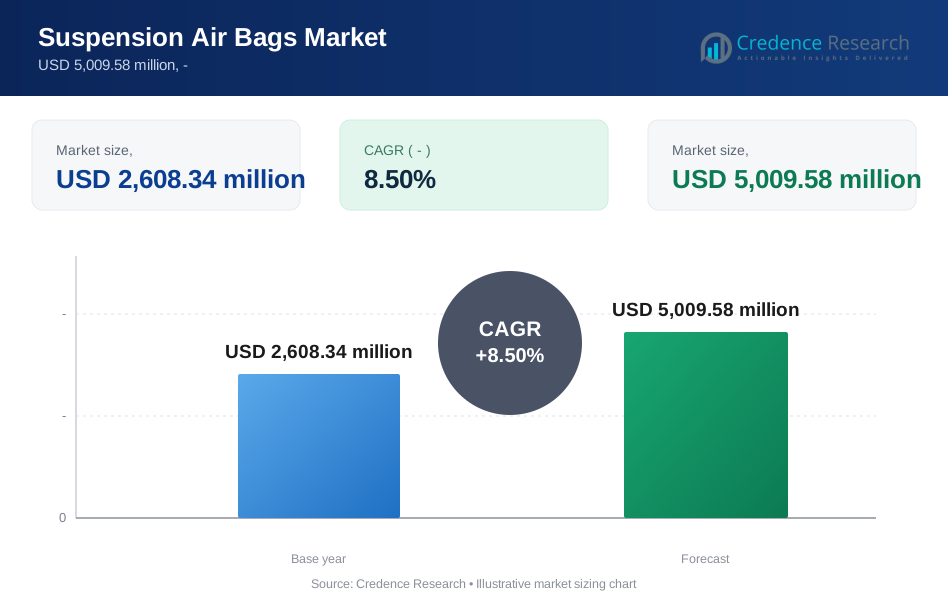
| Suspension Air Bags Market Size 2024 | USD 2,608.34 million |
| Suspension Air Bags Market, CAGR | 8.50% |
| Suspension Air Bags Market Size 2032 | USD 5,009.58 million |
Market Overview:
The Suspension Air Bags Market is experiencing significant growth driven by the increasing demand for improved vehicle performance and comfort. As of 2024, the global Suspension Air Bags Market is valued at USD 2,608.34 million and is projected to grow at a compound annual growth rate (CAGR) of 8.50% over the forecast period, reaching approximately USD 5,009.58 million by 2032. This robust growth reflects the rising adoption of advanced suspension systems in both commercial and passenger vehicles to enhance ride quality, stability, and safety.
The market's expansion is driven by several key factors. The growing automotive industry, particularly in emerging markets, is a significant driver as manufacturers increasingly incorporate advanced technologies to meet consumer demands for better vehicle performance. Additionally, the increasing focus on safety and comfort in vehicles has led to the widespread adoption of air suspension systems, which are known for their ability to adjust the vehicle's height and provide a smoother ride. Technological advancements, such as the integration of electronic control systems in suspension air bags, are also contributing to market growth by offering enhanced features like automatic load levelling and improved handling dynamics.
Regionally, North America holds the largest share of the Suspension Air airbags market, primarily due to the high adoption rate of advanced automotive technologies, a well-established automotive infrastructure, and stringent regulatory requirements. Europe follows closely, driven by similar factors and an increasing focus on vehicle safety and emissions regulations. The Asia-Pacific region is expected to witness significant growth during the forecast period, owing to the expanding automotive sector, increasing disposable incomes, and rising demand for vehicles with enhanced comfort and safety features. Emerging economies in this region, such as China and India, are anticipated to offer substantial growth opportunities due to their large populations and growing investments in automotive infrastructure.
Market Drivers:
Increasing Demand for Vehicle Comfort and Safety:
The demand for enhanced comfort and safety in vehicles is a primary driver of the Suspension Air Bags Market. Consumers are increasingly prioritizing ride quality, leading automakers to adopt advanced suspension systems that can provide a smooth and controlled driving experience. For instance, premium automotive brands like Mercedes-Benz and BMW have incorporated sophisticated air suspension systems into their luxury vehicle models, which allow for real-time adjustments to the vehicle’s height and load distribution, enhancing both comfort and safety. These systems are designed to automatically adapt to varying road conditions, maintaining vehicle stability and ensuring a smoother ride for passengers.
Technological Advancements in Suspension Systems:
The integration of advanced technologies in suspension systems is another significant market driver. Innovations such as electronically controlled air suspension (ECAS) systems are gaining traction due to their ability to offer automatic load levelling and adaptive damping. For instance, Continental AG has developed ECAS systems that are widely used in commercial vehicles to enhance stability under varying load conditions. These systems are crucial in reducing wear and tear on vehicle components and improving fuel efficiency by maintaining optimal ride height, thereby contributing to the vehicle’s overall performance and longevity.
Growing Automotive Industry in Emerging Markets:
The rapid growth of the automotive industry in emerging markets, such as China and India, is contributing significantly to the expansion of the Suspension Air Bags Market. As vehicle ownership rises in these regions, so does the demand for advanced automotive technologies that enhance vehicle performance and safety. For instance, Tata Motors in India and BYD Auto in China are increasingly equipping their vehicles with air suspension systems to cater to the growing consumer demand for better ride comfort and vehicle handling. These manufacturers are leveraging the benefits of air suspension technology to differentiate their offerings in highly competitive markets.
Market Trends:
Adoption of Advanced Suspension Technologies:
The adoption of advanced suspension technologies, such as electronically controlled air suspension (ECAS), is becoming increasingly prevalent in the automotive industry. These systems offer significant benefits in terms of vehicle handling, comfort, and safety. For instance, Volvo has incorporated ECAS into its trucks, allowing for automatic adjustment of the vehicle's suspension based on load conditions. This not only enhances driving stability but also improves fuel efficiency by maintaining optimal ride height, which is particularly beneficial for long-haul transport vehicles.
Integration with Electric and Autonomous Vehicles:
The growing trend of electric and autonomous vehicles is also driving the Suspension Air Bags Market. As these vehicles become more common, there is a rising need for advanced suspension systems that can adapt to different driving conditions without human intervention. For instance, Tesla’s Model S features an adaptive air suspension system that automatically adjusts based on driving speed and road conditions, ensuring a smoother and more efficient ride. This integration of advanced suspension technology with electric vehicles is expected to become more widespread as the industry moves toward fully autonomous driving solutions.
Focus on Lightweight and Sustainable Materials:
There is an increasing focus on developing lightweight and sustainable materials for suspension air bags to improve fuel efficiency and reduce the environmental impact of vehicles. For instance, manufacturers like Firestone Industrial Products are exploring the use of advanced polymers and composites to produce lighter air suspension components without compromising durability or performance. These innovations not only contribute to better vehicle performance but also align with global sustainability goals by reducing the carbon footprint associated with automotive manufacturing.
Expansion in Emerging Markets:
The Suspension Air Bags Market is witnessing rapid growth in emerging markets, driven by rising vehicle ownership and increasing consumer demand for advanced automotive features. For example, in markets like India and China, local manufacturers such as Tata Motors and BYD Auto are integrating air suspension systems into their vehicles to meet the growing expectations of middle-class consumers for enhanced comfort and safety. This expansion is supported by government initiatives to boost the automotive sector and improve infrastructure, further fuelling market growth in these regions.
Market Challenge Analysis for Suspension Air Bags Market
High Production Costs and Complexity:
The Suspension Air Bags Market faces significant challenges due to the high production costs and complexity associated with manufacturing advanced suspension systems. This issue stems from several factors:
Advanced Technology Integration:
Integrating electronic control systems and adaptive damping technologies into vehicles requires sophisticated components and materials. These specialized elements significantly increase the overall production costs, creating a barrier for manufacturers, especially in price-sensitive markets.
Continuous Innovation Demands:
To remain competitive, manufacturers must invest heavily in research and development. This ongoing need for innovation drives up costs further, as companies strive to develop cutting-edge suspension technologies that offer improved performance and comfort.
Skilled Labor Requirements:
The complexity of modern suspension systems necessitates a highly skilled workforce for design, production, and maintenance. This requirement adds to labor costs and can create challenges in regions where such expertise is scarce.
Supply Chain Complexities:
The intricate nature of suspension air bag systems often involves a complex supply chain, with components sourced from various specialized suppliers. Managing this supply chain efficiently while maintaining quality control can be challenging and costly.
Stringent Regulatory Requirements:
Regulatory compliance presents another significant challenge for the Suspension Air Bags Market:
Safety and Emissions Standards:
Manufacturers must adhere to strict safety and emissions standards, which vary across different regions. Meeting these diverse requirements often necessitates multiple versions of the same product, increasing development and production costs.
Extensive Testing and Certification:
Compliance with regulatory standards requires rigorous testing and certification processes. These procedures are time-consuming and expensive, often delaying product launches and adding to the overall cost of bringing new technologies to market.
Evolving Regulations:
The regulatory landscape is continually changing, with new standards being introduced regularly. This dynamic environment requires manufacturers to be agile and adapt their products quickly, which can be both technically challenging and financially burdensome.
Global Market Variations:
Different regions have varying regulatory requirements, making it difficult for manufacturers to create standardized products for the global market. This necessitates region-specific modifications, further complicating production processes and increasing costs.
Impact on Market Growth:
These challenges collectively impact the growth potential of the Suspension Air Bags Market. The high costs associated with production and regulatory compliance can limit the adoption of advanced suspension systems, particularly in emerging markets and mid-range vehicle segments. Manufacturers must balance the need for innovation with cost-effectiveness to ensure market viability and growth. Despite these challenges, the market continues to evolve, driven by consumer demand for improved vehicle performance and comfort, suggesting that companies that can navigate these obstacles effectively will be well-positioned for future success.
Market Segmentation Analysis:
The Suspension Air Bags Market is segmented into several categories based on Product Type, Application, and End User.
By Product Type:
The market includes products such as rolling lobe air springs, convoluted air springs, and sleeve air springs. Rolling lobe air springs dominate the market due to their widespread use in commercial vehicles and their ability to provide a smooth ride by maintaining consistent height under varying loads.
By Application:
The market is categorized into passenger vehicles, light commercial vehicles, and heavy commercial vehicles. Passenger vehicles represent the largest segment, driven by the increasing demand for luxury and comfort features in personal transportation. Light commercial vehicles and heavy commercial vehicles also show significant growth, with air suspension systems being adopted for load management and enhanced driving stability.
By End User:
The market includes OEMs (Original Equipment Manufacturers) and the aftermarket. OEMs hold the largest share, driven by the integration of suspension air bags in new vehicles as standard or optional equipment. The aftermarket segment is also growing, driven by the increasing need for replacement and upgradation of existing suspension systems in older vehicles.
Segmentation:
Based on Product Type:
- Rolling Lobe Air Springs • Convoluted Air Springs • Sleeve Air Springs
Based on Product Design:
- Single-Chamber Air Bags • Dual-Chamber Air Bags • Multi-Chamber Air Bags
Regional Analysis:
North America and Europe: North America holds the largest market share, accounting for approximately 35% of the global Suspension Air Bags Market. The high adoption of advanced automotive technologies and strong demand for luxury vehicles drive this dominance. The U.S. is a major contributor, supported by the presence of leading automotive manufacturers and a focus on vehicle safety and comfort.
Europe follows closely, holding around 30% of the market share. The region's growth is driven by the high demand for premium vehicles and stringent regulations on vehicle safety and emissions. Countries like Germany, the UK, and France are leading adopters of advanced suspension systems, contributing significantly to the market's growth.
Asia-Pacific:
The Asia-Pacific region is expected to exhibit the highest growth rate during the forecast period, currently holding about 25% of the global market share. This growth is fueled by the expanding automotive industry, rising disposable income, and increasing demand for vehicles with enhanced safety and comfort features in countries like China, India, and Japan. The large population and growing middle class in these regions are key drivers of market expansion.
Latin America and the Middle East & Africa:
Latin America and the Middle East & Africa collectively account for the remaining 10% of the market share. These regions offer emerging opportunities for growth as the automotive industry continues to develop. In Latin America, countries like Brazil and Mexico are seeing increased adoption of advanced suspension systems, driven by rising vehicle sales and consumer awareness of vehicle safety and comfort. The Middle East & Africa are also embracing advanced automotive technologies, supported by increasing investments in infrastructure and the automotive sector.
Key Player Analysis:
- Continental AG
- Firestone Industrial Products
- Dunlop Systems and Components
- WABCO Holdings Inc.
- Goodyear Tire & Rubber Company
- ThyssenKrupp AG
- Hendrickson USA, L.L.C.
- VB-Airsuspension B.V.
- Hitachi Automotive Systems Ltd.
- Mando Corporation
Competitive Analysis:
The Suspension Air Bags Market is characterized by intense competition, with several key players striving to expand their market presence and enhance their product offerings. Leading companies such as Continental AG, Firestone Industrial Products, and Dunlop Systems and Components dominate the market due to their comprehensive product portfolios, technological expertise, and extensive customer base. These players are continuously investing in research and development to integrate advanced technologies like electronic control systems and adaptive damping into their air suspension products, enhancing functionality and user experience. The market also features numerous smaller players and start-ups that focus on niche solutions and innovative features to cater to specific needs of the automotive industry. As competition intensifies, strategic partnerships, mergers, acquisitions, and technological innovations are expected to play a crucial role in shaping the market landscape, enabling companies to maintain a competitive edge and drive growth.
Recent Developments:
- In March 2024, Hendrickson USA, L.L.C. launched the ROADMAAX Z, a rear air suspension that stands out as the lightest in its category, with a 46,000-lb. capacity. This suspension system is designed for both on- and off-highway use, providing excellent ride quality and cargo protection. The ROADMAAX Z is compatible with lift axles and can handle up to 25% off-highway operations. It features Zero Maintenance Damping (ZMD) technology, which ensures a smooth ride throughout the lifespan of the air spring, setting a new benchmark for heavy-duty drive axle air suspension systems.
- In July 2023, Hendrickson USA, L.L.C. introduced its air and mechanical suspensions and axles for trailers in India. This product range includes the Severe Duty Suspension (HSDS) system, which offers capacities between 12T and 14T, tailored for the Indian market. The HSDS system also features the Tiremaax Pro, a tire inflation and deflation system, along with Tri-functional bushings designed for durability and performance.
- In November 2022, ZF Aftermarket, a division of ZF Friedrichshafen AG, rolled out a new series of air springs under the Sachs brand. Recognizing the increasing complexity of vehicle air suspension systems, ZF has made air spring replacement easier for workshops with this new product line. Additionally, ZF offers model-specific service guidelines and training courses on air suspension to support automotive technicians.
- In June 2022, Cummins-Meritor, Inc. introduced the ProTec Independent Front Suspension (IFS) system for motorcoaches. The MIS-20E model is the first of its kind designed to meet the demands of heavy load carrying and ride quality in motorcoaches. This system also represents Cummins-Meritor’s first fully integrated suspension and steering solution, designed as a direct replacement for existing bus and coach systems.
Market Concentration & Characteristics:
The Suspension Air Bags Market is moderately concentrated, with a mix of established global players and emerging vendors offering diverse solutions tailored to various automotive segments. Major players like Continental AG, Firestone Industrial Products, and Dunlop Systems and Components hold significant market shares due to their extensive product portfolios, technological expertise, and strong customer relationships. These companies leverage their market positions by continuously innovating and expanding their offerings to include advanced electronic control systems, adaptive damping, and other high-tech features.
The market is characterized by a high degree of innovation, driven by the need for efficient, scalable, and compliant solutions that address the complexities of modern automotive suspension systems. New entrants and niche players focus on specialized solutions, often targeting specific vehicle segments with unique needs. As the demand for advanced suspension technologies grows, market concentration is expected to evolve, fostering a competitive environment focused on technological advancements and customer-centric solutions.
Future Outlook:
- Technological advancements will continue to drive innovation in suspension air bag systems, with a focus on enhancing vehicle safety, comfort, and performance.
- The integration of electronic control systems will become increasingly common, offering real-time adjustments and improved ride quality.
- Emerging markets in Asia-Pacific and Latin America will present significant growth opportunities as vehicle ownership and consumer expectations rise.
- The adoption of advanced suspension systems in electric vehicles (EVs) will create new demand, as manufacturers seek to optimize the driving experience in EVs.
- Environmental concerns will drive the development of more sustainable materials and manufacturing processes in suspension air bag production.
- Collaboration between automotive manufacturers and technology providers will be key to developing next-generation suspension solutions that meet evolving consumer demands.
- The rise of autonomous vehicles will further emphasize the need for advanced suspension systems that can adapt to varying driving conditions and passenger needs.
- Increased focus on aftermarket services will provide growth opportunities for companies offering suspension air bag replacements and upgrades.
- The competitive landscape will continue to evolve, with mergers and acquisitions playing a significant role in market consolidation and expansion.
- Regulatory requirements related to vehicle safety and emissions will drive further adoption of advanced suspension technologies in both developed and emerging markets
Request a Free Sample
Fill in your details and we'll send you a free sample report.
- Sample data tables & charts
- Research methodology
Need a Custom Version of This Report?
Tailor the scope, geography, or segments to your exact requirements.
- Custom geography or segment scope
- Direct access to our analyst team
Frequently Asked Questions
What is driving the growth of the Suspension Air Bags Market?
Which regions are leading the Suspension Air Bags Market?
What challenges does the Suspension Air Bags Market face?
What trends are shaping the Suspension Air Bags Market?
What future developments can be expected in the Suspension Air Bags Market?
Table of Content
Chapter 1. Report Introduction
- 1.1 Report Description & Purpose
- 1.1.1 Report Title & Market Definition
- 1.1.2 Unique Selling Propositions (USP) & Key Differentiators
- 1.1.3 Value Proposition for Stakeholders
- 1.2 Research Objectives
- 1.2.1 Market Sizing Objectives (Volume & Revenue)
- 1.2.2 Segmentation Objectives
- 1.2.3 Competitive Intelligence Objectives
- 1.2.4 Forecast & Scenario Objectives
- 1.3 Report Scope
- 1.3.1 Suspension Air Bags Scope – Types & Subtypes Covered
- 1.3.2 Geographic Scope – Regions & Countries Covered
- 1.3.3 Historical Period, Base Year & Forecast Period (the historical period; forecast to the forecast period)
- 1.3.4 Inclusions & Exclusions
- 1.4 HS Code & Classification Framework
- 1.5 Currency, Units & Pricing Basis
- 1.6 Target Stakeholders
- 1.7 Limitations & Assumptions
Chapter 2. Executive Summary
- 2.1 Global Suspension Air Bags Market Snapshot
- 2.1.1 Market Size – Historical (the historical period) & Forecast (the forecast period) (base year: USD 2,608.34 million → forecast year: USD 5,009.58 million)
- 2.1.2 Volume & Revenue – Global Totals
- 2.1.3 Key Market Highlights – Top Five Facts
- 2.2 Suspension Air Bags Market Segmentation Snapshot
- 2.2.1 Market Split by Region – vs.
- 2.3 Competitive Snapshot
- 2.3.1 Top 10 Players by Revenue Share –
- 2.3.2 Top 10 Players by Volume Share –
- 2.3.3 Recent Strategic Developments (18-Month Summary)
- 2.4 Key Investment Highlights & Strategic Conclusions
Chapter 3. Suspension Air Bags Market Dynamics & Industry Analysis
- 3.1 Market Overview & Context
- 3.1.1 Suspension Air Bags Market Position in the Broader Automotive Value Chain
- 3.1.2 OEM vs. Replacement Market Dynamics
- 3.1.3 Market Maturity & Development Stage by Region
- 3.2 Suspension Air Bags Market Drivers
- 3.3 Suspension Air Bags Market Restraints & Challenges
- 3.4 Suspension Air Bags Market Opportunities
- 3.5 Porter's Five Forces Analysis
- 3.5.1 Threat of New Entrants
- 3.5.2 Bargaining Power of Suppliers
- 3.5.3 Bargaining Power of Buyers
- 3.5.4 Threat of Substitutes
- 3.5.5 Competitive Rivalry – Intensity Assessment
- 3.6 Suspension Air Bags Value Chain Analysis
- 3.6.1 Upstream – Raw Material/Input Suppliers
- 3.6.1.1 Raw Material/Input 1
- 3.6.1.2 Raw Material/Input 2
- 3.6.1.3 Raw Material/Input 3
- 3.6.2 Midstream – Production/Manufacturing/Service Delivery
- 3.6.2.1 Production/Process Overview
- 3.6.2.2 Key Facility Locations & Capacity by Manufacturer
- 3.6.3 Downstream – Distribution & End Consumer
- 3.6.3.1 Primary Channel – B2B/OEM
- 3.6.3.2 Secondary Channels – Dealer, Retail, Online, Direct
- 3.6.4 Value Chain Profitability Analysis
- 3.6.1 Upstream – Raw Material/Input Suppliers
- 3.7 PESTEL Analysis
- 3.7.1 Political Factors
- 3.7.2 Economic Factors
- 3.7.3 Social Factors
- 3.7.4 Technological Factors
- 3.7.5 Environmental Factors
- 3.7.6 Legal Factors
- 3.8 Suspension Air Bags Supply Chain Analysis
- 3.8.1 Raw Material/Input Supply Risk Assessment
- 3.8.2 Manufacturing Concentration Risk (Geographic Exposure)
- 3.8.3 Trade Disruption Impact Analysis
- 3.9 Regulatory & Policy Landscape
Note: The regulatory and policy landscape section covers regulations based on their applicability to the market, Suspension Air Bags category, geography, and scope of the study. Only regulatory frameworks with a material impact on operations, compliance, trade, sustainability, or market access are analyzed in detail.
Chapter 4. Key Investment Pockets & Opportunity Analysis
- 4.1 Suspension Air Bags Market Attractiveness Analysis
- 4.1.1 By Region – Investment Attractiveness Matrix (Volume × CAGR)
- 4.2 Absolute Revenue Growth Opportunity
- 4.2.1 By Region – Absolute USD Growth Through the forecast period
- 4.3 Incremental Volume Opportunity
- 4.3.1 By Region – Incremental Volume Through the forecast period
- 4.3.2 Segment – Incremental Volume
- 4.4 Emerging Submarket Opportunity Deep Dive (Subject to Applicability)
- 4.5 Emerging Market Opportunity Scorecards
- 4.5.1 United States
- 4.5.2 Europe
- 4.5.3 Asia
- 4.5.4 Middle East & Africa
Note: Emerging Market Opportunity Scorecards will be included based on relevance and strategic importance. Regions listed are indicative and may vary depending on data availability and market dynamics.
Chapter 5. Suspension Air Bags Import-Export Analysis & Trade Flows
- 5.1 Global Trade Overview
- 5.1.1 Global Export Value by Country (the historical period)
- 5.1.2 Global Export Volume by Country (the historical period)
- 5.1.3 Global Import Value by Country (the historical period)
- 5.1.4 Global Import Volume by Country (the historical period)
- 5.1.5 Net Trade Balance by Country (the historical period)
- 5.2 Export Analysis – Segment
- 5.2.1 Type 1 (HS Code)
- 5.2.2 Type 2 (HS Code)
- 5.2.3 Type 3 (HS Code)
- 5.2.4 Type 4 (HS Code)
- 5.2.5 Type 5 (HS Code)
- 5.3 Import Analysis – Segment
- 5.3.1 Type 1 (HS Code)
- 5.3.2 Type 2 (HS Code)
- 5.3.3 Type 3 (HS Code)
- 5.3.4 Type 4 (HS Code)
- 5.3.5 Type 5 (HS Code)
- 5.4 Average Unit Trade Prices
- 5.4.1 Average Export Price – Segment & Country
- 5.4.2 Average Import Price – Segment & Source Country
- 5.4.3 Price Trends (the historical period)
- 5.5 Key Trade Route Analysis
- 5.5.1 Trade Route 1
- 5.5.2 Trade Route 2
- 5.5.3 Trade Route 3
- 5.5.4 Trade Route 4
- 5.5.5 Trade Route 5
- 5.6 Trade Policy Impact Assessment
- 5.6.1 US Anti-Dumping & Section 301 Tariffs
- 5.6.2 EU Customs Union Impact
- 5.6.3 Major Free Trade Agreements
- 5.6.4 USMCA Rules of Origin
Note: Trade policy analysis will be included only where relevant to the Suspension Air Bags market.
Chapter 6. Competitive Landscape & Company Benchmarking
- 6.1 Suspension Air Bags Market Concentration & Structure
- 6.1.1 Herfindahl-Hirschman Index (HHI) – vs.
- 6.1.2 Tier 1, Tier 2 & Tier 3 Market Structure
- 6.1.3 Global, Regional & Local Player Dynamics
- 6.2 Suspension Air Bags Market Share Analysis –
- 6.2.1 Global Revenue Share by Company
- 6.2.2 Global Volume Share by Company
- 6.2.3 Regional Revenue Share
- 6.2.4 Market Share Evolution ( vs. )
- 6.2.5 OEM Segment Share by Company
- 6.2.6 Replacement Segment Share by Company
- 6.3 Production/Delivery Capacity & Facility Analysis
- 6.3.1 Global Installed Capacity
- 6.3.2 Capacity Utilization Rates
- 6.3.3 Production/Output Volume
- 6.3.4 Facility Locations & Capacity Map
- 6.3.5 Planned Capacity Additions
- 6.4 Suspension Air Bags Competitive Benchmarking Matrix
- 6.4.1 Revenue, Volume, CAGR & Profitability Comparison
- 6.4.2 Channel Revenue Mix
- 6.4.3 Geographic Revenue Exposure
- 6.4.4 R&D Intensity
- 6.4.5 Sustainability Maturity
- 6.5 Strategic Developments in Suspension Air Bags (Last 24 Months)
- 6.5.1 Mergers, Acquisitions & Divestments
- 6.5.2 New Suspension Air Bags Launches
- 6.5.3 Facility Expansions
- 6.5.4 Strategic Alliances, Joint Ventures & Partnerships
- 6.5.5 Distribution Expansion & Market Entry
- 6.5.6 Sustainability & ESG Initiatives
- 6.6 Competitive Strategy Mapping
- 6.6.1 Leader, Challenger, Follower & Niche Classification
- 6.6.2 Pricing Strategy Comparison
- 6.6.3 Channel Strategy Matrix
Note: Strategic developments are included based on their materiality and the availability of reliable information.
Chapter 7. Global Suspension Air Bags Market – By Distribution Channel
- 7.1 Segment Overview
- 7.1.1 Volume & Revenue Split by Channel ( & )
- 7.1.2 Channel Mix Evolution (the forecast period)
Chapter 8. Regional Market Analysis – Global Overview
- 8.1 Global Regional Overview
- 8.1.1 Regional Volume Share
- 8.1.2 Regional Revenue Share
- 8.1.3 Regional Volume by Region
- 8.1.4 Regional Revenue by Region
- 8.1.5 Regional Forecast Through the forecast period
- 8.2 Cross-Regional Segment Analysis
- 8.2.1 By Distribution Channel
- 8.2.2 By Brand/Price Tier
Chapter 9. North America Suspension Air Bags Market
- 9.1 United States
- 9.2 Canada
- 9.3 Mexico
Chapter 10. Europe Suspension Air Bags Market
- 10.1 Germany
- 10.2 France
- 10.3 Italy
- 10.4 United Kingdom
- 10.5 Spain
- 10.6 Poland
- 10.7 Russia
- 10.8 Netherlands
- 10.9 Belgium
- 10.10 Sweden
- 10.11 Denmark
- 10.12 Norway
- 10.13 Rest of Europe
Chapter 11. Asia Pacific Suspension Air Bags Market
- 11.1 China
- 11.2 India
- 11.3 Japan
- 11.4 South Korea
- 11.5 Thailand
- 11.6 Indonesia
- 11.7 Vietnam
- 11.8 Malaysia
- 11.9 Australia
- 11.10 Rest of Asia Pacific
Chapter 12. Latin America Suspension Air Bags Market
- 12.1 Brazil
- 12.2 Argentina
- 12.3 Colombia
- 12.4 Chile
- 12.5 Rest of Latin America
Chapter 13. Middle East Suspension Air Bags Market
- 13.1 Saudi Arabia
- 13.2 United Arab Emirates
- 13.3 Turkey
- 13.4 Israel
- 13.5 Iran
- 13.6 Rest of the Middle East
Chapter 14. Africa Suspension Air Bags Market
- 14.1 South Africa
- 14.2 Egypt
- 14.3 Nigeria
- 14.4 Morocco
- 14.5 Rest of Africa
Chapter 15. Suspension Air Bags Company Profiles
- 15.1 [Company 01]
- 15.1.1 Company Overview
- 15.1.2 Key Management Personnel
- 15.1.3 Products & Services Portfolio
- 15.1.4 Financial Performance
- 15.1.5 Key Market Focus & Geographic Presence
- 15.1.6 Recent Developments & Strategic Initiatives
Note: The company profile list is preliminary and may change based on research findings, market developments, data availability, and client requirements.
Chapter 16. Appendices
- Appendix A – List of Abbreviations & Acronyms
- Appendix B – Industry Classification Code Reference – Full Series
- Appendix C – Production & Capacity Data Tables
- Appendix D – End-Use & Demand Base Tables
- Appendix E – Consumption & Replacement Rate Assumptions
- Appendix F – ASP Reference Tables
- Appendix G – Manufacturing & Facility Database
- Appendix H – Import-Export Data Tables
- Appendix I – Regulatory Summary Tables
- Appendix J – Primary Research Participant List (Anonymized)
- Appendix K – Primary Research Questionnaire Framework
- Appendix L – Data Sources & Bibliography
- Appendix M – Market Size Divergence & Source Comparison
Chapter 17. Research Methodology
- 17.1 Research Framework & Philosophy
- 17.2 Secondary Research – Sources, Hierarchy & Data Extraction
- 17.3 Data Modeling – Bottom-Up & Top-Down Market Sizing
- 17.4 Primary Research – Stakeholder Framework, LOI & Sample Sizes
- 17.5 Forecast Methodology – Regression, Scenario & Sensitivity Analysis
- 17.6 Quality Control – Four-Layer Validation Framework
- 17.7 Limitations & Standard Assumptions
- 17.8 Disclaimer
