
Market Overview
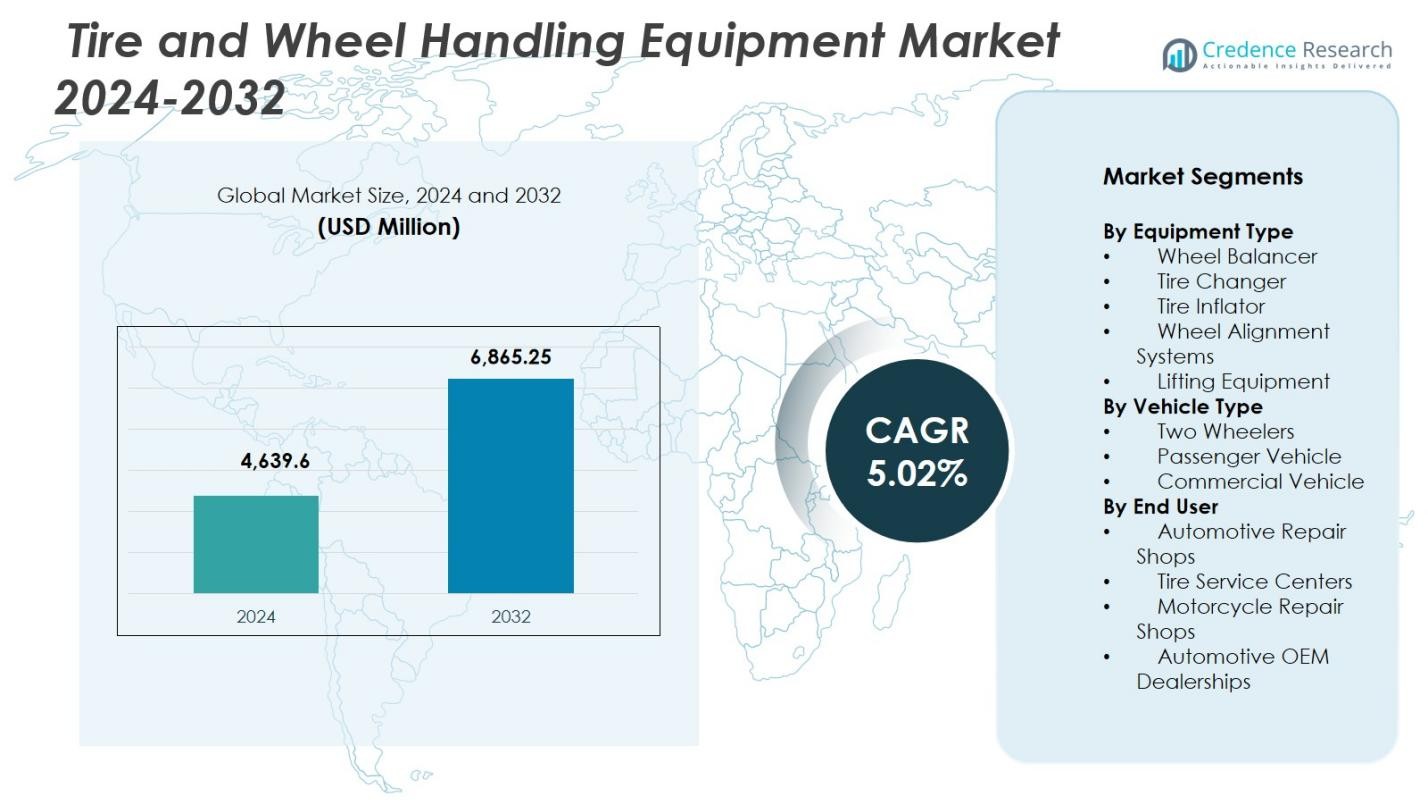
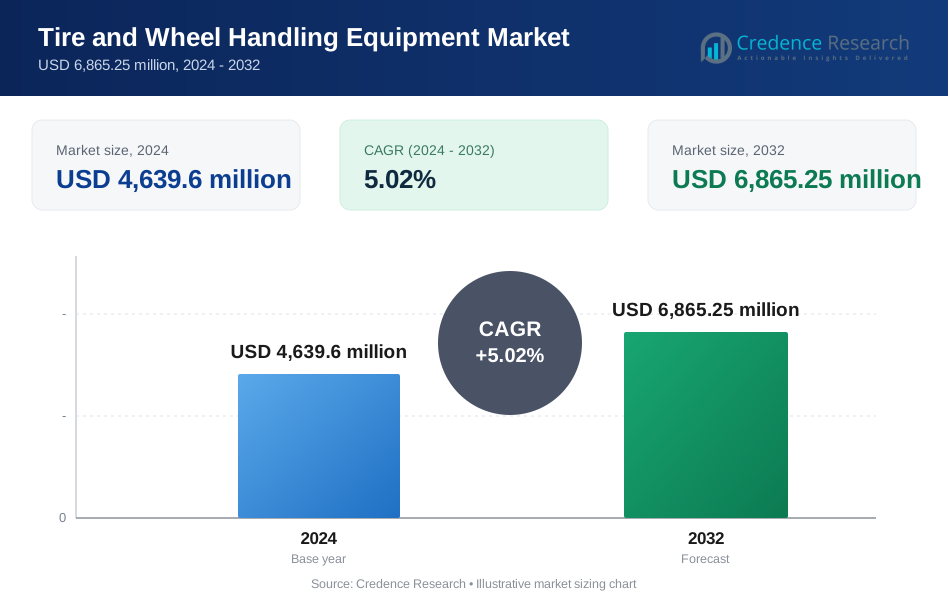
Tire and Wheel Handling Equipment Market size was valued at USD 4,639.6 million in 2024 and is anticipated to reach USD 6,865.25 million by 2032, at a CAGR of 5.02% during the forecast period.
| REPORT ATTRIBUTE | DETAILS |
|---|---|
| Historical Period | 2020-2023 |
| Base Year | 2024 |
| Forecast Period | 2025-2032 |
| Tire and Wheel Handling Equipment Market Size 2024 | USD 4,639.6 Million |
| Tire and Wheel Handling Equipment Market, CAGR | 5.02% |
| Tire and Wheel Handling Equipment Market Size 2032 | USD 6,865.25 Million |
Tire and Wheel Handling Equipment Market features leading players such as Hunter Engineering, Bosch Automotive Service Solutions, Corghi, Ravaglioli, Rotary Lift, Hofmann Megaplan, Coats, Snap-on, JLG Industries, and Camso, all driving advancements in alignment, balancing, lifting, and tire-changing technologies. These companies focus on automation, ADAS compatibility, and EV-ready equipment to meet rising service demands across modern workshops. Asia-Pacific led the global market in 2024 with 33.7% share, supported by expanding automotive production, high two-wheeler density, and rapid workshop modernization. North America and Europe followed, driven by strong service networks, regulatory standards, and high adoption of advanced wheel-handling systems.
Market Insights
- Tire and Wheel Handling Equipment Market was valued at USD 4,639.6 million in 2024 and is projected to grow at a CAGR of 5.02% through 2032.
- Rising vehicle parc and increased maintenance frequency drive demand for wheel alignment systems, which held the largest segment share of 32.4% in 2024 due to their essential role in precision and ADAS-related servicing.
- Digitalization, touchless alignment, IoT-enabled diagnostics, and EV-oriented workshop upgrades are key trends reshaping equipment adoption across global service centers.
- Major players such as Hunter Engineering, Bosch, Corghi, Ravaglioli, Rotary Lift, and Coats strengthen market position through automated, software-integrated, and high-efficiency equipment portfolios targeting modern workshops.
- Asia-Pacific led the market with 33.7% share in 2024, followed by North America at 31.2% and Europe at 29.8%, while Latin America and Middle East & Africa contributed smaller shares due to slower modernization and cost constraints.
Market Segmentation Analysis:
By Equipment Type
The Tire and Wheel Handling Equipment Market is dominated by wheel alignment systems, capturing 32.4% share in 2024 due to their essential role in ensuring precision, safety, and efficiency in modern workshops. Increasing vehicle parc, rising tire replacement frequency, and growing adoption of advanced ADAS-compatible alignment technologies strongly support this dominance. Tire changers follow, driven by the shift toward low-profile and high-performance tires that require specialized equipment. Demand for lifting equipment and wheel balancers is also increasing as service centers modernize operations and prioritize workflow automation and operator safety.
- For instance, John Bean’s Tru-Point ADAS calibration system verifies vehicle alignment and monitors each step of the setup process against OEM safety specifications before and after ADAS calibration, helping workshops ensure accurate thrust angles and sensor positioning.
By Vehicle Type
Passenger vehicles accounted for the largest share of the Tire and Wheel Handling Equipment Market, holding 56.8% share in 2024, supported by rising private vehicle ownership, frequent maintenance cycles, and the rapid expansion of urban mobility. Increased adoption of radial and performance tires further boosts equipment demand across alignment, balancing, and tire-changing systems. Commercial vehicles held a growing share due to fleet expansion and stricter regulations for tire safety and fuel efficiency. Two-wheelers continue to contribute steadily, driven by high vehicle density in emerging economies and increasing service requirements in motorcycle repair workshops.
- For instance, Coats Company's CHD 6330 heavy duty tire changer uses hydraulic power to manage tubeless truck tires up to 63 inches in diameter and 30 inches wide, supporting fleet tire replacement with ergonomic pendant controls.
By End User
Automotive repair shops led the Tire and Wheel Handling Equipment Market with 41.6% share in 2024, driven by rising multi-brand workshop networks, higher vehicle service frequency, and the need for advanced alignment, balancing, and lifting solutions. Tire service centers follow closely as demand for precision tire-related services accelerates, supported by growth in electric and high-performance vehicles. Automotive OEM dealerships maintain a strong presence due to high investment in premium diagnostic tools and customer-centric service models. Motorcycle repair shops contribute consistently, supported by expanding two-wheeler service demand in densely populated markets.
Key Growth Drivers
Rising Vehicle Parc and Increased Maintenance Frequency
Global expansion of vehicle ownership, especially in urban and developing regions, is significantly driving demand for tire and wheel handling equipment. Higher annual mileage, frequent tire replacements, and growing awareness of preventive maintenance push service centers to adopt advanced alignment, balancing, and lifting systems. As passenger and commercial fleets expand, workshops require more efficient, accurate, and automated solutions to handle rising service volumes. This trend directly accelerates equipment investments, strengthening long-term market growth across OEM dealerships, repair shops, and tire service facilities.
- For instance, John Bean introduced the V3300 Wheel Alignment System, which combines fast imaging technology with intelligent software to guide technicians through alignments.
Shift Toward Advanced and Automated Workshop Technologies
Automotive service environments are rapidly transitioning toward automation to improve operational efficiency, reduce human error, and support modern vehicle technologies. ADAS-enabled vehicles, performance tires, and electric vehicle architectures require highly precise alignment, balancing, and diagnostic systems. This shift encourages service centers to replace outdated tools with digital, sensor-based, and software-integrated equipment. Automated lifting platforms, touchless alignment systems, and intelligent tire changers enhance throughput while ensuring consistent service quality. This technological evolution strongly elevates equipment demand and reinforces modernization across tire service infrastructure.
- For instance, Robert Bosch GmbH provides the ADAS One Solution software with DAS 3000 equipment for guided, vehicle-specific calibrations of radar, lidar, and camera sensors. It halves setup time compared to manual methods and generates compliance reports for OEM standards.
Stringent Safety and Efficiency Regulations
Regulatory emphasis on vehicle safety, tire performance, and fuel efficiency is compelling workshops to adopt compliant, technically advanced tire-handling solutions. Mandatory alignment checks, tire pressure monitoring standards, and safety inspections increase the adoption of calibrated inflators, alignment systems, and wheel balancers. Fleet operators, in particular, face stricter compliance obligations for minimizing downtime and ensuring roadworthiness, driving higher investments in precision equipment. These regulatory pressures not only expand the replacement cycle for older machinery but also accelerate new equipment adoption, ensuring sustained market growth.
Key Trends & Opportunities
Integration of Digital, Connected, and Smart Workshop Solutions
A growing trend in the Tire and Wheel Handling Equipment Market is the integration of connected technologies, including IoT-enabled sensors, cloud-based diagnostics, and real-time equipment monitoring. These smart systems offer predictive maintenance, automated calibration, and enhanced accuracy, enabling service centers to optimize workflow and reduce downtime. Touchless wheel alignment, digital measurement tools, and AI-driven balancing systems are rapidly emerging as value-added solutions. This digital transformation presents major opportunities for manufacturers to differentiate through software-driven features and long-term service contracts.
- For instance, Hofmann’s geoliner 609 imaging wheel aligner is tablet‑controlled and cloud‑connected, combining advanced imaging software with smart notification functions that flag issues such as suspension stress and environmental errors to streamline alignment flow in compact workshops.
Expansion of EV-Oriented Tire and Wheel Service Solutions
The accelerating transition to electric vehicles opens a strong opportunity for specialized tire-handling equipment. EVs require precise wheel alignment, advanced lifting systems suited for heavy battery packs, and specialized tire changers capable of handling high-torque wheels. Service centers upgrading to EV-certified infrastructure increasingly invest in premium and automated systems to meet OEM standards. As global EV adoption grows, the need for EV-specific workshop equipment becomes a major opportunity for manufacturers to develop tailored tools, training modules, and integrated service platforms.
- For instance, INDEVA's Liftronic Easy manipulator handles tire rims with instant load weight detection via its automatic balancing system, enabling ergonomic movement across varying wheel weights in automotive assembly.
Key Challenges
High Initial Investment and Maintenance Costs
The high upfront cost of automated alignment systems, advanced balancers, and hydraulic or electronic lifting equipment remains a significant barrier for small and independent workshops. These systems also require routine calibration, software updates, and trained operators, adding to long-term ownership expenses. Budget constraints often delay modernization, limiting equipment adoption in cost-sensitive markets. This challenge particularly affects emerging economies where service centers prioritize affordable solutions, potentially slowing the penetration of advanced technologies across the broader aftermarket ecosystem.
Skill Gaps and Limited Technical Expertise in Workshops
The increasing sophistication of tire-handling and alignment equipment demands skilled technicians capable of operating digital, software-driven, and automated systems. Many workshops face shortages of trained personnel, resulting in underutilization of advanced tools and inconsistent service quality. Lack of structured training programs, especially in developing markets, further widens the skills gap. As vehicles integrate ADAS, complex suspension systems, and EV platforms, the need for specialized technician expertise intensifies making workforce capability a critical challenge for market-wide technology adoption and operational efficiency.
Regional Analysis
North America
North America held 31.2% share of the Tire and Wheel Handling Equipment Market in 2024, driven by a well-established automotive service infrastructure, high vehicle ownership, and strong adoption of advanced workshop technologies. The region benefits from widespread use of automated alignment systems, premium lifting solutions, and ADAS-compatible diagnostic tools across dealership networks and independent repair shops. Growing EV penetration in the U.S. and Canada further stimulates demand for specialized tire-handling systems suited for heavier battery platforms. Continuous investment in service modernization and strict vehicle safety regulations reinforce the region’s leadership position.
Europe
Europe accounted for 29.8% share of the Tire and Wheel Handling Equipment Market in 2024, supported by stringent regulatory standards for vehicle safety, emissions, and tire performance. The region’s dense network of OEM-authorized workshops and the strong presence of premium vehicle manufacturers drive adoption of advanced alignment and balancing solutions. Growing winter tire replacement cycles and high adoption of performance tires further boost equipment demand. Rising EV sales in Germany, the UK, and Nordic countries accelerate investment in specialized lifting systems and EV-compatible tire-changing technologies, strengthening the region’s focus on precision and automation.
Asia-Pacific
Asia-Pacific dominated with 33.7% share in 2024, emerging as the fastest-growing region due to expanding automotive production, increasing vehicle parc, and rapid urbanization. High two-wheeler density, especially in India and Southeast Asia, fuels demand for specialized motorcycle repair equipment. China’s large aftermarket ecosystem and acceleration of EV adoption drive investments in automated balancing, alignment, and lifting tools. Growing multi-brand workshop chains and rising awareness of preventive maintenance further enhance equipment penetration. Government regulations promoting vehicle safety inspections and periodic servicing contribute to the region’s strong market scaling and technological modernization.
Latin America
Latin America captured 3.6% share in 2024, driven by a gradual expansion of automotive repair networks and steady growth in passenger and commercial vehicle fleets. Brazil and Mexico lead regional demand as service centers invest in modern tire-changing and wheel-balancing equipment to improve operational efficiency. Rising emphasis on road safety standards and increasing adoption of mid-range and premium workshop tools support market progression. However, budget constraints among smaller repair shops and economic fluctuations slow large-scale modernization. Growing aftermarket consolidation presents opportunities for equipment suppliers targeting professionalized service environments.
Middle East & Africa
Middle East & Africa held 1.7% share of the market in 2024, supported by expanding vehicle ownership, rising commercial fleets, and growth in organized service centers across Gulf countries and South Africa. Investment in high-end workshop infrastructure, particularly in the UAE and Saudi Arabia, drives demand for advanced lifting systems and alignment solutions. Increasing adoption of premium passenger cars and SUVs further supports specialized tire-handling equipment usage. Despite promising growth potential, limited technical expertise and uneven service ecosystem development in several African markets constrain rapid equipment penetration.
Market Segmentations:
By Equipment Type
- Wheel Balancer
- Tire Changer
- Tire Inflator
- Wheel Alignment Systems
- Lifting Equipment
By Vehicle Type
- Two Wheelers
- Passenger Vehicle
- Commercial Vehicle
By End User
- Automotive Repair Shops
- Tire Service Centers
- Motorcycle Repair Shops
- Automotive OEM Dealerships
By Geography
- North America
- U.S.
- Canada
- Mexico
- Europe
- Germany
- France
- U.K.
- Italy
- Spain
- Rest of Europe
- Asia Pacific
- China
- Japan
- India
- South Korea
- South-east Asia
- Rest of Asia Pacific
- Latin America
- Brazil
- Argentina
- Rest of Latin America
- Middle East & Africa
- GCC Countries
- South Africa
- Rest of the Middle East and Africa
Competitive Landscape
Competitive landscape in the Tire and Wheel Handling Equipment Market is defined by the presence of major players such as Hunter Engineering, Bosch Automotive Service Solutions, Corghi, Ravaglioli, Rotary Lift, Hofmann Megaplan, Coats, Snap-on, JLG Industries, and Camso, all of which collectively shape innovation, pricing, and global distribution strategies. These companies focus on expanding automated and ADAS-compatible solutions to meet the rising demand for precision wheel alignment, balancing, and lifting systems across modern service centers. Manufacturers increasingly invest in software-integrated platforms, touchless alignment technologies, and EV-ready equipment to strengthen their product portfolios and address evolving workshop requirements. Strategic partnerships with OEM dealerships, expansion into high-growth markets in Asia-Pacific, and enhanced after-sales service capabilities further reinforce their competitive positioning. Continuous R&D investment, strong dealer networks, and emphasis on workflow automation enable leading companies to differentiate in a market driven by regulatory compliance, technology upgrades, and increasing aftermarket service volumes.
Key Player Analysis
- Hunter Engineering Company
- Bosch Automotive Service Solutions
- Corghi S.p.A.
- Ravaglioli S.p.A.
- Rotary Lift
- Hofmann Megaplan
- Coats (Fortive)
- Snap-on Incorporated
- JLG Industries, Inc.
- Camso Inc.
Recent Developments
- In November 2025, Hunter Engineering released updated 2026 alignment and ADAS coverage, adding nearly 3,000 new vehicle records to its calibration database.
- In December 2025, Fastco Canada (a subsidiary of Groupe Touchette) announced the acquisition of the ENVY Wheel Brand, strengthening its portfolio in wheels and aftermarket services.
Report Coverage
The research report offers an in-depth analysis based on Equipment Type, Vehicle Type, End User and Geography. It details leading market players, providing an overview of their business, product offerings, investments, revenue streams, and key applications. Additionally, the report includes insights into the competitive environment, SWOT analysis, current market trends, as well as the primary drivers and constraints. Furthermore, it discusses various factors that have driven market expansion in recent years. The report also explores market dynamics, regulatory scenarios, and technological advancements that are shaping the industry. It assesses the impact of external factors and global economic changes on market growth. Lastly, it provides strategic recommendations for new entrants and established companies to navigate the complexities of the market.
Future Outlook
- The market will experience steady growth as vehicle ownership rises and service frequency increases across all regions.
- Adoption of automated and digital workshop equipment will accelerate as service centers modernize operations.
- EV expansion will drive demand for specialized lifting, alignment, and tire-handling systems designed for heavier vehicle platforms.
- ADAS-equipped vehicles will push workshops to invest in advanced, high-precision wheel alignment technologies.
- Organized multi-brand service networks will expand rapidly, increasing equipment standardization and automation.
- Manufacturers will integrate IoT, AI, and cloud analytics into equipment to enable predictive maintenance and real-time diagnostics.
- Increasing regulatory pressure on vehicle safety and inspection standards will boost demand for certified and calibrated tools.
- Growth in fleet management and logistics sectors will enhance adoption of high-capacity and efficiency-driven handling systems.
- Replacement demand for outdated mechanical equipment will strengthen as workshops shift toward digital and touchless solutions.
- Emerging markets will offer strong expansion opportunities driven by urbanization and rising investments in modern service infrastructure.
Request a Free Sample
Fill in your details and we'll send you a free sample report.
- Sample data tables & charts
- Research methodology
Need a Custom Version of This Report?
Tailor the scope, geography, or segments to your exact requirements.
- Custom geography or segment scope
- Direct access to our analyst team
Frequently Asked Questions
What is the current market size for Tire and Wheel Handling Equipment Market, and what is its projected size in 2032?
At what Compound Annual Growth Rate is the Tire and Wheel Handling Equipment Market projected to grow between 2024 and 2032?
Which Tire and Wheel Handling Equipment Market segment held the largest share in 2024?
What are the primary factors fueling the growth of the Tire and Wheel Handling Equipment Market?
Who are the leading companies in the Tire and Wheel Handling Equipment Market?
Which region commanded the largest share of the Tire and Wheel Handling Equipment Market in 2024?
Table of Content
Chapter 1. Report Introduction
- 1.1 Report Description & Purpose
- 1.1.1 Report Title & Market Definition
- 1.1.2 Unique Selling Propositions (USP) & Key Differentiators
- 1.1.3 Value Proposition for Stakeholders
- 1.2 Research Objectives
- 1.2.1 Market Sizing Objectives (Volume & Revenue)
- 1.2.2 Segmentation Objectives
- 1.2.3 Competitive Intelligence Objectives
- 1.2.4 Forecast & Scenario Objectives
- 1.3 Report Scope
- 1.3.1 Tire and Wheel Handling Equipment Scope – Types & Subtypes Covered
- 1.3.2 Geographic Scope – Regions & Countries Covered
- 1.3.3 Historical Period, Base Year & Forecast Period (2024; forecast to 2032)
- 1.3.4 Inclusions & Exclusions
- 1.4 HS Code & Classification Framework
- 1.5 Currency, Units & Pricing Basis
- 1.6 Target Stakeholders
- 1.7 Limitations & Assumptions
Chapter 2. Executive Summary
- 2.1 Global Tire and Wheel Handling Equipment Market Snapshot
- 2.1.1 Market Size – Historical (2024) & Forecast (2024-2032) (2024: USD 4,639.6 million → 2032: USD 6,865.25 million)
- 2.1.2 Volume & Revenue – Global Totals
- 2.1.3 Key Market Highlights – Top Five Facts
- 2.2 Tire and Wheel Handling Equipment Market Segmentation Snapshot
- 2.2.1 Market Split by Region – 2024 vs. 2032
- 2.3 Competitive Snapshot
- 2.3.1 Top 10 Players by Revenue Share – 2024
- 2.3.2 Top 10 Players by Volume Share – 2024
- 2.3.3 Recent Strategic Developments (18-Month Summary)
- 2.4 Key Investment Highlights & Strategic Conclusions
Chapter 3. Tire and Wheel Handling Equipment Market Dynamics & Industry Analysis
- 3.1 Market Overview & Context
- 3.1.1 Tire and Wheel Handling Equipment Market Position in the Broader Automotive Value Chain
- 3.1.2 OEM vs. Replacement Market Dynamics
- 3.1.3 Market Maturity & Development Stage by Region
- 3.2 Tire and Wheel Handling Equipment Market Drivers
- 3.3 Tire and Wheel Handling Equipment Market Restraints & Challenges
- 3.4 Tire and Wheel Handling Equipment Market Opportunities
- 3.5 Porter's Five Forces Analysis
- 3.5.1 Threat of New Entrants
- 3.5.2 Bargaining Power of Suppliers
- 3.5.3 Bargaining Power of Buyers
- 3.5.4 Threat of Substitutes
- 3.5.5 Competitive Rivalry – Intensity Assessment
- 3.6 Tire and Wheel Handling Equipment Value Chain Analysis
- 3.6.1 Upstream – Raw Material/Input Suppliers
- 3.6.1.1 Raw Material/Input 1
- 3.6.1.2 Raw Material/Input 2
- 3.6.1.3 Raw Material/Input 3
- 3.6.2 Midstream – Production/Manufacturing/Service Delivery
- 3.6.2.1 Production/Process Overview
- 3.6.2.2 Key Facility Locations & Capacity by Manufacturer
- 3.6.3 Downstream – Distribution & End Consumer
- 3.6.3.1 Primary Channel – B2B/OEM
- 3.6.3.2 Secondary Channels – Dealer, Retail, Online, Direct
- 3.6.4 Value Chain Profitability Analysis
- 3.6.1 Upstream – Raw Material/Input Suppliers
- 3.7 PESTEL Analysis
- 3.7.1 Political Factors
- 3.7.2 Economic Factors
- 3.7.3 Social Factors
- 3.7.4 Technological Factors
- 3.7.5 Environmental Factors
- 3.7.6 Legal Factors
- 3.8 Tire and Wheel Handling Equipment Supply Chain Analysis
- 3.8.1 Raw Material/Input Supply Risk Assessment
- 3.8.2 Manufacturing Concentration Risk (Geographic Exposure)
- 3.8.3 Trade Disruption Impact Analysis
- 3.9 Regulatory & Policy Landscape
Note: The regulatory and policy landscape section covers regulations based on their applicability to the market, Tire and Wheel Handling Equipment category, geography, and scope of the study. Only regulatory frameworks with a material impact on operations, compliance, trade, sustainability, or market access are analyzed in detail.
Chapter 4. Key Investment Pockets & Opportunity Analysis
- 4.1 Tire and Wheel Handling Equipment Market Attractiveness Analysis
- 4.1.1 By Region – Investment Attractiveness Matrix (Volume × CAGR)
- 4.2 Absolute Revenue Growth Opportunity
- 4.2.1 By Region – Absolute USD Growth Through 2032
- 4.3 Incremental Volume Opportunity
- 4.3.1 By Region – Incremental Volume Through 2032
- 4.3.2 Segment – Incremental Volume
- 4.4 Emerging Submarket Opportunity Deep Dive (Subject to Applicability)
- 4.5 Emerging Market Opportunity Scorecards
- 4.5.1 United States
- 4.5.2 Europe
- 4.5.3 Asia
- 4.5.4 Middle East & Africa
Note: Emerging Market Opportunity Scorecards will be included based on relevance and strategic importance. Regions listed are indicative and may vary depending on data availability and market dynamics.
Chapter 5. Tire and Wheel Handling Equipment Import-Export Analysis & Trade Flows
- 5.1 Global Trade Overview
- 5.1.1 Global Export Value by Country (2024)
- 5.1.2 Global Export Volume by Country (2024)
- 5.1.3 Global Import Value by Country (2024)
- 5.1.4 Global Import Volume by Country (2024)
- 5.1.5 Net Trade Balance by Country (2024)
- 5.2 Export Analysis – Segment
- 5.2.1 Type 1 (HS Code)
- 5.2.2 Type 2 (HS Code)
- 5.2.3 Type 3 (HS Code)
- 5.2.4 Type 4 (HS Code)
- 5.2.5 Type 5 (HS Code)
- 5.3 Import Analysis – Segment
- 5.3.1 Type 1 (HS Code)
- 5.3.2 Type 2 (HS Code)
- 5.3.3 Type 3 (HS Code)
- 5.3.4 Type 4 (HS Code)
- 5.3.5 Type 5 (HS Code)
- 5.4 Average Unit Trade Prices
- 5.4.1 Average Export Price – Segment & Country
- 5.4.2 Average Import Price – Segment & Source Country
- 5.4.3 Price Trends (2024)
- 5.5 Key Trade Route Analysis
- 5.5.1 Trade Route 1
- 5.5.2 Trade Route 2
- 5.5.3 Trade Route 3
- 5.5.4 Trade Route 4
- 5.5.5 Trade Route 5
- 5.6 Trade Policy Impact Assessment
- 5.6.1 US Anti-Dumping & Section 301 Tariffs
- 5.6.2 EU Customs Union Impact
- 5.6.3 Major Free Trade Agreements
- 5.6.4 USMCA Rules of Origin
Note: Trade policy analysis will be included only where relevant to the Tire and Wheel Handling Equipment market.
Chapter 6. Competitive Landscape & Company Benchmarking
- 6.1 Tire and Wheel Handling Equipment Market Concentration & Structure
- 6.1.1 Herfindahl-Hirschman Index (HHI) – vs. 2024
- 6.1.2 Tier 1, Tier 2 & Tier 3 Market Structure
- 6.1.3 Global, Regional & Local Player Dynamics
- 6.2 Tire and Wheel Handling Equipment Market Share Analysis – 2024
- 6.2.1 Global Revenue Share by Company
- 6.2.2 Global Volume Share by Company
- 6.2.3 Regional Revenue Share
- 6.2.4 Market Share Evolution ( vs. 2024)
- 6.2.5 OEM Segment Share by Company
- 6.2.6 Replacement Segment Share by Company
- 6.3 Production/Delivery Capacity & Facility Analysis
- 6.3.1 Global Installed Capacity
- 6.3.2 Capacity Utilization Rates
- 6.3.3 Production/Output Volume
- 6.3.4 Facility Locations & Capacity Map
- 6.3.5 Planned Capacity Additions
- 6.4 Tire and Wheel Handling Equipment Competitive Benchmarking Matrix
- 6.4.1 Revenue, Volume, CAGR & Profitability Comparison
- 6.4.2 Channel Revenue Mix
- 6.4.3 Geographic Revenue Exposure
- 6.4.4 R&D Intensity
- 6.4.5 Sustainability Maturity
- 6.5 Strategic Developments in Tire and Wheel Handling Equipment (Last 24 Months)
- 6.5.1 Mergers, Acquisitions & Divestments
- 6.5.2 New Tire and Wheel Handling Equipment Launches
- 6.5.3 Facility Expansions
- 6.5.4 Strategic Alliances, Joint Ventures & Partnerships
- 6.5.5 Distribution Expansion & Market Entry
- 6.5.6 Sustainability & ESG Initiatives
- 6.6 Competitive Strategy Mapping
- 6.6.1 Leader, Challenger, Follower & Niche Classification
- 6.6.2 Pricing Strategy Comparison
- 6.6.3 Channel Strategy Matrix
Note: Strategic developments are included based on their materiality and the availability of reliable information.
Chapter 7. Global Tire and Wheel Handling Equipment Market – By Distribution Channel
- 7.1 Segment Overview
- 7.1.1 Volume & Revenue Split by Channel (2024 & 2032)
- 7.1.2 Channel Mix Evolution (2024-2032)
Chapter 8. Regional Market Analysis – Global Overview
- 8.1 Global Regional Overview
- 8.1.1 Regional Volume Share
- 8.1.2 Regional Revenue Share
- 8.1.3 Regional Volume by Region
- 8.1.4 Regional Revenue by Region
- 8.1.5 Regional Forecast Through 2032
- 8.2 Cross-Regional Segment Analysis
- 8.2.1 By Distribution Channel
- 8.2.2 By Brand/Price Tier
Chapter 9. North America Tire and Wheel Handling Equipment Market
- 9.1 United States
- 9.2 Canada
- 9.3 Mexico
Chapter 10. Europe Tire and Wheel Handling Equipment Market
- 10.1 Germany
- 10.2 France
- 10.3 Italy
- 10.4 United Kingdom
- 10.5 Spain
- 10.6 Poland
- 10.7 Russia
- 10.8 Netherlands
- 10.9 Belgium
- 10.10 Sweden
- 10.11 Denmark
- 10.12 Norway
- 10.13 Rest of Europe
Chapter 11. Asia Pacific Tire and Wheel Handling Equipment Market
- 11.1 China
- 11.2 India
- 11.3 Japan
- 11.4 South Korea
- 11.5 Thailand
- 11.6 Indonesia
- 11.7 Vietnam
- 11.8 Malaysia
- 11.9 Australia
- 11.10 Rest of Asia Pacific
Chapter 12. Latin America Tire and Wheel Handling Equipment Market
- 12.1 Brazil
- 12.2 Argentina
- 12.3 Colombia
- 12.4 Chile
- 12.5 Rest of Latin America
Chapter 13. Middle East Tire and Wheel Handling Equipment Market
- 13.1 Saudi Arabia
- 13.2 United Arab Emirates
- 13.3 Turkey
- 13.4 Israel
- 13.5 Iran
- 13.6 Rest of the Middle East
Chapter 14. Africa Tire and Wheel Handling Equipment Market
- 14.1 South Africa
- 14.2 Egypt
- 14.3 Nigeria
- 14.4 Morocco
- 14.5 Rest of Africa
Chapter 15. Tire and Wheel Handling Equipment Company Profiles
- 15.1 [Company 01]
- 15.1.1 Company Overview
- 15.1.2 Key Management Personnel
- 15.1.3 Products & Services Portfolio
- 15.1.4 Financial Performance
- 15.1.5 Key Market Focus & Geographic Presence
- 15.1.6 Recent Developments & Strategic Initiatives
Note: The company profile list is preliminary and may change based on research findings, market developments, data availability, and client requirements.
Chapter 16. Appendices
- Appendix A – List of Abbreviations & Acronyms
- Appendix B – Industry Classification Code Reference – Full Series
- Appendix C – Production & Capacity Data Tables
- Appendix D – End-Use & Demand Base Tables
- Appendix E – Consumption & Replacement Rate Assumptions
- Appendix F – ASP Reference Tables
- Appendix G – Manufacturing & Facility Database
- Appendix H – Import-Export Data Tables
- Appendix I – Regulatory Summary Tables
- Appendix J – Primary Research Participant List (Anonymized)
- Appendix K – Primary Research Questionnaire Framework
- Appendix L – Data Sources & Bibliography
- Appendix M – Market Size Divergence & Source Comparison
Chapter 17. Research Methodology
- 17.1 Research Framework & Philosophy
- 17.2 Secondary Research – Sources, Hierarchy & Data Extraction
- 17.3 Data Modeling – Bottom-Up & Top-Down Market Sizing
- 17.4 Primary Research – Stakeholder Framework, LOI & Sample Sizes
- 17.5 Forecast Methodology – Regression, Scenario & Sensitivity Analysis
- 17.6 Quality Control – Four-Layer Validation Framework
- 17.7 Limitations & Standard Assumptions
- 17.8 Disclaimer
