| REPORT ATTRIBUTE | DETAILS |
|---|---|
| Historical Period | 2019-2022 |
| Base Year | 2023 |
| Forecast Period | 2024-2032 |
| Two-Wheeler Suspension System Market Size 2024 | USD 1,665 Million |
| Two-Wheeler Suspension System Market, CAGR | 5.4% |
| Two-Wheeler Suspension System Market Size 2032 | USD 2,535.94 Million |
Market Overview:
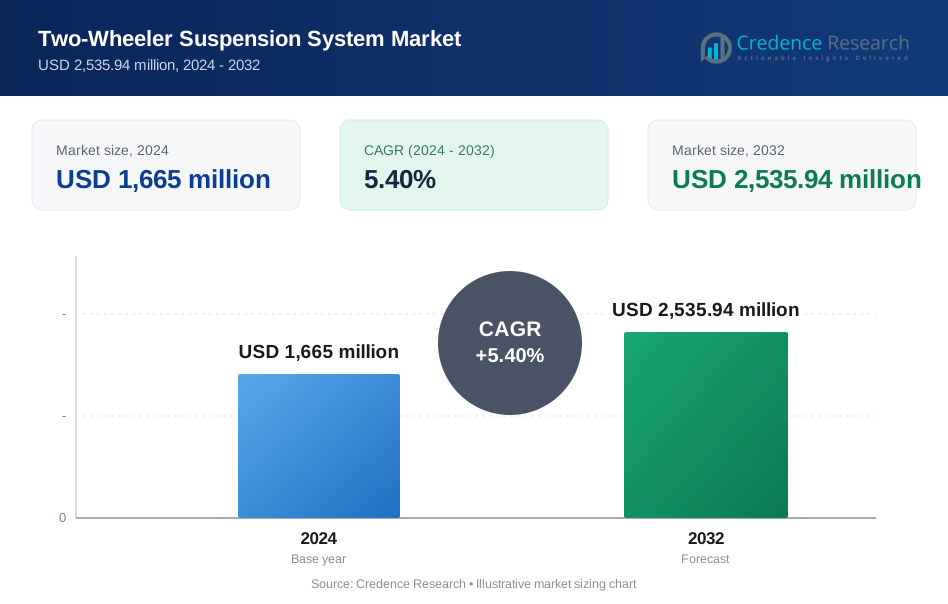
The global Two-Wheeler Suspension System Market is projected to grow from USD 1,665 million in 2024 to USD 2,535.94 million by 2032, registering a compound annual growth rate (CAGR) of 5.4% during the forecast period.
This growth reflects the increasing demand for advanced suspension systems that enhance riding comfort, stability, and performance across a diverse range of two-wheelers, including motorcycles, scooters, and mopeds. The market’s expansion is driven by technological advancements, evolving consumer preferences, and a growing focus on rider safety and comfort.
Key drivers of the market include the increasing global sales of two-wheelers, particularly in emerging economies, and rising consumer demand for vehicles with superior ride quality. The adoption of advanced suspension technologies, such as mono-shocks and inverted forks, is growing in premium and mid-range motorcycles, offering enhanced handling and stability. Additionally, urbanization and rising disposable incomes in developing regions have led to increased two-wheeler adoption, further fueling the demand for high-performance suspension systems. Manufacturers are also focusing on lightweight materials and innovative designs to improve suspension durability and efficiency, aligning with sustainability trends in the automotive sector.
Asia-Pacific dominates the market, accounting for the largest share due to high two-wheeler ownership in countries like India, China, and Indonesia, where motorcycles are essential for daily commuting. The region’s growing middle-class population and increasing consumer preference for advanced features drive demand for modern suspension systems. North America and Europe are significant contributors, driven by a strong culture of motorcycling and a focus on high-performance vehicles. Meanwhile, Latin America and the Middle East & Africa are witnessing steady growth due to improving economic conditions and expanding two-wheeler ownership, highlighting global opportunities for the suspension system market.
Market Insights:
- The market is projected to grow from USD 1,665 million in 2024 to USD 2,535.94 million by 2032, with a CAGR of 5.4%.
- The adoption of advanced suspension systems, such as mono-shocks and inverted forks, is rising, especially in premium motorcycles.
- Increased two-wheeler ownership in urban areas, driven by rising disposable incomes, boosts demand for high-performance suspension systems.
- Consumer preference for enhanced ride quality and stability is driving the integration of innovative suspension technologies.
- Asia-Pacific dominates the market due to high two-wheeler ownership and demand for efficient commuting solutions.
- Challenges include fluctuating raw material costs and the high development costs of advanced suspension systems.
- Growth opportunities exist in Latin America and the Middle East & Africa, supported by improving economic conditions and rising two-wheeler adoption.
Market Drivers:
Increasing Demand for Two-Wheelers:
The rising demand for two-wheelers, particularly in emerging economies, is a significant driver for the suspension system market. According to the International Motorcycle Manufacturers Association (IMMA), global two-wheeler sales reached approximately 60.4 million units in 2022, reflecting a 2.6% increase from the previous year. This growth is primarily attributed to urbanization and the need for affordable transportation solutions. For instance, in India, motorcycle registrations surged by 15% in 2023, with over 1.5 million new motorcycles registered monthly, highlighting the growing reliance on two-wheelers as a primary mode of transport. As more consumers purchase motorcycles and scooters, the demand for advanced suspension systems that enhance ride comfort and safety is expected to rise correspondingly, with estimates suggesting that each new motorcycle sold will drive an additional $200 in suspension-related accessory sales.
Technological Advancements in Suspension Systems:
Innovations in suspension technology are driving market growth by improving performance and rider experience. The introduction of electronic suspension systems has gained traction, allowing for real-time adjustments based on road conditions and rider preferences. For example, companies like Öhlins have reported a 30% increase in sales of their electronically controlled suspension systems in 2023 compared to the previous year, with installations on high-performance bikes increasing from 10% to 25% of their total sales. These advancements not only enhance ride quality but also cater to the increasing consumer expectations for comfort and performance, further propelling market demand as riders seek out the latest technologies for improved handling.
Focus on Safety and Comfort:
Growing awareness of safety among riders is significantly influencing the two-wheeler suspension system market. For instance, The National Highway Traffic Safety Administration (NHTSA) reported that improved suspension systems can reduce accidents caused by loss of control by up to 25%, translating to a potential reduction of thousands of accidents annually. As a result, manufacturers are investing in high-quality suspension components that provide better handling and stability. In 2023, companies like Yamaha introduced new models equipped with advanced suspension technologies that prioritize rider safety and comfort, featuring systems that adapt to different terrains and riding styles.
Government Initiatives and Regulations:
Government initiatives promoting the use of two-wheelers as a solution to urban congestion are also driving market growth. Many countries are implementing policies that encourage two-wheeler adoption through subsidies and incentives. For example, the Indian government launched a program in early 2023 aimed at increasing two-wheeler ownership by offering tax rebates and financing options for new buyers. This initiative is expected to boost demand for two-wheeler accessories, including advanced suspension systems, as more consumers invest in reliable and efficient vehicles tailored for city commuting. With urban areas facing increasing traffic congestion, policymakers are recognizing two-wheelers as a viable solution to enhance mobility while reducing pollution levels.
Market Trends:
Technological Innovations in Suspension Systems:
The two-wheeler suspension system market is experiencing significant advancements in technology, particularly with the introduction of electronic suspension systems. For instance, companies like Öhlins and Showa have developed electronically controlled suspension systems that allow riders to adjust damping settings in real-time based on road conditions, improving ride quality and handling. In 2023, Öhlins reported a 30% increase in sales of their electronic suspension systems, with over 15,000 units sold globally, driven by consumer demand for enhanced ride comfort and performance. This trend towards high-tech solutions highlights the industry's shift toward improving performance through innovative engineering, as manufacturers aim to meet the evolving expectations of riders.
Growing Popularity of Electric Two-Wheelers:
The rising adoption of electric two-wheelers is reshaping the suspension system landscape. As governments worldwide promote sustainable transportation, the demand for electric motorcycles and scooters has surged, with global sales reaching 10 million units in 2023. For example, electric two-wheeler sales in India increased by 45%, with manufacturers like Ather Energy and Ola Electric leading the market with combined sales of over 200,000 units. These vehicles require specialized suspension systems to accommodate different weight distributions and handling characteristics compared to traditional gasoline-powered bikes. Consequently, manufacturers are focusing on developing lightweight and adaptable suspension solutions tailored for electric models, with some companies reporting a 25% reduction in weight for new electric suspension designs.
Emphasis on Safety and Comfort:
Safety remains a top priority for consumers, driving demand for advanced suspension systems that enhance stability and control. For instance, The National Highway Traffic Safety Administration (NHTSA) reported that improved suspension technology can reduce accident rates caused by loss of control by up to 25%, potentially saving thousands of lives annually. In response, major players like Yamaha have introduced new models equipped with advanced suspension technologies designed to prioritize rider safety and comfort. This focus on enhancing the riding experience is reflected in a 20% increase in sales of high-performance suspension components over the past year, with Yamaha reporting that 40% of their new motorcycle models now feature upgraded suspension systems.
Customization Trends Among Riders:
The trend toward personalization is gaining traction in the two-wheeler market, with riders increasingly seeking customized suspension options. For instance, A survey conducted by the Motorcycle Industry Council revealed that over 65% of motorcycle owners are interested in modifying their bikes with aftermarket parts, including adjustable suspension systems. This growing desire for customization has led manufacturers to offer a wider range of products; for example, aftermarket suppliers reported a 35% increase in sales of customizable suspension components in 2023 alone. In response to this demand, Harley-Davidson reported a significant uptick in sales of customizable suspension components, reflecting this trend's impact on the aftermarket segment as riders look to enhance both performance and aesthetics.
Market Challenges Analysis:
High Costs of Advanced Suspension Technologies:
One of the significant challenges facing the two-wheeler suspension system market is the high cost associated with advanced suspension technologies. Premium suspension systems, such as electronic and adjustable damping setups, can significantly increase the overall price of a motorcycle. For instance, an all-in-one motorcycle air suspension kit typically costs between $1,200 and $2,500. This price point can deter budget-conscious consumers, particularly in price-sensitive markets like India, where 66% of motorcycle sales are in the commuter segment. As a result, many consumers prioritize affordability over advanced features, limiting the adoption of cutting-edge suspension systems.
Compatibility and Retrofitting Issues:
The aftermarket segment faces considerable challenges related to the compatibility of advanced suspension systems with existing vehicle models. Retrofitting modern suspension systems into older two-wheelers can be complex and costly. A survey by the Motorcycle Industry Council indicated that approximately 30% of consumers experienced difficulties finding compatible parts for their motorcycles. This lack of compatibility can discourage riders from upgrading their suspension systems, as they may perceive the process as too cumbersome or expensive.
Maintenance Requirements and Complexity:
Suspension systems require regular maintenance and occasional replacement of components such as seals and bushings. Some consumers may view these associated maintenance costs as a barrier to ownership. The National Highway Traffic Safety Administration (NHTSA) reported that improper maintenance of suspension systems is a contributing factor in 15% of motorcycle accidents. Furthermore, advanced suspension systems often come with customization options that require knowledge and expertise for optimal tuning. This complexity can limit the adoption of such systems among less experienced riders.
Competition from Aftermarket Solutions:
The presence of aftermarket suspension solutions poses a challenge to OEM manufacturers. Many consumers opt for affordable aftermarket parts instead of investing in higher-priced OEM components. In 2023, it was reported that aftermarket parts accounted for nearly 40% of total suspension sales, as riders seek budget-friendly alternatives that still offer decent performance. This trend highlights the need for OEMs to innovate and provide competitive pricing while ensuring high quality to maintain market share against lower-cost alternatives.
Market Opportunities:
The two-wheeler suspension system market presents significant growth opportunities, driven by the increasing demand for improved ride quality, stability, and safety. The rising adoption of motorcycles and scooters in emerging economies, such as India, China, and Indonesia, offers a substantial consumer base for manufacturers. Growing urbanization and higher disposable incomes in these regions have shifted consumer preferences toward vehicles with advanced features, including enhanced suspension systems. The integration of technologies like mono-shocks and inverted forks in mid-range and premium motorcycles provides manufacturers with avenues to cater to evolving consumer expectations. Additionally, advancements in lightweight and durable materials align with sustainability trends, creating further opportunities for innovation and differentiation.
Electrification in the two-wheeler industry offers another significant opportunity for the suspension system market. As electric two-wheelers gain traction globally, manufacturers have the chance to develop suspension systems tailored for electric scooters and motorcycles, emphasizing lightweight designs and energy efficiency. Emerging markets in Latin America and the Middle East & Africa also hold untapped potential due to increasing two-wheeler adoption and expanding urban infrastructure. Partnerships with local manufacturers and the expansion of distribution networks in these regions can help companies capture market share. Moreover, the growing emphasis on safety regulations worldwide is expected to drive demand for advanced suspension technologies, positioning the market for sustained growth.
Market Segmentation Analysis:
By Type, the market includes front suspension and rear suspension systems. Front suspension systems dominate the segment, driven by their essential role in absorbing shocks and maintaining stability. Telescopic front forks are widely used in both motorcycles and scooters due to their simplicity and cost-effectiveness. Rear suspension systems, particularly mono-shocks, are gaining popularity in premium and sports motorcycles for their superior performance and ability to handle varying road conditions.
By Technology, the market is divided into conventional suspension systems and advanced suspension systems. Conventional systems, such as hydraulic suspension, remain significant due to their affordability and widespread use in commuter bikes. However, advanced systems, including inverted forks and electronically adjustable suspensions, are rapidly gaining traction in high-performance motorcycles, offering enhanced ride comfort and stability.
By End User, the market caters to original equipment manufacturers (OEMs) and the aftermarket. OEMs hold the largest share, as suspension systems are integral to two-wheeler design and functionality. The aftermarket segment is also growing, driven by consumers seeking to upgrade their vehicles with advanced suspension technologies for improved performance and aesthetics.
Segmentations:
By Product Type:
- Telescopic Front Suspension
- Rear Suspension
- Mono Shocks
- Dual Shocks
By Sales Channel:
- OEM
- Aftermarket
By Vehicle Type:
- Motorcycles
- Scooters
- Mopeds
Key Regions Covered
- North America
- U.S.
- Canada
- Mexico
- Europe
- UK
- France
- Germany
- Italy
- Spain
- Russia
- Belgium
- Netherlands
- Austria
- Sweden
- Poland
- Denmark
- Switzerland
- Rest of Europe
- Asia Pacific
- China
- Japan
- South Korea
- India
- Australia
- Thailand
- Indonesia
- Vietnam
- Malaysia
- Philippines
- Taiwan
- Rest of Asia Pacific
- Latin America
- Brazil
- Argentina
- Peru
- Chile
- Colombia
- Rest of Latin America
- Middle East
- UAE
- KSA
- Israel
- Turkey
- Iran
- Rest of Middle East
- Africa
- Egypt
- Nigeria
- Algeria
- Morocco
- Rest of Africa
Regional Analysis:
Asia-Pacific dominates the two-wheeler suspension system market, accounting for approximately 55% of the global market share. The region’s leadership is driven by high two-wheeler ownership in countries such as India, China, and Indonesia, where motorcycles and scooters are essential for daily commuting. India alone contributes over 30% of global two-wheeler sales, with annual sales exceeding 17 million units in 2022, highlighting robust demand for efficient suspension systems. China’s vast production capacity supports 50% of global motorcycle exports, reflecting strong local manufacturing capabilities. Rising disposable incomes and rapid urbanization further fuel the adoption of advanced suspension technologies, such as mono-shocks, particularly in mid-range and premium vehicles. Additionally, major manufacturers such as Hero MotoCorp and Yamaha have established strong production bases in the region, ensuring steady market growth.
North America holds approximately 15% of the market share, driven by a strong culture of motorcycle ownership and a focus on high-performance vehicles. The United States leads this region, with over 8.5 million registered motorcycles in 2022, and growing interest in touring and adventure motorcycles driving demand for advanced suspension systems. 60% of premium motorcycle buyers in the U.S. prioritize features like electronically adjustable suspensions for enhanced comfort. Canada also contributes significantly, with rising sales of recreational motorcycles and adoption of advanced technologies like inverted forks and electronically controlled dampers.
Europe accounts for around 18% of the global market share, supported by a well-established two-wheeler industry and strong consumer preferences for high-performance and eco-friendly vehicles. Countries like Germany, Italy, and France lead the region, with Germany alone accounting for 25% of Europe’s two-wheeler sales. The increasing popularity of electric two-wheelers, particularly in urban areas, has created a niche for lightweight and efficient suspension systems. European consumers prioritize safety and comfort, with 70% of two-wheeler owners in the region expressing a preference for technologically advanced suspension solutions.
Latin America and the Middle East & Africa (MEA) collectively account for 12% of the market share and are experiencing steady growth. In Latin America, Brazil and Mexico are key contributors, with two-wheeler adoption growing at an annual rate of 10%, driven by affordability and urban commuting needs. In the MEA region, urbanization and infrastructure expansion in countries such as Saudi Arabia and South Africa are driving the demand for durable suspension systems. Products designed to perform in challenging terrains, such as reinforced shock absorbers, are increasingly popular, reflecting the region’s unique market needs.
Key Player Analysis:
- KYB Corporation
- Showa Corporation
- Gabriel India Limited
- Marzocchi Moto
- Öhlins Racing AB
- WP Suspension
- Progressive Suspension
- Endurance Technologies
- BITUBO
- Nitron Racing Shocks
Competitive Analysis:
The two-wheeler suspension system market is highly competitive, with key players such as KYB Corporation, Showa Corporation, and Gabriel India Limited leading due to their advanced technologies and extensive global presence. These companies collectively account for a significant share of the market, driven by strong relationships with original equipment manufacturers (OEMs) and innovative product offerings like mono-shocks and inverted forks. Premium brands such as Öhlins Racing AB and WP Suspension dominate the high-performance motorcycle segment, while companies like Endurance Technologies and Gabriel India cater to the growing demand for affordable solutions in emerging markets. In 2022, approximately 70% of two-wheeler manufacturers globally partnered with these key players for suspension systems, underscoring their market dominance. The rise in electric two-wheeler adoption has intensified competition, with manufacturers focusing on lightweight and efficient suspension systems tailored for EVs. Continuous innovation and strategic partnerships remain critical for maintaining competitive advantage in this evolving market.
Recent Developments:
- In December 2023, KYB Corporation announced the launch of its new electronically controlled suspension system designed specifically for electric two-wheelers. This innovative system allows for real-time adjustments based on road conditions and rider preferences, enhancing overall ride comfort. The company reported a 20% increase in demand for these systems, reflecting the growing trend towards electric mobility and the need for lightweight suspension solutions that accommodate the unique characteristics of electric vehicles.
- Öhlins Racing AB has expanded its product line with the introduction of a new range of high-performance suspension components for off-road motorcycles in September 2024. These components feature advanced damping technology and are designed to improve traction and stability on rugged terrains. The company reported a 30% increase in sales of their new suspension systems within the first quarter of launch, indicating strong market acceptance and demand among off-road enthusiasts.
- In March 2024, Gabriel India Limited launched a new line of suspension products tailored for electric two-wheelers, focusing on lightweight materials and enhanced durability. The company aims to capture a significant share of the growing electric vehicle market, which is projected to expand at a CAGR of 49% through 2030. Gabriel's innovative approach includes using advanced composites that reduce weight by up to 15%, improving performance without compromising safety.
- WP Suspension unveiled its latest WP Xact Pro components for the 2023 KTM motocross range in August 2023. These new suspension systems incorporate Cone Valve Technology, which allows riders to easily adapt settings for various track conditions. WP reported that these components have been well-received, with a notable 25% increase in orders from professional racing teams and enthusiasts alike, emphasizing the importance of high-performance suspension systems in competitive environments.
Market Concentration & Characteristics:
The two-wheeler suspension system market exhibits a moderately concentrated structure, with a mix of global leaders and regional players competing to meet diverse consumer and OEM demands. Dominant players such as KYB Corporation, Showa Corporation, and Gabriel India Limited hold a significant share, leveraging their extensive product portfolios, strong OEM partnerships, and advanced manufacturing capabilities. These companies focus on continuous innovation, integrating technologies like mono-shocks and inverted forks to cater to premium and high-performance segments. Regional players such as Endurance Technologies and BITUBO contribute by addressing cost-sensitive markets and offering localized solutions. The market is characterized by increasing demand for lightweight, durable, and efficient suspension systems, driven by rising two-wheeler ownership in emerging economies and the growing adoption of electric motorcycles. The ability to provide customized, technologically advanced solutions positions key players for sustained growth in this competitive and evolving market.
Report Coverage:
The research report offers an in-depth analysis based on Product Type, Sales Channel, Vehicle Type, and Regions. It details leading market players, providing an overview of their business, product offerings, investments, revenue streams, and key applications. Additionally, the report includes insights into the competitive environment, SWOT analysis, current market trends, as well as the primary drivers and constraints. Furthermore, it discusses various factors that have driven market expansion in recent years. The report also explores market dynamics, regulatory scenarios, and technological advancements that are shaping the industry. It assesses the impact of external factors and global economic changes on market growth. Lastly, it provides strategic recommendations for new entrants and established companies to navigate the complexities of the market.
Future Outlook :
- The demand for advanced suspension systems will grow as consumers prioritize ride quality, safety, and stability in two-wheelers.
- Increasing adoption of electric two-wheelers will create opportunities for suspension systems tailored for lightweight and energy-efficient designs.
- Emerging markets in Asia-Pacific, Latin America, and the Middle East & Africa will drive demand due to rising two-wheeler ownership and urbanization.
- Manufacturers will focus on developing innovative technologies, such as electronically adjustable suspensions, to cater to the premium motorcycle segment.
- The integration of durable and lightweight materials in suspension components will align with sustainability goals and enhance product efficiency.
- Rising disposable incomes and a growing middle class in developing regions will fuel demand for mid-range and premium two-wheelers with advanced suspension systems.
- Collaborations between suspension system providers and OEMs will strengthen market presence and accelerate innovation.
- The growth of e-commerce platforms will enhance aftermarket sales, making advanced suspension upgrades more accessible to consumers globally.
- Government regulations emphasizing safety standards will encourage the adoption of high-performance suspension systems in commuter and recreational motorcycles.
- Expansion of production facilities in emerging markets will reduce costs and improve accessibility, enabling companies to meet increasing demand effectively
Request a Free Sample
Fill in your details and we'll send you a free sample report.
- Sample data tables & charts
- Research methodology
Market Dynamics
Surging Two-Wheeler Ownership in Emerging Markets
Rapid urbanization and rising disposable incomes in countries like India, China, and Indonesia are driving up two-wheeler sales, directly increasing demand for advanced suspension systems that enhance comfort and safety.
Technological Advancements in Suspension Systems
The introduction of electronic and adjustable suspension technologies, such as mono-shocks and inverted forks, is improving ride quality and handling, making these features increasingly desirable in both premium and mid-range motorcycles.
Growth of Electric Two-Wheelers
The global shift toward electric mobility is creating new requirements for lightweight and efficient suspension systems tailored to the unique characteristics of electric motorcycles and scooters, expanding the market for specialized suspension solutions.
Focus on Rider Safety and Comfort
Heightened awareness of safety and the desire for superior ride quality are prompting manufacturers to invest in high-performance suspension components, as improved systems can significantly reduce accident rates and enhance overall riding experience.
Government Incentives and Urban Mobility Policies
Policies promoting two-wheeler adoption as a solution to urban congestion, including subsidies and tax incentives, are boosting vehicle sales and, consequently, the demand for advanced suspension systems designed for city commuting.
Need a Custom Version of This Report?
Tailor the scope, geography, or segments to your exact requirements.
- Custom geography or segment scope
- Direct access to our analyst team
Frequently Asked Questions
What is the current size of the Two-Wheeler Suspension System Market?
What factors are driving the growth of the Two-Wheeler Suspension System Market?
What are some challenges faced by the Two-Wheeler Suspension System Market?
Who are the major players in the Two-Wheeler Suspension System Market?
Which segment is leading the market share?
Table of Content
Chapter 1 Market Segmentation
- 1.1 Segmentation Framework
- 1.1.1 Product and Service Classification
- 1.1.2 Application and End-Use Classification
- 1.1.3 Technology and Solution Classification
- 1.1.4 Customer and Distribution Channel Classification
- 1.1.5 Geographic Segmentation
- 1.1.6 Market Segment Definitions and Boundaries
- 1.2 By Product Type
- 1.2.1 Telescopic Front Suspension
- 1.2.2 Rear Suspension
- 1.2.3 Mono Shocks
- 1.2.4 Dual Shocks
- 1.3 By Vehicle Type
- 1.3.1 Motorcycles
- 1.3.2 Scooters
- 1.3.3 Mopeds
- 1.4 By Sales Channel
- 1.4.1 OEM
- 1.4.2 Aftermarket
Chapter 2 Introduction
- 2.1 Report Objectives and Scope
- 2.2 Product Definition and Industry Terminology
- 2.3 Market Inclusions and Exclusions
- 2.4 Research Process
- 2.4.1 Primary Research and Expert Interviews
- 2.4.2 Secondary Research and Source Review
- 2.4.3 Top-Down and Bottom-Up Estimation
- 2.4.4 Data Triangulation and Verification
- 2.5 Market Size Measurement Basis
- 2.5.1 2024: USD 1,665 million → 2032: USD 2,535.94 million
- 2.6 Historical and Forecast Reference Periods
- 2.6.1 Base Year: 2024
- 2.6.2 Forecast Period: 2024-2032
- 2.7 Research Assumptions and Limitations
Chapter 3 Executive Summary
- 3.1 Market Snapshot and Key Findings
- 3.2 Base-Year Market Size, 2024
- 3.3 Forecast Market Size, 2032
- 3.4 Revenue and Volume Growth Outlook
- 3.5 Key Demand and Supply Indicators
- 3.6 Leading Market Segments
- 3.7 Fastest-Growing Market Opportunities
- 3.8 Regional Performance Highlights
- 3.9 Technology and Industry Transformation
- 3.10 Competitive Landscape Summary
- 3.11 Analyst View and Strategic Implications
Chapter 4 Global Two-Wheeler Suspension System Market Trends and Developments
- 4.1 Historical Industry Development
- 4.2 Recent Market Trends and Developments
- 4.3 Demand and Customer Behavior Trends
- 4.4 Technology and Product Innovation
- 4.5 Artificial Intelligence, Automation and Digitalization
- 4.6 Local Manufacturing and Supply Chain Realignment
- 4.7 Industry Partnerships, Mergers and Acquisitions
- 4.8 Sustainability and Circular Economy Developments
- 4.9 Government and Private Sector Investment Trends
- 4.10 Emerging Business Models and Commercialization
- 4.11 Industry Developments and Announcements
Chapter 5 Global Two-Wheeler Suspension System Market Production, Supply and Demand Analysis
- 5.1 Demand Trend and Consumption Analysis
- 5.2 Demand Forecast, 2024-2032
- 5.3 Production and Output Trend
- 5.4 Production and Output Forecast, 2024-2032
- 5.5 Installed Capacity and Capacity Utilization
- 5.6 Company-Wise Production Plants and Statistics
- 5.6.1 Installed Production Capacity
- 5.6.2 Actual Production
- 5.6.3 Planned Capacity and Expansion Targets
- 5.7 Supply Chain Structure and Procurement Trends
- 5.8 Supply-Demand Gap and Bottlenecks
- 5.9 Import Dependence and Sourcing Structure
- 5.10 Contract Manufacturing and Outsourcing
- 5.11 Regional Supply and Demand Concentration
Chapter 6 Global Two-Wheeler Suspension System Market Pricing Analysis
- 6.1 Pricing Structure and Measurement
- 6.2 Historical Pricing Trends
- 6.3 Pricing Outlook, 2024-2032
- 6.4 Average Selling Price and Unit Economics
- 6.5 Pricing by Product and Market Segment
- 6.6 Geographic Pricing Differences
- 6.7 Key Input, Energy, Labor and Logistics Costs
- 6.8 Contract Pricing and Purchasing Models
- 6.9 Pricing Sensitivity and Competitive Positioning
- 6.10 Price, Margin and Profitability Implications
Chapter 7 Global Two-Wheeler Suspension System Market Dynamics
- 7.1 Market Growth Drivers
- 7.1.1 Demand-Side Drivers
- 7.1.2 Technology and Innovation Drivers
- 7.1.3 Infrastructure and Investment Drivers
- 7.1.4 Regulatory and Policy Drivers
- 7.2 Market Restraints
- 7.2.1 Cost and Affordability Constraints
- 7.2.2 Technology and Adoption Barriers
- 7.2.3 Supply Chain and Operational Constraints
- 7.3 Market Challenges
- 7.3.1 Competitive Pressure and Margin Erosion
- 7.3.2 Skills, Infrastructure and Implementation Gaps
- 7.4 Emerging Market Opportunities
- 7.5 Market Dynamics Impact and Time-Horizon Assessment
Chapter 8 Global Two-Wheeler Suspension System Value Chain Analysis
- 8.1 Industry Value Chain Overview
- 8.2 Upstream Suppliers and Critical Inputs
- 8.3 Technology and Component Providers
- 8.4 Manufacturing or Service Delivery
- 8.5 Distribution, Channel Partners and Integrators
- 8.6 Downstream Applications and End Users
- 8.7 Value Addition and Profit Pools
- 8.8 Vertical Integration and Outsourcing
- 8.9 Supplier Concentration and Risk
- 8.10 Supply Chain Localization and Resilience
Chapter 9 Global Two-Wheeler Suspension System Market Regulations and Policies
- 9.1 Relevant Laws, Standards and Compliance Frameworks
- 9.2 Product, Service, Safety and Quality Requirements
- 9.3 Government Policies, Incentives and Subsidies
- 9.4 Imports, Exports and Trade Barriers
- 9.5 Public Procurement and Local Content Requirements
- 9.6 Environmental and Sustainability Compliance
- 9.7 Upcoming Policy Changes and Market Implications
Chapter 10 Global Two-Wheeler Suspension System Market Hotspots and Opportunities
- 10.1 Market Opportunity Mapping and Growth Hotspots
- 10.2 High-Growth Applications and Customer Groups
- 10.3 Underserved Markets and White-Space Opportunities
- 10.4 Emerging Technology and Product Opportunities
- 10.5 New Capacity and Investment Hotspots
- 10.6 Market Entry and Expansion Opportunities
- 10.7 Distribution and Partnership Opportunities
- 10.8 Near-Term and Long-Term Commercial Potential
- 10.9 Opportunity Attractiveness and Execution Risks
Chapter 11 Global Two-Wheeler Suspension System Market Outlook, 2024-2032
- 11.1 Market Size and Analysis
- 11.1.1 Revenue (Market Measurement: 2024: USD 1,665 million → 2032: USD 2,535.94 million)
- 11.1.2 Market Volume and Quantity Sold
- 11.1.3 Historical Market Size
- 11.1.4 Base-Year Market Size, 2024
- 11.2 Market Forecast, 2024-2032
- 11.2.1 Revenue Forecast to 2032
- 11.2.2 Volume Forecast to 2032
- 11.2.3 CAGR and Year-on-Year Growth
- 11.2.4 Incremental Revenue Opportunity
- 11.3 Forecast Assumptions and Scenario Analysis
- 11.3.1 Base-Case Forecast
- 11.3.2 Optimistic and Conservative Scenarios
- 11.3.3 Technology, Pricing and Policy Sensitivities
- 11.4 Market Attractiveness and Growth Outlook
Chapter 12 Global Two-Wheeler Suspension System Market Segmentation and Outlook
- 12.1 Segmentation Summary and Market Shares, 2024
- 12.2 Largest and Fastest-Growing Segments
- 12.3 By Product Type - Market Size and Forecast, 2024-2032
- 12.3.1 Segment Definition and Scope
- 12.3.2 Historical Market Size
- 12.3.3 Revenue Forecast, 2024-2032
- 12.3.4 Volume Forecast, 2024-2032
- 12.3.5 Base-Year Market Share, 2024
- 12.3.6 Segment CAGR and Growth Drivers
- 12.3.7 Subsegment Market Size and Forecast
- 12.3.7.1 Telescopic Front Suspension
- 12.3.7.2 Rear Suspension
- 12.3.7.3 Mono Shocks
- 12.3.7.4 Dual Shocks
- 12.3.8 Subsegment Pricing and Adoption Trends
- 12.3.9 Leading Suppliers and Competition
- 12.3.10 Regional Demand and Opportunities
- 12.4 By Vehicle Type - Market Size and Forecast, 2024-2032
- 12.4.1 Segment Definition and Scope
- 12.4.2 Historical Market Size
- 12.4.3 Revenue Forecast, 2024-2032
- 12.4.4 Volume Forecast, 2024-2032
- 12.4.5 Base-Year Market Share, 2024
- 12.4.6 Segment CAGR and Growth Drivers
- 12.4.7 Subsegment Market Size and Forecast
- 12.4.7.1 Motorcycles
- 12.4.7.2 Scooters
- 12.4.7.3 Mopeds
- 12.4.8 Subsegment Pricing and Adoption Trends
- 12.4.9 Leading Suppliers and Competition
- 12.4.10 Regional Demand and Opportunities
- 12.5 By Sales Channel - Market Size and Forecast, 2024-2032
- 12.5.1 Segment Definition and Scope
- 12.5.2 Historical Market Size
- 12.5.3 Revenue Forecast, 2024-2032
- 12.5.4 Volume Forecast, 2024-2032
- 12.5.5 Base-Year Market Share, 2024
- 12.5.6 Segment CAGR and Growth Drivers
- 12.5.7 Subsegment Market Size and Forecast
- 12.5.7.1 OEM
- 12.5.7.2 Aftermarket
- 12.5.8 Subsegment Pricing and Adoption Trends
- 12.5.9 Leading Suppliers and Competition
- 12.5.10 Regional Demand and Opportunities
- 12.6 Segment Growth Comparison
- 12.7 Segment Attractiveness and Priority Matrix
Chapter 13 Global Two-Wheeler Suspension System Geographic Market Outlook, 2024-2032
- 13.1 Regional Market Size and Share, 2024
- 13.2 Regional Market Forecast, 2024-2032
- 13.3 Regional Pricing, Production and Demand Differences
- 13.4 North America
- 13.4.1 United States
- 13.4.2 Canada
- 13.4.3 Mexico
- 13.5 Europe
- 13.5.1 Germany
- 13.5.2 France
- 13.5.3 Italy
- 13.5.4 United Kingdom
- 13.5.5 Spain
- 13.5.6 Poland
- 13.5.7 Russia
- 13.5.8 Netherlands
- 13.5.9 Belgium
- 13.5.10 Sweden
- 13.5.11 Denmark
- 13.5.12 Norway
- 13.5.13 Rest of Europe
- 13.6 Asia Pacific
- 13.6.1 China
- 13.6.2 India
- 13.6.3 Japan
- 13.6.4 South Korea
- 13.6.5 Thailand
- 13.6.6 Indonesia
- 13.6.7 Vietnam
- 13.6.8 Malaysia
- 13.6.9 Australia
- 13.6.10 Rest of Asia Pacific
- 13.7 Latin America
- 13.7.1 Brazil
- 13.7.2 Argentina
- 13.7.3 Colombia
- 13.7.4 Chile
- 13.7.5 Rest of Latin America
- 13.8 Middle East
- 13.8.1 Saudi Arabia
- 13.8.2 United Arab Emirates
- 13.8.3 Turkey
- 13.8.4 Israel
- 13.8.5 Iran
- 13.8.6 Rest of the Middle East
- 13.9 Africa
- 13.9.1 South Africa
- 13.9.2 Egypt
- 13.9.3 Nigeria
- 13.9.4 Morocco
- 13.9.5 Rest of Africa
- 13.10 Regional Investment, Policy and Supply Chain Differences
- 13.11 Regional Competitive Landscape
- 13.12 Geographic Growth Hotspots
Chapter 14 Global Two-Wheeler Suspension System Technology, Innovation and Sustainability Outlook
- 14.1 Technology Landscape and Maturity
- 14.2 Product, Process and Service Innovation
- 14.3 AI, Automation and Digital Tools in the Industry
- 14.4 Technology Adoption and Performance Benchmarking
- 14.5 Innovation Pipeline and R&D Investment
- 14.6 Patent and Intellectual Property Trends
- 14.7 Energy Efficiency and Resource Management
- 14.8 Sustainability, Recycling and Circularity
- 14.9 Technology Roadmap, 2024-2032
- 14.10 Risks of Obsolescence and Technology Substitution
Chapter 15 Global Two-Wheeler Suspension System Market Key Strategic Imperatives
- 15.1 Growth and Market Entry Priorities
- 15.2 High-Return Products and Segments
- 15.3 Pricing, Profitability and Cost Optimization
- 15.4 Technology Investment and Product Differentiation
- 15.5 Supply Chain Localization and Resilience
- 15.6 Distribution and Customer Acquisition
- 15.7 Partnership, Acquisition and Capacity Strategy
- 15.8 Regional Expansion Priorities
- 15.9 Short-, Medium- and Long-Term Actions
Chapter 16 Competition Outlook
- 16.1 Industry Competition Characteristics
- 16.2 Market Structure and Concentration
- 16.3 Market Share and Competitive Positioning, 2024
- 16.4 Company-Wise Revenue and Product Benchmarking
- 16.5 Production and Service Capacity Benchmarking
- 16.6 Technology, Pricing and Differentiation
- 16.7 Regional Footprint and Distribution Strength
- 16.8 Mergers, Acquisitions and Strategic Alliances
- 16.9 New Entrants and Competitive Threats
- 16.10 Porter's Five Forces and Industry Attractiveness
- 16.11 Competitive Outlook, 2024-2032
Chapter 17 Company Profiles
- 17.1 Company Coverage and Selection Criteria
- 17.2 KYB Corporation
- 17.2.1 Business Description
- 17.2.2 Company Ownership and Geographic Presence
- 17.2.3 Product and Service Portfolio
- 17.2.4 Manufacturing and Operating Footprint
- 17.2.5 Production Capacity and Expansion Plans
- 17.2.6 Financial Performance and Investment
- 17.2.7 Market Share and Competitive Position
- 17.2.8 Technology and Innovation Capabilities
- 17.2.9 Strategic Alliances or Partnerships
- 17.2.10 Recent Developments
- 17.2.11 Growth Strategy and Outlook
- 17.3 Showa Corporation
- 17.4 Gabriel India Limited
- 17.5 Marzocchi Moto
- 17.6 Öhlins Racing AB
- 17.7 WP Suspension
- 17.8 Progressive Suspension
- 17.9 Endurance Technologies
- 17.10 BITUBO
- 17.11 Nitron Racing Shocks
- 17.12 Other Relevant Market Participants
Note: Every listed company is profiled on the structure shown under the first company. The company list is preliminary and may change based on research findings, market developments, data availability and client requirements.
Chapter 18 Disclaimer
- 18.1 Research and Forecast Disclaimer
- 18.2 Data Source and Estimation Limitations
Note: The depth of individual sections depends on data availability for this market. Volume, capacity, trade and other unit-based metrics are included where applicable.