
| REPORT ATTRIBUTE | DETAILS |
|---|---|
| Historical Period | 2020-2023 |
| Base Year | 2024 |
| Forecast Period | 2025-2032 |
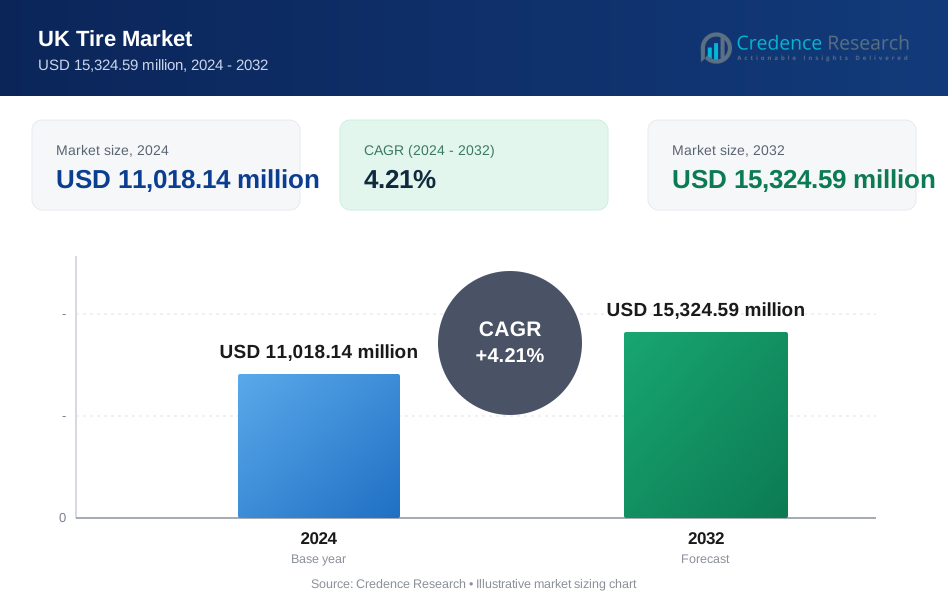
| UK Tire Market Size 2024 | USD 11,018.14 million |
| UK Tire Market, CAGR | 4.21% |
| UK Tire Market Size 2032 | USD 15,324.59 million |
Market Overview
UK Tire market size was valued at USD 11,018.14 million in 2024 and is anticipated to reach USD 15,324.59 million by 2032, at a CAGR of 4.21% during the forecast period (2024-2032).
The UK tire market is experiencing steady growth, driven by increasing vehicle ownership, rising demand for replacement tires, and advancements in tire technologies that enhance fuel efficiency and safety. The surge in electric vehicle (EV) adoption has further fueled the need for specialized tires designed to support higher torque and lower rolling resistance. Additionally, government regulations promoting road safety and sustainable transportation are encouraging consumers to invest in high-quality, long-lasting tires. The growing popularity of all-season and run-flat tires is also influencing market dynamics, as consumers seek convenience and enhanced performance. Moreover, the expansion of e-commerce platforms has improved tire accessibility and competitive pricing, supporting market expansion. Key market players are increasingly focusing on product innovation, including the use of eco-friendly materials and smart tire technologies, to meet evolving consumer preferences and environmental goals. These factors collectively contribute to the robust outlook of the UK tire market during the forecast period.
The UK tire market is influenced by diverse geographical factors, with key regions such as London, Manchester, Birmingham, and Scotland driving significant demand. Urban areas like London and Manchester exhibit high demand due to dense populations, a large number of vehicles, and the increasing preference for high-performance and electric vehicle tires. Meanwhile, regions with industrial and agricultural activities, such as Birmingham and Scotland, contribute to the demand for commercial vehicle and off-road tires. Key players in the market include prominent tire manufacturers such as Michelin and Pirelli, alongside established retailers like Kwik Fit, Halfords, and ATS Euromaster. These companies play a pivotal role in providing a wide range of tire solutions, from passenger car to commercial and specialty tires. Their strategic positioning across key regions allows them to cater to both urban and rural markets, ensuring a comprehensive and competitive landscape in the UK tire industry.
Market Insights
- The UK tire market was valued at USD 11,018.14 million in 2024 and is expected to reach USD 15,324.59 million by 2032, growing at a CAGR of 4.21% during the forecast period.
- The global tire market was valued at USD 3,29,521.50 million in 2024 and is projected to reach USD 4,62,900.23 million by 2032, growing at a CAGR of 4.34% during the forecast period.
- Increasing demand for high-performance, all-season, and eco-friendly tires is driving market growth, particularly in urban areas.
- The shift towards electric vehicles (EVs) and rising emphasis on sustainable tire production are key trends impacting the market.
- Leading companies like Michelin, Pirelli, Kwik Fit, Halfords, and ATS Euromaster dominate the competitive landscape with strong retail and service networks.
- The UK tire market faces challenges from volatile raw material prices and increasing regulatory pressures on tire disposal and environmental standards.
- Regional demand is concentrated in major cities such as London, Manchester, Birmingham, and Scotland, driven by varying consumer needs and industrial activities.
- Digital transformation in tire retailing, with e-commerce and smart tire technologies, is reshaping consumer purchasing behaviors.
Report Scope
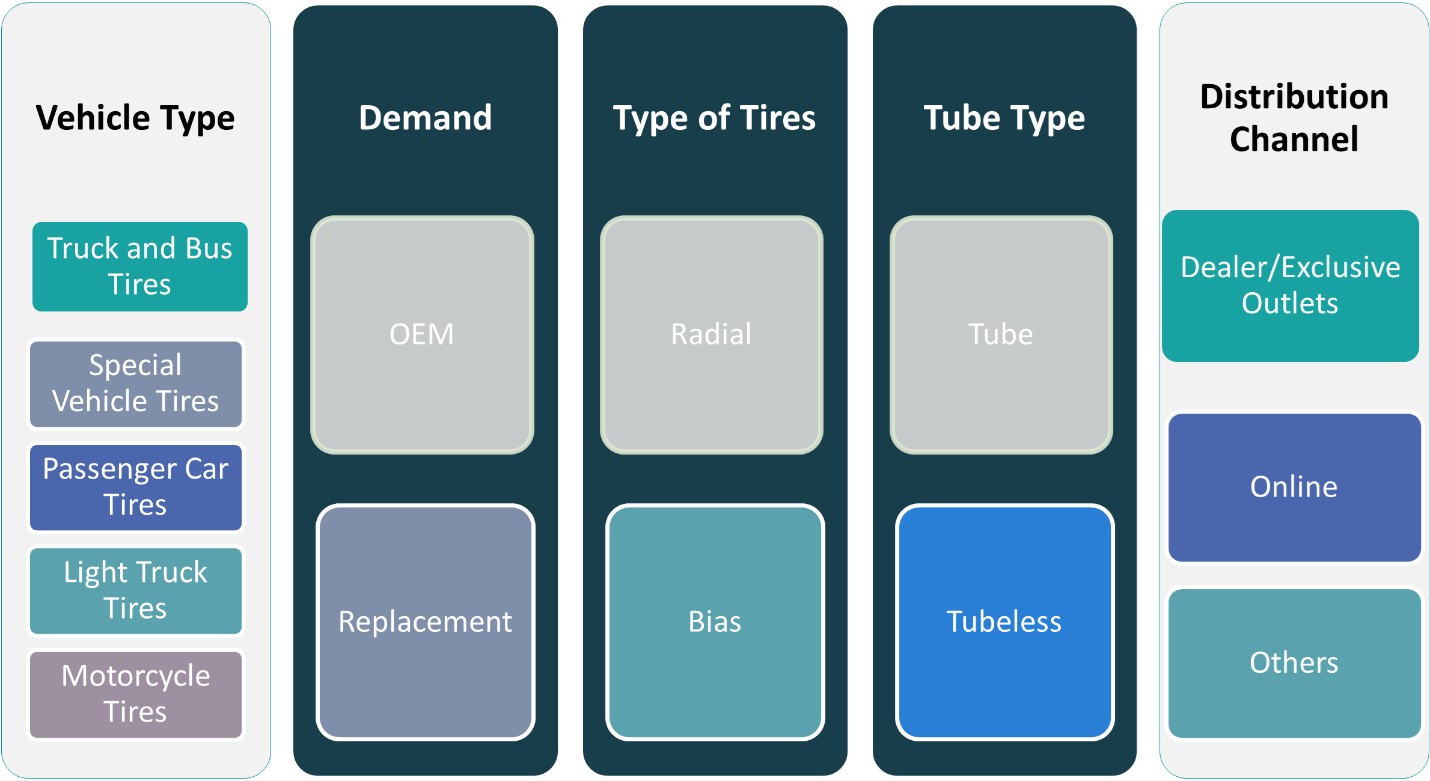
This report segments the UK Tire Market as follows:
Market Drivers
Rising Vehicle Ownership and Fleet Expansion
The continuous rise in vehicle ownership across the UK remains a primary driver of the tire market. With a growing population and increased urbanization, the number of passenger cars and commercial vehicles on the road has surged significantly. For instance, the UK government’s vehicle licensing statistics indicate a steady increase in registered vehicles, reflecting rising ownership rates. In addition, fleet operators in the logistics and transportation sectors are expanding their vehicle bases to meet the rising demand for home deliveries and efficient cargo movement. This directly translates to a higher demand for both original equipment and replacement tires. The regular wear and tear from extensive road usage, especially in the commercial segment, fuels the replacement tire segment, creating a consistent demand cycle. Furthermore, improved road infrastructure and intercity connectivity encourage long-distance travel, resulting in accelerated tire usage and higher replacement rates.
Accelerating Shift Towards Electric and Hybrid Vehicles
The UK government’s aggressive push for cleaner mobility solutions has significantly boosted the adoption of electric and hybrid vehicles, which has in turn impacted the tire market. Electric vehicles (EVs) require tires with specific characteristics such as low rolling resistance, enhanced durability, and the ability to support higher torque. For instance, the UK’s electric vehicle fleet surpassed 1.47 million cars in 2023, including battery-electric and hybrid models. As a result, tire manufacturers are investing in research and development to design and produce EV-compatible tires. With EV registrations on the rise and internal combustion engine vehicle sales facing gradual restrictions, the demand for innovative tire solutions is gaining momentum. The shift is also prompting aftermarket players to diversify their offerings with specialized products, further fueling growth in the premium and performance tire segments.
Emphasis on Safety and Regulatory Compliance
Road safety remains a key priority for both consumers and regulatory authorities in the UK. Stricter government regulations mandating regular tire checks and minimum tread depth requirements have led to increased consumer awareness regarding tire performance and maintenance. Safety-conscious buyers are now more inclined to replace tires proactively to ensure optimal vehicle control and braking efficiency. Additionally, seasonal tire regulations and unpredictable weather patterns have prompted many vehicle owners to invest in all-season or winter-specific tires. The heightened focus on regulatory compliance has created a favorable environment for high-quality tire brands that emphasize durability, grip, and performance, thereby supporting market growth across various vehicle categories.
Technological Advancements and E-Commerce Expansion
Advancements in tire manufacturing technologies and materials have played a pivotal role in driving market expansion. The integration of smart features such as tire pressure monitoring systems (TPMS) and self-sealing capabilities are gaining traction among tech-savvy consumers. Moreover, manufacturers are increasingly adopting sustainable materials and processes to align with the UK’s green initiatives. Simultaneously, the rise of e-commerce platforms has transformed the tire retail landscape by offering consumers convenience, product variety, and competitive pricing. Online platforms now allow customers to compare tire specifications, access user reviews, and schedule doorstep installation services, thereby enhancing the overall buying experience. This digital transformation has made tires more accessible to a wider audience, reinforcing demand across both urban and rural regions.
Market Trends
Growing Demand for High-Performance and All-Season Tires
One of the prominent trends in the UK tire market is the rising demand for high-performance and all-season tires. Consumers are increasingly prioritizing tires that offer superior handling, enhanced safety, and better traction in varying weather conditions. For instance, the UK tire market is experiencing a notable shift toward premium and ultra-high-performance tires, particularly among SUV and luxury vehicle owners. With the UK's unpredictable climate, all-season tires have gained significant traction as they offer a practical solution without the need for frequent seasonal changes. High-performance tires are also gaining momentum among owners of luxury and sports vehicles, who seek improved cornering and braking performance. This shift in consumer preference has encouraged manufacturers to develop tires with optimized tread designs and advanced rubber compounds to meet diverse performance expectations.
Emphasis on Sustainability and Eco-Friendly Materials
Sustainability has become a major focus area in the UK tire industry, influenced by environmental regulations and increasing consumer awareness. Tire manufacturers are actively exploring eco-friendly materials such as soybean oil, recycled rubber, and silica to reduce the environmental footprint of tire production. For instance, the UK tire market is witnessing a surge in demand for sustainable and eco-friendly tires, with manufacturers investing in research and development to introduce recyclable materials and low rolling resistance designs. The shift toward green manufacturing processes and sustainable product life cycles reflects the broader national goals of achieving carbon neutrality and reducing waste. Additionally, initiatives promoting tire recycling and retreading are gaining ground, offering a cost-effective and environmentally conscious alternative to tire disposal. As the UK government intensifies its climate change policies, sustainability is expected to remain a long-term trend influencing product development and brand positioning.
Integration of Smart Tire Technologies
Technological innovation continues to shape the UK tire market, with smart tires emerging as a key trend. These advanced tires are embedded with sensors that monitor critical parameters such as air pressure, temperature, tread wear, and load. The data generated is relayed in real-time to vehicle systems or mobile apps, enabling proactive maintenance and enhancing vehicle safety. This trend is especially relevant for fleet operators who rely on predictive analytics to optimize vehicle performance and minimize downtime. As connected vehicles and autonomous driving technologies evolve, smart tire solutions are expected to become a standard feature, driving demand for intelligent tire systems across the market.
Rise of E-Commerce and Omnichannel Distribution
The expansion of e-commerce and digital retail platforms has significantly reshaped how tires are bought and sold in the UK. Consumers now prefer online channels for tire purchases due to the ease of price comparison, wider selection, and convenience of home delivery and installation services. Many tire manufacturers and retailers are adopting an omnichannel approach, combining online sales with physical service centers to enhance customer experience. The ability to access detailed product information, user reviews, and virtual fitment tools online has empowered consumers to make informed decisions, thereby accelerating tire sales through digital platforms.
Market Challenges Analysis
Volatile Raw Material Prices and Supply Chain Disruptions
One of the most pressing challenges faced by the UK tire market is the volatility in raw material prices, particularly rubber, carbon black, and synthetic polymers. These fluctuations significantly impact production costs, putting pressure on manufacturers to balance pricing strategies without compromising product quality. For instance, the UK government has introduced a critical imports and supply chain strategy to safeguard vital goods and mitigate risks associated with supply chain shocks. Additionally, the UK’s dependency on imported raw materials makes it vulnerable to global supply chain disruptions, especially in the post-Brexit trade environment. Delays at ports, increased tariffs, and customs regulations have created logistical hurdles that can lead to longer lead times and increased operational expenses. Such factors can limit inventory availability and impact timely product delivery, ultimately affecting customer satisfaction and brand loyalty.
Intense Market Competition and Regulatory Pressures
The UK tire market is highly competitive, with numerous domestic and international players vying for market share. Price wars among budget and premium brands have intensified, making it difficult for smaller manufacturers to maintain profitability. Additionally, regulatory compliance related to tire labeling, environmental safety, and waste management adds another layer of complexity for manufacturers and distributors. Meeting stringent standards such as wet grip performance, rolling resistance, and noise emission under the EU tire labeling regulation requires continuous investment in R&D and testing. For smaller players with limited resources, adhering to these requirements while staying competitive on pricing can be particularly challenging. Moreover, improper tire disposal and growing environmental concerns about non-biodegradable waste have increased scrutiny from environmental agencies, pushing the industry to adopt more sustainable practices under tight regulatory oversight.
Market Opportunities
The UK tire market presents significant growth opportunities driven by evolving mobility trends, technological innovation, and shifting consumer preferences. The increasing adoption of electric and hybrid vehicles offers a substantial opportunity for tire manufacturers to develop and supply specialized tires designed to handle higher torque and lower rolling resistance, which are essential for enhancing EV efficiency and range. As the UK government pushes forward with its net-zero emissions goals and bans on new petrol and diesel vehicle sales by 2035, the demand for EV-compatible tires is expected to rise considerably. This shift opens up avenues for tire makers to introduce advanced products tailored to electric drivetrains, tapping into a rapidly expanding segment. Additionally, the rise in urban mobility solutions, such as car-sharing and last-mile delivery services, is creating consistent demand for durable, long-lasting tires that can withstand high usage frequencies.
Another major opportunity lies in the digital transformation of tire retailing and servicing. The growing preference for e-commerce channels allows tire brands and distributors to reach a broader customer base through online platforms that offer product comparisons, user reviews, and doorstep installation services. By leveraging digital tools, companies can enhance customer engagement, streamline the purchasing process, and build brand loyalty. Furthermore, innovations in smart tire technologies, such as embedded sensors for real-time performance monitoring, present a competitive edge for manufacturers willing to invest in research and development. These features appeal not only to individual consumers but also to commercial fleet operators seeking to reduce downtime and maintenance costs. As environmental awareness increases, tire manufacturers also have an opportunity to capitalize on the growing demand for eco-friendly products by integrating sustainable materials and processes into their production lines. These emerging trends offer long-term growth potential for companies that can align their strategies with evolving market expectations in the UK.
Market Segmentation Analysis:
By Vehicle Type:
The UK tire market is segmented by vehicle type into passenger car tires, light truck tires, motorcycle tires, truck and bus tires, and special vehicle tires. Among these, passenger car tires account for the largest market share due to the high volume of private vehicle ownership and daily urban commuting needs. Increasing consumer preference for all-season and high-performance tires is further driving demand in this segment. Light truck tires are also witnessing steady growth, supported by rising e-commerce activity and the expansion of last-mile delivery services across urban and suburban areas. Truck and bus tires play a crucial role in supporting logistics and public transportation networks, creating recurring demand for robust and high-durability tires. Meanwhile, motorcycle tires benefit from growing two-wheeler ownership in congested city areas where they serve as a cost-effective mobility solution. Special vehicle tires, used in sectors such as agriculture, construction, and industrial operations, represent a niche yet vital segment, driven by infrastructure development and heavy-duty applications.
By Demand:
Based on demand, the UK tire market is categorized into OEM (Original Equipment Manufacturer) and Replacement segments. The replacement tire segment dominates the market, supported by the UK’s extensive existing vehicle fleet and the need for regular tire replacements due to wear and tear, seasonal changes, and safety considerations. Increased consumer awareness of tire quality, performance, and sustainability is also prompting a shift toward premium and eco-friendly replacement options. On the other hand, the OEM segment is closely linked to new vehicle sales and manufacturing activity. While its market share is smaller, it holds steady growth potential, particularly with the rising production of electric and hybrid vehicles requiring factory-fitted specialized tires. OEM demand is also influenced by partnerships between vehicle manufacturers and tire companies, which can boost brand visibility and long-term loyalty. Overall, the replacement market’s dominance, coupled with evolving OEM needs, creates a balanced and diverse demand landscape in the UK tire industry.
Segments:
Based on Vehicle Type:
- Truck and Bus Tires
- Special Vehicle Tires
- Passenger Car Tires
- Light Truck Tires
- Motorcycle Tires
Based on Demand:
- OEM
- Replacement
Based on Type of Tires:
- Radial
- Bias
Based on Tube Type
- Tube
- Tubeless
Based on Distribution Channel:
- Dealer/Exclusive Outlets
- Online
- Others
Based on the Geography:
- London
- Manchester
- Birmingham
- Scotland
Regional Analysis
London
London holds the largest share of the UK tire market, accounting for approximately 33% in 2024. The dominance of the capital region is attributed to its dense population, extensive private and commercial vehicle ownership, and a well-established transportation network. The high volume of passenger cars, taxis, ride-sharing fleets, and delivery vehicles generates substantial demand for both OEM and replacement tires. Moreover, London’s emphasis on sustainability and its growing electric vehicle (EV) penetration supports the demand for specialized EV tires with low rolling resistance and high durability. The presence of a large number of premium car owners also fuels the market for high-performance and all-season tires. Additionally, stringent regulations regarding tire safety, emissions, and vehicle maintenance encourage timely replacements, contributing to consistent market turnover. With numerous service stations, online platforms, and mobile fitting services available, consumers in London have easy access to a wide range of tire options, enhancing overall sales and reinforcing the region’s leadership in the UK tire market.
Manchester
Manchester contributes approximately 21% to the UK tire market, making it a significant regional player. The city’s growing urban population, industrial base, and vibrant commercial activity have led to increasing ownership of private and light commercial vehicles. With the rise in e-commerce, logistics providers in Greater Manchester rely heavily on delivery vans and small trucks, driving consistent demand for light truck and replacement tires. Additionally, the city’s adoption of smart transportation initiatives and electric mobility encourages the development of infrastructure supporting EV tires and associated services. Local consumers increasingly favor digital platforms for tire purchases and scheduling installation, contributing to the regional market’s modernization. The city’s diverse climate also leads to seasonal tire replacements, especially among consumers who prioritize performance and safety. Regional distributors and independent retailers continue to play a key role in meeting this dynamic demand, positioning Manchester as a strategically important region for tire manufacturers and suppliers.
Birmingham
Birmingham holds an estimated 19% share of the UK tire market, driven by its role as a major manufacturing and logistics hub. As one of the UK’s most connected cities, it hosts significant commercial vehicle traffic, which generates recurring demand for robust and long-lasting tires. The city’s strategic location in the Midlands makes it a key base for transport and freight operations, fueling tire demand in both the truck and bus segment. Birmingham’s strong aftermarket ecosystem, including independent garages and national tire chains, ensures that consumers have access to a broad selection of tire brands and services. The increasing trend toward fleet leasing and contract hire in the region has also contributed to higher volumes of tire replacements as operators prioritize road safety and vehicle uptime. Additionally, government initiatives promoting green mobility are gradually influencing the local market for EV-compatible and sustainable tires, further diversifying the product landscape in Birmingham.
Scotland
Scotland accounts for around 13% of the UK tire market, supported by its diverse geographical landscape and widespread reliance on vehicles for rural and intercity travel. The region exhibits strong demand for all-season and winter tires, particularly in northern and highland areas where weather conditions are more severe. The importance of agricultural, construction, and forestry sectors also drives the need for specialty tires suited to off-road and heavy-duty use. In urban centers like Glasgow and Edinburgh, rising vehicle ownership and expanding public transportation fleets contribute to the growth of passenger car and bus tire segments. Furthermore, the Scottish Government’s push toward net-zero transportation has supported infrastructure development for EVs, gradually increasing demand for next-generation tire technologies. While Scotland’s share is smaller compared to major English cities, its unique mix of terrain, climate, and industrial needs makes it a vital component of the UK’s overall tire market landscape.
Key Player Analysis
- Michelin
- Pirelli
- Kwik Fit
- Halfords
- ATS Euromaster
Competitive Analysis
The UK tire market is highly competitive, with leading players such as Michelin, Pirelli, Kwik Fit, Halfords, and ATS Euromaster maintaining significant market presence. Companies in the market are focusing on innovation to differentiate themselves, particularly in the development of high-performance tires, electric vehicle (EV)-compatible tires, and eco-friendly products. Premium tire manufacturers are capitalizing on advancements in tire technology, offering products with improved fuel efficiency, durability, and safety features, which appeal to both consumer and commercial vehicle segments. Retailers and service providers are also highly competitive, offering a combination of product availability, affordability, and customer convenience. Many have expanded their services to include mobile fitting, online tire purchasing, and doorstep delivery, catering to the growing demand for convenience and time-saving solutions. Furthermore, the rise of digital platforms has intensified competition, with companies increasingly leveraging e-commerce channels to enhance their market reach and engage with consumers directly. In addition, commercial and fleet tire services are becoming increasingly important, with companies focusing on providing specialized solutions for businesses in logistics, public transport, and construction. The market's competitive dynamics are driven by these companies' ability to meet diverse consumer needs, adapt to evolving mobility trends, and stay ahead of regulatory requirements, including those related to sustainability and tire disposal.
Recent Developments
- In May 2025,Continental reported its best Q1 earnings since 2021, with adjusted group earnings of €586 million, driven by cost reductions and a rebound in tire replacement demand. The company is undergoing a major overhaul, spinning off its automotive unit and planning to divest the ContiTech industrial division to focus on its profitable tires business.
- In March 2025, Bridgestone announced its 2025 motorsports plan, continuing support for professional and grassroots motorsports globally. The company is emphasizing sustainable motorsport as a "mobile laboratory" to refine technologies for commercial tire development. Bridgestone remains the exclusive tire supplier for major race series, including Japan’s SUPER GT and North America’s NTT INDYCAR® SERIES.
- In March 2025, Michelin was named one of the world's 100 most innovative companies by Clarivate, recognizing its strong R&D capabilities. The company also launched the MICHELIN City Touring tire for bicycles, emphasizing safety and sustainability.
- In February 2025,Goodyear announced a capacity expansion at its Lawton, Oklahoma facility, targeting production of 10 million additional premium tires annually, especially larger rim sizes and higher-margin segments.
- In January 2025,Apollo highlighted double-digit growth in commercial vehicle and farm tires, high single-digit growth in passenger car tires, and continued investment in R&D and AI-driven efficiency. The company is also investing in natural rubber cultivation in India to address commodity challenges.
Market Concentration & Characteristics
The UK tire market exhibits moderate concentration, with a mix of dominant multinational tire manufacturers and strong local retailers and service providers. While a few global players control a significant share of the market, the presence of numerous regional and independent companies ensures a competitive landscape. The market is characterized by its diverse customer base, which includes private vehicle owners, commercial fleets, and specialized sectors such as agriculture and construction. Companies in the market offer a wide range of tire types, from budget to premium options, to cater to different needs. The demand for high-performance, eco-friendly, and electric vehicle-compatible tires is growing, driving innovation and technological advancements in tire design and manufacturing. Retailers and service providers play a critical role in the market, offering value-added services such as mobile fitting and online sales platforms, enhancing customer convenience and expanding market reach. This combination of competition and innovation shapes the UK tire market.
Report Coverage
The research report offers an in-depth analysis based on Vehicle Type, Demand, Type of Tires, Tube Type, Distribution Channel and Geography. It details leading market players, providing an overview of their business, product offerings, investments, revenue streams, and key applications. Additionally, the report includes insights into the competitive environment, SWOT analysis, current market trends, as well as the primary drivers and constraints. Furthermore, it discusses various factors that have driven market expansion in recent years. The report also explores market dynamics, regulatory scenarios, and technological advancements that are shaping the industry. It assesses the impact of external factors and global economic changes on market growth. Lastly, it provides strategic recommendations for new entrants and established companies to navigate the complexities of the market.
Future Outlook
- The UK tire market is expected to continue growing steadily due to increasing vehicle ownership and the expansion of the electric vehicle segment.
- Rising consumer demand for eco-friendly and sustainable tire solutions will drive innovation in materials and manufacturing processes.
- The growth of e-commerce and online tire purchasing platforms will further reshape the retail landscape, making tire buying more convenient.
- Technological advancements in tire design, such as smart tires and improved durability features, will become increasingly common.
- As urban mobility solutions like ride-sharing and delivery services expand, demand for durable, high-mileage tires will rise.
- The shift toward electric vehicles will create a need for specialized tires that offer low rolling resistance and better energy efficiency.
- Government regulations promoting environmental sustainability and reduced carbon footprints will push manufacturers to prioritize eco-friendly tire options.
- The UK’s growing emphasis on safety standards and tire performance will drive demand for premium tires equipped with advanced safety features.
- Increased consumer awareness regarding tire maintenance and performance will boost the demand for high-quality replacement tires.
- The competitive landscape will become more fragmented as new entrants focus on niche markets, such as off-road tires and EV-specific solutions.
Request a Free Sample
Fill in your details and we'll send you a free sample report.
- Sample data tables & charts
- Research methodology
Need a Custom Version of This Report?
Tailor the scope, geography, or segments to your exact requirements.
- Custom geography or segment scope
- Direct access to our analyst team
Frequently Asked Questions
What is the current size of the UK Tire?
What factors are driving the growth of the UK Tire?
What are some challenges faced by the UK Tire?
Who are the major players in the UK Tire?
Table of Content
Chapter 1. Report Introduction
- 1.1 Report Description & Purpose
- 1.1.1 Report Title & Market Definition
- 1.1.2 Unique Selling Propositions (USP) & Key Differentiators
- 1.1.3 Value Proposition for Stakeholders
- 1.2 Research Objectives
- 1.2.1 Market Sizing Objectives (Volume & Revenue) (Volume Where Applicable)
- 1.2.2 Segmentation Objectives
- 1.2.3 Competitive Intelligence Objectives
- 1.2.4 Forecast & Scenario Objectives
- 1.3 Report Scope
- 1.3.1 UK Tire Scope – Segments & Subsegments Covered
- 1.3.2 Geographic Scope – Selected Country & Subnational Markets Covered
- 1.3.3 Historical Period, Base Year & Forecast Period (2024; forecast to 2032)
- 1.3.4 Inclusions & Exclusions
- 1.4 Industry Classification & Applicable Codes
- 1.5 Currency, Measurement Units & Valuation Basis
- 1.6 Target Stakeholders
- 1.7 Limitations & Assumptions
Chapter 2. Executive Summary
- 2.1 UK Tire Snapshot
- 2.1.1 Market Size – Historical (2024) & Forecast (2024-2032) (2024: USD 11,018.14 million → 2032: USD 15,324.59 million)
- 2.1.2 Volume & Revenue – National Totals (Volume Where Applicable)
- 2.1.3 Key Market Highlights – Top Five Facts
- 2.2 UK Tire Segmentation Snapshot
- 2.2.1 Market Split by Subnational Area – 2024 vs. 2032
- 2.3 Competitive Snapshot
- 2.3.1 Top 10 Players by Revenue Share – 2024
- 2.3.2 Top 10 Players by Volume Share – 2024 (Volume Where Applicable)
- 2.3.3 Recent Strategic Developments (18-Month Summary)
- 2.4 Key Investment Highlights & Strategic Conclusions
Chapter 3. UK Tire Dynamics & Industry Analysis
- 3.1 Market Overview & Context
- 3.1.1 UK Tire Position in the Broader Industry Value Chain
- 3.1.2 Demand Structure & Purchasing Dynamics
- 3.1.3 Market Maturity & Development Stage Across Domestic Markets
- 3.2 UK Tire Drivers
- 3.3 UK Tire Restraints & Challenges
- 3.4 UK Tire Opportunities
- 3.5 Porter's Five Forces Analysis
- 3.5.1 Threat of New Entrants
- 3.5.2 Bargaining Power of Suppliers
- 3.5.3 Bargaining Power of Buyers
- 3.5.4 Threat of Substitutes
- 3.5.5 Competitive Rivalry – Intensity Assessment
- 3.6 UK Tire Value Chain Analysis
- 3.6.1 Upstream – Key Inputs, Resources & Suppliers
- 3.6.1.1 Key Input/Resource 1
- 3.6.1.2 Key Input/Resource 2
- 3.6.1.3 Key Input/Resource 3
- 3.6.2 Midstream – Core Operations & Value Creation
- 3.6.2.1 Operating Model & Process Overview
- 3.6.2.2 Key Operating Locations & Capabilities by Company
- 3.6.3 Downstream – Market Channels & End Users
- 3.6.3.1 Direct Sales & Customer Engagement Channels
- 3.6.3.2 Indirect Sales, Intermediaries & Partner Channels
- 3.6.4 Value Chain Profitability Analysis
- 3.6.1 Upstream – Key Inputs, Resources & Suppliers
- 3.7 PESTEL Analysis
- 3.7.1 Political Factors
- 3.7.2 Economic Factors
- 3.7.3 Social Factors
- 3.7.4 Technological Factors
- 3.7.5 Environmental Factors
- 3.7.6 Legal Factors
- 3.8 UK Tire Supply Chain Analysis
- 3.8.1 Critical Input & Resource Availability Risk Assessment
- 3.8.2 Supplier & Operational Concentration Risk (Geographic Exposure)
- 3.8.3 Supply & Service Disruption Impact Analysis
- 3.9 National & Subnational Regulatory Landscape
Note: The regulatory and policy landscape section covers regulations based on their applicability to the market, UK Tire category, geography, and scope of the study. Only regulatory frameworks with a material impact on operations, compliance, trade, sustainability, or market access are analyzed in detail.
Chapter 4. Key Investment Pockets & Opportunity Analysis
- 4.1 UK Tire Attractiveness Analysis
- 4.1.1 By Subnational Area – Investment Attractiveness Matrix (Market Size × CAGR)
- 4.2 Absolute Revenue Growth Opportunity
- 4.2.1 By Subnational Area – Absolute Revenue Growth Through 2032
- 4.3 Incremental Demand Opportunity
- 4.3.1 By Subnational Area – Incremental Demand Through 2032
- 4.3.2 Segment – Incremental Demand
- 4.4 Emerging Submarket Opportunity Deep Dive (Subject to Applicability)
- 4.5 Priority Domestic Market Opportunity Scorecards
- 4.5.1 Priority Domestic Market 1
- 4.5.2 Priority Domestic Market 2
- 4.5.3 Priority Domestic Market 3
- 4.5.4 Priority Domestic Market 4
Note: Domestic market scorecards cover relevant states, provinces, territories, cities, or economic zones within the selected country. Numbered entries are populated with market names suited to the national administrative structure and research scope. Geographic share tables use one consistent, nonoverlapping set of areas.
Chapter 5. UK Tire Cross-Border Trade & Market Access Analysis
- 5.1 National Trade & International Partner Overview
- 5.1.1 Export Value by Destination Country (2024)
- 5.1.2 Export Volume by Destination Country (2024) (Where Applicable)
- 5.1.3 Import Value by Source Country (2024)
- 5.1.4 Import Volume by Source Country (2024) (Where Applicable)
- 5.1.5 National & Partner-Country Trade Balances (2024)
- 5.2 Export Analysis – Segment
- 5.2.1 Category 1 (Applicable Classification Code)
- 5.2.2 Category 2 (Applicable Classification Code)
- 5.2.3 Category 3 (Applicable Classification Code)
- 5.2.4 Category 4 (Applicable Classification Code)
- 5.2.5 Category 5 (Applicable Classification Code)
- 5.3 Import Analysis – Segment
- 5.3.1 Category 1 (Applicable Classification Code)
- 5.3.2 Category 2 (Applicable Classification Code)
- 5.3.3 Category 3 (Applicable Classification Code)
- 5.3.4 Category 4 (Applicable Classification Code)
- 5.3.5 Category 5 (Applicable Classification Code)
- 5.4 Cross-Border Pricing & Transaction Benchmarks
- 5.4.1 Export Pricing – Segment & Destination Country
- 5.4.2 Import Pricing – Segment & Source Country
- 5.4.3 Price Trends (2024)
- 5.5 Key Cross-Border Trade & Delivery Routes
- 5.5.1 Cross-Border Trade/Delivery Route 1
- 5.5.2 Cross-Border Trade/Delivery Route 2
- 5.5.3 Cross-Border Trade/Delivery Route 3
- 5.5.4 Cross-Border Trade/Delivery Route 4
- 5.5.5 Cross-Border Trade/Delivery Route 5
- 5.6 Trade Policy & Market Access Impact Assessment
- 5.6.1 Tariff & Non-Tariff Barriers
- 5.6.2 National Participation in Regional Trade & Economic Frameworks
- 5.6.3 Bilateral & Multilateral Trade Agreements
- 5.6.4 Cross-Border Operating, Licensing & Localization Requirements
Note: This chapter covers international trade relevant to UK Tire in the selected country. Exports are analyzed by destination and imports by source. Domestic interregional flows are excluded from international trade totals. Goods, services, and digital offerings use applicable classifications; volume and route analyses apply only where meaningful.
Chapter 6. Competitive Landscape & Company Benchmarking
- 6.1 UK Tire Concentration & Structure
- 6.1.1 Herfindahl-Hirschman Index (HHI) – vs. 2024
- 6.1.2 Leading, Mid-Sized & Emerging Player Structure
- 6.1.3 Multinational, National & Local Player Dynamics
- 6.2 UK Tire Share Analysis – 2024
- 6.2.1 National Revenue Share by Company
- 6.2.2 National Volume Share by Company (Volume Where Applicable)
- 6.2.3 Company Revenue Share by Subnational Area
- 6.2.4 Market Share Evolution ( vs. 2024)
- 6.2.5 Company Market Share by Key Segment
- 6.2.6 Company Market Share by Customer Group
- 6.3 Operating Scale, Capacity & Infrastructure Analysis
- 6.3.1 National Operating Scale & Supply Capacity
- 6.3.2 Resource Utilization & Operating Efficiency
- 6.3.3 Output, Service Delivery & Activity Metrics
- 6.3.4 Operating Footprint & Infrastructure Map
- 6.3.5 Planned Operational & Capacity Expansion
- 6.4 UK Tire Competitive Benchmarking Matrix
- 6.4.1 Revenue, Growth, Profitability & Operating Metric Comparison
- 6.4.2 Channel Revenue Mix
- 6.4.3 Revenue Exposure Across Domestic Markets
- 6.4.4 R&D Intensity
- 6.4.5 Sustainability Maturity
- 6.5 Strategic Developments in UK Tire (Last 24 Months)
- 6.5.1 Mergers, Acquisitions & Divestments
- 6.5.2 New Products, Services & Solutions in UK Tire
- 6.5.3 Operational & Infrastructure Expansions
- 6.5.4 Strategic Alliances, Joint Ventures & Partnerships
- 6.5.5 Distribution Expansion & Market Entry
- 6.5.6 Sustainability & ESG Initiatives
- 6.6 Competitive Strategy Mapping
- 6.6.1 Leader, Challenger, Follower & Niche Classification
- 6.6.2 Pricing Strategy Comparison
- 6.6.3 Channel Strategy Matrix
Note: Strategic developments are included based on their materiality and the availability of reliable information.
Chapter 7. UK Tire – By Sales & Delivery Channel
- 7.1 Segment Overview
- 7.1.1 Volume & Revenue Split by Channel (2024 & 2032) (Volume Where Applicable)
- 7.1.2 Channel Mix Evolution (2024-2032)
Chapter 8. Subnational Market Analysis – Country Overview
- 8.1 Domestic Geographic Market Overview
- 8.1.1 Subnational Volume Share (Where Applicable)
- 8.1.2 Subnational Revenue Share
- 8.1.3 Market Volume by Subnational Area (Where Applicable)
- 8.1.4 Market Revenue by Subnational Area
- 8.1.5 Subnational Forecasts Through 2032
- 8.2 Cross-Area Segment Analysis Within the Country
- 8.2.1 By Sales & Delivery Channel
- 8.2.2 By Competitive Positioning & Price Tier
Chapter 9. UK Tire – Priority Domestic Market 1
Chapter 10. UK Tire – Priority Domestic Market 2
Chapter 11. UK Tire – Priority Domestic Market 3
Chapter 12. UK Tire – Priority Domestic Market 4
Chapter 13. UK Tire Company Profiles
- 13.1 [Company 01]
- 13.1.1 Company Overview
- 13.1.2 Key Management Personnel
- 13.1.3 Products & Services Portfolio
- 13.1.4 Financial Performance
- 13.1.5 Domestic Market Focus & Local Operating Presence
- 13.1.6 Recent Developments & Strategic Initiatives
Note: The company profile list is preliminary and may change based on research findings, market developments, data availability, and client requirements.
Chapter 14. Appendices
- Appendix A – List of Abbreviations & Acronyms
- Appendix B – Industry Classification Code Reference – Full Series
- Appendix C – Supply, Output & Operating Capacity Data Tables
- Appendix D – End-Use & Demand Base Tables
- Appendix E – Demand, Adoption & Usage Assumptions
- Appendix F – Pricing & Revenue Metric Reference Tables
- Appendix G – Company Operations & Infrastructure Database
- Appendix H – Cross-Border Trade & Activity Data Tables (Where Applicable)
- Appendix I – Regulatory Summary Tables
- Appendix J – Primary Research Participant List (Anonymized)
- Appendix K – Primary Research Questionnaire Framework
- Appendix L – Data Sources & Bibliography
- Appendix M – Market Size Divergence & Source Comparison
Chapter 15. Research Methodology
- 15.1 Research Framework & Philosophy
- 15.2 Secondary Research – Sources, Hierarchy & Data Extraction
- 15.3 Data Modeling – National Market Sizing & Subnational Allocation
- 15.4 Primary Research – Stakeholder Framework, LOI & Sample Sizes
- 15.5 Forecast Methodology – Regression, Scenario & Sensitivity Analysis
- 15.6 Quality Control – Four-Layer Validation Framework
- 15.7 Limitations & Standard Assumptions
- 15.8 Disclaimer
