
| REPORT ATTRIBUTE | DETAILS |
|---|---|
| Historical Period | 2019-2022 |
| Base Year | 2023 |
| Forecast Period | 2024-2032 |
| Video Surveillance Equipment and Services Market Size 2023 | USD 54815.20 Million |
| Video Surveillance Equipment and Services Market, CAGR | 9.00% |
| Video Surveillance Equipment and Services Market Size 2032 | USD 119052.76 Million |
Market Insights
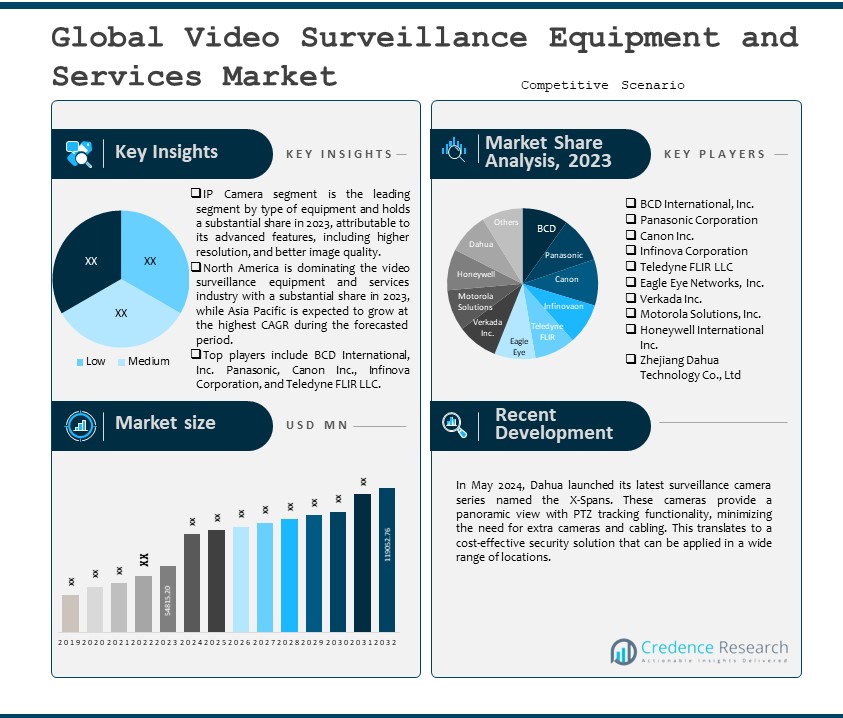
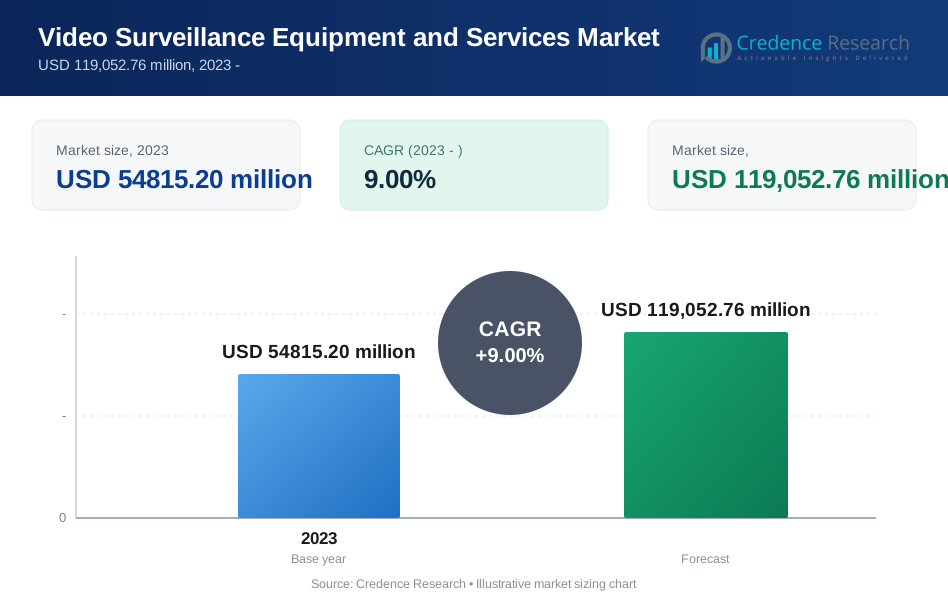
- The global demand for video surveillance equipment and services was valued at USD 54815.20 million in 2023 and is expected to reach USD 119052.76 million in 2032, growing at a CAGR of 9.00% between 2024 and 2032.
- In 2023, the IP Cameras (Network Cameras) was the market leader by type of equipment, accounting for the highest share in value 2023, while the Video Analytics segment is expected to grow rapidly throughout the forecast period.
- The Managed Services segment is predicted to grow fastest over the projection period, while Monitoring Services had the largest Service Offerings market share in 2023.
- Over the projection period, the Industrial segment is expected to expand at the fastest rate, and the Commercial segment dominates the market share in 2023.
- The market's primary possibilities include significant growth potential driven by several factors, including the integration of video surveillance systems with the Internet of Things (IoT) and the adoption of smart devices.
Executive Summary
Market Definition
Video surveillance equipment and services encompass hardware such as cameras, recording devices, and software used to monitor and record activities in specific areas for security or management purposes.
Typically, video surveillance systems capture and transmit video footage to centralized monitoring stations or cloud-based storage, where it can be accessed and reviewed in real time or retrospectively. Advanced systems may incorporate analytics and AI to automate monitoring, detect anomalies, and improve response times.
The advantages of video surveillance include enhancing security by deterring crime, providing evidence for investigations, improving situational awareness in real-time, and enabling remote monitoring capabilities, thereby bolstering overall safety and operational efficiency in various environments.
Market Overview
The global video surveillance equipment and services market has witnessed steady growth in recent years and is expected to grow at a CAGR of 9.00% between 2024 and 2032. The market was valued at USD 54815.20 million in 2023 and is expected to reach USD 119052.76 million in 2032.
The video surveillance market is propelled by ongoing advancements in high-definition cameras, artificial intelligence (AI)-powered analytics, and cloud-based solutions, which are significantly enhancing the capabilities and effectiveness of video surveillance systems. High-definition cameras deliver crystal-clear visuals, enabling operators to identify potential threats with greater accuracy. AI-powered analytics allows for intelligent data analysis that can predict and prevent security incidents.
Moreover, cloud-based solutions offer remote access and storage capabilities, ensuring footage is readily available for review and analysis, regardless of location. These combined technological advancements empower proactive security measures and contribute to a more secure environment.
Furthermore, government mandates and smart city initiatives are driving the installation of comprehensive surveillance infrastructure to enhance public safety and emergency management. These factors combine to significantly boost demand for video surveillance equipment and services.
On the other hand, the integration of video surveillance systems with the Internet of Things (IoT) presents a significant growth opportunity. IoT enables seamless device interconnection and data sharing, enhancing surveillance functionality, efficiency, and intelligence. It allows real-time remote monitoring and control of cameras, improving response times and situational awareness. IoT also enables advanced analytics and AI integration for smarter security solutions, automatically detecting anomalies and coordinating with other security measures such as access controls and alarms to create cohesive security ecosystems.
Segmentation by Type of Equipment
- IP Cameras is the leading segment by Type of Equipment and held the dominant share in value in 2023, attributable to the advanced features, including higher resolution, better image quality, and the capability to integrate with network systems for remote monitoring and management.
- The Video Analytics segment is expected to exhibit the highest CAGR during the forecast period. This growth is fueled by the integration of AI and machine learning technologies, which enhance the capabilities of video surveillance systems beyond traditional security uses. Video analytics can provide advanced functionalities such as behavior recognition, facial recognition, object detection, and anomaly detection, making them indispensable in modern security infrastructures and various commercial applications.
- The other segments also significantly contribute to the market share.
Segmentation by Service Offerings
- Monitoring services hold the largest market share within the hardware segment in terms of value in 2023. This dominance is driven by the increasing need for real-time surveillance and security across various sectors, such as retail, banking, transportation, and residential areas.
- Managed services devices are expected to be the fastest-growing segment. The rapid growth is attributed to the increasing adoption of cloud-based solutions, which offer flexibility, scalability, and reduced costs for businesses.
- Installation & integration and maintenance & support are anticipated to contribute significantly to the market growth.
Segmentation by End User Industries
- The commercial sector held the largest value share in 2023. This sector benefits from the widespread adoption of video surveillance to enhance security, monitor customer behavior, improve store management, and ensure safer work environments.
- The industrial sector segment is anticipated to register the highest CAGR during the projection period, as the deployment of advanced surveillance systems is critical to ensuring safety and security in these environments. The growing need for such solutions in industrial settings, combined with the integration of advanced technologies, including AI-driven video analytics, is driving rapid growth in this segment.
- Other sectors, including government & public, residential, healthcare & education segment, also contribute to the market share significantly.
Segmentation by Region
- North America drove the growth of the video surveillance equipment and services industry in 2023, driven by the growing use of facial recognition in different sectors across the region.
- Asia Pacific is anticipated to showcase the highest growth rate during the forecast period due to government initiatives, such as smart city developments, which are driving the adoption of video surveillance systems in Asia Pacific countries.
- The rest of the world, including Latin America, the Middle East, and Africa, supplies the remaining demand for video surveillance equipment and services.
North America holds the major share of the video surveillance equipment and services market and is expected to dominate the market throughout the forecast period. This is attributed to the increasing adoption of facial surveillance technologies across various sectors in this region. For instance, in January 2024, the Transportation Security Administration (TSA) implemented a refined facial recognition system that uses minimal data to accurately identify passengers, aiming to improve security measures while addressing privacy concerns. This system is implemented to modernize airport security, and leverages advanced algorithms to ensure high accuracy and minimize data storage and privacy risks.
On the other hand, the Asia Pacific region is anticipated to showcase the highest growth rate in the Video Surveillance Equipment and Services Market due to increasing smart city initiatives and urbanization. Governments across the region are heavily investing in smart city projects, integrating advanced surveillance systems to enhance public safety, traffic management, and overall urban living conditions.
For instance, China's smart city development plan includes extensive use of AI-powered surveillance cameras to monitor and manage urban environments effectively. Additionally, India's Smart Cities Mission aims to develop sustainable and citizen-friendly cities, incorporating state-of-the-art video surveillance technologies to ensure security and efficient public service delivery. These initiatives drive the demand for advanced surveillance solutions, contributing significantly to market growth in the Asia Pacific region.
Moreover, the presence of leading market players such as Zhejiang Dahua Technology Co., Ltd, Infinova Corporation, and Panasonic Corporation further fuels market growth in this region through the launch of numerous innovative products. For instance, in March 2023, Dahua updated its low-light product line by introducing the first Enhanced Night Color 180° panoramic camera series. This new series features a unique Electronic Pan Tilt Zoom (EPTZ) capability that can automatically track targets. Additionally, it includes a new 4MP dual-sensor camera that utilizes Dahua's improved Night Color technology, enhancing video surveillance capabilities.
Key Highlights of the Report
The global Video Surveillance Equipment and Services Market is segmented by type of equipment, service offerings, end-user industries, and region. IP Cameras will dominate the market in 2023, holding the largest value share. However, managed services are expected to see the fastest growth by service offerings, and the industrial sector remains the primary industry vertical, with North America leading the market share.
Technological advancements in high-definition cameras, AI-powered analytics, and cloud-based solutions are enhancing the capabilities of video surveillance systems, fueling market growth. Government mandates and smart city initiatives are driving the installation of comprehensive surveillance infrastructures to improve public safety and manage emergencies. These combined factors are significantly boosting the demand for video surveillance equipment and services.
Nonetheless, While North America is expected to hold the largest market share due to the increasing adoption of facial surveillance technologies across various sectors in this region, Asia Pacific is anticipated to see the fastest growth driven by government initiatives such as smart city development that have significantly promoted the use of video surveillance in the region.
What are The Main Drivers of The Global Video Surveillance Equipment and Services Market?
Technological advancements and government initiatives are major drivers of the video surveillance equipment and services market. Innovations in video surveillance technologies, such as high-definition cameras, AI-powered analytics, and cloud-based solutions, are significantly enhancing system capabilities and effectiveness. These advancements enable real-time monitoring, intelligent data analysis, and proactive security measures, fueling market growth. Additionally, increasing governmental mandates for installing surveillance systems in public places, along with smart city initiatives, are driving market expansion. Governments worldwide are prioritizing comprehensive surveillance infrastructures to enhance public safety, manage traffic congestion, and respond effectively to emergencies, thereby bolstering demand for video surveillance equipment and services.
What are The Major Challenges Faced by The Global Video Surveillance Equipment and Services Market?
Stricter privacy regulations pose a significant restraint to the growth of the video surveillance equipment and services market. These regulations, such as GDPR and CCPA, impose rigorous standards on data collection, storage, and usage, necessitating comprehensive compliance measures. Non-compliance can result in substantial fines and legal repercussions, creating additional costs and complexities for businesses. Consequently, these regulatory challenges can deter market adoption, slow down implementation timelines, and increase operational costs.
What Are The Growth Opportunities In The Global Video Surveillance Equipment and Services Market?
The integration of video surveillance systems with the Internet of Things (IoT) presents a significant growth opportunity for the market by enabling real-time remote monitoring, advanced analytics, and automated responses. IoT connectivity allows surveillance cameras to communicate seamlessly with other devices and systems, enhancing situational awareness, improving response times, and creating comprehensive security ecosystems. This integration also facilitates predictive maintenance, reducing downtime and operational costs.
Market Drivers
Several factors drive the global Video Surveillance Equipment and Services Market. The following are the key drivers of the global Video Surveillance Equipment and Services Market:
Technological advancements in video surveillance
Technological advancements in video surveillance are transforming the capabilities and efficacy of surveillance systems on multiple fronts. Advancements in high-definition cameras offer superior image clarity, enabling sharper monitoring and identification of individuals and objects in real time. This enhanced visual fidelity is crucial for critical applications such as facial recognition and license plate identification, bolstering security efforts across various sectors. For instance, In April 2024, Hikvision, a leading manufacturer of video surveillance equipment, launched the next generation of its Turbo HD line of analog security systems, called Turbo HD 8.0. This system features a new dual-lens camera that utilizes proprietary image-stitching technology to deliver seamless, 180-degree HD video coverage.
Moreover, the integration of artificial intelligence (AI) has revolutionized video analytics by enabling automated detection and analysis of anomalies and suspicious activities. AI-powered algorithms can discern patterns, detect unusual behaviors, and predict potential threats, significantly enhancing proactive security measures. This capability reduces response times and minimizes false alarms, optimizing resource allocation and operational efficiency.
Cloud-based solutions further amplify these benefits by enabling remote access, storage, and management of surveillance data. This flexibility streamlines operations and facilitates scalability and cost-effectiveness, making advanced surveillance technologies accessible to a broader range of organizations and applications.
Market Restraints
The global video surveillance equipment and services market faces some challenges that may hinder its growth. These include the following:
Stringent Privacy Regulations Restraints the Market Growth
Stricter privacy regulations pose a significant restraint to the growth of the video surveillance equipment and services market. With the increasing deployment of surveillance systems, concerns over privacy invasion and data security have intensified among individuals, organizations, and regulatory bodies. Many countries have enacted stringent data protection laws, such as the General Data Protection Regulation (GDPR) in Europe and the California Consumer Privacy Act (CCPA) in the United States, which impose rigorous standards on how personal data, including video footage, can be collected, stored, and utilized.
These regulations necessitate comprehensive compliance measures, including obtaining explicit consent from individuals being recorded, ensuring robust data encryption, and implementing strict access controls. Non-compliance can result in substantial fines and legal repercussions, creating additional costs and complexities for businesses deploying and managing video surveillance systems. Consequently, these regulatory challenges can deter market adoption, slow down implementation timelines, and increase operational costs, thereby restraining the overall market growth.
Opportunities
The global video surveillance equipment and services market offers significant growth opportunities. These include the following:
Integration of IoT into video surveillance systems
The integration of video surveillance systems with the Internet of Things (IoT) represents a significant growth opportunity for the market. IoT technology enables the interconnection of various devices and systems, facilitating seamless communication and data sharing among them. When applied to video surveillance, IoT integration can significantly enhance the functionality, efficiency, and intelligence of surveillance solutions.
One of the key benefits of IoT integration is the ability to enable real-time monitoring and control of surveillance systems from remote locations. For instance, surveillance cameras can be connected to a centralized network, allowing security personnel to access live feeds and control camera settings through mobile devices or web interfaces. This remote accessibility improves response times and situational awareness, particularly in critical scenarios.
Additionally, IoT-enabled video surveillance systems can leverage advanced analytics and artificial intelligence (AI) to provide smarter security solutions. These systems can automatically detect and analyze unusual activities, send alerts, and trigger automated responses such as locking doors or notifying authorities. By using IoT sensors and devices, surveillance systems can also integrate with other security measures, such as access control systems, fire alarms, and environmental sensors, to create comprehensive and cohesive security ecosystems.
Competitive Landscape
Key Players
The global Video Surveillance Equipment and Services Market is highly competitive, with several key players. Some of the major players in the market and their market share are as follows:
- BCD International, Inc.
- Panasonic Corporation
- Canon Inc.
- Infinova Corporation
- Teledyne FLIR LLC.
- Eagle Eye Networks, Inc.
- Verkada Inc.
- Motorola Solutions, Inc.
- Honeywell International Inc.
- Zhejiang Dahua Technology Co., Ltd
These organizations prioritize product innovation, distribution channel expansion, and mergers and acquisitions to stay competitive.
The global Video Surveillance Equipment and Services Market's key players continually seek to stay ahead by launching new products.
In May 2024, Dahua launched its latest surveillance camera series named the X-Spans. These cameras provide a panoramic view with PTZ tracking functionality, minimizing the need for extra cameras and cabling. This translates to a cost-effective security solution that can be applied in a wide range of locations.
In January 2024, Canon Inc. launched the "Video Enhancement Software Version 1.0" for its ultra-high-sensitivity camera series. This software enhances video visibility by utilizing AI-based noise reduction processing. Canon's proprietary technology achieves high-precision and high-speed noise reduction, enabling more accurate and real-time comprehension of subject information.
How are Companies Performing in the Video Surveillance Equipment and Services Market?
The global video surveillance equipment and services market is highly competitive, with several key players.
Startups are playing a transformative role in the Video Surveillance Equipment and Services industry by introducing cutting-edge technologies and innovative solutions. Startups are making substantial contributions in advanced AI and analytics with innovations of startups, including Deep Vision AI and Calipsa. Deep Vision AI provides real-time video analytics that can detect and identify objects, faces, and activities, offering valuable insights that enhance security and operational efficiency. Similarly, Calipsa utilizes AI to filter false alarms in surveillance systems, reducing the workload on human operators and improving the accuracy of threat detection.
Moreover, cybersecurity integration is a critical area where startups are making significant strides. Companies, including CyberLink and AnyVision, are embedding robust cybersecurity measures into their video surveillance systems to protect against hacking and unauthorized access. CyberLink’s FaceMe software combines facial recognition with stringent security protocols to ensure data security and compliance with privacy regulations. AnyVision’s technology enhances surveillance capabilities while incorporating features to maintain data integrity and prevent security breaches.
Furthermore, some startups are focusing on niche applications and custom solutions to address specific industry needs. For instance, Spot AI specializes in AI-driven video analytics for the logistics and manufacturing sectors, helping businesses improve safety and optimize operational processes. Also, Cocoon Cam offers specialized video monitoring solutions for baby monitoring, utilizing AI to detect movements and breathing patterns, thereby providing real-time alerts to parents.
Additionally, the integration of IoT technology into video surveillance is another significant contribution from startups. For instance, Verkada offers a hybrid cloud video surveillance solution that integrates IoT devices with AI analytics. This integration enables dynamic real-time alerts and automated responses to security incidents, making surveillance systems more efficient and effective. These innovative contributions by startups are fostering market growth.
Summary of Key Findings
- Technological innovation is propelling the video surveillance market. Advancements in high-definition cameras, AI analytics, and cloud solutions are empowering video surveillance systems, leading to increased market demand. Furthermore, government regulations and smart city initiatives are driving the installation of comprehensive surveillance infrastructure for improved public safety and emergency response.
- Market segmented by type of equipment, service offerings, end-user industries, and region.
- IP Cameras are the most popular, with the commercial sector remaining the primary end-user industry.
- North America is leading market growth; the market is highly competitive, with key players including BCD International, Inc., Panasonic Corporation, Canon Inc., Infinova Corporation, Teledyne FLIR LLC., Eagle Eye Networks, Inc., Verkada Inc., Motorola Solutions, Inc., Honeywell International Inc., Zhejiang Dahua Technology Co., Ltd.
Future Outlook
- Positive outlook for the global Video Surveillance Equipment and Services Market with significant growth potential in the Asia Pacific region.
- The key drivers accelerating the growth of the Video Surveillance Equipment and Services Market include advancements in high-definition cameras, AI-powered analytics, and cloud-based solutions, which are enhancing the capabilities of video surveillance systems and fueling market growth.
- During the forecast period, Stricter privacy regulations are expected to significantly restrain the growth of the Video Surveillance Equipment and Services Market.
- Key firms must focus on product innovation, growing market reach, and maintaining competitive pricing to keep ahead of the competition.
How CXOs Can Benefit from the Credence Research Video Surveillance Equipment and Services Market Report
The Credence Research Video Surveillance Equipment and Services Market Report provides CXOs with a comprehensive overview of the market, including:
- Market size and growth forecast:The report provides detailed estimates of the global Video Surveillance Equipment and Services Market size, segmented by type of equipment, service offerings, end-user industries, and region. It also includes forecasts for the market through 2032 based on key trends and drivers.
- Market segmentation:The report segments the Video Surveillance Equipment and Services Market by type of equipment, service offerings, end-user industries, and region. This segmentation provides CXOs with a granular understanding of the market and the opportunities in each segment.
- Competitive Landscape:The report profiles the key players in the Video Surveillance Equipment and Services Market and provides insights into their strategies, product offerings, and financial performance. This information can help CXOs to identify and assess their competition.
- Key trends and drivers:The report identifies and analyzes the key trends and drivers shaping the Video Surveillance Equipment and Services Market. This information can help CXOs make informed decisions about their investments and strategies.
CXOs can use the insights from the Credence Research Video Surveillance Equipment and Services Market Report to:
- Identify growth opportunities:The report can help CXOs identify new growth opportunities in the Video Surveillance Equipment and Services Market. For example, it identifies the growing demand for video surveillance equipment and services for remote monitoring access and data storage capabilities.
- Make informed investment decisions:The report can help CXOs make informed investment decisions about video surveillance equipment and services. For example, the report provides insights into the key factors to consider when evaluating video surveillance equipment and service providers.
- Develop competitive strategies:The report can help CXOs develop competitive strategies for their video surveillance equipment and services businesses. For example, the report identifies the key strategies that video surveillance equipment and service providers are using to differentiate themselves from their competitors.
- Track market developments:The report can help CXOs monitor market developments and stay ahead of the curve. For example, it provides insights into the latest trends and innovations in the video surveillance equipment and services market.
Overall, the Credence Research video surveillance equipment and services Market Report is a valuable resource for CXOs who are looking to gain a deeper understanding of the market and identify opportunities for growth.
Segmentation
- By Type of Equipment
- Cameras
- Analog Cameras
- IP Cameras (Network Cameras)
- HD and Ultra HD Cameras
- PTZ Cameras (Pan-Tilt-Zoom)
- Video Management Systems (VMS)
- Storage Solutions
- DVRs (Digital Video Recorders)
- NVRs (Network Video Recorders)
- Cloud Storage
- Video Analytics
- Accessories
- By Service Offerings
- Installation & Integration
- Maintenance & Support
- Monitoring Services
- Managed Services
- By End User Industries
- Commercial
- Government & Public Sector
- Industrial
- Residential
- Healthcare & Education
- By Region
- North America
- The U.S.
- Canada
- Mexico
- Europe
- Germany
- France
- The U.K.
- Italy
- Spain
- Rest of Europe
- Asia Pacific
- China
- Japan
- India
- South Korea
- South-east Asia
- Rest of Asia Pacific
- Latin America
- Brazil
- Argentina
- Rest of Latin America
- Middle East & Africa
- GCC Countries
- South Africa
- Rest of the Middle East and Africa
- North America
Adjacent Markets
In the Video Surveillance Equipment and Services Market, several adjacent markets have high revenue growth opportunities. The key adjacent markets for Video Surveillance Equipment and Services Market -
Adjacent Markets |
||
| IP Camera Market | Video Management Systems (VMS) Market | Smart Home Security Camera Market |
| Cloud-based Video Surveillance Market | Digital Video Recorder (DVR) Market | Mobile Video Surveillance Market |
| AI-Powered Video Analytics Market | Body-Worn Camera Market | Public Safety and Security Market |
Request a Free Sample
Fill in your details and we'll send you a free sample report.
- Sample data tables & charts
- Research methodology
Need a Custom Version of This Report?
Tailor the scope, geography, or segments to your exact requirements.
- Custom geography or segment scope
- Direct access to our analyst team
Frequently Asked Questions
What is the current size of the global video surveillance equipment and services market?
What is the expected growth rate of the Video Surveillance Equipment and Services Market between 2024 and 2032?
Which segment is leading the market share in terms of type of equipment?
Which service offerings predominate the demand for video surveillance equipment and services globally?
Which industry vertical is expected to post the highest CAGR during the forecast period?
Which region is fueling the growth of the video surveillance equipment and services industry?
Who are the major players in the global Video Surveillance Equipment and Services Market?
What are the major market drivers of the video surveillance equipment and services industry?
What are the major market restraints of the video surveillance equipment and services industry?
What are the major market opportunities of the video surveillance equipment and services industry?
Table of Content
Chapter 1. Report Introduction
- 1.1 Report Description & Purpose
- 1.1.1 Report Title & Market Definition
- 1.1.2 Unique Selling Propositions (USP) & Key Differentiators
- 1.1.3 Value Proposition for Stakeholders
- 1.2 Research Objectives
- 1.2.1 Market Sizing Objectives (Volume & Revenue)
- 1.2.2 Segmentation Objectives
- 1.2.3 Competitive Intelligence Objectives
- 1.2.4 Forecast & Scenario Objectives
- 1.3 Report Scope
- 1.3.1 Video Surveillance Equipment and Services Scope – Types & Subtypes Covered
- 1.3.2 Geographic Scope – Regions & Countries Covered
- 1.3.3 Historical Period, Base Year & Forecast Period (2023; forecast to the forecast period)
- 1.3.4 Inclusions & Exclusions
- 1.4 HS Code & Classification Framework
- 1.5 Currency, Units & Pricing Basis
- 1.6 Target Stakeholders
- 1.7 Limitations & Assumptions
Chapter 2. Executive Summary
- 2.1 Global Video Surveillance Equipment and Services Market Snapshot
- 2.1.1 Market Size – Historical (2023) & Forecast (the forecast period) (2023: USD 54815.20 million → forecast year: USD 119,052.76 million)
- 2.1.2 Volume & Revenue – Global Totals
- 2.1.3 Key Market Highlights – Top Five Facts
- 2.2 Video Surveillance Equipment and Services Market Segmentation Snapshot
- 2.2.1 Market Split by Region – 2023 vs.
- 2.3 Competitive Snapshot
- 2.3.1 Top 10 Players by Revenue Share – 2023
- 2.3.2 Top 10 Players by Volume Share – 2023
- 2.3.3 Recent Strategic Developments (18-Month Summary)
- 2.4 Key Investment Highlights & Strategic Conclusions
Chapter 3. Video Surveillance Equipment and Services Market Dynamics & Industry Analysis
- 3.1 Market Overview & Context
- 3.1.1 Video Surveillance Equipment and Services Market Position in the Broader Automotive Value Chain
- 3.1.2 OEM vs. Replacement Market Dynamics
- 3.1.3 Market Maturity & Development Stage by Region
- 3.2 Video Surveillance Equipment and Services Market Drivers
- 3.3 Video Surveillance Equipment and Services Market Restraints & Challenges
- 3.4 Video Surveillance Equipment and Services Market Opportunities
- 3.5 Porter's Five Forces Analysis
- 3.5.1 Threat of New Entrants
- 3.5.2 Bargaining Power of Suppliers
- 3.5.3 Bargaining Power of Buyers
- 3.5.4 Threat of Substitutes
- 3.5.5 Competitive Rivalry – Intensity Assessment
- 3.6 Video Surveillance Equipment and Services Value Chain Analysis
- 3.6.1 Upstream – Raw Material/Input Suppliers
- 3.6.1.1 Raw Material/Input 1
- 3.6.1.2 Raw Material/Input 2
- 3.6.1.3 Raw Material/Input 3
- 3.6.2 Midstream – Production/Manufacturing/Service Delivery
- 3.6.2.1 Production/Process Overview
- 3.6.2.2 Key Facility Locations & Capacity by Manufacturer
- 3.6.3 Downstream – Distribution & End Consumer
- 3.6.3.1 Primary Channel – B2B/OEM
- 3.6.3.2 Secondary Channels – Dealer, Retail, Online, Direct
- 3.6.4 Value Chain Profitability Analysis
- 3.6.1 Upstream – Raw Material/Input Suppliers
- 3.7 PESTEL Analysis
- 3.7.1 Political Factors
- 3.7.2 Economic Factors
- 3.7.3 Social Factors
- 3.7.4 Technological Factors
- 3.7.5 Environmental Factors
- 3.7.6 Legal Factors
- 3.8 Video Surveillance Equipment and Services Supply Chain Analysis
- 3.8.1 Raw Material/Input Supply Risk Assessment
- 3.8.2 Manufacturing Concentration Risk (Geographic Exposure)
- 3.8.3 Trade Disruption Impact Analysis
- 3.9 Regulatory & Policy Landscape
Note: The regulatory and policy landscape section covers regulations based on their applicability to the market, Video Surveillance Equipment and Services category, geography, and scope of the study. Only regulatory frameworks with a material impact on operations, compliance, trade, sustainability, or market access are analyzed in detail.
Chapter 4. Key Investment Pockets & Opportunity Analysis
- 4.1 Video Surveillance Equipment and Services Market Attractiveness Analysis
- 4.1.1 By Region – Investment Attractiveness Matrix (Volume × CAGR)
- 4.2 Absolute Revenue Growth Opportunity
- 4.2.1 By Region – Absolute USD Growth Through the forecast period
- 4.3 Incremental Volume Opportunity
- 4.3.1 By Region – Incremental Volume Through the forecast period
- 4.3.2 Segment – Incremental Volume
- 4.4 Emerging Submarket Opportunity Deep Dive (Subject to Applicability)
- 4.5 Emerging Market Opportunity Scorecards
- 4.5.1 United States
- 4.5.2 Europe
- 4.5.3 Asia
- 4.5.4 Middle East & Africa
Note: Emerging Market Opportunity Scorecards will be included based on relevance and strategic importance. Regions listed are indicative and may vary depending on data availability and market dynamics.
Chapter 5. Video Surveillance Equipment and Services Import-Export Analysis & Trade Flows
- 5.1 Global Trade Overview
- 5.1.1 Global Export Value by Country (2023)
- 5.1.2 Global Export Volume by Country (2023)
- 5.1.3 Global Import Value by Country (2023)
- 5.1.4 Global Import Volume by Country (2023)
- 5.1.5 Net Trade Balance by Country (2023)
- 5.2 Export Analysis – Segment
- 5.2.1 Type 1 (HS Code)
- 5.2.2 Type 2 (HS Code)
- 5.2.3 Type 3 (HS Code)
- 5.2.4 Type 4 (HS Code)
- 5.2.5 Type 5 (HS Code)
- 5.3 Import Analysis – Segment
- 5.3.1 Type 1 (HS Code)
- 5.3.2 Type 2 (HS Code)
- 5.3.3 Type 3 (HS Code)
- 5.3.4 Type 4 (HS Code)
- 5.3.5 Type 5 (HS Code)
- 5.4 Average Unit Trade Prices
- 5.4.1 Average Export Price – Segment & Country
- 5.4.2 Average Import Price – Segment & Source Country
- 5.4.3 Price Trends (2023)
- 5.5 Key Trade Route Analysis
- 5.5.1 Trade Route 1
- 5.5.2 Trade Route 2
- 5.5.3 Trade Route 3
- 5.5.4 Trade Route 4
- 5.5.5 Trade Route 5
- 5.6 Trade Policy Impact Assessment
- 5.6.1 US Anti-Dumping & Section 301 Tariffs
- 5.6.2 EU Customs Union Impact
- 5.6.3 Major Free Trade Agreements
- 5.6.4 USMCA Rules of Origin
Note: Trade policy analysis will be included only where relevant to the Video Surveillance Equipment and Services market.
Chapter 6. Competitive Landscape & Company Benchmarking
- 6.1 Video Surveillance Equipment and Services Market Concentration & Structure
- 6.1.1 Herfindahl-Hirschman Index (HHI) – vs. 2023
- 6.1.2 Tier 1, Tier 2 & Tier 3 Market Structure
- 6.1.3 Global, Regional & Local Player Dynamics
- 6.2 Video Surveillance Equipment and Services Market Share Analysis – 2023
- 6.2.1 Global Revenue Share by Company
- 6.2.2 Global Volume Share by Company
- 6.2.3 Regional Revenue Share
- 6.2.4 Market Share Evolution ( vs. 2023)
- 6.2.5 OEM Segment Share by Company
- 6.2.6 Replacement Segment Share by Company
- 6.3 Production/Delivery Capacity & Facility Analysis
- 6.3.1 Global Installed Capacity
- 6.3.2 Capacity Utilization Rates
- 6.3.3 Production/Output Volume
- 6.3.4 Facility Locations & Capacity Map
- 6.3.5 Planned Capacity Additions
- 6.4 Video Surveillance Equipment and Services Competitive Benchmarking Matrix
- 6.4.1 Revenue, Volume, CAGR & Profitability Comparison
- 6.4.2 Channel Revenue Mix
- 6.4.3 Geographic Revenue Exposure
- 6.4.4 R&D Intensity
- 6.4.5 Sustainability Maturity
- 6.5 Strategic Developments in Video Surveillance Equipment and Services (Last 24 Months)
- 6.5.1 Mergers, Acquisitions & Divestments
- 6.5.2 New Video Surveillance Equipment and Services Launches
- 6.5.3 Facility Expansions
- 6.5.4 Strategic Alliances, Joint Ventures & Partnerships
- 6.5.5 Distribution Expansion & Market Entry
- 6.5.6 Sustainability & ESG Initiatives
- 6.6 Competitive Strategy Mapping
- 6.6.1 Leader, Challenger, Follower & Niche Classification
- 6.6.2 Pricing Strategy Comparison
- 6.6.3 Channel Strategy Matrix
Note: Strategic developments are included based on their materiality and the availability of reliable information.
Chapter 7. Global Video Surveillance Equipment and Services Market – By Distribution Channel
- 7.1 Segment Overview
- 7.1.1 Volume & Revenue Split by Channel (2023 & )
- 7.1.2 Channel Mix Evolution (the forecast period)
Chapter 8. Regional Market Analysis – Global Overview
- 8.1 Global Regional Overview
- 8.1.1 Regional Volume Share
- 8.1.2 Regional Revenue Share
- 8.1.3 Regional Volume by Region
- 8.1.4 Regional Revenue by Region
- 8.1.5 Regional Forecast Through the forecast period
- 8.2 Cross-Regional Segment Analysis
- 8.2.1 By Distribution Channel
- 8.2.2 By Brand/Price Tier
Chapter 9. North America Video Surveillance Equipment and Services Market
- 9.1 United States
- 9.2 Canada
- 9.3 Mexico
Chapter 10. Europe Video Surveillance Equipment and Services Market
- 10.1 Germany
- 10.2 France
- 10.3 Italy
- 10.4 United Kingdom
- 10.5 Spain
- 10.6 Poland
- 10.7 Russia
- 10.8 Netherlands
- 10.9 Belgium
- 10.10 Sweden
- 10.11 Denmark
- 10.12 Norway
- 10.13 Rest of Europe
Chapter 11. Asia Pacific Video Surveillance Equipment and Services Market
- 11.1 China
- 11.2 India
- 11.3 Japan
- 11.4 South Korea
- 11.5 Thailand
- 11.6 Indonesia
- 11.7 Vietnam
- 11.8 Malaysia
- 11.9 Australia
- 11.10 Rest of Asia Pacific
Chapter 12. Latin America Video Surveillance Equipment and Services Market
- 12.1 Brazil
- 12.2 Argentina
- 12.3 Colombia
- 12.4 Chile
- 12.5 Rest of Latin America
Chapter 13. Middle East Video Surveillance Equipment and Services Market
- 13.1 Saudi Arabia
- 13.2 United Arab Emirates
- 13.3 Turkey
- 13.4 Israel
- 13.5 Iran
- 13.6 Rest of the Middle East
Chapter 14. Africa Video Surveillance Equipment and Services Market
- 14.1 South Africa
- 14.2 Egypt
- 14.3 Nigeria
- 14.4 Morocco
- 14.5 Rest of Africa
Chapter 15. Video Surveillance Equipment and Services Company Profiles
- 15.1 [Company 01]
- 15.1.1 Company Overview
- 15.1.2 Key Management Personnel
- 15.1.3 Products & Services Portfolio
- 15.1.4 Financial Performance
- 15.1.5 Key Market Focus & Geographic Presence
- 15.1.6 Recent Developments & Strategic Initiatives
Note: The company profile list is preliminary and may change based on research findings, market developments, data availability, and client requirements.
Chapter 16. Appendices
- Appendix A – List of Abbreviations & Acronyms
- Appendix B – Industry Classification Code Reference – Full Series
- Appendix C – Production & Capacity Data Tables
- Appendix D – End-Use & Demand Base Tables
- Appendix E – Consumption & Replacement Rate Assumptions
- Appendix F – ASP Reference Tables
- Appendix G – Manufacturing & Facility Database
- Appendix H – Import-Export Data Tables
- Appendix I – Regulatory Summary Tables
- Appendix J – Primary Research Participant List (Anonymized)
- Appendix K – Primary Research Questionnaire Framework
- Appendix L – Data Sources & Bibliography
- Appendix M – Market Size Divergence & Source Comparison
Chapter 17. Research Methodology
- 17.1 Research Framework & Philosophy
- 17.2 Secondary Research – Sources, Hierarchy & Data Extraction
- 17.3 Data Modeling – Bottom-Up & Top-Down Market Sizing
- 17.4 Primary Research – Stakeholder Framework, LOI & Sample Sizes
- 17.5 Forecast Methodology – Regression, Scenario & Sensitivity Analysis
- 17.6 Quality Control – Four-Layer Validation Framework
- 17.7 Limitations & Standard Assumptions
- 17.8 Disclaimer
