
Market Overview:
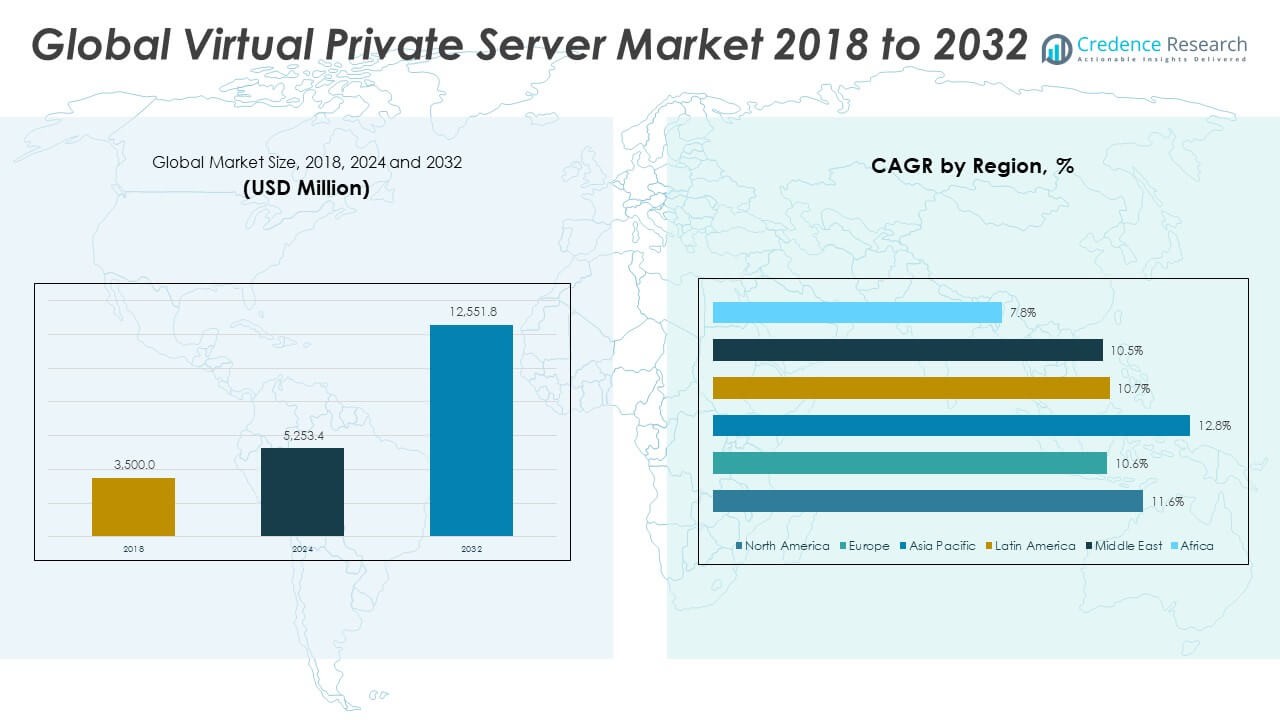
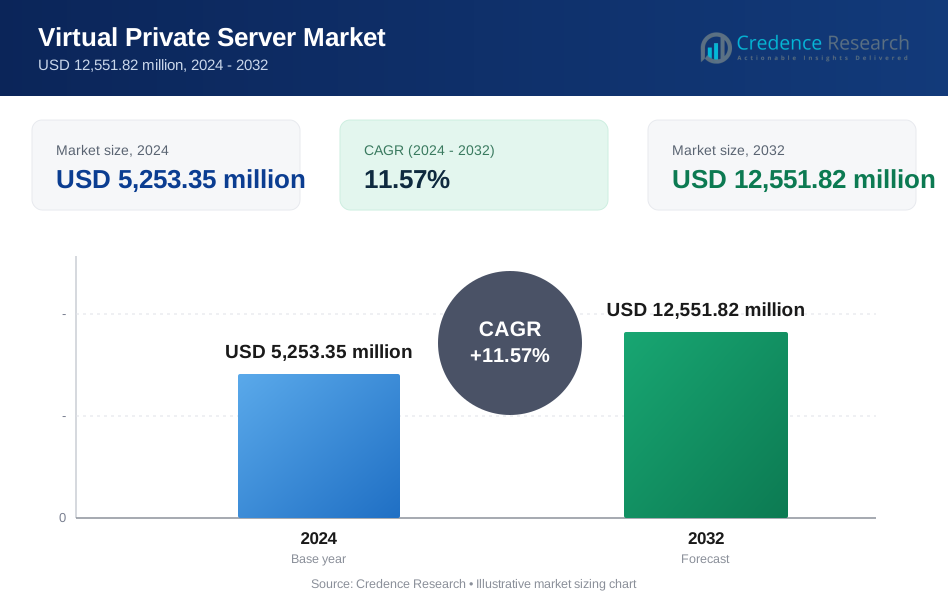
The Virtual Private Server Market size was valued at USD 3,500.00 million in 2018 to USD 5,253.35 million in 2024 and is anticipated to reach USD 12,551.82 million by 2032, at a CAGR of 11.57% during the forecast period.
| REPORT ATTRIBUTE | DETAILS |
|---|---|
| Historical Period | 2020-2024 |
| Base Year | 2024 |
| Forecast Period | 2025-2032 |
| Virtual Private Server Market Size 2024 | USD 5,253.35 Million |
| Virtual Private Server Market, CAGR | 11.57% |
| Virtual Private Server Market Size 2032 | USD 12,551.82 Million |
The growth of the Virtual Private Server Market is driven by the increasing demand for scalable, secure, and cost-effective hosting solutions across various industries. Businesses are shifting from shared hosting to VPS due to the need for enhanced control, customization, and performance. The rising adoption of digital platforms, coupled with the proliferation of small and medium-sized enterprises (SMEs) seeking affordable cloud infrastructure, has further accelerated market growth. Additionally, the expansion of e-commerce, mobile applications, and content management systems is prompting organizations to invest in VPS solutions to ensure stability, speed, and data protection.
Geographically, North America leads the Virtual Private Server Market due to the presence of major tech companies, widespread digital adoption, and robust IT infrastructure. Europe follows closely, supported by a strong focus on data security and cloud innovation. The Asia-Pacific region is emerging as a high-growth area, fueled by rapid digitalization, growing internet penetration, and a surge in startups and SMEs adopting virtualized environments. Countries such as China, India, and Indonesia are witnessing increased investments in cloud technologies, driving demand for VPS hosting solutions across sectors.
Market Insights:
- The Virtual Private Server Market was valued at USD 5,253.35 million in 2024 and is projected to reach USD 12,551.82 million by 2032, growing at a CAGR of 11.57%.
- Increasing demand for scalable, cost-effective hosting solutions among SMEs and startups continues to drive rapid market expansion.
- The adoption of managed VPS services is rising as non-technical users seek simplified server management and reduced operational burden.
- Security concerns and limited customization options in shared VPS environments remain key restraints for enterprise users.
- North America dominated the market in 2024, driven by robust IT infrastructure, high cloud maturity, and early adoption of virtualized environments.
- Asia Pacific is emerging as the fastest-growing region due to rapid digital transformation, rising internet penetration, and a surge in new digital businesses.
- The market is witnessing a shift toward Linux-based VPS solutions, favored for their flexibility, open-source ecosystem, and cost advantages.
Market Drivers:
Increasing Demand from SMEs and Startups Seeking Cost-Efficient Hosting Solutions
Small and medium-sized enterprises are adopting VPS solutions to manage operations cost-effectively while maintaining control and flexibility. Shared hosting often limits scalability, while dedicated servers may exceed budget constraints. VPS strikes the right balance between affordability and performance, enabling SMEs to deploy applications, manage websites, and store data securely. Startups in fintech, e-commerce, and SaaS increasingly prefer VPS for quick deployment and customization. The rise of remote work also contributes to server-based solutions for operational continuity. VPS enables access to virtual environments from any location, supporting business agility. The Virtual Private Server Market benefits from this growing shift toward virtualized infrastructure among cost-conscious businesses.
- For instance, JaguarPC reports that its VPS-hosted websites load up to 35% faster than shared hosting counterparts, handling hundreds of concurrent users without performance drops, a crucial benefit for SMEs managing fluctuating traffic volumes.
Digital Transformation Initiatives Fueling Cloud Hosting Adoption
Organizations across industries are investing in digital infrastructure to streamline operations, deliver services online, and engage customers efficiently. VPS plays a key role in this transformation by offering scalable resources, high uptime, and secured environments. Enterprises upgrading legacy systems find VPS an ideal mid-tier option that balances control and operational flexibility. With increasing cloud migration, businesses require environments that support faster deployment and testing. It supports application hosting, development environments, and internal tools, accelerating innovation cycles. Public and private organizations implement VPS to meet compliance needs and reduce latency. The Virtual Private Server Market grows steadily as digital transformation expands across sectors.
Expanding E-Commerce Sector Demanding Reliable Hosting Performance
The global surge in online shopping has created a pressing need for scalable and secure web infrastructure. E-commerce platforms rely on VPS for hosting websites, payment systems, and customer databases. Seasonal traffic fluctuations and promotions require quick resource scaling without downtime, which VPS supports efficiently. Businesses running multi-storefront operations prefer VPS for isolated environments. VPS also aids in protecting sensitive data like user credentials and transaction records through encryption and controlled access. Website speed and responsiveness directly affect user experience and SEO, pushing retailers toward performance-optimized VPS. The Virtual Private Server Market captures strong demand from online retailers enhancing digital storefronts.
- For example, Verpex offers e-commerce‑oriented VPS hosting powered by dedicated Xeon CPUs and ultra‑fast NVMe SSD storage, providing rapid page loading capabilities and backing service reliability with a 99.9% uptime guarantee.
Need for Enhanced Data Security and Regulatory Compliance
Data privacy laws and cybersecurity threats have increased the need for secure server environments. VPS provides users with isolated virtual environments that reduce the risk of cross-contamination common in shared hosting. It enables customizable security protocols, firewall configurations, and regular backups. Organizations bound by data protection regulations benefit from VPS-hosted applications with defined access controls. Industries such as healthcare, finance, and legal services deploy VPS to ensure compliance with HIPAA, GDPR, and other standards. VPS also supports the integration of third-party security tools for enhanced protection. The Virtual Private Server Market strengthens as enterprises prioritize controlled, policy-compliant environments.
Market Trends
Growing Popularity of Managed VPS Services among Non-Technical Users
Businesses lacking dedicated IT teams are adopting managed VPS solutions to handle server maintenance, updates, and security. Managed services reduce operational complexity while ensuring optimal server performance. Hosting providers offer bundled solutions with automated backups, performance monitoring, and 24/7 support. The increasing number of digital entrepreneurs and online businesses creates demand for simplified VPS hosting. Content creators, online educators, and niche e-commerce stores prefer managed VPS over configuring servers manually. It allows users to focus on core business activities rather than server upkeep. The Virtual Private Server Market adapts to non-technical user preferences by expanding fully managed hosting portfolios.
Integration of AI and Automation to Optimize Server Performance
Cloud service providers are integrating AI-based tools to automate resource allocation and predict usage trends. Automated scaling based on traffic patterns improves application uptime and performance. VPS environments can now self-adjust CPU, RAM, and bandwidth to match real-time workload demands. AI-powered security protocols detect anomalies and mitigate threats proactively. It reduces manual monitoring needs while enhancing operational efficiency. Automation also accelerates server provisioning, minimizing deployment delays for clients. The Virtual Private Server Market adopts intelligent automation to improve reliability and deliver advanced customer experiences through real-time optimization.
Adoption of SSD and NVMe Storage for Faster Hosting Environments
Hosting providers are transitioning from traditional HDD to SSD and NVMe storage configurations to improve speed and data throughput. SSD-based VPS ensures faster read/write speeds, reduced load times, and improved database performance. NVMe offers even greater efficiency, especially for high-demand applications like gaming, streaming, and e-commerce. Businesses gain competitive advantage through quicker page rendering and smoother user interaction. It reduces latency and enhances real-time data processing in customer-facing applications. The Virtual Private Server Market reflects this storage evolution by integrating high-speed drives across VPS tiers. Providers promote performance-focused packages to meet client expectations.
- For example, MonoVM offers NVMe VPS plans with enterprise-grade NVMe SSDs delivering read/write speeds of up to approximately 3,500 MB/s, which is about seven times faster than traditional SSDs.
Containerization and Microservices Supporting VPS Deployment
Modern software development trends favor lightweight, scalable applications managed through containers and microservices. VPS platforms offer the isolated environments needed to host containerized apps with dedicated resources. Developers use VPS to build and test Kubernetes clusters or Docker containers without interference. It enables the deployment of decentralized services, improving modularity and system resilience. The rise in DevOps practices further supports the use of VPS for CI/CD pipelines. Developers benefit from enhanced control over the environment and deployment process. The Virtual Private Server Market aligns with agile development needs by supporting microservice architecture on virtualized systems.
- For example, InMotion Hosting enables installation of Docker on all its VPS and Dedicated Server platforms, including UltraStack, Unmanaged Cloud VPS, Control Web Panel, and cPanel-Managed VPS. This setup supports containerized deployments and scale‑out workflows for experienced users
Market Challenges Analysis
Limited Customization in Shared VPS Environments Affecting Complex Applications
Although VPS provides more control than shared hosting, certain limitations persist in entry-level packages. Users often face restrictions in kernel access, network configuration, and third-party module installations. Complex enterprise applications may require deeper customization not possible in some VPS setups. It creates a gap between customer expectations and service capabilities. Businesses seeking higher levels of configurability may migrate to dedicated servers or private cloud options. Performance consistency can also vary based on resource oversubscription by hosting providers. The Virtual Private Server Market must address these limitations to retain advanced users requiring greater flexibility and control.
Intense Price Competition Leading to Profit Margin Pressures
Numerous hosting providers offer VPS services with similar features, resulting in commoditization and aggressive pricing. To attract customers, providers often reduce prices or include extensive add-ons at no cost. While beneficial for clients, this model affects long-term profitability and service differentiation. Smaller players face difficulty competing with established brands offering bundled solutions. Maintaining server infrastructure, support services, and security at lower price points becomes unsustainable. Some providers compromise on hardware quality or customer service to remain competitive. The Virtual Private Server Market experiences ongoing pricing pressure that challenges scalability and innovation for mid-sized providers.
Market Opportunities
Rising Demand from Edge Computing and IoT Deployments
Edge computing and IoT require localized processing environments to minimize latency and optimize bandwidth usage. VPS serves as an ideal middle-ground solution for hosting edge nodes and regional applications. It allows developers to deploy lightweight, distributed systems closer to data sources. Smart cities, industrial automation, and remote monitoring systems benefit from VPS-based micro data centers. The Virtual Private Server Market has an opportunity to scale through integration with edge and IoT ecosystems, supporting responsive, decentralized applications.
Expansion into Emerging Markets with Growing Digital Infrastructure
Countries in Asia-Pacific, Latin America, and Africa are investing in internet access, digital services, and cloud infrastructure. Small businesses in these regions seek affordable, flexible hosting to launch digital platforms and e-commerce operations. VPS providers offering region-specific packages can gain early market advantage. Localization of data centers and multilingual support enhance user trust. The Virtual Private Server Market finds growth opportunities by targeting underserved geographies with tailored solutions that support digital inclusion and entrepreneurship.
Market Segmentation Analysis:
The Virtual Private Server Market is segmented by operating system, organization size, and industry vertical, reflecting its broad adoption across various business needs.
By operating system, Linux dominates the market due to its open-source nature, cost efficiency, and flexibility. It attracts developers and enterprises looking for scalable environments. Windows VPS is preferred in enterprises with legacy systems or applications requiring Microsoft-specific compatibility, offering ease of use and integration with Microsoft services.
- For example, Windows Server versions from 2012 through 2022 are fully supported as guest operating systems on Hyper‑V virtual machines, offering built‑in integration with the Microsoft ecosystem including Active Directory, Group Policy, and PowerShell automation which enhances compatibility and simplifies management for organizations using Windows‑based workflows
By organization size, small and medium-sized enterprises (SMEs) hold a significant share owing to the growing need for affordable hosting with scalable resources. VPS allows SMEs to run websites, applications, and cloud-based platforms without investing in physical infrastructure. Large enterprises also use VPS solutions, primarily for isolated environments within hybrid IT infrastructures, enabling secure data handling and development flexibility.
- For instance, organizations prioritize hybrid cloud security tools that protect data while enabling operational agility, often integrating VPS as part of their overall hybrid architecture
By vertical, the BFSI segment leads due to stringent security demands and the need for robust, isolated computing environments. IT & Telecom follows, leveraging VPS for cloud service delivery and application hosting. The retail sector uses VPS to support e-commerce platforms with dynamic scaling. Healthcare organizations implement VPS to store and process sensitive patient data securely. Government and defense sectors require virtual environments that meet regulatory standards and offer full control. The Virtual Private Server Market continues to expand across other verticals, including education and media, driven by digital transformation and rising demand for flexible infrastructure.
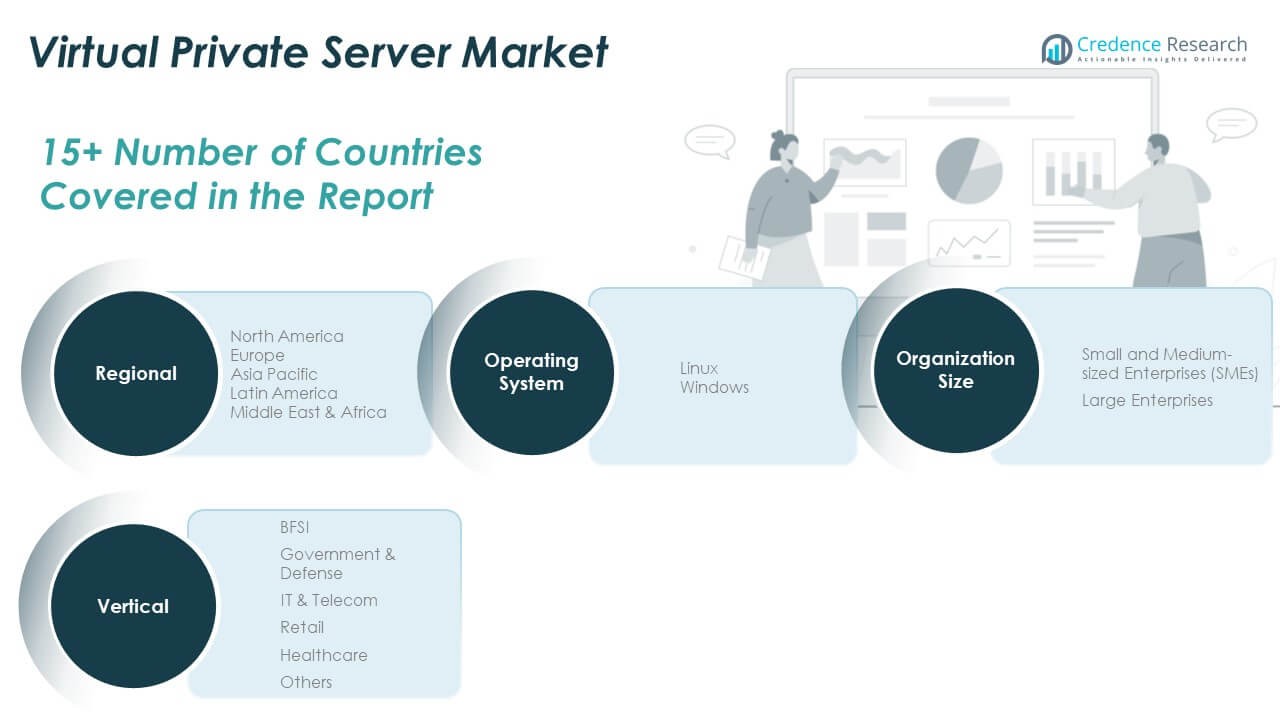
Segmentation:
By Operating System
- Linux
- Windows
By Organization Size
- Small and Medium-sized Enterprises (SMEs)
- Large Enterprises
By Vertical
- BFSI (Banking, Financial Services, and Insurance)
- Government & Defense
- IT & Telecom
- Retail
- Healthcare
- Others
By Region
- North America
- U.S.
- Canada
- Mexico
- Europe
- Germany
- France
- U.K.
- Italy
- Spain
- Rest of Europe
- Asia Pacific
- China
- Japan
- India
- South Korea
- South-east Asia
- Rest of Asia Pacific
- Latin America
- Brazil
- Argentina
- Rest of Latin America
- Middle East & Africa
- GCC Countries
- South Africa
- Rest of the Middle East and Africa
Regional Analysis:
North America
The North America Virtual Private Server Market size was valued at USD 1,356.60 million in 2018 to USD 2,013.05 million in 2024 and is anticipated to reach USD 4,803.60 million by 2032, at a CAGR of 11.6% during the forecast period. It accounted for 38.32% of the global market share in 2024. North America leads in VPS adoption due to strong digital infrastructure, high cloud penetration, and widespread enterprise reliance on virtual environments. The region houses several major VPS providers and data center operators that offer scalable and secure services to businesses. The rise in remote work, SaaS platforms, and data compliance regulations drives the use of VPS across industries. U.S.-based SMEs are rapidly moving to cloud-hosted platforms for cost efficiency and control. Financial services, retail, and healthcare sectors actively deploy VPS to support workload flexibility and application security. The Virtual Private Server Market in North America continues to expand due to rising demand for managed hosting and enhanced network performance.
Europe
The Europe Virtual Private Server Market size was valued at USD 758.80 million in 2018 to USD 1,085.20 million in 2024 and is anticipated to reach USD 2,416.89 million by 2032, at a CAGR of 10.6% during the forecast period. It captured 20.65% of the global market share in 2024. European countries emphasize data protection and GDPR compliance, prompting businesses to adopt VPS for greater control over data environments. Germany, France, and the UK lead the region in VPS deployment due to their robust IT ecosystems. Enterprises prefer VPS hosting for its cost-effectiveness and ability to meet security mandates without investing in physical servers. The rise of digital government initiatives and smart infrastructure across the EU supports this demand. Hosting providers in Europe are investing in local data centers and green server solutions. The Virtual Private Server Market in Europe reflects a growing need for hybrid cloud environments supporting secure digital transformation.
Asia Pacific
The Asia Pacific Virtual Private Server Market size was valued at USD 924.00 million in 2018 to USD 1,443.86 million in 2024 and is anticipated to reach USD 3,781.87 million by 2032, at a CAGR of 12.8% during the forecast period. It represented 27.48% of the global market share in 2024. The region is witnessing strong digital growth fueled by increasing internet access, mobile-first economies, and SME digitization. Countries like China, India, Japan, and South Korea are rapidly adopting VPS hosting for application deployment and online service delivery. Government programs supporting cloud infrastructure expansion create new demand for VPS solutions. E-commerce platforms and fintech startups are major contributors to this growth. VPS also supports localized content delivery and compliance with regional data laws. The Virtual Private Server Market in Asia Pacific is growing due to affordable service offerings and the expanding footprint of global and regional hosting providers.
Latin America
The Latin America Virtual Private Server Market size was valued at USD 248.50 million in 2018 to USD 369.78 million in 2024 and is anticipated to reach USD 826.79 million by 2032, at a CAGR of 10.7% during the forecast period. It constituted 7.04% of the global market share in 2024. The market in this region is driven by an expanding startup ecosystem, increased digital adoption, and cloud-based business models. Countries such as Brazil, Mexico, and Colombia are investing in digital infrastructure and data localization. SMEs are adopting VPS solutions for flexibility, affordability, and quick scalability. The region is also experiencing growth in media streaming, online education, and e-commerce, which require reliable hosting. Local hosting providers and telecom companies are entering the VPS market with tailored packages. The Virtual Private Server Market in Latin America continues to grow as businesses shift from traditional IT setups to cloud-native models.
Middle East
The Middle East Virtual Private Server Market size was valued at USD 168.00 million in 2018 to USD 239.52 million in 2024 and is anticipated to reach USD 528.50 million by 2032, at a CAGR of 10.5% during the forecast period. It held 4.56% of the global market share in 2024. Rapid urbanization, national digital visions, and investments in smart cities are driving cloud services demand in this region. Countries like the UAE and Saudi Arabia are leading the transition to VPS hosting for government and private sector applications. Businesses are increasingly moving to VPS environments for secure hosting and application management. Data privacy laws and cyber threat preparedness fuel the need for isolated and scalable server environments. Cloud adoption is accelerating across retail, banking, and education sectors. The Virtual Private Server Market in the Middle East is gaining traction as the region invests in localized data centers and hybrid IT solutions.
Africa
The Africa Virtual Private Server Market size was valued at USD 44.10 million in 2018 to USD 101.94 million in 2024 and is anticipated to reach USD 194.17 million by 2032, at a CAGR of 7.8% during the forecast period. It accounted for 1.94% of the global market share in 2024. The market in Africa is emerging with growing internet penetration, mobile device usage, and small business digitization. Countries such as South Africa, Nigeria, and Kenya are witnessing increased interest in virtualized hosting. SMEs seek affordable VPS plans to manage e-commerce websites and digital services. Infrastructure limitations and high latency still pose challenges, but local data center investments are improving availability. Global cloud providers are entering the region through partnerships or local ventures. The Virtual Private Server Market in Africa is set to grow gradually as digital literacy and access to cloud resources improve across urban and semi-urban areas.
Key Player Analysis:
- Amazon Web Services, Inc.
- DreamHost, LLC
- Endurance International Group
- GoDaddy Operating Company, LLC
- IBM
- InMotion Hosting
- Liquid Web
- OVH
- Rackspace US, Inc.
- United Internet AG
Competitive Analysis:
The Virtual Private Server Market features intense competition among global and regional players, with companies differentiating through pricing, performance, and managed services. Amazon Web Services, GoDaddy, IBM, and OVH lead with extensive infrastructure and scalable offerings. Smaller providers like InMotion Hosting and DreamHost compete by targeting niche segments and offering value-added services. The market sees frequent developments in SSD storage, AI integration, and managed VPS platforms. Companies invest in data center expansion and strategic partnerships to enhance geographic reach. It experiences a steady stream of mergers, product launches, and upgrades aimed at improving security, performance, and automation.
Recent Developments:
- In March 2025, Google agreed to acquire Wiz, a New York-based cybersecurity startup specializing in cloud computing security, for $32 billion. This acquisition, announced in March 2025, is Google's largest ever and aims to enhance security for artificial intelligence companies and enable multi-cloud service usage.
- In March 2025, InMotion Hosting launched a new 2 vCPU VPS plan priced at $4.49 per month, aimed at budget-conscious businesses and developers. The plan features 4 GB RAM, NVMe SSD storage, 5 TB bandwidth, and a dedicated IP, offering a balance of performance and affordability. This strategic move strengthens its position in the Virtual Private Server Market by expanding access to high-performance virtual hosting solutions.
- In April 2025, World Host Group acquired FastComet to strengthen its position in the Virtual Private Server Market. FastComet, recognized for its developer-friendly features and strong infrastructure, will continue operating under its brand while leveraging World Host Group’s broader infrastructure and innovation capabilities. This acquisition supports the group's strategy to consolidate and scale in the competitive VPS landscape.
Market Concentration & Characteristics:
The Virtual Private Server Market exhibits moderate to high concentration, with a few dominant players holding substantial revenue share. It is highly fragmented at the regional level, where localized providers serve SMEs with tailored offerings. The market is price-sensitive but evolving toward service-based differentiation. Key characteristics include rapid adoption of cloud-native technologies, rising demand for managed VPS, and expansion across diverse verticals. It remains driven by innovation in virtualization, containerization, and edge hosting infrastructure. Companies focus on enhancing uptime, automation, and scalability to meet enterprise-grade performance. Strategic alliances and localized data centers continue to shape competitive positioning and customer acquisition.
Report Coverage:
The research report offers an in-depth analysis based on Operating System, Organization Size and Vertical. It details leading market players, providing an overview of their business, product offerings, investments, revenue streams, and key applications. Additionally, the report includes insights into the competitive environment, SWOT analysis, current market trends, as well as the primary drivers and constraints. Furthermore, it discusses various factors that have driven market expansion in recent years. The report also explores market dynamics, regulatory scenarios, and technological advancements that are shaping the industry. It assesses the impact of external factors and global economic changes on market growth. Lastly, it provides strategic recommendations for new entrants and established companies to navigate the complexities of the market.Future Outlook:
- The Virtual Private Server Market will witness strong growth driven by increased cloud adoption among small and medium-sized enterprises seeking flexible and cost-effective hosting solutions.
- Advancements in virtualization and container technologies will enable faster deployments, improved server performance, and better resource utilization.
- Demand for managed VPS services will rise, particularly among non-technical users and businesses without in-house IT support.
- Integration of artificial intelligence and automation tools will enhance server monitoring, threat detection, and workload optimization across VPS platforms.
- Industries such as e-commerce and fintech will increase VPS adoption to meet growing digital infrastructure needs and ensure secure operations.
- The expansion of global data center infrastructure will improve service availability, reduce latency, and support regional growth strategies.
- Linux-based VPS solutions will maintain dominance due to their open-source advantages, scalability, and broad developer support.
- Asia Pacific will emerge as a high-growth region, supported by digital transformation initiatives, startup ecosystems, and expanding internet access.
- Regulatory compliance in sectors like BFSI and healthcare will drive demand for isolated and secure virtual hosting environments.
- Mergers, acquisitions, and strategic alliances among key players will redefine the competitive landscape and expand service capabilities.
Request a Free Sample
Fill in your details and we'll send you a free sample report.
- Sample data tables & charts
- Research methodology
Need a Custom Version of This Report?
Tailor the scope, geography, or segments to your exact requirements.
- Custom geography or segment scope
- Direct access to our analyst team
Frequently Asked Questions
What is the current market size for Virtual Private Server Market, and what is its projected size in 2032?
At what Compound Annual Growth Rate is the Virtual Private Server Market projected to grow between 2024 and 2032?
Which Virtual Private Server Market segment held the largest share in 2024?
What are the primary factors fueling the growth of the Virtual Private Server Market?
Who are the leading companies in the Virtual Private Server Market?
Which region commanded the largest share of the Virtual Private Server Market in 2024?
Table of Content
Chapter 1. Report Introduction
- 1.1 Report Description & Purpose
- 1.1.1 Report Title & Market Definition
- 1.1.2 Unique Selling Propositions (USP) & Key Differentiators
- 1.1.3 Value Proposition for Stakeholders
- 1.2 Research Objectives
- 1.2.1 Market Sizing Objectives (Volume & Revenue)
- 1.2.2 Segmentation Objectives
- 1.2.3 Competitive Intelligence Objectives
- 1.2.4 Forecast & Scenario Objectives
- 1.3 Report Scope
- 1.3.1 Virtual Private Server Scope – Types & Subtypes Covered
- 1.3.2 Geographic Scope – Regions & Countries Covered
- 1.3.3 Historical Period, Base Year & Forecast Period (2024; forecast to 2032)
- 1.3.4 Inclusions & Exclusions
- 1.4 HS Code & Classification Framework
- 1.5 Currency, Units & Pricing Basis
- 1.6 Target Stakeholders
- 1.7 Limitations & Assumptions
Chapter 2. Executive Summary
- 2.1 Global Virtual Private Server Market Snapshot
- 2.1.1 Market Size – Historical (2024) & Forecast (2024-2032) (2024: USD 5,253.35 million → 2032: USD 12,551.82 million)
- 2.1.2 Volume & Revenue – Global Totals
- 2.1.3 Key Market Highlights – Top Five Facts
- 2.2 Virtual Private Server Market Segmentation Snapshot
- 2.2.1 Market Split by Region – 2024 vs. 2032
- 2.3 Competitive Snapshot
- 2.3.1 Top 10 Players by Revenue Share – 2024
- 2.3.2 Top 10 Players by Volume Share – 2024
- 2.3.3 Recent Strategic Developments (18-Month Summary)
- 2.4 Key Investment Highlights & Strategic Conclusions
Chapter 3. Virtual Private Server Market Dynamics & Industry Analysis
- 3.1 Market Overview & Context
- 3.1.1 Virtual Private Server Market Position in the Broader Automotive Value Chain
- 3.1.2 OEM vs. Replacement Market Dynamics
- 3.1.3 Market Maturity & Development Stage by Region
- 3.2 Virtual Private Server Market Drivers
- 3.3 Virtual Private Server Market Restraints & Challenges
- 3.4 Virtual Private Server Market Opportunities
- 3.5 Porter's Five Forces Analysis
- 3.5.1 Threat of New Entrants
- 3.5.2 Bargaining Power of Suppliers
- 3.5.3 Bargaining Power of Buyers
- 3.5.4 Threat of Substitutes
- 3.5.5 Competitive Rivalry – Intensity Assessment
- 3.6 Virtual Private Server Value Chain Analysis
- 3.6.1 Upstream – Raw Material/Input Suppliers
- 3.6.1.1 Raw Material/Input 1
- 3.6.1.2 Raw Material/Input 2
- 3.6.1.3 Raw Material/Input 3
- 3.6.2 Midstream – Production/Manufacturing/Service Delivery
- 3.6.2.1 Production/Process Overview
- 3.6.2.2 Key Facility Locations & Capacity by Manufacturer
- 3.6.3 Downstream – Distribution & End Consumer
- 3.6.3.1 Primary Channel – B2B/OEM
- 3.6.3.2 Secondary Channels – Dealer, Retail, Online, Direct
- 3.6.4 Value Chain Profitability Analysis
- 3.6.1 Upstream – Raw Material/Input Suppliers
- 3.7 PESTEL Analysis
- 3.7.1 Political Factors
- 3.7.2 Economic Factors
- 3.7.3 Social Factors
- 3.7.4 Technological Factors
- 3.7.5 Environmental Factors
- 3.7.6 Legal Factors
- 3.8 Virtual Private Server Supply Chain Analysis
- 3.8.1 Raw Material/Input Supply Risk Assessment
- 3.8.2 Manufacturing Concentration Risk (Geographic Exposure)
- 3.8.3 Trade Disruption Impact Analysis
- 3.9 Regulatory & Policy Landscape
Note: The regulatory and policy landscape section covers regulations based on their applicability to the market, Virtual Private Server category, geography, and scope of the study. Only regulatory frameworks with a material impact on operations, compliance, trade, sustainability, or market access are analyzed in detail.
Chapter 4. Key Investment Pockets & Opportunity Analysis
- 4.1 Virtual Private Server Market Attractiveness Analysis
- 4.1.1 By Region – Investment Attractiveness Matrix (Volume × CAGR)
- 4.2 Absolute Revenue Growth Opportunity
- 4.2.1 By Region – Absolute USD Growth Through 2032
- 4.3 Incremental Volume Opportunity
- 4.3.1 By Region – Incremental Volume Through 2032
- 4.3.2 Segment – Incremental Volume
- 4.4 Emerging Submarket Opportunity Deep Dive (Subject to Applicability)
- 4.5 Emerging Market Opportunity Scorecards
- 4.5.1 United States
- 4.5.2 Europe
- 4.5.3 Asia
- 4.5.4 Middle East & Africa
Note: Emerging Market Opportunity Scorecards will be included based on relevance and strategic importance. Regions listed are indicative and may vary depending on data availability and market dynamics.
Chapter 5. Virtual Private Server Import-Export Analysis & Trade Flows
- 5.1 Global Trade Overview
- 5.1.1 Global Export Value by Country (2024)
- 5.1.2 Global Export Volume by Country (2024)
- 5.1.3 Global Import Value by Country (2024)
- 5.1.4 Global Import Volume by Country (2024)
- 5.1.5 Net Trade Balance by Country (2024)
- 5.2 Export Analysis – Segment
- 5.2.1 Type 1 (HS Code)
- 5.2.2 Type 2 (HS Code)
- 5.2.3 Type 3 (HS Code)
- 5.2.4 Type 4 (HS Code)
- 5.2.5 Type 5 (HS Code)
- 5.3 Import Analysis – Segment
- 5.3.1 Type 1 (HS Code)
- 5.3.2 Type 2 (HS Code)
- 5.3.3 Type 3 (HS Code)
- 5.3.4 Type 4 (HS Code)
- 5.3.5 Type 5 (HS Code)
- 5.4 Average Unit Trade Prices
- 5.4.1 Average Export Price – Segment & Country
- 5.4.2 Average Import Price – Segment & Source Country
- 5.4.3 Price Trends (2024)
- 5.5 Key Trade Route Analysis
- 5.5.1 Trade Route 1
- 5.5.2 Trade Route 2
- 5.5.3 Trade Route 3
- 5.5.4 Trade Route 4
- 5.5.5 Trade Route 5
- 5.6 Trade Policy Impact Assessment
- 5.6.1 US Anti-Dumping & Section 301 Tariffs
- 5.6.2 EU Customs Union Impact
- 5.6.3 Major Free Trade Agreements
- 5.6.4 USMCA Rules of Origin
Note: Trade policy analysis will be included only where relevant to the Virtual Private Server market.
Chapter 6. Competitive Landscape & Company Benchmarking
- 6.1 Virtual Private Server Market Concentration & Structure
- 6.1.1 Herfindahl-Hirschman Index (HHI) – vs. 2024
- 6.1.2 Tier 1, Tier 2 & Tier 3 Market Structure
- 6.1.3 Global, Regional & Local Player Dynamics
- 6.2 Virtual Private Server Market Share Analysis – 2024
- 6.2.1 Global Revenue Share by Company
- 6.2.2 Global Volume Share by Company
- 6.2.3 Regional Revenue Share
- 6.2.4 Market Share Evolution ( vs. 2024)
- 6.2.5 OEM Segment Share by Company
- 6.2.6 Replacement Segment Share by Company
- 6.3 Production/Delivery Capacity & Facility Analysis
- 6.3.1 Global Installed Capacity
- 6.3.2 Capacity Utilization Rates
- 6.3.3 Production/Output Volume
- 6.3.4 Facility Locations & Capacity Map
- 6.3.5 Planned Capacity Additions
- 6.4 Virtual Private Server Competitive Benchmarking Matrix
- 6.4.1 Revenue, Volume, CAGR & Profitability Comparison
- 6.4.2 Channel Revenue Mix
- 6.4.3 Geographic Revenue Exposure
- 6.4.4 R&D Intensity
- 6.4.5 Sustainability Maturity
- 6.5 Strategic Developments in Virtual Private Server (Last 24 Months)
- 6.5.1 Mergers, Acquisitions & Divestments
- 6.5.2 New Virtual Private Server Launches
- 6.5.3 Facility Expansions
- 6.5.4 Strategic Alliances, Joint Ventures & Partnerships
- 6.5.5 Distribution Expansion & Market Entry
- 6.5.6 Sustainability & ESG Initiatives
- 6.6 Competitive Strategy Mapping
- 6.6.1 Leader, Challenger, Follower & Niche Classification
- 6.6.2 Pricing Strategy Comparison
- 6.6.3 Channel Strategy Matrix
Note: Strategic developments are included based on their materiality and the availability of reliable information.
Chapter 7. Global Virtual Private Server Market – By Distribution Channel
- 7.1 Segment Overview
- 7.1.1 Volume & Revenue Split by Channel (2024 & 2032)
- 7.1.2 Channel Mix Evolution (2024-2032)
Chapter 8. Regional Market Analysis – Global Overview
- 8.1 Global Regional Overview
- 8.1.1 Regional Volume Share
- 8.1.2 Regional Revenue Share
- 8.1.3 Regional Volume by Region
- 8.1.4 Regional Revenue by Region
- 8.1.5 Regional Forecast Through 2032
- 8.2 Cross-Regional Segment Analysis
- 8.2.1 By Distribution Channel
- 8.2.2 By Brand/Price Tier
Chapter 9. North America Virtual Private Server Market
- 9.1 United States
- 9.2 Canada
- 9.3 Mexico
Chapter 10. Europe Virtual Private Server Market
- 10.1 Germany
- 10.2 France
- 10.3 Italy
- 10.4 United Kingdom
- 10.5 Spain
- 10.6 Poland
- 10.7 Russia
- 10.8 Netherlands
- 10.9 Belgium
- 10.10 Sweden
- 10.11 Denmark
- 10.12 Norway
- 10.13 Rest of Europe
Chapter 11. Asia Pacific Virtual Private Server Market
- 11.1 China
- 11.2 India
- 11.3 Japan
- 11.4 South Korea
- 11.5 Thailand
- 11.6 Indonesia
- 11.7 Vietnam
- 11.8 Malaysia
- 11.9 Australia
- 11.10 Rest of Asia Pacific
Chapter 12. Latin America Virtual Private Server Market
- 12.1 Brazil
- 12.2 Argentina
- 12.3 Colombia
- 12.4 Chile
- 12.5 Rest of Latin America
Chapter 13. Middle East Virtual Private Server Market
- 13.1 Saudi Arabia
- 13.2 United Arab Emirates
- 13.3 Turkey
- 13.4 Israel
- 13.5 Iran
- 13.6 Rest of the Middle East
Chapter 14. Africa Virtual Private Server Market
- 14.1 South Africa
- 14.2 Egypt
- 14.3 Nigeria
- 14.4 Morocco
- 14.5 Rest of Africa
Chapter 15. Virtual Private Server Company Profiles
- 15.1 [Company 01]
- 15.1.1 Company Overview
- 15.1.2 Key Management Personnel
- 15.1.3 Products & Services Portfolio
- 15.1.4 Financial Performance
- 15.1.5 Key Market Focus & Geographic Presence
- 15.1.6 Recent Developments & Strategic Initiatives
Note: The company profile list is preliminary and may change based on research findings, market developments, data availability, and client requirements.
Chapter 16. Appendices
- Appendix A – List of Abbreviations & Acronyms
- Appendix B – Industry Classification Code Reference – Full Series
- Appendix C – Production & Capacity Data Tables
- Appendix D – End-Use & Demand Base Tables
- Appendix E – Consumption & Replacement Rate Assumptions
- Appendix F – ASP Reference Tables
- Appendix G – Manufacturing & Facility Database
- Appendix H – Import-Export Data Tables
- Appendix I – Regulatory Summary Tables
- Appendix J – Primary Research Participant List (Anonymized)
- Appendix K – Primary Research Questionnaire Framework
- Appendix L – Data Sources & Bibliography
- Appendix M – Market Size Divergence & Source Comparison
Chapter 17. Research Methodology
- 17.1 Research Framework & Philosophy
- 17.2 Secondary Research – Sources, Hierarchy & Data Extraction
- 17.3 Data Modeling – Bottom-Up & Top-Down Market Sizing
- 17.4 Primary Research – Stakeholder Framework, LOI & Sample Sizes
- 17.5 Forecast Methodology – Regression, Scenario & Sensitivity Analysis
- 17.6 Quality Control – Four-Layer Validation Framework
- 17.7 Limitations & Standard Assumptions
- 17.8 Disclaimer
