
| REPORT ATTRIBUTE | DETAILS |
|---|---|
| Historical Period | 2020-2023 |
| Base Year | 2024 |
| Forecast Period | 2025-2032 |
| Volunteer Management Platforms Market Size 2024 | USD 1,250 Million |
| Volunteer Management Platforms Market, CAGR | 8.6% |
| Volunteer Management Platforms Market Size 2032 | USD 2,419 Million |
Market Overview:
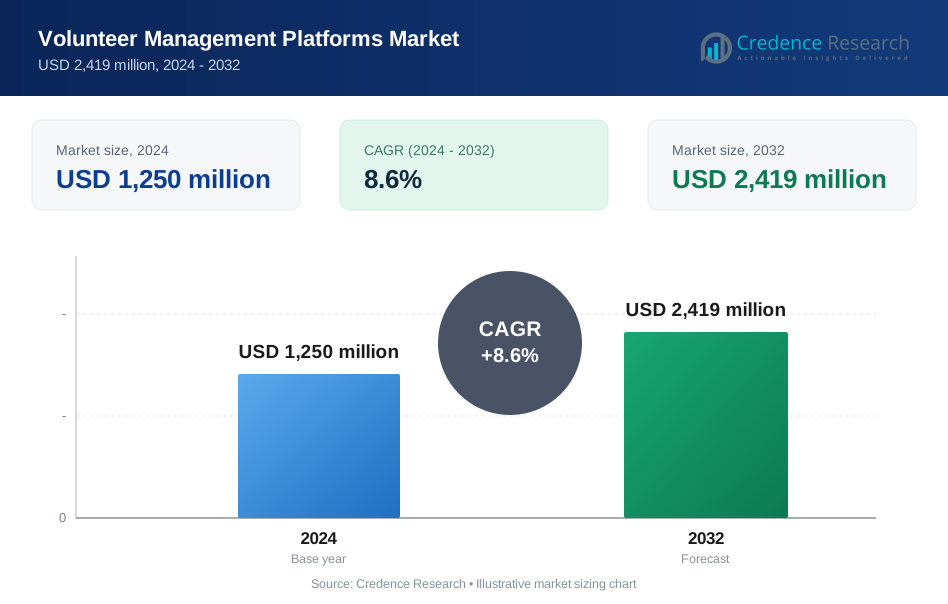
Volunteer Management Platforms Market size was valued at USD 1,250 million in 2024 and is anticipated to reach USD 2,419 million by 2032, at a CAGR of 8.6% during the forecast period (2024-2032).
Several factors are driving the expansion of the Volunteer Management Platforms Market. As volunteer-based programs become more complex and large-scale, traditional methods of volunteer coordination are proving inadequate. The demand for centralized, user-friendly platforms that offer automation, real-time updates, and data analytics has surged. Moreover, the rise in corporate social responsibility (CSR) initiatives and employee volunteering programs has encouraged enterprises to invest in robust volunteer management solutions. Cloud-based platforms, mobile accessibility, and integration capabilities with CRM and HR systems are key features propelling adoption. Additionally, heightened focus on volunteer engagement, retention, and satisfaction is influencing the development of innovative tools to deliver personalized experiences and timely communication. The integration of AI-powered features such as predictive analytics and smart scheduling is further optimizing volunteer utilization. In addition, enhanced security and compliance capabilities are making these platforms more appealing to large organizations and public institutions.
Regionally, North America holds the largest share of the Volunteer Management Platforms Market, attributed to the high concentration of nonprofit organizations, strong technological infrastructure, and widespread culture of philanthropy. The United States, in particular, has witnessed a significant increase in volunteer activities supported by digital tools. Europe follows closely, driven by government-backed community programs and growing awareness of digital transformation among NGOs. Meanwhile, the Asia-Pacific region is expected to register the fastest growth, owing to increasing digital penetration, emerging nonprofit ecosystems, and growing governmental and corporate initiatives aimed at boosting civic engagement and social development. The rapid expansion of mobile-first platforms in countries like India, Indonesia, and the Philippines is facilitating broader volunteer participation. Furthermore, regional partnerships between technology providers and social enterprises are accelerating the deployment of volunteer management systems.
Market Insights:
- Volunteer Management Platforms Market size is valued at USD 1,250 million and is projected to reach USD 2,419 million by 2032, registering a CAGR of 8.6%.
- North America holds the largest share at 42%, driven by a strong nonprofit network, technological maturity, and widespread CSR adoption.
- The market is expanding due to rising demand for real-time volunteer scheduling, centralized communication, and data-driven decision-making.
- Corporate CSR initiatives and employee engagement programs are fueling adoption across enterprises, boosting the need for scalable digital platforms.
- AI-powered features such as predictive analytics and smart scheduling enhance operational efficiency and volunteer utilization.
- Key challenges include data privacy compliance, limited IT resources in nonprofits, and budget constraints for smaller organizations.
- Asia-Pacific, with 18% of the market, is the fastest-growing region, supported by mobile-first platforms, digital expansion, and government-backed community programs.
Market Drivers:
Growing Need for Operational Efficiency in Volunteer Coordination
The Volunteer Management Platforms Market is expanding due to the growing demand for streamlined volunteer operations. Organizations face challenges in managing large numbers of volunteers using manual systems, which often result in inefficiencies and miscommunication. Volunteer management platforms offer real-time scheduling, task assignment, and shift tracking, allowing coordinators to optimize volunteer deployment. These tools ensure transparency in roles and responsibilities while enabling faster communication and feedback collection. Automation of routine tasks reduces administrative workload and improves overall productivity. It helps organizations focus more on mission-driven goals rather than logistical concerns.
Rising Corporate Social Responsibility Initiatives and Employee Engagement
Corporate social responsibility (CSR) programs are becoming essential for modern businesses, pushing them to adopt digital tools for managing employee volunteer initiatives. The Volunteer Management Platforms Market benefits significantly from this shift. Companies use these platforms to organize volunteering events, track participation, and measure social impact. It also allows HR departments to align volunteering activities with employee skills and company values. Structured volunteer opportunities improve employee morale, retention, and brand reputation. These platforms provide the data needed to showcase CSR success to stakeholders.
- For instance, National Australia Bank leveraged Benevity’s platform to achieve a substantial increase in employee participation in volunteering, and the Association of Corporate Citizenship Professionals observed higher volunteer participation after companies broadened their volunteering initiatives.
Increased Focus on Data-Driven Decision-Making and Impact Measurement
Organizations are prioritizing impact assessment to ensure volunteer efforts are aligned with measurable outcomes. The Volunteer Management Platforms Market addresses this need by offering advanced analytics and reporting features. Platforms enable tracking of volunteer hours, contribution value, and program effectiveness. It allows nonprofits to secure funding and support through data-backed impact presentations. Decision-makers can identify trends, gaps, and performance bottlenecks with ease. This improves strategic planning and long-term sustainability.
- For instance, Goodera’s platform has helped clients achieve higher participation and engagement in volunteering events, while VolunteerHub and TeamKinetic have enabled organizations to efficiently track, report, and improve volunteer program outcomes through robust analytics and feedback tools.
Digital Transformation Across the Nonprofit and Public Sectors
The push for digital transformation in nonprofit and government sectors is accelerating platform adoption. The Volunteer Management Platforms Market supports this trend by offering scalable, cloud-based solutions that replace outdated systems. Many NGOs and civic organizations are transitioning to digital platforms to improve accountability and donor engagement. It ensures better integration with CRM and financial software for streamlined operations. Mobile access further enhances reach and volunteer participation. Public institutions also use these platforms to manage large-scale community service and disaster response programs efficiently.
Market Trends:
Integration of AI and Automation Tools to Enhance Volunteer Management
Artificial intelligence and automation are reshaping how organizations manage volunteers. The Volunteer Management Platforms Market is witnessing a shift toward intelligent features such as automated scheduling, smart matching of volunteers with tasks, and real-time availability tracking. It allows coordinators to reduce manual intervention and improve decision-making. Predictive analytics help forecast volunteer turnout, optimize resource allocation, and identify potential engagement gaps. Chatbots and automated notifications streamline communication, ensuring timely updates and reduced no-shows. These innovations improve operational efficiency and create a more responsive volunteer experience.
- For instance, the University of Michigan Health System implemented an AI-powered volunteer scheduling system to streamline shift assignments and improve volunteer satisfaction, while the American Red Cross adopted an AI communication system that delivers more personalized, timely information to its volunteer base.
Adoption of Mobile-First and Cloud-Based Platforms for Greater Accessibility
Mobile-first and cloud-based solutions are driving user engagement and expanding the reach of volunteer programs. The Volunteer Management Platforms Market is aligning with this trend by offering mobile apps and responsive interfaces that enable volunteers to register, check schedules, and receive alerts from any location. It supports real-time communication and fosters higher participation rates, especially among younger, tech-savvy demographics. Cloud-based platforms offer scalability, easy updates, and integration with third-party systems like CRM and HR software. These systems ensure data security, centralized access, and consistent user experience across devices. The trend is enabling nonprofits and enterprises to manage local and global volunteer operations with greater agility.
- For instance, Civic Champs offers a mobile-first, app-based platform that simplifies volunteer check-ins and tracking for organizations, while Habitat for Humanity uses the VolunteerHub system to enhance project management and communication with volunteers.
Market Challenges Analysis:
Data Privacy Concerns and Compliance with Regional Regulations
Organizations face increasing pressure to protect volunteer data and comply with data privacy laws. The Volunteer Management Platforms Market must address these concerns to maintain trust and adoption. It often handles sensitive personal information, including contact details, availability, and preferences. Compliance with frameworks such as GDPR, HIPAA, and other regional mandates requires robust security infrastructure and frequent updates. Any breach or misuse of data can damage an organization’s credibility and deter volunteer participation. Limited in-house IT expertise among nonprofits further complicates secure platform management.
- For instance, Rosterfy, a leading volunteer management system, has implemented GDPR-compliant data handling by allowing volunteers to access, correct, and erase their personal data as required by law.
Budget Constraints and Resistance to Technology Adoption
Many nonprofits and community organizations operate with tight budgets and limited access to technology funding. The Volunteer Management Platforms Market faces challenges in penetrating this segment, despite clear operational benefits. It must offer cost-effective pricing models without compromising functionality. Resistance to change from traditional methods and limited technical knowledge slow down adoption in smaller organizations. Training requirements and system complexity can also deter implementation. Vendors need to provide user-friendly interfaces and strong onboarding support to overcome these barriers.
Market Opportunities:
Expansion into Emerging Nonprofit Ecosystems and Developing Markets
Rapid growth in the nonprofit sector across emerging economies presents untapped potential. The Volunteer Management Platforms Market can leverage this momentum by offering scalable, affordable solutions tailored to local needs. It enables small and mid-sized organizations to manage volunteer networks efficiently with minimal infrastructure. Rising digital literacy and smartphone penetration support wider platform adoption in Asia-Pacific, Latin America, and Africa. Governments and international agencies are also promoting civic participation, creating demand for volunteer coordination tools. Vendors that localize features and offer multilingual support can gain a competitive edge.
Partnerships with Educational Institutions and Corporate CSR Programs
Collaborations with schools, universities, and corporations offer new growth avenues. The Volunteer Management Platforms Market can serve structured programs that engage students and employees in community work. It helps institutions track hours, generate reports, and align efforts with broader impact goals. Corporate social responsibility continues to evolve into a strategic priority, encouraging investment in digital tools. Platforms that integrate with HR and learning systems can streamline volunteer workflows. Building partnerships with CSR-driven businesses enhances visibility and fosters long-term platform usage.
Market Segmentation Analysis:
By Type of Organization
The Volunteer Management Platforms Market supports a wide range of organizations including nonprofits, educational institutions, healthcare providers, faith-based groups, and corporate CSR departments. Nonprofits lead this segment due to their constant reliance on volunteer coordination for program delivery and impact assessment. Educational institutions use these platforms to manage student volunteering and service-learning projects efficiently. Healthcare providers adopt them to track community outreach and auxiliary staff engagement. Faith-based organizations utilize platforms for event coordination and congregation involvement. Corporate entities integrate volunteer management into their CSR frameworks to streamline employee engagement and impact reporting.
By Volunteer Engagement Level
This segment includes episodic volunteers, regular volunteers, and skilled volunteers. Regular volunteers form the largest user base due to their frequent and structured participation in organizational activities. The platforms help manage schedules, maintain communication, and track hours for ongoing contributors. Episodic volunteers prefer quick onboarding and task flexibility, requiring platforms to offer simplified interfaces and minimal commitment processes. Skilled volunteers demand task-specific assignments and outcome tracking aligned with their professional expertise. The platform’s adaptability to various engagement levels enhances its effectiveness across different use cases.
By Functionality
Key functionalities in the Volunteer Management Platforms Market include scheduling and shift management, communication tools, volunteer recruitment, data reporting and analytics, and mobile accessibility. Scheduling and shift management dominate due to their importance in organizing tasks and optimizing volunteer availability. Communication features like automated alerts and direct messaging improve coordination and volunteer retention. Analytics modules support impact evaluation and strategic planning. Volunteer recruitment tools enhance outreach efforts, while mobile access ensures real-time updates and participation flexibility. The market thrives by delivering comprehensive, user-centric solutions tailored to operational needs.
Segmentations:
By Type of Organization
- Nonprofit Organizations
- Educational Institutions
- Healthcare Providers
- Faith-Based Organizations
- Corporate CSR Departments
- Government Agencies
By Volunteer Engagement Level
- Episodic Volunteers
- Regular Volunteers
- Skilled Volunteers
By Functionality
- Scheduling and Shift Management
- Volunteer Recruitment
- Communication Tools
- Data Reporting and Analytics
- Mobile Access and Portals
- Event and Program Tracking
By Technology Deployment
- Cloud-Based Platforms
- On-Premise Solutions
- Hybrid Models
By User Demographics
- Students and Youth Volunteers
- Retired Professionals
- Corporate Employees
- Community Groups
- Healthcare and Emergency Responders
By Region
- North America
- U.S.
- Canada
- Mexico
- Europe
- UK
- France
- Germany
- Italy
- Spain
- Russia
- Rest of Europe
- Asia Pacific
- China
- Japan
- South Korea
- India
- Australia
- Southeast Asia
- Rest of Asia Pacific
- Latin America
- Brazil
- Argentina
- Rest of Latin America
- Middle East
- GCC Countries
- Israel
- Turkey
- Rest of Middle East
- Africa
- South Africa
- Egypt
- Rest of Africa
Regional Analysis:
North America Leads Due to Strong Philanthropic Culture and Technological Maturity
North America accounts for 42% of the global Volunteer Management Platforms Market, making it the largest regional segment. The United States remains the key contributor, supported by a mature nonprofit ecosystem and high technology integration. The region benefits from widespread volunteer participation and a strong culture of civic engagement. It drives demand for advanced platforms that enhance volunteer coordination, communication, and reporting. Many organizations rely on data analytics and cloud-based solutions to improve transparency and program effectiveness. Corporate CSR initiatives and employee volunteering programs further strengthen market growth. The region offers a favorable regulatory and digital environment for platform vendors.
Europe Sees Steady Growth with Government-Supported Community Programs
Europe holds 28% of the global Volunteer Management Platforms Market, representing the second-largest share by region. The market expands steadily due to strong public service frameworks and government-backed community engagement programs. Countries such as the United Kingdom, Germany, and the Netherlands demonstrate high adoption rates, supported by digital readiness and strong social responsibility norms. It helps organizations improve volunteer coordination, track engagement, and comply with evolving transparency standards. EU data protection regulations influence platform architecture and operational compliance. NGOs increasingly adopt localized solutions that cater to multilingual and region-specific needs. Consistent funding and structured partnerships enhance long-term platform integration.
Asia-Pacific Emerges as a High-Growth Region with Expanding Digital Access
Asia-Pacific captures 18% of the global Volunteer Management Platforms Market and is projected to experience the highest growth rate among all regions. Rapid expansion in nonprofit activity across countries such as India, Indonesia, and the Philippines fuels platform demand. It creates opportunities for mobile-first, cloud-based solutions tailored to organizations with limited infrastructure. Corporate and government-backed volunteer programs encourage digital adoption in the civic sector. Local partnerships and digital inclusion efforts support platform scalability. Vendors offering affordable, flexible tools are well-positioned to expand across the region’s diverse markets. The rising focus on social development and impact measurement sustains long-term growth.
Key Player Analysis:
- ClubExpress
- GrowthZone
- VolunteerLocal
- DonorPerfect Fundraising Software
- Argenta
- Virtuous
- Salsa CRM
- MemberClicks
- NetSuite
- Salesforce.com
- EveryAction
- Charityproud
Competitive Analysis:
The Volunteer Management Platforms Market features strong competition among established players and emerging solution providers. Key companies include Volgistics, Better Impact, Galaxy Digital, VolunteerHub, Golden Volunteer App, and CERVIS Technologies. These vendors focus on expanding platform capabilities through AI integration, mobile access, and real-time data analytics. It enables organizations to manage volunteers efficiently while improving engagement and program effectiveness. Players compete on user experience, customization, pricing flexibility, and integration with third-party systems like CRM and HR tools. Strategic partnerships with nonprofits, schools, and corporations help strengthen market presence and client retention. Cloud-based deployment, multilingual support, and automated communication tools serve as key differentiators. The market remains dynamic, with frequent product updates and feature enhancements aimed at meeting evolving user demands. Startups are entering the space with niche solutions for specific organization types, driving innovation and expanding the competitive landscape. Strong brand reputation and customer service remain critical to long-term success.
Recent Developments:
- In April 2023, EveryAction launched an advanced matching gift integration with 360MatchPro, automating matching gift identification and follow-up, thereby increasing fundraising efficiency.
- In January 2025, Argenta announced a strategic realignment of its CRO platform, organizing operations into Americas CRO and Europe CRO segments to better integrate services and drive global coordination.
- In April 2024, Virtuous launched two new products: VirtuousBI, a data analytics engine and report builder, and a new version of RaiseDonors, offering advanced donor engagement and online giving tools.
Market Concentration & Characteristics:
The Volunteer Management Platforms Market is moderately concentrated, with a mix of established vendors and emerging players offering specialized solutions. It features a diverse range of platforms catering to nonprofits, educational institutions, healthcare providers, and corporate CSR programs. The market is characterized by the growing demand for cloud-based deployment, mobile accessibility, user-friendly interfaces, and seamless integration with CRM and HR systems. Vendors compete by offering customization, automation, and robust analytics to meet varied organizational needs. Innovation in AI features, secure data handling, and real-time communication tools further defines the competitive landscape. The market shows high customer retention driven by platform reliability, service quality, and long-term support. Regional preferences and regulatory compliance also shape product offerings and vendor strategies.
Report Coverage:
The research report offers an in-depth analysis based on Type of Organization, Volunteer Engagement Level, Functionality, Technology Deployment, User Demographics, Region. It details leading market players, providing an overview of their business, product offerings, investments, revenue streams, and key applications. Additionally, the report includes insights into the competitive environment, SWOT analysis, current market trends, as well as the primary drivers and constraints. Furthermore, it discusses various factors that have driven market expansion in recent years. The report also explores market dynamics, regulatory scenarios, and technological advancements that are shaping the industry. It assesses the impact of external factors and global economic changes on market growth. Lastly, it provides strategic recommendations for new entrants and established companies to navigate the complexities of the market.
Future Outlook:
- Platforms will increasingly incorporate AI, predictive analytics, and automation to improve volunteer matching, scheduling, and performance tracking.
- Mobile-first interfaces will drive engagement, allowing volunteers to manage tasks and schedules more efficiently from any device.
- Data security will become a top priority, with vendors strengthening encryption protocols and compliance with global regulations like GDPR and HIPAA.
- Integration with corporate CSR strategies will expand, enabling businesses to align employee volunteering with social impact goals.
- Demand for customizable and scalable solutions will grow, particularly among midsize organizations and multi-location nonprofits.
- Advanced analytics and real-time reporting features will support organizations in evaluating volunteer contributions and program effectiveness.
- Emerging markets in Asia-Pacific and Latin America will show rising adoption due to improved digital access and civic participation efforts.
- Seamless interoperability with CRM, HR, and financial systems will help streamline operations and improve overall data accuracy.
- Platforms will enhance volunteer retention features such as recognition tools, personalized updates, and impact tracking dashboards.
- Hybrid deployment models combining cloud flexibility with on-premise control will become more common to meet diverse organizational needs.
Request a Free Sample
Fill in your details and we'll send you a free sample report.
- Sample data tables & charts
- Research methodology
Market Dynamics
Growing Need for Operational Efficiency in Volunteer Coordination
Organizations are increasingly challenged by the complexity and scale of volunteer programs, making manual coordination inefficient. Volunteer management platforms automate scheduling, communication, and reporting, enabling organizations to deploy volunteers more effectively and focus on mission-critical activities.
Rising Corporate Social Responsibility Initiatives and Employee Engagement
The expansion of corporate CSR programs and employee volunteering is driving enterprises to adopt digital platforms for organizing, tracking, and reporting on volunteer activities. These platforms help align volunteering with company values, improve employee morale, and demonstrate social impact to stakeholders.
Increased Focus on Data-Driven Decision-Making and Impact Measurement
Nonprofits and enterprises are prioritizing the measurement of volunteer impact to secure funding and optimize programs. Volunteer management platforms provide advanced analytics and reporting tools, enabling organizations to track hours, assess outcomes, and make informed strategic decisions.
Digital Transformation Across the Nonprofit and Public Sectors
The shift toward digital operations in nonprofits and public institutions is accelerating the adoption of cloud-based, mobile-accessible volunteer management solutions. These platforms replace outdated systems, improve accountability, and facilitate broader volunteer participation, especially in large-scale or distributed programs.
Integration of AI and Automation Tools
The adoption of AI-powered features such as predictive analytics, smart scheduling, and automated communication is enhancing operational efficiency and volunteer engagement. These innovations help organizations optimize resource allocation, reduce administrative burden, and deliver a more personalized volunteer experience.
Need a Custom Version of This Report?
Tailor the scope, geography, or segments to your exact requirements.
- Custom geography or segment scope
- Direct access to our analyst team
Frequently Asked Questions
What is the current size and growth rate of the Volunteer Management Platforms Market?
Why are organizations adopting volunteer management platforms?
What features are most in demand in these platforms?
Which region leads the market and why?
Where is the fastest market growth expected?
Table of Content
Chapter 1 Market Segmentation
- 1.1 Segmentation Framework
- 1.1.1 Product and Service Classification
- 1.1.2 Application and End-Use Classification
- 1.1.3 Technology and Solution Classification
- 1.1.4 Customer and Distribution Channel Classification
- 1.1.5 Geographic Segmentation
- 1.1.6 Market Segment Definitions and Boundaries
- 1.2 By Functionality
- 1.2.1 Scheduling and Shift Management
- 1.2.2 Volunteer Recruitment
- 1.2.3 Communication Tools
- 1.2.4 Data Reporting and Analytics
- 1.2.5 Mobile Access and Portals
- 1.2.6 Event and Program Tracking
- 1.3 By Type of Organization
- 1.3.1 Nonprofit Organizations
- 1.3.2 Educational Institutions
- 1.3.3 Healthcare Providers
- 1.3.4 Faith-Based Organizations
- 1.3.5 Corporate CSR Departments
- 1.3.6 Government Agencies
- 1.4 By Technology Deployment
- 1.4.1 Cloud-Based Platforms
- 1.4.2 On-Premise Solutions
- 1.4.3 Hybrid Models
- 1.5 By Volunteer Engagement Level
- 1.5.1 Episodic Volunteers
- 1.5.2 Regular Volunteers
- 1.5.3 Skilled Volunteers
Chapter 2 Introduction
- 2.1 Report Objectives and Scope
- 2.2 Product Definition and Industry Terminology
- 2.3 Market Inclusions and Exclusions
- 2.4 Research Process
- 2.4.1 Primary Research and Expert Interviews
- 2.4.2 Secondary Research and Source Review
- 2.4.3 Top-Down and Bottom-Up Estimation
- 2.4.4 Data Triangulation and Verification
- 2.5 Market Size Measurement Basis
- 2.5.1 2024: USD 1,250 million → 2032: USD 2,419 million
- 2.6 Historical and Forecast Reference Periods
- 2.6.1 Base Year: 2024
- 2.6.2 Forecast Period: 2024-2032
- 2.7 Research Assumptions and Limitations
Chapter 3 Executive Summary
- 3.1 Market Snapshot and Key Findings
- 3.2 Base-Year Market Size, 2024
- 3.3 Forecast Market Size, 2032
- 3.4 Revenue and Volume Growth Outlook
- 3.5 Key Demand and Supply Indicators
- 3.6 Leading Market Segments
- 3.7 Fastest-Growing Market Opportunities
- 3.8 Regional Performance Highlights
- 3.9 Technology and Industry Transformation
- 3.10 Competitive Landscape Summary
- 3.11 Analyst View and Strategic Implications
Chapter 4 Global Volunteer Management Platforms Market Trends and Developments
- 4.1 Historical Industry Development
- 4.2 Recent Market Trends and Developments
- 4.3 Demand and Customer Behavior Trends
- 4.4 Technology and Product Innovation
- 4.5 Artificial Intelligence, Automation and Digitalization
- 4.6 Local Manufacturing and Supply Chain Realignment
- 4.7 Industry Partnerships, Mergers and Acquisitions
- 4.8 Sustainability and Circular Economy Developments
- 4.9 Government and Private Sector Investment Trends
- 4.10 Emerging Business Models and Commercialization
- 4.11 Industry Developments and Announcements
Chapter 5 Global Volunteer Management Platforms Market Production, Supply and Demand Analysis
- 5.1 Demand Trend and Consumption Analysis
- 5.2 Demand Forecast, 2024-2032
- 5.3 Production and Output Trend
- 5.4 Production and Output Forecast, 2024-2032
- 5.5 Installed Capacity and Capacity Utilization
- 5.6 Company-Wise Production Plants and Statistics
- 5.6.1 Installed Production Capacity
- 5.6.2 Actual Production
- 5.6.3 Planned Capacity and Expansion Targets
- 5.7 Supply Chain Structure and Procurement Trends
- 5.8 Supply-Demand Gap and Bottlenecks
- 5.9 Import Dependence and Sourcing Structure
- 5.10 Contract Manufacturing and Outsourcing
- 5.11 Regional Supply and Demand Concentration
Chapter 6 Global Volunteer Management Platforms Market Pricing Analysis
- 6.1 Pricing Structure and Measurement
- 6.2 Historical Pricing Trends
- 6.3 Pricing Outlook, 2024-2032
- 6.4 Average Selling Price and Unit Economics
- 6.5 Pricing by Product and Market Segment
- 6.6 Geographic Pricing Differences
- 6.7 Key Input, Energy, Labor and Logistics Costs
- 6.8 Contract Pricing and Purchasing Models
- 6.9 Pricing Sensitivity and Competitive Positioning
- 6.10 Price, Margin and Profitability Implications
Chapter 7 Global Volunteer Management Platforms Market Dynamics
- 7.1 Market Growth Drivers
- 7.1.1 Demand-Side Drivers
- 7.1.2 Technology and Innovation Drivers
- 7.1.3 Infrastructure and Investment Drivers
- 7.1.4 Regulatory and Policy Drivers
- 7.2 Market Restraints
- 7.2.1 Cost and Affordability Constraints
- 7.2.2 Technology and Adoption Barriers
- 7.2.3 Supply Chain and Operational Constraints
- 7.3 Market Challenges
- 7.3.1 Competitive Pressure and Margin Erosion
- 7.3.2 Skills, Infrastructure and Implementation Gaps
- 7.4 Emerging Market Opportunities
- 7.5 Market Dynamics Impact and Time-Horizon Assessment
Chapter 8 Global Volunteer Management Platforms Value Chain Analysis
- 8.1 Industry Value Chain Overview
- 8.2 Upstream Suppliers and Critical Inputs
- 8.3 Technology and Component Providers
- 8.4 Manufacturing or Service Delivery
- 8.5 Distribution, Channel Partners and Integrators
- 8.6 Downstream Applications and End Users
- 8.7 Value Addition and Profit Pools
- 8.8 Vertical Integration and Outsourcing
- 8.9 Supplier Concentration and Risk
- 8.10 Supply Chain Localization and Resilience
Chapter 9 Global Volunteer Management Platforms Market Regulations and Policies
- 9.1 Relevant Laws, Standards and Compliance Frameworks
- 9.2 Product, Service, Safety and Quality Requirements
- 9.3 Government Policies, Incentives and Subsidies
- 9.4 Imports, Exports and Trade Barriers
- 9.5 Public Procurement and Local Content Requirements
- 9.6 Environmental and Sustainability Compliance
- 9.7 Data Protection, AI and Cybersecurity Compliance
- 9.8 Upcoming Policy Changes and Market Implications
Chapter 10 Global Volunteer Management Platforms Market Hotspots and Opportunities
- 10.1 Market Opportunity Mapping and Growth Hotspots
- 10.2 High-Growth Applications and Customer Groups
- 10.3 Underserved Markets and White-Space Opportunities
- 10.4 Emerging Technology and Product Opportunities
- 10.5 New Capacity and Investment Hotspots
- 10.6 Market Entry and Expansion Opportunities
- 10.7 Distribution and Partnership Opportunities
- 10.8 Near-Term and Long-Term Commercial Potential
- 10.9 Opportunity Attractiveness and Execution Risks
Chapter 11 Global Volunteer Management Platforms Market Outlook, 2024-2032
- 11.1 Market Size and Analysis
- 11.1.1 Revenue (Market Measurement: 2024: USD 1,250 million → 2032: USD 2,419 million)
- 11.1.2 Market Volume and Quantity Sold
- 11.1.3 Historical Market Size
- 11.1.4 Base-Year Market Size, 2024
- 11.2 Market Forecast, 2024-2032
- 11.2.1 Revenue Forecast to 2032
- 11.2.2 Volume Forecast to 2032
- 11.2.3 CAGR and Year-on-Year Growth
- 11.2.4 Incremental Revenue Opportunity
- 11.3 Forecast Assumptions and Scenario Analysis
- 11.3.1 Base-Case Forecast
- 11.3.2 Optimistic and Conservative Scenarios
- 11.3.3 Technology, Pricing and Policy Sensitivities
- 11.4 Market Attractiveness and Growth Outlook
Chapter 12 Global Volunteer Management Platforms Market Segmentation and Outlook
- 12.1 Segmentation Summary and Market Shares, 2024
- 12.2 Largest and Fastest-Growing Segments
- 12.3 By Functionality - Market Size and Forecast, 2024-2032
- 12.3.1 Segment Definition and Scope
- 12.3.2 Historical Market Size
- 12.3.3 Revenue Forecast, 2024-2032
- 12.3.4 Volume Forecast, 2024-2032
- 12.3.5 Base-Year Market Share, 2024
- 12.3.6 Segment CAGR and Growth Drivers
- 12.3.7 Subsegment Market Size and Forecast
- 12.3.7.1 Scheduling and Shift Management
- 12.3.7.2 Volunteer Recruitment
- 12.3.7.3 Communication Tools
- 12.3.7.4 Data Reporting and Analytics
- 12.3.7.5 Mobile Access and Portals
- 12.3.7.6 Event and Program Tracking
- 12.3.8 Subsegment Pricing and Adoption Trends
- 12.3.9 Leading Suppliers and Competition
- 12.3.10 Regional Demand and Opportunities
- 12.4 By Type of Organization - Market Size and Forecast, 2024-2032
- 12.4.1 Segment Definition and Scope
- 12.4.2 Historical Market Size
- 12.4.3 Revenue Forecast, 2024-2032
- 12.4.4 Volume Forecast, 2024-2032
- 12.4.5 Base-Year Market Share, 2024
- 12.4.6 Segment CAGR and Growth Drivers
- 12.4.7 Subsegment Market Size and Forecast
- 12.4.7.1 Nonprofit Organizations
- 12.4.7.2 Educational Institutions
- 12.4.7.3 Healthcare Providers
- 12.4.7.4 Faith-Based Organizations
- 12.4.7.5 Corporate CSR Departments
- 12.4.7.6 Government Agencies
- 12.4.8 Subsegment Pricing and Adoption Trends
- 12.4.9 Leading Suppliers and Competition
- 12.4.10 Regional Demand and Opportunities
- 12.5 By Technology Deployment - Market Size and Forecast, 2024-2032
- 12.5.1 Segment Definition and Scope
- 12.5.2 Historical Market Size
- 12.5.3 Revenue Forecast, 2024-2032
- 12.5.4 Volume Forecast, 2024-2032
- 12.5.5 Base-Year Market Share, 2024
- 12.5.6 Segment CAGR and Growth Drivers
- 12.5.7 Subsegment Market Size and Forecast
- 12.5.7.1 Cloud-Based Platforms
- 12.5.7.2 On-Premise Solutions
- 12.5.7.3 Hybrid Models
- 12.5.8 Subsegment Pricing and Adoption Trends
- 12.5.9 Leading Suppliers and Competition
- 12.5.10 Regional Demand and Opportunities
- 12.6 By Volunteer Engagement Level - Market Size and Forecast, 2024-2032
- 12.6.1 Segment Definition and Scope
- 12.6.2 Historical Market Size
- 12.6.3 Revenue Forecast, 2024-2032
- 12.6.4 Volume Forecast, 2024-2032
- 12.6.5 Base-Year Market Share, 2024
- 12.6.6 Segment CAGR and Growth Drivers
- 12.6.7 Subsegment Market Size and Forecast
- 12.6.7.1 Episodic Volunteers
- 12.6.7.2 Regular Volunteers
- 12.6.7.3 Skilled Volunteers
- 12.6.8 Subsegment Pricing and Adoption Trends
- 12.6.9 Leading Suppliers and Competition
- 12.6.10 Regional Demand and Opportunities
- 12.7 Segment Growth Comparison
- 12.8 Segment Attractiveness and Priority Matrix
Chapter 13 Global Volunteer Management Platforms Geographic Market Outlook, 2024-2032
- 13.1 Regional Market Size and Share, 2024
- 13.2 Regional Market Forecast, 2024-2032
- 13.3 Regional Pricing, Production and Demand Differences
- 13.4 North America
- 13.4.1 United States
- 13.4.2 Canada
- 13.4.3 Mexico
- 13.5 Europe
- 13.5.1 Germany
- 13.5.2 France
- 13.5.3 Italy
- 13.5.4 United Kingdom
- 13.5.5 Spain
- 13.5.6 Poland
- 13.5.7 Russia
- 13.5.8 Netherlands
- 13.5.9 Belgium
- 13.5.10 Sweden
- 13.5.11 Denmark
- 13.5.12 Norway
- 13.5.13 Rest of Europe
- 13.6 Asia Pacific
- 13.6.1 China
- 13.6.2 India
- 13.6.3 Japan
- 13.6.4 South Korea
- 13.6.5 Thailand
- 13.6.6 Indonesia
- 13.6.7 Vietnam
- 13.6.8 Malaysia
- 13.6.9 Australia
- 13.6.10 Rest of Asia Pacific
- 13.7 Latin America
- 13.7.1 Brazil
- 13.7.2 Argentina
- 13.7.3 Colombia
- 13.7.4 Chile
- 13.7.5 Rest of Latin America
- 13.8 Middle East
- 13.8.1 Saudi Arabia
- 13.8.2 United Arab Emirates
- 13.8.3 Turkey
- 13.8.4 Israel
- 13.8.5 Iran
- 13.8.6 Rest of the Middle East
- 13.9 Africa
- 13.9.1 South Africa
- 13.9.2 Egypt
- 13.9.3 Nigeria
- 13.9.4 Morocco
- 13.9.5 Rest of Africa
- 13.10 Regional Investment, Policy and Supply Chain Differences
- 13.11 Regional Competitive Landscape
- 13.12 Geographic Growth Hotspots
Chapter 14 Global Volunteer Management Platforms Technology, Innovation and Sustainability Outlook
- 14.1 Technology Landscape and Maturity
- 14.2 Product, Process and Service Innovation
- 14.3 AI, Automation and Digital Tools in the Industry
- 14.4 Technology Adoption and Performance Benchmarking
- 14.5 Innovation Pipeline and R&D Investment
- 14.6 Patent and Intellectual Property Trends
- 14.7 Energy Efficiency and Resource Management
- 14.8 Sustainability, Recycling and Circularity
- 14.9 Technology Roadmap, 2024-2032
- 14.10 Risks of Obsolescence and Technology Substitution
Chapter 15 Global Volunteer Management Platforms Market Key Strategic Imperatives
- 15.1 Growth and Market Entry Priorities
- 15.2 High-Return Products and Segments
- 15.3 Pricing, Profitability and Cost Optimization
- 15.4 Technology Investment and Product Differentiation
- 15.5 Supply Chain Localization and Resilience
- 15.6 Distribution and Customer Acquisition
- 15.7 Partnership, Acquisition and Capacity Strategy
- 15.8 Regional Expansion Priorities
- 15.9 Short-, Medium- and Long-Term Actions
Chapter 16 Competition Outlook
- 16.1 Industry Competition Characteristics
- 16.2 Market Structure and Concentration
- 16.3 Market Share and Competitive Positioning, 2024
- 16.4 Company-Wise Revenue and Product Benchmarking
- 16.5 Production and Service Capacity Benchmarking
- 16.6 Technology, Pricing and Differentiation
- 16.7 Regional Footprint and Distribution Strength
- 16.8 Mergers, Acquisitions and Strategic Alliances
- 16.9 New Entrants and Competitive Threats
- 16.10 Porter's Five Forces and Industry Attractiveness
- 16.11 Competitive Outlook, 2024-2032
Chapter 17 Company Profiles
- 17.1 Company Coverage and Selection Criteria
- 17.2 VolunteerHub
- 17.2.1 Business Description
- 17.2.2 Company Ownership and Geographic Presence
- 17.2.3 Product and Service Portfolio
- 17.2.4 Manufacturing and Operating Footprint
- 17.2.5 Production Capacity and Expansion Plans
- 17.2.6 Financial Performance and Investment
- 17.2.7 Market Share and Competitive Position
- 17.2.8 Technology and Innovation Capabilities
- 17.2.9 Strategic Alliances or Partnerships
- 17.2.10 Recent Developments
- 17.2.11 Growth Strategy and Outlook
- 17.3 Galaxy Digital
- 17.4 Better Impact
- 17.5 Volgistics
- 17.6 CERVIS Technologies
- 17.7 Golden Volunteer App
- 17.8 EveryAction
- 17.9 Virtuous
- 17.10 Benevity
- 17.11 Civic Champs
- 17.12 Other Relevant Market Participants
Note: Every listed company is profiled on the structure shown under the first company. The company list is preliminary and may change based on research findings, market developments, data availability and client requirements.
Chapter 18 Disclaimer
- 18.1 Research and Forecast Disclaimer
- 18.2 Data Source and Estimation Limitations
Note: The depth of individual sections depends on data availability for this market. Volume, capacity, trade and other unit-based metrics are included where applicable.

