
Market Overview:
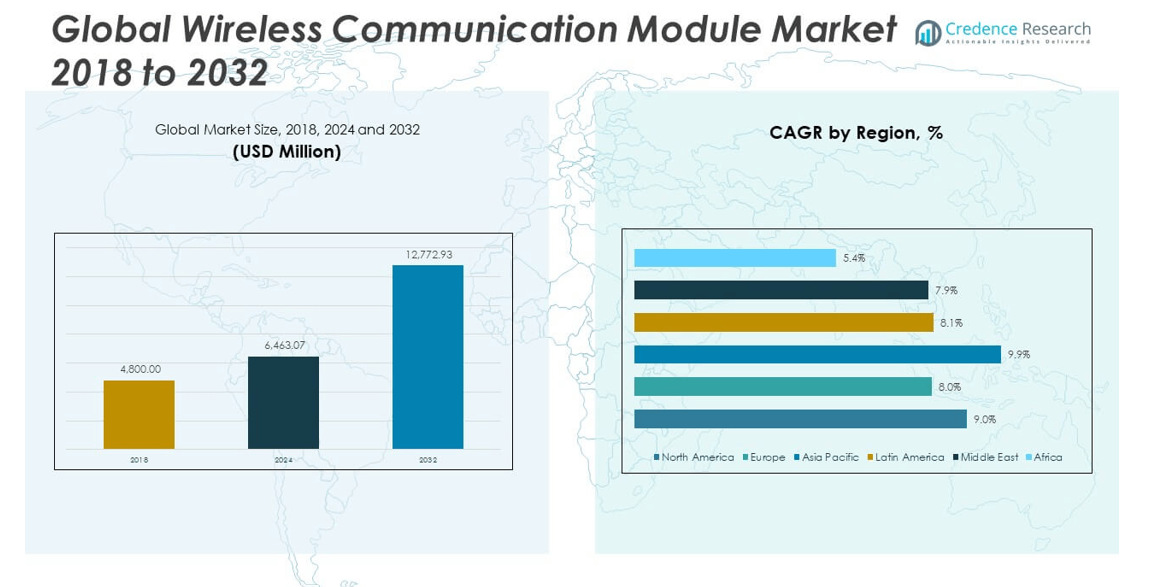
The Wireless Communication Module Market size was valued at USD 4,800.00 million in 2018, increased to USD 6,463.07 million in 2024, and is anticipated to reach USD 12,772.93 million by 2032, at a CAGR of 8.98% during the forecast period.
| REPORT ATTRIBUTE | DETAILS |
|---|---|
| Historical Period | 2020-2023 |
| Base Year | 2024 |
| Forecast Period | 2025-2032 |
| Wireless Communication Module Market Size 2024 | USD 6,463.07 million |
| Wireless Communication Module Market, CAGR | 8.98% |
| Wireless Communication Module Market Size 2032 | USD 12,772.93 million |
The growth of the Wireless Communication Module Market is primarily driven by the rapid adoption of Internet of Things (IoT) devices and advancements in wireless technologies like 5G. These modules are crucial for enabling seamless connectivity across industries, including automotive, healthcare, consumer electronics, and industrial automation. Increasing demand for smart homes, wearable devices, and connected cars is further fueling market growth. Additionally, the rise in cloud computing and data-driven services strengthens the need for faster and more efficient communication modules.
Geographically, North America and Europe hold significant shares in the Wireless Communication Module Market due to their mature technological infrastructure and high adoption of smart devices. The United States and Germany lead in industrial automation, IoT integration, and smart city initiatives. Meanwhile, the Asia-Pacific region, especially China and India, is emerging rapidly, driven by urbanization, rising disposable incomes, and a growing demand for connected consumer products. These countries are making substantial investments in wireless communication networks, supporting the expansion of the market in this region.
Market Insights:
- The Wireless Communication Module Market size was valued at USD 4,800.00 million in 2018, increased to USD 6,463.07 million in 2024, and is anticipated to reach USD 12,772.93 million by 2032, growing at a CAGR of 8.98% during the forecast period.
- The increasing adoption of IoT devices and advancements in wireless technologies like 5G drive the market’s growth. The demand for connected devices in sectors such as automotive, healthcare, and consumer electronics continues to rise.
- Security concerns in wireless communication systems and the challenge of ensuring low power consumption in large-scale deployments pose significant restraints in the market.
- North America and Europe dominate the market due to strong technological infrastructure and high adoption of smart devices, while the Asia Pacific region is rapidly emerging, particularly in China and India, driven by urbanization and industrial growth.
- The demand for smart homes, wearable devices, and connected cars further fuels market growth, with wireless modules enabling seamless communication across various industries.
- Regulatory compliance and inflationary pressures create economic frictions that may limit the expansion of the market, especially in developing regions.
- Investment in 5G networks and IoT applications in emerging markets such as Asia Pacific is expected to enhance market growth, with substantial contributions from countries like China, India, and South Korea.
Market Drivers:
Increasing Adoption of IoT Devices
The Wireless Communication Module Market benefits from the growing adoption of IoT devices across various sectors. These modules enable devices to connect to the internet, facilitating real-time communication. The increasing deployment of IoT in smart homes, healthcare, and industrial applications drives the market demand. IoT integration enhances operational efficiency and consumer experience, making it a crucial technology in modern systems. The market grows as industries realize the importance of wireless communication modules for seamless connectivity between devices.
- For example, MinewSemi, a leading module manufacturer, launched the ME54BS12 Bluetooth 6.0 moduleboasting a 128 MHz Arm Cortex-M33 processor, 1.5MB Flash, and 256KB RAM, supporting Bluetooth Mesh, Zigbee, Thread, and Matter protocols-illustrating the trend toward multi-protocol, high-performance modules designed for specific vertical applications like smart homes and industrial
Advancements in Wireless Communication Technologies
The advancement of wireless technologies, such as 5G and Wi-Fi 6, fuels the expansion of the Wireless Communication Module Market. These technologies provide faster data transfer speeds, reduced latency, and increased reliability, all of which enhance the capabilities of wireless communication modules. The demand for faster and more efficient data transmission is essential in supporting applications like autonomous vehicles, augmented reality, and remote healthcare services. Innovations in wireless communication technologies are transforming the market, driving growth and adoption.
- For instance, Wi-Fi 6 modules now deliver up to 9.6Gbps of throughputacross multiple channels, leveraging OFDMA for simultaneous multi-endpoint transmissions and TWT (Target Wake Time) for energy savings in battery-operated devices. WPA3 further enhances wireless security with 256-bit AES encryption as a baseline.
Demand for Smart and Connected Devices
Smart devices are increasingly embedded with wireless communication modules, leading to higher market demand. This trend is evident across consumer electronics, automotive, and healthcare sectors. In consumer electronics, wireless modules are integral to smartphones, wearables, and home automation systems. The automotive industry leverages these modules for connected vehicles, which enhances driving safety and convenience. As more devices become interconnected, the Wireless Communication Module Market continues to expand, meeting the demand for communication in diverse applications.
Government Initiatives and Investments in Communication Infrastructure
Governments across the globe are investing in advanced communication infrastructure, which contributes to the growth of the Wireless Communication Module Market. Programs aimed at deploying smart city technologies, improving wireless networks, and supporting digital transformation initiatives boost the market. These investments focus on expanding high-speed wireless networks and fostering the development of smart infrastructures. As governments push for digital economies, the adoption of wireless communication modules becomes essential in creating more connected environments.
Market Trends:
Growing Use of Wireless Communication in Industrial Automation
The trend toward industrial automation is a significant driver of the Wireless Communication Module Market. Industries are increasingly adopting automation technologies that rely on wireless communication for real-time monitoring and control of operations. Wireless communication modules enable seamless data exchange between machines and sensors, enhancing operational efficiency. Industries like manufacturing, logistics, and energy are integrating wireless modules to optimize performance and reduce downtime. As industrial automation continues to grow, the demand for wireless communication modules intensifies.
- For instance, at Hannover Messe 2023, Moxa showcased its industrial 5G solutions that achieved over 1 Gbps throughput and 50 ms recovery times using Virtual Router Redundancy Protocol (VRRP) in dual cellular configurations. This enabled seamless, real-time control in mission-critical environments such as rail and high-end manufacturing.
Integration with AI and Machine Learning for Enhanced Connectivity
The integration of AI and machine learning technologies with wireless communication modules is a growing trend. These technologies help improve the functionality of wireless communication systems by enhancing data analysis, predictive maintenance, and autonomous decision-making. AI-driven communication systems offer improved network management, optimizing bandwidth usage and reducing latency. As AI becomes more integrated with wireless communication systems, the demand for advanced modules that support these technologies continues to rise, offering higher performance and increased capabilities.
Rise of Low-Power Wide-Area Networks (LPWANs)
The Wireless Communication Module Market is witnessing the rise of Low-Power Wide-Area Networks (LPWANs), which are designed to support long-range communications with minimal power consumption. LPWANs are particularly useful in applications that require extended battery life, such as in remote monitoring and sensor-based systems. The adoption of LPWAN technologies allows industries to deploy large networks of connected devices with low energy consumption, making them ideal for applications like agriculture, smart cities, and logistics.
Evolution of Edge Computing in Wireless Systems
Edge computing is becoming a critical part of the Wireless Communication Module Market. By processing data closer to the source, edge computing reduces latency and bandwidth requirements, improving the overall efficiency of wireless communication systems. This trend is particularly important in applications requiring real-time decision-making, such as autonomous vehicles, robotics, and industrial automation. The integration of edge computing with wireless modules ensures faster data processing, which is essential for emerging applications in sectors like healthcare, manufacturing, and logistics.
- For instance, ClearBlade’s 2024 Intelligent Assets platform updates enable rapid GenAI chatbot deployment and high-availability edge clusters for industrial use cases, processing data locally to ensure sub-10ms response times.
Market Challenges Analysis:
Security Concerns in Wireless Communication Systems
One of the key challenges in the Wireless Communication Module Market is the growing concern over security. As the number of connected devices increases, so does the risk of cyberattacks and data breaches. Wireless communication systems are vulnerable to hacking, unauthorized access, and malicious activities that can compromise sensitive data. Ensuring the security of communication modules through encryption, secure protocols, and robust authentication methods is a critical requirement. The complexity of securing large-scale wireless communication networks presents ongoing challenges to market stakeholders.
High Energy Consumption in Large-Scale Deployments
Another challenge facing the Wireless Communication Module Market is the energy consumption of large-scale wireless communication systems. While advancements in low-power technologies have helped, some wireless modules still consume significant amounts of energy, especially in extensive networks. This can increase operational costs and reduce the overall efficiency of deployed systems. Developing energy-efficient communication modules that offer optimal performance without compromising battery life or increasing costs remains a crucial challenge in the market.
Market Opportunities:
Expansion of 5G Networks
The ongoing rollout of 5G networks presents a significant opportunity for the Wireless Communication Module Market. 5G networks promise faster data transfer speeds, lower latency, and greater connectivity, which are essential for emerging applications such as autonomous vehicles, smart cities, and industrial automation. The demand for communication modules that support 5G standards is expected to rise rapidly as telecom providers and enterprises deploy next-generation wireless networks. This trend opens up new growth opportunities for companies involved in the development of advanced wireless modules.
Increasing Demand for Connected Healthcare Solutions
The rise of telemedicine, remote patient monitoring, and connected healthcare devices offers substantial opportunities for the Wireless Communication Module Market. As the healthcare industry embraces digital transformation, wireless communication modules play a key role in enabling seamless connectivity between medical devices, sensors, and healthcare platforms. These modules ensure real-time data transmission, improving patient care and operational efficiency. With an increasing emphasis on remote healthcare services and personalized medicine, the market for wireless communication modules in healthcare continues to expand.
Market Segmentation Analysis:
The Wireless Communication Module Market is segmented into several categories based on form factors, applications, frequency bands, and technologies.
By Form Factor Segments include embedded modules, external modules, system-on-module (SoM), development boards, and miniaturized modules. Embedded modules are widely used in industrial and consumer electronics due to their compact nature, while external modules offer more flexibility in terms of connectivity. SoM provides a complete communication system in a compact form, catering to space-sensitive applications.
- For instance, u-blox’s NORA-W2 Wi-Fi 4 and Bluetooth 5.2 embedded modules measure just 10.4 × 14.3 × 1.8 mm, enabling manufacturers to integrate robust wireless connectivity into consumer electronics, industrial sensors, and automation devices while minimizing PCB footprint.
By Application Segments highlight the versatility of wireless modules across industries. Consumer electronics dominate the market, with modules embedded in smartphones, wearables, and home automation devices. Automotive applications leverage wireless modules for connectivity and safety systems, while industrial automation and healthcare sectors benefit from real-time data transmission and remote monitoring. Smart home devices and wearable devices further enhance the market’s growth, driving demand for efficient wireless solutions. Aerospace and defense applications use advanced modules for communication in critical operations.
- For instance, Apple’s A15 Bionic chip integrates custom cellular, Wi-Fi 6, and Bluetooth 5.0 modules in the iPhone 13 family, supporting peak download speeds of up to 9.6 Gbps and ultra-low latency for consumer mobile experiences.
By Frequency Band Segments include the Sub-GHz, 2.4 GHz, 5 GHz, and microwave bands (above 10 GHz). Each frequency band serves specific needs, with the Sub-GHz band offering long-range communication, 2.4 GHz providing a balance of range and speed, and 5 GHz supporting high-speed, low-latency communication.
By Technology Segments comprise Bluetooth, Wi-Fi, Zigbee, cellular, RF, NFC, and LoRa modules. Bluetooth and Wi-Fi are essential for short-range communications in consumer electronics, while Zigbee and LoRa cater to low-power, wide-area networking. Cellular modules support mobile communication, and RF and NFC modules are used in various industrial and commercial applications. Each technology plays a crucial role in addressing the unique demands of the Wireless Communication Module Market.
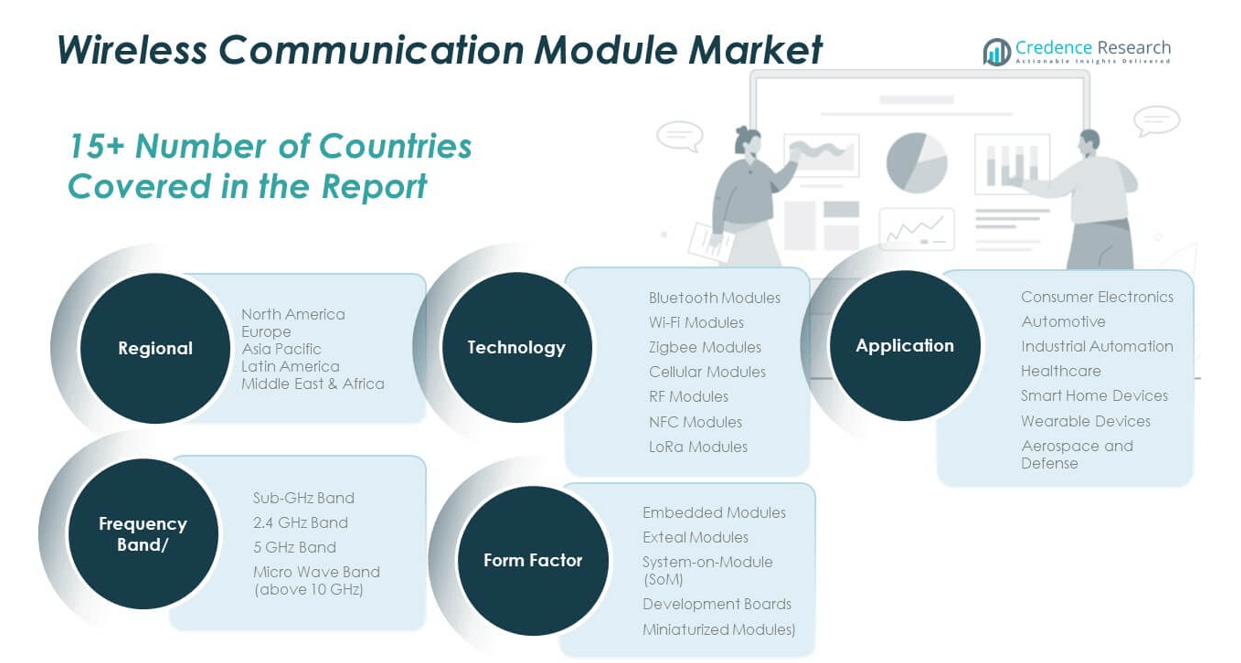
Segmentation:
By Form Factor Segments:
- Embedded Modules
- External Modules
- System-on-Module (SoM)
- Development Boards
- Miniaturized Modules
By Application Segments:
- Consumer Electronics
- Automotive
- Industrial Automation
- Healthcare
- Smart Home Devices
- Wearable Devices
- Aerospace and Defense
By Frequency Band Segments:
- Sub-GHz Band
- 2.4 GHz Band
- 5 GHz Band
- Microwave Band (above 10 GHz)
By Technology Segments:
- Bluetooth Modules
- Wi-Fi Modules
- Zigbee Modules
- Cellular Modules
- RF Modules
- NFC Modules
- LoRa Modules
By Region Segments:
- North America
- U.S.
- Canada
- Mexico
- Europe
- Germany
- France
- U.K.
- Italy
- Spain
- Rest of Europe
- Asia Pacific
- China
- Japan
- India
- South Korea
- South-east Asia
- Rest of Asia Pacific
- Latin America
- Brazil
- Argentina
- Rest of Latin America
- Middle East & Africa
- GCC Countries
- South Africa
- Rest of the Middle East and Africa
Regional Analysis:
North America
The North America Wireless Communication Module Market size was valued at USD 1,365.60 million in 2018, increased to USD 1,810.27 million in 2024, and is anticipated to reach USD 3,571.33 million by 2032, at a CAGR of 9.0% during the forecast period. North America holds a significant market share of approximately 22.9% in the global Wireless Communication Module Market. The market is driven by the region’s strong technological infrastructure, rapid adoption of IoT, and extensive investments in 5G networks. The United States, being a major contributor, leads in demand for advanced communication systems, particularly in automotive, healthcare, and consumer electronics sectors. This trend is reinforced by government initiatives promoting the development of smart cities and digital transformation. North America’s market share will continue to grow as consumer demand for connected devices and the integration of wireless communication modules across industries remains high.
Europe
The Europe Wireless Communication Module Market size was valued at USD 1,035.84 million in 2018, increased to USD 1,328.63 million in 2024, and is anticipated to reach USD 2,446.69 million by 2032, at a CAGR of 8.0% during the forecast period. Europe holds a market share of approximately 20.5%. The market is driven by the demand for industrial automation, IoT integration, and the expansion of 5G networks. Countries like Germany, the UK, and France play a major role in the market, with Germany leading in smart manufacturing, automotive technologies, and IoT deployments. The European market benefits from its focus on sustainability, technological advancements, and high consumer adoption of smart devices. By 2032, Europe is expected to maintain a strong share of the market, driven by continued advancements in industrial automation and digital transformation.
Asia Pacific
The Asia Pacific Wireless Communication Module Market size was valued at USD 1,769.76 million in 2018, increased to USD 2,453.03 million in 2024, and is anticipated to reach USD 5,185.82 million by 2032, at a CAGR of 9.9% during the forecast period. Asia Pacific holds the largest market share, approximately 36.7%. The region benefits from rapid industrialization, urbanization, and a growing demand for connected devices. China and India lead the market due to large-scale investments in smart cities, IoT applications, and 5G infrastructure. The region is witnessing significant growth in industries such as automotive, healthcare, and consumer electronics. With the rise in the number of mobile devices, wearables, and IoT technologies, Asia Pacific will continue to dominate the market, capturing an even larger market share by 2032.
Latin America
The Latin America Wireless Communication Module Market size was valued at USD 330.72 million in 2018, increased to USD 441.36 million in 2024, and is anticipated to reach USD 814.53 million by 2032, at a CAGR of 8.1% during the forecast period. Latin America holds a market share of approximately 7.4%. The market is driven by the increasing demand for IoT devices, urbanization, and advancements in wireless communication technologies. Brazil and Mexico are the leading countries in this region, with significant investments in smart city projects, energy management systems, and industrial IoT solutions. The region will continue to see steady growth and capture a larger share of the market as connectivity solutions expand across various industries in the coming years.
Middle East
The Middle East Wireless Communication Module Market size was valued at USD 233.76 million in 2018, increased to USD 299.20 million in 2024, and is anticipated to reach USD 546.75 million by 2032, at a CAGR of 7.9% during the forecast period. The Middle East holds a market share of approximately 4.8%. The market is growing rapidly due to significant investments in infrastructure, smart city projects, and the adoption of IoT technologies. Countries like the UAE, Saudi Arabia, and Qatar lead the market, with substantial investments in digital transformation and wireless communication systems. The demand for connected devices in sectors such as healthcare, automotive, and energy is increasing, positioning the region for further growth in market share by 2032.
Africa
The Africa Wireless Communication Module Market size was valued at USD 64.32 million in 2018, increased to USD 130.58 million in 2024, and is anticipated to reach USD 207.81 million by 2032, at a CAGR of 5.4% during the forecast period. Africa holds a market share of approximately 2.0%. The market is showing signs of significant growth, driven by increasing mobile device penetration, rural connectivity projects, and advancements in wireless communication technologies. The demand for wireless communication modules is particularly strong in countries like South Africa and Nigeria, where there is growing investment in infrastructure and digital connectivity. Africa is expected to capture a larger portion of the global market share as mobile and IoT solutions expand across various industries.
Key Player Analysis:
- Murata
- ROHM
- STMicroelectronics
- TDK
- FATEK
- NXP
- Siemens
- Microchip Technology
- ERL
Competitive Analysis:
The Wireless Communication Module Market is highly competitive, with several established players driving innovation and growth. Key market participants include companies like Qualcomm, Texas Instruments, Nordic Semiconductor, and Broadcom, which are leading in terms of technology advancements, product offerings, and strategic partnerships. These companies focus on providing reliable, high-performance wireless modules that support emerging technologies such as 5G, IoT, and industrial automation. Competitive strategies in the market involve continuous product development, mergers, and acquisitions to expand capabilities and enhance market presence. Companies are also focusing on offering cost-effective solutions to cater to a wide range of applications in automotive, consumer electronics, healthcare, and industrial sectors. With the increasing demand for connectivity and wireless solutions, competition will intensify as companies strive to meet evolving customer needs and capitalize on the growing market opportunities.
Recent Developments:
- In June 2025, STMicroelectronics announced the mass production of its ST67W611M1 Bluetooth/Wi-Fi module, developed in collaboration with Qualcomm. This marks the first product in ST’s and Qualcomm’s partnership, aiming to accelerate the integration of advanced wireless connectivity for IoT applications. The module supports Wi-Fi 6 and Bluetooth Low Energy 5.4, providing seamless solutions for both industrial and consumer devices
- In March 2025, Siemens entered into a new partnership with HMS Networks, with the Anybus Wireless Bolt 5G module successfully passing Siemens' Device Interoperability Testing for 5G. This partnership enables Siemens to expand its portfolio of private 5G infrastructure and industrial wireless connectivity for demanding applications, with the Anybus Bolt showcased at the 2025 Hannover Messe in Germany.
- In April 2025, Murata launched and began mass production of its compact wireless communication module, Type 2FY. This new module features Infineon’s CYW55513 chip and supports Wi-Fi 6E across 2.4GHz, 5GHz, and 6GHz bands, as well as Bluetooth and Bluetooth Low Energy capabilities.
- In November 2023, ROHM completed the acquisition of Solar Frontier's former Kunitomi Plant in Japan. While this acquisition primarily expands ROHM’s capacity for power semiconductor production, it signifies ROHM’s investment in its manufacturing footprint, which could impact its abilities in various product areas including wireless modules.
Market Concentration & Characteristics:
The Wireless Communication Module Market exhibits moderate concentration, with several key players holding significant shares, while also allowing room for regional and niche players. It is characterized by rapid technological advancements, particularly in 5G, IoT, and industrial automation sectors. The market is marked by high innovation, with companies focusing on enhancing data transfer speeds, reducing latency, and optimizing energy efficiency. Competition centers on product differentiation, with a strong emphasis on meeting the specific needs of various applications across industries like automotive, healthcare, and consumer electronics. Strategic collaborations, acquisitions, and investments in research and development are common among industry leaders, aiming to expand product portfolios and maintain competitive advantages.
Report Coverage:
The research report offers an in-depth analysis based on form factors, applications, frequency bands, and technologies. It details leading market players, providing an overview of their business, product offerings, investments, revenue streams, and key applications. Additionally, the report includes insights into the competitive environment, SWOT analysis, current market trends, as well as the primary drivers and constraints. Furthermore, it discusses various factors that have driven market expansion in recent years. The report also explores market dynamics, regulatory scenarios, and technological advancements that are shaping the industry. It assesses the impact of external factors and global economic changes on market growth. Lastly, it provides strategic recommendations for new entrants and established companies to navigate the complexities of the market.
Future Outlook:
- The Wireless Communication Module Market will continue to expand due to the increasing adoption of IoT devices across multiple industries.
- 5G technology will play a significant role in driving demand for faster, more reliable wireless communication modules.
- Growth in smart home technologies and connected consumer electronics will contribute to market expansion.
- Industrial automation and connected manufacturing systems will require advanced wireless modules for seamless operations.
- The healthcare sector’s shift toward connected medical devices will spur the demand for more reliable wireless communication solutions.
- Emerging markets in Asia Pacific will experience rapid growth, driven by urbanization and increasing disposable incomes.
- Strategic partnerships and acquisitions among market players will lead to enhanced product offerings and market consolidation.
- The expansion of cloud computing and edge computing technologies will boost the need for high-performance wireless communication modules.
- The rise in autonomous vehicles and connected automotive systems will be a key growth driver for the market.
- Sustainable wireless communication technologies with lower power consumption will gain traction due to environmental concerns and energy efficiency goals.

Request a Free Sample
Fill in your details and we'll send you a free sample report.
- Sample data tables & charts
- Research methodology
Market Dynamics
Increasing Adoption of IoT Devices
The proliferation of IoT devices across industries such as smart homes, healthcare, and industrial automation is driving demand for wireless communication modules, as these modules are essential for enabling real-time connectivity and data exchange.
Advancements in Wireless Technologies (5G, Wi-Fi 6)
Technological progress in wireless standards like 5G and Wi-Fi 6 is enabling faster data transfer, lower latency, and more reliable connections, which expands the range of applications for wireless communication modules in areas like autonomous vehicles and remote healthcare.
Growth in Smart and Connected Devices
The integration of wireless modules into consumer electronics, automotive systems, and wearables is fueling market growth, as manufacturers seek to offer enhanced connectivity, safety, and user experiences.
Government Initiatives and Infrastructure Investments
Global investments in smart city projects, digital transformation, and advanced wireless infrastructure by governments are accelerating the deployment of wireless communication modules, particularly in emerging markets.
Expansion of Industrial Automation
The shift toward automation in manufacturing, logistics, and energy sectors relies on wireless communication modules for real-time monitoring and control, boosting demand as industries seek to optimize operations and reduce downtime.
Need a Custom Version of This Report?
Tailor the scope, geography, or segments to your exact requirements.
- Custom geography or segment scope
- Direct access to our analyst team
Frequently Asked Questions
What is the current size of the Wireless Communication Module Market?
What are the key segments within the Wireless Communication Module Market?
What are some challenges faced by the Wireless Communication Module Market?
Who are the major players in the Wireless Communication Module Market?
Table of Content
Chapter 1 Market Segmentation
- 1.1 Segmentation Framework
- 1.1.1 Product and Service Classification
- 1.1.2 Application and End-Use Classification
- 1.1.3 Technology and Solution Classification
- 1.1.4 Customer and Distribution Channel Classification
- 1.1.5 Geographic Segmentation
- 1.1.6 Market Segment Definitions and Boundaries
- 1.2 By Technology
- 1.2.1 Bluetooth Modules
- 1.2.2 Wi-Fi Modules
- 1.2.3 Zigbee Modules
- 1.2.4 Cellular Modules
- 1.2.5 RF Modules
- 1.2.6 NFC Modules
- 1.2.7 LoRa Modules
- 1.3 By Application
- 1.3.1 Consumer Electronics
- 1.3.2 Automotive
- 1.3.3 Industrial Automation
- 1.3.4 Healthcare
- 1.3.5 Smart Home Devices
- 1.3.6 Wearable Devices
- 1.3.7 Aerospace and Defense
- 1.4 By Form Factor
- 1.4.1 Embedded Modules
- 1.4.2 External Modules
- 1.4.3 System-on-Module (SoM)
- 1.4.4 Development Boards
- 1.4.5 Miniaturized Modules
- 1.5 By Frequency Band
- 1.5.1 Sub-GHz Band
- 1.5.2 2.4 GHz Band
- 1.5.3 5 GHz Band
- 1.5.4 Microwave Band (above 10 GHz)
Chapter 2 Introduction
- 2.1 Report Objectives and Scope
- 2.2 Product Definition and Industry Terminology
- 2.3 Market Inclusions and Exclusions
- 2.4 Research Process
- 2.4.1 Primary Research and Expert Interviews
- 2.4.2 Secondary Research and Source Review
- 2.4.3 Top-Down and Bottom-Up Estimation
- 2.4.4 Data Triangulation and Verification
- 2.5 Market Size Measurement Basis
- 2.5.1 2018: USD 4,800.00 million → 2032: USD 12,772.93 million
- 2.6 Historical and Forecast Reference Periods
- 2.6.1 Base Year: 2018
- 2.6.2 Forecast Period: 2018-2032
- 2.7 Research Assumptions and Limitations
Chapter 3 Executive Summary
- 3.1 Market Snapshot and Key Findings
- 3.2 Base-Year Market Size, 2018
- 3.3 Forecast Market Size, 2032
- 3.4 Revenue and Volume Growth Outlook
- 3.5 Key Demand and Supply Indicators
- 3.6 Leading Market Segments
- 3.7 Fastest-Growing Market Opportunities
- 3.8 Regional Performance Highlights
- 3.9 Technology and Industry Transformation
- 3.10 Competitive Landscape Summary
- 3.11 Analyst View and Strategic Implications
Chapter 4 Global Wireless Communication Module Market Trends and Developments
- 4.1 Historical Industry Development
- 4.2 Recent Market Trends and Developments
- 4.3 Demand and Customer Behavior Trends
- 4.4 Technology and Product Innovation
- 4.5 Artificial Intelligence, Automation and Digitalization
- 4.6 Local Manufacturing and Supply Chain Realignment
- 4.7 Industry Partnerships, Mergers and Acquisitions
- 4.8 Sustainability and Circular Economy Developments
- 4.9 Government and Private Sector Investment Trends
- 4.10 Emerging Business Models and Commercialization
- 4.11 Industry Developments and Announcements
Chapter 5 Global Wireless Communication Module Market Production, Supply and Demand Analysis
- 5.1 Demand Trend and Consumption Analysis
- 5.2 Demand Forecast, 2018-2032
- 5.3 Production and Output Trend
- 5.4 Production and Output Forecast, 2018-2032
- 5.5 Installed Capacity and Capacity Utilization
- 5.6 Company-Wise Production Plants and Statistics
- 5.6.1 Installed Production Capacity
- 5.6.2 Actual Production
- 5.6.3 Planned Capacity and Expansion Targets
- 5.7 Supply Chain Structure and Procurement Trends
- 5.8 Supply-Demand Gap and Bottlenecks
- 5.9 Import Dependence and Sourcing Structure
- 5.10 Contract Manufacturing and Outsourcing
- 5.11 Regional Supply and Demand Concentration
Chapter 6 Global Wireless Communication Module Market Pricing Analysis
- 6.1 Pricing Structure and Measurement
- 6.2 Historical Pricing Trends
- 6.3 Pricing Outlook, 2018-2032
- 6.4 Average Selling Price and Unit Economics
- 6.5 Pricing by Product and Market Segment
- 6.6 Geographic Pricing Differences
- 6.7 Key Input, Energy, Labor and Logistics Costs
- 6.8 Contract Pricing and Purchasing Models
- 6.9 Pricing Sensitivity and Competitive Positioning
- 6.10 Price, Margin and Profitability Implications
Chapter 7 Global Wireless Communication Module Market Dynamics
- 7.1 Market Growth Drivers
- 7.1.1 Demand-Side Drivers
- 7.1.2 Technology and Innovation Drivers
- 7.1.3 Infrastructure and Investment Drivers
- 7.1.4 Regulatory and Policy Drivers
- 7.2 Market Restraints
- 7.2.1 Cost and Affordability Constraints
- 7.2.2 Technology and Adoption Barriers
- 7.2.3 Supply Chain and Operational Constraints
- 7.3 Market Challenges
- 7.3.1 Competitive Pressure and Margin Erosion
- 7.3.2 Skills, Infrastructure and Implementation Gaps
- 7.4 Emerging Market Opportunities
- 7.5 Market Dynamics Impact and Time-Horizon Assessment
Chapter 8 Global Wireless Communication Module Value Chain Analysis
- 8.1 Industry Value Chain Overview
- 8.2 Upstream Suppliers and Critical Inputs
- 8.3 Technology and Component Providers
- 8.4 Manufacturing or Service Delivery
- 8.5 Distribution, Channel Partners and Integrators
- 8.6 Downstream Applications and End Users
- 8.7 Value Addition and Profit Pools
- 8.8 Vertical Integration and Outsourcing
- 8.9 Supplier Concentration and Risk
- 8.10 Supply Chain Localization and Resilience
Chapter 9 Global Wireless Communication Module Market Regulations and Policies
- 9.1 Relevant Laws, Standards and Compliance Frameworks
- 9.2 Product, Service, Safety and Quality Requirements
- 9.3 Government Policies, Incentives and Subsidies
- 9.4 Imports, Exports and Trade Barriers
- 9.5 Public Procurement and Local Content Requirements
- 9.6 Environmental and Sustainability Compliance
- 9.7 Data Protection, AI and Cybersecurity Compliance
- 9.8 Upcoming Policy Changes and Market Implications
Chapter 10 Global Wireless Communication Module Market Hotspots and Opportunities
- 10.1 Market Opportunity Mapping and Growth Hotspots
- 10.2 High-Growth Applications and Customer Groups
- 10.3 Underserved Markets and White-Space Opportunities
- 10.4 Emerging Technology and Product Opportunities
- 10.5 New Capacity and Investment Hotspots
- 10.6 Market Entry and Expansion Opportunities
- 10.7 Distribution and Partnership Opportunities
- 10.8 Near-Term and Long-Term Commercial Potential
- 10.9 Opportunity Attractiveness and Execution Risks
Chapter 11 Global Wireless Communication Module Market Outlook, 2018-2032
- 11.1 Market Size and Analysis
- 11.1.1 Revenue (Market Measurement: 2018: USD 4,800.00 million → 2032: USD 12,772.93 million)
- 11.1.2 Market Volume and Quantity Sold
- 11.1.3 Historical Market Size
- 11.1.4 Base-Year Market Size, 2018
- 11.2 Market Forecast, 2018-2032
- 11.2.1 Revenue Forecast to 2032
- 11.2.2 Volume Forecast to 2032
- 11.2.3 CAGR and Year-on-Year Growth
- 11.2.4 Incremental Revenue Opportunity
- 11.3 Forecast Assumptions and Scenario Analysis
- 11.3.1 Base-Case Forecast
- 11.3.2 Optimistic and Conservative Scenarios
- 11.3.3 Technology, Pricing and Policy Sensitivities
- 11.4 Market Attractiveness and Growth Outlook
Chapter 12 Global Wireless Communication Module Market Segmentation and Outlook
- 12.1 Segmentation Summary and Market Shares, 2018
- 12.2 Largest and Fastest-Growing Segments
- 12.3 By Technology - Market Size and Forecast, 2018-2032
- 12.3.1 Segment Definition and Scope
- 12.3.2 Historical Market Size
- 12.3.3 Revenue Forecast, 2018-2032
- 12.3.4 Volume Forecast, 2018-2032
- 12.3.5 Base-Year Market Share, 2018
- 12.3.6 Segment CAGR and Growth Drivers
- 12.3.7 Subsegment Market Size and Forecast
- 12.3.7.1 Bluetooth Modules
- 12.3.7.2 Wi-Fi Modules
- 12.3.7.3 Zigbee Modules
- 12.3.7.4 Cellular Modules
- 12.3.7.5 RF Modules
- 12.3.7.6 NFC Modules
- 12.3.7.7 LoRa Modules
- 12.3.8 Subsegment Pricing and Adoption Trends
- 12.3.9 Leading Suppliers and Competition
- 12.3.10 Regional Demand and Opportunities
- 12.4 By Application - Market Size and Forecast, 2018-2032
- 12.4.1 Segment Definition and Scope
- 12.4.2 Historical Market Size
- 12.4.3 Revenue Forecast, 2018-2032
- 12.4.4 Volume Forecast, 2018-2032
- 12.4.5 Base-Year Market Share, 2018
- 12.4.6 Segment CAGR and Growth Drivers
- 12.4.7 Subsegment Market Size and Forecast
- 12.4.7.1 Consumer Electronics
- 12.4.7.2 Automotive
- 12.4.7.3 Industrial Automation
- 12.4.7.4 Healthcare
- 12.4.7.5 Smart Home Devices
- 12.4.7.6 Wearable Devices
- 12.4.7.7 Aerospace and Defense
- 12.4.8 Subsegment Pricing and Adoption Trends
- 12.4.9 Leading Suppliers and Competition
- 12.4.10 Regional Demand and Opportunities
- 12.5 By Form Factor - Market Size and Forecast, 2018-2032
- 12.5.1 Segment Definition and Scope
- 12.5.2 Historical Market Size
- 12.5.3 Revenue Forecast, 2018-2032
- 12.5.4 Volume Forecast, 2018-2032
- 12.5.5 Base-Year Market Share, 2018
- 12.5.6 Segment CAGR and Growth Drivers
- 12.5.7 Subsegment Market Size and Forecast
- 12.5.7.1 Embedded Modules
- 12.5.7.2 External Modules
- 12.5.7.3 System-on-Module (SoM)
- 12.5.7.4 Development Boards
- 12.5.7.5 Miniaturized Modules
- 12.5.8 Subsegment Pricing and Adoption Trends
- 12.5.9 Leading Suppliers and Competition
- 12.5.10 Regional Demand and Opportunities
- 12.6 By Frequency Band - Market Size and Forecast, 2018-2032
- 12.6.1 Segment Definition and Scope
- 12.6.2 Historical Market Size
- 12.6.3 Revenue Forecast, 2018-2032
- 12.6.4 Volume Forecast, 2018-2032
- 12.6.5 Base-Year Market Share, 2018
- 12.6.6 Segment CAGR and Growth Drivers
- 12.6.7 Subsegment Market Size and Forecast
- 12.6.7.1 Sub-GHz Band
- 12.6.7.2 2.4 GHz Band
- 12.6.7.3 5 GHz Band
- 12.6.7.4 Microwave Band (above 10 GHz)
- 12.6.8 Subsegment Pricing and Adoption Trends
- 12.6.9 Leading Suppliers and Competition
- 12.6.10 Regional Demand and Opportunities
- 12.7 Segment Growth Comparison
- 12.8 Segment Attractiveness and Priority Matrix
Chapter 13 Global Wireless Communication Module End-Use and Application Market Outlook
- 13.1 End-Use Industry and Customer Demand Structure
- 13.2 Leading Applications and Customer Groups
- 13.3 End-Use Market Size, Share and Forecast
- 13.4 Major End-Use Industry Deep Dives
- 13.4.1 Customer Requirements and Use Cases
- 13.4.2 Demand and Replacement Cycles
- 13.4.3 Technical and Regulatory Considerations
- 13.4.4 Purchasing and Procurement Models
- 13.4.5 Leading Vendors and Distribution Channels
- 13.4.6 Forecast and Commercial Opportunities
- 13.5 Emerging Applications and Cross-Segment Demand
- 13.6 End-Use Industry Investment Priorities
Chapter 14 Global Wireless Communication Module Geographic Market Outlook, 2018-2032
- 14.1 Regional Market Size and Share, 2018
- 14.2 Regional Market Forecast, 2018-2032
- 14.3 Regional Pricing, Production and Demand Differences
- 14.4 North America
- 14.4.1 United States
- 14.4.2 Canada
- 14.4.3 Mexico
- 14.5 Europe
- 14.5.1 Germany
- 14.5.2 France
- 14.5.3 Italy
- 14.5.4 United Kingdom
- 14.5.5 Spain
- 14.5.6 Poland
- 14.5.7 Russia
- 14.5.8 Netherlands
- 14.5.9 Belgium
- 14.5.10 Sweden
- 14.5.11 Denmark
- 14.5.12 Norway
- 14.5.13 Rest of Europe
- 14.6 Asia Pacific
- 14.6.1 China
- 14.6.2 India
- 14.6.3 Japan
- 14.6.4 South Korea
- 14.6.5 Thailand
- 14.6.6 Indonesia
- 14.6.7 Vietnam
- 14.6.8 Malaysia
- 14.6.9 Australia
- 14.6.10 Rest of Asia Pacific
- 14.7 Latin America
- 14.7.1 Brazil
- 14.7.2 Argentina
- 14.7.3 Colombia
- 14.7.4 Chile
- 14.7.5 Rest of Latin America
- 14.8 Middle East
- 14.8.1 Saudi Arabia
- 14.8.2 United Arab Emirates
- 14.8.3 Turkey
- 14.8.4 Israel
- 14.8.5 Iran
- 14.8.6 Rest of the Middle East
- 14.9 Africa
- 14.9.1 South Africa
- 14.9.2 Egypt
- 14.9.3 Nigeria
- 14.9.4 Morocco
- 14.9.5 Rest of Africa
- 14.10 Regional Investment, Policy and Supply Chain Differences
- 14.11 Regional Competitive Landscape
- 14.12 Geographic Growth Hotspots
Chapter 15 Global Wireless Communication Module Technology, Innovation and Sustainability Outlook
- 15.1 Technology Landscape and Maturity
- 15.2 Product, Process and Service Innovation
- 15.3 AI, Automation and Digital Tools in the Industry
- 15.4 Technology Adoption and Performance Benchmarking
- 15.5 Innovation Pipeline and R&D Investment
- 15.6 Patent and Intellectual Property Trends
- 15.7 Energy Efficiency and Resource Management
- 15.8 Sustainability, Recycling and Circularity
- 15.9 Technology Roadmap, 2018-2032
- 15.10 Risks of Obsolescence and Technology Substitution
Chapter 16 Global Wireless Communication Module Market Key Strategic Imperatives
- 16.1 Growth and Market Entry Priorities
- 16.2 High-Return Products and Segments
- 16.3 Pricing, Profitability and Cost Optimization
- 16.4 Technology Investment and Product Differentiation
- 16.5 Supply Chain Localization and Resilience
- 16.6 Distribution and Customer Acquisition
- 16.7 Partnership, Acquisition and Capacity Strategy
- 16.8 Regional Expansion Priorities
- 16.9 Short-, Medium- and Long-Term Actions
Chapter 17 Competition Outlook
- 17.1 Industry Competition Characteristics
- 17.2 Market Structure and Concentration
- 17.3 Market Share and Competitive Positioning, 2018
- 17.4 Company-Wise Revenue and Product Benchmarking
- 17.5 Production and Service Capacity Benchmarking
- 17.6 Technology, Pricing and Differentiation
- 17.7 Regional Footprint and Distribution Strength
- 17.8 Mergers, Acquisitions and Strategic Alliances
- 17.9 New Entrants and Competitive Threats
- 17.10 Porter's Five Forces and Industry Attractiveness
- 17.11 Competitive Outlook, 2018-2032
Chapter 18 Company Profiles
- 18.1 Company Coverage and Selection Criteria
- 18.2 Murata
- 18.2.1 Business Description
- 18.2.2 Company Ownership and Geographic Presence
- 18.2.3 Product and Service Portfolio
- 18.2.4 Manufacturing and Operating Footprint
- 18.2.5 Production Capacity and Expansion Plans
- 18.2.6 Financial Performance and Investment
- 18.2.7 Market Share and Competitive Position
- 18.2.8 Technology and Innovation Capabilities
- 18.2.9 Strategic Alliances or Partnerships
- 18.2.10 Recent Developments
- 18.2.11 Growth Strategy and Outlook
- 18.3 ROHM
- 18.4 STMicroelectronics
- 18.5 TDK
- 18.6 NXP Semiconductors
- 18.7 Siemens
- 18.8 Microchip Technology
- 18.9 Qualcomm
- 18.10 Texas Instruments
- 18.11 Nordic Semiconductor
- 18.12 Other Relevant Market Participants
Note: Every listed company is profiled on the structure shown under the first company. The company list is preliminary and may change based on research findings, market developments, data availability and client requirements.
Chapter 19 Disclaimer
- 19.1 Research and Forecast Disclaimer
- 19.2 Data Source and Estimation Limitations
Note: The depth of individual sections depends on data availability for this market. Volume, capacity, trade and other unit-based metrics are included where applicable.

