| REPORT ATTRIBUTE | DETAILS |
|---|---|
| Historical Period | 2019-2022 |
| Base Year | 2023 |
| Forecast Period | 2024-2032 |
| Yacht Charter Market Size 2024 | USD 18,995 million |
| Yacht Charter Market, CAGR | 4.8% |
| Yacht Charter Market Size 2032 | USD 27,639.46 million |
Market Overview
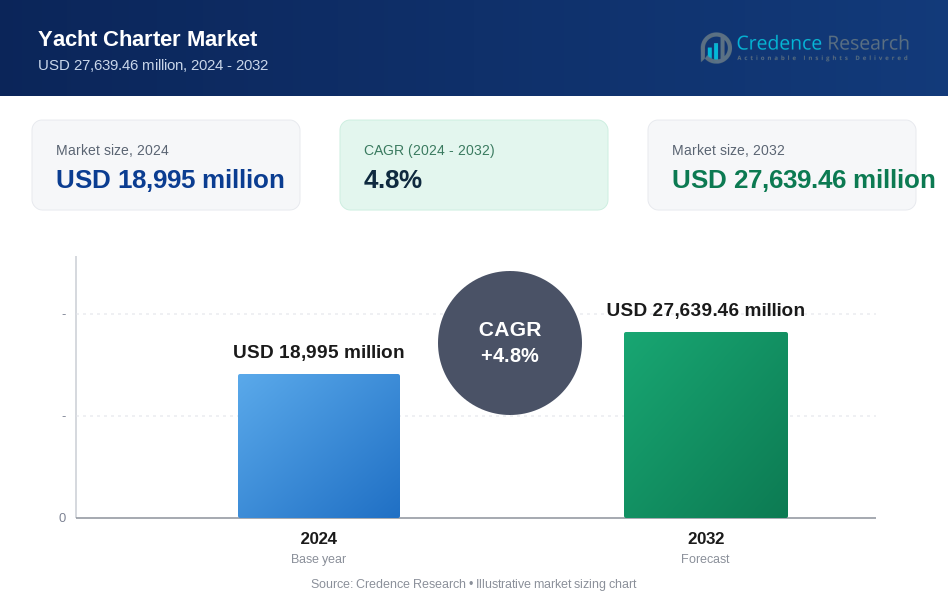
The yacht charter market is projected to grow from USD 18,995 million in 2024 to USD 27,639.46 million by 2032, representing a compound annual growth rate (CAGR) of 4.8%.
The yacht charter market is driven by increasing disposable incomes and a growing preference for luxury travel experiences among affluent individuals. Additionally, the rise in adventure tourism and personalized travel options is fueling demand for yacht charters, as they offer unique and customizable itineraries. Technological advancements, such as enhanced booking platforms and innovative charter management systems, are streamlining the booking process, attracting a broader customer base. Furthermore, the growing popularity of eco-friendly yachts is aligning with sustainability trends, enabling operators to tap into the environmentally conscious segment of the market, thus driving further growth and diversification.
The yacht charter market is geographically diverse, with prominent activity in regions such as Europe, North America, and the Caribbean. Europe leads the market, particularly in the Mediterranean, attracting a high volume of international clientele seeking luxury experiences. Key players in this sector include Burgess, Northrop & Johnson, and IYC, which dominate the European market. In North America, companies like Yachtico Inc. and Barrington Hall Yacht Charters cater to affluent travelers in popular destinations like Florida and California. The Caribbean, known for its stunning waters and vibrant culture, is also a significant area for yacht charters, featuring players like Royal Yacht International and Sailogy S.A.
Market Drivers
Rising Disposable Income
The yacht charter market is significantly driven by the growing wealth of high-net-worth and ultra-high-net-worth individuals. As the number of affluent individuals increases, so does their desire for exclusive and personalized experiences, which yacht charters uniquely provide. For instance, the number of high-net-worth individuals worldwide increased by nearly 9% in 2020. These individuals seek luxurious and customized vacations that cater to their tastes, making yacht charters an appealing option for their leisure pursuits.
Growing Tourism Industry
The global tourism industry’s expansion is another catalyst for the yacht charter market. The emergence of new and exciting destinations ranging from popular hotspots to off-the-beaten-path locales continues to attract yacht charter enthusiasts. For example, the global tourist industry saw a 4% increase from 400 million in 2020 to 415 million in 2021. Additionally, advancements in transportation and infrastructure have made yacht charters more accessible, broadening the potential traveler base and encouraging more individuals to experience the luxury of yacht travel.
Desire for Personalized Experiences
Yacht charters are distinguished by their ability to provide tailored itineraries that cater specifically to individual preferences and interests. This level of customization is a significant draw for travelers looking to create unique experiences that resonate with their personal desires. Guests can work closely with charter companies to curate every aspect of their journey, from selecting destinations and onboard amenities to choosing activities and dining options. This flexibility not only enhances overall satisfaction but also fosters deeper engagement with the travel experience. Furthermore, the privacy and exclusivity inherent in yacht charters offer a striking contrast to traditional tourism, where crowded attractions often detract from the overall enjoyment. Guests can escape the hustle and bustle of popular tourist spots, relishing the tranquility of open waters and private anchorages.
Adventurous and Recreational Activities
The allure of yacht charters transcends mere relaxation, encompassing a diverse array of adventurous and recreational activities that cater to thrill-seekers and nature lovers alike. Guests aboard a yacht can enjoy easy access to a variety of water sports, such as diving, snorkeling, fishing, and paddleboarding, all of which enhance the overall experience. These activities allow guests to immerse themselves in the vibrant marine environment, exploring underwater ecosystems teeming with colorful fish and coral reefs. The opportunity to engage in water sports not only provides excitement but also fosters a deeper appreciation for the natural beauty surrounding them. Additionally, yacht charters offer the chance to explore secluded coves, hidden beaches, and uninhabited islands, adding an element of adventure to the journey. Whether it's discovering a private snorkeling spot or setting off on a fishing expedition, guests create unforgettable memories in stunning and unique settings.
Market Trends
Sustainability and Eco-Friendliness
The yacht charter market is increasingly embracing sustainability and eco-friendliness, driven by growing consumer awareness of environmental issues. Charter companies are implementing green initiatives, such as using renewable energy sources and minimizing their overall environmental impact. For instance, some yacht companies have started using hybrid engines and solar panels to reduce fuel consumption. This shift is evident in the rising demand for eco-friendly yachts equipped with hybrid engines and efficient waste management systems. By adopting sustainable practices, these companies not only enhance their market appeal but also align themselves with the values of environmentally conscious travelers, making sustainability a pivotal trend in the yacht charter industry.
Experiential Travel and Technology Integration
Experiential travel is transforming the yacht charter landscape, as companies expand their offerings beyond traditional sun and sea experiences. Charter providers now curate a diverse range of experiences, including cultural tours, culinary adventures, and wildlife encounters, allowing guests to engage with the destinations on a deeper level. Personalization is key, with guests seeking tailored itineraries that reflect their unique interests and preferences. This trend is complemented by advancements in technology, where digital platforms and virtual tours simplify the booking process and enhance the customer experience. Furthermore, the integration of smart technology in yachts featuring automated systems, entertainment options, and enhanced connectivity ensures that guests enjoy a seamless and luxurious experience onboard, reinforcing the appeal of yacht charters as a sophisticated and immersive travel option.
Market Challenges Analysis
Economic Fluctuations and Competition
The yacht charter market faces significant challenges from economic fluctuations, particularly during recessions and market downturns. Such economic conditions typically lead to decreased discretionary spending among potential customers, which can negatively impact charter bookings. For instance, during economic downturns, reduced disposable incomes and constrained spending on luxury items diminish demand for yachts. Moreover, fluctuations in fuel prices pose another hurdle, as rising costs directly affect the operational expenses of charter companies. To maintain profitability, operators may be compelled to pass these increased costs onto customers in the form of higher charter rates, potentially deterring bookings and reducing overall demand. In addition to economic pressures, the yacht charter industry is experiencing heightened competition, with an increasing number of charter companies and private yacht owners entering the market. This surge in competition intensifies pricing pressures, making it challenging for companies to establish and maintain profitable pricing strategies. Striking a balance between attracting customers and ensuring profitability becomes a critical concern, as operators navigate a landscape where aggressive pricing can undermine revenue and profit margins.
Regulatory, Environmental, and Personnel Challenges
Charter companies also contend with a complex web of regulatory and legal considerations, which can impose significant operational burdens. Adherence to stringent maritime regulations, including safety standards and environmental protection measures, is essential yet challenging. Failure to comply can result in substantial fines and legal repercussions, not to mention reputational damage that can deter customers. Legal issues surrounding accidents, injuries, or property damage further compound these challenges, leading to potential financial liabilities and increasing operational risk. Environmental concerns, particularly those related to climate change, present additional hurdles. Changes in climate can adversely affect coastal areas and marine ecosystems, limiting the availability of desirable cruising grounds and complicating charter operations. Additionally, charter companies face the challenge of balancing economic growth with environmental sustainability. As they strive to minimize their ecological footprint, they must implement sustainable practices while remaining competitive in the market. Finally, personnel shortages pose a pressing issue, as finding and retaining qualified crew members becomes increasingly difficult, especially in popular charter destinations. Investing in crew training and development is vital for maintaining high-quality service and safety standards, yet it adds to operational costs, further complicating the challenges faced by the yacht charter industry.
Market Segmentation Analysis:
By Sailing Yachts:
The yacht charter market can be segmented by the type of sailing yachts, which includes sloop, schooner, catamaran, and ketch. Sloops are among the most popular choices due to their single-masted design, offering efficiency and ease of handling, making them ideal for both novice and experienced sailors. Schooners, characterized by their two or more masts, provide a classic sailing experience and often appeal to charterers seeking a vintage aesthetic combined with spacious decks. Catamarans are increasingly favored for their stability and ample living space, making them perfect for families or groups. Their dual-hull design also enhances comfort, particularly in choppy waters. Ketches, with their two masts and versatile rigging, offer a balance of speed and stability, appealing to those who prioritize performance alongside comfort. This diversity in sailing yacht types caters to a wide range of preferences and sailing experiences, driving growth in the sailing yacht segment of the yacht charter market.
By Motor Yachts:
In addition to sailing yachts, the yacht charter market is also segmented by motor yachts, including displacement type, semi-displacement, planing, catamaran, and trimaran. Displacement motor yachts are designed for efficient cruising, moving through the water with minimal resistance, which is ideal for long voyages and fuel efficiency. Semi-displacement yachts offer a hybrid experience, allowing for both slow cruising and faster speeds, making them versatile options for various types of charters. Planing motor yachts are designed for speed, providing a thrilling experience for those looking to cover long distances quickly. Catamaran motor yachts share the benefits of stability and spaciousness with their sailing counterparts, appealing to families and groups seeking comfort. Trimaran motor yachts, with their three-hull design, combine speed and stability, making them popular among adventure seekers. Each of these motor yacht categories offers distinct advantages, ensuring that the diverse needs of yacht charter clients are met while driving growth in this segment of the market.
Segments:
Based on Sailing Yachts:
- Sloop
- Schooner
- Catamaran
- Ketch
Based on Motor Yachts:
- Displacement Type
- Semi-displacement
- Planing
- Catamaran
- Trimaran
Based on Size:
- Small (up to 30m) Yachts
- Medium (30m-50m) Yachts
- Large (over 50m) Yachts
Based on Consumer:
- Corporate Yacht Charters
- Retail Yacht Charters
- Individual
- Family/Group
- Couple
Based on the Geography:
- North America
- U.S.
- Canada
- Mexico
- Europe
- Germany
- France
- U.K.
- Italy
- Spain
- Rest of Europe
- Asia Pacific
- China
- Japan
- India
- South Korea
- South-east Asia
- Rest of Asia Pacific
- Latin America
- Brazil
- Argentina
- Rest of Latin America
- Middle East & Africa
- GCC Countries
- South Africa
- Rest of the Middle East and Africa
Regional Analysis
North America
North America holds a significant share of the yacht charter market, accounting for approximately 30% of the global market. The region's robust tourism infrastructure, combined with a high concentration of high-net-worth individuals, drives demand for yacht charters, particularly in popular destinations such as Florida and California. The Mediterranean Sea is a favored cruising ground for North American charterers, who often seek both relaxation and adventure in this picturesque locale. Additionally, the region's diverse offerings, including sailing, motor yacht charters, and a variety of water sports, cater to a wide range of consumer preferences. Seasonal events and festivals further boost charter demand, particularly during the summer months, as affluent travelers seek unique and personalized experiences on the water.
Europe
Europe, encompassing key yachting destinations like the Mediterranean, the Adriatic Sea, and the Baltic Sea, holds a dominant position in the yacht charter market with a market share of around 50%. The Mediterranean, in particular, attracts a substantial number of international charterers, drawn by its stunning coastlines, rich cultural heritage, and favorable sailing conditions. Countries like Greece, Italy, and Spain are among the most sought-after locations for yacht charters, offering diverse itineraries that range from exploring historic coastal towns to indulging in culinary experiences. The European yacht charter market is characterized by its strong focus on luxury and customization, with charter companies continually innovating to meet the evolving demands of affluent clientele. This focus on personalized experiences, combined with the region’s rich maritime tradition and well-established infrastructure, positions Europe as a leader in the yacht charter industry, driving consistent growth and interest from global travelers.
Key Player Analysis
- Burgess
- Northrop & Johnson
- Ionian Catamarans
- IYC
- Sailogy S.A.
- Princess Yacht Charter
- Royal Yacht International
- Zizooboats GmbH
- Barrington Hall Yacht Charters
- Yachtico Inc.
Competitive Analysis
The yacht charter market is characterized by intense competition among several leading players, including Burgess, Northrop & Johnson, IYC, Yachtico Inc., Barrington Hall Yacht Charters, Royal Yacht International, Sailogy S.A., Ionian Catamarans, and Princess Yacht Charter. Leading players differentiate themselves through strategies such as personalized experiences, diverse fleet options, and exceptional customer service. Companies known for their luxury offerings often leverage extensive global networks, while others focus on high-end yacht management and charter services. Many operators are enhancing their booking processes and customer engagement through technological advancements, allowing for seamless experiences. Additionally, regional companies cater to specific markets, providing localized expertise that enhances their appeal. As the market continues to grow, companies must innovate and adapt to evolving consumer preferences while maintaining competitive pricing and high service standards to attract and retain clientele.
Recent Developments
- In July 2023, Northrop & Johnson added MAORIA Numarine Yacht to its fleet. The 85’4” (25.6m) yacht has been made available to cruise through France, including Corsica and Sardinia. The cost of charters starts from USD 59,390 per week, plus expenses.
- In July 2023, Camper & Nicholsons International Ltd added Eratosthenes to its charter CA fleet from Nautor’s Swan. The sailing yacht is 34.3m and accommodates six guests in three cabins, along with two Pullman berths especially suited to children. The yacht is available for charter in the Greek islands.
- In April 2023, Ocean Independence added the 27m motor yacht A4 to its charter fleet. It can accommodate ten guests in 4 staterooms. In addition, three crew members run the yacht.
- In January 2023, Burgess Yachts announced the addition of six new stunning yachts to its fleet. This new addition includes the luxury of M'BRACE to chic free spirit ENTERPRISE, elegant lady LIND to high octane ROX STAR. All these yacht helped the company to attrach more tourists during the summer.
- In January 2023, Dream Yacht Worldwide and Fountaine Pajot, builders of leading-edge luxury catamarans, announced their partnership to launch their fleet’s first collection of electric catamarans. The Aura 51 Smart Electric will be the first electric model introduced to the Dream Yacht Worldwide fleet and made available for chartering in Italy from April 2023.
Market Concentration & Characteristics
The yacht charter market exhibits a moderate level of concentration, with several key players dominating various regions while numerous smaller operators cater to niche markets. This diversity fosters a competitive environment where companies strive to differentiate themselves through unique offerings, such as personalized itineraries and luxury experiences. Characteristics of the market include a strong emphasis on customer service, with many operators prioritizing tailored experiences to meet individual preferences. Additionally, the market is influenced by seasonal demand, particularly in popular cruising destinations, which can lead to fluctuations in bookings and revenue. Furthermore, technological advancements are reshaping the landscape, enabling operators to enhance their booking processes and customer engagement through online platforms and mobile applications. Sustainability is also becoming increasingly important, as consumers seek eco-friendly options and operators adopt greener practices. This combination of competitive dynamics, customer-centric focus, and evolving trends shapes the overall landscape of the yacht charter market.Top of Form
Report Coverage
The research report offers an in-depth analysis based on Sailing Yachts, Motor Yachts, Size, Consumer and Geography. It details leading market players, providing an overview of their business, product offerings, investments, revenue streams, and key applications. Additionally, the report includes insights into the competitive environment, SWOT analysis, current market trends, as well as the primary drivers and constraints. Furthermore, it discusses various factors that have driven market expansion in recent years. The report also explores market dynamics, regulatory scenarios, and technological advancements that are shaping the industry. It assesses the impact of external factors and global economic changes on market growth. Lastly, it provides strategic recommendations for new entrants and established companies to navigate the complexities of the market.
Future Outlook
- The yacht charter market is expected to grow steadily due to increasing disposable incomes and a rising number of high-net-worth individuals.
- Demand for personalized experiences will drive operators to offer customized itineraries and unique onboard services.
- Sustainability initiatives will gain importance, with more charter companies adopting eco-friendly practices and offering green yachts.
- Technological advancements will enhance the booking process, making it more efficient and user-friendly through digital platforms and apps.
- Increased interest in adventure tourism will lead to more diverse activity offerings, including water sports and cultural experiences.
- The emergence of new and less crowded destinations will attract travelers seeking unique cruising experiences.
- Short-term charters will become more popular as travelers seek flexible getaway options without long commitments.
- The integration of smart technology in yachts will enhance guest comfort and convenience, appealing to tech-savvy clients.
- Competitive pricing strategies will be essential for operators to attract a wider customer base while maintaining profitability.
- Partnerships with luxury brands and local businesses will create exclusive packages, enhancing the overall charter experience for clients.
Request a Free Sample
Fill in your details and we'll send you a free sample report.
- Sample data tables & charts
- Research methodology
Market Dynamics
Rising Disposable Income
The increasing wealth among high-net-worth and ultra-high-net-worth individuals is fueling demand for luxury travel experiences, including yacht charters, as affluent consumers seek exclusive and personalized vacations.
Growth in Adventure and Experiential Tourism
A growing preference for adventure tourism and unique, customizable travel experiences is driving more travelers to choose yacht charters, which offer tailored itineraries and access to secluded destinations and water-based activities.
Technological Advancements in Booking and Management
Enhanced digital booking platforms and innovative charter management systems are streamlining the reservation process, making yacht charters more accessible and appealing to a broader customer base.
Sustainability and Eco-Friendly Yachts
The adoption of eco-friendly practices and the introduction of hybrid or electric yachts are attracting environmentally conscious travelers, expanding the market and aligning with global sustainability trends.
Expansion of Tourism Infrastructure
Improvements in global tourism infrastructure and the emergence of new yachting destinations are making yacht charters more accessible, encouraging more individuals and groups to explore this luxury travel option.
Need a Custom Version of This Report?
Tailor the scope, geography, or segments to your exact requirements.
- Custom geography or segment scope
- Direct access to our analyst team
Frequently Asked Questions
What is the size of Yacht Charter Market?
What factors are driving the growth of the Yacht Charter market?
What are the key segments within the Yacht Charter market?
What are some challenges faced by the Yacht Charter market?
Who are the major players in this market?
Table of Content
Chapter 1 Market Segmentation
- 1.1 Segmentation Framework
- 1.1.1 Product and Service Classification
- 1.1.2 Application and End-Use Classification
- 1.1.3 Technology and Solution Classification
- 1.1.4 Customer and Distribution Channel Classification
- 1.1.5 Geographic Segmentation
- 1.1.6 Market Segment Definitions and Boundaries
- 1.2 By Size
- 1.2.1 Small (up to 30m) Yachts
- 1.2.2 Medium (30m-50m) Yachts
- 1.2.3 Large (over 50m) Yachts
- 1.3 By Consumer
- 1.3.1 Corporate Yacht Charters
- 1.3.2 Retail Yacht Charters
- 1.3.3 Individual
- 1.3.4 Family/Group
- 1.3.5 Couple
- 1.4 By Yacht Type
- 1.4.1 Sailing Yachts
- 1.4.2 Motor Yachts
- 1.5 By Motor Yacht Type
- 1.5.1 Displacement Type
- 1.5.2 Semi-displacement
- 1.5.3 Planing
- 1.5.4 Catamaran
- 1.5.5 Trimaran
- 1.6 By Sailing Yacht Type
- 1.6.1 Sloop
- 1.6.2 Schooner
- 1.6.3 Catamaran
- 1.6.4 Ketch
Chapter 2 Introduction
- 2.1 Report Objectives and Scope
- 2.2 Product Definition and Industry Terminology
- 2.3 Market Inclusions and Exclusions
- 2.4 Research Process
- 2.4.1 Primary Research and Expert Interviews
- 2.4.2 Secondary Research and Source Review
- 2.4.3 Top-Down and Bottom-Up Estimation
- 2.4.4 Data Triangulation and Verification
- 2.5 Market Size Measurement Basis
- 2.5.1 2024: USD 18,995 million → 2032: USD 27,639.46 million
- 2.6 Historical and Forecast Reference Periods
- 2.6.1 Base Year: 2024
- 2.6.2 Forecast Period: 2024-2032
- 2.7 Research Assumptions and Limitations
Chapter 3 Executive Summary
- 3.1 Market Snapshot and Key Findings
- 3.2 Base-Year Market Size, 2024
- 3.3 Forecast Market Size, 2032
- 3.4 Revenue and Volume Growth Outlook
- 3.5 Key Demand and Supply Indicators
- 3.6 Leading Market Segments
- 3.7 Fastest-Growing Market Opportunities
- 3.8 Regional Performance Highlights
- 3.9 Technology and Industry Transformation
- 3.10 Competitive Landscape Summary
- 3.11 Analyst View and Strategic Implications
Chapter 4 Global Yacht Charter Market Trends and Developments
- 4.1 Historical Industry Development
- 4.2 Recent Market Trends and Developments
- 4.3 Demand and Customer Behavior Trends
- 4.4 Technology and Product Innovation
- 4.5 Artificial Intelligence, Automation and Digitalization
- 4.6 Local Manufacturing and Supply Chain Realignment
- 4.7 Industry Partnerships, Mergers and Acquisitions
- 4.8 Sustainability and Circular Economy Developments
- 4.9 Government and Private Sector Investment Trends
- 4.10 Emerging Business Models and Commercialization
- 4.11 Industry Developments and Announcements
Chapter 5 Global Yacht Charter Market Production, Supply and Demand Analysis
- 5.1 Demand Trend and Consumption Analysis
- 5.2 Demand Forecast, 2024-2032
- 5.3 Production and Output Trend
- 5.4 Production and Output Forecast, 2024-2032
- 5.5 Installed Capacity and Capacity Utilization
- 5.6 Company-Wise Production Plants and Statistics
- 5.6.1 Installed Production Capacity
- 5.6.2 Actual Production
- 5.6.3 Planned Capacity and Expansion Targets
- 5.7 Supply Chain Structure and Procurement Trends
- 5.8 Supply-Demand Gap and Bottlenecks
- 5.9 Import Dependence and Sourcing Structure
- 5.10 Contract Manufacturing and Outsourcing
- 5.11 Regional Supply and Demand Concentration
Chapter 6 Global Yacht Charter Market Pricing Analysis
- 6.1 Pricing Structure and Measurement
- 6.2 Historical Pricing Trends
- 6.3 Pricing Outlook, 2024-2032
- 6.4 Average Selling Price and Unit Economics
- 6.5 Pricing by Product and Market Segment
- 6.6 Geographic Pricing Differences
- 6.7 Key Input, Energy, Labor and Logistics Costs
- 6.8 Contract Pricing and Purchasing Models
- 6.9 Pricing Sensitivity and Competitive Positioning
- 6.10 Price, Margin and Profitability Implications
Chapter 7 Global Yacht Charter Market Dynamics
- 7.1 Market Growth Drivers
- 7.1.1 Demand-Side Drivers
- 7.1.2 Technology and Innovation Drivers
- 7.1.3 Infrastructure and Investment Drivers
- 7.1.4 Regulatory and Policy Drivers
- 7.2 Market Restraints
- 7.2.1 Cost and Affordability Constraints
- 7.2.2 Technology and Adoption Barriers
- 7.2.3 Supply Chain and Operational Constraints
- 7.3 Market Challenges
- 7.3.1 Competitive Pressure and Margin Erosion
- 7.3.2 Skills, Infrastructure and Implementation Gaps
- 7.4 Emerging Market Opportunities
- 7.5 Market Dynamics Impact and Time-Horizon Assessment
Chapter 8 Global Yacht Charter Value Chain Analysis
- 8.1 Industry Value Chain Overview
- 8.2 Upstream Suppliers and Critical Inputs
- 8.3 Technology and Component Providers
- 8.4 Manufacturing or Service Delivery
- 8.5 Distribution, Channel Partners and Integrators
- 8.6 Downstream Applications and End Users
- 8.7 Value Addition and Profit Pools
- 8.8 Vertical Integration and Outsourcing
- 8.9 Supplier Concentration and Risk
- 8.10 Supply Chain Localization and Resilience
Chapter 9 Global Yacht Charter Market Regulations and Policies
- 9.1 Relevant Laws, Standards and Compliance Frameworks
- 9.2 Product, Service, Safety and Quality Requirements
- 9.3 Government Policies, Incentives and Subsidies
- 9.4 Imports, Exports and Trade Barriers
- 9.5 Public Procurement and Local Content Requirements
- 9.6 Environmental and Sustainability Compliance
- 9.7 Upcoming Policy Changes and Market Implications
Chapter 10 Global Yacht Charter Market Hotspots and Opportunities
- 10.1 Market Opportunity Mapping and Growth Hotspots
- 10.2 High-Growth Applications and Customer Groups
- 10.3 Underserved Markets and White-Space Opportunities
- 10.4 Emerging Technology and Product Opportunities
- 10.5 New Capacity and Investment Hotspots
- 10.6 Market Entry and Expansion Opportunities
- 10.7 Distribution and Partnership Opportunities
- 10.8 Near-Term and Long-Term Commercial Potential
- 10.9 Opportunity Attractiveness and Execution Risks
Chapter 11 Global Yacht Charter Market Outlook, 2024-2032
- 11.1 Market Size and Analysis
- 11.1.1 Revenue (Market Measurement: 2024: USD 18,995 million → 2032: USD 27,639.46 million)
- 11.1.2 Market Volume and Quantity Sold
- 11.1.3 Historical Market Size
- 11.1.4 Base-Year Market Size, 2024
- 11.2 Market Forecast, 2024-2032
- 11.2.1 Revenue Forecast to 2032
- 11.2.2 Volume Forecast to 2032
- 11.2.3 CAGR and Year-on-Year Growth
- 11.2.4 Incremental Revenue Opportunity
- 11.3 Forecast Assumptions and Scenario Analysis
- 11.3.1 Base-Case Forecast
- 11.3.2 Optimistic and Conservative Scenarios
- 11.3.3 Technology, Pricing and Policy Sensitivities
- 11.4 Market Attractiveness and Growth Outlook
Chapter 12 Global Yacht Charter Market Segmentation and Outlook
- 12.1 Segmentation Summary and Market Shares, 2024
- 12.2 Largest and Fastest-Growing Segments
- 12.3 By Size - Market Size and Forecast, 2024-2032
- 12.3.1 Segment Definition and Scope
- 12.3.2 Historical Market Size
- 12.3.3 Revenue Forecast, 2024-2032
- 12.3.4 Volume Forecast, 2024-2032
- 12.3.5 Base-Year Market Share, 2024
- 12.3.6 Segment CAGR and Growth Drivers
- 12.3.7 Subsegment Market Size and Forecast
- 12.3.7.1 Small (up to 30m) Yachts
- 12.3.7.2 Medium (30m-50m) Yachts
- 12.3.7.3 Large (over 50m) Yachts
- 12.3.8 Subsegment Pricing and Adoption Trends
- 12.3.9 Leading Suppliers and Competition
- 12.3.10 Regional Demand and Opportunities
- 12.4 By Consumer - Market Size and Forecast, 2024-2032
- 12.4.1 Segment Definition and Scope
- 12.4.2 Historical Market Size
- 12.4.3 Revenue Forecast, 2024-2032
- 12.4.4 Volume Forecast, 2024-2032
- 12.4.5 Base-Year Market Share, 2024
- 12.4.6 Segment CAGR and Growth Drivers
- 12.4.7 Subsegment Market Size and Forecast
- 12.4.7.1 Corporate Yacht Charters
- 12.4.7.2 Retail Yacht Charters
- 12.4.7.3 Individual
- 12.4.7.4 Family/Group
- 12.4.7.5 Couple
- 12.4.8 Subsegment Pricing and Adoption Trends
- 12.4.9 Leading Suppliers and Competition
- 12.4.10 Regional Demand and Opportunities
- 12.5 By Yacht Type - Market Size and Forecast, 2024-2032
- 12.5.1 Segment Definition and Scope
- 12.5.2 Historical Market Size
- 12.5.3 Revenue Forecast, 2024-2032
- 12.5.4 Volume Forecast, 2024-2032
- 12.5.5 Base-Year Market Share, 2024
- 12.5.6 Segment CAGR and Growth Drivers
- 12.5.7 Subsegment Market Size and Forecast
- 12.5.7.1 Sailing Yachts
- 12.5.7.2 Motor Yachts
- 12.5.8 Subsegment Pricing and Adoption Trends
- 12.5.9 Leading Suppliers and Competition
- 12.5.10 Regional Demand and Opportunities
- 12.6 By Motor Yacht Type - Market Size and Forecast, 2024-2032
- 12.6.1 Segment Definition and Scope
- 12.6.2 Historical Market Size
- 12.6.3 Revenue Forecast, 2024-2032
- 12.6.4 Volume Forecast, 2024-2032
- 12.6.5 Base-Year Market Share, 2024
- 12.6.6 Segment CAGR and Growth Drivers
- 12.6.7 Subsegment Market Size and Forecast
- 12.6.7.1 Displacement Type
- 12.6.7.2 Semi-displacement
- 12.6.7.3 Planing
- 12.6.7.4 Catamaran
- 12.6.7.5 Trimaran
- 12.6.8 Subsegment Pricing and Adoption Trends
- 12.6.9 Leading Suppliers and Competition
- 12.6.10 Regional Demand and Opportunities
- 12.7 By Sailing Yacht Type - Market Size and Forecast, 2024-2032
- 12.7.1 Segment Definition and Scope
- 12.7.2 Historical Market Size
- 12.7.3 Revenue Forecast, 2024-2032
- 12.7.4 Volume Forecast, 2024-2032
- 12.7.5 Base-Year Market Share, 2024
- 12.7.6 Segment CAGR and Growth Drivers
- 12.7.7 Subsegment Market Size and Forecast
- 12.7.7.1 Sloop
- 12.7.7.2 Schooner
- 12.7.7.3 Catamaran
- 12.7.7.4 Ketch
- 12.7.8 Subsegment Pricing and Adoption Trends
- 12.7.9 Leading Suppliers and Competition
- 12.7.10 Regional Demand and Opportunities
- 12.8 Segment Growth Comparison
- 12.9 Segment Attractiveness and Priority Matrix
Chapter 13 Global Yacht Charter Geographic Market Outlook, 2024-2032
- 13.1 Regional Market Size and Share, 2024
- 13.2 Regional Market Forecast, 2024-2032
- 13.3 Regional Pricing, Production and Demand Differences
- 13.4 North America
- 13.4.1 United States
- 13.4.2 Canada
- 13.4.3 Mexico
- 13.5 Europe
- 13.5.1 Germany
- 13.5.2 France
- 13.5.3 Italy
- 13.5.4 United Kingdom
- 13.5.5 Spain
- 13.5.6 Poland
- 13.5.7 Russia
- 13.5.8 Netherlands
- 13.5.9 Belgium
- 13.5.10 Sweden
- 13.5.11 Denmark
- 13.5.12 Norway
- 13.5.13 Rest of Europe
- 13.6 Asia Pacific
- 13.6.1 China
- 13.6.2 India
- 13.6.3 Japan
- 13.6.4 South Korea
- 13.6.5 Thailand
- 13.6.6 Indonesia
- 13.6.7 Vietnam
- 13.6.8 Malaysia
- 13.6.9 Australia
- 13.6.10 Rest of Asia Pacific
- 13.7 Latin America
- 13.7.1 Brazil
- 13.7.2 Argentina
- 13.7.3 Colombia
- 13.7.4 Chile
- 13.7.5 Rest of Latin America
- 13.8 Middle East
- 13.8.1 Saudi Arabia
- 13.8.2 United Arab Emirates
- 13.8.3 Turkey
- 13.8.4 Israel
- 13.8.5 Iran
- 13.8.6 Rest of the Middle East
- 13.9 Africa
- 13.9.1 South Africa
- 13.9.2 Egypt
- 13.9.3 Nigeria
- 13.9.4 Morocco
- 13.9.5 Rest of Africa
- 13.10 Regional Investment, Policy and Supply Chain Differences
- 13.11 Regional Competitive Landscape
- 13.12 Geographic Growth Hotspots
Chapter 14 Global Yacht Charter Technology, Innovation and Sustainability Outlook
- 14.1 Technology Landscape and Maturity
- 14.2 Product, Process and Service Innovation
- 14.3 AI, Automation and Digital Tools in the Industry
- 14.4 Technology Adoption and Performance Benchmarking
- 14.5 Innovation Pipeline and R&D Investment
- 14.6 Patent and Intellectual Property Trends
- 14.7 Energy Efficiency and Resource Management
- 14.8 Sustainability, Recycling and Circularity
- 14.9 Technology Roadmap, 2024-2032
- 14.10 Risks of Obsolescence and Technology Substitution
Chapter 15 Global Yacht Charter Market Key Strategic Imperatives
- 15.1 Growth and Market Entry Priorities
- 15.2 High-Return Products and Segments
- 15.3 Pricing, Profitability and Cost Optimization
- 15.4 Technology Investment and Product Differentiation
- 15.5 Supply Chain Localization and Resilience
- 15.6 Distribution and Customer Acquisition
- 15.7 Partnership, Acquisition and Capacity Strategy
- 15.8 Regional Expansion Priorities
- 15.9 Short-, Medium- and Long-Term Actions
Chapter 16 Competition Outlook
- 16.1 Industry Competition Characteristics
- 16.2 Market Structure and Concentration
- 16.3 Market Share and Competitive Positioning, 2024
- 16.4 Company-Wise Revenue and Product Benchmarking
- 16.5 Production and Service Capacity Benchmarking
- 16.6 Technology, Pricing and Differentiation
- 16.7 Regional Footprint and Distribution Strength
- 16.8 Mergers, Acquisitions and Strategic Alliances
- 16.9 New Entrants and Competitive Threats
- 16.10 Porter's Five Forces and Industry Attractiveness
- 16.11 Competitive Outlook, 2024-2032
Chapter 17 Company Profiles
- 17.1 Company Coverage and Selection Criteria
- 17.2 Burgess
- 17.2.1 Business Description
- 17.2.2 Company Ownership and Geographic Presence
- 17.2.3 Product and Service Portfolio
- 17.2.4 Manufacturing and Operating Footprint
- 17.2.5 Production Capacity and Expansion Plans
- 17.2.6 Financial Performance and Investment
- 17.2.7 Market Share and Competitive Position
- 17.2.8 Technology and Innovation Capabilities
- 17.2.9 Strategic Alliances or Partnerships
- 17.2.10 Recent Developments
- 17.2.11 Growth Strategy and Outlook
- 17.3 Northrop & Johnson
- 17.4 IYC
- 17.5 Sailogy S.A.
- 17.6 Princess Yacht Charter
- 17.7 Royal Yacht International
- 17.8 Zizooboats GmbH
- 17.9 Barrington Hall Yacht Charters
- 17.10 Yachtico Inc.
- 17.11 Ionian Catamarans
- 17.12 Other Relevant Market Participants
Note: Every listed company is profiled on the structure shown under the first company. The company list is preliminary and may change based on research findings, market developments, data availability and client requirements.
Chapter 18 Disclaimer
- 18.1 Research and Forecast Disclaimer
- 18.2 Data Source and Estimation Limitations
Note: The depth of individual sections depends on data availability for this market. Volume, capacity, trade and other unit-based metrics are included where applicable.