
| REPORT ATTRIBUTE | DETAILS |
|---|---|
| Historical Period | 2019-2022 |
| Base Year | 2023 |
| Forecast Period | 2024-2032 |
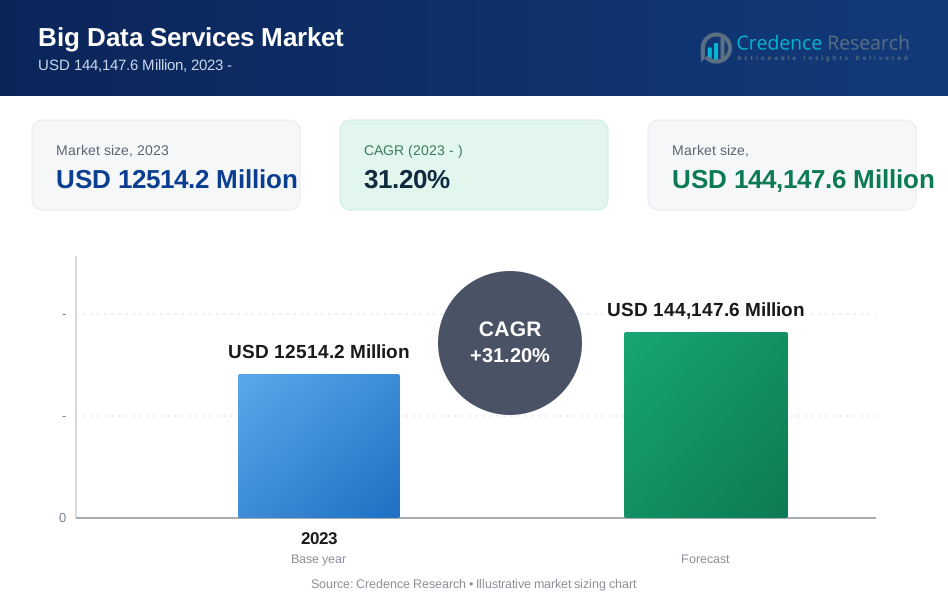
| Big Data Services Market Size 2023 | USD 12514.2 Million |
| Big Data Services Market, CAGR | 31.20% |
| Big Data Services Market Size 2032 | USD 144147.6 Million |
Market Insights
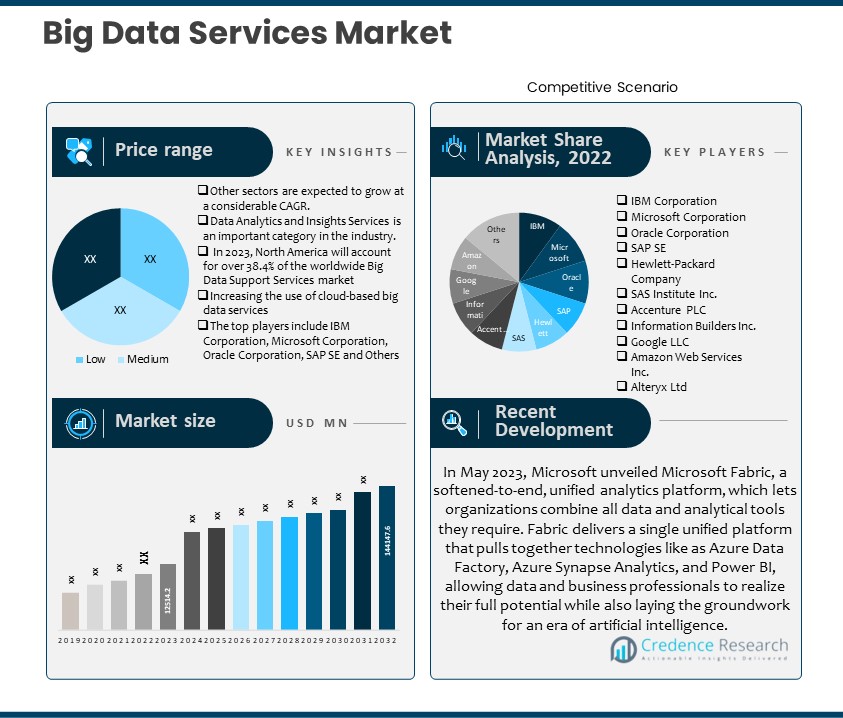
- The global demand for Big Data Services was valued at USD 12514.2 Million in 2023 and is expected to reach USD 144147.6 Million in 2032, growing at a CAGR of 31.20% between 2024 and 2032.
- The cloud-based category is predicted to dominate the Big Data industry, with Data Analytics and Insights Services being another major area in the industry.
- The Enterprise category is expected to grow at a CAGR of 32.6% between 2023 and 2032, while Small and Medium-sized Enterprises (SMEs) are another key segment in the market.
- The Healthcare and Life Sciences category is predicted to expand at the fastest CAGR throughout the forecast period, while other sectors are expected to increase at a substantial CAGR.
- In 2023, North America will account for around 38.4% of the worldwide Big Data Support Services market, while Europe is expected to grow at a substantial CAGR throughout the anticipated timeframe.
- The increasing volume of data is one of the key drivers of big data in the service sector.
- Adhering to diverse customer needs is a significant barrier to the evolution of the global big data as a service market.
Executive Summary
Market Definition
Big Data as a Service (BDaaS) is a cloud-based architecture that provides organizations with comprehensive big data solutions on demand. BDaaS can be defined as a hybrid of Hadoop-as-a-Service (HDaaS), Data-as-a-Service (DaaS), and Data Analytics-as-a-Service. The growing need for high data quality and channelized data flow in businesses has fueled the demand for technologically advanced big data solutions to store, assess, gather, visualize, and anticipate information from massive data volumes. The global market for Big Data as a Service (BDaaS) is predicted to develop rapidly in the next years as cloud-based data analytics solutions become more widely used.
Market Overview
The global Big Data Services Market has witnessed steady growth in recent years and is expected to grow at a CAGR of 31.20% between 2024 and 2032. The market was valued at USD 12514.2 million in 2023 and is expected to reach USD 144147.6 million in 2032.
The Big Data Market is expected to increase significantly during the forecast period. Businesses from a variety of industries are deploying big data solutions to capitalize on big data's promise by properly managing and analyzing it to provide actionable insights. The big data market is expanding rapidly as a result of the massive increase in data, as well as the rise of mobile apps and Internet of Things (IoT) devices. Big data is widely used in a variety of industries, including banking, financial services, and insurance (BFSI), government, defense, healthcare, life sciences, manufacturing, retail, and consumer goods, media and entertainment, telecommunications and information technology, transportation, and logistics, among others.
One of the primary drivers of the Big Data Market is the use of analytics by organizations to maximize their growth in the face of increasing competition. Additionally, because Big Data analytics software enables businesses to explore the factors that influence outcomes and gives decision optimization capabilities, the growing need for insights for business planning is expected to present appealing opportunities for market expansion.
Segmentation By Service Type
- The cloud-based category is expected to dominate the Big Data Market because of the technical benefits that cloud-based systems provide, such as improved usability and accessibility, which give them a significant advantage over traditional systems.
- Data Analytics and Insights Services: is another important category in the market. It entails providing analytics tools and platforms for analyzing huge datasets without the use of on-premises infrastructure.
- Data Visualization Services have a considerable market share. Providers provide visualization tools and platforms that allow users to build dynamic and meaningful visual representations of data.
Segmentation by End-User
- The Enterprise segment is predicted to increase at a CAGR of 32.6% between 2023 and 2032. Enterprises include huge corporations and businesses. Major companies are adopting Big Data Support Services at a rapid pace because, in today's highly competitive environment, major enterprises will go to any length to increase their market share. These organizations have generally divided the disparate data among various divisions.
- Small and Medium-sized Enterprises (SMEs) is the another important segment in the market.
Segmentation by Industry Vertical
- The Healthcare and Life Sciences category is expected to grow at the fastest CAGR during the forecast period, owing to increased demand for big data services across healthcare facilities and the growing volume of medical data. In the healthcare business, big data as a service is used to collect, analyze, and use patients' physical and dinical data. It also aids in the detection of patterns and configurations in health outcomes, patient happiness, and overall hospital growth.
- In 2023, the BFSI (Banking, Financial Services, and Insurance) segment dominated the Big Data as a Service (BDaaS) market, accounting for more than 24.4%.
- Other sectors, including retail and e-commerce, as well as the government and public sector, are expected to increase at a significant CAGR during the forecast period. The growth is attributable to the increasing number of startups in the retail and e-commerce industries embracing public areas.
Segmentation by Region
- In 2023, North America accounts for about 38.4% of the global Big Data Support Services market.
- Europe is likely to increase at a significant CAGR throughout the forecasted timeframe.
- The rest of the world, including Latin America, the Middle East, and Africa, supplies the remaining demand for Big Data Services.
North America currently dominates the worldwide Big Data Support Services market, accounting for more than 38.4% in 2023. Because of the high concentration of Big Data Support Services suppliers, North America is expected to account for the greatest market share throughout the projection period. American organizations are increasingly turning to emerging technologies like data analytics, Artificial Intelligence (AI), Machine Learning (ML), the Internet of Things (IoT), and the cloud to improve Big Data Support Services. Growing e-commerce, combined with rising government funding to assist large-scale data initiatives in the United States, is a major factor driving market expansion. The region is seeing significant changes in the big data business as a result of the increasing use of IoT devices by various companies in the region. Organizations have begun to use big data solutions, particularly in the United States, to provide data insights for strategic business choices and market competitiveness.
Moreover, Europe is expected to grow at a substantial CAGR during the predicted period. This is due to the growing popularity of connected devices based on the Internet of Things (loT) in nations such as the United Kingdom, Spain, Italy, Germany, and elsewhere. Furthermore, the increasing investment and acceptance of big data services by governments in European countries would encourage growth.
Key Highlights of the Report
Service Type, End-User, Industry Vertical, and Region segment the global Big Data Services Market. The cloud-based and BFSI categories are likely to dominate the Big Data Market, while the Healthcare and Life Sciences sector is expected to grow at the quickest rate. However, Small and Medium-sized Enterprises (SMEs) are another key group in the market and North America, leading the market growth.
The market's major drivers are rapid data development, cost-effectiveness, adaptability, and scalability. Also, the market's key limits include data security and privacy concerns, a shortage of skilled labor, and integration obstacles. The key market opportunities are digitization and globalization, regulatory compliance and data governance, and a focus on core capabilities.
North America currently dominates the global Big Data Support Services market, with more than 38.4% in 2023. Because of the high concentration of Big Data Support Services suppliers, North America is likely to have the largest market share over the forecast period. Furthermore, Europe is likely to increase at a significant CAGR throughout the forecast period. This is due to the increasing popularity of connected devices based on the Internet of Things (loT) in countries such as the United Kingdom, Spain, Italy, Germany, and others.
What Are The Main Drivers Of The Global Big Data Services Market?
The Big Data Services Market is being driven by rising demand for real-time data analytics, the adoption of cloud-based services, and the incorporation of AI and machine learning technologies. These factors are moving the market forward by allowing organizations to use data to gain insights and make better decisions.
What Are The Major Challenges Faced By The Global Big Data Services Market?
However, difficulties such as data security and privacy concerns, high initial investment costs, and the complexity of handling massive datasets all function as barriers to market expansion.
What Are The Growth Opportunities In The Global Big Data Services Market?
There are substantial opportunities to expand big data services in the healthcare sector, attract increased investment in data infrastructure, and develop edge computing solutions for faster data processing. These opportunities can propel the Big Data Services market forward while also driving innovation in data analytics and management.
Market Drivers
Several factors drive the global Big Data Services Market. The following are the key drivers of the global Big Data Services Market:
Increasing Volume Of Data
Enterprise applications generate significant amounts of data, and this trend will continue throughout the forecast period and beyond. Organizations are struggling to analyze and manage huge datasets efficiently as the volume, variety, veracity, and velocity of data, sometimes known as the 4Vs, grows. The increasing volume of data collected in enterprises via numerous channels and sources has driven them to employ big data analytics in order to save large amounts of money.
Big data analytics has enabled firms to convert unstructured and semi-structured data into structured and relevant data. Big data analytics gathered and processed data to uncover important flaws, create indicator patterns to detect opportunities and risks, and optimize business decisions. As the demand for big data analytics grows, big services such as big data project-based services and big data outsourcing services are required to manage big data analytics applications and assure security, agility, and performance.
Market Restraints
The global Big Data Services Market faces some challenges that may hinder its growth. These include the following:
Adhering To Varied Client Needs
Several industries lack standards or procedures for storing large amounts of data, making it difficult for big data to perform well. As a result, the market penetration of big data service providers decreases as their service quality deteriorates. Big data service providers must constantly innovate and offer creative solutions in response to changing consumer requirements. This is a complex and costly process since it entails high levels of uncertainty, and failure to comprehend client requirements results in potential time and money losses. Most clients want business results but are cautious about spending.
The lack of a proactive policy makes it difficult for vendors to assess and track ROI. This may impede service providers' value adds, posing a challenge to market expansion. As a result, vendors must comprehend the current market demand and provide specialized solutions to clients in order to achieve long-term success.
Opportunities
The global Big Data Services Market offers significant growth opportunities. These include the following:
Big Data In Blockchain Technology
Blockchain technology is gaining traction in the finance industry. JPMorgan, Citi, Wells Fargo, US Bancorp, PNC, Fifth Third Bank, and Signature Bank are among the banks that use blockchain technology. It will replace the current centralized business paradigm for financial services. Blockchain technology, also known as a ledger framework, is a distributed network of digital databases that keep records and manage transactions. It employs powerful cryptography to safeguard transactions and handle approvals. All transaction information is then stored in the database. Furthermore, large data blockchain technology includes scalable databases with query languages and accurate blockchains. The big data blockchain database is decentralized thus control can be shared with the relevant authorities.
Big data Blockchain technology aids in the collection and interpretation of massive amounts of data, as well as supporting businesses' decision-making processes. This boosts operational efficiency and improves security. The system also overhauls and enhances security, highlighting areas where work is required both before and after an attack. However, transitioning to a decentralized database network will necessitate educating end users and operators, as well as incorporating it into existing workflows.
Competitive Landscape
Key Players
The global Big Data Services Market is highly competitive, with several key players. Some of the major players in the market and their market share are as follows:
- IBM Corporation
- Microsoft Corporation
- Oracle Corporation
- SAP SE
- Hewlett-Packard Company
- SAS Institute Inc.
- Accenture PLC
- Information Builders Inc.
- Google LLC
- Amazon Web Services Inc.
- Alteryx Ltd
- Wipro Ltd
- Opera Solutions LLC
- Guavus Inc.
These organizations prioritize product innovation, End-User expansion, and mergers and acquisitions to stay competitive.
The global Big Data Services Market's key players continually seek to stay ahead by offering new products and developments.
In November 2022, Amazon Web Services, Inc. (AWS) introduced five new capabilities for its database and analytics portfolios. These enhancements allow users to handle and analyze data on a petabyte scale more efficiently and quickly, making it easier for clients to run high-performance database and analytics workloads at scale.
In October 2022, Oracle launched the Oracle Network Analytics Suite, which comprises a new cloud-native portfolio of analytics solutions. This suite enables operators to make more automated and educated decisions on the performance and stability of their whole 5G network core by combining network function data, machine learning, and artificial intelligence.
Summary of Key Findings
- Big data in blockchain technology is a key trend driving growth in the global data analytics industry.
- Market segmented By Service Type, End-User , Industry Vertical, and region.
- The cloud-based category is predicted to dominate the Big Data industry
- Small and Medium-sized Enterprises (SMEs) are another key segment in the market.
- North America is leading in market growth; the market is highly competitive with key players, including IBM Corporation, Microsoft Corporation, Oracle Corporation, SAP SE and Others.
Future Outlook
- Increasing the use of cloud-based big data services.
- A focus on data security and privacy.
- Expanding big data services in the healthcare sector.
- Growing investment in big data infrastructure.
How CXOs Can Benefit from the Credence Research Big Data Services Market Report
The Credence Research Big Data Services Market Report provides CXOs with a comprehensive overview of the market, including:
- Market size and growth forecast: The report provides detailed estimates of the global Big Data Services Market size, segmented By Service Type, End-User , Industry Vertical, and region. It also includes forecasts for the market through 2032 based on key trends and drivers.
- Market segmentation: The report segments the Big Data Services Market By Type, End-User , Industry Vertical, and region. This segmentation provides CXOs with a granular understanding of the market and the opportunities in each segment.
- Competitive Landscape: The report profiles the key players in the Big Data Services Market and provides insights into their strategies, product offerings, and financial performance. This information can help CXOs to identify and assess their competition.
- Key trends and drivers: The report identifies and analyzes the key trends and drivers that are shaping the Big Data Services Market. This information can help CXOs to make informed decisions about their investments and strategies.
CXOs can use the insights from the Credence Research Big Data Services Market Report to:
- Identify growth opportunities: The report can help CXOs to identify new growth opportunities in the Big Data Services Market. For example, it can pinpoint emerging trends in industries like aerospace and automotive, helping executives make informed decisions on expanding their product lines or entering new market segments where Big Data Services properties can be leveraged for success.
- Make informed investment decisions: The report can help CXOs make informed investment decisions about Big Data Services. For example, it can provide crucial insights into market trends, competitive landscape, and potential growth areas, empowering executives to allocate resources strategically and seize opportunities for maximizing returns on investments in the Big Data Services sector.
- Develop competitive strategies: The report can help CXOs develop competitive strategies for their Big Data Services businesses. For example, it can offer valuable insights into market trends, competitor analysis, and innovative End-user industries of Big Data Services, enabling executives to stay ahead of the competition and drive business growth in this dynamic industry.
- Track market developments: The report can help CXOs monitor market developments and stay ahead of the curve. For example, it provides insights into the latest trends and innovations in the Big Data Services Market.
Overall, the Credence Research Big Data Services Market Report is a valuable resource for CXOs who are looking to gain a deeper understanding of the market and identify opportunities for growth.
Segmentation
- By Service Type:
- Consulting Services
- Data Integration and Management Services
- Data Analytics and Insights Services
- Data Visualization Services
- Data Science and Machine Learning Services
- Data Security and Governance Services
- Managed Big Data Services
- Training and Support Services
- Cloud-based Services
- By End-User Segmentation:
- Enterprises
- Small and Medium-sized Enterprises (SMEs)
- Government and Public Sector
- Academic and Research Institutions
- By Industry Vertical Segmentation:
- Retail and E-commerce
- Healthcare and Life Sciences
- Banking, Financial Services, and Insurance (BFSI)
- Manufacturing and Logistics
- Telecommunications and Media
- Energy and Utilities
- Transportation and Logistics
- Others
- By Region
- North America
- The U.S.
- Canada
- Mexico
- Europe
- Germany
- France
- The U.K.
- Italy
- Spain
- Rest of Europe
- Asia Pacific
- China
- Japan
- India
- South Korea
- South-east Asia
- Rest of Asia Pacific
- Latin America
- Brazil
- Argentina
- Rest of Latin America
- Middle East & Africa
- GCC Countries
- South Africa
- Rest of the Middle East and Africa
- North America
Request a Free Sample
Fill in your details and we'll send you a free sample report.
- Sample data tables & charts
- Research methodology
Market Dynamics
Increasing Volume of Data
The exponential growth in enterprise data from sources such as IoT devices, mobile applications, and digital transactions is driving organizations to adopt big data services to efficiently store, manage, and analyze massive datasets for actionable insights.
Adoption of Cloud-Based Solutions
Cloud-based big data services offer scalability, flexibility, and cost-effectiveness, enabling organizations to access advanced analytics and storage capabilities without heavy upfront investments in infrastructure, thus accelerating market growth.
Integration of AI and Machine Learning
The incorporation of artificial intelligence and machine learning technologies into big data services enhances the ability to extract predictive insights, automate decision-making, and optimize business processes, making these services more valuable to end-users.
Expansion in Healthcare and Life Sciences
The healthcare sector's growing need to analyze large volumes of clinical and patient data for improved outcomes, operational efficiency, and regulatory compliance is fueling rapid adoption of big data services in this vertical.
Regulatory Compliance and Data Governance
Stricter regulations around data privacy and governance are prompting organizations to invest in big data services that ensure compliance, secure data management, and robust audit trails, further boosting market demand.
Need a Custom Version of This Report?
Tailor the scope, geography, or segments to your exact requirements.
- Custom geography or segment scope
- Direct access to our analyst team
Frequently Asked Questions
What is the current size of the global Big Data Services Market?
What is the expected growth rate of the Big Data Services Market between 2024 and 2032?
Which segment is leading the market share in terms of Service Type?
Which Industry Vertical segment is expected to post the fastest growth rate during the forecast period?
Who are the major players in the global Big Data Services Market?
Table of Content
Chapter 1 Market Segmentation
- 1.1 Segmentation Framework
- 1.1.1 Product and Service Classification
- 1.1.2 Application and End-Use Classification
- 1.1.3 Technology and Solution Classification
- 1.1.4 Customer and Distribution Channel Classification
- 1.1.5 Geographic Segmentation
- 1.1.6 Market Segment Definitions and Boundaries
- 1.2 By End-User
- 1.2.1 Enterprises
- 1.2.2 Small and Medium-sized Enterprises (SMEs)
- 1.2.3 Government and Public Sector
- 1.2.4 Academic and Research Institutions
- 1.3 By Service Type
- 1.3.1 Consulting Services
- 1.3.2 Data Integration and Management Services
- 1.3.3 Data Analytics and Insights Services
- 1.3.4 Data Visualization Services
- 1.3.5 Data Science and Machine Learning Services
- 1.3.6 Data Security and Governance Services
- 1.3.7 Managed Big Data Services
- 1.3.8 Training and Support Services
- 1.3.9 Cloud-based Services
- 1.4 By Industry Vertical
- 1.4.1 Retail and E-commerce
- 1.4.2 Healthcare and Life Sciences
- 1.4.3 Banking, Financial Services, and Insurance (BFSI)
- 1.4.4 Manufacturing and Logistics
- 1.4.5 Telecommunications and Media
- 1.4.6 Energy and Utilities
- 1.4.7 Transportation and Logistics
- 1.4.8 Others
Chapter 2 Introduction
- 2.1 Report Objectives and Scope
- 2.2 Product Definition and Industry Terminology
- 2.3 Market Inclusions and Exclusions
- 2.4 Research Process
- 2.4.1 Primary Research and Expert Interviews
- 2.4.2 Secondary Research and Source Review
- 2.4.3 Top-Down and Bottom-Up Estimation
- 2.4.4 Data Triangulation and Verification
- 2.5 Market Size Measurement Basis
- 2.5.1 2023: USD 12514.2 Million → 2032: USD 144,147.6 Million
- 2.6 Historical and Forecast Reference Periods
- 2.6.1 Base Year: 2023
- 2.6.2 Forecast Period: 2023-2032
- 2.7 Research Assumptions and Limitations
Chapter 3 Executive Summary
- 3.1 Market Snapshot and Key Findings
- 3.2 Base-Year Market Size, 2023
- 3.3 Forecast Market Size, 2032
- 3.4 Revenue and Volume Growth Outlook
- 3.5 Key Demand and Supply Indicators
- 3.6 Leading Market Segments
- 3.7 Fastest-Growing Market Opportunities
- 3.8 Regional Performance Highlights
- 3.9 Technology and Industry Transformation
- 3.10 Competitive Landscape Summary
- 3.11 Analyst View and Strategic Implications
Chapter 4 Global Big Data Services Market Trends and Developments
- 4.1 Historical Industry Development
- 4.2 Recent Market Trends and Developments
- 4.3 Demand and Customer Behavior Trends
- 4.4 Technology and Product Innovation
- 4.5 Artificial Intelligence, Automation and Digitalization
- 4.6 Local Manufacturing and Supply Chain Realignment
- 4.7 Industry Partnerships, Mergers and Acquisitions
- 4.8 Sustainability and Circular Economy Developments
- 4.9 Government and Private Sector Investment Trends
- 4.10 Emerging Business Models and Commercialization
- 4.11 Industry Developments and Announcements
Chapter 5 Global Big Data Services Market Supply and Demand Analysis
- 5.1 Demand Trend and Consumption Analysis
- 5.2 Demand Forecast, 2023-2032
- 5.3 Supply Chain Structure and Procurement Trends
- 5.4 Supply-Demand Gap and Bottlenecks
- 5.5 Import Dependence and Sourcing Structure
- 5.6 Regional Supply and Demand Concentration
Chapter 6 Global Big Data Services Market Pricing Analysis
- 6.1 Pricing Structure and Measurement
- 6.2 Historical Pricing Trends
- 6.3 Pricing Outlook, 2023-2032
- 6.4 Pricing by Product and Market Segment
- 6.5 Geographic Pricing Differences
- 6.6 Key Input, Energy, Labor and Logistics Costs
- 6.7 Contract Pricing and Purchasing Models
- 6.8 Pricing Sensitivity and Competitive Positioning
- 6.9 Price, Margin and Profitability Implications
Chapter 7 Global Big Data Services Market Dynamics
- 7.1 Market Growth Drivers
- 7.1.1 Demand-Side Drivers
- 7.1.2 Technology and Innovation Drivers
- 7.1.3 Infrastructure and Investment Drivers
- 7.1.4 Regulatory and Policy Drivers
- 7.2 Market Restraints
- 7.2.1 Cost and Affordability Constraints
- 7.2.2 Technology and Adoption Barriers
- 7.2.3 Supply Chain and Operational Constraints
- 7.3 Market Challenges
- 7.3.1 Competitive Pressure and Margin Erosion
- 7.3.2 Skills, Infrastructure and Implementation Gaps
- 7.4 Emerging Market Opportunities
- 7.5 Market Dynamics Impact and Time-Horizon Assessment
Chapter 8 Global Big Data Services Value Chain Analysis
- 8.1 Industry Value Chain Overview
- 8.2 Upstream Suppliers and Critical Inputs
- 8.3 Technology and Component Providers
- 8.4 Manufacturing or Service Delivery
- 8.5 Distribution, Channel Partners and Integrators
- 8.6 Downstream Applications and End Users
- 8.7 Value Addition and Profit Pools
- 8.8 Vertical Integration and Outsourcing
- 8.9 Supplier Concentration and Risk
- 8.10 Supply Chain Localization and Resilience
Chapter 9 Global Big Data Services Market Regulations and Policies
- 9.1 Relevant Laws, Standards and Compliance Frameworks
- 9.2 Product, Service, Safety and Quality Requirements
- 9.3 Government Policies, Incentives and Subsidies
- 9.4 Imports, Exports and Trade Barriers
- 9.5 Public Procurement and Local Content Requirements
- 9.6 Data Protection, AI and Cybersecurity Compliance
- 9.7 Upcoming Policy Changes and Market Implications
Chapter 10 Global Big Data Services Market Hotspots and Opportunities
- 10.1 Market Opportunity Mapping and Growth Hotspots
- 10.2 High-Growth Applications and Customer Groups
- 10.3 Underserved Markets and White-Space Opportunities
- 10.4 Emerging Technology and Product Opportunities
- 10.5 New Capacity and Investment Hotspots
- 10.6 Market Entry and Expansion Opportunities
- 10.7 Distribution and Partnership Opportunities
- 10.8 Near-Term and Long-Term Commercial Potential
- 10.9 Opportunity Attractiveness and Execution Risks
Chapter 11 Global Big Data Services Market Outlook, 2023-2032
- 11.1 Market Size and Analysis
- 11.1.1 Revenue (Market Measurement: 2023: USD 12514.2 Million → 2032: USD 144,147.6 Million)
- 11.1.2 Historical Market Size
- 11.1.3 Base-Year Market Size, 2023
- 11.2 Market Forecast, 2023-2032
- 11.2.1 Revenue Forecast to 2032
- 11.2.2 CAGR and Year-on-Year Growth
- 11.2.3 Incremental Revenue Opportunity
- 11.3 Forecast Assumptions and Scenario Analysis
- 11.3.1 Base-Case Forecast
- 11.3.2 Optimistic and Conservative Scenarios
- 11.3.3 Technology, Pricing and Policy Sensitivities
- 11.4 Market Attractiveness and Growth Outlook
Chapter 12 Global Big Data Services Market Segmentation and Outlook
- 12.1 Segmentation Summary and Market Shares, 2023
- 12.2 Largest and Fastest-Growing Segments
- 12.3 By End-User - Market Size and Forecast, 2023-2032
- 12.3.1 Segment Definition and Scope
- 12.3.2 Historical Market Size
- 12.3.3 Revenue Forecast, 2023-2032
- 12.3.4 Base-Year Market Share, 2023
- 12.3.5 Segment CAGR and Growth Drivers
- 12.3.6 Subsegment Market Size and Forecast
- 12.3.6.1 Enterprises
- 12.3.6.2 Small and Medium-sized Enterprises (SMEs)
- 12.3.6.3 Government and Public Sector
- 12.3.6.4 Academic and Research Institutions
- 12.3.7 Subsegment Pricing and Adoption Trends
- 12.3.8 Leading Suppliers and Competition
- 12.3.9 Regional Demand and Opportunities
- 12.4 By Service Type - Market Size and Forecast, 2023-2032
- 12.4.1 Segment Definition and Scope
- 12.4.2 Historical Market Size
- 12.4.3 Revenue Forecast, 2023-2032
- 12.4.4 Base-Year Market Share, 2023
- 12.4.5 Segment CAGR and Growth Drivers
- 12.4.6 Subsegment Market Size and Forecast
- 12.4.6.1 Consulting Services
- 12.4.6.2 Data Integration and Management Services
- 12.4.6.3 Data Analytics and Insights Services
- 12.4.6.4 Data Visualization Services
- 12.4.6.5 Data Science and Machine Learning Services
- 12.4.6.6 Data Security and Governance Services
- 12.4.6.7 Managed Big Data Services
- 12.4.6.8 Training and Support Services
- 12.4.6.9 Cloud-based Services
- 12.4.7 Subsegment Pricing and Adoption Trends
- 12.4.8 Leading Suppliers and Competition
- 12.4.9 Regional Demand and Opportunities
- 12.5 By Industry Vertical - Market Size and Forecast, 2023-2032
- 12.5.1 Segment Definition and Scope
- 12.5.2 Historical Market Size
- 12.5.3 Revenue Forecast, 2023-2032
- 12.5.4 Base-Year Market Share, 2023
- 12.5.5 Segment CAGR and Growth Drivers
- 12.5.6 Subsegment Market Size and Forecast
- 12.5.6.1 Retail and E-commerce
- 12.5.6.2 Healthcare and Life Sciences
- 12.5.6.3 Banking, Financial Services, and Insurance (BFSI)
- 12.5.6.4 Manufacturing and Logistics
- 12.5.6.5 Telecommunications and Media
- 12.5.6.6 Energy and Utilities
- 12.5.6.7 Transportation and Logistics
- 12.5.6.8 Others
- 12.5.7 Subsegment Pricing and Adoption Trends
- 12.5.8 Leading Suppliers and Competition
- 12.5.9 Regional Demand and Opportunities
- 12.6 Segment Growth Comparison
- 12.7 Segment Attractiveness and Priority Matrix
Chapter 13 Global Big Data Services End-Use and Application Market Outlook
- 13.1 End-Use Industry and Customer Demand Structure
- 13.2 Leading Applications and Customer Groups
- 13.3 End-Use Market Size, Share and Forecast
- 13.4 Major End-Use Industry Deep Dives
- 13.4.1 Customer Requirements and Use Cases
- 13.4.2 Demand and Replacement Cycles
- 13.4.3 Technical and Regulatory Considerations
- 13.4.4 Purchasing and Procurement Models
- 13.4.5 Leading Vendors and Distribution Channels
- 13.4.6 Forecast and Commercial Opportunities
- 13.5 Emerging Applications and Cross-Segment Demand
- 13.6 End-Use Industry Investment Priorities
Chapter 14 Global Big Data Services Geographic Market Outlook, 2023-2032
- 14.1 Regional Market Size and Share, 2023
- 14.2 Regional Market Forecast, 2023-2032
- 14.3 Regional Pricing, Production and Demand Differences
- 14.4 North America
- 14.4.1 United States
- 14.4.2 Canada
- 14.4.3 Mexico
- 14.5 Europe
- 14.5.1 Germany
- 14.5.2 France
- 14.5.3 Italy
- 14.5.4 United Kingdom
- 14.5.5 Spain
- 14.5.6 Poland
- 14.5.7 Russia
- 14.5.8 Netherlands
- 14.5.9 Belgium
- 14.5.10 Sweden
- 14.5.11 Denmark
- 14.5.12 Norway
- 14.5.13 Rest of Europe
- 14.6 Asia Pacific
- 14.6.1 China
- 14.6.2 India
- 14.6.3 Japan
- 14.6.4 South Korea
- 14.6.5 Thailand
- 14.6.6 Indonesia
- 14.6.7 Vietnam
- 14.6.8 Malaysia
- 14.6.9 Australia
- 14.6.10 Rest of Asia Pacific
- 14.7 Latin America
- 14.7.1 Brazil
- 14.7.2 Argentina
- 14.7.3 Colombia
- 14.7.4 Chile
- 14.7.5 Rest of Latin America
- 14.8 Middle East
- 14.8.1 Saudi Arabia
- 14.8.2 United Arab Emirates
- 14.8.3 Turkey
- 14.8.4 Israel
- 14.8.5 Iran
- 14.8.6 Rest of the Middle East
- 14.9 Africa
- 14.9.1 South Africa
- 14.9.2 Egypt
- 14.9.3 Nigeria
- 14.9.4 Morocco
- 14.9.5 Rest of Africa
- 14.10 Regional Investment, Policy and Supply Chain Differences
- 14.11 Regional Competitive Landscape
- 14.12 Geographic Growth Hotspots
Chapter 15 Global Big Data Services Technology, Innovation and Sustainability Outlook
- 15.1 Technology Landscape and Maturity
- 15.2 Product, Process and Service Innovation
- 15.3 AI, Automation and Digital Tools in the Industry
- 15.4 Technology Adoption and Performance Benchmarking
- 15.5 Innovation Pipeline and R&D Investment
- 15.6 Energy Efficiency and Resource Management
- 15.7 Sustainability, Recycling and Circularity
- 15.8 Technology Roadmap, 2023-2032
- 15.9 Risks of Obsolescence and Technology Substitution
Chapter 16 Global Big Data Services Market Key Strategic Imperatives
- 16.1 Growth and Market Entry Priorities
- 16.2 High-Return Products and Segments
- 16.3 Pricing, Profitability and Cost Optimization
- 16.4 Technology Investment and Product Differentiation
- 16.5 Supply Chain Localization and Resilience
- 16.6 Distribution and Customer Acquisition
- 16.7 Partnership, Acquisition and Capacity Strategy
- 16.8 Regional Expansion Priorities
- 16.9 Short-, Medium- and Long-Term Actions
Chapter 17 Competition Outlook
- 17.1 Industry Competition Characteristics
- 17.2 Market Structure and Concentration
- 17.3 Market Share and Competitive Positioning, 2023
- 17.4 Company-Wise Revenue and Product Benchmarking
- 17.5 Production and Service Capacity Benchmarking
- 17.6 Technology, Pricing and Differentiation
- 17.7 Regional Footprint and Distribution Strength
- 17.8 Mergers, Acquisitions and Strategic Alliances
- 17.9 New Entrants and Competitive Threats
- 17.10 Porter's Five Forces and Industry Attractiveness
- 17.11 Competitive Outlook, 2023-2032
Chapter 18 Company Profiles
- 18.1 Company Coverage and Selection Criteria
- 18.2 IBM Corporation
- 18.2.1 Business Description
- 18.2.2 Company Ownership and Geographic Presence
- 18.2.3 Product and Service Portfolio
- 18.2.4 Manufacturing and Operating Footprint
- 18.2.5 Financial Performance and Investment
- 18.2.6 Market Share and Competitive Position
- 18.2.7 Technology and Innovation Capabilities
- 18.2.8 Strategic Alliances or Partnerships
- 18.2.9 Recent Developments
- 18.2.10 Growth Strategy and Outlook
- 18.3 Microsoft Corporation
- 18.4 Oracle Corporation
- 18.5 SAP SE
- 18.6 Hewlett-Packard Company
- 18.7 SAS Institute Inc.
- 18.8 Accenture PLC
- 18.9 Google LLC
- 18.10 Amazon Web Services Inc.
- 18.11 Wipro Ltd
- 18.12 Other Relevant Market Participants
Note: Every listed company is profiled on the structure shown under the first company. The company list is preliminary and may change based on research findings, market developments, data availability and client requirements.
Chapter 19 Disclaimer
- 19.1 Research and Forecast Disclaimer
- 19.2 Data Source and Estimation Limitations
Note: The depth of individual sections depends on data availability for this market. Volume, capacity, trade and other unit-based metrics are included where applicable.

