
| REPORT ATTRIBUTE | DETAILS |
|---|---|
| Historical Period | 2019-2022 |
| Base Year | 2023 |
| Forecast Period | 2024-2032 |
| Gamification Market Size 2023 | USD 9258.2 million |
| Gamification Market, CAGR | 28.00% |
| Gamification Market Size 2032 | USD 85391.82 million |
Market Insights
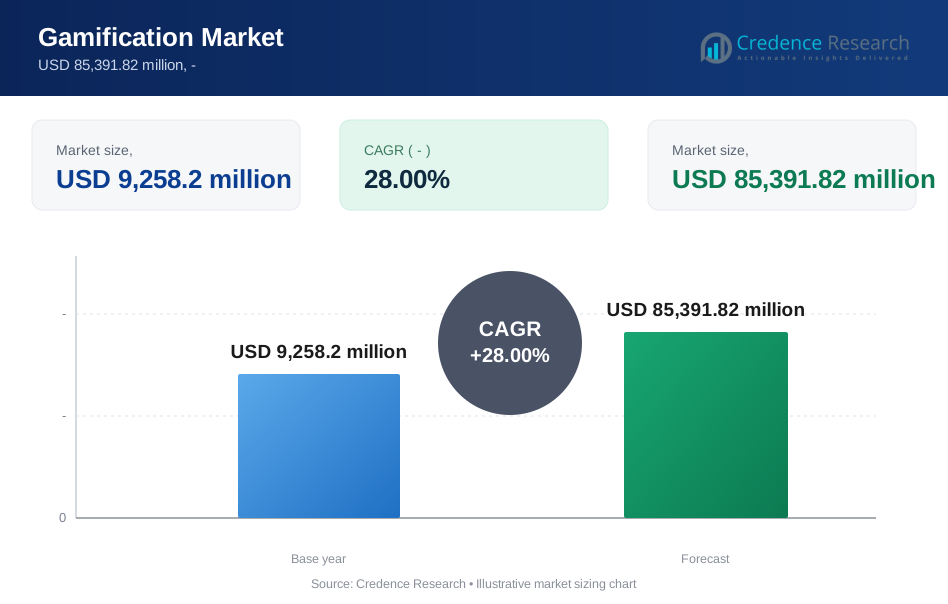
- The global market for gamification is expected to develop at a compound annual growth rate (CAGR) of 28.00% between 2024 and 2032, from its estimated USD 9258.2 million in 2023 to USD 85391.82 million in 2032.
- The largest category is software as a service (SaaS) platforms. On-premises platforms, on the other hand, are expected to grow at a strong CAGR.
- The employee engagement and productivity category will expand at a rapid rate of growth.
- The CAGR for points, badges, and leaderboards (PBL) is expected to be the highest during the projection period.
- The education and e-learning category will have the highest CAGR throughout the prediction period.
- North America dominated the gamification market.
- Regarding the market share of gamification, Europe is expected to come second.
- Throughout the projection period, Asia Pacific is anticipated to have the highest CAGR rate.
- The global gamification market is expanding due to many factors, such as individuals' need for motivation and engagement, the ability to facilitate behavioral change, the improvement of learning experiences, and the increase in employee productivity and involvement.
- Due to the extensive use of smartphones and tablets, the gamification sector has experienced remarkable growth.
Executive Summary
Market Definition
Gamification is the process of adding interactive elements and rewards to tasks to encourage learning, productivity, and positive behavior changes in a variety of domains, including marketing, business, healthcare, education, and personal development. Some companies utilize gamification to improve the learning process in staff training programs. Other businesses might use gamification to guarantee that salespeople maintain motivation by offering incentives to achieve.
Market Overview
The gamification sector is estimated to develop at a 28.00% compound annual growth rate (CAGR) between 2024 and 2032, maintaining its current upward trend. The market will continue to develop, rising from its estimated USD 9258.2 million in 2023 to USD 85391.82 million in 2032.
The gamification market is expanding as businesses across different sectors recognize its potential to drive engagement and influence behavior. By integrating game mechanics like points, badges, and challenges into non-game activities, companies aim to enhance user participation and motivation. This approach finds applications in diverse fields such as education, healthcare, retail, and finance, where it's used to improve learning outcomes, boost employee productivity, and foster customer loyalty. With the proliferation of digital platforms and increasing demand for interactive experiences, gamification is poised for further growth as organizations seek innovative ways to achieve their objectives and connect with their audiences.
The increasing prominence of training and learning in today's fast-paced environment is the driving force behind the introduction of gamification in corporate and educational settings. Data-driven decision-making is particularly important since gamification platforms provide insightful data that helps businesses enhance their strategy and customize their user experiences.
Segmentation by Platform Type
- Software-as-a-service (SaaS) platforms dominate the market in terms of platform type. SaaS platforms can enhance user retention rates by incorporating gamification components. Over time, gamified features motivate users to remain engaged on the site by setting and achieving goals, rewarding themselves, and engaging in competitive activities.
- The on-premises platforms category will exhibit a sizable CAGR during the projected period. Organizations can use gamification to increase productivity by using it as an incentive for desirable actions. Through the implementation of goal-tracking systems, leaderboards, and performance-based incentives, on-premises platforms can motivate staff members to meet deadlines, accomplish goals, and pursue excellence in their jobs.
Segmentation by Application Area
- Employee engagement and productivity are considered the best application area category. Gamification enhances productivity, motivation, and employee engagement. It adds gaming elements, such as leaderboards, awards, and prizes, to encourage positive behavior, promote healthy competition, and recognize staff members' contributions.
- The education and training will likely register a significant CAGR during forecasting. Education and training is experiencing substantial growth due to the increasing demand for remote learning solutions and the widespread acceptance of digital training platforms across industries.
- Other application areas, such as marketing and advertising, health and wellness, social impact and civic engagement, training and development, sales and revenue generation, and customer engagement and loyalty, also contribute to the demand for gamification.
Segmentation by Gamification Mechanics
- The points, badges, and leaderboards (PBL) category is projected to grow faster over the projection period. Within a gamified system, points are an easy-to-use yet powerful approach to measuring user actions and progress. Badges are virtual awards or accomplishments that users get for accomplishing tasks, hitting benchmarks, or proving their expertise in particular fields. Users are ranked on leaderboards according to their achievements, points, or performance in the gamified system.
- Other gamification mechanics, including challenges and quests, levels and progression, rewards and incentives, feedback and recognition, and social interaction and collaboration, influence the need for gamification.
Segmentation by Industry Vertical
- The education and e-learning category will likely have the highest CAGR during the projection period. In education and e-learning, gamification turns static, one-way learning experiences into dynamic, personalized learning paths that meet students' varied requirements and interests.
- Other industry verticals, such as healthcare and wellness, retail and consumer goods, technology and software, financial services and banking, travel and hospitality, and sports and entertainment, also contribute to the demand for gamification.
Segmentation by Region
- North America controlled the gamification market. The robust communication infrastructure among major corporations and the increasing need for tailored solutions are anticipated to propel the expansion of the North American gamification market.
- Europe is estimated to rank second in gamification market size.
- The gamification industry is predicted to flourish rapidly in Asia Pacific.
- Regions such as Africa, the Middle East, and Latin America cover the remaining requirement for gamification.
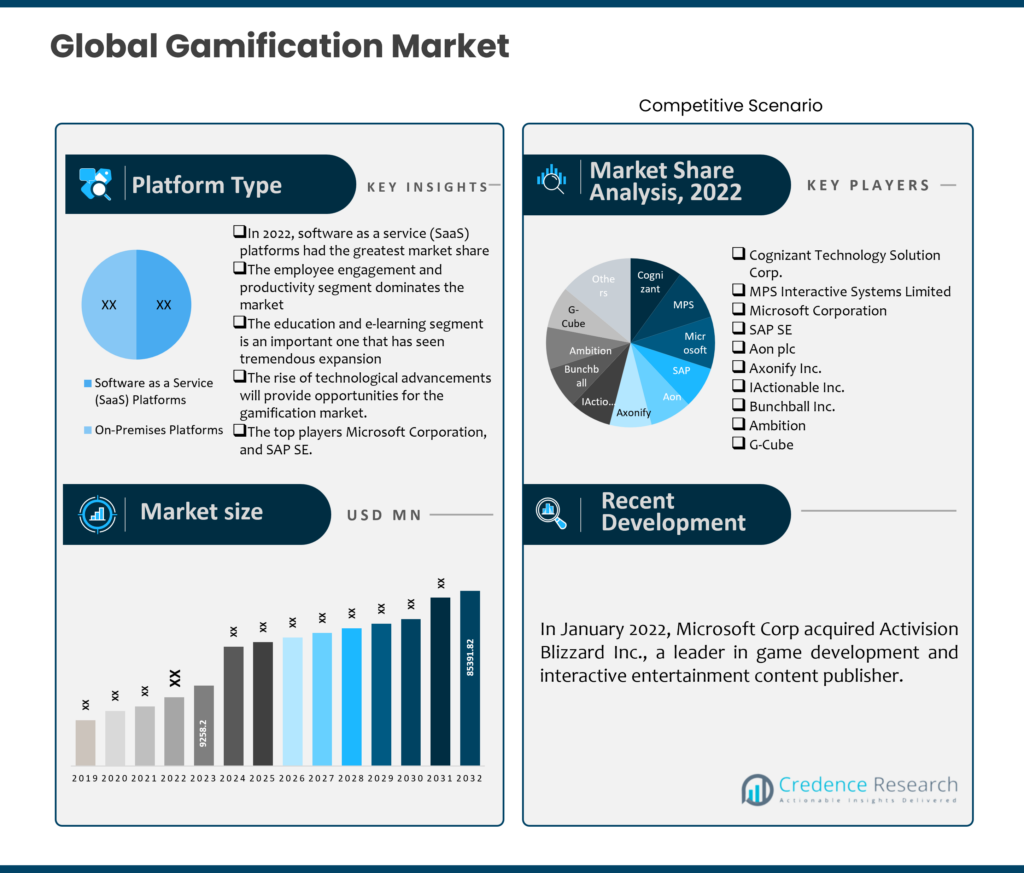
Numerous companies and governments are organizing conferences and events to raise awareness of gamification solutions in nations such as the UK, Germany, France, and others. For example, the Europe Gamification conference was held in December 2019 so that businesses could learn about and comprehend the offerings. Additionally, the expanding retail and healthcare industries in Germany and Spain should help these nations gain momentum. Prominent industry players prioritize delivering cutting-edge solutions that improve employee engagement, increase revenue, and give a superior customer experience, thereby driving up end-user demand for software.
The North American region has shown a significant level of receptivity to the adoption of gamification solutions, revealed through the widespread use of internet connectivity to interact with a variety of channel partners and clients from different sectors. In North America, the market for gamification is expanding due to the widespread adoption of both customer-based and enterprise-based solutions. Particularly active gamification users are found in the US and Canada. These countries utilize gamification to enhance advertising, client retention, and brand promotion. The gamification market in North America has been increasing rapidly due to the increasing demand for cloud-based solutions among organizations.
The Asia-Pacific region has emerged as the fastest-growing market for gamification, driven by growing internet penetration, rising digitization, and an increasing emphasis on enhancing user engagement and retention. Countries like China, India, and Japan are witnessing significant adoption of gamification solutions, particularly in the e-learning, healthcare, and consumer goods sectors.
Key Highlights of the Report
The global gamification market is segmented by platform type, application area, gamification mechanics, industry vertical, and region. As far as the platform type is concerned, software as a service (SaaS) platforms are the market spearhead. Employee engagement and productivity are the top application area category. The points, badges, and leaderboards (PBL) category is anticipated to increase at the highest CAGR throughout the projection period. The education and e-learning category will experience the highest CAGR during the forecast period. The gamification market is expanding mostly in North America.
One significant trend that is becoming more and more popular in the gamification business is technological developments. To maintain their market share, major gamification firms are concentrating on launching innovative technology. For example, in January 2022, the UK-based technology company Soffos introduced TestMe, an AI-driven quiz-based training platform designed for corporate training managers and student exam preparation. It creates open-ended, quiz-style exams that can be put onto the platform and taken by users from any resource. Answers can be typed in or spoken in natural language. Throughout the learning journey, this gamification feature will keep the user interested in investigating hot topics and updating others on their progress.
North America is anticipated to have the top position in the global gamification market. The reason for this is the existence of customer-focused companies in the area, like Oracle, Cisco System, Inc., Salesforce, Inc., and more. With the goal of helping cloud customers, Oracle, for example, introduced Oracle Launchpad, a digital learning platform, in June 2018. With the new learning platform, users may look up and study topics according to their schedules. The Asia Pacific region is also assumed to have the market's sharpest growth. Engaging players in the gamification sector is thought to be most effective in the Asia Pacific area. The country with the most anticipated revenue share is China.
Which Key Factors Are Driving the Global Gamification Market?
The gamification industry is growing as more businesses realize how crucial it is to keep customers, employees, and users motivated and engaged in order to promote desired behaviors and achieve certain objectives.
What Are the Main Challenges Confronting the Global Gamification Market?
Gamified systems need to adhere to a number of rules, and businesses might not have the technical expertise required to deploy and manage gamification solutions. These are the key obstacles confronting the global gamification market.
What Market Opportunities Exist for Gamification Globally?
Opportunities for the global gamification industry include raising user engagement across industries, promoting behavior change, and improving learning outcomes.
Market Drivers
Adoption of Gamification solutions powered by Artificial Intelligence (AI) to Encourage Market Growth
The increasing prevalence of gamification technologies built on the AI platform is one of the important factors supporting the market's expansion. In order to get deep insights into their workforce, large enterprises are implementing cutting-edge technologies and AI-based systems. By removing any doubt about an employee's motivations, AI-based gamification frameworks offer precise answers and facilitate more effective target achievement. For example, since Cisco gamified its social media training program, over 650 employees of Cisco Systems have completed over 13000 courses and received certifications. The market's major companies are concentrating their investments on the creation of AI-based solutions.
An engaging culture of collaboration and transparency gives the business a competitive edge over rivals. AI-based solutions are being adopted by small and medium-sized organizations (SMEs) to improve employee engagement, motivation, and involvement. Growing market growth could result from the increased use of AI-based solutions to foster transparent and cooperative cultures. Persuasive artificial intelligence (AI)-driven software as a service (SaaS) systems, for example, offer digitalized employee communication, engagement, and recognition tools that improve organizational transparency and collaborative culture.
Venture investors are also funding new businesses that offer SaaS platforms powered by AI technologies. The SaaS solution Worxogo Solutions Pvt. Ltd. offers to employees is one example of the investments made by Ideaspring Capital and Inventus Capital India. Employee daily performance data is individualized by the solution. For the enterprise learning industry, Quodeck has also introduced a SaaS offering based on AI/ML and gamification. AI-based gamification solutions are being adopted by businesses in a variety of business units, such as marketing, HR, sales, and others, in an effort to improve the alignment of workers' tasks with the organization's goals.
Market Restraints
Unexpected Outcome from Improper Design is Probably Going to Hinder Software Adoption
A key component of ensuring that the desired result is achieved is gamification design. It has been noted that designers, however, frequently fall short of creating original, cutting-edge designs that satisfy the requirements of each given company. It's possible that this will hinder the market's adoption of solutions. The process of developing a solution is complex because, even while it is tailored to a certain company, it may not be effective for other audiences. Therefore, to attain the intended effect, a precisely planned design and its appropriate implementation are essential; otherwise, doing so will compromise the results and impede market expansion.
Opportunities
Increased Customer Experience and Financial Well-Being through the Growth of Gamified Finance Apps
Major competitors in the gamification space are concentrating on creating revolutionary goods like gamified finance apps in order to obtain a competitive edge. Apps for finance that are gamified make use of gaming techniques and aspects to improve user experience and improve financial results. In May 2023, Truist Financial Corporation, a bank holding corporation based in the United States, introduced a gamified finance software called Long Game. It offers awards to users who improve their financial wellness. This mobile app is an amazing example of how our Truist Foundry group's unique start-up methodology combines cutting-edge technology with a human touch to improve clients' financial experiences. Users launch the Long Game app after installation and are greeted by the 'daily game.' Using this function, users can earn money to play a variety of additional games.
Competitive Landscape
Key Players
Several major competitors exist in the fiercely competitive global gamification market. The following are a few of the leading market participants and their market shares:
- Cognizant Technology Solution Corp.
- MPS Interactive Systems Limited
- Microsoft Corporation
- SAP SE
- Aon plc
- Axonify Inc.
- IActionable Inc.
- Bunchball Inc.
- Ambition
- G-Cube
- Others
These companies prioritize product innovation, distribution channel partnership, collaboration, and acquisitions to remain competitive.
The largest suppliers in the global gamification market continuously work to stay one step ahead of the competition by developing innovative concepts and products.
In December 2021, SAP established a partnership with Attensi, the global leader in 3D gamified simulation training. The companies worked together to deploy SAP SuccessFactors Solutions to deliver development and learning. In addition, Attensi would offer a novel educational experience by including features like game automation and a competitive element.
In November 2021, Ambition announced a collaboration with Gong, the leading provider of revenue intelligence. Through this cooperation, Ambition would integrate Gong's capabilities with its insights-to-action coaching tool.
In April 2021, Axonify, a leader in frontline employee training, acquired Atlanta-based MLevel, a data-driven digital learning platform. It is expected that the strategic alliance will bring the two industry giants together and leverage their complementary strengths to the benefit of their combined clientele, propelling modern education forward.
How are Companies Performing in the Gamification Market?
The substantial performance of companies in the gamification sector can be attributed to some noteworthy reasons. Companies are making significant investments in immersive technologies such as mixed reality, virtual reality, and augmented reality. Companies are offering gamification solutions that make use of this immersive technology. For example, to transform the shopping experience, two of the biggest names in the retail sector, Amazon.com, Inc., and Walmart, are utilizing augmented reality, virtual reality, and mixed reality technologies. These businesses use VR showrooms to exhibit their products by utilizing immersive technologies. Additionally, Walmart is spending money on gamification and augmented reality to promote its items. Retailers are able to engage customers both inside and outside of their establishments by using this technology. The integration of immersive technology with gamification is expected to facilitate more compelling product promotion and improve the overall shopping experience for customers.
Furthermore, Microsoft has been actively advancing in the gamification market through its Dynamics 365 platform, notably with Dynamics 365 Gamification. This service empowers businesses to inspire their employees using gamified experiences, including competitions, challenges, and rewards, seamlessly integrated with Microsoft's suite of business applications. Microsoft has strategically strengthened its position in the gamification market. One significant move was the acquisition of PlayFab in 2018. PlayFab, renowned for its backend platform for live games, contributed its expertise in cloud-based gaming services to Microsoft's portfolio, enhancing its offerings in gaming and gamification. This acquisition enabled Microsoft to improve its ability to deliver scalable, real-time gaming experiences while gaining valuable insights into player behavior and engagement. Overall, companies are thriving in the gamification market, driven by innovation, customization, and a commitment to delivering engaging experiences across industries.
Summary of Key Findings
- The platforms for gamification provide a high priority on accessibility, usability, and user experience to guarantee broad adoption and engagement.
- The market is segmented by platform type, application area, gamification mechanics, industry vertical, and region.
- In the market, software as a service (SaaS) platforms are the most widely used platform type.
- Employee engagement and productivity category is the foremost category.
- Points, badges, and leaderboards (PBL) category is expected to grow at the fastest CAGR during the forecast period.
- The education and e-learning category will likely see the highest CAGR during the anticipated time frame.
- North America is leading market development; the market is highly competitive with key players including Cognizant Technology Solution Corp., MPS Interactive Systems Limited, Microsoft Corporation, SAP SE, Aon plc, Axonify Inc., IActionable Inc., Bunchball Inc., Ambition, G-Cube, and Others.
Future Outlook
- The gamification industry is expected to increase significantly in North America, and its outlook is positive worldwide.
- Gamified educational materials support the development of abilities in project management, language learning, and coding through interactive learning experiences.
- Platforms for gamification may have challenges with technology, such as glitches, compatibility problems, or performance constraints.
- To stay ahead of the competition, key enterprises must develop new products, expand their market reach, and keep their prices competitive.
How CXOs Can Benefit from the Credence Research Gamification Market Report
CXOs may get a detailed picture of the market in the Credence Research Gamification Market Report, which includes:
- Market size and growth forecast: The report provides detailed estimates of the global gamification market size, segmented by platform type, application area, gamification mechanics, industry vertical, and region. It also includes forecasts for the market through 2032 based on key trends and drivers.
- Market segmentation: The research report breaks down the gamification market into segments based on platform type, application area, gamification mechanics, industry vertical, and region. This segmentation provides CXOs with a granular understanding of the market and the opportunities in each segment.
- Competitive landscape: The research report offers a detailed analysis of the major companies in the gamification industry, including information on their business plans, product lines, and earnings. CXOs can use this information to evaluate and identify their competitors.
- Key trends and drivers: The research report identifies and evaluates the main trends and factors influencing the gamification market. CXOs can use this information to make well-informed choices regarding their plans and investments.
CXOs can use the insights from the Credence Research Gamification Market Report to:
- Identify growth opportunities: This analysis may help CXOs identify new growth opportunities in the gamification sector. For example, the report identifies the growing demand for gamification from the technology and software industry as a key opportunity.
- Make informed investment decisions: The report helps CXOs choose gamification wisely. For example, the research study provides information on the critical factors to consider when selecting gamification and evaluating suppliers.
- Develop competitive strategies: CXOs can use the research report to develop competitive strategies for their gamification businesses. For example, the research paper outlines the main strategies that gamification providers utilize to differentiate themselves from competitors.
- Track market developments: This research report may help CXOs stay ahead of the curve by tracking market developments. For instance, it offers insights into the most recent developments and trends in the gamification market.
CXOs seeking to expand their industry knowledge and spot growth prospects will find the Credence Research Gamification Market Report useful.
Segmentation
-
By Platform Type
- Software as a Service (SaaS) Platforms
- On-Premises Platforms
-
By Application Area
- Marketing and Advertising
- Education and Training
- Health and Wellness
- Employee Engagement and Productivity
- Customer Engagement and Loyalty
- Sales and Revenue Generation
- Social Impact and Civic Engagement
- Training and Development
-
By Gamification Mechanics
- Points, Badges, and Leaderboards (PBL)
- Challenges and Quests
- Levels and Progression
- Rewards and Incentives
- Feedback and Recognition
- Social Interaction and Collaboration
-
By Industry Vertical
- Education and e-Learning
- Healthcare and Wellness
- Retail and Consumer Goods
- Technology and Software
- Financial Services and Banking
- Travel and Hospitality
- Sports and Entertainment
-
By Region
- North America
- U.S.
- Canada
- Mexico
- Europe
- Germany
- France
- UK.
- Italy
- Spain
- Rest of Europe
- Asia Pacific
- China
- Japan
- India
- South Korea
- South-east Asia
- Rest of Asia Pacific
- Latin America
- Brazil
- Argentina
- Rest of Latin America
- Middle East & Africa
- GCC Countries
- South Africa
- The Rest of the Middle East and Africa
- North America
Request a Free Sample
Fill in your details and we'll send you a free sample report.
- Sample data tables & charts
- Research methodology
Need a Custom Version of This Report?
Tailor the scope, geography, or segments to your exact requirements.
- Custom geography or segment scope
- Direct access to our analyst team
Frequently Asked Questions
How much does the global market currently hold for gamification?
What is the gamification market's projected growth rate between 2024 and 2032?
In terms of platform type, which market category is leading?
Regarding the application area, which market category is in the lead?
Which industry vertical segment is estimated to have the highest CAGR throughout the forecast period?
In which region is the market for gamification expanding?
Who are the main players in the global gamification industry?
Which market factors are the primary drivers of the gamification industry?
What main market challenges prevent the growth of the Gamification sector?
What are the main market opportunities for the Gamification sector?
Table of Content
Chapter 1. Report Introduction
- 1.1 Report Description & Purpose
- 1.1.1 Report Title & Market Definition
- 1.1.2 Unique Selling Propositions (USP) & Key Differentiators
- 1.1.3 Value Proposition for Stakeholders
- 1.2 Research Objectives
- 1.2.1 Market Sizing Objectives (Volume & Revenue)
- 1.2.2 Segmentation Objectives
- 1.2.3 Competitive Intelligence Objectives
- 1.2.4 Forecast & Scenario Objectives
- 1.3 Report Scope
- 1.3.1 Gamification Scope – Types & Subtypes Covered
- 1.3.2 Geographic Scope – Regions & Countries Covered
- 1.3.3 Historical Period, Base Year & Forecast Period (the historical period; forecast to the forecast period)
- 1.3.4 Inclusions & Exclusions
- 1.4 HS Code & Classification Framework
- 1.5 Currency, Units & Pricing Basis
- 1.6 Target Stakeholders
- 1.7 Limitations & Assumptions
Chapter 2. Executive Summary
- 2.1 Global Gamification Market Snapshot
- 2.1.1 Market Size – Historical (the historical period) & Forecast (the forecast period) (base year: USD 9,258.2 million → forecast year: USD 85,391.82 million)
- 2.1.2 Volume & Revenue – Global Totals
- 2.1.3 Key Market Highlights – Top Five Facts
- 2.2 Gamification Market Segmentation Snapshot
- 2.2.1 Market Split by Region – vs.
- 2.3 Competitive Snapshot
- 2.3.1 Top 10 Players by Revenue Share –
- 2.3.2 Top 10 Players by Volume Share –
- 2.3.3 Recent Strategic Developments (18-Month Summary)
- 2.4 Key Investment Highlights & Strategic Conclusions
Chapter 3. Gamification Market Dynamics & Industry Analysis
- 3.1 Market Overview & Context
- 3.1.1 Gamification Market Position in the Broader Automotive Value Chain
- 3.1.2 OEM vs. Replacement Market Dynamics
- 3.1.3 Market Maturity & Development Stage by Region
- 3.2 Gamification Market Drivers
- 3.3 Gamification Market Restraints & Challenges
- 3.4 Gamification Market Opportunities
- 3.5 Porter's Five Forces Analysis
- 3.5.1 Threat of New Entrants
- 3.5.2 Bargaining Power of Suppliers
- 3.5.3 Bargaining Power of Buyers
- 3.5.4 Threat of Substitutes
- 3.5.5 Competitive Rivalry – Intensity Assessment
- 3.6 Gamification Value Chain Analysis
- 3.6.1 Upstream – Raw Material/Input Suppliers
- 3.6.1.1 Raw Material/Input 1
- 3.6.1.2 Raw Material/Input 2
- 3.6.1.3 Raw Material/Input 3
- 3.6.2 Midstream – Production/Manufacturing/Service Delivery
- 3.6.2.1 Production/Process Overview
- 3.6.2.2 Key Facility Locations & Capacity by Manufacturer
- 3.6.3 Downstream – Distribution & End Consumer
- 3.6.3.1 Primary Channel – B2B/OEM
- 3.6.3.2 Secondary Channels – Dealer, Retail, Online, Direct
- 3.6.4 Value Chain Profitability Analysis
- 3.6.1 Upstream – Raw Material/Input Suppliers
- 3.7 PESTEL Analysis
- 3.7.1 Political Factors
- 3.7.2 Economic Factors
- 3.7.3 Social Factors
- 3.7.4 Technological Factors
- 3.7.5 Environmental Factors
- 3.7.6 Legal Factors
- 3.8 Gamification Supply Chain Analysis
- 3.8.1 Raw Material/Input Supply Risk Assessment
- 3.8.2 Manufacturing Concentration Risk (Geographic Exposure)
- 3.8.3 Trade Disruption Impact Analysis
- 3.9 Regulatory & Policy Landscape
Note: The regulatory and policy landscape section covers regulations based on their applicability to the market, Gamification category, geography, and scope of the study. Only regulatory frameworks with a material impact on operations, compliance, trade, sustainability, or market access are analyzed in detail.
Chapter 4. Key Investment Pockets & Opportunity Analysis
- 4.1 Gamification Market Attractiveness Analysis
- 4.1.1 By Region – Investment Attractiveness Matrix (Volume × CAGR)
- 4.2 Absolute Revenue Growth Opportunity
- 4.2.1 By Region – Absolute USD Growth Through the forecast period
- 4.3 Incremental Volume Opportunity
- 4.3.1 By Region – Incremental Volume Through the forecast period
- 4.3.2 Segment – Incremental Volume
- 4.4 Emerging Submarket Opportunity Deep Dive (Subject to Applicability)
- 4.5 Emerging Market Opportunity Scorecards
- 4.5.1 United States
- 4.5.2 Europe
- 4.5.3 Asia
- 4.5.4 Middle East & Africa
Note: Emerging Market Opportunity Scorecards will be included based on relevance and strategic importance. Regions listed are indicative and may vary depending on data availability and market dynamics.
Chapter 5. Gamification Import-Export Analysis & Trade Flows
- 5.1 Global Trade Overview
- 5.1.1 Global Export Value by Country (the historical period)
- 5.1.2 Global Export Volume by Country (the historical period)
- 5.1.3 Global Import Value by Country (the historical period)
- 5.1.4 Global Import Volume by Country (the historical period)
- 5.1.5 Net Trade Balance by Country (the historical period)
- 5.2 Export Analysis – Segment
- 5.2.1 Type 1 (HS Code)
- 5.2.2 Type 2 (HS Code)
- 5.2.3 Type 3 (HS Code)
- 5.2.4 Type 4 (HS Code)
- 5.2.5 Type 5 (HS Code)
- 5.3 Import Analysis – Segment
- 5.3.1 Type 1 (HS Code)
- 5.3.2 Type 2 (HS Code)
- 5.3.3 Type 3 (HS Code)
- 5.3.4 Type 4 (HS Code)
- 5.3.5 Type 5 (HS Code)
- 5.4 Average Unit Trade Prices
- 5.4.1 Average Export Price – Segment & Country
- 5.4.2 Average Import Price – Segment & Source Country
- 5.4.3 Price Trends (the historical period)
- 5.5 Key Trade Route Analysis
- 5.5.1 Trade Route 1
- 5.5.2 Trade Route 2
- 5.5.3 Trade Route 3
- 5.5.4 Trade Route 4
- 5.5.5 Trade Route 5
- 5.6 Trade Policy Impact Assessment
- 5.6.1 US Anti-Dumping & Section 301 Tariffs
- 5.6.2 EU Customs Union Impact
- 5.6.3 Major Free Trade Agreements
- 5.6.4 USMCA Rules of Origin
Note: Trade policy analysis will be included only where relevant to the Gamification market.
Chapter 6. Competitive Landscape & Company Benchmarking
- 6.1 Gamification Market Concentration & Structure
- 6.1.1 Herfindahl-Hirschman Index (HHI) – vs.
- 6.1.2 Tier 1, Tier 2 & Tier 3 Market Structure
- 6.1.3 Global, Regional & Local Player Dynamics
- 6.2 Gamification Market Share Analysis –
- 6.2.1 Global Revenue Share by Company
- 6.2.2 Global Volume Share by Company
- 6.2.3 Regional Revenue Share
- 6.2.4 Market Share Evolution ( vs. )
- 6.2.5 OEM Segment Share by Company
- 6.2.6 Replacement Segment Share by Company
- 6.3 Production/Delivery Capacity & Facility Analysis
- 6.3.1 Global Installed Capacity
- 6.3.2 Capacity Utilization Rates
- 6.3.3 Production/Output Volume
- 6.3.4 Facility Locations & Capacity Map
- 6.3.5 Planned Capacity Additions
- 6.4 Gamification Competitive Benchmarking Matrix
- 6.4.1 Revenue, Volume, CAGR & Profitability Comparison
- 6.4.2 Channel Revenue Mix
- 6.4.3 Geographic Revenue Exposure
- 6.4.4 R&D Intensity
- 6.4.5 Sustainability Maturity
- 6.5 Strategic Developments in Gamification (Last 24 Months)
- 6.5.1 Mergers, Acquisitions & Divestments
- 6.5.2 New Gamification Launches
- 6.5.3 Facility Expansions
- 6.5.4 Strategic Alliances, Joint Ventures & Partnerships
- 6.5.5 Distribution Expansion & Market Entry
- 6.5.6 Sustainability & ESG Initiatives
- 6.6 Competitive Strategy Mapping
- 6.6.1 Leader, Challenger, Follower & Niche Classification
- 6.6.2 Pricing Strategy Comparison
- 6.6.3 Channel Strategy Matrix
Note: Strategic developments are included based on their materiality and the availability of reliable information.
Chapter 7. Global Gamification Market – By Distribution Channel
- 7.1 Segment Overview
- 7.1.1 Volume & Revenue Split by Channel ( & )
- 7.1.2 Channel Mix Evolution (the forecast period)
Chapter 8. Regional Market Analysis – Global Overview
- 8.1 Global Regional Overview
- 8.1.1 Regional Volume Share
- 8.1.2 Regional Revenue Share
- 8.1.3 Regional Volume by Region
- 8.1.4 Regional Revenue by Region
- 8.1.5 Regional Forecast Through the forecast period
- 8.2 Cross-Regional Segment Analysis
- 8.2.1 By Distribution Channel
- 8.2.2 By Brand/Price Tier
Chapter 9. North America Gamification Market
- 9.1 United States
- 9.2 Canada
- 9.3 Mexico
Chapter 10. Europe Gamification Market
- 10.1 Germany
- 10.2 France
- 10.3 Italy
- 10.4 United Kingdom
- 10.5 Spain
- 10.6 Poland
- 10.7 Russia
- 10.8 Netherlands
- 10.9 Belgium
- 10.10 Sweden
- 10.11 Denmark
- 10.12 Norway
- 10.13 Rest of Europe
Chapter 11. Asia Pacific Gamification Market
- 11.1 China
- 11.2 India
- 11.3 Japan
- 11.4 South Korea
- 11.5 Thailand
- 11.6 Indonesia
- 11.7 Vietnam
- 11.8 Malaysia
- 11.9 Australia
- 11.10 Rest of Asia Pacific
Chapter 12. Latin America Gamification Market
- 12.1 Brazil
- 12.2 Argentina
- 12.3 Colombia
- 12.4 Chile
- 12.5 Rest of Latin America
Chapter 13. Middle East Gamification Market
- 13.1 Saudi Arabia
- 13.2 United Arab Emirates
- 13.3 Turkey
- 13.4 Israel
- 13.5 Iran
- 13.6 Rest of the Middle East
Chapter 14. Africa Gamification Market
- 14.1 South Africa
- 14.2 Egypt
- 14.3 Nigeria
- 14.4 Morocco
- 14.5 Rest of Africa
Chapter 15. Gamification Company Profiles
- 15.1 [Company 01]
- 15.1.1 Company Overview
- 15.1.2 Key Management Personnel
- 15.1.3 Products & Services Portfolio
- 15.1.4 Financial Performance
- 15.1.5 Key Market Focus & Geographic Presence
- 15.1.6 Recent Developments & Strategic Initiatives
Note: The company profile list is preliminary and may change based on research findings, market developments, data availability, and client requirements.
Chapter 16. Appendices
- Appendix A – List of Abbreviations & Acronyms
- Appendix B – Industry Classification Code Reference – Full Series
- Appendix C – Production & Capacity Data Tables
- Appendix D – End-Use & Demand Base Tables
- Appendix E – Consumption & Replacement Rate Assumptions
- Appendix F – ASP Reference Tables
- Appendix G – Manufacturing & Facility Database
- Appendix H – Import-Export Data Tables
- Appendix I – Regulatory Summary Tables
- Appendix J – Primary Research Participant List (Anonymized)
- Appendix K – Primary Research Questionnaire Framework
- Appendix L – Data Sources & Bibliography
- Appendix M – Market Size Divergence & Source Comparison
Chapter 17. Research Methodology
- 17.1 Research Framework & Philosophy
- 17.2 Secondary Research – Sources, Hierarchy & Data Extraction
- 17.3 Data Modeling – Bottom-Up & Top-Down Market Sizing
- 17.4 Primary Research – Stakeholder Framework, LOI & Sample Sizes
- 17.5 Forecast Methodology – Regression, Scenario & Sensitivity Analysis
- 17.6 Quality Control – Four-Layer Validation Framework
- 17.7 Limitations & Standard Assumptions
- 17.8 Disclaimer
