Automotive Hypervisor Market Size, Trends, Share & Forecast 2032

Automotive Hypervisor market size was valued at USD 575.06 million in 2024 and is projected to reach USD 4,139.20 million by 2032.

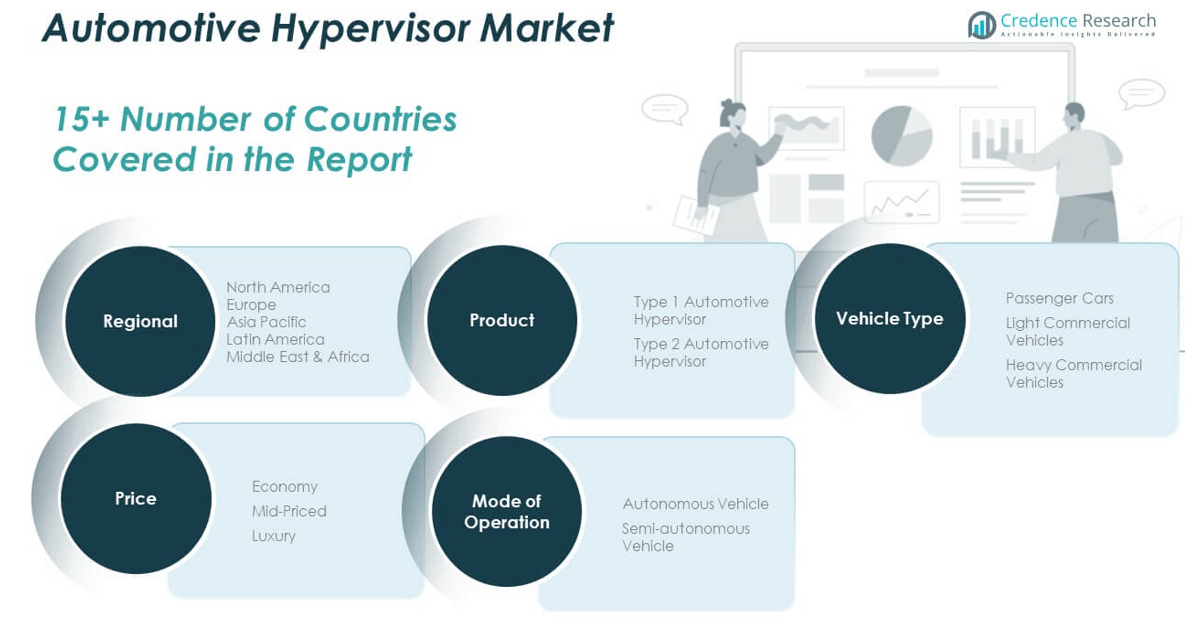
Automotive Hypervisor Market By Product Type (Type 1 Automotive Hypervisor, Type 2 Automotive Hypervisor); By Vehicle Type (Passenger Cars, Light Commercial Vehicles, Heavy Commercial Vehicles); By Price (Economy, Mid-Priced, Luxury); By Mode of Operation (Autonomous Vehicle, Semi-autonomous Vehicle) – Growth, Share, Opportunities & Competitive Analysis, 2024 – 2032

SKU: CR679Report Pages: 250Category: Automotive & TransportationReport Format: PDF, ExcelLast Updated: Jul 19Author: Ganesh ChandwadePreferred on

Market Report Metrics

Revenue, 2024 -
USD 575.06 million
Forecast Year -
2032
CAGR (2024–2032)
28.03%
Report Coverage
Global
REPORT ATTRIBUTE DETAILS
Historical Period 2020-2023
Base Year 2024
Forecast Period 2025-2032
Automotive Hypervisor Market Size 2024 USD 575.06 million
Automotive Hypervisor Market, CAGR 28.03%
Automotive Hypervisor Market Size 2032  USD 4,139.20 million

Market Overview:

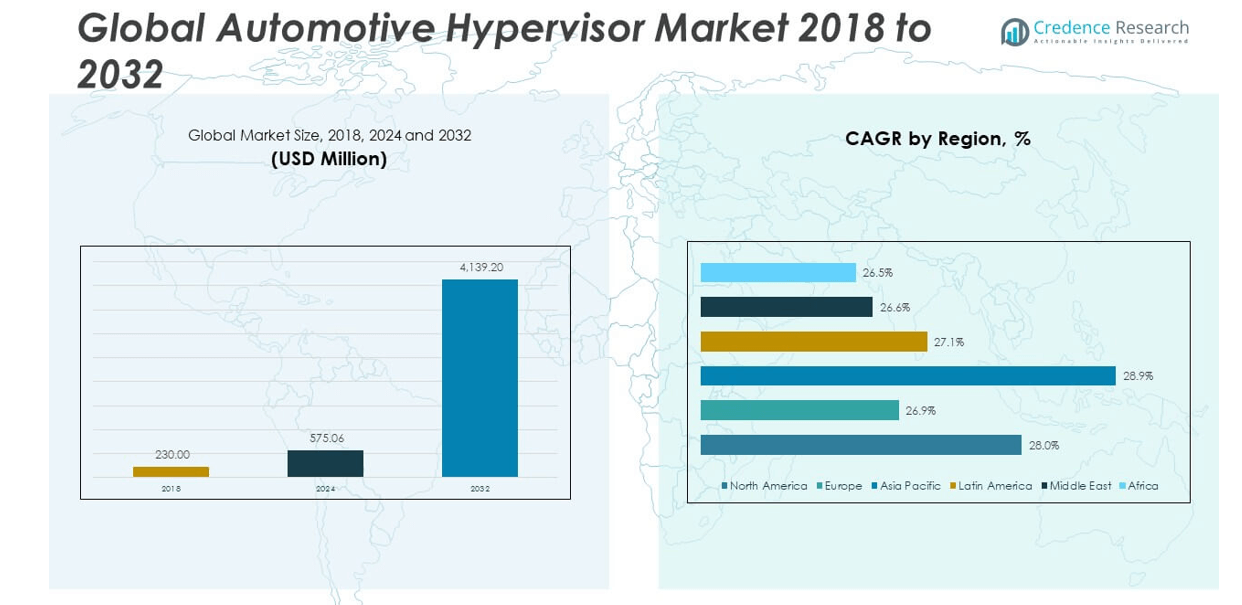
The Global Automotive Hypervisor Market size was valued at USD  230.00 million in 2018 to USD 575.06 million in 2024 and is anticipated to reach USD 4,139.20 million by 2032, at a CAGR of 28.03% during the forecast period.

Key factors are fueling the growth of the automotive hypervisor market. The rising adoption of Advanced Driver-Assistance Systems (ADAS), autonomous driving capabilities, and in-vehicle infotainment systems is increasing the complexity of vehicle electronic systems. Hypervisors help manage this complexity by allowing multiple operating systems and applications to coexist on shared hardware platforms while remaining securely isolated from one another. Automakers are transitioning to centralized domain controller architectures to consolidate various electronic control units (ECUs), and hypervisors enable this shift by optimizing processor utilization and maintaining system safety. The growing popularity of electric vehicles (EVs) and connected vehicles further contributes to demand, as these platforms require real-time communication, OTA (over-the-air) update capabilities, and cybersecurity safeguards—areas where hypervisor technology offers significant advantages. Regulatory compliance and functional safety standards, such as ISO 26262, are also encouraging OEMs and Tier-1 suppliers to adopt hypervisors for safer software integration across critical systems.

Regionally, Asia Pacific held the largest market share in 2023, contributing to global revenue. Countries like China, Japan, and South Korea are leading in vehicle electrification, ADAS deployment, and smart mobility infrastructure, all of which require sophisticated electronic architectures. China’s aggressive EV policies and large automotive production base are key contributors to this dominance. North America ranks second in market size, driven by high demand for connected vehicles, strong adoption of electric mobility, and regulatory emphasis on cybersecurity and vehicle safety. Europe is expected to register the fastest growth during the forecast period due to strict EU regulations mandating the inclusion of ADAS and vehicle safety systems, such as emergency braking and lane-keeping assistance, in new vehicles. Leading European OEMs are embracing hypervisor technology to meet these regulatory benchmarks while simplifying electronic architecture. Although Latin America and the Middle East & Africa currently represent smaller shares of the market, these regions are experiencing significant growth due to rising demand for advanced safety technologies, improving automotive infrastructure, and growing investments by global automakers.

Automotive Hypervisor Market size

Market Insights:

  • The Global Automotive Hypervisor Market grew from USD 230.00 million in 2018 to USD 575.06 million in 2024 and is projected to reach USD 4,139.20 million by 2032, registering a CAGR of 28.03% during the forecast period.
  • Increasing adoption of ADAS, autonomous driving, and infotainment systems is driving demand for hypervisors that manage multiple operating systems securely on a single hardware platform.
  • Automakers are transitioning to centralized domain controller architectures, using hypervisors to reduce ECU count, improve processor efficiency, and enhance system safety.
  • The rise of electric and connected vehicles requires hypervisors to manage complex system interactions, enable real-time processing, support OTA updates, and reinforce cybersecurity.
  • Regulatory pressures, including ISO 26262 compliance and vehicle data protection standards, are encouraging OEMs and Tier-1 suppliers to integrate hypervisors for safe and secure software execution.
  • High software complexity, validation requirements, integration costs, and limited skilled workforce remain key barriers to mass adoption across vehicle segments.
  • Asia Pacific leads the market in revenue share due to strong EV production, ADAS deployment, and smart mobility infrastructure, followed by North America and Europe, which are driving innovation and regulatory-based adoption.

Market Drivers:

Rising Vehicle Software Complexity and Functional Integration Demand Virtualization:

The automotive industry's shift toward centralized computing and domain controller architectures is driving the demand for virtualization solutions. Multiple vehicle functions—such as infotainment, instrument clusters, and ADAS—now run concurrently and require independent, secure operating environments. The Global Automotive Hypervisor Market benefits from this evolution by offering a software framework that enables safe and efficient consolidation of these systems onto fewer hardware platforms. It helps reduce the number of Electronic Control Units (ECUs), cutting costs and simplifying vehicle electrical architecture. Automakers increasingly rely on hypervisors to ensure that critical functions remain isolated from non-critical systems. This segregation enhances fault tolerance and system resilience in safety-critical applications.

  • For instance, Volvo Cars uses BlackBerry QNX Hypervisor to run its infotainment (Android Automotive OS) and instrument cluster on a shared NVIDIA DRIVE hardware platform in all new SPA2 models, streamlining ECU count by more than 30% compared to previous platforms.

Growth of Electric and Connected Vehicles Demands Advanced System Management:

The rapid adoption of electric vehicles (EVs) and connected vehicles is increasing the need for advanced software platforms to manage various systems. EVs require tight coordination between battery management, thermal systems, infotainment, and safety controls. The Global Automotive Hypervisor Market plays a central role by enabling real-time execution of diverse applications with strict timing requirements. It facilitates secure communication across subsystems while maintaining operational efficiency. Connected cars also require over-the-air updates and cybersecurity features that are easier to implement in virtualized environments. Hypervisors provide a trusted execution base that ensures data integrity and functional safety across distributed applications.

  • For instance, Hyundai Motor Group utilizes virtualization platforms like Green Hills Software’s INTEGRITY Multivisor within its E-GMP EV architecture. This enables secure OTA updates and real-time controls for its electric powertrain and safety systems, supporting a growing global fleet of smart electric vehicles.

Software-Defined Vehicle Architecture Accelerates Hypervisor Integration:

OEMs are rapidly transitioning toward software-defined vehicles (SDVs), where most vehicle functions are controlled by software rather than traditional mechanical systems. The Global Automotive Hypervisor Market gains traction from this transformation, as virtualization is critical for managing the vehicle's evolving digital architecture. It supports scalability and modularity, enabling faster development and deployment of new features. Hypervisors also reduce time-to-market for OEMs by decoupling software from hardware, supporting flexible upgrades. They create an abstraction layer that simplifies system design and fosters compatibility across hardware platforms. This architecture supports future-ready vehicles that can adapt to evolving mobility requirements.

Stringent Functional Safety and Cybersecurity Standards Reinforce Adoption:

Governments and regulatory bodies are enforcing stricter standards for vehicle safety and cybersecurity, increasing the need for fault-isolated software execution. The Global Automotive Hypervisor Market aligns with these regulations by supporting ISO 26262 functional safety compliance. It ensures that safety-critical operations remain unaffected by faults in other software modules. Cybersecurity threats in connected vehicles demand secure environments where software applications remain insulated. Hypervisors create protected virtual machines that minimize exposure to unauthorized access or data breaches. This trusted software architecture enables OEMs to meet regulatory expectations while improving system security and operational reliability.

Market Trends:

Transition to Mixed-Criticality Consolidation on Single Hardware Platforms:

A growing trend in the Global Automotive Hypervisor Market is the consolidation of mixed-criticality applications on shared computing platforms. Traditionally, automotive systems separated critical functions from non-critical ones using multiple ECUs. Manufacturers now prefer to integrate applications with different safety levels—such as ADAS and infotainment—on a single processor to reduce hardware cost and weight. Hypervisors make this possible by enforcing strong isolation between applications. This trend is expanding in both premium and mass-market segments. It supports flexible design strategies and paves the way for scalable vehicle platforms.

  • For instance, Volkswagen leverages the OpenSynergy COQOS Hypervisor with Qualcomm Snapdragon Automotive Cockpit Platforms to consolidate digital cockpit (cluster and infotainment), heads-up display, and safety-relevant controls for more than 3 million vehicles in production, demonstrating safe mixed-criticality consolidation on a single SoC.

Integration of Real-Time Operating Systems (RTOS) with Hypervisor Platforms:

OEMs are integrating real-time operating systems alongside general-purpose OSs to support performance-critical vehicle operations. The Global Automotive Hypervisor Market reflects this shift as hypervisors now coordinate multiple OS environments in a single system. It enables real-time processing for functions like autonomous navigation while supporting user-facing features like media playback. RTOS compatibility within hypervisor frameworks offers precision timing and resource control. This trend strengthens the foundation for advanced driving and control systems. It also supports better software lifecycle management and version control.

  • For instance, Siemens Embedded Hypervisor allows automotive manufacturers to run AUTOSAR and Linux-based systems together on a single ECU, supporting strict real-time constraints and easier software lifecycle management for advanced driver-assistance and user applications.

Increased Investment in Open-Source Hypervisor Solutions:

Automotive companies are showing growing interest in open-source hypervisor platforms to reduce dependency on proprietary software. The Global Automotive Hypervisor Market is witnessing the rise of projects like Xen and ACRN that provide customizable, community-supported virtualization stacks. Open-source solutions allow OEMs and Tier-1 suppliers to adapt hypervisors to their specific hardware configurations and system needs. This trend supports collaborative innovation and fosters ecosystem-wide compatibility. It also reduces licensing costs and promotes transparency in safety certification processes. The shift toward open-source reflects the industry's long-term vision for software flexibility.

Adoption of AI Workloads and Virtualization at the Edge:

The inclusion of AI-based features such as driver monitoring, predictive maintenance, and in-cabin personalization is expanding virtualization demands. The Global Automotive Hypervisor Market is evolving to accommodate AI workloads at the edge, directly within the vehicle. Hypervisors now manage high-performance compute units capable of handling machine learning models alongside traditional automotive functions. Edge-based AI requires reliable scheduling, memory protection, and performance isolation—all provided by hypervisor technology. This trend supports faster response times and improved data privacy compared to cloud-reliant models. It positions hypervisors as key enablers of intelligent mobility.

Market Challenges Analysis:

High Software Complexity and Integration Cost Hinders Broad Deployment:

Automotive hypervisors require sophisticated software integration and testing to ensure real-time performance, functional safety, and compatibility with diverse electronic components. The Global Automotive Hypervisor Market faces a major challenge in managing this complexity across varying vehicle platforms and processor architectures. It demands extensive validation to meet ISO 26262 safety standards and real-time processing benchmarks. OEMs must allocate significant engineering resources and capital to develop, configure, and certify hypervisor-based systems, making the technology less feasible for budget-sensitive models. Compatibility issues between hypervisors and legacy in-vehicle software further increase development timelines. These factors limit the rapid and uniform adoption of hypervisors across all vehicle segments.

Shortage of Skilled Developers and Lack of Standardization Slows Adoption:

The shortage of developers with expertise in embedded systems, virtualization, and automotive-grade real-time operating systems presents a significant bottleneck. The Global Automotive Hypervisor Market struggles with workforce constraints that delay project implementation and system testing. It also lacks unified standards governing interoperability between hypervisors and vehicle subsystems, leading to inconsistent development practices across OEMs and Tier-1 suppliers. This absence of standardization complicates supplier collaboration and increases software fragmentation across brands. Training requirements for internal engineering teams and integration partners further extend deployment cycles. The market must address both skill gaps and technical harmonization to support scalable, cost-effective growth.

Market Opportunities:

Emergence of Centralized Zonal Architectures and Consolidated ECUs Creates New Demand

The growing shift toward zonal architectures in modern vehicles presents a strong opportunity for virtualization platforms. Automakers are replacing distributed ECUs with a few high-performance domain controllers that manage multiple functions across zones. The Global Automotive Hypervisor Market benefits from this shift by offering secure partitioning and real-time coordination between diverse systems on shared hardware. It allows OEMs to streamline vehicle architecture, reduce wiring complexity, and support flexible upgrades. The trend enables integration of mixed-criticality applications, increasing the demand for robust and safety-certified hypervisors. This architectural evolution aligns with industry needs for scalability, modularity, and cost-efficiency.

Expansion of Autonomous Driving and AI Integration in Vehicles Boosts Virtualization Scope

The rising integration of AI for autonomous navigation, driver monitoring, and in-cabin experience creates fresh opportunities for advanced hypervisor adoption. The Global Automotive Hypervisor Market can support these AI workloads by managing real-time execution across CPUs, GPUs, and accelerators. It ensures performance isolation while enabling adaptive behavior across driving environments. OEMs can leverage hypervisors to embed machine learning models alongside safety-critical applications without system interference. As autonomy levels increase, vehicles require fault-tolerant software layers that hypervisors are designed to deliver. The growing complexity of AI-driven features amplifies the relevance of flexible, secure, and high-performance virtualization platforms.

Market Segmentation Analysis:

By Product Type

The Global Automotive Hypervisor Market is divided into Type 1 and Type 2 hypervisors. Type 1 hypervisors lead the market due to their direct interaction with hardware, offering superior performance and safety critical for ADAS and autonomous driving. Type 2 hypervisors are used in infotainment and other non-critical systems where flexibility and ease of deployment are prioritized.

  • For instance, Daimler adopted BlackBerry QNX Type 1 hypervisor to power the MBUX infotainment and ADAS domain in Mercedes-Benz vehicles.

By Vehicle Type

Passenger cars hold the largest share owing to high integration of digital cockpit, ADAS, and infotainment systems. Light commercial vehicles increasingly adopt hypervisors for fleet management and telematics. Heavy commercial vehicles show growing interest in hypervisors to support autonomous logistics and safety system consolidation.

  • For instance, ETAS’s RTA-Hypervisor (RTA-HVR) enables OEMs to reduce ECUs by partitioning them into virtual machines on a single microcontroller, allowing integration of applications from various suppliers with strong security and real-time performance in commercial fleets.

By Price

Mid-priced vehicles account for a significant portion of the market as OEMs use hypervisors to optimize feature-rich offerings while controlling costs. Luxury vehicles drive early adoption with complex architectures requiring secure virtualization. Economy vehicles begin to integrate basic hypervisor functions to enhance safety and connectivity at lower cost.

By Mode of Operation

Autonomous vehicles generate the highest demand for hypervisors by requiring isolation and real-time execution of AI-driven systems. Semi-autonomous vehicles contribute strongly, particularly in Level 2 and Level 3 automation models where software-defined functions must coexist safely on shared hardware. Hypervisors support this transition by ensuring operational safety and system efficiency.

Automotive Hypervisor Market segmentation

Segmentation:

By Product Type

  • Type 1 Automotive Hypervisor
  • Type 2 Automotive Hypervisor

By Vehicle Type

  • Passenger Cars
  • Light Commercial Vehicles
  • Heavy Commercial Vehicles

By Price

  • Economy
  • Mid-Priced
  • Luxury

By Mode of Operation

  • Autonomous Vehicle
  • Semi-autonomous Vehicle

By Region

  • North America
    • U.S.
    • Canada
    • Mexico
  • Europe
    • Germany
    • France
    • U.K.
    • Italy
    • Spain
    • Rest of Europe
  • Asia Pacific
    • China
    • Japan
    • India
    • South Korea
    • South-east Asia
    • Rest of Asia Pacific
  • Latin America
    • Brazil
    • Argentina
    • Rest of Latin America
  • Middle East & Africa
    • GCC Countries
    • South Africa
    • Rest of the Middle East and Africa

Regional Analysis:

North America

The North America Automotive Hypervisor Market size was valued at USD 58.42 million in 2018 to USD 143.53 million in 2024 and is anticipated to reach USD 1,031.08 million by 2032, at a CAGR of 28.0% during the forecast period. The region accounts for 25% of the global market share in 2024. The Global Automotive Hypervisor Market in North America benefits from strong adoption of ADAS, connected vehicles, and centralized computing platforms. U.S.-based OEMs and Tier-1 suppliers are investing in Level 3 and Level 4 automation, driving demand for hypervisors that ensure real-time coordination and safety. Regulatory frameworks supporting cybersecurity and OTA functionality further encourage integration of virtualization. Leading automotive software providers and chipmakers have strong presence in the region, enabling a robust development ecosystem. High EV adoption in the U.S. and Canada also accelerates the use of hypervisor-based architectures.

Europe

The Europe Automotive Hypervisor Market size was valued at USD 45.49 million in 2018 to USD 107.86 million in 2024 and is anticipated to reach USD 720.85 million by 2032, at a CAGR of 26.9% during the forecast period. The region holds 19% of the global market share in 2024. The Global Automotive Hypervisor Market in Europe is driven by strict vehicle safety mandates and widespread deployment of ADAS features. The European Union enforces regulatory requirements for lane-keeping, automatic braking, and emergency assist systems, which increase software complexity. Leading European automakers are transitioning to domain controller architectures to streamline vehicle electronics. Hypervisors play a critical role in separating safety-critical and infotainment systems in compliance with ISO 26262. The region’s focus on premium EVs and intelligent vehicle platforms supports continued market expansion.

Asia Pacific

The Asia Pacific Automotive Hypervisor Market size was valued at USD 91.70 million in 2018 to USD 235.51 million in 2024 and is anticipated to reach USD 1,795.30 million by 2032, at a CAGR of 28.9% during the forecast period. It accounts for the largest market share at 41% in 2024. The Global Automotive Hypervisor Market in Asia Pacific is driven by rapid vehicle electrification, expansion of smart mobility platforms, and dominance in automotive manufacturing. China leads in volume and innovation, supported by aggressive EV policies and strong domestic OEM investments. Japan and South Korea contribute through technological advancements in autonomous systems and high-performance electronics. The region’s competitive production costs and dense supplier networks enable faster implementation of virtualization technologies. Government initiatives in connected infrastructure further boost hypervisor demand.

Latin America

The Latin America Automotive Hypervisor Market size was valued at USD 18.93 million in 2018 to USD 46.98 million in 2024 and is anticipated to reach USD 319.42 million by 2032, at a CAGR of 27.1% during the forecast period. It captures 8% of the global market share in 2024. The Global Automotive Hypervisor Market in Latin America is growing steadily as OEMs expand local manufacturing and integrate digital platforms in vehicles. Brazil and Mexico are central hubs, adopting ADAS and infotainment features in mid-range vehicles. Hypervisor deployment is supported by the need for ECU consolidation and system-level safety. While infrastructure limitations exist, rising investments in smart mobility and regulatory alignment create a favorable outlook. Tier-1 suppliers are establishing software development centers to serve regional demand.

Middle East

The Middle East Automotive Hypervisor Market size was valued at USD 9.94 million in 2018 to USD 23.46 million in 2024 and is anticipated to reach USD 154.41 million by 2032, at a CAGR of 26.6% during the forecast period. It holds 4% of the global market share in 2024. The Global Automotive Hypervisor Market in the Middle East is emerging as nations invest in smart cities, connected infrastructure, and autonomous public transport. UAE and Saudi Arabia are leading adoption with policies promoting high-tech mobility solutions. Hypervisors are gaining traction in luxury and electric vehicle segments targeting urban customers. The market benefits from rising digitalization, supportive government initiatives, and demand for cybersecurity in vehicle systems. High import reliance still limits volume scale but presents niche growth opportunities.

Africa

The Africa Automotive Hypervisor Market size was valued at USD 5.52 million in 2018 to USD 17.71 million in 2024 and is anticipated to reach USD 118.13 million by 2032, at a CAGR of 26.5% during the forecast period. The region represents 3% of the global market share in 2024. The Global Automotive Hypervisor Market in Africa is in early development, with increasing interest in vehicle software standardization and cost-efficient hardware consolidation. South Africa leads the region with gradual implementation of ADAS and connected features in passenger vehicles. OEMs are exploring virtualization to reduce vehicle electronic costs while maintaining safety and performance. Though infrastructure and regulatory challenges persist, demand is building across fleet management, public transport, and electric mobility. Africa presents a long-term growth opportunity as market awareness and digital adoption improve.

Key Player Analysis:

  • BlackBerry Limited
  • Continental AG
  • Green Hills Software
  • Infineon Technologies AG
  • NXP Semiconductors N.V.
  • Panasonic Holdings Corporation
  • Renesas Electronics Corporation
  • Sasken Technologies Ltd
  • Siemens
  • Visteon Corporation

Competitive Analysis:

The Global Automotive Hypervisor Market features a competitive landscape shaped by established software firms, semiconductor companies, and Tier-1 suppliers. Key players include BlackBerry Limited, Continental AG, Green Hills Software, NXP Semiconductors, Panasonic Holdings Corporation, Renesas Electronics, and Visteon Corporation. It reflects a blend of proprietary and open-source solutions catering to different OEM requirements. Companies are focusing on safety certification, ISO 26262 compliance, and hypervisor optimization for real-time performance. Strategic collaborations between hardware providers and hypervisor vendors are accelerating system-level integration. Firms are investing in AI-ready platforms, cybersecurity features, and compatibility with domain controller architectures. Market participants aim to strengthen their position through R&D, partnerships with automakers, and product differentiation across autonomous and semi-autonomous vehicle segments. The competition remains intense as players align their offerings with evolving regulatory standards and software-defined vehicle strategies. The market favors vendors that deliver scalable, secure, and high-performance virtualization platforms across multiple vehicle classes.

Recent Developments:

  • In June 2025, QNX (BlackBerry) and Vector formalized a partnership by signing a Memorandum of Understanding to jointly develop a foundational vehicle software platform. This collaboration is intended to accelerate software-defined vehicle (SDV) development for OEMs, combining QNX’s safety-certified operating system with Vector’s middleware technology, further enhancing hypervisor-based architectures in the automotive domain.
  • In May 2025, BlackBerry’s QNX division launched the QNX Hypervisor 8.0, an advanced embedded virtualization platform. The new solution enables multiple operating systems—including Android, Linux, and QNX—to run securely and independently on a single system-on-chip (SoC). This release, built upon the latest QNX Software Development Platform, is designed to meet the demands of increasingly complex automotive embedded systems, supporting safe consolidation and isolation of critical vehicle functions essential for the evolution of software-defined vehicles.
  • In March 2025, Green Hills Software announced a collaboration with NXP Semiconductors to develop integrated hardware and software solutions for automotive zonal architectures, using NXP’s S32K5 microcontroller family. The partnership delivers a comprehensive platform that features the µ-velOSity RTOS, the µ-visor hypervisor, and advanced debugging tools. This effort addresses the need for safely consolidating mixed-criticality ECU functions, optimizing development for modern vehicles.

Market Concentration & Characteristics:

The Global Automotive Hypervisor Market is moderately concentrated, with a mix of dominant players and emerging technology providers competing on innovation, safety compliance, and integration capabilities. It is characterized by high entry barriers due to technical complexity, stringent safety certifications, and long development cycles. Leading vendors focus on developing ISO 26262-compliant solutions and enabling multi-OS support for domain controller architectures. The market shows strong alignment with trends in software-defined vehicles, centralized computing, and autonomous driving. It requires deep collaboration between software firms, semiconductor manufacturers, and OEMs. Vendors that offer scalable, secure, and real-time virtualization platforms maintain a competitive edge. Demand is concentrated among premium and mid-range vehicle segments, with expansion into volume-driven categories gaining momentum.

Report Coverage:

The research report offers an in-depth analysis based on product type, vehicle type, price, and mode of operation. It details leading market players, providing an overview of their business, product offerings, investments, revenue streams, and key applications. Additionally, the report includes insights into the competitive environment, SWOT analysis, current market trends, as well as the primary drivers and constraints. Furthermore, it discusses various factors that have driven market expansion in recent years. The report also explores market dynamics, regulatory scenarios, and technological advancements that are shaping the industry. It assesses the impact of external factors and global economic changes on market growth. Lastly, it provides strategic recommendations for new entrants and established companies to navigate the complexities of the market.

Future Outlook:

  • Market expansion will be driven by increased vehicle software complexity and virtualization needs.
  • OEMs will adopt hypervisors to streamline domain controller integration and reduce hardware dependency.
  • Type 1 hypervisors will dominate due to their reliability in safety-critical automotive applications.
  • Growth in mid-range vehicle segments will boost demand for scalable and cost-efficient hypervisor solutions.
  • Electric and connected vehicle platforms will rely on hypervisors for real-time system coordination.
  • Autonomous driving advancements will require secure partitioning of AI and sensor-processing workloads.
  • Cybersecurity regulations will strengthen the role of hypervisors in protecting critical vehicle systems.
  • Open-source hypervisors will gain traction as OEMs seek flexibility and lower licensing costs.
  • Strategic partnerships will focus on developing cross-platform, high-performance hypervisor solutions.
  • Asia Pacific will lead market growth, supported by strong innovation and large-scale automotive production.
Automotive Hypervisor Market Size, Trends, Share & Forecast 2032
Report Attribute Details
Details
Historical Period
-
Base Year
2024
Forecast Period
2024–2032
Automotive Hypervisor Size 2024
USD 575.06 million
Automotive Hypervisor CAGR
28.03%
Automotive Hypervisor Size 2032
USD 4,139.20 million

Request a Free Sample

Fill in your details and we'll send you a free sample report.

  • Sample data tables & charts
  • Research methodology

Need a Custom Version of This Report?

Tailor the scope, geography, or segments to your exact requirements.

  • Custom geography or segment scope
  • Direct access to our analyst team

Frequently Asked Questions

What is the current size of the Global Automotive Hypervisor Market?
The market was valued at USD 575.06 million in 2024 and is expected to reach USD 4,139.20 million by 2032.
What are the key segments within the Global Automotive Hypervisor Market?
Segments include product type (Type 1, Type 2), vehicle type (Passenger Cars, LCVs, HCVs), price (Economy, Mid-Priced, Luxury), and mode of operation (Autonomous, Semi-autonomous).
What are some challenges faced by the Global Automotive Hypervisor Market?
Challenges include high integration costs, lack of standardization, and shortage of skilled embedded system developers.
Who are the major players in the Global Automotive Hypervisor Market?
Key players include BlackBerry Limited, Continental AG, NXP Semiconductors, Renesas Electronics, Siemens, and Visteon Corporation.

Table of Content

Chapter 1. Report Introduction

  • 1.1 Report Description & Purpose
    • 1.1.1 Report Title & Market Definition
    • 1.1.2 Unique Selling Propositions (USP) & Key Differentiators
    • 1.1.3 Value Proposition for Stakeholders
  • 1.2 Research Objectives
    • 1.2.1 Market Sizing Objectives (Volume & Revenue)
    • 1.2.2 Segmentation Objectives
    • 1.2.3 Competitive Intelligence Objectives
    • 1.2.4 Forecast & Scenario Objectives
  • 1.3 Report Scope
    • 1.3.1 Automotive Hypervisor Scope – Types & Subtypes Covered
    • 1.3.2 Geographic Scope – Regions & Countries Covered
    • 1.3.3 Historical Period, Base Year & Forecast Period (2024; forecast to 2032)
    • 1.3.4 Inclusions & Exclusions
  • 1.4 HS Code & Classification Framework
  • 1.5 Currency, Units & Pricing Basis
  • 1.6 Target Stakeholders
  • 1.7 Limitations & Assumptions

Chapter 2. Executive Summary

  • 2.1 Global Automotive Hypervisor Market Snapshot
    • 2.1.1 Market Size – Historical (2024) & Forecast (2024-2032) (2024: USD 575.06 million → 2032: USD 4,139.20 million)
    • 2.1.2 Volume & Revenue – Global Totals
    • 2.1.3 Key Market Highlights – Top Five Facts
  • 2.2 Automotive Hypervisor Market Segmentation Snapshot
    • 2.2.1 Market Split by Region – 2024 vs. 2032
  • 2.3 Competitive Snapshot
    • 2.3.1 Top 10 Players by Revenue Share – 2024
    • 2.3.2 Top 10 Players by Volume Share – 2024
    • 2.3.3 Recent Strategic Developments (18-Month Summary)
  • 2.4 Key Investment Highlights & Strategic Conclusions

Chapter 3. Automotive Hypervisor Market Dynamics & Industry Analysis

  • 3.1 Market Overview & Context
    • 3.1.1 Automotive Hypervisor Market Position in the Broader Automotive Value Chain
    • 3.1.2 OEM vs. Replacement Market Dynamics
    • 3.1.3 Market Maturity & Development Stage by Region
  • 3.2 Automotive Hypervisor Market Drivers
  • 3.3 Automotive Hypervisor Market Restraints & Challenges
  • 3.4 Automotive Hypervisor Market Opportunities
  • 3.5 Porter's Five Forces Analysis
    • 3.5.1 Threat of New Entrants
    • 3.5.2 Bargaining Power of Suppliers
    • 3.5.3 Bargaining Power of Buyers
    • 3.5.4 Threat of Substitutes
    • 3.5.5 Competitive Rivalry – Intensity Assessment
  • 3.6 Automotive Hypervisor Value Chain Analysis
    • 3.6.1 Upstream – Raw Material/Input Suppliers
      • 3.6.1.1 Raw Material/Input 1
      • 3.6.1.2 Raw Material/Input 2
      • 3.6.1.3 Raw Material/Input 3
    • 3.6.2 Midstream – Production/Manufacturing/Service Delivery
      • 3.6.2.1 Production/Process Overview
      • 3.6.2.2 Key Facility Locations & Capacity by Manufacturer
    • 3.6.3 Downstream – Distribution & End Consumer
      • 3.6.3.1 Primary Channel – B2B/OEM
      • 3.6.3.2 Secondary Channels – Dealer, Retail, Online, Direct
    • 3.6.4 Value Chain Profitability Analysis
  • 3.7 PESTEL Analysis
    • 3.7.1 Political Factors
    • 3.7.2 Economic Factors
    • 3.7.3 Social Factors
    • 3.7.4 Technological Factors
    • 3.7.5 Environmental Factors
    • 3.7.6 Legal Factors
  • 3.8 Automotive Hypervisor Supply Chain Analysis
    • 3.8.1 Raw Material/Input Supply Risk Assessment
    • 3.8.2 Manufacturing Concentration Risk (Geographic Exposure)
    • 3.8.3 Trade Disruption Impact Analysis
  • 3.9 Regulatory & Policy Landscape

Note: The regulatory and policy landscape section covers regulations based on their applicability to the market, Automotive Hypervisor category, geography, and scope of the study. Only regulatory frameworks with a material impact on operations, compliance, trade, sustainability, or market access are analyzed in detail.

Chapter 4. Key Investment Pockets & Opportunity Analysis

  • 4.1 Automotive Hypervisor Market Attractiveness Analysis
    • 4.1.1 By Region – Investment Attractiveness Matrix (Volume × CAGR)
  • 4.2 Absolute Revenue Growth Opportunity
    • 4.2.1 By Region – Absolute USD Growth Through 2032
  • 4.3 Incremental Volume Opportunity
    • 4.3.1 By Region – Incremental Volume Through 2032
    • 4.3.2 Segment – Incremental Volume
  • 4.4 Emerging Submarket Opportunity Deep Dive (Subject to Applicability)
  • 4.5 Emerging Market Opportunity Scorecards
    • 4.5.1 United States
    • 4.5.2 Europe
    • 4.5.3 Asia
    • 4.5.4 Middle East & Africa

Note: Emerging Market Opportunity Scorecards will be included based on relevance and strategic importance. Regions listed are indicative and may vary depending on data availability and market dynamics.

Chapter 5. Automotive Hypervisor Import-Export Analysis & Trade Flows

  • 5.1 Global Trade Overview
    • 5.1.1 Global Export Value by Country (2024)
    • 5.1.2 Global Export Volume by Country (2024)
    • 5.1.3 Global Import Value by Country (2024)
    • 5.1.4 Global Import Volume by Country (2024)
    • 5.1.5 Net Trade Balance by Country (2024)
  • 5.2 Export Analysis – Segment
    • 5.2.1 Type 1 (HS Code)
    • 5.2.2 Type 2 (HS Code)
    • 5.2.3 Type 3 (HS Code)
    • 5.2.4 Type 4 (HS Code)
    • 5.2.5 Type 5 (HS Code)
  • 5.3 Import Analysis – Segment
    • 5.3.1 Type 1 (HS Code)
    • 5.3.2 Type 2 (HS Code)
    • 5.3.3 Type 3 (HS Code)
    • 5.3.4 Type 4 (HS Code)
    • 5.3.5 Type 5 (HS Code)
  • 5.4 Average Unit Trade Prices
    • 5.4.1 Average Export Price – Segment & Country
    • 5.4.2 Average Import Price – Segment & Source Country
    • 5.4.3 Price Trends (2024)
  • 5.5 Key Trade Route Analysis
    • 5.5.1 Trade Route 1
    • 5.5.2 Trade Route 2
    • 5.5.3 Trade Route 3
    • 5.5.4 Trade Route 4
    • 5.5.5 Trade Route 5
  • 5.6 Trade Policy Impact Assessment
    • 5.6.1 US Anti-Dumping & Section 301 Tariffs
    • 5.6.2 EU Customs Union Impact
    • 5.6.3 Major Free Trade Agreements
    • 5.6.4 USMCA Rules of Origin

Note: Trade policy analysis will be included only where relevant to the Automotive Hypervisor market.

Chapter 6. Competitive Landscape & Company Benchmarking

  • 6.1 Automotive Hypervisor Market Concentration & Structure
    • 6.1.1 Herfindahl-Hirschman Index (HHI) – vs. 2024
    • 6.1.2 Tier 1, Tier 2 & Tier 3 Market Structure
    • 6.1.3 Global, Regional & Local Player Dynamics
  • 6.2 Automotive Hypervisor Market Share Analysis – 2024
    • 6.2.1 Global Revenue Share by Company
    • 6.2.2 Global Volume Share by Company
    • 6.2.3 Regional Revenue Share
    • 6.2.4 Market Share Evolution ( vs. 2024)
    • 6.2.5 OEM Segment Share by Company
    • 6.2.6 Replacement Segment Share by Company
  • 6.3 Production/Delivery Capacity & Facility Analysis
    • 6.3.1 Global Installed Capacity
    • 6.3.2 Capacity Utilization Rates
    • 6.3.3 Production/Output Volume
    • 6.3.4 Facility Locations & Capacity Map
    • 6.3.5 Planned Capacity Additions
  • 6.4 Automotive Hypervisor Competitive Benchmarking Matrix
    • 6.4.1 Revenue, Volume, CAGR & Profitability Comparison
    • 6.4.2 Channel Revenue Mix
    • 6.4.3 Geographic Revenue Exposure
    • 6.4.4 R&D Intensity
    • 6.4.5 Sustainability Maturity
  • 6.5 Strategic Developments in Automotive Hypervisor (Last 24 Months)
    • 6.5.1 Mergers, Acquisitions & Divestments
    • 6.5.2 New Automotive Hypervisor Launches
    • 6.5.3 Facility Expansions
    • 6.5.4 Strategic Alliances, Joint Ventures & Partnerships
    • 6.5.5 Distribution Expansion & Market Entry
    • 6.5.6 Sustainability & ESG Initiatives
  • 6.6 Competitive Strategy Mapping
    • 6.6.1 Leader, Challenger, Follower & Niche Classification
    • 6.6.2 Pricing Strategy Comparison
    • 6.6.3 Channel Strategy Matrix

Note: Strategic developments are included based on their materiality and the availability of reliable information.

Chapter 7. Global Automotive Hypervisor Market – By Distribution Channel

  • 7.1 Segment Overview
    • 7.1.1 Volume & Revenue Split by Channel (2024 & 2032)
    • 7.1.2 Channel Mix Evolution (2024-2032)

Chapter 8. Regional Market Analysis – Global Overview

  • 8.1 Global Regional Overview
    • 8.1.1 Regional Volume Share
    • 8.1.2 Regional Revenue Share
    • 8.1.3 Regional Volume by Region
    • 8.1.4 Regional Revenue by Region
    • 8.1.5 Regional Forecast Through 2032
  • 8.2 Cross-Regional Segment Analysis
    • 8.2.1 By Distribution Channel
    • 8.2.2 By Brand/Price Tier

Chapter 9. North America Automotive Hypervisor Market

  • 9.1 United States
  • 9.2 Canada
  • 9.3 Mexico

Chapter 10. Europe Automotive Hypervisor Market

  • 10.1 Germany
  • 10.2 France
  • 10.3 Italy
  • 10.4 United Kingdom
  • 10.5 Spain
  • 10.6 Poland
  • 10.7 Russia
  • 10.8 Netherlands
  • 10.9 Belgium
  • 10.10 Sweden
  • 10.11 Denmark
  • 10.12 Norway
  • 10.13 Rest of Europe

Chapter 11. Asia Pacific Automotive Hypervisor Market

  • 11.1 China
  • 11.2 India
  • 11.3 Japan
  • 11.4 South Korea
  • 11.5 Thailand
  • 11.6 Indonesia
  • 11.7 Vietnam
  • 11.8 Malaysia
  • 11.9 Australia
  • 11.10 Rest of Asia Pacific

Chapter 12. Latin America Automotive Hypervisor Market

  • 12.1 Brazil
  • 12.2 Argentina
  • 12.3 Colombia
  • 12.4 Chile
  • 12.5 Rest of Latin America

Chapter 13. Middle East Automotive Hypervisor Market

  • 13.1 Saudi Arabia
  • 13.2 United Arab Emirates
  • 13.3 Turkey
  • 13.4 Israel
  • 13.5 Iran
  • 13.6 Rest of the Middle East

Chapter 14. Africa Automotive Hypervisor Market

  • 14.1 South Africa
  • 14.2 Egypt
  • 14.3 Nigeria
  • 14.4 Morocco
  • 14.5 Rest of Africa

Chapter 15. Automotive Hypervisor Company Profiles

  • 15.1 [Company 01]
    • 15.1.1 Company Overview
    • 15.1.2 Key Management Personnel
    • 15.1.3 Products & Services Portfolio
    • 15.1.4 Financial Performance
    • 15.1.5 Key Market Focus & Geographic Presence
    • 15.1.6 Recent Developments & Strategic Initiatives

Note: The company profile list is preliminary and may change based on research findings, market developments, data availability, and client requirements.

Chapter 16. Appendices

  • Appendix A – List of Abbreviations & Acronyms
  • Appendix B – Industry Classification Code Reference – Full Series
  • Appendix C – Production & Capacity Data Tables
  • Appendix D – End-Use & Demand Base Tables
  • Appendix E – Consumption & Replacement Rate Assumptions
  • Appendix F – ASP Reference Tables
  • Appendix G – Manufacturing & Facility Database
  • Appendix H – Import-Export Data Tables
  • Appendix I – Regulatory Summary Tables
  • Appendix J – Primary Research Participant List (Anonymized)
  • Appendix K – Primary Research Questionnaire Framework
  • Appendix L – Data Sources & Bibliography
  • Appendix M – Market Size Divergence & Source Comparison

Chapter 17. Research Methodology

  • 17.1 Research Framework & Philosophy
  • 17.2 Secondary Research – Sources, Hierarchy & Data Extraction
  • 17.3 Data Modeling – Bottom-Up & Top-Down Market Sizing
  • 17.4 Primary Research – Stakeholder Framework, LOI & Sample Sizes
  • 17.5 Forecast Methodology – Regression, Scenario & Sensitivity Analysis
  • 17.6 Quality Control – Four-Layer Validation Framework
  • 17.7 Limitations & Standard Assumptions
  • 17.8 Disclaimer

Methodology

Meet the Team

Ganesh Chandwade
Ganesh Chandwade

Senior Industry Consultant

Ganesh is a senior industry consultant specializing in heavy industries and advanced materials.

Related Topics

Railroad Tie Market Size, Growth, Share and Forecast 2032

The global railroad tie market was valued at USD 5,704.16 million in 2024 and is projected to reach USD 7,866.79 million by 2032, expanding at a CAGR of 4.1% during the forecast period, according to Credence Research.

Railway Aftermarket Market Size, Share, Growth & Forecast 2032

The global railway aftermarket market was valued at USD 88,979.7 million in 2024 and is projected to reach USD 140,753.31 million by 2032, expanding at a CAGR of 5.9% during the forecast period

Cargo Handling Equipment Market Size, Growth and Forecast 2032

The global cargo handling equipment market was valued at USD 27,016 million in 2024 and is expected to reach USD 35,328.01 million by 2032.

Railway Management System Market Size, Share and Forecast 2032

Global Railway Management System market size stood at USD 60,989.5 million in 2024 and is projected to reach USD 121,614.62 million by 2032.

Railway Maintenance Machinery Market Size and Forecast 2032

Global Railway Maintenance Machinery market size stood at USD 5,567.71 million in 2024 and is projected to reach USD 8,609.7 million by 2032.

Indonesia Sustainable Tourism Market Size, Growth and Forecast 2032

Indonesia’s sustainable tourism market was valued at USD 17,393 million in 2024 and is projected to reach USD 118,449.7 million by 2032, expanding at a robust CAGR of 27.1% during the forecast period.