
| REPORT ATTRIBUTE | DETAILS |
|---|---|
| Historical Period | 2019-2022 |
| Base Year | 2023 |
| Forecast Period | 2024-2032 |
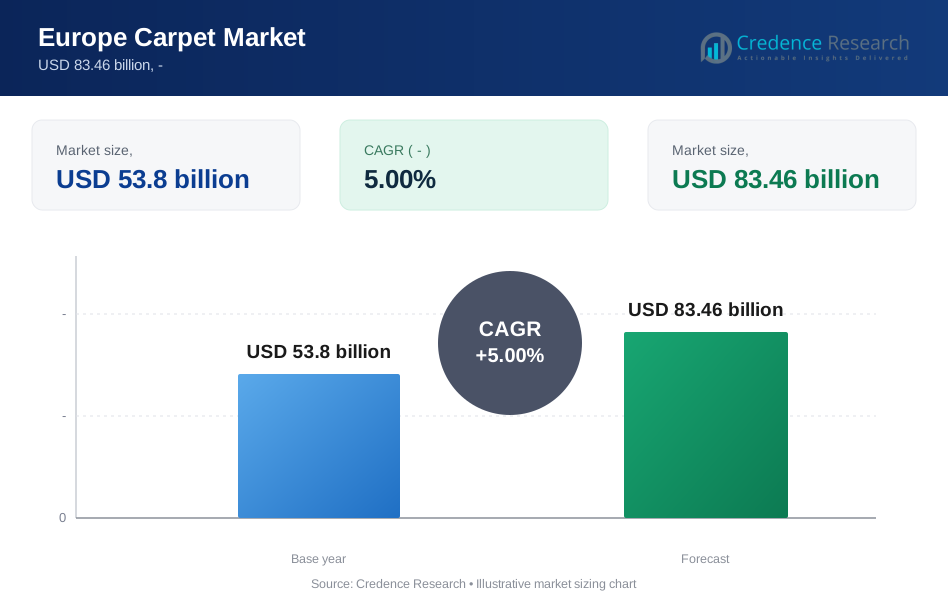
| Europe Carpet Market Size 2023 | USD 53.8 billion |
| Europe Carpet Market, CAGR | 5.00% |
| Europe Carpet Market Size 2032 | USD 83.46 billion |
Market Insights
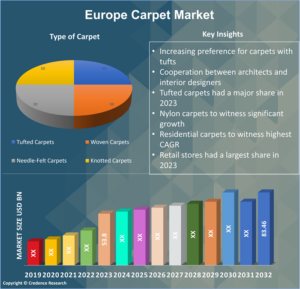
- The market for European carpets is projected to increase at a CAGR of 5.00% between 2024 and 2032, from its estimated USD 53.8 billion in 2023 to USD 83.46 billion in 2032.
- The largest type of carpet section is tufted carpets. On the other hand, woven carpets are expected to grow at a strong CAGR.
- The leading material segment is nylon carpets.
- The CAGR for residential carpets is expected to be the highest during the projection period.
- The retail stores will probably have the highest CAGR throughout the prediction period.
- Mid-range carpets are estimated to have the greatest CAGR during the forecast period.
- The textured carpets segment will likely have the highest CAGR during the prediction period.
- During the forecasting period, carpets made from recycled materials will probably be the segment with the highest CAGR.
- Wall-to-wall carpets are anticipated to grow fastest over the projected timeframe.
- Germany dominated the European carpet market.
- Regarding European carpet market share, the United Kingdom is expected to come second.
- In the European carpet market, France is anticipated to grow fastest.
- The commodity's exceptional insulating properties, significant use in homes as well as business settings, and strong popularity among consumers of soft flooring commodities are estimated to have a beneficial effect on the future development of the European carpet sector.
- The European carpet business has a lot of prospects as it broadens its customer base and the availability through e-commerce websites and implements home automation systems for the quality of the air, managing temperatures, and lighting.
Executive Summary
Market Definition
The commercial and economic operations associated with the purchase and sale of carpets within the borders of Europe are referred to as the European Carpet Market. This market includes the manufacturing, distribution, selling, and use of carpets and other goods, among other facets of the carpet business. In residential, commercial, and institutional contexts, carpets are textile floor coverings primarily constructed of woven or tufted fabric. They have dual uses: they are aesthetically pleasing and useful.
Market Overview
With consistent growth in recent years, the European carpet market is predicted to expand at a compound annual growth rate (CAGR) of 5.00% between 2024 and 2032. The market was valued at USD 53.8 Billion in 2023 and is expected to reach USD 83.46 Billion in 2032.
The degree of building and real estate development in Europe significantly impacts carpet demand. The need for flooring solutions, especially carpets, is driven by new construction projects, restorations, and housing developments. Carpet sales are influenced by shifting customer preferences in design and lifestyle. Carpets that offer comfort and visual appeal are in high demand, and they frequently follow the latest trends in interior design.
Consumer decisions are influenced by constant advances in carpet design, manufacturing technologies, and materials. Carpets possessing distinct designs, feel, and improved functionality have the potential to become more well-liked in the marketplace. Customer spending on home and interior-related products is influenced by economic factors, including the increase in GDP, employment rates, and disposable income. Higher spending on carpets is usually associated with a stronger economy. These are the factors that support the development of the European carpet market.
Segmentation by Type of Carpet
- Tufted carpets are the market leader by type of Carpet. In the commercial and hotel industries, where extensive carpeting is frequently needed, there is a notable demand for tufted carpets. Tufted carpets are a popular choice for hotels, workplaces, and other business locations due to their affordability and adaptability in terms of design.
- The woven carpets category will exhibit a sizable CAGR during the projected period. The coziness of your living rooms is increased with woven rugs, which offer a soft and comfy surface underfoot. These textiles' warmth and softness make your home feel snug and inviting, whether sitting, standing, or lying down.
- The need for European carpets is additionally supported by other types of carpets, including needle-felt carpets and knotted carpets.
Segmentation by Material
- The main material is nylon carpets. Because of its elasticity, strength, and durability, nylon is a great material for places with a lot of foot activity.
- The polyester carpets category will likely register a significant CAGR during forecasting. For a softer feel, polyester carpet is frequently utilized in family areas and bedrooms. Additionally, it's a wise option for customers on a tight budget.
- The market for European carpets is further encouraged by the availability of other materials including blended carpets, wool carpets, and polypropylene carpets.
Segmentation by Application
- It is projected that over the projection period, the residential carpets category will grow fastest. Residential carpets are used in many ways in houses, offering functional and visual advantages.
- Other applications, such as commercial and hospitality carpets, also contribute to the demand for European carpets.
Segmentation by Distribution Channel
- The retail stores category will likely have the highest CAGR during the projection period. Carpets are a common tool retailers use to highlight sales, discounts, and special promotions.
- Other end-users, such as online retail and commercial suppliers, also contribute to the demand for European carpets.
Segmentation by Price Range
- Mid-range carpets will be expected to have the foremost CAGR during the prediction period. Carpets in the mid-range are priced to be within the reach of a wide spectrum of buyers. Cost-effectiveness is a major aspect boosting consumer preference for mid-range options.
- Other price ranges, such as low-end/value carpets and high-end/luxury carpets, also contribute to the demand for European carpets.
Segmentation by Design and Pattern
- Throughout the forecast duration, the category for textured carpets is anticipated to have the greatest CAGR. From delicate patterns to striking motifs, textured carpets are available in many shapes and patterns. Due to this adaptability, customers can choose products that match their decor and interests.
- Other designs and patterns, such as solid/plain carpets and patterned carpets (floral, geometric, striped, etc.), also contribute to the demand for European carpets.
Segmentation by Sustainability and Eco-Friendly Carpets
- Throughout the forecast period, carpets made from recycled materials are anticipated to have the highest CAGR. Recycled PET, often obtained from recycled plastic bottles, can be used to make carpets. To make carpet yarn, the plastic is treated and spun into fibers. PET carpets are suitable for various applications and can have a soft feel.
- Other sustainability and eco-friendly carpets, such as environmentally friendly manufacturing practices, also contribute to the demand for European carpets.
Segmentation by Installation Type
- Throughout the forecast duration, the category for wall-to-wall carpets is anticipated to have the greatest CAGR. When installing wall-to-wall carpets, the Carpet is stretched across the whole floor and secured at the room's boundaries. For a smooth, wrinkle-free finish, professional installation is usually necessary.
- Other installation types, such as area rugs and carpet tiles, also contribute to the demand for European carpets.
Segmentation by Country
- Germany leads the European carpet industry. High-end and luxurious carpets may be in demand in particular areas, like Germany. This market category is influenced by buyers seeking out rare brands, elaborate designs, and high-quality materials.
- The United Kingdom is estimated to rank second in market size for European carpets.
- France will witness the most rapid growth of the European carpet market.
Due to the significant need for domestic and non-residential applications in a wide range of countries, including Germany, France, Russia, Italy, and the United Kingdom, the European market is going to experience an increase in merchandise demand in the years to come. This may be determined by the widespread use of carpets as flooring in commercial buildings, manufacturing facilities, and non-residential workplaces throughout Europe.
In terms of projections, Germany will probably rule the European carpet market. In Germany, the requirement for carpets is directly correlated with the housing market and building sector. The need for flooring, particularly carpets, may be stimulated by an increase in building residential properties, remodeling, and residential and commercial construction projects.
During the anticipated timeframe, the United Kingdom's share of the European carpet market is anticipated to expand at the fastest rate. One trend to keep an eye on in the UK is incorporating technology into carpets and other flooring goods. This could involve advancements that improve the flooring's operation, such as heating components, smart sensors, or other features.
Key Highlights of the Report
The European carpet market is segmented by type of Carpet, material, application, distribution channel, price range, design and pattern, sustainability and eco-friendly carpets, installation type, and country. As far as the type of Carpet is concerned, tufted carpets are the market spearhead. Nylon carpets are the top material segment. The residential carpets category is anticipated to increase at the highest CAGR throughout the projection period. The retail stores will experience the highest CAGR during the forecast period. Europe Carpet is expanding mostly in Germany.
Approximately one billion euros worth of imports are made yearly, with Germany leading the way. Development in the building and transportation sectors, as well as an increase in renovation activity, are the main market drivers. Also, consumers are gravitating increasingly towards eye-catching hues and distinctive, non-geometrical designs, which support market demand.
Germany is expected to have the biggest market share in Europe for Carpet. Expanding trends in Germany include a propensity for modern area rugs, a rising desire for eco-friendly items, and an increasing acceptance of carpet tiles. The United Kingdom is also assumed to have the market's sharpest growth. The strong demand in the United Kingdom for handcrafted goods of superior quality will persist, leading to anticipated expansion in the industry over the coming years.
Which Key Factors Are Driving The European Carpet Market?
The European carpet market is expected to continue growing due to GDP growth, fluctuations that can affect consumer confidence and willingness to invest in durable products like carpets, and new building and renovations.
What Are The Main Obstacles in the European Carpet Market?
Several factors, including competition from substitute materials, low-cost carpets from nations like China that might pressure European manufacturers, and counterfeiting and imitation, are impeding the growth of the European carpet industry.
What Market Opportunities Exist For Europe Carpet?
Carpet manufacturers might benefit from focusing on the commercial sector, which includes places of business, lodging, and shopping. Additionally, new materials and technological advancements have contributed to the growing demand for European carpets.
Market Drivers
Increasing Preference for Carpets with Tufts
The expanding preference of customers for tufted carpets is one of the most significant reasons influencing the growth of the European carpet market. When considering the cost of production, tufted carpets are frequently less expensive than other carpet kinds, such as woven carpets. Due to its affordability, tufted carpets may be a desirable choice for various clients, including both business and residential clients. Tufted carpets provide a wide range of patterns, textures, and colors, giving designers a great deal of creative freedom. Customers looking for flooring solutions that may be customized to fit their interior design trends and tastes will find this adaptability appealing. Tutting is typically speedier than traditional carpet manufacturing techniques, allowing for faster production and delivery schedules. This can help meet demand quickly, particularly in projects involving building and refurbishment that move quickly.
Market Restraints
Price Fluctuations for Raw Materials
The variations in pricing for raw materials are a major problem preventing the continued growth of the European carpet market. Manufacturers of carpets may incur higher production expenses due to fluctuations in the price of essential raw materials, including backing materials, natural fibers like wool, and synthetic fibers. This could, therefore, result in completed carpets costing more money. Profit margins are frequently narrow for carpet manufacturers, and large rises in the price of raw materials can potentially reduce these margins. Manufacturers' capacity to invest in innovation and growth may be restricted if they cannot pass on the higher costs to customers.
Opportunities
Cooperation Between Architects and Interior Designers
The Europe Carpet Industry might benefit greatly from cooperation among interior designers and architects. When interior designers and architects collaborate, they may produce integrated, comprehensive design solutions for places. In this partnership, carpets take on a crucial role that fulfills both practical and aesthetic needs. The room's use and aesthetic appeal are improved by the rugs' smooth integration into the overall design. When people work together, interior spaces can be tailored and personalized to each client's unique requirements and tastes. Choose carpets that align with the overall design concept to create a personalized and distinctive space. They come in a variety of colors, patterns, and textures. Carpet alternatives that are environmentally friendly are made possible by the growing emphasis on sustainable design methods. The demand for carpets made of eco-friendly materials or produced through sustainable techniques is expected to increase due to the preference of architects and interior designers who value sustainability.
Competitive Landscape
Key Players
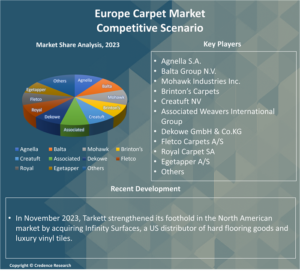
The European carpet market is extremely competitive and has several significant rivals. Some prominent market players, together with their respective market shares, are as follows:
- Agnella S.A.
- Balta Group N.V.
- Mohawk Industries Inc.
- Brinton’s Carpets
- Creatuft NV
- Associated Weavers International Group
- Dekowe GmbH & Co.KG
- Fletco Carpets A/S
- Royal Carpet SA
- Egetapper A/S
- Teppichwerke GmbH
- Radici Pietro Industries & Brands S.p.A.
- Tarkett SA
- MoquetasRols SA
- Birko Birlesik Koyunlu’lular Mensucat Ticaret Ve Sanayi a.s. (Koyunlu AS)
- Ruckstuhl AG
- Others
These businesses prioritize product innovation, acquisitions, and expanding their distribution networks to stay competitive.
The most significant players in the European carpet market constantly strive to stay one step ahead of their rivals by launching new ideas and goods.
In April 2022, In March, Milliken & Company bought Zebra-chem GmbH to broaden its facilities and capacity in order to meet the requirements of the market. Concentrates of additives and blowing agents are made by speciality compounder and chemicals company Zebra-chem for polyolefins, PVC and engineering thermoplastics. With this extension, Milliken boosted production at the Bad Bentheim factory by 60% by the end of 2022.
In November 2021, UK-based Victoria, a company that makes carpets and floor coverings, paid GBP 117 million (about USD 141.5 million) to purchase the rugs segment of the Baltic Group. The most significant European carpet manufacturer, Balta Group, has its headquarters in Belgium.
Summary of Key Findings
- Nowadays, customers—millennials in particular—make environmentally friendly and sustainable decisions in practically every aspect of their lives. Millennials today have a holistic perspective on products and place a high value on a brand's ethos and values. Because of this, the "green carpet" product idea is anticipated to become considerably more popular in Europe in the future.
- The market is segmented by type of Carpet, material, application, distribution channel, price range, design and pattern, sustainability and eco-friendly carpets, installation type, and country.
- The most popular type of Carpet in the market is tufted carpets.
- Nylon carpets are the foremost material category.
- Regarding CAGR, residential carpets are expected to grow fastest during the forecast period.
- The category for mid-range carpets will likely see the highest CAGR during the anticipated time frame.
- Germany is leading market development; the market is highly competitive with key players including Agnella S.A., Balta Group N.V., Mohawk Industries Inc., Brinton’s Carpets, Creatuft NV, Associated Weavers International Group, Dekowe GmbH & Co.KG, Fletco Carpets A/S, Royal Carpet SA, Egetapper A/S, Teppichwerke GmbH, Radici Pietro Industries & Brands S.p.A., Tarkett SA, MoquetasRols SA, Birko Birlesik Koyunlu’lular Mensucat Ticaret Ve Sanayi a.s. (Koyunlu AS), Ruckstuhl AG, and Others.
Future Outlook
- With an optimistic outlook, the European carpet market is anticipated to grow significantly in Germany.
- Europe's carpet market is growing due to changing customer preferences and lifestyles.
- Concerns regarding synthetic materials are among the key factors expected to limit the growth of the carpet market in Europe during the projected timeframe.
- To stay ahead of the competition, key enterprises must develop new products, expand their market reach, and keep their prices competitive.
How CXOs Can Benefit from the Credence Research Europe Carpet Market Report
CXOs may get a detailed picture of the market in the Credence Research Europe Carpet Market Report, which includes:
- Market size and growth forecast: The report offers comprehensive estimations of the size of the carpet market in Europe, broken down by carpet type, material, application, price range, distribution channel, sustainability and eco-friendly carpets, design and pattern, installation type, and country. In addition, projections for the market through 2032 based on significant drivers and trends are included.
- Market segmentation: The research report divides the carpet market in Europe into categories such as carpet type, material, application, price range, distribution channel, sustainability and eco-friendly carpets, design and pattern, installation type, and country. CXOs benefit from this segmentation by having a detailed awareness of the market and the potential inside each segment.
- Competitive landscape: The research study offers insights into the strategy, product offerings, and financial performance of the major participants in the European carpet industry through profiles of these companies. CXOs can use this information to evaluate and identify their competitors.
- Key trends and drivers: The research report identifies and evaluates the significant trends and factors influencing the European carpet market. CXOs can use this information to assist them in deciding on strategy and investments with knowledge.
CXOs can benefit from the following insightful information provided by the Credence Research Europe Carpet Market Report:
- Identify growth opportunities: The research findings may be used by CXOs for discovering fresh opportunities for expansion in the European carpet industry. For example, the report identifies the growing demand for carpets from commercial suppliers as a key opportunity.
- Make informed investment decisions: The research can be used by CXOs to make educated decisions about carpet investments. For instance, the research report offers insights into the crucial elements to consider when choosing European carpet solutions and assessing European carpet providers.
- Develop competitive strategies: The research findings can help CXOs develop competitive strategies for their carpet companies. For instance, the report lists the primary tactics European carpet suppliers utilize to set themselves apart from their rivals.
- Track market developments: CXOs can keep on top of trends and track market developments with the aid of this study. For instance, the research offers information on the most recent innovations and trends in the European carpet market.
In summary, CXOs seeking to expand their comprehension of the market and pinpoint avenues for expansion will find great value in the Credence Research Europe Carpet Market Report.
Segmentation
By Type of Carpet- Tufted Carpets
- Woven Carpets
- Needle-Felt Carpets
- Knotted Carpets
- Nylon Carpets
- Polyester Carpets
- Wool Carpets
- Polypropylene Carpets
- Blended Carpets
- Residential Carpets
- Commercial Carpets
- Hospitality Carpets
- Retail Stores
- Online Retail
- Commercial Suppliers
- Low-End/Value Carpets
- Mid-Range Carpets
- High-End/Luxury Carpets
- Solid/Plain Carpets
- Patterned Carpets (Floral, Geometric, Striped, etc.)
- Textured Carpets
- Carpets Made from Recycled Materials
- Environmentally Friendly Manufacturing Practices
- Wall-to-Wall Carpets
- Area Rugs and Carpet Tiles
- Germany
- France
- UK
- Italy
- Spain
- Rest of Europe
Adjacent Markets
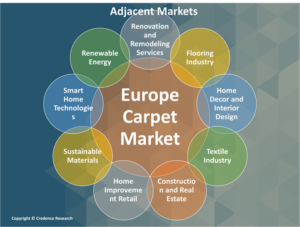
Several adjacent markets in the European carpet market have high revenue growth opportunities. The key adjacent markets for the Europe carpet market -
Request a Free Sample
Fill in your details and we'll send you a free sample report.
- Sample data tables & charts
- Research methodology
Need a Custom Version of This Report?
Tailor the scope, geography, or segments to your exact requirements.
- Custom geography or segment scope
- Direct access to our analyst team
Frequently Asked Questions
How large is the carpet market in Europe at the moment?
What is the projected growth rate of the European carpet market between 2024 and2032?
In terms of carpet type, which market category is leading?
Regarding material, which market category is in the lead?
Which application segment is estimated to have the highest CAGR throughout theforecast period?
In which country is the market for European Carpets expanding?
Who are the key participants in the European market for carpets?
Which market factors dominate the carpet industry in Europe?
Table of Content
Chapter 1. Report Introduction
- 1.1 Report Description & Purpose
- 1.1.1 Report Title & Market Definition
- 1.1.2 Unique Selling Propositions (USP) & Key Differentiators
- 1.1.3 Value Proposition for Stakeholders
- 1.2 Research Objectives
- 1.2.1 Market Sizing Objectives (Volume & Revenue)
- 1.2.2 Segmentation Objectives
- 1.2.3 Competitive Intelligence Objectives
- 1.2.4 Forecast & Scenario Objectives
- 1.3 Report Scope
- 1.3.1 Europe Carpet Scope – Types & Subtypes Covered
- 1.3.2 Geographic Scope – Regions & Countries Covered
- 1.3.3 Historical Period, Base Year & Forecast Period (the historical period; forecast to the forecast period)
- 1.3.4 Inclusions & Exclusions
- 1.4 HS Code & Classification Framework
- 1.5 Currency, Units & Pricing Basis
- 1.6 Target Stakeholders
- 1.7 Limitations & Assumptions
Chapter 2. Executive Summary
- 2.1 Global Europe Carpet Market Snapshot
- 2.1.1 Market Size – Historical (the historical period) & Forecast (the forecast period) (base year: USD 53.8 billion → forecast year: USD 83.46 billion)
- 2.1.2 Volume & Revenue – Global Totals
- 2.1.3 Key Market Highlights – Top Five Facts
- 2.2 Europe Carpet Market Segmentation Snapshot
- 2.2.1 Market Split by Region – vs.
- 2.3 Competitive Snapshot
- 2.3.1 Top 10 Players by Revenue Share –
- 2.3.2 Top 10 Players by Volume Share –
- 2.3.3 Recent Strategic Developments (18-Month Summary)
- 2.4 Key Investment Highlights & Strategic Conclusions
Chapter 3. Europe Carpet Market Dynamics & Industry Analysis
- 3.1 Market Overview & Context
- 3.1.1 Europe Carpet Market Position in the Broader Automotive Value Chain
- 3.1.2 OEM vs. Replacement Market Dynamics
- 3.1.3 Market Maturity & Development Stage by Region
- 3.2 Europe Carpet Market Drivers
- 3.3 Europe Carpet Market Restraints & Challenges
- 3.4 Europe Carpet Market Opportunities
- 3.5 Porter's Five Forces Analysis
- 3.5.1 Threat of New Entrants
- 3.5.2 Bargaining Power of Suppliers
- 3.5.3 Bargaining Power of Buyers
- 3.5.4 Threat of Substitutes
- 3.5.5 Competitive Rivalry – Intensity Assessment
- 3.6 Europe Carpet Value Chain Analysis
- 3.6.1 Upstream – Raw Material/Input Suppliers
- 3.6.1.1 Raw Material/Input 1
- 3.6.1.2 Raw Material/Input 2
- 3.6.1.3 Raw Material/Input 3
- 3.6.2 Midstream – Production/Manufacturing/Service Delivery
- 3.6.2.1 Production/Process Overview
- 3.6.2.2 Key Facility Locations & Capacity by Manufacturer
- 3.6.3 Downstream – Distribution & End Consumer
- 3.6.3.1 Primary Channel – B2B/OEM
- 3.6.3.2 Secondary Channels – Dealer, Retail, Online, Direct
- 3.6.4 Value Chain Profitability Analysis
- 3.6.1 Upstream – Raw Material/Input Suppliers
- 3.7 PESTEL Analysis
- 3.7.1 Political Factors
- 3.7.2 Economic Factors
- 3.7.3 Social Factors
- 3.7.4 Technological Factors
- 3.7.5 Environmental Factors
- 3.7.6 Legal Factors
- 3.8 Europe Carpet Supply Chain Analysis
- 3.8.1 Raw Material/Input Supply Risk Assessment
- 3.8.2 Manufacturing Concentration Risk (Geographic Exposure)
- 3.8.3 Trade Disruption Impact Analysis
- 3.9 Regulatory & Policy Landscape
Note: The regulatory and policy landscape section covers regulations based on their applicability to the market, Europe Carpet category, geography, and scope of the study. Only regulatory frameworks with a material impact on operations, compliance, trade, sustainability, or market access are analyzed in detail.
Chapter 4. Key Investment Pockets & Opportunity Analysis
- 4.1 Europe Carpet Market Attractiveness Analysis
- 4.1.1 By Region – Investment Attractiveness Matrix (Volume × CAGR)
- 4.2 Absolute Revenue Growth Opportunity
- 4.2.1 By Region – Absolute USD Growth Through the forecast period
- 4.3 Incremental Volume Opportunity
- 4.3.1 By Region – Incremental Volume Through the forecast period
- 4.3.2 Segment – Incremental Volume
- 4.4 Emerging Submarket Opportunity Deep Dive (Subject to Applicability)
- 4.5 Emerging Market Opportunity Scorecards
- 4.5.1 United States
- 4.5.2 Europe
- 4.5.3 Asia
- 4.5.4 Middle East & Africa
Note: Emerging Market Opportunity Scorecards will be included based on relevance and strategic importance. Regions listed are indicative and may vary depending on data availability and market dynamics.
Chapter 5. Europe Carpet Import-Export Analysis & Trade Flows
- 5.1 Global Trade Overview
- 5.1.1 Global Export Value by Country (the historical period)
- 5.1.2 Global Export Volume by Country (the historical period)
- 5.1.3 Global Import Value by Country (the historical period)
- 5.1.4 Global Import Volume by Country (the historical period)
- 5.1.5 Net Trade Balance by Country (the historical period)
- 5.2 Export Analysis – Segment
- 5.2.1 Type 1 (HS Code)
- 5.2.2 Type 2 (HS Code)
- 5.2.3 Type 3 (HS Code)
- 5.2.4 Type 4 (HS Code)
- 5.2.5 Type 5 (HS Code)
- 5.3 Import Analysis – Segment
- 5.3.1 Type 1 (HS Code)
- 5.3.2 Type 2 (HS Code)
- 5.3.3 Type 3 (HS Code)
- 5.3.4 Type 4 (HS Code)
- 5.3.5 Type 5 (HS Code)
- 5.4 Average Unit Trade Prices
- 5.4.1 Average Export Price – Segment & Country
- 5.4.2 Average Import Price – Segment & Source Country
- 5.4.3 Price Trends (the historical period)
- 5.5 Key Trade Route Analysis
- 5.5.1 Trade Route 1
- 5.5.2 Trade Route 2
- 5.5.3 Trade Route 3
- 5.5.4 Trade Route 4
- 5.5.5 Trade Route 5
- 5.6 Trade Policy Impact Assessment
- 5.6.1 US Anti-Dumping & Section 301 Tariffs
- 5.6.2 EU Customs Union Impact
- 5.6.3 Major Free Trade Agreements
- 5.6.4 USMCA Rules of Origin
Note: Trade policy analysis will be included only where relevant to the Europe Carpet market.
Chapter 6. Competitive Landscape & Company Benchmarking
- 6.1 Europe Carpet Market Concentration & Structure
- 6.1.1 Herfindahl-Hirschman Index (HHI) – vs.
- 6.1.2 Tier 1, Tier 2 & Tier 3 Market Structure
- 6.1.3 Global, Regional & Local Player Dynamics
- 6.2 Europe Carpet Market Share Analysis –
- 6.2.1 Global Revenue Share by Company
- 6.2.2 Global Volume Share by Company
- 6.2.3 Regional Revenue Share
- 6.2.4 Market Share Evolution ( vs. )
- 6.2.5 OEM Segment Share by Company
- 6.2.6 Replacement Segment Share by Company
- 6.3 Production/Delivery Capacity & Facility Analysis
- 6.3.1 Global Installed Capacity
- 6.3.2 Capacity Utilization Rates
- 6.3.3 Production/Output Volume
- 6.3.4 Facility Locations & Capacity Map
- 6.3.5 Planned Capacity Additions
- 6.4 Europe Carpet Competitive Benchmarking Matrix
- 6.4.1 Revenue, Volume, CAGR & Profitability Comparison
- 6.4.2 Channel Revenue Mix
- 6.4.3 Geographic Revenue Exposure
- 6.4.4 R&D Intensity
- 6.4.5 Sustainability Maturity
- 6.5 Strategic Developments in Europe Carpet (Last 24 Months)
- 6.5.1 Mergers, Acquisitions & Divestments
- 6.5.2 New Europe Carpet Launches
- 6.5.3 Facility Expansions
- 6.5.4 Strategic Alliances, Joint Ventures & Partnerships
- 6.5.5 Distribution Expansion & Market Entry
- 6.5.6 Sustainability & ESG Initiatives
- 6.6 Competitive Strategy Mapping
- 6.6.1 Leader, Challenger, Follower & Niche Classification
- 6.6.2 Pricing Strategy Comparison
- 6.6.3 Channel Strategy Matrix
Note: Strategic developments are included based on their materiality and the availability of reliable information.
Chapter 7. Global Europe Carpet Market – By Distribution Channel
- 7.1 Segment Overview
- 7.1.1 Volume & Revenue Split by Channel ( & )
- 7.1.2 Channel Mix Evolution (the forecast period)
Chapter 8. Regional Market Analysis – Global Overview
- 8.1 Global Regional Overview
- 8.1.1 Regional Volume Share
- 8.1.2 Regional Revenue Share
- 8.1.3 Regional Volume by Region
- 8.1.4 Regional Revenue by Region
- 8.1.5 Regional Forecast Through the forecast period
- 8.2 Cross-Regional Segment Analysis
- 8.2.1 By Distribution Channel
- 8.2.2 By Brand/Price Tier
Chapter 9. North America Europe Carpet Market
- 9.1 United States
- 9.2 Canada
- 9.3 Mexico
Chapter 10. Europe Europe Carpet Market
- 10.1 Germany
- 10.2 France
- 10.3 Italy
- 10.4 United Kingdom
- 10.5 Spain
- 10.6 Poland
- 10.7 Russia
- 10.8 Netherlands
- 10.9 Belgium
- 10.10 Sweden
- 10.11 Denmark
- 10.12 Norway
- 10.13 Rest of Europe
Chapter 11. Asia Pacific Europe Carpet Market
- 11.1 China
- 11.2 India
- 11.3 Japan
- 11.4 South Korea
- 11.5 Thailand
- 11.6 Indonesia
- 11.7 Vietnam
- 11.8 Malaysia
- 11.9 Australia
- 11.10 Rest of Asia Pacific
Chapter 12. Latin America Europe Carpet Market
- 12.1 Brazil
- 12.2 Argentina
- 12.3 Colombia
- 12.4 Chile
- 12.5 Rest of Latin America
Chapter 13. Middle East Europe Carpet Market
- 13.1 Saudi Arabia
- 13.2 United Arab Emirates
- 13.3 Turkey
- 13.4 Israel
- 13.5 Iran
- 13.6 Rest of the Middle East
Chapter 14. Africa Europe Carpet Market
- 14.1 South Africa
- 14.2 Egypt
- 14.3 Nigeria
- 14.4 Morocco
- 14.5 Rest of Africa
Chapter 15. Europe Carpet Company Profiles
- 15.1 [Company 01]
- 15.1.1 Company Overview
- 15.1.2 Key Management Personnel
- 15.1.3 Products & Services Portfolio
- 15.1.4 Financial Performance
- 15.1.5 Key Market Focus & Geographic Presence
- 15.1.6 Recent Developments & Strategic Initiatives
Note: The company profile list is preliminary and may change based on research findings, market developments, data availability, and client requirements.
Chapter 16. Appendices
- Appendix A – List of Abbreviations & Acronyms
- Appendix B – Industry Classification Code Reference – Full Series
- Appendix C – Production & Capacity Data Tables
- Appendix D – End-Use & Demand Base Tables
- Appendix E – Consumption & Replacement Rate Assumptions
- Appendix F – ASP Reference Tables
- Appendix G – Manufacturing & Facility Database
- Appendix H – Import-Export Data Tables
- Appendix I – Regulatory Summary Tables
- Appendix J – Primary Research Participant List (Anonymized)
- Appendix K – Primary Research Questionnaire Framework
- Appendix L – Data Sources & Bibliography
- Appendix M – Market Size Divergence & Source Comparison
Chapter 17. Research Methodology
- 17.1 Research Framework & Philosophy
- 17.2 Secondary Research – Sources, Hierarchy & Data Extraction
- 17.3 Data Modeling – Bottom-Up & Top-Down Market Sizing
- 17.4 Primary Research – Stakeholder Framework, LOI & Sample Sizes
- 17.5 Forecast Methodology – Regression, Scenario & Sensitivity Analysis
- 17.6 Quality Control – Four-Layer Validation Framework
- 17.7 Limitations & Standard Assumptions
- 17.8 Disclaimer
