Market Overview:
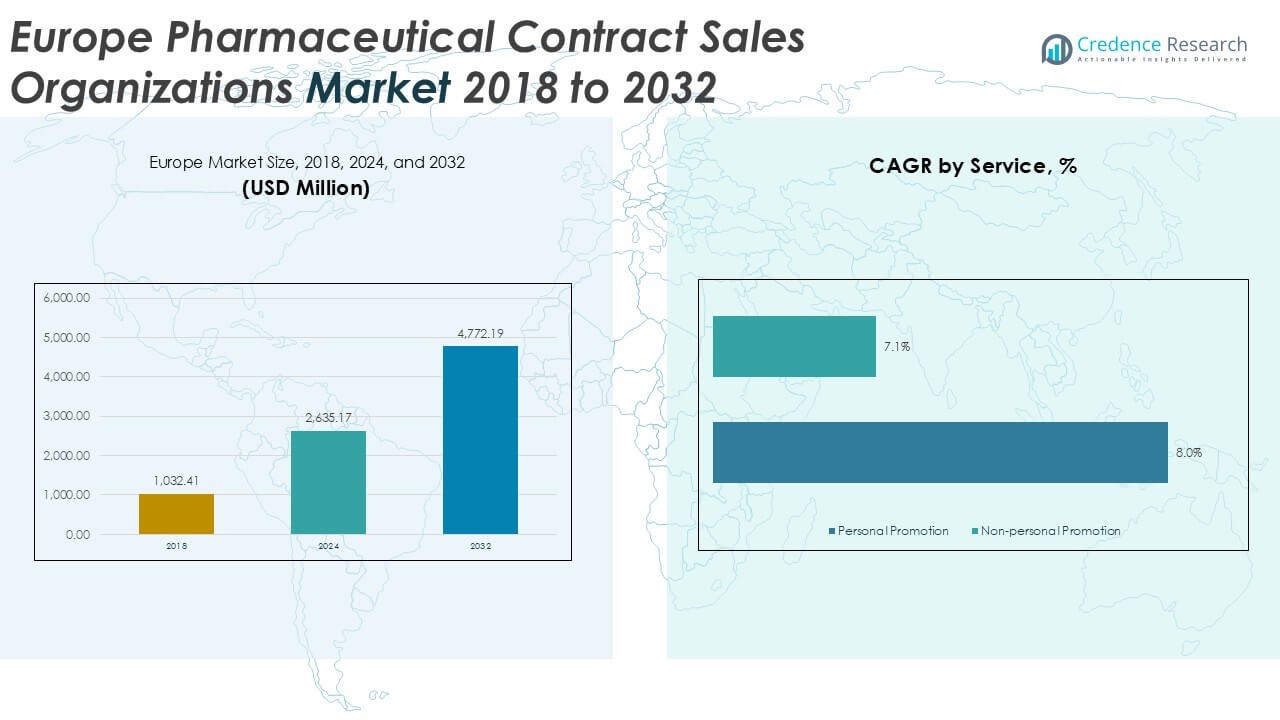
The Europe Pharmaceutical Contract Sales Organizations Market is projected to grow from USD 2,635.17 million in 2024 to an estimated USD 4,772.90 million by 2032, with a compound annual growth rate (CAGR) of 7.71% from 2024 to 2032.
| REPORT ATTRIBUTE | DETAILS |
|---|---|
| Historical Period | 2020-2023 |
| Base Year | 2024 |
| Forecast Period | 2025-2032 |
| Europe Pharmaceutical Contract Sales Organizations Market Size 2024 | USD 2,635.17 million |
| Europe Pharmaceutical Contract Sales Organizations Market, CAGR | 7.71% |
| Europe Pharmaceutical Contract Sales Organizations Market Size 2032 | USD 4,772.90 million |
Several factors are fueling the growth of the Europe Pharmaceutical CSO Market. The need for cost-efficient sales and marketing strategies has encouraged pharmaceutical companies to engage CSOs, reducing the burden of maintaining large in-house sales teams. Additionally, the complexity of modern pharmaceutical products, such as biologics and personalized medicines, requires specialized sales expertise and training, which CSOs are well-equipped to provide. The increasing adoption of digital sales channels, including virtual detailing and remote interactions, further supports the market, as CSOs integrate advanced technologies to enhance customer engagement. Furthermore, the growing regulatory requirements in Europe necessitate compliance expertise, which CSOs can effectively deliver, ensuring seamless product promotion in a highly regulated market.
Western Europe dominates the Europe Pharmaceutical CSO Market, accounting for a significant share due to the presence of major pharmaceutical hubs in countries like Germany, the United Kingdom, and France. These regions benefit from well-established healthcare systems, high pharmaceutical expenditure, and a mature market for innovative therapies. Central and Eastern Europe are emerging as attractive regions for pharmaceutical CSOs, driven by lower operational costs, expanding healthcare infrastructure, and rising demand for affordable therapies. Countries such as Poland, Hungary, and the Czech Republic are witnessing increased investments from CSOs seeking to capitalize on these growth opportunities. The regional diversity in market maturity and regulatory landscapes provides a dynamic environment for pharmaceutical CSOs to adapt and thrive.
Market Insights:
- The Europe Pharmaceutical CSO Market is forecasted to grow from USD 2,635.17 million in 2024 to USD 4,772.90 million by 2032, with a robust CAGR of 7.71%, reflecting the increasing reliance on outsourcing sales functions.
- Western Europe dominates the market, accounting for 65% of the share, driven by strong pharmaceutical hubs in Germany, the United Kingdom, and France, benefiting from well-established healthcare infrastructure.
- Central and Eastern Europe are emerging markets, contributing 25% to market share, due to lower operational costs, expanding healthcare infrastructure, and growing investment in countries like Poland, Hungary, and the Czech Republic.
- The rising adoption of digital sales solutions, such as AI-driven analytics and virtual detailing, is reshaping the pharmaceutical sales landscape, enhancing engagement efficiency for CSOs.
- Increasing demand for expertise in complex therapies, including biologics and personalized medicine, is driving the need for well-trained and specialized salesforces, making CSOs indispensable partners.
- The highly regulated pharmaceutical market in Europe is boosting demand for CSOs, as they offer expertise in navigating compliance challenges across diverse regulatory landscapes.
- Market growth faces challenges such as intense competition, high costs of talent and training, and saturation in Western Europe, driving CSOs to explore untapped opportunities in less mature markets.
Market Drivers:
Increasing Outsourcing of Sales Functions
The growing trend of outsourcing sales functions is a significant driver of the Europe Pharmaceutical CSO Market. Pharmaceutical companies are increasingly focusing on core competencies, such as research and development, while relying on CSOs for sales and marketing. Outsourcing provides cost-efficiency, operational flexibility, and access to a highly skilled salesforce without the burden of managing in-house teams.
- For instance, in 2023, Bristol Myers Squibb partnered with IQVIA to outsource its sales and marketing activities in Europe. This partnership allows Bristol Myers Squibb to focus on its core competencies while leveraging IQVIA's expertise in sales and marketing.
As competition intensifies, companies are turning to CSOs to optimize their go-to-market strategies, reduce time-to-market, and ensure compliance with regional regulations, driving the demand for specialized contract sales services.
Demand for Expertise in Complex Therapies
The rising prevalence of advanced therapies, including biologics, gene therapies, and personalized medicines, is driving the need for specialized expertise in pharmaceutical sales. These therapies require in-depth knowledge and tailored communication to effectively engage healthcare providers and patients. For example, Syneos Health has invested in training programs to equip their sales teams with the necessary expertise to promote complex therapies. CSOs are uniquely positioned to meet this demand, offering well-trained teams and therapeutic-specific sales strategies. As biologics and complex treatments account for an increasing share of pharmaceutical pipelines, CSOs’ ability to provide specialized services has become a critical growth driver in the European market.
Integration of Digital Sales Solutions
The adoption of digital sales solutions is reshaping the pharmaceutical sales landscape and driving growth for CSOs. The integration of technologies such as AI-driven analytics, virtual detailing, and customer relationship management (CRM) platforms allows CSOs to enhance engagement and efficiency.
- For instance, IQVIA has implemented AI-driven CRM systems, resulting in a increase in sales productivity.
These digital tools enable better targeting, personalized communication, and streamlined workflows. The shift toward hybrid sales models that combine face-to-face interactions with virtual engagements aligns with healthcare providers’ preferences, further boosting the adoption of CSO services equipped with digital capabilities.
Stringent Regulatory Environment
Europe’s highly regulated pharmaceutical market is another driver for CSO demand, as companies seek expert partners to navigate complex compliance requirements. Regulations related to promotional activities, data privacy, and ethical marketing are stringent across the region, with significant variation among countries. CSOs bring value by ensuring adherence to these regulatory frameworks while effectively promoting products. For example, PharmaLex specializes in regulatory affairs and compliance, helping pharmaceutical companies navigate the complex European regulatory landscape. Their ability to manage compliance challenges, particularly for multinational companies operating in diverse markets, makes them indispensable in the highly regulated European pharmaceutical landscape.
Market Trends:
Rising Adoption of Digital Engagement Models
The Europe Pharmaceutical Contract Sales Organizations (CSO) Market is experiencing a significant shift toward digital engagement strategies. As healthcare providers increasingly prefer virtual interactions, CSOs are leveraging advanced technologies like AI-powered CRM platforms and telemedicine tools to enhance remote detailing.
- For instance, BirdzAI by P360 has integrated with major vendors such as IQVIA, Veeva, MMIT, MedPro, and Symphony, providing a single source of truth across sales, marketing, and regulatory operations.
Virtual Medical Science Liaisons (MSLs) and nurse educators have become essential in maintaining consistent communication with healthcare providers and patients. This digital transformation not only improves accessibility and efficiency but also reduces the overall cost of sales operations, aligning with industry efforts to optimize resource allocation.
Increased Focus on Specialized Therapeutic Areas
A growing trend in the market is the focus on specialized therapeutic areas, including oncology, rare diseases, and biologics. The demand for expertise in these areas is driven by the rising prevalence of complex conditions and the introduction of innovative therapies.
- For instance, companies like Travere Therapeutics and PTC Therapeutics are specifically focusing on finding treatments for rare diseases. Travere Therapeutics has ongoing phase 2 and 3 clinical trials across several rare diseases, including IgAN, ALS, and others.
CSOs are increasingly offering tailored services such as key account management and clinical education to meet the unique requirements of these advanced treatment areas. This trend reflects the evolving landscape of the pharmaceutical industry, where a one-size-fits-all approach is being replaced by targeted, therapeutic-specific sales strategies.
Emergence of Central and Eastern Europe as Growth Hubs
Central and Eastern Europe are emerging as key regions for market expansion due to their lower operational costs, growing healthcare infrastructure, and increasing demand for cost-efficient solutions. Countries such as Poland, Hungary, and the Czech Republic have witnessed significant investment from global CSOs aiming to tap into these developing markets.
- For instance, is the largest pharmaceutical market in the region with a revenue of over 10.5 billion euros in 2023, showcasing its potential for growth.
This shift is creating new opportunities for both multinational and regional players to establish a strong foothold while catering to the rising demand for affordable therapies and localized expertise in these regions.
Shift Toward Sustainable Practices
Sustainability is becoming an integral part of the market, with CSOs adopting environmentally and socially responsible practices. This includes reducing travel emissions through virtual engagements, minimizing waste in promotional activities, and ensuring ethical marketing strategies.
- For instance, Evonik Health Care, this company is adopting sustainable practices by reducing waste, using renewable energy sources, and employing green chemistry principles.
Additionally, pharmaceutical companies are increasingly aligning with CSOs that demonstrate a commitment to sustainability, reflecting broader industry goals of environmental stewardship. This trend not only enhances the reputation of CSOs but also positions them as valuable partners in achieving long-term business and societal objectives.
Market Challenges Analysis:
Regulatory Complexity
One of the primary restraints in the Europe Pharmaceutical CSO Market is the highly complex and diverse regulatory environment. Each European country has its own set of rules and compliance standards governing pharmaceutical sales and marketing. Navigating these regulatory frameworks requires significant expertise and resources, increasing operational challenges for CSOs. Additionally, frequent updates to guidelines, particularly regarding data privacy (e.g., GDPR), require constant adaptation, adding to the administrative burden.
High Cost of Talent and Training
The increasing complexity of modern therapies, such as biologics and personalized medicines, necessitates specialized sales expertise. Recruiting and retaining highly skilled sales professionals, medical science liaisons, and nurse educators is both challenging and costly. Furthermore, continuous training is required to keep staff updated on new products, therapies, and compliance standards, significantly adding to operational expenses.
Intense Competition
The market’s fragmented nature fosters intense competition among global leaders and regional players. While large CSOs leverage advanced technologies and expansive networks, smaller firms compete by offering niche services or cost advantages. This competitive pressure leads to price sensitivity, reducing profit margins and making it difficult for new entrants to establish a foothold.
Technological Adaptation
While the shift toward digital and hybrid sales models offers growth opportunities, it also presents challenges. CSOs must invest heavily in advanced technologies like CRM tools, AI-driven analytics, and virtual engagement platforms to remain competitive. However, these investments come with high upfront costs and implementation risks, creating barriers for smaller firms.
Market Saturation in Western Europe
Western Europe, being a mature market, faces saturation in certain therapeutic segments. This limits growth potential and forces CSOs to seek opportunities in less mature markets, where operational and regulatory challenges are higher.
Market Opportunities:
The Europe Pharmaceutical Contract Sales Organizations (CSO) Market presents significant growth opportunities driven by evolving pharmaceutical industry dynamics and shifting market demands. The increasing adoption of outsourcing strategies among pharmaceutical and biopharmaceutical companies is a primary growth catalyst. By outsourcing sales and promotional activities, these companies can focus on core operations such as research and development while leveraging the expertise and cost-efficiency of CSOs. The rise of complex therapies, such as biologics and personalized medicine, demands specialized knowledge and training, which CSOs are well-positioned to provide. Additionally, the growing emphasis on digital engagement models, including virtual detailing and remote medical science liaisons, has opened avenues for innovative service offerings, catering to the modern preferences of healthcare providers and patients.
Expanding healthcare infrastructure and rising pharmaceutical investment in Central and Eastern Europe further amplify market opportunities. These regions offer cost-effective operations and a skilled workforce, attracting investments from global CSOs looking to tap into underserved markets. Meanwhile, increasing regulatory requirements across Europe create a demand for CSOs with expertise in compliance and market access strategies, making them indispensable partners for pharmaceutical firms. Moreover, the rapid adoption of hybrid sales models, integrating personal and non-personal promotional strategies, reflects a shift toward more comprehensive engagement approaches, enabling CSOs to expand their service portfolios. These factors collectively position the Europe Pharmaceutical CSO Market as a critical enabler of growth and innovation in the pharmaceutical sales landscape.
Market Segmentation Analysis:
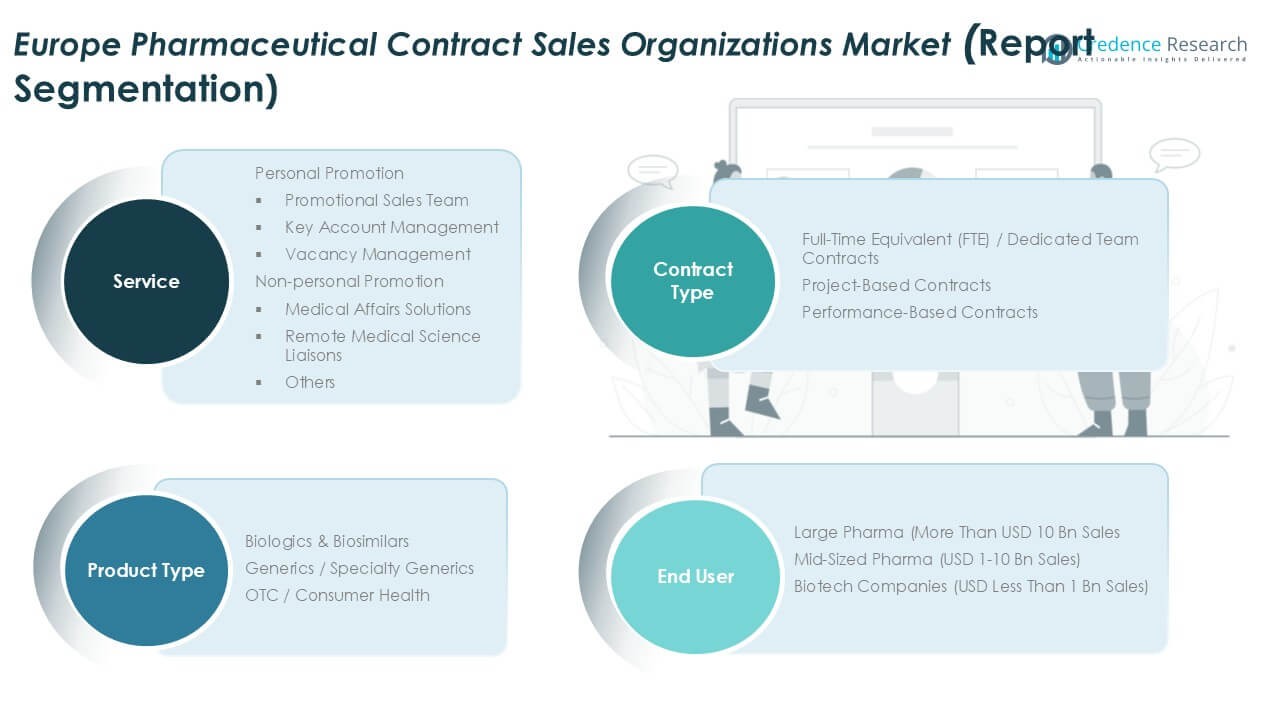
The Europe Pharmaceutical Contract Sales Organizations (CSO) Market is segmented by service type and end-use, reflecting diverse needs across the pharmaceutical and biopharmaceutical industries.
By Service
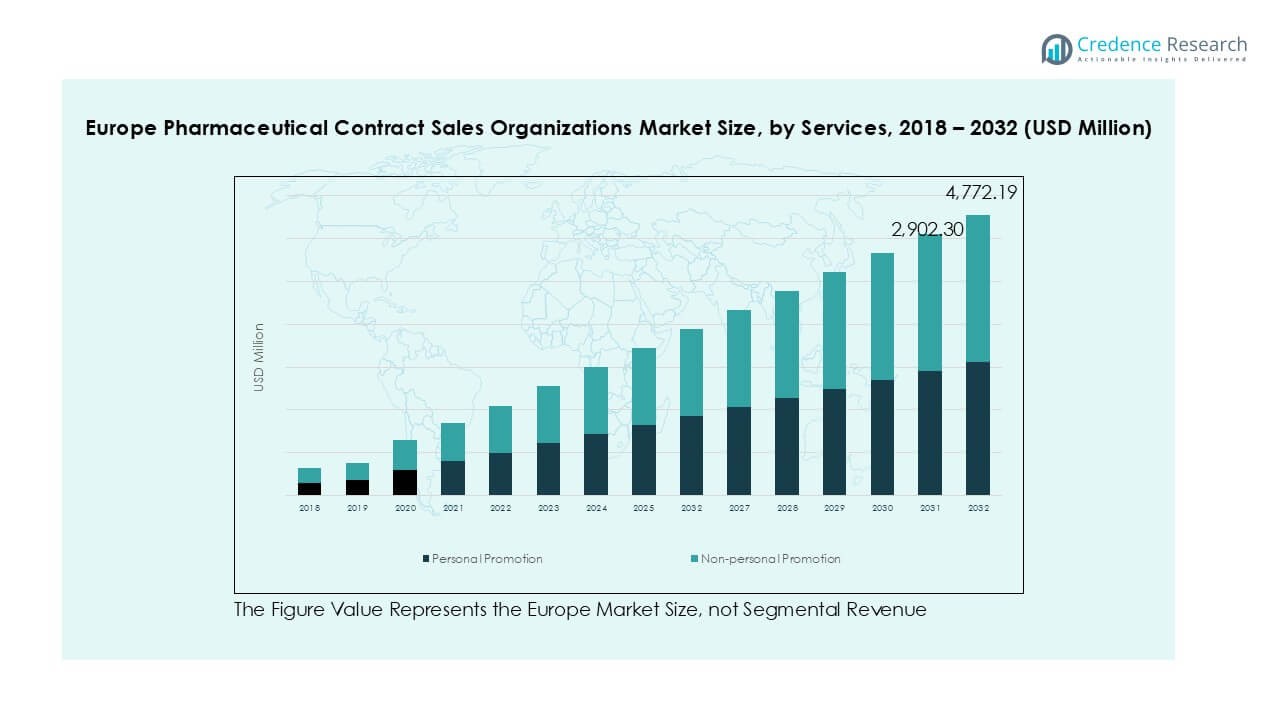
The personal promotion segment holds a significant share, driven by its direct impact on sales performance. Subcategories such as promotional sales teams and key account management are essential for engaging healthcare providers, establishing product value, and driving prescriptions. Vacancy management services are also gaining traction, offering seamless salesforce coverage during staff shortages. The non-personal promotion segment is witnessing rapid growth due to the increasing adoption of digital and remote engagement solutions. Medical affairs solutions and remote medical science liaisons are pivotal in bridging scientific communication gaps, particularly for complex therapies like biologics. Nurse (clinical) educators play a critical role in patient education and adherence, while other services support broader engagement strategies. The shift toward hybrid sales models combining personal and non-personal promotions is reshaping this segment.
By End-use
Pharmaceutical companies dominate the end-use segment, leveraging CSOs to streamline operations, expand market reach, and focus on core research and development activities. The increasing complexity of modern therapies further drives demand for specialized CSO services. Biopharmaceutical companies represent a growing segment, as these firms rely heavily on CSOs for expert sales capabilities and compliance with Europe’s stringent regulatory frameworks. The rising focus on niche therapies, including personalized medicine, amplifies the importance of tailored CSO services for this end-use category.
Segmentation:
By Service
- Personal Promotion
- Promotional Sales Team
- Key Account Management
- Vacancy Management
- Non-personal Promotion
- Medical Affairs Solutions
- Remote Medical Science Liaisons
- Nurse (Clinical) Educators
- Others
By End-use
- Pharmaceutical Companies
- Biopharmaceutical Companies
Regional Analysis:
The Europe Pharmaceutical Contract Sales Organizations (CSO) Market exhibits significant regional diversity, with Western Europe dominating the landscape. The region accounts for approximately 65% of the market share in 2024, driven by the presence of established pharmaceutical hubs in countries like Germany, the United Kingdom, and France. These nations benefit from advanced healthcare systems, high pharmaceutical expenditure, and robust demand for innovative therapies. Western Europe’s mature market landscape is bolstered by the adoption of digital technologies, regulatory compliance expertise, and a strong emphasis on patient-centric sales strategies.
Central and Eastern Europe represent a growing segment of the market, contributing roughly 25% to the total share. This region is emerging as a key destination for pharmaceutical CSOs due to its lower operational costs, expanding healthcare infrastructure, and rising demand for cost-efficient therapies. Countries such as Poland, Hungary, and the Czech Republic are witnessing increased investment from global CSOs seeking to capitalize on their growing pharmaceutical industries. The availability of skilled yet cost-effective labor and government initiatives to strengthen the healthcare sector further amplify the region’s attractiveness.
The Nordic countries, including Sweden, Denmark, and Norway, account for approximately 7% of the market. These regions are characterized by high levels of innovation in pharmaceutical sales and a strong emphasis on sustainability. The increasing prevalence of biologics and personalized medicine aligns with the Nordic region's focus on advanced healthcare solutions, fostering growth in contract sales services.
Southern Europe, including countries like Italy, Spain, and Portugal, contributes around 3% of the market share. The region benefits from a growing pharmaceutical industry, increasing adoption of digital sales channels, and an expanding focus on generics and biosimilars. Despite its smaller market share, Southern Europe’s dynamic healthcare landscape presents growth opportunities for CSOs targeting niche therapeutic areas.
Overall, Europe’s diverse regional markets offer a combination of mature opportunities and untapped potential. The varied regulatory landscapes, healthcare infrastructure, and market demands create a complex environment, enabling CSOs to tailor their strategies and services for optimal regional impact. The balance between established markets in Western Europe and emerging opportunities in Central and Eastern Europe positions the region as a vibrant and evolving landscape for pharmaceutical contract sales organizations.
Key Player Analysis:
- PDI Health
- Charles River Laboratories
- ManpowerGroup Solutions
- Celerion
- QFR Solutions
- MaBico
- Mednext Pharma Pvt. Ltd.
- Peak Pharma Solutions Inc.
- IQVIA, Inc.
- Syneous Health
Competitive Analysis:
The Europe Pharmaceutical Contract Sales Organizations (CSO) Market is marked by competitive dynamics driven by established global players and regional firms. Leading companies, such as Ashfield, IQVIA, and Syneos Health, maintain a stronghold due to their comprehensive service offerings, technological integration, and deep client relationships. These players often leverage advanced analytics and digital platforms to deliver tailored solutions, enhancing their competitive edge. Regional firms compete by offering cost-effective services and localized expertise, particularly in emerging markets within Central and Eastern Europe. The competitive landscape is also shaped by increasing investments in innovative sales models, including virtual detailing and multichannel engagement strategies. Market consolidation is becoming more prevalent, with mergers and acquisitions enabling companies to expand their geographic reach and diversify service portfolios.
- For instance, EVERSANA has partnered with Yaral Pharma Inc. to support the expansion of its portfolio of pain and endocrinology products in the United States, showcasing the adoption of virtual detailing and multichannel engagement strategies.
The competition is further intensified by the need for regulatory compliance expertise, specialized training for biologics, and the growing demand for digital sales capabilities.
Recent Developments:
- In a strategic move to enhance its global presence, CMIC Holdings Co., Ltd. announced on January 1, 2025, the reorganization of its affiliates under a new mutual holding company structure. This restructuring has created Central Mutual Holding Company (CMHC), which now directly or indirectly owns all of the Central Insurance affiliates. Additionally, Central Insurance has converted to a stock insurance company, Central Insurance Company (CIC), an indirect, wholly owned subsidiary of CMHC. This initiative aims to ensure long-term success and flexibility for growth opportunities.
- PDI Health, a global leader in delivering solutions for the convenience retail and petroleum wholesale ecosystem, announced on December 2, 2024, its acquisition of the Comdata Merchant Solutions business from Corpay Inc. This acquisition includes Point of Sale (POS) hardware, software, and systems that enable transactions at truck stops and unattended commercial fueling locations. The addition of these assets strengthens PDI's POS portfolio, enhancing its offerings in both retail fuel and convenience sectors
Market Concentration & Characteristics:
The Europe Pharmaceutical Contract Sales Organizations (CSO) Market is moderately fragmented, with a mix of established players and emerging firms competing for market share. Leading CSOs dominate the market due to their robust service portfolios, extensive expertise in pharmaceutical sales, and strong client networks. These players leverage advanced digital tools, data analytics, and specialized teams to provide tailored sales solutions across diverse therapeutic areas. The market is characterized by increasing competition, driven by the growing outsourcing trends among pharmaceutical companies. Additionally, the rising complexity of modern therapies, such as biologics and personalized medicines, demands specialized skills, creating opportunities for niche providers. Regional dynamics also play a significant role, with Western Europe being a mature market, while Central and Eastern Europe present opportunities for cost-efficient operations and expansion.
Report Coverage:
The research report offers an in-depth analysis based on By Service and By End Use. It details leading market players, providing an overview of their business, product offerings, investments, revenue streams, and key applications. Additionally, the report includes insights into the competitive environment, SWOT analysis, current market trends, as well as the primary drivers and constraints. Furthermore, it discusses various factors that have driven market expansion in recent years. The report also explores market dynamics, regulatory scenarios, and technological advancements that are shaping the industry. It assesses the impact of external factors and global economic changes on market growth. Lastly, it provides strategic recommendations for new entrants and established companies to navigate the complexities of the market.
Future Outlook:
- The Europe Pharmaceutical CSO Market is poised for significant growth, driven by the increasing outsourcing of sales functions to enhance operational efficiency.
- Digital transformation, including the adoption of virtual detailing and AI-powered customer engagement tools, will shape future sales strategies.
- Rising demand for biologics and personalized medicine will require specialized training and expertise from CSOs, fostering market expansion.
- The focus on cost optimization among pharmaceutical companies will continue to fuel the demand for third-party sales solutions.
- Central and Eastern Europe will see increased investments due to lower costs and expanding healthcare infrastructure.
- Compliance with evolving European regulations will create opportunities for CSOs offering tailored regulatory solutions.
- Technological advancements in CRM and analytics tools will enhance CSO efficiency and decision-making.
- Collaborative models between CSOs and pharmaceutical companies will drive innovation in targeted sales and marketing efforts.
- The growing emphasis on sustainable practices will encourage CSOs to adopt eco-friendly and socially responsible strategies.
- Market consolidation through mergers and acquisitions will intensify, creating opportunities for larger players to expand their service portfolios.

Request a Free Sample
Fill in your details and we'll send you a free sample report.
- Sample data tables & charts
- Research methodology
Market Dynamics
Increasing Outsourcing of Sales Functions
Pharmaceutical companies in Europe are increasingly outsourcing sales and marketing activities to CSOs to focus on core competencies like R&D, reduce operational costs, and gain access to specialized sales expertise without maintaining large in-house teams.
Demand for Expertise in Complex Therapies
The rise of biologics, gene therapies, and personalized medicines requires highly trained salesforces with deep therapeutic knowledge, making CSOs indispensable partners for pharmaceutical firms seeking to effectively promote advanced therapies.
Integration of Digital Sales Solutions
The adoption of AI-driven analytics, CRM platforms, and virtual detailing by CSOs is enhancing engagement efficiency, enabling better targeting and communication with healthcare providers, and supporting the shift toward hybrid sales models.
Stringent Regulatory Environment
Europe's complex and evolving regulatory landscape drives pharmaceutical companies to partner with CSOs that possess compliance expertise, ensuring effective and compliant product promotion across diverse markets.
Emergence of Central and Eastern Europe as Growth Hubs
Lower operational costs, expanding healthcare infrastructure, and rising pharmaceutical investment in Central and Eastern Europe are attracting CSOs to these regions, creating new growth opportunities beyond the mature Western European markets.
Need a Custom Version of This Report?
Tailor the scope, geography, or segments to your exact requirements.
- Custom geography or segment scope
- Direct access to our analyst team
Frequently Asked Questions
What is the projected growth of the Europe Pharmaceutical CSO Market?
What factors are driving the growth of the Europe Pharmaceutical CSO Market?
Which region dominates the Europe Pharmaceutical CSO Market?
What are the challenges faced by the Europe Pharmaceutical CSO Market?
Table of Content
Chapter 1 Market Segmentation
- 1.1 Segmentation Framework
- 1.1.1 Product and Service Classification
- 1.1.2 Application and End-Use Classification
- 1.1.3 Technology and Solution Classification
- 1.1.4 Customer and Distribution Channel Classification
- 1.1.5 Geographic Segmentation
- 1.1.6 Market Segment Definitions and Boundaries
- 1.2 By End-use
- 1.2.1 Pharmaceutical Companies
- 1.2.2 Biopharmaceutical Companies
- 1.3 By Service
- 1.3.1 Personal Promotion
- 1.3.2 Promotional Sales Team
- 1.3.3 Key Account Management
- 1.3.4 Vacancy Management
- 1.3.5 Non-personal Promotion
- 1.3.6 Medical Affairs Solutions
- 1.3.7 Remote Medical Science Liaisons
- 1.3.8 Nurse (Clinical) Educators
- 1.3.9 Others
Chapter 2 Introduction
- 2.1 Report Objectives and Scope
- 2.2 Product Definition and Industry Terminology
- 2.3 Market Inclusions and Exclusions
- 2.4 Research Process
- 2.4.1 Primary Research and Expert Interviews
- 2.4.2 Secondary Research and Source Review
- 2.4.3 Top-Down and Bottom-Up Estimation
- 2.4.4 Data Triangulation and Verification
- 2.5 Market Size Measurement Basis
- 2.5.1 2024: USD 2,635.17 million → 2032: USD 4,772.90 million
- 2.6 Historical and Forecast Reference Periods
- 2.6.1 Base Year: 2024
- 2.6.2 Forecast Period: 2024-2032
- 2.7 Research Assumptions and Limitations
Chapter 3 Executive Summary
- 3.1 Market Snapshot and Key Findings
- 3.2 Base-Year Market Size, 2024
- 3.3 Forecast Market Size, 2032
- 3.4 Revenue and Volume Growth Outlook
- 3.5 Key Demand and Supply Indicators
- 3.6 Leading Market Segments
- 3.7 Fastest-Growing Market Opportunities
- 3.8 Regional Performance Highlights
- 3.9 Technology and Industry Transformation
- 3.10 Competitive Landscape Summary
- 3.11 Analyst View and Strategic Implications
Chapter 4 Europe Pharmaceutical Contract Sales Organizations Market Trends and Developments
- 4.1 Historical Industry Development
- 4.2 Recent Market Trends and Developments
- 4.3 Demand and Customer Behavior Trends
- 4.4 Technology and Product Innovation
- 4.5 Artificial Intelligence, Automation and Digitalization
- 4.6 Local Manufacturing and Supply Chain Realignment
- 4.7 Industry Partnerships, Mergers and Acquisitions
- 4.8 Sustainability and Circular Economy Developments
- 4.9 Government and Private Sector Investment Trends
- 4.10 Emerging Business Models and Commercialization
- 4.11 Industry Developments and Announcements
Chapter 5 Europe Pharmaceutical Contract Sales Organizations Market Production, Supply and Demand Analysis
- 5.1 Demand Trend and Consumption Analysis
- 5.2 Demand Forecast, 2024-2032
- 5.3 Production and Output Trend
- 5.4 Production and Output Forecast, 2024-2032
- 5.5 Installed Capacity and Capacity Utilization
- 5.6 Company-Wise Production Plants and Statistics
- 5.6.1 Installed Production Capacity
- 5.6.2 Actual Production
- 5.6.3 Planned Capacity and Expansion Targets
- 5.7 Supply Chain Structure and Procurement Trends
- 5.8 Supply-Demand Gap and Bottlenecks
- 5.9 Import Dependence and Sourcing Structure
- 5.10 Contract Manufacturing and Outsourcing
- 5.11 Regional Supply and Demand Concentration
Chapter 6 Europe Pharmaceutical Contract Sales Organizations Market Pricing Analysis
- 6.1 Pricing Structure and Measurement
- 6.2 Historical Pricing Trends
- 6.3 Pricing Outlook, 2024-2032
- 6.4 Average Selling Price and Unit Economics
- 6.5 Pricing by Product and Market Segment
- 6.6 Geographic Pricing Differences
- 6.7 Key Input, Energy, Labor and Logistics Costs
- 6.8 Contract Pricing and Purchasing Models
- 6.9 Pricing Sensitivity and Competitive Positioning
- 6.10 Price, Margin and Profitability Implications
Chapter 7 Europe Pharmaceutical Contract Sales Organizations Market Dynamics
- 7.1 Market Growth Drivers
- 7.1.1 Demand-Side Drivers
- 7.1.2 Technology and Innovation Drivers
- 7.1.3 Infrastructure and Investment Drivers
- 7.1.4 Regulatory and Policy Drivers
- 7.2 Market Restraints
- 7.2.1 Cost and Affordability Constraints
- 7.2.2 Technology and Adoption Barriers
- 7.2.3 Supply Chain and Operational Constraints
- 7.3 Market Challenges
- 7.3.1 Competitive Pressure and Margin Erosion
- 7.3.2 Skills, Infrastructure and Implementation Gaps
- 7.4 Emerging Market Opportunities
- 7.5 Market Dynamics Impact and Time-Horizon Assessment
Chapter 8 Europe Pharmaceutical Contract Sales Organizations Value Chain Analysis
- 8.1 Industry Value Chain Overview
- 8.2 Upstream Suppliers and Critical Inputs
- 8.3 Technology and Component Providers
- 8.4 Manufacturing or Service Delivery
- 8.5 Distribution, Channel Partners and Integrators
- 8.6 Downstream Applications and End Users
- 8.7 Value Addition and Profit Pools
- 8.8 Vertical Integration and Outsourcing
- 8.9 Supplier Concentration and Risk
- 8.10 Supply Chain Localization and Resilience
Chapter 9 Europe Pharmaceutical Contract Sales Organizations Market Regulations and Policies
- 9.1 Relevant Laws, Standards and Compliance Frameworks
- 9.2 Product, Service, Safety and Quality Requirements
- 9.3 Government Policies, Incentives and Subsidies
- 9.4 Imports, Exports and Trade Barriers
- 9.5 Public Procurement and Local Content Requirements
- 9.6 Environmental and Sustainability Compliance
- 9.7 Upcoming Policy Changes and Market Implications
Chapter 10 Europe Pharmaceutical Contract Sales Organizations Market Hotspots and Opportunities
- 10.1 Market Opportunity Mapping and Growth Hotspots
- 10.2 High-Growth Applications and Customer Groups
- 10.3 Underserved Markets and White-Space Opportunities
- 10.4 Emerging Technology and Product Opportunities
- 10.5 New Capacity and Investment Hotspots
- 10.6 Market Entry and Expansion Opportunities
- 10.7 Distribution and Partnership Opportunities
- 10.8 Near-Term and Long-Term Commercial Potential
- 10.9 Opportunity Attractiveness and Execution Risks
Chapter 11 Europe Pharmaceutical Contract Sales Organizations Market Outlook, 2024-2032
- 11.1 Market Size and Analysis
- 11.1.1 Revenue (Market Measurement: 2024: USD 2,635.17 million → 2032: USD 4,772.90 million)
- 11.1.2 Market Volume and Quantity Sold
- 11.1.3 Historical Market Size
- 11.1.4 Base-Year Market Size, 2024
- 11.2 Market Forecast, 2024-2032
- 11.2.1 Revenue Forecast to 2032
- 11.2.2 Volume Forecast to 2032
- 11.2.3 CAGR and Year-on-Year Growth
- 11.2.4 Incremental Revenue Opportunity
- 11.3 Forecast Assumptions and Scenario Analysis
- 11.3.1 Base-Case Forecast
- 11.3.2 Optimistic and Conservative Scenarios
- 11.3.3 Technology, Pricing and Policy Sensitivities
- 11.4 Market Attractiveness and Growth Outlook
Chapter 12 Europe Pharmaceutical Contract Sales Organizations Market Segmentation and Outlook
- 12.1 Segmentation Summary and Market Shares, 2024
- 12.2 Largest and Fastest-Growing Segments
- 12.3 By End-use - Market Size and Forecast, 2024-2032
- 12.3.1 Segment Definition and Scope
- 12.3.2 Historical Market Size
- 12.3.3 Revenue Forecast, 2024-2032
- 12.3.4 Volume Forecast, 2024-2032
- 12.3.5 Base-Year Market Share, 2024
- 12.3.6 Segment CAGR and Growth Drivers
- 12.3.7 Subsegment Market Size and Forecast
- 12.3.7.1 Pharmaceutical Companies
- 12.3.7.2 Biopharmaceutical Companies
- 12.3.8 Subsegment Pricing and Adoption Trends
- 12.3.9 Leading Suppliers and Competition
- 12.3.10 Regional Demand and Opportunities
- 12.4 By Service - Market Size and Forecast, 2024-2032
- 12.4.1 Segment Definition and Scope
- 12.4.2 Historical Market Size
- 12.4.3 Revenue Forecast, 2024-2032
- 12.4.4 Volume Forecast, 2024-2032
- 12.4.5 Base-Year Market Share, 2024
- 12.4.6 Segment CAGR and Growth Drivers
- 12.4.7 Subsegment Market Size and Forecast
- 12.4.7.1 Personal Promotion
- 12.4.7.2 Promotional Sales Team
- 12.4.7.3 Key Account Management
- 12.4.7.4 Vacancy Management
- 12.4.7.5 Non-personal Promotion
- 12.4.7.6 Medical Affairs Solutions
- 12.4.7.7 Remote Medical Science Liaisons
- 12.4.7.8 Nurse (Clinical) Educators
- 12.4.7.9 Others
- 12.4.8 Subsegment Pricing and Adoption Trends
- 12.4.9 Leading Suppliers and Competition
- 12.4.10 Regional Demand and Opportunities
- 12.5 Segment Growth Comparison
- 12.6 Segment Attractiveness and Priority Matrix
Chapter 13 Europe Pharmaceutical Contract Sales Organizations End-Use and Application Market Outlook
- 13.1 End-Use Industry and Customer Demand Structure
- 13.2 Leading Applications and Customer Groups
- 13.3 End-Use Market Size, Share and Forecast
- 13.4 Major End-Use Industry Deep Dives
- 13.4.1 Customer Requirements and Use Cases
- 13.4.2 Demand and Replacement Cycles
- 13.4.3 Technical and Regulatory Considerations
- 13.4.4 Purchasing and Procurement Models
- 13.4.5 Leading Vendors and Distribution Channels
- 13.4.6 Forecast and Commercial Opportunities
- 13.5 Emerging Applications and Cross-Segment Demand
- 13.6 End-Use Industry Investment Priorities
Chapter 14 Europe Pharmaceutical Contract Sales Organizations Geographic Market Outlook, 2024-2032
- 14.1 Regional Market Size and Country-Level Shares, 2024
- 14.2 Country Market Size Comparison, 2024
- 14.3 Country Market Forecasts, 2024-2032
- 14.4 Subregional Industrial and Demand Clusters
- 14.5 Intra-Regional Pricing and Cost Differences
- 14.6 Cross-Border Trade and Supply Networks
- 14.7 Regional Supply and Demand Balances
- 14.8 Country Opportunity Comparison and Prioritization
Note: Every listed country is covered on the structure shown under the first country.
Chapter 15 Europe Pharmaceutical Contract Sales Organizations Technology, Innovation and Sustainability Outlook
- 15.1 Technology Landscape and Maturity
- 15.2 Product, Process and Service Innovation
- 15.3 AI, Automation and Digital Tools in the Industry
- 15.4 Technology Adoption and Performance Benchmarking
- 15.5 Innovation Pipeline and R&D Investment
- 15.6 Patent and Intellectual Property Trends
- 15.7 Energy Efficiency and Resource Management
- 15.8 Sustainability, Recycling and Circularity
- 15.9 Technology Roadmap, 2024-2032
- 15.10 Risks of Obsolescence and Technology Substitution
Chapter 16 Europe Pharmaceutical Contract Sales Organizations Market Key Strategic Imperatives
- 16.1 Growth and Market Entry Priorities
- 16.2 High-Return Products and Segments
- 16.3 Pricing, Profitability and Cost Optimization
- 16.4 Technology Investment and Product Differentiation
- 16.5 Supply Chain Localization and Resilience
- 16.6 Distribution and Customer Acquisition
- 16.7 Partnership, Acquisition and Capacity Strategy
- 16.8 Regional Expansion Priorities
- 16.9 Short-, Medium- and Long-Term Actions
Chapter 17 Competition Outlook
- 17.1 Industry Competition Characteristics
- 17.2 Market Structure and Concentration
- 17.3 Market Share and Competitive Positioning, 2024
- 17.4 Company-Wise Revenue and Product Benchmarking
- 17.5 Production and Service Capacity Benchmarking
- 17.6 Technology, Pricing and Differentiation
- 17.7 Regional Footprint and Distribution Strength
- 17.8 Mergers, Acquisitions and Strategic Alliances
- 17.9 New Entrants and Competitive Threats
- 17.10 Porter's Five Forces and Industry Attractiveness
- 17.11 Competitive Outlook, 2024-2032
Chapter 18 Company Profiles
- 18.1 Company Coverage and Selection Criteria
- 18.2 IQVIA, Inc.
- 18.2.1 Business Description
- 18.2.2 Company Ownership and Geographic Presence
- 18.2.3 Product and Service Portfolio
- 18.2.4 Manufacturing and Operating Footprint
- 18.2.5 Production Capacity and Expansion Plans
- 18.2.6 Financial Performance and Investment
- 18.2.7 Market Share and Competitive Position
- 18.2.8 Technology and Innovation Capabilities
- 18.2.9 Strategic Alliances or Partnerships
- 18.2.10 Recent Developments
- 18.2.11 Growth Strategy and Outlook
- 18.3 Syneos Health
- 18.4 Ashfield (UDG Healthcare)
- 18.5 PDI Health
- 18.6 Charles River Laboratories
- 18.7 ManpowerGroup Solutions
- 18.8 Celerion
- 18.9 Peak Pharma Solutions Inc.
- 18.10 MaBico
- 18.11 Mednext Pharma Pvt. Ltd.
- 18.12 Other Relevant Market Participants
Note: Every listed company is profiled on the structure shown under the first company. The company list is preliminary and may change based on research findings, market developments, data availability and client requirements.
Chapter 19 Disclaimer
- 19.1 Research and Forecast Disclaimer
- 19.2 Data Source and Estimation Limitations
Note: The depth of individual sections depends on data availability for this market. Volume, capacity, trade and other unit-based metrics are included where applicable.