
Market Insights
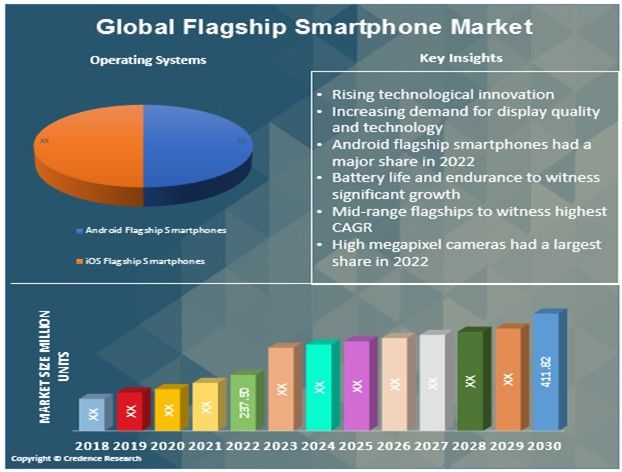
- The flagship smartphone market is projected to grow from $240.30 billion in 2023 to $480.35 billion by 2032, at a compound annual growth rate (CAGR) of 8.00%.
- Android flagship smartphones are the leading segment of operating systems. iOS flagship smartphones, on the other hand, are expected to grow at a strong CAGR.
- The leading specifications and performance segment is camera-centric flagships.
- The CAGR for mid-range flagships is expected to be the highest during the projection period.
- During the forecast time frame, the high-megapixel cameras category will likely have the highest CAGR.
- OLED and AMOLED displays are estimated to have the greatest CAGR during the forecast period.
- The OnePlus segment will likely have the highest CAGR during the prediction period.
- The 5G flagship smartphones segment's CAGR will certainly be the top during the projected period.
- During the forecast time, the category with the largest compound annual growth rate (CAGR) is expected to be privacy and security features.
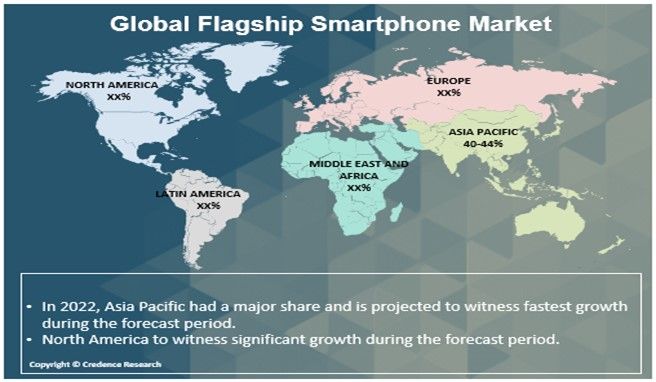
- Asia Pacific dominated the flagship smartphone market.
- Europe is predicted to be the second-largest region in the flagship smartphone market.
- In the market for flagship smartphones, North America is anticipated to grow at the fastest rate.
- The growing need for battery life, charging speed, operating system, and software updates is driving growth in the market for flagship smartphones.
- The market for flagship smartphones has a lot of opportunity due to expanding advanced sensor fusion and data analytics, sustainable practices, increasing foldable and flexible displays, and secure and seamless mobile payments.
Executive Summary
Market Definition
The flagship smartphone market consists of high-end mobile handsets with cutting-edge features and technology, which are the culmination of a manufacturer's product line. With their advanced features, enhanced performance, and cutting-edge specifications, these high-end gadgets attempt to redefine the mobile industry and appeal to discriminating customers looking for the epitome of innovation.
Market Overview
Display quality and technology are crucial factors that can significantly drive the growth of the flagship smartphone market. Flagship smartphones often feature high-resolution displays, providing crisp and clear visuals. Higher pixel densities result in sharper images and text, enhancing the overall viewing experience for users. Advanced display technologies, including High Dynamic Range (HDR), enable smartphones to reproduce a wider range of colors and better contrast. This enhances the vibrancy of content such as photos, videos, and games.
Visually appealing designs attract consumers, and flagship smartphones often incorporate premium materials and finishes. Sleek and stylish designs enhance the overall attractiveness of the device. Consumers appreciate slim and lightweight smartphones that are comfortable to hold and carry. Designing flagship devices with slim profiles and lightweight builds enhances user convenience and portability.
Flagship smartphones with long-lasting battery life appeal to consumers who seek devices that can handle a full day of use without needing frequent recharging. Extended battery life is a major selling point for users with active lifestyles. Fast charging capabilities allow users to recharge their smartphones, providing convenience and reducing downtime quickly. Flagship devices often come equipped with advanced fast-charging technologies that can replenish a significant portion of the battery in a short time.
Segmentation by Operating Systems
- By operating systems, android flagship smartphones are the market leader. The customized versions of Android are released by manufacturers, even if the operating system itself is open-source. Manufacturers often provide security patches, new features, and UI enhancements to flagship smartphones on a regular basis.
- The iOS flagship smartphones category is anticipated to exhibit a sizable CAGR during the projected period. iOS is made to integrate easily with other Apple goods and services, resulting in a unified ecosystem. When using numerous Apple devices-such as iPhones, iPads, Macs, Apple Watches, and Apple TVs-this integration improves the user experience.
Segmentation by Specifications and Performance
- The main specifications and performance category is camera-centric flagships. Flagships in this category commonly incorporate multiple lenses, including wide-angle, ultra-wide-angle, telephoto, and macro lenses. With this adaptable system, users may take pictures from different angles.
- The battery life and endurance category will likely register a significant CAGR during forecasting. Flagship smartphones often include features to monitor and maintain battery health. These features help users prolong the lifespan of their device's battery, ensuring consistent performance over time.
- Other specifications and performance, such as performance powerhouses, multimedia and entertainment, and innovative features, also contribute to the demand for flagship smartphones.
Segmentation by Price Tiers
- The category for mid-range flagships is anticipated to experience the highest CAGR during the projection period. Mid-range flagships often feature capable processors, sufficient RAM, and adequate storage, providing a smooth and responsive user experience. This appeals to users who prioritize good performance without the higher cost associated with top-tier devices.
- Other price tiers, such as ultra-premium flagships and budget flagships, also contribute to the demand for flagship smartphones.
Segmentation by Camera Features
- During the projection period, the high-megapixel camera categories are likely to have the highest CAGR. Flagship smartphones often feature high megapixel counts for their primary cameras, providing users with the ability to capture detailed and sharp images.
- Other camera features, such as camera array flagships, night mode and low-light performance, and videography flagships, also contribute to the demand for flagship smartphones.
Segmentation by Display Technologies
- OLED and AMOLED displays will be expected to have the foremost CAGR during the prediction period. Response times for OLED displays are quicker than those of conventional LCDs. As a result, fast-paced content like gaming and video playback performs better and has smoother motion with less motion blur. Furthermore, HDR is frequently supported by AMOLED screens, offering a greater variety of colours and higher brightness levels. This improves the visual experience in general and HDR content in particular.
- Other display technologies, such as high refresh rate displays and foldable flagships, also contribute to the demand for flagship smartphones.
Segmentation by Brands and Manufacturers
- Throughout the forecast duration, the category for OnePlus is anticipated to have the greatest CAGR. OnePlus devices are known for their powerful hardware, featuring top-of-the-line processors, ample RAM, and fast internal storage. The emphasis on flagship-level performance attracts users who seek high-speed and smooth multitasking experiences.
- Other brands and manufacturers, such as Samsung Galaxy S Series, Apple iPhone, Google Pixel, Huawei P And Mate Series, Xiaomi Mi Series, And Oppo Find Series, also contribute to the demand for flagship smartphones.
Segmentation by Connectivity and 5G
- The highest CAGR is anticipated for 5G flagship smartphones throughout estimation. 5G technology offers significantly faster data speeds compared to 4G LTE. Flagship smartphones equipped with 5G connectivity can deliver quicker downloads, smoother streaming, and improved overall internet performance.
- Other connectivity and 5G, such as advanced connectivity, also contribute to the demand for flagship smartphones.
Segmentation by Market Trends
- Over the estimation period, privacy and security features are expected to have the greatest CAGR. Users' need for safe and easy access to smartphones is driving the market for biometric authentication technologies like facial recognition and fingerprint sensors. The extra protection that these sophisticated authentication techniques offer is valued by users.
- Other market trends, such as sustainability, eco-friendly packaging, 5G integration, and customization and personalization, also contribute to the demand for flagship smartphones.
Segmentation by Region
- Asia Pacific leads the flagship smartphone market. The demand for flagship smartphones has increased in major areas around Asia Pacific as a result of urbanization and better connectivity.
- Europe is estimated to rank second in market size for flagship smartphones.
- North America will witness the most rapid growth in the flagship smartphone market.
- The demand for flagship smartphones is met by the rest of the world, which includes Africa, Latin America, and the Middle East.
The factors that are predicted to boost the expansion of the global market include performance and processing power, brand reputation, storage capacity options, and security and privacy features.
During forecasting, Asia Pacific will probably rule the flagship smartphone market. The Asia Pacific region is home to a vast and rapidly growing consumer base, with countries like China and India boasting large populations. The sheer scale of the market presents substantial opportunities for flagship smartphone manufacturers to tap into a diverse range of consumers. Greater purchasing power has resulted from the middle class's growing affluence throughout the Asia Pacific area. The demand for flagship smartphones is rising in these areas as consumers look for high-end, feature-rich smartphones.
The North American area is projected to grow fastest throughout the forecast. North America, particularly the United States, has a relatively high level of disposable income among its population. This high spending power makes the region a lucrative market for premium and flagship smartphones. Consumers in North America are known for their early adoption of new technologies. Tech-savvy users in the region often seek the latest features and innovations, making flagship smartphones appealing to this demographic.
Flagship smartphones often feature advanced camera systems with high megapixel counts, large sensors, and multiple lenses. These specifications appeal to photography enthusiasts who seek professional-grade imaging capabilities. Flagship smartphones invest in technologies such as larger sensor sizes and improved low-light sensitivity, enabling users to capture clear and detailed photos in challenging lighting conditions. This feature is a significant selling point for consumers who value versatile camera performance.
Advanced sensor fusion enables smartphones to integrate data from multiple sensors, such as accelerometers, gyroscopes, and magnetometers. This allows for more accurate and responsive user interactions, leading to better navigation, gaming, and augmented reality experiences.
Key Highlights of the Report
The global flagship smartphone market is segmented by operating systems, specifications and performance, price tiers, camera features, display technologies, brands and manufacturers, connectivity and 5G, market trends, and region. Android flagship smartphones are the industry leaders in terms of operating systems. Camera-centric flagships are the top specifications and performance segment. During the forecast period, the mid-range flagships category is expected to grow at the highest CAGR. The high-megapixel cameras are anticipated to experience the highest CAGR during the forecast period. The market expansion for flagship smartphones is being driven by Asia Pacific.
Constant software upgrades, including security patches and fixes, are necessary to preserve user data confidentiality and safety. Flagship smartphones with robust security features and prompt updates attract consumers who prioritize data protection. Operating system updates introduce new features, improvements, and functionalities. Flagship smartphones that receive timely OS updates are seen as cutting-edge devices, providing users with access to the latest innovations and capabilities. Software updates often include optimizations and performance enhancements. Regular updates ensure that flagship smartphones continue to deliver optimal performance, improving overall user satisfaction and extending the longevity of the device.
However, according to forecasts, Asia Pacific will hold the largest market share for flagship smartphones globally. The Asia Pacific area has adopted mobile technology as their main method of internet access and communication. As a result, smartphones are integral to daily life, and consumers in these markets often prioritize high-end devices for their functionalities. The North American region is also assumed to have the market's sharpest growth. The consumption of media and entertainment content on smartphones is a significant trend in North America. Consumers prioritize devices with high-quality displays, powerful processors, and advanced camera capabilities, characteristics often found in flagship smartphones.
Which Key Factors Are Driving The Global Flagship Smartphone Market?
Technological innovation, increasing design and build quality, growing camera capabilities, and rising demand for display quality and technology are all driving growth in the flagship smartphone market.
What Are The Key Challenges In The Global Market For Flagship Smartphones?
The growth of the flagship smartphone market is impeded by several challenges, including saturation and market maturity, economic factors, global supply chain issues, rapid technological obsolescence, and changing consumer behavior.
What Market Opportunities Exist For Flagship Smartphones Globally?
Enhanced AI and machine learning capabilities, augmented reality (AR) and virtual reality (VR) integration, camera innovations, and health and wellness features are creating opportunities in the flagship smartphone market.
Market Drivers
Several factors influence the market for flagship smartphones globally. The main factors influencing the market for flagship smartphones globally are as follows:
Expanding Technological Innovation
The Integration of 5G technology enables faster download and upload speeds, low latency, and improved connectivity. This innovation enhances the overall user experience, especially for data-intensive applications, streaming, and online gaming. Foldable display technology allows manufacturers to create smartphones with larger screens that can be folded for increased portability. This innovation provides users with more versatile form factors and expanded screen real estate. Ongoing advancements in camera technology, including larger sensors, improved low-light performance, and multiple lenses, contribute to enhanced photography and videography capabilities. Smartphone manufacturers focus on delivering professional-grade imaging experiences to attract photography enthusiasts. Innovations in biometric authentication, such as under-display fingerprint sensors and facial recognition technology, improve the security and convenience of unlocking smartphones. These features are critical for user privacy and data protection.
Market Restraints
Several challenges could prevent the expansion of the global market for flagship smartphones. Among them are the following:
High Price of Flagship Smartphone
High prices limit the affordability of flagship smartphones for a significant portion of the consumer market. This can result in potential buyers opting for more budget-friendly alternatives or delaying their smartphone upgrades. During economic downturns or uncertainties, consumers tend to become more price-conscious. High-priced flagship smartphones may experience a decline in demand as consumers prioritize essential spending over luxury or high-end devices. The increasing capabilities of mid-range smartphones at more affordable price points provide consumers with viable alternatives. This intensifies competition, as users may opt for devices that offer a good balance of features and cost. Changes in consumer priorities, such as a greater emphasis on value for money, may lead to a preference for devices that offer a more reasonable price-to-performance ratio. This shift can impact the market share of high-priced flagship smartphones. Emerging smartphone manufacturers offering feature-rich devices at lower costs pose a challenge to established flagship brands. Consumers may explore these alternatives, especially if they provide competitive specifications at more attractive price points.
Opportunities
The global market for flagship smartphones presents significant potential opportunities. The following is an example of these:
Rising Demand for Foldable and Flexible Displays
Foldable and flexible displays provide users with a more immersive and versatile experience. The ability to unfold a larger screen for multimedia consumption, gaming, and multitasking enhances overall user satisfaction. Foldable displays allow for innovative form factors, such as clamshell and book-like designs. Manufacturers can experiment with different shapes and sizes, offering users a range of options to suit their preferences and needs. Foldable displays enable smartphones to have larger screens without compromising on portability. Users can benefit from a more expansive view of content consumption, productivity, and creative applications. The larger unfolded screens of foldable smartphones facilitate better multitasking. Users can run multiple applications simultaneously, making it more convenient for work-related tasks or entertainment. Foldable smartphones offer a unique and futuristic design, capturing the attention of consumers who appreciate innovation and cutting-edge technology. This uniqueness can contribute to brand differentiation and attract early adopters.
Competitive Landscape
Key Players
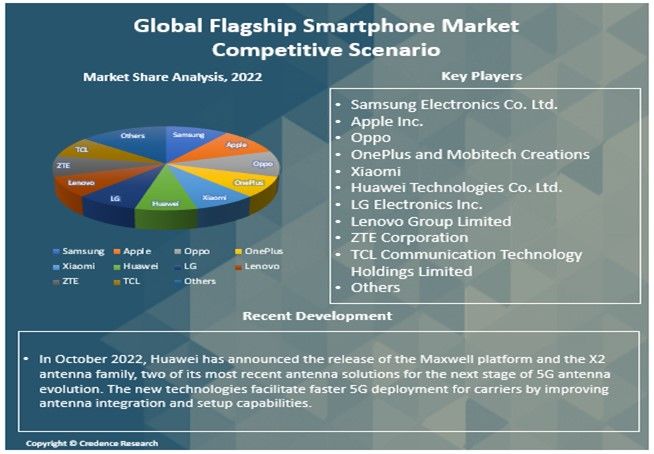
The global market for flagship smartphones is very competitive, with many powerful players. Some of the leading market participants and their corresponding market shares are listed below:
- Samsung Electronics Co. Ltd.
- Apple Inc.
- Oppo
- OnePlus and Mobitech Creations
- Xiaomi
- Huawei Technologies Co. Ltd.
- LG Electronics Inc.
- Lenovo Group Limited
- ZTE Corporation
- TCL Communication Technology Holdings Limited
- Vivo Communication Technology Co. Ltd.
- Others
These companies prioritize mergers and acquisitions, expanding their distribution network, and developing new products to remain competitive.
The leading competitors in the global market for flagship smartphones are constantly looking for ways to get an advantage by releasing new items and advancements.
In September 2022, Comcast and Samsung Electronics partnered to develop 5G Radio Access Network (RAN) technology, which will enable users of Comcast Business Mobile and Xfinity Mobile in Comcast service areas to have better 5G connectivity. Samsung will provide 5G RAN technology. Comcast will deploy Citizens Broadband Radio Service (CBRS) and 600 MHz spectrum to provide 5G access to consumer and commercial users in the United States.
In September 2022, Apple launched the 6.1- and 6.7-inch iPhone 14 and iPhone 14 Plus, which sport innovative safety features, a smart design, and improved cameras. The iPhone 14 and iPhone 14 Plus have a powerful camera system that incorporates the front and primary TrueDepth cameras, the Ultra Wide camera for unique perspectives, the Photonic engine, and an improved picture pipeline. These components allow the phones to produce photos and videos with remarkably high quality.
Summary of Key Findings
- The flagship smartphone sector continues to grow due to expanding technological innovation.
- The market is segmented by operating systems, specifications and performance, price tiers, camera features, display technologies, brands and manufacturers, connectivity and 5G, market trends, and region.
- The most popular type of operating system in the market is Android flagship smartphones.
- The most ubiquitous specifications and performance fragments are camera-centric flagships.
- Regarding CAGR, mid-range flagships are expected to grow fastest during the forecast period.
- The category for high-megapixel cameras will likely see the highest CAGR during the anticipated time frame.
- Asia Pacific is leading market development; the market is highly competitive with key players including Samsung Electronics Co. Ltd., Apple Inc., Oppo, OnePlus and Mobitech Creations, Xiaomi, Huawei Technologies Co. Ltd., LG Electronics Inc., Lenovo Group Limited, ZTE Corporation, TCL Communication Technology Holdings Limited, and Vivo Communication Technology Co. Ltd., and others.
Future Outlook
- Optimistic viewpoint for the global flagship smartphone market with noteworthy growth potential in the Asia Pacific region.
- One of the major factors supporting the growth of the flagship smartphone market is the focus on display quality and technology.
- During the projected period, the high price of flagship smartphones will be a significant challenge to the market's expansion.
- Foremost companies must concentrate on product innovation, expanding their market reach, and maintaining competitive pricing to stay ahead.
How CXOs Can Benefit from the Credence Research Flagship Smartphone Market Report
The Credence Research Flagship Smartphone Market Report provides CXOs with a comprehensive overview of the market, including:
- Market size and growth forecast: The report provides detailed estimates of the global flagship smartphone market size, segmented by operating systems, specifications and performance, price tiers, camera features, display technologies, brands and manufacturers, connectivity and 5G, market trends, and region. It also includes forecasts for the market through 2032 based on key trends and drivers.
- Market segmentation: The report segments the flagship smartphone market by operating systems, specifications and performance, price tiers, camera features, display technologies, brands and manufacturers, connectivity and 5G, market trends, and region. This segmentation provides CXOs with a granular understanding of the market and the opportunities in each segment.
- Competitive landscape: The report profiles the key players in the flagship smartphone market and provides insights into their strategies, product offerings, and financial performance. This information can help CXOs to identify and assess their competition.
- Key trends and drivers: The report identifies and analyzes the key trends and drivers that are shaping the flagship smartphone market. This information can help CXOs to make informed decisions about their investments and strategies.
CXOs can use the insights from the Credence Research Flagship Smartphone Market Report to:
- Identify growth opportunities: The report can help CXOs identify new growth opportunities in the flagship smartphone market. For example, the report identifies the growing demand for flagship smartphones from business professionals, fashion and design-conscious consumers, social media influencers, and mobile gamers as a key opportunity.
- Make informed investment decisions: The report can help CXOs make informed investment decisions about flagship smartphones. For example, the report provides insights into the key factors to consider when evaluating flagship smartphone providers and selecting flagship smartphone solutions.
- Develop competitive strategies: The report can help CXOs develop competitive strategies for their flagship smartphone businesses. For example, the report identifies the key strategies that flagship smartphone providers are using to differentiate themselves from their competitors.
- Track market developments: The report can help CXOs track market developments and stay ahead of the curve. For example, the report provides insights into the latest trends and innovations in the flagship smartphone market.
Overall, the Credence Research Flagship Smartphone Market Report is a valuable resource for CXOs who are looking to gain a deeper understanding of the market and identify opportunities for growth.
Segmentation
- By Operating Systems
- Android Flagship Smartphones
- iOS Flagship Smartphones
- By Specifications and Performance
- Camera-Centric Flagships
- Performance Powerhouses
- Multimedia and Entertainment
- Battery Life and Endurance
- Innovative Features
- By Price Tiers
- Ultra-Premium Flagships
- Mid-Range Flagships
- Budget Flagships
- By Camera Features
- High Megapixel Cameras
- Camera Array Flagships
- Night Mode and Low-Light Performance
- Videography Flagships
- By Display Technologies
- OLED and AMOLED Displays
- High Refresh Rate Displays
- Foldable Flagships
- By Brands and Manufacturers
- Samsung Galaxy S Series
- Apple iPhone
- Google Pixel
- OnePlus
- Huawei P and Mate Series
- Xiaomi Mi Series
- Oppo Find Series
- By Connectivity and 5G
- 5G Flagship Smartphones
- Advanced Connectivity
- By Market Trends
- Sustainability
- Eco-Friendly Packaging
- 5G Integration
- Privacy and Security Features
- Customization and Personalization
- By Region
- North America
- The U.S.
- Canada
- Mexico
- Europe
- Germany
- France
- The U.K.
- Italy
- Spain
- Rest of Europe
- Asia Pacific
- China
- Japan
- India
- South Korea
- South-east Asia
- Rest of Asia Pacific
- Latin America
- Brazil
- Argentina
- Rest of Latin America
- Middle East & Africa
- GCC Countries
- South Africa
- Rest of the Middle East and Africa
- North America

Request a Free Sample
Fill in your details and we'll send you a free sample report.
- Sample data tables & charts
- Research methodology
Market Dynamics
Technological Innovation and Advanced Features
Continuous advancements in display technology, camera systems, and processing power are pushing flagship smartphones to offer superior user experiences, attracting consumers seeking the latest innovations.
5G Integration and Connectivity
The rollout and adoption of 5G networks are driving demand for flagship smartphones that support faster data speeds, lower latency, and enhanced connectivity, making them essential for tech-savvy users.
Premium Design and Build Quality
Flagship smartphones are distinguished by their use of high-end materials, sleek designs, and premium finishes, which appeal to consumers looking for status symbols and devices that reflect personal style.
Enhanced Camera Capabilities
The focus on high-megapixel sensors, multiple lens arrays, and advanced computational photography features is a key differentiator, catering to users who prioritize professional-grade imaging and content creation.
Focus on Privacy and Security Features
Growing consumer awareness around data protection and secure authentication is leading manufacturers to integrate advanced biometric and privacy features, making flagship devices more attractive to security-conscious buyers.
Need a Custom Version of This Report?
Tailor the scope, geography, or segments to your exact requirements.
- Custom geography or segment scope
- Direct access to our analyst team
Frequently Asked Questions
How big is the global market for flagship smartphones right now?
What is the flagship smartphone market's anticipated growth rate from 2023 to 2030?
In terms of operating systems, which market category is in the lead?
Which segment is leading the market in terms of specifications and performance?
Which price tier segment is estimated to have the highest CAGR throughout the forecast period?
Table of Content
Chapter 1 Market Segmentation
- 1.1 Segmentation Framework
- 1.1.1 Product and Service Classification
- 1.1.2 Application and End-Use Classification
- 1.1.3 Technology and Solution Classification
- 1.1.4 Customer and Distribution Channel Classification
- 1.1.5 Geographic Segmentation
- 1.1.6 Market Segment Definitions and Boundaries
- 1.2 By Price Tiers
- 1.2.1 Ultra-Premium Flagships
- 1.2.2 Mid-Range Flagships
- 1.2.3 Budget Flagships
- 1.3 By Operating Systems
- 1.3.1 Android Flagship Smartphones
- 1.3.2 iOS Flagship Smartphones
- 1.4 By Specifications and Performance
- 1.4.1 Camera-Centric Flagships
- 1.4.2 Performance Powerhouses
- 1.4.3 Battery Life and Endurance
- 1.4.4 Multimedia and Entertainment
- 1.4.5 Innovative Features
Chapter 2 Introduction
- 2.1 Report Objectives and Scope
- 2.2 Product Definition and Industry Terminology
- 2.3 Market Inclusions and Exclusions
- 2.4 Research Process
- 2.4.1 Primary Research and Expert Interviews
- 2.4.2 Secondary Research and Source Review
- 2.4.3 Top-Down and Bottom-Up Estimation
- 2.4.4 Data Triangulation and Verification
- 2.5 Market Size Measurement Basis
- 2.5.1 2023: USD 240.30 billion → 2032: USD 480.35 billion
- 2.6 Historical and Forecast Reference Periods
- 2.6.1 Base Year: 2023
- 2.6.2 Forecast Period: 2023-2032
- 2.7 Research Assumptions and Limitations
Chapter 3 Executive Summary
- 3.1 Market Snapshot and Key Findings
- 3.2 Base-Year Market Size, 2023
- 3.3 Forecast Market Size, 2032
- 3.4 Revenue and Volume Growth Outlook
- 3.5 Key Demand and Supply Indicators
- 3.6 Leading Market Segments
- 3.7 Fastest-Growing Market Opportunities
- 3.8 Regional Performance Highlights
- 3.9 Technology and Industry Transformation
- 3.10 Competitive Landscape Summary
- 3.11 Analyst View and Strategic Implications
Chapter 4 Global Flagship Smartphone Market Trends and Developments
- 4.1 Historical Industry Development
- 4.2 Recent Market Trends and Developments
- 4.3 Demand and Customer Behavior Trends
- 4.4 Technology and Product Innovation
- 4.5 Artificial Intelligence, Automation and Digitalization
- 4.6 Local Manufacturing and Supply Chain Realignment
- 4.7 Industry Partnerships, Mergers and Acquisitions
- 4.8 Sustainability and Circular Economy Developments
- 4.9 Government and Private Sector Investment Trends
- 4.10 Emerging Business Models and Commercialization
- 4.11 Industry Developments and Announcements
Chapter 5 Global Flagship Smartphone Market Production, Supply and Demand Analysis
- 5.1 Demand Trend and Consumption Analysis
- 5.2 Demand Forecast, 2023-2032
- 5.3 Production and Output Trend
- 5.4 Production and Output Forecast, 2023-2032
- 5.5 Installed Capacity and Capacity Utilization
- 5.6 Company-Wise Production Plants and Statistics
- 5.6.1 Installed Production Capacity
- 5.6.2 Actual Production
- 5.6.3 Planned Capacity and Expansion Targets
- 5.7 Supply Chain Structure and Procurement Trends
- 5.8 Supply-Demand Gap and Bottlenecks
- 5.9 Import Dependence and Sourcing Structure
- 5.10 Contract Manufacturing and Outsourcing
- 5.11 Regional Supply and Demand Concentration
Chapter 6 Global Flagship Smartphone Market Pricing Analysis
- 6.1 Pricing Structure and Measurement
- 6.2 Historical Pricing Trends
- 6.3 Pricing Outlook, 2023-2032
- 6.4 Average Selling Price and Unit Economics
- 6.5 Pricing by Product and Market Segment
- 6.6 Geographic Pricing Differences
- 6.7 Key Input, Energy, Labor and Logistics Costs
- 6.8 Contract Pricing and Purchasing Models
- 6.9 Pricing Sensitivity and Competitive Positioning
- 6.10 Price, Margin and Profitability Implications
Chapter 7 Global Flagship Smartphone Market Dynamics
- 7.1 Market Growth Drivers
- 7.1.1 Demand-Side Drivers
- 7.1.2 Technology and Innovation Drivers
- 7.1.3 Infrastructure and Investment Drivers
- 7.1.4 Regulatory and Policy Drivers
- 7.2 Market Restraints
- 7.2.1 Cost and Affordability Constraints
- 7.2.2 Technology and Adoption Barriers
- 7.2.3 Supply Chain and Operational Constraints
- 7.3 Market Challenges
- 7.3.1 Competitive Pressure and Margin Erosion
- 7.3.2 Skills, Infrastructure and Implementation Gaps
- 7.4 Emerging Market Opportunities
- 7.5 Market Dynamics Impact and Time-Horizon Assessment
Chapter 8 Global Flagship Smartphone Value Chain Analysis
- 8.1 Industry Value Chain Overview
- 8.2 Upstream Suppliers and Critical Inputs
- 8.3 Technology and Component Providers
- 8.4 Manufacturing or Service Delivery
- 8.5 Distribution, Channel Partners and Integrators
- 8.6 Downstream Applications and End Users
- 8.7 Value Addition and Profit Pools
- 8.8 Vertical Integration and Outsourcing
- 8.9 Supplier Concentration and Risk
- 8.10 Supply Chain Localization and Resilience
Chapter 9 Global Flagship Smartphone Market Regulations and Policies
- 9.1 Relevant Laws, Standards and Compliance Frameworks
- 9.2 Product, Service, Safety and Quality Requirements
- 9.3 Government Policies, Incentives and Subsidies
- 9.4 Imports, Exports and Trade Barriers
- 9.5 Public Procurement and Local Content Requirements
- 9.6 Environmental and Sustainability Compliance
- 9.7 Upcoming Policy Changes and Market Implications
Chapter 10 Global Flagship Smartphone Market Hotspots and Opportunities
- 10.1 Market Opportunity Mapping and Growth Hotspots
- 10.2 High-Growth Applications and Customer Groups
- 10.3 Underserved Markets and White-Space Opportunities
- 10.4 Emerging Technology and Product Opportunities
- 10.5 New Capacity and Investment Hotspots
- 10.6 Market Entry and Expansion Opportunities
- 10.7 Distribution and Partnership Opportunities
- 10.8 Near-Term and Long-Term Commercial Potential
- 10.9 Opportunity Attractiveness and Execution Risks
Chapter 11 Global Flagship Smartphone Market Outlook, 2023-2032
- 11.1 Market Size and Analysis
- 11.1.1 Revenue (Market Measurement: 2023: USD 240.30 billion → 2032: USD 480.35 billion)
- 11.1.2 Market Volume and Quantity Sold
- 11.1.3 Historical Market Size
- 11.1.4 Base-Year Market Size, 2023
- 11.2 Market Forecast, 2023-2032
- 11.2.1 Revenue Forecast to 2032
- 11.2.2 Volume Forecast to 2032
- 11.2.3 CAGR and Year-on-Year Growth
- 11.2.4 Incremental Revenue Opportunity
- 11.3 Forecast Assumptions and Scenario Analysis
- 11.3.1 Base-Case Forecast
- 11.3.2 Optimistic and Conservative Scenarios
- 11.3.3 Technology, Pricing and Policy Sensitivities
- 11.4 Market Attractiveness and Growth Outlook
Chapter 12 Global Flagship Smartphone Market Segmentation and Outlook
- 12.1 Segmentation Summary and Market Shares, 2023
- 12.2 Largest and Fastest-Growing Segments
- 12.3 By Price Tiers - Market Size and Forecast, 2023-2032
- 12.3.1 Segment Definition and Scope
- 12.3.2 Historical Market Size
- 12.3.3 Revenue Forecast, 2023-2032
- 12.3.4 Volume Forecast, 2023-2032
- 12.3.5 Base-Year Market Share, 2023
- 12.3.6 Segment CAGR and Growth Drivers
- 12.3.7 Subsegment Market Size and Forecast
- 12.3.7.1 Ultra-Premium Flagships
- 12.3.7.2 Mid-Range Flagships
- 12.3.7.3 Budget Flagships
- 12.3.8 Subsegment Pricing and Adoption Trends
- 12.3.9 Leading Suppliers and Competition
- 12.3.10 Regional Demand and Opportunities
- 12.4 By Operating Systems - Market Size and Forecast, 2023-2032
- 12.4.1 Segment Definition and Scope
- 12.4.2 Historical Market Size
- 12.4.3 Revenue Forecast, 2023-2032
- 12.4.4 Volume Forecast, 2023-2032
- 12.4.5 Base-Year Market Share, 2023
- 12.4.6 Segment CAGR and Growth Drivers
- 12.4.7 Subsegment Market Size and Forecast
- 12.4.7.1 Android Flagship Smartphones
- 12.4.7.2 iOS Flagship Smartphones
- 12.4.8 Subsegment Pricing and Adoption Trends
- 12.4.9 Leading Suppliers and Competition
- 12.4.10 Regional Demand and Opportunities
- 12.5 By Specifications and Performance - Market Size and Forecast, 2023-2032
- 12.5.1 Segment Definition and Scope
- 12.5.2 Historical Market Size
- 12.5.3 Revenue Forecast, 2023-2032
- 12.5.4 Volume Forecast, 2023-2032
- 12.5.5 Base-Year Market Share, 2023
- 12.5.6 Segment CAGR and Growth Drivers
- 12.5.7 Subsegment Market Size and Forecast
- 12.5.7.1 Camera-Centric Flagships
- 12.5.7.2 Performance Powerhouses
- 12.5.7.3 Battery Life and Endurance
- 12.5.7.4 Multimedia and Entertainment
- 12.5.7.5 Innovative Features
- 12.5.8 Subsegment Pricing and Adoption Trends
- 12.5.9 Leading Suppliers and Competition
- 12.5.10 Regional Demand and Opportunities
- 12.6 Segment Growth Comparison
- 12.7 Segment Attractiveness and Priority Matrix
Chapter 13 Global Flagship Smartphone Geographic Market Outlook, 2023-2032
- 13.1 Regional Market Size and Share, 2023
- 13.2 Regional Market Forecast, 2023-2032
- 13.3 Regional Pricing, Production and Demand Differences
- 13.4 North America
- 13.4.1 United States
- 13.4.2 Canada
- 13.4.3 Mexico
- 13.5 Europe
- 13.5.1 Germany
- 13.5.2 France
- 13.5.3 Italy
- 13.5.4 United Kingdom
- 13.5.5 Spain
- 13.5.6 Poland
- 13.5.7 Russia
- 13.5.8 Netherlands
- 13.5.9 Belgium
- 13.5.10 Sweden
- 13.5.11 Denmark
- 13.5.12 Norway
- 13.5.13 Rest of Europe
- 13.6 Asia Pacific
- 13.6.1 China
- 13.6.2 India
- 13.6.3 Japan
- 13.6.4 South Korea
- 13.6.5 Thailand
- 13.6.6 Indonesia
- 13.6.7 Vietnam
- 13.6.8 Malaysia
- 13.6.9 Australia
- 13.6.10 Rest of Asia Pacific
- 13.7 Latin America
- 13.7.1 Brazil
- 13.7.2 Argentina
- 13.7.3 Colombia
- 13.7.4 Chile
- 13.7.5 Rest of Latin America
- 13.8 Middle East
- 13.8.1 Saudi Arabia
- 13.8.2 United Arab Emirates
- 13.8.3 Turkey
- 13.8.4 Israel
- 13.8.5 Iran
- 13.8.6 Rest of the Middle East
- 13.9 Africa
- 13.9.1 South Africa
- 13.9.2 Egypt
- 13.9.3 Nigeria
- 13.9.4 Morocco
- 13.9.5 Rest of Africa
- 13.10 Regional Investment, Policy and Supply Chain Differences
- 13.11 Regional Competitive Landscape
- 13.12 Geographic Growth Hotspots
Chapter 14 Global Flagship Smartphone Technology, Innovation and Sustainability Outlook
- 14.1 Technology Landscape and Maturity
- 14.2 Product, Process and Service Innovation
- 14.3 AI, Automation and Digital Tools in the Industry
- 14.4 Technology Adoption and Performance Benchmarking
- 14.5 Innovation Pipeline and R&D Investment
- 14.6 Patent and Intellectual Property Trends
- 14.7 Energy Efficiency and Resource Management
- 14.8 Sustainability, Recycling and Circularity
- 14.9 Technology Roadmap, 2023-2032
- 14.10 Risks of Obsolescence and Technology Substitution
Chapter 15 Global Flagship Smartphone Market Key Strategic Imperatives
- 15.1 Growth and Market Entry Priorities
- 15.2 High-Return Products and Segments
- 15.3 Pricing, Profitability and Cost Optimization
- 15.4 Technology Investment and Product Differentiation
- 15.5 Supply Chain Localization and Resilience
- 15.6 Distribution and Customer Acquisition
- 15.7 Partnership, Acquisition and Capacity Strategy
- 15.8 Regional Expansion Priorities
- 15.9 Short-, Medium- and Long-Term Actions
Chapter 16 Competition Outlook
- 16.1 Industry Competition Characteristics
- 16.2 Market Structure and Concentration
- 16.3 Market Share and Competitive Positioning, 2023
- 16.4 Company-Wise Revenue and Product Benchmarking
- 16.5 Production and Service Capacity Benchmarking
- 16.6 Technology, Pricing and Differentiation
- 16.7 Regional Footprint and Distribution Strength
- 16.8 Mergers, Acquisitions and Strategic Alliances
- 16.9 New Entrants and Competitive Threats
- 16.10 Porter's Five Forces and Industry Attractiveness
- 16.11 Competitive Outlook, 2023-2032
Chapter 17 Company Profiles
- 17.1 Company Coverage and Selection Criteria
- 17.2 Samsung Electronics Co. Ltd.
- 17.2.1 Business Description
- 17.2.2 Company Ownership and Geographic Presence
- 17.2.3 Product and Service Portfolio
- 17.2.4 Manufacturing and Operating Footprint
- 17.2.5 Production Capacity and Expansion Plans
- 17.2.6 Financial Performance and Investment
- 17.2.7 Market Share and Competitive Position
- 17.2.8 Technology and Innovation Capabilities
- 17.2.9 Strategic Alliances or Partnerships
- 17.2.10 Recent Developments
- 17.2.11 Growth Strategy and Outlook
- 17.3 Apple Inc.
- 17.4 Oppo
- 17.5 OnePlus
- 17.6 Xiaomi
- 17.7 Huawei Technologies Co. Ltd.
- 17.8 LG Electronics Inc.
- 17.9 Lenovo Group Limited
- 17.10 Vivo Communication Technology Co. Ltd.
- 17.11 Google
- 17.12 Other Relevant Market Participants
Note: Every listed company is profiled on the structure shown under the first company. The company list is preliminary and may change based on research findings, market developments, data availability and client requirements.
Chapter 18 Disclaimer
- 18.1 Research and Forecast Disclaimer
- 18.2 Data Source and Estimation Limitations
Note: The depth of individual sections depends on data availability for this market. Volume, capacity, trade and other unit-based metrics are included where applicable.

