
| REPORT ATTRIBUTE | DETAILS |
|---|---|
| Historical Period | 2019-2022 |
| Base Year | 2023 |
| Forecast Period | 2024-2032 |
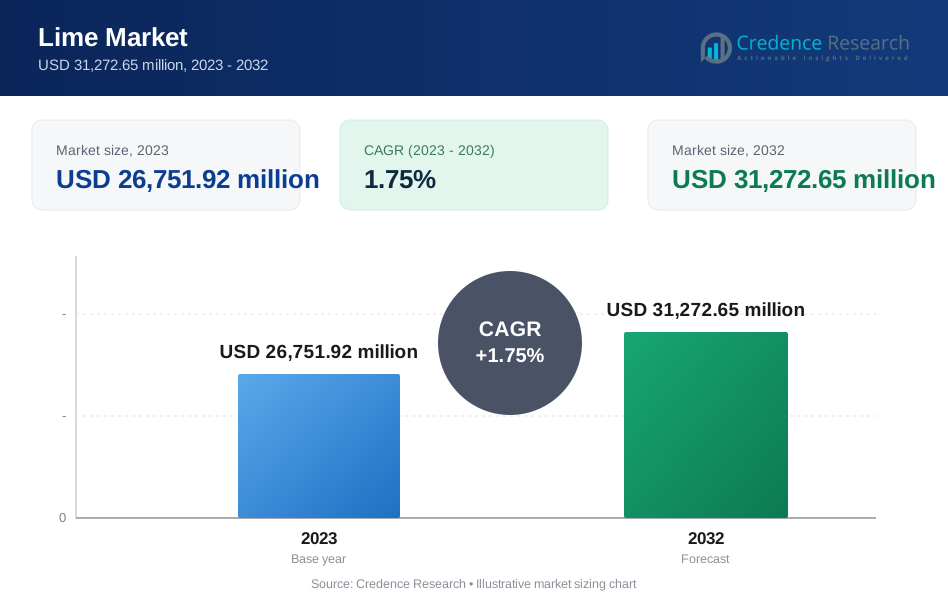
| Lime Market Size 2023 | USD 26,751.92 Million |
| Lime Market, CAGR | 1.75% |
| Lime Market Size 2032 | USD 31,272.65 Million |
Market Overview
The Lime Market is projected to grow from USD 26,751.92 million in 2023 to USD 31,272.65 million by 2032, reflecting a compound annual growth rate (CAGR) of 1.75%.
The Global Lime Market is driven by the increasing demand from the construction and steel industries, where lime is essential for various applications such as soil stabilization and as a fluxing agent. Environmental regulations promoting the use of lime in flue gas treatment and water purification also contribute to market growth. Additionally, the agriculture sector's need for lime as a soil conditioner to enhance soil pH and fertility supports market demand. Technological advancements in lime production and processing, combined with the growing adoption of sustainable practices, are further shaping the market, ensuring steady growth and innovation.
The Global Lime Market is characterized by significant geographical diversity, with Asia-Pacific, particularly China and India, dominating due to rapid industrialization, infrastructure development, and extensive steel production. North America and Europe follow, driven by their well-established construction and environmental sectors, alongside stringent environmental regulations that boost lime demand for pollution control. Key players such as Lhoist, Carmeuse, and Graymont have a strong presence across these regions, leveraging advanced production technologies and expansive distribution networks. These companies drive market growth through strategic expansions, mergers, and investments in sustainable practices to meet the rising global demand for lime across various industries.
Market Drivers
Industrial Applications
Lime plays a pivotal role across multiple industrial applications, making it a key driver in the Global Lime Market. In steel production, lime is essential for removing impurities and enhancing the quality of the metal, underscoring its importance in the metallurgical industry. For instance, in steel production, lime is essential for removing impurities and enhancing the quality of the metal, underscoring its importance in the metallurgical industry. The construction sector also relies heavily on lime for the production of cement, mortar, and plaster, which are fundamental materials for building infrastructure. Additionally, lime is a critical component in water treatment plants, where it helps to adjust pH levels and remove impurities, ensuring safe and clean water supply. The pulp and paper industry utilizes lime in the pulping process to separate cellulose fibers from lignin, vital for producing paper products. Similarly, in sugar refining, lime is used to neutralize acidic sugar solutions, thereby improving product quality.
Environmental Regulations
Stricter environmental regulations are a significant market driver, with lime being integral to various pollution control processes. Lime is widely used in flue gas desulfurization systems, where it helps reduce sulfur dioxide emissions from power plants and industrial facilities, thereby aiding in compliance with air quality standards. Additionally, in wastewater treatment, lime is employed to neutralize acidic wastewater and remove pollutants, ensuring that water discharge meets environmental safety standards. These applications highlight lime's critical role in supporting industries to meet regulatory requirements and contribute to environmental sustainability.
Growing Infrastructure Development
The ongoing global urbanization and infrastructure development significantly boost lime demand. As cities expand and populations grow, there is an increasing need for infrastructure such as roads, buildings, and water treatment facilities, all of which drive the demand for lime. Lime’s use in construction materials and water treatment processes is crucial to supporting the rapid development of urban areas, making it indispensable in infrastructure projects.
Rising Demand for Lime-Based Products
The demand for lime-based products is also rising in the personal care and food and beverage industries. In personal care, lime is a key ingredient in products such as soaps, lotions, and deodorants, valued for its antibacterial properties and refreshing scent. In the food and beverage sector, lime is used as a flavoring agent and preservative, enhancing taste and extending shelf life. These diverse applications showcase lime's versatility and growing demand across various consumer markets, driving the market's expansion.
Market Trends
Consolidation, Competition, and Technological Advancements
The Global Lime Market is witnessing significant consolidation as industry players pursue mergers and acquisitions to achieve economies of scale, expand their geographic presence, and diversify product offerings. These strategic moves allow companies to strengthen their market position and leverage synergies that enhance their operational efficiency and market reach. For instance, in the electric scooter sector, companies like Lime are always looking for strategic partnerships, investments, and growth opportunities. Lime producers are increasingly adopting energy-efficient technologies to reduce environmental impact and lower operating costs. For example, the German Lime Association is researching both carbon direct avoidance and smart carbon separation (SCS). Direct avoidance will require alternative fuels, and new kiln technologies using pure hydrogen or oxyfuel. At the same time, the market is becoming increasingly competitive with the entry of new players and the expansion of existing ones, which is driving innovation and compelling companies to offer better products and services. Alongside this, technological advancements are playing a crucial role in shaping the market. Lime producers are increasingly adopting energy-efficient technologies to reduce environmental impact and lower operating costs. The integration of automation into production processes is also on the rise, aimed at improving productivity, reducing labor costs, and ensuring consistent product quality. These technological trends are crucial for maintaining competitiveness in a rapidly evolving market landscape.
Regional Shifts, Sustainability Focus, and Product Diversification
The Asia-Pacific region, particularly China and India, continues to dominate the Global Lime Market, driven by rapid industrialization and large-scale infrastructure development projects. This region's substantial consumption of lime is pivotal to supporting its economic growth and urban expansion. Additionally, emerging markets in Africa and Latin America are showing significant growth in lime demand due to increasing industrial activities and investments in infrastructure, highlighting a shift in regional market dynamics. Sustainability is another critical trend influencing the lime market, with stricter environmental regulations prompting producers to adopt more sustainable practices. These include efforts to reduce emissions, minimize waste, and ensure sustainable sourcing of limestone. Producers are also investing in developing technologies that make lime production more efficient and environmentally friendly. In response to diverse market needs, lime producers are diversifying their product portfolios to include value-added products like hydrated lime, dolomitic lime, and specialized lime-based chemicals. The growing demand for high-purity lime for electronics and food-grade lime for the food and beverage industry underscores the market’s shift towards specialized applications, catering to specific industrial needs and driving further market expansion.
Market Challenges Analysis
Price Volatility, Environmental Regulations, and Energy Costs
The Global Lime Market faces significant challenges related to price volatility, driven by fluctuating raw material costs and energy expenses. Limestone, the primary raw material for lime production, can experience price swings due to variations in mining costs, transportation expenses, and shifts in supply and demand dynamics. For instance, the pricing of raw materials in the chemical industry, including limestone used for lime production, can fluctuate significantly due to a myriad of interconnected factors, each exerting its influence on the supply chain. Additionally, energy costs represent a substantial portion of production expense. For example, the European lime industry has lowered its emissions substantially over the past 20 years, mainly by modernizing their kilns to be more energy-efficient. These fluctuations create uncertainty in production costs and can impact profitability for lime producers. Additionally, energy costs represent a substantial portion of production expenses, and any volatility in fuel prices directly affects the overall cost structure of lime production. The market is also under pressure from increasingly stringent environmental regulations, which require producers to invest in advanced pollution control technologies and adhere to strict compliance measures. These regulations not only increase operational costs but also pose challenges in terms of securing the necessary permits for new production facilities, which can be both time-consuming and costly. The need to balance environmental compliance with cost efficiency remains a significant challenge for the industry.
Competition from Substitutes, Transportation, and Economic Downturns
Competition from alternative materials presents another challenge for the lime market. In various applications, lime faces competition from substitutes such as fly ash, slag, and synthetic materials, which can offer similar functionalities at potentially lower costs. This competition can exert downward pressure on lime prices, affecting market profitability. Additionally, lime's nature as a bulk commodity means that transportation costs are a critical factor in its overall market dynamics. High transportation costs, particularly for long-distance shipments, can reduce profitability, and infrastructure constraints like inadequate roads and railways further exacerbate these challenges by limiting market access and increasing logistical expenses. The market is also vulnerable to economic downturns, which can lead to reduced demand, particularly in sectors like construction and manufacturing that are significant consumers of lime. During economic slowdowns, the heightened competition can intensify price pressure, compelling producers to reduce prices to maintain market share, thereby squeezing margins and profitability. These combined challenges underscore the complexities of navigating the lime market and highlight the need for strategic management to ensure sustainable growth.
Market Segmentation Analysis:
By Type:
The Global Lime Market is primarily segmented into Quicklime and Slaked Lime. Quicklime, also known as calcium oxide, is extensively used due to its reactive properties, making it a critical component in industries such as steelmaking, where it serves as a flux to remove impurities. It is also used in environmental applications, such as flue gas desulfurization, and in construction for soil stabilization and asphalt treatment. On the other hand, Slaked Lime, or calcium hydroxide, is preferred in applications requiring a less reactive form of lime. It is widely utilized in water treatment to adjust pH levels, in the food industry for sugar refining, and in the production of mortar and plaster. The growing demand for both Quicklime and Slaked Lime across various applications highlights their importance in supporting industrial, environmental, and construction needs.
By End-User:
The Global Lime Market caters to diverse end-user industries, with significant applications in Chemical Intermediates, Metallurgical, Construction & Environment, and Paper & Pulp. In the Chemical Intermediates segment, lime is crucial for producing various chemicals, including calcium carbide and sodium alkalis. The Metallurgical segment relies heavily on lime, particularly in steel production, where it helps in purifying metals by removing sulfur, phosphorus, and other impurities. The Construction & Environment segment is a major consumer of lime, utilizing it for soil stabilization, asphalt production, and wastewater treatment. The Paper & Pulp industry uses lime primarily for the pulping process, where it helps in separating fibers and in the recovery of caustic soda. The versatility of lime across these end-user segments demonstrates its critical role in industrial processes, environmental management, and infrastructure development, driving the market's growth and expansion.
Segments:
Based on Type:
- Quicklime
- Slaked Lime
Based on End-User:
- Chemical Intermediates
- Metallurgical
- Construction & Environment
- Paper & Pulp
- Others
Based on the Geography:
- North America
- U.S.
- Canada
- Mexico
- Europe
- Germany
- France
- U.K.
- Italy
- Spain
- Rest of Europe
- Asia Pacific
- China
- Japan
- India
- South Korea
- South-east Asia
- Rest of Asia Pacific
- Latin America
- Brazil
- Argentina
- Rest of Latin America
- Middle East & Africa
- GCC Countries
- South Africa
- Rest of the Middle East and Africa
Regional Analysis
Asia-Pacific
The Asia-Pacific region dominates the global lime market, commanding a substantial market share of approximately 45%. This region's prominence is primarily driven by the rapid industrialization and urbanization in countries like China and India, which are major consumers of lime across various sectors. For instance, limestone plays a pivotal role in the construction industry due to its fundamental use as a primary component for producing cement and concrete. The construction industry, in particular, has been a significant contributor to the demand for lime in this region, with its use in mortar, plaster, and soil stabilization. Additionally, the growing steel production in countries such as China, Japan, and South Korea has further bolstered the demand for lime, as it is a crucial component in the steelmaking process. The agricultural sector in the Asia-Pacific region also plays a vital role in sustaining the lime market, with lime being widely used for soil treatment and pH adjustment. The region's market is characterized by the presence of numerous local and international players, fostering a competitive environment that drives innovation and efficiency in lime production and distribution.
North America
North America holds the second-largest share in the global lime market, accounting for approximately 25% of the total market value. The United States is the primary contributor to this regional market, with significant demand coming from diverse industries such as construction, environmental protection, and chemical manufacturing. The region's robust infrastructure development projects and ongoing urban renewal initiatives continue to drive the demand for lime in construction applications. Moreover, the increasing focus on environmental regulations has boosted the use of lime in flue gas desulfurization processes, particularly in coal-fired power plants. The agriculture sector in North America also contributes substantially to lime consumption, with farmers using it to enhance soil quality and crop yields. The North American lime market is characterized by a high degree of technological advancement in production processes, with manufacturers investing in energy-efficient and environmentally friendly lime production methods to meet the growing demand while adhering to stringent environmental standards.
Key Player Analysis
- GP Group
- Sigma Minerals Ltd.
- Lhoist
- Carmeuse
- Graymont
- Cheney Lime & Cement Company
- Linwood Mining & Minerals Corp.
- Pete Lien & Sons, Inc.
- Cape Lime, Ltd
- Valley Minerals LLC
- United States Lime & Minerals, Inc.
- Cornish Lime
- Nordkalk Corporation
- Minerals Technologies, Inc.
Competitive Analysis
The competitive landscape of the Global Lime Market is shaped by leading players such as Lhoist, Carmeuse, Graymont, and Sigma Minerals Ltd., who dominate the market through their extensive production capacities and advanced technological capabilities. These companies have established strong footholds in key regions, including Asia-Pacific, North America, and Europe, where they benefit from high demand in construction, steel, and environmental sectors. Strategic initiatives, including mergers, acquisitions, and joint ventures, are common among these players, allowing them to expand their market presence and enhance their product offerings. For instance, by acquiring local firms, these companies not only increase their production capacities but also gain access to new markets and resources. Moreover, these leading players invest heavily in research and development to innovate sustainable lime production methods and comply with stringent environmental regulations, ensuring their competitive advantage. The focus on quality, sustainability, and strategic expansion positions these companies as dominant forces in the global lime market.
Recent Developments
- In May 2024, Lhoist Group announced plans to produce the first low-carbon dolime at its Dolomies de Marche-les-Dames site.
- In 2024, Pete Lien & Sons Inc., a provider of food and pharmaceutical-grade lime products, received the FSSC 22000 Certification.
- In September 2022, Graymont completed its acquisition of Valley Minerals, a single-site dolomitic quicklime producer based in Bonne Terre, Missouri.
- In September 2022, Valley Minerals was acquired by Mississippi Lime Company.
Market Concentration & Characteristics
The Global Lime Market exhibits a moderate to high level of market concentration, with a few key players commanding a significant share of the market. Major companies such as Lhoist, Carmeuse, Graymont, and Sigma Minerals Ltd. dominate the industry, benefiting from their extensive production capabilities, advanced technological expertise, and well-established distribution networks. This concentration allows these leading firms to invest substantially in research and development, focusing on innovation and the adoption of sustainable practices to meet environmental regulations. Market characteristics include a strong emphasis on the production of both quicklime and slaked lime, catering to a wide range of industrial applications such as steel manufacturing, construction, water treatment, and environmental remediation. The market is geographically diverse, with robust demand across Asia-Pacific, North America, and Europe, driven by infrastructure development and industrial activities. As these key players continue to consolidate their positions, the focus remains on expanding product offerings and optimizing production processes to maintain competitive advantages.
Report Coverage
The research report offers an in-depth analysis based on Type, End-User, and Geography. It details leading market players, providing an overview of their business, product offerings, investments, revenue streams, and key applications. Additionally, the report includes insights into the competitive environment, SWOT analysis, current market trends, as well as the primary drivers and constraints. Furthermore, it discusses various factors that have driven market expansion in recent years. The report also explores market dynamics, regulatory scenarios, and technological advancements that are shaping the industry. It assesses the impact of external factors and global economic changes on market growth. Lastly, it provides strategic recommendations for new entrants and established companies to navigate the complexities of the market.
Future Outlook
- The market is expected to grow steadily due to increasing demand from the construction and steel industries.
- Technological advancements in production methods will enhance efficiency and reduce environmental impact.
- Rising infrastructure projects, especially in developing countries, will drive the demand for lime.
- Environmental regulations will continue to promote the use of lime in emission control and water treatment.
- The adoption of sustainable practices will become a key focus for lime producers to meet regulatory requirements.
- Growth in the Asia-Pacific region will dominate, driven by rapid industrialization and urbanization.
- Lime producers will invest in expanding their product portfolios to include more value-added lime products.
- Strategic mergers and acquisitions will be prevalent as companies seek to expand their market share and geographic reach.
- Increasing use of lime in agriculture for soil conditioning will support market growth.
- The development of new applications for lime in various industries will create additional growth opportunities.
Request a Free Sample
Fill in your details and we'll send you a free sample report.
- Sample data tables & charts
- Research methodology
Need a Custom Version of This Report?
Tailor the scope, geography, or segments to your exact requirements.
- Custom geography or segment scope
- Direct access to our analyst team
Frequently Asked Questions
What is the current size of the Global Lime Market?
What factors are driving the growth of the Global Lime Market?
What are the key segments within the Global Lime Market?
What are some challenges faced by the Global Lime Market?
Who are the major players in the Global Lime Market?
Table of Content
Chapter 1. Report Introduction
- 1.1 Report Description & Purpose
- 1.1.1 Report Title & Market Definition
- 1.1.2 Unique Selling Propositions (USP) & Key Differentiators
- 1.1.3 Value Proposition for Stakeholders
- 1.2 Research Objectives
- 1.2.1 Market Sizing Objectives (Volume & Revenue)
- 1.2.2 Segmentation Objectives
- 1.2.3 Competitive Intelligence Objectives
- 1.2.4 Forecast & Scenario Objectives
- 1.3 Report Scope
- 1.3.1 Lime Scope – Types & Subtypes Covered
- 1.3.2 Geographic Scope – Regions & Countries Covered
- 1.3.3 Historical Period, Base Year & Forecast Period (2023; forecast to 2032)
- 1.3.4 Inclusions & Exclusions
- 1.4 HS Code & Classification Framework
- 1.5 Currency, Units & Pricing Basis
- 1.6 Target Stakeholders
- 1.7 Limitations & Assumptions
Chapter 2. Executive Summary
- 2.1 Global Lime Market Snapshot
- 2.1.1 Market Size – Historical (2023) & Forecast (2023-2032) (2023: USD 26,751.92 million → 2032: USD 31,272.65 million)
- 2.1.2 Volume & Revenue – Global Totals
- 2.1.3 Key Market Highlights – Top Five Facts
- 2.2 Lime Market Segmentation Snapshot
- 2.2.1 Market Split by Region – 2023 vs. 2032
- 2.3 Competitive Snapshot
- 2.3.1 Top 10 Players by Revenue Share – 2023
- 2.3.2 Top 10 Players by Volume Share – 2023
- 2.3.3 Recent Strategic Developments (18-Month Summary)
- 2.4 Key Investment Highlights & Strategic Conclusions
Chapter 3. Lime Market Dynamics & Industry Analysis
- 3.1 Market Overview & Context
- 3.1.1 Lime Market Position in the Broader Automotive Value Chain
- 3.1.2 OEM vs. Replacement Market Dynamics
- 3.1.3 Market Maturity & Development Stage by Region
- 3.2 Lime Market Drivers
- 3.3 Lime Market Restraints & Challenges
- 3.4 Lime Market Opportunities
- 3.5 Porter's Five Forces Analysis
- 3.5.1 Threat of New Entrants
- 3.5.2 Bargaining Power of Suppliers
- 3.5.3 Bargaining Power of Buyers
- 3.5.4 Threat of Substitutes
- 3.5.5 Competitive Rivalry – Intensity Assessment
- 3.6 Lime Value Chain Analysis
- 3.6.1 Upstream – Raw Material/Input Suppliers
- 3.6.1.1 Raw Material/Input 1
- 3.6.1.2 Raw Material/Input 2
- 3.6.1.3 Raw Material/Input 3
- 3.6.2 Midstream – Production/Manufacturing/Service Delivery
- 3.6.2.1 Production/Process Overview
- 3.6.2.2 Key Facility Locations & Capacity by Manufacturer
- 3.6.3 Downstream – Distribution & End Consumer
- 3.6.3.1 Primary Channel – B2B/OEM
- 3.6.3.2 Secondary Channels – Dealer, Retail, Online, Direct
- 3.6.4 Value Chain Profitability Analysis
- 3.6.1 Upstream – Raw Material/Input Suppliers
- 3.7 PESTEL Analysis
- 3.7.1 Political Factors
- 3.7.2 Economic Factors
- 3.7.3 Social Factors
- 3.7.4 Technological Factors
- 3.7.5 Environmental Factors
- 3.7.6 Legal Factors
- 3.8 Lime Supply Chain Analysis
- 3.8.1 Raw Material/Input Supply Risk Assessment
- 3.8.2 Manufacturing Concentration Risk (Geographic Exposure)
- 3.8.3 Trade Disruption Impact Analysis
- 3.9 Regulatory & Policy Landscape
Note: The regulatory and policy landscape section covers regulations based on their applicability to the market, Lime category, geography, and scope of the study. Only regulatory frameworks with a material impact on operations, compliance, trade, sustainability, or market access are analyzed in detail.
Chapter 4. Key Investment Pockets & Opportunity Analysis
- 4.1 Lime Market Attractiveness Analysis
- 4.1.1 By Region – Investment Attractiveness Matrix (Volume × CAGR)
- 4.2 Absolute Revenue Growth Opportunity
- 4.2.1 By Region – Absolute USD Growth Through 2032
- 4.3 Incremental Volume Opportunity
- 4.3.1 By Region – Incremental Volume Through 2032
- 4.3.2 Segment – Incremental Volume
- 4.4 Emerging Submarket Opportunity Deep Dive (Subject to Applicability)
- 4.5 Emerging Market Opportunity Scorecards
- 4.5.1 United States
- 4.5.2 Europe
- 4.5.3 Asia
- 4.5.4 Middle East & Africa
Note: Emerging Market Opportunity Scorecards will be included based on relevance and strategic importance. Regions listed are indicative and may vary depending on data availability and market dynamics.
Chapter 5. Lime Import-Export Analysis & Trade Flows
- 5.1 Global Trade Overview
- 5.1.1 Global Export Value by Country (2023)
- 5.1.2 Global Export Volume by Country (2023)
- 5.1.3 Global Import Value by Country (2023)
- 5.1.4 Global Import Volume by Country (2023)
- 5.1.5 Net Trade Balance by Country (2023)
- 5.2 Export Analysis – Segment
- 5.2.1 Type 1 (HS Code)
- 5.2.2 Type 2 (HS Code)
- 5.2.3 Type 3 (HS Code)
- 5.2.4 Type 4 (HS Code)
- 5.2.5 Type 5 (HS Code)
- 5.3 Import Analysis – Segment
- 5.3.1 Type 1 (HS Code)
- 5.3.2 Type 2 (HS Code)
- 5.3.3 Type 3 (HS Code)
- 5.3.4 Type 4 (HS Code)
- 5.3.5 Type 5 (HS Code)
- 5.4 Average Unit Trade Prices
- 5.4.1 Average Export Price – Segment & Country
- 5.4.2 Average Import Price – Segment & Source Country
- 5.4.3 Price Trends (2023)
- 5.5 Key Trade Route Analysis
- 5.5.1 Trade Route 1
- 5.5.2 Trade Route 2
- 5.5.3 Trade Route 3
- 5.5.4 Trade Route 4
- 5.5.5 Trade Route 5
- 5.6 Trade Policy Impact Assessment
- 5.6.1 US Anti-Dumping & Section 301 Tariffs
- 5.6.2 EU Customs Union Impact
- 5.6.3 Major Free Trade Agreements
- 5.6.4 USMCA Rules of Origin
Note: Trade policy analysis will be included only where relevant to the Lime market.
Chapter 6. Competitive Landscape & Company Benchmarking
- 6.1 Lime Market Concentration & Structure
- 6.1.1 Herfindahl-Hirschman Index (HHI) – vs. 2023
- 6.1.2 Tier 1, Tier 2 & Tier 3 Market Structure
- 6.1.3 Global, Regional & Local Player Dynamics
- 6.2 Lime Market Share Analysis – 2023
- 6.2.1 Global Revenue Share by Company
- 6.2.2 Global Volume Share by Company
- 6.2.3 Regional Revenue Share
- 6.2.4 Market Share Evolution ( vs. 2023)
- 6.2.5 OEM Segment Share by Company
- 6.2.6 Replacement Segment Share by Company
- 6.3 Production/Delivery Capacity & Facility Analysis
- 6.3.1 Global Installed Capacity
- 6.3.2 Capacity Utilization Rates
- 6.3.3 Production/Output Volume
- 6.3.4 Facility Locations & Capacity Map
- 6.3.5 Planned Capacity Additions
- 6.4 Lime Competitive Benchmarking Matrix
- 6.4.1 Revenue, Volume, CAGR & Profitability Comparison
- 6.4.2 Channel Revenue Mix
- 6.4.3 Geographic Revenue Exposure
- 6.4.4 R&D Intensity
- 6.4.5 Sustainability Maturity
- 6.5 Strategic Developments in Lime (Last 24 Months)
- 6.5.1 Mergers, Acquisitions & Divestments
- 6.5.2 New Lime Launches
- 6.5.3 Facility Expansions
- 6.5.4 Strategic Alliances, Joint Ventures & Partnerships
- 6.5.5 Distribution Expansion & Market Entry
- 6.5.6 Sustainability & ESG Initiatives
- 6.6 Competitive Strategy Mapping
- 6.6.1 Leader, Challenger, Follower & Niche Classification
- 6.6.2 Pricing Strategy Comparison
- 6.6.3 Channel Strategy Matrix
Note: Strategic developments are included based on their materiality and the availability of reliable information.
Chapter 7. Global Lime Market – By Distribution Channel
- 7.1 Segment Overview
- 7.1.1 Volume & Revenue Split by Channel (2023 & 2032)
- 7.1.2 Channel Mix Evolution (2023-2032)
Chapter 8. Regional Market Analysis – Global Overview
- 8.1 Global Regional Overview
- 8.1.1 Regional Volume Share
- 8.1.2 Regional Revenue Share
- 8.1.3 Regional Volume by Region
- 8.1.4 Regional Revenue by Region
- 8.1.5 Regional Forecast Through 2032
- 8.2 Cross-Regional Segment Analysis
- 8.2.1 By Distribution Channel
- 8.2.2 By Brand/Price Tier
Chapter 9. North America Lime Market
- 9.1 United States
- 9.2 Canada
- 9.3 Mexico
Chapter 10. Europe Lime Market
- 10.1 Germany
- 10.2 France
- 10.3 Italy
- 10.4 United Kingdom
- 10.5 Spain
- 10.6 Poland
- 10.7 Russia
- 10.8 Netherlands
- 10.9 Belgium
- 10.10 Sweden
- 10.11 Denmark
- 10.12 Norway
- 10.13 Rest of Europe
Chapter 11. Asia Pacific Lime Market
- 11.1 China
- 11.2 India
- 11.3 Japan
- 11.4 South Korea
- 11.5 Thailand
- 11.6 Indonesia
- 11.7 Vietnam
- 11.8 Malaysia
- 11.9 Australia
- 11.10 Rest of Asia Pacific
Chapter 12. Latin America Lime Market
- 12.1 Brazil
- 12.2 Argentina
- 12.3 Colombia
- 12.4 Chile
- 12.5 Rest of Latin America
Chapter 13. Middle East Lime Market
- 13.1 Saudi Arabia
- 13.2 United Arab Emirates
- 13.3 Turkey
- 13.4 Israel
- 13.5 Iran
- 13.6 Rest of the Middle East
Chapter 14. Africa Lime Market
- 14.1 South Africa
- 14.2 Egypt
- 14.3 Nigeria
- 14.4 Morocco
- 14.5 Rest of Africa
Chapter 15. Lime Company Profiles
- 15.1 [Company 01]
- 15.1.1 Company Overview
- 15.1.2 Key Management Personnel
- 15.1.3 Products & Services Portfolio
- 15.1.4 Financial Performance
- 15.1.5 Key Market Focus & Geographic Presence
- 15.1.6 Recent Developments & Strategic Initiatives
Note: The company profile list is preliminary and may change based on research findings, market developments, data availability, and client requirements.
Chapter 16. Appendices
- Appendix A – List of Abbreviations & Acronyms
- Appendix B – Industry Classification Code Reference – Full Series
- Appendix C – Production & Capacity Data Tables
- Appendix D – End-Use & Demand Base Tables
- Appendix E – Consumption & Replacement Rate Assumptions
- Appendix F – ASP Reference Tables
- Appendix G – Manufacturing & Facility Database
- Appendix H – Import-Export Data Tables
- Appendix I – Regulatory Summary Tables
- Appendix J – Primary Research Participant List (Anonymized)
- Appendix K – Primary Research Questionnaire Framework
- Appendix L – Data Sources & Bibliography
- Appendix M – Market Size Divergence & Source Comparison
Chapter 17. Research Methodology
- 17.1 Research Framework & Philosophy
- 17.2 Secondary Research – Sources, Hierarchy & Data Extraction
- 17.3 Data Modeling – Bottom-Up & Top-Down Market Sizing
- 17.4 Primary Research – Stakeholder Framework, LOI & Sample Sizes
- 17.5 Forecast Methodology – Regression, Scenario & Sensitivity Analysis
- 17.6 Quality Control – Four-Layer Validation Framework
- 17.7 Limitations & Standard Assumptions
- 17.8 Disclaimer
