
Market Overview
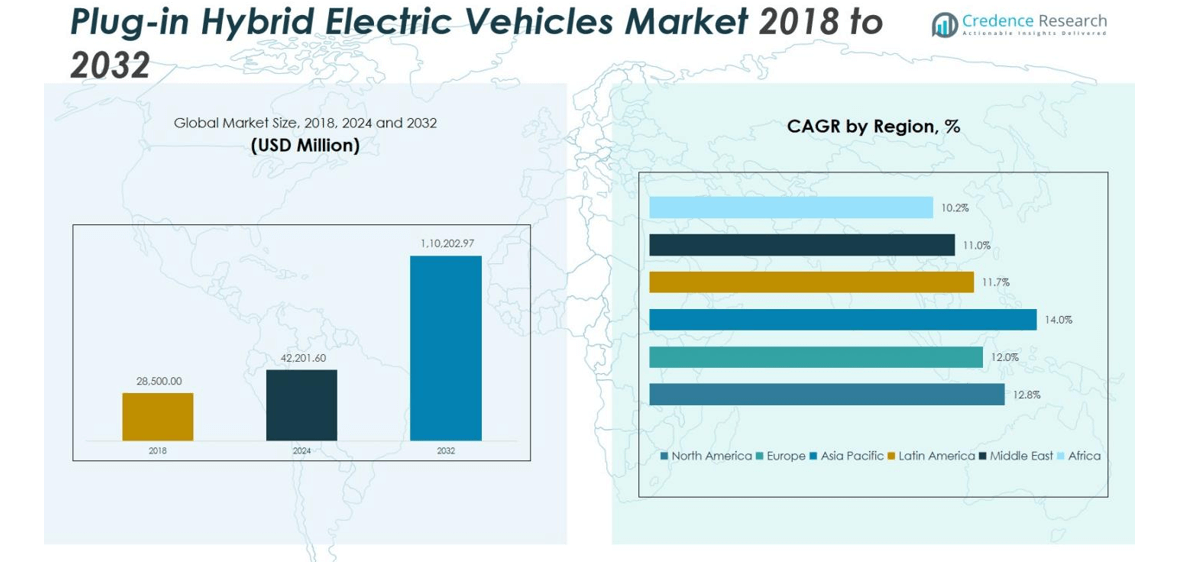
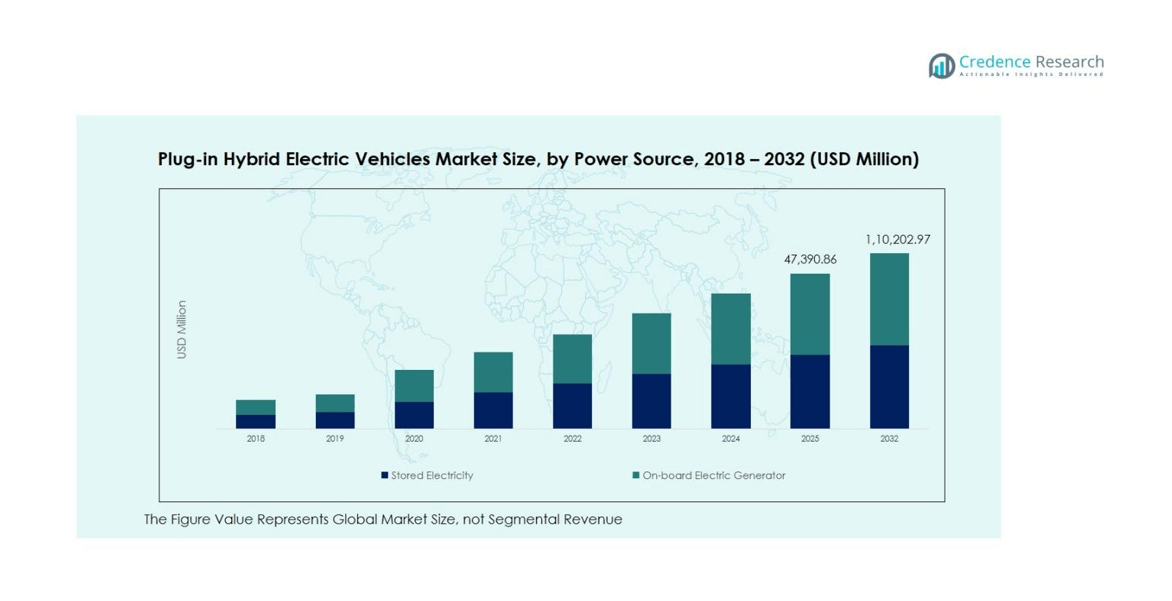
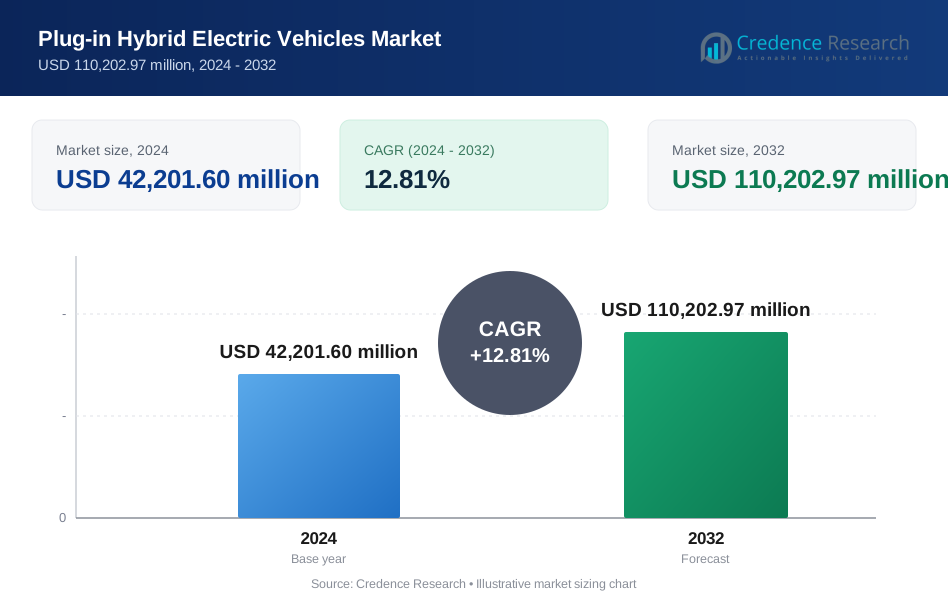
The Plug-in Hybrid Electric Vehicles Market size was valued at USD 28,500.00 million in 2018, increasing to USD 42,201.60 million in 2024, and is anticipated to reach USD 110,202.97 million by 2032, registering a CAGR of 12.81% during the forecast period.
| REPORT ATTRIBUTE | DETAILS |
|---|---|
| Historical Period | 2020-2023 |
| Base Year | 2024 |
| Forecast Period | 2025-2032 |
| Plug-in Hybrid Electric Vehicles Market Size 2024 | USD 42,201.60 million |
| Plug-in Hybrid Electric Vehicles Market, CAGR | 12.81% |
| Plug-in Hybrid Electric Vehicles Market Size 2032 | USD 110,202.97 million |
The Plug-in Hybrid Electric Vehicles (PHEV) market is led by prominent automakers such as Toyota Motor Corporation, BMW Group, Ford Motor Company, Nissan Motor Co., Ltd., Mercedes-Benz Group AG, Volkswagen AG, Honda Motor Co., Ltd., Renault Group, and General Motors. These players dominate through continuous innovation in hybrid powertrains, expansion of electric vehicle portfolios, and strategic collaborations with battery and technology providers. Toyota and BMW hold strong positions with advanced hybrid architectures and wide model availability, while Volkswagen and Ford are rapidly scaling production to meet growing global demand. Regionally, Asia Pacific leads the PHEV market with over 42% market share in 2024, driven by strong adoption in China, Japan, and South Korea, supported by government incentives, robust charging infrastructure, and expanding consumer preference for sustainable mobility solutions.
Market Insights
- The Plug-in Hybrid Electric Vehicles Market was valued at USD 42,201.60 million in 2024 and is projected to reach USD 110,202.97 million by 2032, growing at a CAGR of 12.81% during the forecast period.
- Market growth is primarily driven by rising demand for low-emission and fuel-efficient vehicles, supported by advancements in battery technology and strong government incentives promoting hybrid adoption.
- The market is witnessing trends such as the integration of smart charging infrastructure, expansion of hybrid SUV and crossover models, and technological convergence with connected vehicle systems.
- Key players including Toyota, BMW, Ford, Volkswagen, and Nissan are focusing on hybrid powertrain innovation, partnerships, and cost optimization to strengthen market presence and meet emission targets.
- North America leads with 32% of the global market share, followed by Asia Pacific, while the stored electricity segment dominates with 71% of total revenue, supported by rapid charging network expansion.
Market Segmentation Analysis:
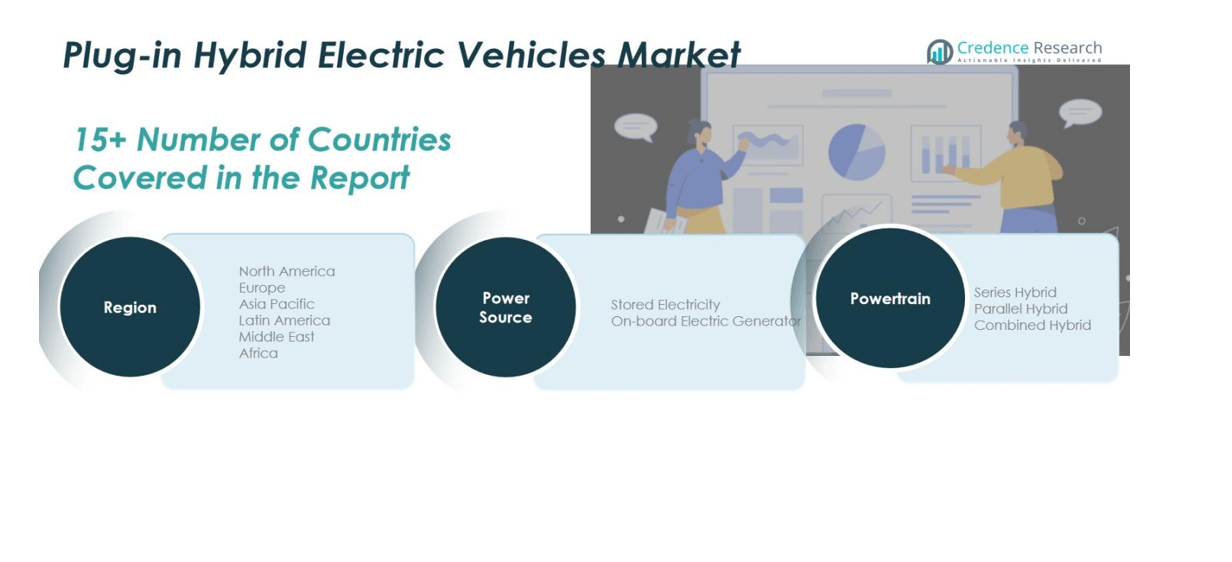
By Power Source
The stored electricity segment dominates the Plug-in Hybrid Electric Vehicles (PHEV) market, accounting for 71% of the total revenue share. Its leadership is supported by the rapid expansion of charging infrastructure, falling lithium-ion battery costs, and stringent emission norms driving the adoption of cleaner power solutions. Consumers increasingly prefer battery-based PHEVs for their extended electric-only range and lower operating costs. Conversely, the on-board electric generator segment holds a smaller market share, catering mainly to regions with limited charging infrastructure. Its appeal lies in enhanced range assurance and hybrid flexibility, though dependency on liquid fuels and higher system complexity limit its overall growth potential.
- For instance, India's public EV charging stations have grown fivefold from FY22 to early FY25, reaching over 26,000 stations, significantly supporting battery-based PHEV adoption.
By Powertrain
The parallel hybrid sub-segment leads the powertrain market, representing 82% of the overall segment share. This dominance is attributed to its efficient design that allows both the internal combustion engine and electric motor to power the wheels directly, providing higher fuel efficiency and seamless performance for SUVs and sedans. The series hybrid configuration, holding a moderate share, is valued for its smooth electric driving experience but limited by inefficiency at higher speeds. Meanwhile, the combined hybrid system is gaining traction with an estimated 48% share in advanced models, offering optimized energy use and superior performance despite its higher cost and engineering complexity.
- For instance, Toyota's Hybrid Synergy Drive system used in the Prius and Camry Hybrid exemplifies this, delivering seamless power integration and improved fuel economy.
Key Growth Drivers
Advancements in Battery Technology
Ongoing advancements in lithium-ion and solid-state battery technologies are significantly driving the Plug-in Hybrid Electric Vehicles (PHEV) market. These innovations enhance energy density, reduce charging time, and extend vehicle range, making PHEVs more practical for daily commuting. Falling battery costs are also lowering vehicle prices, making hybrids more accessible to mass consumers. Automakers are investing heavily in next-generation batteries that offer better efficiency and durability, thereby improving overall performance and reducing lifecycle emissions-factors crucial to accelerating the global adoption of PHEVs.
- For instance, Mercedes-Benz has partnered with Factorial Energy to develop Solstice solid-state batteries that promise to extend EV ranges to over 600 miles with higher safety and energy density, significantly enhancing PHEV practicality.
Government Incentives and Emission Regulations
Stringent emission standards and supportive government policies are major growth catalysts for the PHEV market. Tax benefits, purchase subsidies, and registration fee reductions are encouraging consumers to switch from internal combustion vehicles to hybrids. Regulatory bodies in regions such as the European Union, China, and North America are mandating lower carbon emissions and promoting hybrid technologies as a transitional solution toward full electrification. This policy-driven push is compelling automakers to expand PHEV portfolios and invest in cleaner mobility innovations.
- For instance, in Spain, private buyers of PHEVs with a gross list price below €45,000 can claim a personal income tax deduction of 15% of the acquisition cost, up to a maximum of €3,000, as part of the 2025 incentive scheme.
Rising Consumer Demand for Fuel Efficiency
Growing consumer awareness regarding environmental sustainability and fuel efficiency is a primary driver of the PHEV market. Consumers are increasingly drawn to hybrid models for their ability to deliver both electric-only operation and extended range without compromising performance. Rising fuel prices further strengthen the case for PHEVs, especially in urban areas where short-distance electric driving reduces costs and emissions. Automakers are responding with advanced powertrain designs and competitive pricing strategies to meet this shifting demand toward greener, cost-effective mobility solutions.
Key Trends and Opportunities
Integration of Smart Charging Infrastructure
The integration of smart charging solutions and grid-connected technologies presents a transformative trend in the PHEV market. Manufacturers and energy providers are collaborating to develop vehicle-to-grid (V2G) systems that allow bidirectional energy flow, optimizing energy consumption and supporting grid stability. The rise of fast-charging stations and mobile charging units further enhances convenience and range reliability for PHEV owners. This technological evolution offers opportunities for automakers to expand ecosystem-based business models and improve user experience across global markets.
- For instance, Toyota has developed a vehicle-to-grid (V2G) system that enables electric vehicles to supply electricity back to the grid during peak demand or outages, enhancing grid reliability through bidirectional energy flow.
Expansion of Hybrid Fleets in Commercial Mobility
The adoption of plug-in hybrid technology in commercial fleets, including logistics and ride-sharing services, offers significant growth potential. Businesses are increasingly shifting toward PHEVs to meet sustainability targets while maintaining operational flexibility. Fleet electrification reduces total cost of ownership through lower fuel and maintenance expenses. Governments offering fleet purchase incentives and corporate sustainability initiatives further amplify this opportunity. As demand for urban delivery and mobility-as-a-service models rises, hybrid fleet deployment is becoming a strategic avenue for market expansion.
- For instance, DHL Supply Chain introduced Volvo FM electric trucks with a 540 kWh battery and a range of up to 180 miles in the UK, significantly reducing emissions and operational costs.
Key Challenges
High Initial Cost and Battery Replacement Expense
The high upfront cost of plug-in hybrid vehicles remains a major barrier to market growth. Advanced powertrain systems and battery components significantly increase vehicle pricing compared to conventional models. Additionally, long-term ownership costs rise with potential battery replacement expenses after warranty periods. These financial constraints deter middle-income consumers despite long-term fuel savings. Automakers are focusing on cost optimization, localized manufacturing, and scalable battery production to mitigate these pricing challenges and enhance affordability in emerging markets.
Limited Charging Infrastructure in Developing Regions
Insufficient charging infrastructure, particularly in developing and rural areas, poses a significant restraint to PHEV adoption. Inadequate public charging networks limit the convenience of recharging, discouraging potential buyers who rely on reliable access to charging facilities. While developed regions are advancing rapidly in charging deployment, developing nations lag due to high setup costs and grid limitations. Strategic government investment, private sector partnerships, and smart grid integration are essential to overcome this bottleneck and support the wider rollout of plug-in hybrid mobility solutions.
Regional Analysis
North America
North America accounted for 32% of the global Plug-in Hybrid Electric Vehicles (PHEV) market in 2024, valued at USD 13,605.54 million, up from USD 9,313.80 million in 2018. The market is projected to reach USD 35,474.54 million by 2032, registering a CAGR of 12.8%. Growth is primarily driven by strong government incentives, rapid EV infrastructure expansion, and the presence of leading automakers such as Ford, General Motors, and Tesla introducing hybrid variants. Increasing consumer preference for sustainable mobility and supportive emission policies are further propelling regional adoption, especially across the U.S. and Canada.
Europe
Europe represents 26% of the global PHEV market, valued at USD 10,751.81 million in 2024, rising from USD 7,552.50 million in 2018 and projected to reach USD 26,531.66 million by 2032, at a CAGR of 12.0%. The region benefits from stringent carbon regulations, widespread EV subsidies, and strong automotive innovation across Germany, France, and the UK. European automakers such as BMW, Volkswagen, and Mercedes-Benz are leading hybrid development, focusing on battery efficiency and sustainability. The EU’s Green Deal initiatives and growing public charging networks are strengthening the market outlook.
Asia Pacific
Asia Pacific dominates the global Plug-in Hybrid Electric Vehicles market with a 31% market share, valued at USD 12,991.58 million in 2024, up from USD 8,464.50 million in 2018, and is forecasted to reach USD 36,840.94 million by 2032, growing at a CAGR of 14.0%. China, Japan, and South Korea are key contributors due to massive investments in hybrid technology, large-scale production, and government-led electrification programs. Expanding urbanization, rising disposable incomes, and growing awareness of sustainable mobility are fueling adoption. Strategic collaborations among Asian automakers and battery producers further enhance regional competitiveness.
Latin America
Latin America held a 6% share of the Plug-in Hybrid Electric Vehicles market in 2024, valued at USD 2,464.15 million, rising from USD 1,681.50 million in 2018, and is anticipated to reach USD 5,936.63 million by 2032, growing at a CAGR of 11.7%. Brazil and Mexico are leading markets, driven by supportive policies for low-emission vehicles and growing awareness of fuel-efficient mobility. The availability of affordable hybrid options and increasing investment by global automakers are improving market accessibility. However, limited charging infrastructure continues to challenge widespread regional adoption.
Middle East
The Middle East accounted for 3% of the global market, valued at USD 1,206.69 million in 2024, up from USD 883.50 million in 2018, and is projected to reach USD 2,766.70 million by 2032, expanding at a CAGR of 11.0%. The region’s growth is driven by increasing governmental focus on energy diversification and sustainability initiatives, particularly in the UAE and Saudi Arabia. Premium automakers are introducing hybrid models tailored for high-performance segments. However, dependency on conventional fuel and limited local manufacturing capabilities slightly restrain faster adoption.
Africa
Africa represents 2% of the global Plug-in Hybrid Electric Vehicles market, with a valuation of USD 1,181.82 million in 2024, increasing from USD 604.20 million in 2018, and expected to reach USD 2,652.50 million by 2032, registering a CAGR of 10.2%. South Africa dominates regional sales, supported by gradual infrastructure development and rising environmental awareness. Although high vehicle costs and limited charging facilities pose barriers, growing government initiatives and foreign investment in green mobility are likely to boost adoption over the forecast period.\
Market Segmentations:
By Power Source
- Stored Electricity
- On-board Electric Generator
By Powertrain
- Series Hybrid
- Parallel Hybrid
- Combined Hybrid
By Region
- North America
- U.S.
- Canada
- Mexico
- Europe
- Germany
- France
- U.K.
- Italy
- Spain
- Rest of Europe
- Asia Pacific
- China
- Japan
- India
- South Korea
- South-east Asia
- Rest of Asia Pacific
- Latin America
- Brazil
- Argentina
- Rest of Latin America
- Middle East & Africa
- GCC Countries
- South Africa
- Rest of the Middle East and Africa
Competitive Landscape
The competitive landscape of the Plug-in Hybrid Electric Vehicles (PHEV) market is characterized by intense rivalry among leading automakers such as Toyota Motor Corporation, BMW Group, Ford Motor Company, Nissan Motor Co., Ltd., Mercedes-Benz Group AG, Volkswagen AG, Honda Motor Co., Ltd., Renault Group, and General Motors. These companies are focusing on expanding their hybrid vehicle portfolios through technological innovation, battery optimization, and integration of advanced connectivity features. Strategic partnerships, mergers, and joint ventures with battery suppliers and charging network providers are becoming crucial to enhancing market reach and production efficiency. Toyota and BMW continue to lead with robust R&D investments in hybrid architectures, while Ford and Volkswagen are accelerating the introduction of cost-effective PHEVs for mainstream consumers. Competition also centers on sustainability initiatives, lightweight materials, and improved powertrain performance. As emission regulations tighten globally, manufacturers are adopting electrification strategies to strengthen their market share and brand positioning in the hybrid vehicle segment.
Key Player Analysis
- Nissan Motor Co., Ltd.
- Mercedes-Benz Group AG
- General Motors
- Volkswagen AG
- Renault Group
- Ford Motor Company
- BMW Group
- Honda Motor Co., Ltd.
- Toyota Motor Corporation
Recent Developments
- In October 2025, BYD Auto introduced its SEALION 6 DM-i, the company’s first plug-in hybrid model for the Japanese market, unveiled at the Japan Mobility Show 2025.
- In December 2024, Toyota Motor Corporation revealed plans to launch its all-new Alphard and Vellfire PHEV models in Japan from January 2025.
- In October 2025, Volvo Cars celebrated the delivery of its one-millionth plug-in hybrid vehicle, marking a key milestone in its electrification strategy.
- On October 04, 2025, Chery Malaysia launched its TIGGO 7 PHEV and TIGGO 8 PHEV models, expanding its new energy vehicle line-up in Malaysia
Report Coverage
The research report offers an in-depth analysis based on Power Source, Powertrain and Region. It details leading market players, providing an overview of their business, product offerings, investments, revenue streams, and key applications. Additionally, the report includes insights into the competitive environment, SWOT analysis, current market trends, as well as the primary drivers and constraints. Furthermore, it discusses various factors that have driven market expansion in recent years. The report also explores market dynamics, regulatory scenarios, and technological advancements that are shaping the industry. It assesses the impact of external factors and global economic changes on market growth. Lastly, it provides strategic recommendations for new entrants and established companies to navigate the complexities of the market.
Future Outlook
- The market will experience strong growth driven by the global shift toward sustainable mobility solutions.
- Automakers will increase investments in hybrid technology to bridge the gap between conventional and fully electric vehicles.
- Continuous advancements in battery technology will enhance range, charging efficiency, and overall vehicle performance.
- Government policies promoting low-emission vehicles will accelerate adoption across major economies.
- Integration of smart charging infrastructure and vehicle-to-grid technology will improve energy management and user convenience.
- Hybrid models in the SUV and crossover segments will dominate due to rising consumer preference for versatile vehicles.
- Expansion of hybrid fleets in logistics and public transportation will create new growth opportunities.
- Emerging markets in Asia Pacific and Latin America will witness rapid adoption supported by urbanization and policy incentives.
- Competition among key players will intensify, leading to more affordable and efficient hybrid offerings.
- Technological convergence with autonomous and connected systems will shape the next generation of plug-in hybrid vehicles.
Request a Free Sample
Fill in your details and we'll send you a free sample report.
- Sample data tables & charts
- Research methodology
Need a Custom Version of This Report?
Tailor the scope, geography, or segments to your exact requirements.
- Custom geography or segment scope
- Direct access to our analyst team
Frequently Asked Questions
What is the current market size for the Plug-in Hybrid Electric Vehicles Market, and what is its projected size in 2032?
At what Compound Annual Growth Rate is the Plug-in Hybrid Electric Vehicles Market projected to grow between 2025 and 2032?
Which Plug-in Hybrid Electric Vehicles Market segment held the largest share in 2024?
What are the primary factors fueling the growth of the Plug-in Hybrid Electric Vehicles Market?
Who are the leading companies in the Plug-in Hybrid Electric Vehicles Market?
Who are the major players in this market?
Table of Content
Chapter 1. Report Introduction
- 1.1 Report Description & Purpose
- 1.1.1 Report Title & Market Definition
- 1.1.2 Unique Selling Propositions (USP) & Key Differentiators
- 1.1.3 Value Proposition for Stakeholders
- 1.2 Research Objectives
- 1.2.1 Market Sizing Objectives (Volume & Revenue) (Volume Where Applicable)
- 1.2.2 Segmentation Objectives
- 1.2.3 Competitive Intelligence Objectives
- 1.2.4 Forecast & Scenario Objectives
- 1.3 Report Scope
- 1.3.1 Plug-in Hybrid Electric Vehicles Scope – Segments & Subsegments Covered
- 1.3.2 Geographic Scope – Regions & Countries Covered
- 1.3.3 Historical Period, Base Year & Forecast Period (2024; forecast to 2032)
- 1.3.4 Inclusions & Exclusions
- 1.4 Industry Classification & Applicable Codes
- 1.5 Currency, Measurement Units & Valuation Basis
- 1.6 Target Stakeholders
- 1.7 Limitations & Assumptions
Chapter 2. Executive Summary
- 2.1 Global Plug-in Hybrid Electric Vehicles Market Snapshot
- 2.1.1 Market Size – Historical (2024) & Forecast (2024-2032) (2024: USD 42,201.60 million → 2032: USD 110,202.97 million)
- 2.1.2 Volume & Revenue – Global Totals (Volume Where Applicable)
- 2.1.3 Key Market Highlights – Top Five Facts
- 2.2 Plug-in Hybrid Electric Vehicles Market Segmentation Snapshot
- 2.2.1 Market Split by Region – 2024 vs. 2032
- 2.3 Competitive Snapshot
- 2.3.1 Top 10 Players by Revenue Share – 2024
- 2.3.2 Top 10 Players by Volume Share – 2024 (Volume Where Applicable)
- 2.3.3 Recent Strategic Developments (18-Month Summary)
- 2.4 Key Investment Highlights & Strategic Conclusions
Chapter 3. Plug-in Hybrid Electric Vehicles Market Dynamics & Industry Analysis
- 3.1 Market Overview & Context
- 3.1.1 Plug-in Hybrid Electric Vehicles Market Position in the Broader Industry Value Chain
- 3.1.2 Demand Structure & Purchasing Dynamics
- 3.1.3 Market Maturity & Development Stage by Region
- 3.2 Plug-in Hybrid Electric Vehicles Market Drivers
- 3.3 Plug-in Hybrid Electric Vehicles Market Restraints & Challenges
- 3.4 Plug-in Hybrid Electric Vehicles Market Opportunities
- 3.5 Porter's Five Forces Analysis
- 3.5.1 Threat of New Entrants
- 3.5.2 Bargaining Power of Suppliers
- 3.5.3 Bargaining Power of Buyers
- 3.5.4 Threat of Substitutes
- 3.5.5 Competitive Rivalry – Intensity Assessment
- 3.6 Plug-in Hybrid Electric Vehicles Value Chain Analysis
- 3.6.1 Upstream – Key Inputs, Resources & Suppliers
- 3.6.1.1 Key Input/Resource 1
- 3.6.1.2 Key Input/Resource 2
- 3.6.1.3 Key Input/Resource 3
- 3.6.2 Midstream – Core Operations & Value Creation
- 3.6.2.1 Operating Model & Process Overview
- 3.6.2.2 Key Operating Locations & Capabilities by Company
- 3.6.3 Downstream – Market Channels & End Users
- 3.6.3.1 Direct Sales & Customer Engagement Channels
- 3.6.3.2 Indirect Sales, Intermediaries & Partner Channels
- 3.6.4 Value Chain Profitability Analysis
- 3.6.1 Upstream – Key Inputs, Resources & Suppliers
- 3.7 PESTEL Analysis
- 3.7.1 Political Factors
- 3.7.2 Economic Factors
- 3.7.3 Social Factors
- 3.7.4 Technological Factors
- 3.7.5 Environmental Factors
- 3.7.6 Legal Factors
- 3.8 Plug-in Hybrid Electric Vehicles Supply Chain Analysis
- 3.8.1 Critical Input & Resource Availability Risk Assessment
- 3.8.2 Supplier & Operational Concentration Risk (Geographic Exposure)
- 3.8.3 Supply & Service Disruption Impact Analysis
- 3.9 Regulatory & Policy Landscape
Note: The regulatory and policy landscape section covers regulations based on their applicability to the market, Plug-in Hybrid Electric Vehicles category, geography, and scope of the study. Only regulatory frameworks with a material impact on operations, compliance, trade, sustainability, or market access are analyzed in detail.
Chapter 4. Key Investment Pockets & Opportunity Analysis
- 4.1 Plug-in Hybrid Electric Vehicles Market Attractiveness Analysis
- 4.1.1 By Region – Investment Attractiveness Matrix (Market Size × CAGR)
- 4.2 Absolute Revenue Growth Opportunity
- 4.2.1 By Region – Absolute Revenue Growth Through 2032
- 4.3 Incremental Demand Opportunity
- 4.3.1 By Region – Incremental Demand Through 2032
- 4.3.2 Segment – Incremental Demand
- 4.4 Emerging Submarket Opportunity Deep Dive (Subject to Applicability)
- 4.5 Priority Market Opportunity Scorecards
- 4.5.1 United States
- 4.5.2 Europe
- 4.5.3 Asia
- 4.5.4 Middle East & Africa
Note: Priority market opportunity scorecards reflect the geographic scope and strategic relevance of the study. Listed markets are indicative and may be adapted to the industry.
Chapter 5. Plug-in Hybrid Electric Vehicles Cross-Border Trade & Market Access Analysis
- 5.1 International Trade & Cross-Border Activity Overview
- 5.1.1 Global Export Value by Country (2024)
- 5.1.2 Global Export Volume by Country (2024) (Volume Where Applicable)
- 5.1.3 Global Import Value by Country (2024)
- 5.1.4 Global Import Volume by Country (2024) (Volume Where Applicable)
- 5.1.5 Net Trade Balance by Country (2024)
- 5.2 Export Analysis – Segment
- 5.2.1 Category 1 (Applicable Classification Code)
- 5.2.2 Category 2 (Applicable Classification Code)
- 5.2.3 Category 3 (Applicable Classification Code)
- 5.2.4 Category 4 (Applicable Classification Code)
- 5.2.5 Category 5 (Applicable Classification Code)
- 5.3 Import Analysis – Segment
- 5.3.1 Category 1 (Applicable Classification Code)
- 5.3.2 Category 2 (Applicable Classification Code)
- 5.3.3 Category 3 (Applicable Classification Code)
- 5.3.4 Category 4 (Applicable Classification Code)
- 5.3.5 Category 5 (Applicable Classification Code)
- 5.4 Cross-Border Pricing & Transaction Benchmarks
- 5.4.1 Export Pricing – Segment & Country
- 5.4.2 Import Pricing – Segment & Source Country
- 5.4.3 Price Trends (2024)
- 5.5 Key Cross-Border Trade & Delivery Routes
- 5.5.1 Cross-Border Trade/Delivery Route 1
- 5.5.2 Cross-Border Trade/Delivery Route 2
- 5.5.3 Cross-Border Trade/Delivery Route 3
- 5.5.4 Cross-Border Trade/Delivery Route 4
- 5.5.5 Cross-Border Trade/Delivery Route 5
- 5.6 Trade Policy & Market Access Impact Assessment
- 5.6.1 Tariff & Non-Tariff Barriers
- 5.6.2 Regional Trade & Economic Integration Frameworks
- 5.6.3 Bilateral & Multilateral Trade Agreements
- 5.6.4 Cross-Border Operating, Licensing & Localization Requirements
Note: This chapter applies where cross-border trade or delivery is relevant to Plug-in Hybrid Electric Vehicles. Goods, services, and digital offerings are assessed using applicable classifications and transaction measures. Import-export volumes, trade balances, and route analyses are included only where meaningful to the market.
Chapter 6. Competitive Landscape & Company Benchmarking
- 6.1 Plug-in Hybrid Electric Vehicles Market Concentration & Structure
- 6.1.1 Herfindahl-Hirschman Index (HHI) – vs. 2024
- 6.1.2 Leading, Mid-Sized & Emerging Player Structure
- 6.1.3 Global, Regional & Local Player Dynamics
- 6.2 Plug-in Hybrid Electric Vehicles Market Share Analysis – 2024
- 6.2.1 Global Revenue Share by Company
- 6.2.2 Global Volume Share by Company (Volume Where Applicable)
- 6.2.3 Regional Revenue Share
- 6.2.4 Market Share Evolution ( vs. 2024)
- 6.2.5 Company Market Share by Key Segment
- 6.2.6 Company Market Share by Customer Group
- 6.3 Operating Scale, Capacity & Infrastructure Analysis
- 6.3.1 Global Operating Scale & Supply Capacity
- 6.3.2 Resource Utilization & Operating Efficiency
- 6.3.3 Output, Service Delivery & Activity Metrics
- 6.3.4 Operating Footprint & Infrastructure Map
- 6.3.5 Planned Operational & Capacity Expansion
- 6.4 Plug-in Hybrid Electric Vehicles Competitive Benchmarking Matrix
- 6.4.1 Revenue, Growth, Profitability & Operating Metric Comparison
- 6.4.2 Channel Revenue Mix
- 6.4.3 Geographic Revenue Exposure
- 6.4.4 R&D Intensity
- 6.4.5 Sustainability Maturity
- 6.5 Strategic Developments in Plug-in Hybrid Electric Vehicles (Last 24 Months)
- 6.5.1 Mergers, Acquisitions & Divestments
- 6.5.2 New Products, Services & Solutions in Plug-in Hybrid Electric Vehicles
- 6.5.3 Operational & Infrastructure Expansions
- 6.5.4 Strategic Alliances, Joint Ventures & Partnerships
- 6.5.5 Distribution Expansion & Market Entry
- 6.5.6 Sustainability & ESG Initiatives
- 6.6 Competitive Strategy Mapping
- 6.6.1 Leader, Challenger, Follower & Niche Classification
- 6.6.2 Pricing Strategy Comparison
- 6.6.3 Channel Strategy Matrix
Note: Strategic developments are included based on their materiality and the availability of reliable information.
Chapter 7. Global Plug-in Hybrid Electric Vehicles Market – By Sales & Delivery Channel
- 7.1 Segment Overview
- 7.1.1 Volume & Revenue Split by Channel (2024 & 2032) (Volume Where Applicable)
- 7.1.2 Channel Mix Evolution (2024-2032)
Chapter 8. Regional Market Analysis – Global Overview
- 8.1 Global Regional Overview
- 8.1.1 Regional Volume Share (Volume Where Applicable)
- 8.1.2 Regional Revenue Share
- 8.1.3 Regional Volume by Region (Volume Where Applicable)
- 8.1.4 Regional Revenue by Region
- 8.1.5 Regional Forecast Through 2032
- 8.2 Cross-Regional Segment Analysis
- 8.2.1 By Sales & Delivery Channel
- 8.2.2 By Competitive Positioning & Price Tier
Chapter 9. North America Plug-in Hybrid Electric Vehicles Market
- 9.1 United States
- 9.2 Canada
- 9.3 Mexico
Chapter 10. Europe Plug-in Hybrid Electric Vehicles Market
- 10.1 Germany
- 10.2 France
- 10.3 Italy
- 10.4 United Kingdom
- 10.5 Spain
- 10.6 Poland
- 10.7 Russia
- 10.8 Netherlands
- 10.9 Belgium
- 10.10 Sweden
- 10.11 Denmark
- 10.12 Norway
- 10.13 Rest of Europe
Chapter 11. Asia Pacific Plug-in Hybrid Electric Vehicles Market
- 11.1 China
- 11.2 India
- 11.3 Japan
- 11.4 South Korea
- 11.5 Thailand
- 11.6 Indonesia
- 11.7 Vietnam
- 11.8 Malaysia
- 11.9 Australia
- 11.10 Rest of Asia Pacific
Chapter 12. Latin America Plug-in Hybrid Electric Vehicles Market
- 12.1 Brazil
- 12.2 Argentina
- 12.3 Colombia
- 12.4 Chile
- 12.5 Rest of Latin America
Chapter 13. Middle East Plug-in Hybrid Electric Vehicles Market
- 13.1 Saudi Arabia
- 13.2 United Arab Emirates
- 13.3 Turkey
- 13.4 Israel
- 13.5 Iran
- 13.6 Rest of the Middle East
Chapter 14. Africa Plug-in Hybrid Electric Vehicles Market
- 14.1 South Africa
- 14.2 Egypt
- 14.3 Nigeria
- 14.4 Morocco
- 14.5 Rest of Africa
Chapter 15. Plug-in Hybrid Electric Vehicles Company Profiles
- 15.1 [Company 01]
- 15.1.1 Company Overview
- 15.1.2 Key Management Personnel
- 15.1.3 Products & Services Portfolio
- 15.1.4 Financial Performance
- 15.1.5 Key Market Focus & Geographic Presence
- 15.1.6 Recent Developments & Strategic Initiatives
Note: The company profile list is preliminary and may change based on research findings, market developments, data availability, and client requirements.
Chapter 16. Appendices
- Appendix A – List of Abbreviations & Acronyms
- Appendix B – Industry Classification Code Reference – Full Series
- Appendix C – Supply, Output & Operating Capacity Data Tables
- Appendix D – End-Use & Demand Base Tables
- Appendix E – Demand, Adoption & Usage Assumptions
- Appendix F – Pricing & Revenue Metric Reference Tables
- Appendix G – Company Operations & Infrastructure Database
- Appendix H – Cross-Border Trade & Activity Data Tables (Where Applicable)
- Appendix I – Regulatory Summary Tables
- Appendix J – Primary Research Participant List (Anonymized)
- Appendix K – Primary Research Questionnaire Framework
- Appendix L – Data Sources & Bibliography
- Appendix M – Market Size Divergence & Source Comparison
Chapter 17. Research Methodology
- 17.1 Research Framework & Philosophy
- 17.2 Secondary Research – Sources, Hierarchy & Data Extraction
- 17.3 Data Modeling – Bottom-Up & Top-Down Market Sizing
- 17.4 Primary Research – Stakeholder Framework, LOI & Sample Sizes
- 17.5 Forecast Methodology – Regression, Scenario & Sensitivity Analysis
- 17.6 Quality Control – Four-Layer Validation Framework
- 17.7 Limitations & Standard Assumptions
- 17.8 Disclaimer
