
| REPORT ATTRIBUTE | DETAILS |
|---|---|
| Historical Period | 2019-2022 |
| Base Year | 2023 |
| Forecast Period | 2024-2032 |
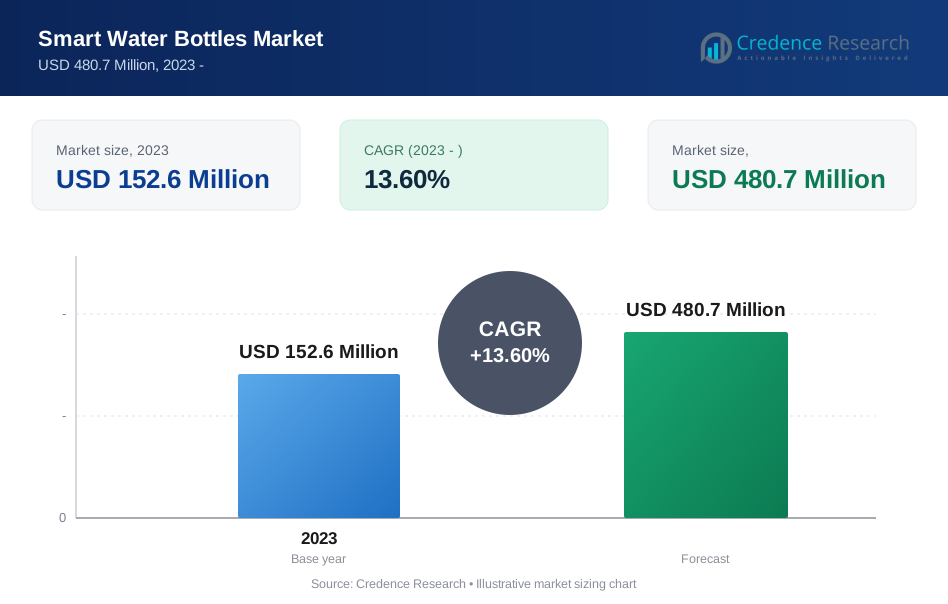
| Smart Water Bottles Market Size 2023 | USD 152.6 Million |
| Smart Water Bottles Market, CAGR | 13.60% |
| Smart Water Bottles Market Size 2032 | USD 480.7 Million |
Market Insights
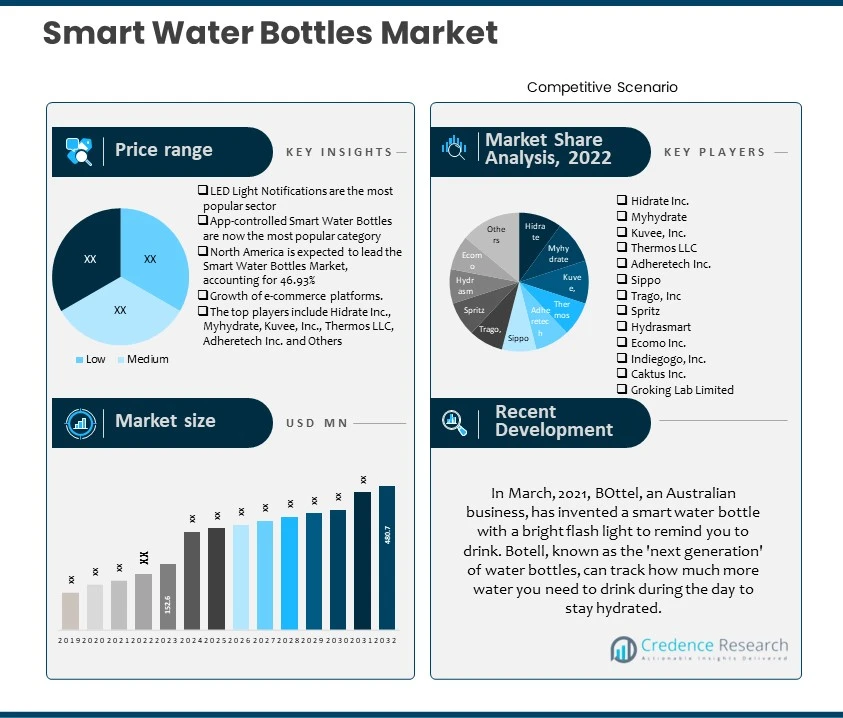
- The global demand for Smart Water Bottles was valued at USD 152.6 Million in 2023 and is expected to reach USD 480.7 Million in 2032, growing at a CAGR of 13.60% between 2024 and 2032.
- In 2023, the Hydration Tracking Bottles category will account for the majority of the Smart Water Bottle Market, with Temperature Control Bottles also playing an important role.
- Stainless Steel Smart Water Bottles are expected to be a significant share-holding category, while Glass Smart Water Bottles may be the fastest-growing market.
- App-controlled Smart Water Bottles are now the most popular category, and the fastest-growing area is expected to be Sync with Fitness Trackers and Health Apps.
- Sensor-based Hydration Tracking is predicted to lead the worldwide smart water bottle market, with Smart Lid or Cap Sensors being another key market sector.
- LED Light Notifications are the most popular segment of the smart water bottle market.
- Collapsible Smart Water Bottles are probably the fastest-growing area of the market.
- Rechargeable Smart Water Bottles are the most popular sector.
- The most demanding category is fitness fanatics and athletes, with health-conscious customers also playing a significant role.
- The Online Retailers sector had the biggest market share in 2023, accounting for 64.22%, while Convenience Stores is expected to be the fastest-growing area throughout the forecast period.
- North America is expected to lead the Smart Water Bottles Market, accounting for 46.93%, while Asia-Pacific will experience considerable market expansion.
- Vacuum Insulation holds a significant part of the market.
- Technological advancements will drive market expansion.
- High cost and battery life impedes industry expansion.
Executive Summary
Market Definition
A smart bottle uses sensor technology to track a person's water intake. Smart bottles use sensor technology, typically situated in the bottle's cap, to determine how much water a person is drinking. Smart bottles include temperature sensors, freshness timers, drinking reminders, and daily hydration statistics. These qualities help the drinker decide when to refill their bottle, how frequently they drink, and how much extra water to include in their daily goal. The growing number of conscientious customers who need to maintain their strength and fitness is driving the growth of the Smart bottle market globally.
Market Overview
The global Smart Water Bottles Market has witnessed steady growth in recent years and is expected to grow at a CAGR of 13.60% between 2024 and 2032. The market was valued at USD 152.6 million in 2023 and is expected to reach USD 480.7 million in 2032.
IoT technology is being employed in a variety of industries to build user-friendly and intelligent products. Smart things communicate with other smart devices via Internet of Things (IoT) technologies. IoT technologies enable product designers and consumers to exchange real-time usage information. For instance, smart bottles with measurement employ IoT technology to connect with smart devices that have an app for collecting usage statistics. As a result, the increased usage of IoT for smart bottle products is likely to propel the smart bottle market forward throughout the forecast period.
The smart bottle industry is expanding northward, driven by rising health consciousness among young people and adults, as well as an increased understanding of hydration technologies. Furthermore, the increased demand for fitness trackers, gym accessories, and wireless technologies is likely to drive the smart bottle market growth over the forecast period.
The high cost of smart bottles is projected to be a major impediment to smart bottle market growth over the forecast period. The cost of smart bottles is likely to rise dramatically throughout the forecast period due to the usage of sensor technology and crucial technical capabilities such as information about the user's hydration status, as well as their connection to mobile apps. Furthermore, the typical battery life of a smart bottle is 6 months, which is significantly reduced by alerts and the time spent connecting it to any mobile app, resulting in inaccuracy. As a result, the decline in battery life is viewed as a significant impediment to the expansion of the smart bottle business.
Segmentation by Type of Smart Water Bottle
- In 2023, the Hydration Tracking Bottles category will account for the highest proportion of the Smart Water Bottle Market (62.3%). The majority of interactive bottle makers provide accurate information about their users' daily water intake and allow them to set individualized hydration goals. As hydration technology has become increasingly important for both adolescents and adults, applications are evolving into individualized systems to assist users in meeting daily goals.
- Temperature Control Bottles are an important market segment.
Segmentation by Material Compositions
- Stainless Steel Smart Water Bottles are projected to be a substantial share-holding category because of their durability, insulating qualities, and eco-friendliness.
- On the other hand, Glass Smart Water Bottles could be the fastest-growing market
Segmentation by Connectivity Features
- App-controlled Smart Water Bottles are currently the most popular category in the Smart Water Bottles Market. These bottles provide convenience and customization through smartphone apps, allowing users to track their water intake and create reminders with ease.
- However, the fastest-growing area is projected to be Sync with Fitness Trackers and Health Apps.
Segmentation by Hydration Tracking Technology
- The Sensor-based Hydration Tracking segment is expected to dominate the global smart water bottle market during the forecast period. Smart bottles with sensors offer health and fitness tracking capabilities. These sensors are essential for tracking users' water intake, allowing them to keep hydrated throughout the day and maintain their regular hydration track.
- Smart Lid or Cap Sensors are another significant market sector.
Segmentation by Reminder Mechanisms
- LED Light Notifications are the most popular segment of the Smart Water Bottles Market. These notifications give an easy-to-see visual cue, especially in different lighting circumstances, making them a popular choice for consumers looking for a clear indication of their hydration status.
Segmentation by Temperature Control Features
- Vacuum Insulation holds a considerable part of the Smart Water Bottles Market. Vacuum insulation technology keeps the temperature of the liquid inside the bottle stable for an extended amount of time, whether hot or cold, making it a popular choice for customers who want to keep their beverages at the ideal temperature for longer periods of time.
- Additionally, Double-Walled Construction is an important component in the industry.
Segmentation by Design and Capacity
- Collapsible Smart Water Bottles are most likely the fastest-growing segment of the Smart Water Bottles Market. These bottles are popular with consumers who are on the go and appreciate space-saving features in their hydration items because they are convenient and portable.
Segmentation by Power Source
- Rechargeable Smart Water Bottles are the most popular sector in the Smart Water Bottles Market. These bottles are easily rechargeable, reducing the need for frequent battery replacements and providing a sustainable and cost-effective alternative for users who appreciate environmentally friendly and long-lasting products.
Segmentation by End-User
- Fitness enthusiasts and athletes are the most demanding segment of the Smart Water Bottles Market. They frequently demand particular qualities such as durability, insulation, and convenience of use to meet their active lifestyles and hydration requirements.
- Another important market niche is health-conscious consumers.
Segmentation by Distribution Channel
- The Online Retailers sector had the greatest market share in 2023, accounting for 64.22%. The smart water bottles are not presently available in retail stores or other offline merchants; the majority of sales are made via the online distribution channel. Customers frequently prefer to buy goods and services over the Internet.
- On the other hand, Convenience Stores is predicted to be the fastest-growing area during the forecast period.
.Segmentation by Region
- North America is predicted to lead the Smart Water Bottles Market, accounting for 46.93%.
- Asia-Pacific will see significant market growth
- The rest of the world, including Latin America, the Middle East, and Africa, supplies the remaining demand for Smart Water Bottles.
North America dominated the Smart Water Bottle Market. The growing demand for advanced fitness tracking systems, as well as increased consumer spending power, are boosting the Smart Water Bottle Market in this region. Furthermore, increased consumer interest in health clubs, as well as the use of technology-enabled gym equipment and fitness trackers, are important factors driving market expansion in North America. According to IHRSA, the health club industry in the United States alone was worth $32.3 billion in 2018. Increased obesity rates in the population, as well as changing consumer lifestyles, are driving the Smart Water Bottle Market share in this area. Furthermore, the increasing use of smart wearable technology is a major factor driving the growth of the Smart Water Bottle Market in North America.
On the other hand, The Asia Pacific area is predicted to develop significantly at a CAGR of 14.37% during the forecast period. The region's rise is due to growing awareness of the necessity of maintaining hydration levels in the body, which is increasing the use of smart bottles. Governments in countries such as India and China are taking steps to limit plastic waste production and promote the use of recyclable materials, resulting in an increase in the manufacturing of smart bottles throughout the region.
Key Highlights of the Report
Type of Smart Water Bottle, Material Compositions, Connectivity Features, Hydration Tracking Technology, Reminder Mechanisms, Temperature Control Features, Design and Capacity, Power Source , End-User, Distribution Channel, and Region segment of the global Smart Water Bottles Market. In 2023, hospitals were the leading category in the global market, while hearing aids were the largest shareholder segment. Adaptive kitchen and dining aids are the fastest-growing market area, whereas memory aids have the highest demand. Also, another prominent market segment is augmentative and alternative communication (AAC) devices, with North America leading the market growth.
The integration of smart technologies and IoT, growing health and wellness trends, and increased consumer focus on hydration tracking are the market's primary drivers. Furthermore, the market is constrained by high starting prices for smart water bottles as well as concerns about data privacy and security. The market's significant opportunities include expanding product features and functions and targeting environmentally concerned consumers.
Nonetheless, North America dominated the smart water bottle market. The growing demand for improved fitness tracking systems, combined with higher consumer buying power, is driving the Smart Water Bottle Market in this area. On the other hand, the Asia Pacific region is expected to develop rapidly at a CAGR of 14.37% during the projection period.
What Are The Main Drivers Of The Global Smart Water Bottles Market?
The Smart Water Bottles Market is being pushed by the combination of smart technology and IoT, which enables enhanced features such as hydration tracking and reminders. Furthermore, the market is benefiting from the growing emphasis on health and wellness trends as customers look for new ways to track their water intake for overall health.
What Are The Major Challenges Faced By The Global Smart Water Bottles Market?
Several constraints must be considered. The high initial costs of smart water bottles may dissuade some consumers from investing in them, restricting market share. Furthermore, customers may be unaware of the benefits and functionality of smart water bottles, which may limit adoption rates.
What Are The Growth Opportunities In The Global Smart Water Bottles Market?
The Smart Water Bottles Market has numerous chances for growth and development. Companies can use the increase of product features and functionalities to reach a larger consumer base looking for individualized hydration solutions. Collaboration with popular fitness and health applications to combine data tracking and analysis could boost the market presence of smart water bottles.
Market Drivers
Several factors drive the global Smart Water Bottles Market. The following are the key drivers of the global Smart Water Bottles Market:
Advancements In Technology
Exercise monitors, smart bands, hydration-tracking applications, and other emerging technologies are becoming increasingly popular as the number of fitness lovers grows. The fitness and health sectors have expanded at an astonishing rate as sensor technology has advanced. To remain competitive in the market, companies are producing a variety of technologically advanced items. For example, Apple is selling two new HidrateSpark intelligent water bottles that let customers to connect their water intake to the Apple Health app. These water bottles are designed with a stainless steel, vacuum-insulated bottom that keeps liquids cool for up to 24 hours. The Apple water bottle includes an ED smart sensor that connects to Apple Health via Bluetooth and tracks users' water intake. Over the projected time, demand for smart water bottles is expected to rise due to its qualities.
Market Restraints
The global Smart Water Bottles Market faces some challenges that may hinder its growth. These include the following:
High Cost and Battery Life
The high cost of smart water bottles is a major impediment to the market's growth. Smart water bottles are created with sensor technology and incorporate key technical tasks such as providing the user with information about their hydration status, as well as being connected to mobile apps, which increases the cost. Furthermore, the average battery life of a smart water bottle is 6 months, which is greatly reduced owing to warnings or the time spent connecting it to any mobile app, resulting in inaccuracy. Thus, the decreasing of battery life is seen as a major factor impeding the growth of the Smart Water Bottle market.
Opportunities
The global Smart Water Bottles Market offers significant growth opportunities. These include the following:
Increasing Internet Penetration
The increasing global penetration of internet and smartphone technology promotes the use of smart water bottles. In addition, all types of mobile data are becoming more affordable. The number of individuals using mobile internet is increasing over the world. It can be managed remotely from a PCS, tablet, or cellphone linked to the Internet. According to current trends, internet users are increasing at a 4% annual rate, which means that 196 million new individuals use the internet each year. As of 2022, 4.9 billion people, or 69% of the global population, were actively using the internet. Thus, increased internet penetration will drive up demand for smart water bottles via online sales channels.
Competitive Landscape
Key Players
The global Smart Water Bottles Market is highly competitive, with several key players. Some of the major players in the market and their market share are as follows:
- Hidrate Inc.
- Myhydrate
- Kuvee, Inc.
- Thermos LLC
- Adheretech Inc.
- Sippo
- Trago, Inc
- Spritz
- Hydrasmart
- Ecomo Inc.
- Indiegogo, Inc.
- Caktus Inc.
- Groking Lab Limited
- Moikit
- Open-2, LLC
- Out of Galaxy
- Thermos L.L.C.
- Lifefuels, Inc.
- Intelligi LLC.
- Ozmo
These organizations prioritize product innovation, Connectivity Features expansion, and mergers and acquisitions to stay competitive.
The global Smart Water Bottles Market's key players continually seek to stay ahead by offering new products and developments.
In September 2019, Lifefuels, a beverage technology startup, announced the development of a smart nutrition bottle. This revolutionary smart nutrition bottle consists of three separate systems: a stylish, smart water bottle and delectable and nutritious multi-serve FuelPods. The smart nutrition bottle also has an app that allows the user to track their hydration and nutrition. Thus, the advent of this innovative product will gain momentum among users, propelling the Smart Water Bottle Market.
In March 2022, Apple introduced two HidrateSpark smart water bottles for sale in its American retail stores and online. These bottles allow users to track their water intake and link it to Apple Health. They are made of shatter- and odor-resistant Tritan plastic and have a rechargeable battery and charging connection.
Summary of Key Findings
- Increased internet penetration will propel market expansion.
- The market is segmented by Type of Smart Water Bottle, Material Compositions, Connectivity Features, Hydration Tracking Technology, Reminder Mechanisms, Temperature Control Features, Design and Capacity, Power Source , End-User, Distribution Channel, and region.
- App-controlled Smart Water Bottles are now the most popular category
- Collapsible Smart Water Bottles are probably the fastest-growing area of the market.
- Stainless Steel Smart Water Bottles are predicted to be a significant share-holding category
- North America is leading market growth.. The market is highly competitive, with key players including Hidrate Inc., Myhydrate, Kuvee, Inc., Thermos LLC, Adheretech Inc. and Others.
Future Outlook
- Integration of smart technologies and Internet of Things
- Increase in health and wellness trends.
- Increasing emphasis on hydration tracking.
- Growth of e-commerce platforms.
- Creation of eco-friendly and sustainable alternatives.
How CXOs Can Benefit from the Credence Research Smart Water Bottles Market Report
The Credence Research Smart Water Bottles Market Report provides CXOs with a comprehensive overview of the market, including:
- Market Temperature Control Features and growth forecast: The report provides detailed estimates of the global Smart Water Bottles Market Temperature Control Features, segmented by Type of Smart Water Bottle, Material Compositions, Connectivity Features, Hydration Tracking Technology, Reminder Mechanisms, Temperature Control Features, Design and Capacity, Power Source , End-User, Distribution Channel and region. It also includes forecasts for the market through 2032 based on key trends and drivers.
- Market segmentation: The report segments the Smart Water Bottles Market by Type of Smart Water Bottle, Material Compositions, Connectivity Features, Hydration Tracking Technology, Reminder Mechanisms, Temperature Control Features, Design and Capacity, Power Source , End-User, Distribution Channel and Region. This segmentation provides CXOs with a granular understanding of the market and the opportunities in each segment…
- Competitive Landscape: The report profiles the key players in the Smart Water Bottles Market and provides insights into their strategies, product offerings, and financial performance. This information can help CXOs to identify and assess their competition.
- Key trends and drivers: The report identifies and analyzes the key trends and drivers that are shaping the Smart Water Bottles Market. This information can help CXOs to make informed decisions about their investments and strategies.
CXOs can use the insights from the Credence Research Smart Water Bottles Market Report to:
- Identify growth opportunities: The report can help CXOs to identify new growth opportunities in the Smart Water Bottles Market. For example, it can provide insights into emerging trends, market dynamics, and competitive landscapes.
- Make informed investment decisions: The report can help CXOs make informed investment decisions about Smart Water Bottles. For example, it provides market analysis and insights into key players, market trends, and growth opportunities.
- Develop competitive strategies: The report can help CXOs develop competitive strategies for their Smart Water Bottles businesses. It provides insights on market trends, customer preferences, and competitor analysis.
- Track market developments: The report can help CXOs monitor market developments and stay ahead of the curve. For example, it provides insights into the latest trends and innovations in the Smart Water Bottles Market.
Overall, the Credence Research Smart Water Bottles Market Report is a valuable resource for CXOs who are looking to gain a deeper understanding of the market and identify opportunities for growth.
Segmentation
By Type of Smart Water Bottle:- Hydration Tracking Bottles
- Reminder Bottles
- Temperature Control Bottles
- UV-C Sterilization Bottles
- Integrated Filtration Bottles
- Infuser Bottles (for adding fruit or herbs)
- Others
- Stainless Steel Smart Water Bottles
- Plastic Smart Water Bottles
- Glass Smart Water Bottles
- Bluetooth-enabled Smart Water Bottles
- Wi-Fi-enabled Smart Water Bottles
- NFC (Near Field Communication) Smart Water Bottles
- App-controlled Smart Water Bottles
- Sync with Fitness Trackers and Health Apps
- Sensor-based Hydration Tracking
- Weight Measurement
- Capacitive Touch Sensors
- Smart Lid or Cap Sensors
- Others
- LED Light Notifications
- Vibration Alerts
- Sound Alerts
- App Notifications
- Customizable Reminder Settings
- Vacuum Insulation
- Double-Walled Construction
- Built-in Cooling System
- Built-in Heating System
- Thermoelectric Cooling Technology
- Others
- Slim Design Smart Water Bottles
- Wide-mouth Smart Water Bottles
- High-capacity Smart Water Bottles (e.g., 32oz, 40oz)
- Collapsible Smart Water Bottles
- Lightweight Smart Water Bottles
- Fashionable Smart Water Bottles (with customizable skins or designs)
- Rechargeable Smart Water Bottles
- Replaceable Battery Smart Water Bottles
- Solar-powered Smart Water Bottles
- Fitness Enthusiasts and Athletes
- Outdoor Enthusiasts (e.g., hikers, campers)
- Health-conscious Consumers
- Office Workers
- Students
- Others
- Online Retailers (e-commerce)
- Specialty Health and Fitness Stores
- Convenience Stores
- Department Stores
- Others
- North America
- The U.S.
- Canada
- Mexico
- Europe
- Germany
- France
- The U.K.
- Italy
- Spain
- Rest of Europe
- Asia Pacific
- China
- Japan
- India
- South Korea
- South-east Asia
- Rest of Asia Pacific
- Latin America
- Brazil
- Argentina
- Rest of Latin America
- Middle East & Africa
- GCC Countries
- South Africa
- Rest of the Middle East and Africa
Request a Free Sample
Fill in your details and we'll send you a free sample report.
- Sample data tables & charts
- Research methodology
Need a Custom Version of This Report?
Tailor the scope, geography, or segments to your exact requirements.
- Custom geography or segment scope
- Direct access to our analyst team
Frequently Asked Questions
What is the current Temperature Control Features of the global Smart Water Bottles Market?
What is the expected growth rate of the Smart Water Bottles Market between 2024 and 2032?
Which segment is leading the market share in terms of Design and Capacity?
Which Reminder Mechanisms segment governs the demand for Smart Water Bottles in the world?
Who are the major players in the global Smart Water Bottles Market?
Table of Content
Chapter 1. Report Introduction
- 1.1 Report Description & Purpose
- 1.1.1 Report Title & Market Definition
- 1.1.2 Unique Selling Propositions (USP) & Key Differentiators
- 1.1.3 Value Proposition for Stakeholders
- 1.2 Research Objectives
- 1.2.1 Market Sizing Objectives (Volume & Revenue)
- 1.2.2 Segmentation Objectives
- 1.2.3 Competitive Intelligence Objectives
- 1.2.4 Forecast & Scenario Objectives
- 1.3 Report Scope
- 1.3.1 Smart Water Bottles Scope – Types & Subtypes Covered
- 1.3.2 Geographic Scope – Regions & Countries Covered
- 1.3.3 Historical Period, Base Year & Forecast Period (2023; forecast to the forecast period)
- 1.3.4 Inclusions & Exclusions
- 1.4 HS Code & Classification Framework
- 1.5 Currency, Units & Pricing Basis
- 1.6 Target Stakeholders
- 1.7 Limitations & Assumptions
Chapter 2. Executive Summary
- 2.1 Global Smart Water Bottles Market Snapshot
- 2.1.1 Market Size – Historical (2023) & Forecast (the forecast period) (2023: USD 152.6 Million → forecast year: USD 480.7 Million)
- 2.1.2 Volume & Revenue – Global Totals
- 2.1.3 Key Market Highlights – Top Five Facts
- 2.2 Smart Water Bottles Market Segmentation Snapshot
- 2.2.1 Market Split by Region – 2023 vs.
- 2.3 Competitive Snapshot
- 2.3.1 Top 10 Players by Revenue Share – 2023
- 2.3.2 Top 10 Players by Volume Share – 2023
- 2.3.3 Recent Strategic Developments (18-Month Summary)
- 2.4 Key Investment Highlights & Strategic Conclusions
Chapter 3. Smart Water Bottles Market Dynamics & Industry Analysis
- 3.1 Market Overview & Context
- 3.1.1 Smart Water Bottles Market Position in the Broader Automotive Value Chain
- 3.1.2 OEM vs. Replacement Market Dynamics
- 3.1.3 Market Maturity & Development Stage by Region
- 3.2 Smart Water Bottles Market Drivers
- 3.3 Smart Water Bottles Market Restraints & Challenges
- 3.4 Smart Water Bottles Market Opportunities
- 3.5 Porter's Five Forces Analysis
- 3.5.1 Threat of New Entrants
- 3.5.2 Bargaining Power of Suppliers
- 3.5.3 Bargaining Power of Buyers
- 3.5.4 Threat of Substitutes
- 3.5.5 Competitive Rivalry – Intensity Assessment
- 3.6 Smart Water Bottles Value Chain Analysis
- 3.6.1 Upstream – Raw Material/Input Suppliers
- 3.6.1.1 Raw Material/Input 1
- 3.6.1.2 Raw Material/Input 2
- 3.6.1.3 Raw Material/Input 3
- 3.6.2 Midstream – Production/Manufacturing/Service Delivery
- 3.6.2.1 Production/Process Overview
- 3.6.2.2 Key Facility Locations & Capacity by Manufacturer
- 3.6.3 Downstream – Distribution & End Consumer
- 3.6.3.1 Primary Channel – B2B/OEM
- 3.6.3.2 Secondary Channels – Dealer, Retail, Online, Direct
- 3.6.4 Value Chain Profitability Analysis
- 3.6.1 Upstream – Raw Material/Input Suppliers
- 3.7 PESTEL Analysis
- 3.7.1 Political Factors
- 3.7.2 Economic Factors
- 3.7.3 Social Factors
- 3.7.4 Technological Factors
- 3.7.5 Environmental Factors
- 3.7.6 Legal Factors
- 3.8 Smart Water Bottles Supply Chain Analysis
- 3.8.1 Raw Material/Input Supply Risk Assessment
- 3.8.2 Manufacturing Concentration Risk (Geographic Exposure)
- 3.8.3 Trade Disruption Impact Analysis
- 3.9 Regulatory & Policy Landscape
Note: The regulatory and policy landscape section covers regulations based on their applicability to the market, Smart Water Bottles category, geography, and scope of the study. Only regulatory frameworks with a material impact on operations, compliance, trade, sustainability, or market access are analyzed in detail.
Chapter 4. Key Investment Pockets & Opportunity Analysis
- 4.1 Smart Water Bottles Market Attractiveness Analysis
- 4.1.1 By Region – Investment Attractiveness Matrix (Volume × CAGR)
- 4.2 Absolute Revenue Growth Opportunity
- 4.2.1 By Region – Absolute USD Growth Through the forecast period
- 4.3 Incremental Volume Opportunity
- 4.3.1 By Region – Incremental Volume Through the forecast period
- 4.3.2 Segment – Incremental Volume
- 4.4 Emerging Submarket Opportunity Deep Dive (Subject to Applicability)
- 4.5 Emerging Market Opportunity Scorecards
- 4.5.1 United States
- 4.5.2 Europe
- 4.5.3 Asia
- 4.5.4 Middle East & Africa
Note: Emerging Market Opportunity Scorecards will be included based on relevance and strategic importance. Regions listed are indicative and may vary depending on data availability and market dynamics.
Chapter 5. Smart Water Bottles Import-Export Analysis & Trade Flows
- 5.1 Global Trade Overview
- 5.1.1 Global Export Value by Country (2023)
- 5.1.2 Global Export Volume by Country (2023)
- 5.1.3 Global Import Value by Country (2023)
- 5.1.4 Global Import Volume by Country (2023)
- 5.1.5 Net Trade Balance by Country (2023)
- 5.2 Export Analysis – Segment
- 5.2.1 Type 1 (HS Code)
- 5.2.2 Type 2 (HS Code)
- 5.2.3 Type 3 (HS Code)
- 5.2.4 Type 4 (HS Code)
- 5.2.5 Type 5 (HS Code)
- 5.3 Import Analysis – Segment
- 5.3.1 Type 1 (HS Code)
- 5.3.2 Type 2 (HS Code)
- 5.3.3 Type 3 (HS Code)
- 5.3.4 Type 4 (HS Code)
- 5.3.5 Type 5 (HS Code)
- 5.4 Average Unit Trade Prices
- 5.4.1 Average Export Price – Segment & Country
- 5.4.2 Average Import Price – Segment & Source Country
- 5.4.3 Price Trends (2023)
- 5.5 Key Trade Route Analysis
- 5.5.1 Trade Route 1
- 5.5.2 Trade Route 2
- 5.5.3 Trade Route 3
- 5.5.4 Trade Route 4
- 5.5.5 Trade Route 5
- 5.6 Trade Policy Impact Assessment
- 5.6.1 US Anti-Dumping & Section 301 Tariffs
- 5.6.2 EU Customs Union Impact
- 5.6.3 Major Free Trade Agreements
- 5.6.4 USMCA Rules of Origin
Note: Trade policy analysis will be included only where relevant to the Smart Water Bottles market.
Chapter 6. Competitive Landscape & Company Benchmarking
- 6.1 Smart Water Bottles Market Concentration & Structure
- 6.1.1 Herfindahl-Hirschman Index (HHI) – vs. 2023
- 6.1.2 Tier 1, Tier 2 & Tier 3 Market Structure
- 6.1.3 Global, Regional & Local Player Dynamics
- 6.2 Smart Water Bottles Market Share Analysis – 2023
- 6.2.1 Global Revenue Share by Company
- 6.2.2 Global Volume Share by Company
- 6.2.3 Regional Revenue Share
- 6.2.4 Market Share Evolution ( vs. 2023)
- 6.2.5 OEM Segment Share by Company
- 6.2.6 Replacement Segment Share by Company
- 6.3 Production/Delivery Capacity & Facility Analysis
- 6.3.1 Global Installed Capacity
- 6.3.2 Capacity Utilization Rates
- 6.3.3 Production/Output Volume
- 6.3.4 Facility Locations & Capacity Map
- 6.3.5 Planned Capacity Additions
- 6.4 Smart Water Bottles Competitive Benchmarking Matrix
- 6.4.1 Revenue, Volume, CAGR & Profitability Comparison
- 6.4.2 Channel Revenue Mix
- 6.4.3 Geographic Revenue Exposure
- 6.4.4 R&D Intensity
- 6.4.5 Sustainability Maturity
- 6.5 Strategic Developments in Smart Water Bottles (Last 24 Months)
- 6.5.1 Mergers, Acquisitions & Divestments
- 6.5.2 New Smart Water Bottles Launches
- 6.5.3 Facility Expansions
- 6.5.4 Strategic Alliances, Joint Ventures & Partnerships
- 6.5.5 Distribution Expansion & Market Entry
- 6.5.6 Sustainability & ESG Initiatives
- 6.6 Competitive Strategy Mapping
- 6.6.1 Leader, Challenger, Follower & Niche Classification
- 6.6.2 Pricing Strategy Comparison
- 6.6.3 Channel Strategy Matrix
Note: Strategic developments are included based on their materiality and the availability of reliable information.
Chapter 7. Global Smart Water Bottles Market – By Distribution Channel
- 7.1 Segment Overview
- 7.1.1 Volume & Revenue Split by Channel (2023 & )
- 7.1.2 Channel Mix Evolution (the forecast period)
Chapter 8. Regional Market Analysis – Global Overview
- 8.1 Global Regional Overview
- 8.1.1 Regional Volume Share
- 8.1.2 Regional Revenue Share
- 8.1.3 Regional Volume by Region
- 8.1.4 Regional Revenue by Region
- 8.1.5 Regional Forecast Through the forecast period
- 8.2 Cross-Regional Segment Analysis
- 8.2.1 By Distribution Channel
- 8.2.2 By Brand/Price Tier
Chapter 9. North America Smart Water Bottles Market
- 9.1 United States
- 9.2 Canada
- 9.3 Mexico
Chapter 10. Europe Smart Water Bottles Market
- 10.1 Germany
- 10.2 France
- 10.3 Italy
- 10.4 United Kingdom
- 10.5 Spain
- 10.6 Poland
- 10.7 Russia
- 10.8 Netherlands
- 10.9 Belgium
- 10.10 Sweden
- 10.11 Denmark
- 10.12 Norway
- 10.13 Rest of Europe
Chapter 11. Asia Pacific Smart Water Bottles Market
- 11.1 China
- 11.2 India
- 11.3 Japan
- 11.4 South Korea
- 11.5 Thailand
- 11.6 Indonesia
- 11.7 Vietnam
- 11.8 Malaysia
- 11.9 Australia
- 11.10 Rest of Asia Pacific
Chapter 12. Latin America Smart Water Bottles Market
- 12.1 Brazil
- 12.2 Argentina
- 12.3 Colombia
- 12.4 Chile
- 12.5 Rest of Latin America
Chapter 13. Middle East Smart Water Bottles Market
- 13.1 Saudi Arabia
- 13.2 United Arab Emirates
- 13.3 Turkey
- 13.4 Israel
- 13.5 Iran
- 13.6 Rest of the Middle East
Chapter 14. Africa Smart Water Bottles Market
- 14.1 South Africa
- 14.2 Egypt
- 14.3 Nigeria
- 14.4 Morocco
- 14.5 Rest of Africa
Chapter 15. Smart Water Bottles Company Profiles
- 15.1 [Company 01]
- 15.1.1 Company Overview
- 15.1.2 Key Management Personnel
- 15.1.3 Products & Services Portfolio
- 15.1.4 Financial Performance
- 15.1.5 Key Market Focus & Geographic Presence
- 15.1.6 Recent Developments & Strategic Initiatives
Note: The company profile list is preliminary and may change based on research findings, market developments, data availability, and client requirements.
Chapter 16. Appendices
- Appendix A – List of Abbreviations & Acronyms
- Appendix B – Industry Classification Code Reference – Full Series
- Appendix C – Production & Capacity Data Tables
- Appendix D – End-Use & Demand Base Tables
- Appendix E – Consumption & Replacement Rate Assumptions
- Appendix F – ASP Reference Tables
- Appendix G – Manufacturing & Facility Database
- Appendix H – Import-Export Data Tables
- Appendix I – Regulatory Summary Tables
- Appendix J – Primary Research Participant List (Anonymized)
- Appendix K – Primary Research Questionnaire Framework
- Appendix L – Data Sources & Bibliography
- Appendix M – Market Size Divergence & Source Comparison
Chapter 17. Research Methodology
- 17.1 Research Framework & Philosophy
- 17.2 Secondary Research – Sources, Hierarchy & Data Extraction
- 17.3 Data Modeling – Bottom-Up & Top-Down Market Sizing
- 17.4 Primary Research – Stakeholder Framework, LOI & Sample Sizes
- 17.5 Forecast Methodology – Regression, Scenario & Sensitivity Analysis
- 17.6 Quality Control – Four-Layer Validation Framework
- 17.7 Limitations & Standard Assumptions
- 17.8 Disclaimer
