
United Kingdom (UK) Gift Cards Market Overview:
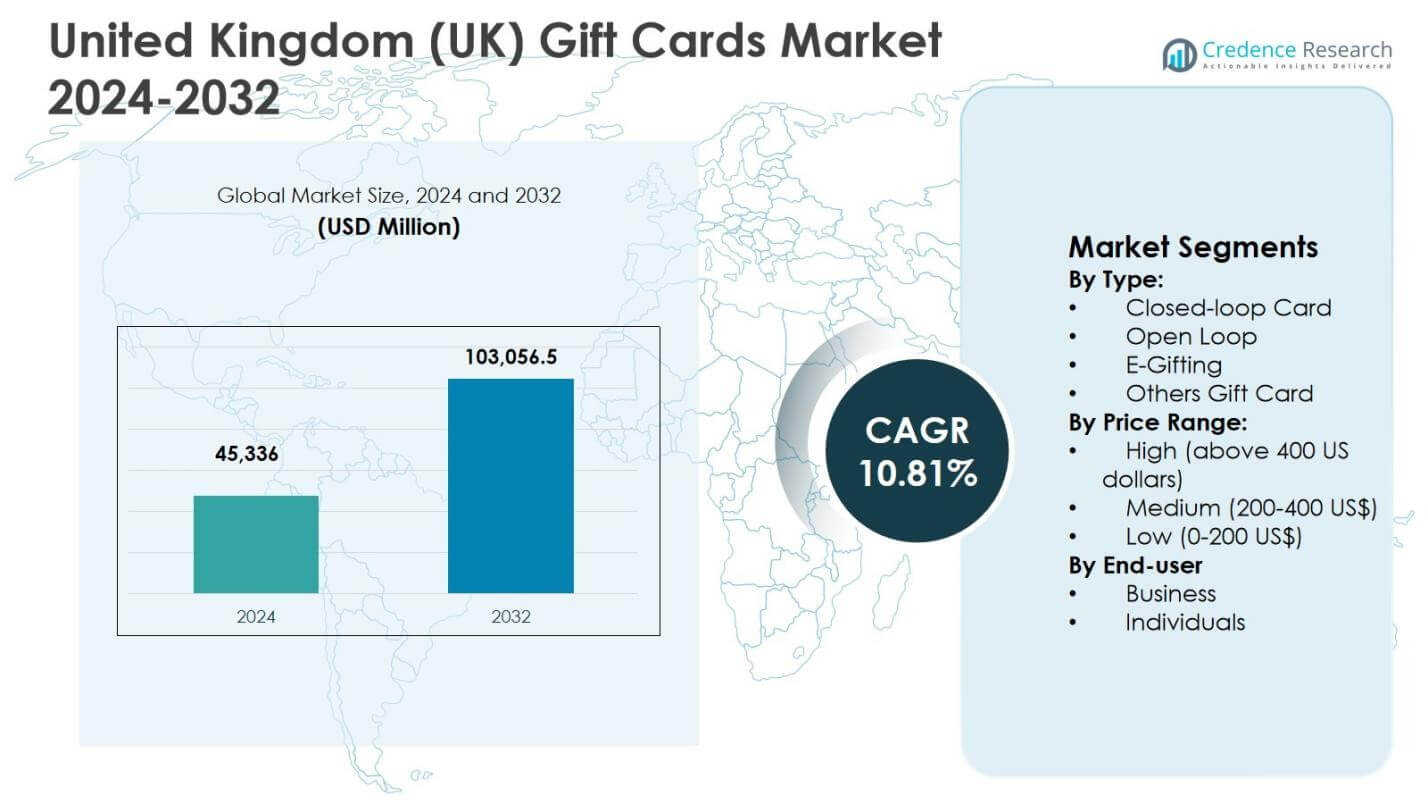
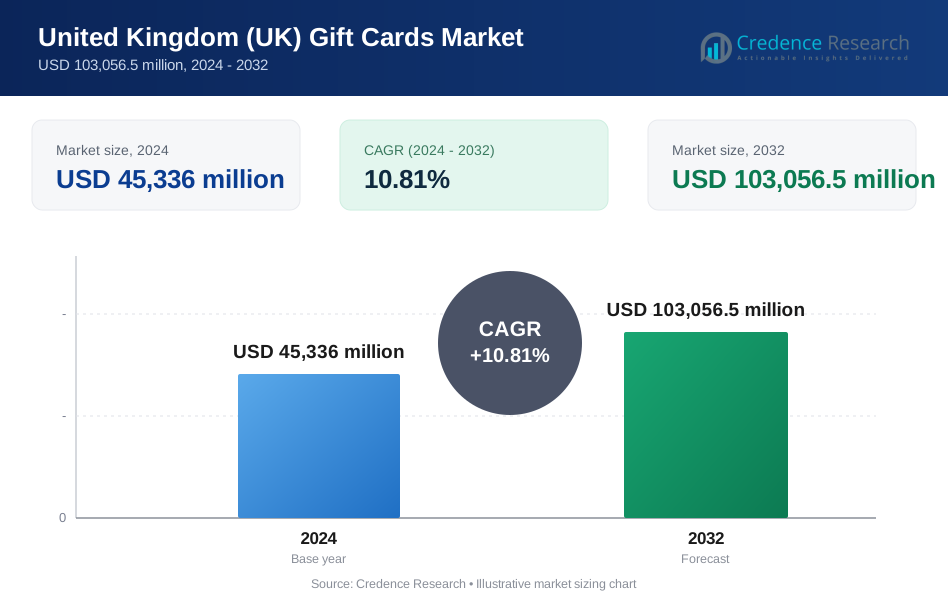
The United Kingdom (UK) Gift Cards Market size was valued at USD 45,336 million in 2024 and is anticipated to reach USD 103,056.5 million by 2032, expanding at a CAGR of 10.81% during the forecast period.
| REPORT ATTRIBUTE | DETAILS |
|---|---|
| Historical Period | 2020-2023 |
| Base Year | 2024 |
| Forecast Period | 2025-2032 |
| United Kingdom (UK) Gift Cards Market Size 2024 | USD 45,336 million |
| United Kingdom (UK) Gift Cards Market, CAGR | 10.81% |
| United Kingdom (UK) Gift Cards Market Size 2032 | USD 103,056.5 million |
United Kingdom (UK) Gift Cards Market Insights
- United Kingdom (UK) Gift Cards Market growth accelerates due to expanding digital payments, rising e-commerce penetration, and increasing corporate incentives and employee reward programs.
- United Kingdom (UK) Gift Cards Market trends highlight E-Gifting as the leading type with 41.6% share in 2024, while Low (USD 0–200) leads price range with 52.3% share, supported by frequent-use gifting and mobile-first distribution.
- United Kingdom (UK) Gift Cards Market remains led by Amazon.com, Inc., Apple Inc., Google LLC, PayPal, Inc., American Express Company, Fiserv, Inc., IKEA, Hennes & Mauritz AB, JD Sports (Pentland Group), and J. Sainsbury plc, while fraud risks and cybersecurity concerns persist as key restraints.
- United Kingdom (UK) Gift Cards Market regional demand is led by England with 83.4% share in 2024, followed by Scotland with 8.1%, Wales with 5.0%, and Northern Ireland with 3.5%, reflecting stronger retail density and digital adoption in England.
United Kingdom (UK) Gift Cards Market Segmentation Analysis:
By Type:
In the United Kingdom (UK) Gift Cards Market, the E-Gifting segment emerged as the dominant sub-segment, accounting for 41.6% market share in 2024. Strong adoption of digital wallets, widespread smartphone penetration, and rising preference for instant, contactless gifting continue to support its leadership. E-gifting benefits from ease of personalization, immediate delivery, and seamless redemption across online platforms. Closed-loop cards maintain steady demand from retail and hospitality brands, while open-loop cards gain traction for multi-merchant flexibility. Corporate incentive programs and seasonal promotions further reinforce growth across card types.
- For instance, Amazon offers eGift cards delivered instantly via email, available in denominations from £0.10 to £1,000, with validity for 10 years and redeemable for millions of products like books and electronics.
By Price Range:
Based on price range, the Low (USD 0–200) segment dominated the United Kingdom (UK) Gift Cards Market with a 52.3% share in 2024. High transaction volumes, affordability, and frequent use for everyday gifting occasions such as birthdays, festivals, and employee rewards drive this segment’s leadership. Consumers increasingly favor lower-value cards for repeat purchases and digital gifting. The medium segment benefits from corporate incentives and bundled offers, while high-value cards remain niche, primarily used for luxury retail, travel, and premium experiential gifting applications.
- For instance, Tesco offers the "Every Little Helps eGift" card loaded between £5 and £150, ideal for affordable repeat purchases on groceries and essentials, driving frequent consumer use.
By End-User:
By end-user, Individuals represented the dominant sub-segment, capturing 68.9% market share in 2024 in the United Kingdom (UK) Gift Cards Market. Growth is driven by rising consumer spending on personal gifting, strong e-commerce integration, and expanding acceptance of gift cards across retail, entertainment, and food services. Social gifting trends and digital distribution platforms further strengthen individual adoption. The business segment continues to expand through employee recognition, loyalty programs, and sales promotions, but individual consumers remain the primary revenue contributors due to higher purchase frequency.
Key Growth Drivers
Rapid Expansion of Digital Payments and E-Commerce
The United Kingdom (UK) Gift Cards Market is strongly driven by the rapid expansion of digital payments and the mature e-commerce ecosystem. High penetration of smartphones, widespread use of digital wallets, and consumer familiarity with online transactions have accelerated the adoption of digital and e-gift cards. Retailers increasingly integrate gift cards into mobile apps and checkout platforms, enabling instant issuance and redemption. The growth of omnichannel retailing further supports demand, as consumers seek flexible gifting options that work seamlessly across online and offline environments, improving convenience and purchase frequency.
- For instance, Marks & Spencer partnered with Runa's digital platform to streamline B2B gift card ordering, achieving a 245% year-on-year increase in gift card revenue volume by enabling instant digital issuance to new customers.
Rising Corporate Incentives and Employee Reward Programs
Corporate adoption of gift cards as incentive and reward tools is a major growth driver in the United Kingdom (UK) Gift Cards Market. Businesses increasingly use gift cards for employee recognition, sales incentives, customer loyalty programs, and promotional campaigns due to their flexibility and ease of distribution. Gift cards offer employers tax-efficient, customizable, and scalable reward solutions compared to traditional cash bonuses. As organizations focus on employee engagement, retention, and performance-driven cultures, demand for both digital and physical gift cards continues to strengthen across corporate and institutional end users.
- For instance, SSP, operator of food and beverage outlets, launched a staff loyalty scheme in July 2015 that recognizes long-service milestones with gift cards. This initiative rewards employees for dedication and tenure, enhancing retention across its UK workforce.
Growing Preference for Convenient and Personalized Gifting
Changing consumer lifestyles and gifting preferences significantly support the growth of the United Kingdom (UK) Gift Cards Market. Consumers increasingly prefer gift cards over physical products due to convenience, reduced decision-making effort, and the ability to personalize value and format. Digital customization features, including branded designs, messages, and instant delivery, enhance consumer appeal. Seasonal events, festivals, and social celebrations further amplify demand. This shift toward experience-based and flexible gifting continues to drive higher adoption among individuals across multiple age groups.
Key Trends & Opportunities
Acceleration of E-Gifting and Mobile-First Distribution
- gifting represents a key trend and opportunity in the United Kingdom (UK) Gift Cards Market as consumers increasingly favor instant, mobile-first solutions. Digital gift cards integrated with mobile apps, email, and messaging platforms enable real-time delivery and easy redemption. Retailers benefit from reduced physical distribution costs and enhanced customer data insights. Opportunities are expanding through integration with loyalty programs, subscription services, and app-based marketplaces. As digital-native consumers prioritize speed and convenience, e-gifting is expected to unlock sustained revenue growth and higher engagement rates.
- For instance, Love2shop launched the UK's first fully digital multi-brand gift card, the Select Digital Gift Card, which sends instantly via email, text, Facebook Messenger, or WhatsApp.
Integration with Loyalty Programs and Branded Ecosystems
The integration of gift cards with loyalty programs and branded ecosystems is creating strong opportunities in the United Kingdom (UK) Gift Cards Market. Retailers increasingly link gift cards with reward points, cashback offers, and personalized promotions to drive repeat purchases. This integration enhances customer retention while increasing average transaction values. Branded gift cards tied to fashion, grocery, entertainment, and lifestyle platforms benefit from strong consumer trust. As data analytics and personalization tools improve, gift cards are evolving into strategic customer engagement instruments.
- For instance, Verve app users purchase branded gift cards for UK retailers directly in-app, earning instant cashback rewards that stack for future use without needing loyalty cards or vouchers.
Key Challenges
Fraud Risks and Cybersecurity Concerns
Fraud and cybersecurity risks remain a critical challenge in the United Kingdom (UK) Gift Cards Market, particularly for digital and e-gift cards. Unauthorized access, phishing attacks, and card code theft can undermine consumer confidence and increase operational costs for issuers. As digital distribution expands, companies must invest heavily in encryption, authentication, and fraud-detection technologies. Managing chargebacks and ensuring regulatory compliance further adds complexity. Failure to address these risks effectively may limit adoption, especially among first-time and risk-averse consumers.
Market Saturation and Competitive Pressure
Intensifying competition and market saturation pose challenges to sustained growth in the United Kingdom (UK) Gift Cards Market. The presence of numerous retailers, fintech providers, and payment platforms offering similar gift card solutions increases pricing pressure and reduces differentiation. Smaller players often struggle to compete with established brands that benefit from scale, extensive distribution networks, and strong consumer loyalty. Maintaining profitability requires continuous innovation, strategic partnerships, and value-added services, making long-term competitiveness increasingly challenging in a crowded market environment.
Regional Analysis
England
England dominated the United Kingdom (UK) Gift Cards Market with a 83.4% market share in 2024, driven by its large population base, strong retail concentration, and advanced digital payment infrastructure. High adoption of e-commerce, widespread use of mobile wallets, and strong presence of national and international retailers support sustained demand. Corporate gifting, employee rewards, and promotional programs are widely used across England’s commercial hubs, further strengthening market performance. Seasonal gifting occasions and omnichannel retail strategies continue to enhance gift card usage across physical stores and digital platforms.
Scotland
Scotland accounted for a 8.1% market share in 2024 in the United Kingdom (UK) Gift Cards Market, supported by steady consumer spending and growing acceptance of digital gifting solutions. Urban centers such as Glasgow and Edinburgh contribute significantly through strong retail, hospitality, and tourism activity. Rising adoption of e-gifting for personal occasions and corporate incentives supports market expansion. Retailers increasingly integrate gift cards with loyalty programs and online platforms, enhancing accessibility. Consistent growth in digital payments and consumer preference for flexible gifting options continue to reinforce Scotland’s market position.
Wales
Wales held a 5.0% market share in 2024 within the United Kingdom (UK) Gift Cards Market, driven by increasing retail digitization and rising consumer awareness of gift card solutions. Growth is supported by expanding e-commerce penetration and greater use of gift cards for local retail, food services, and entertainment. Small and medium-sized businesses increasingly adopt gift cards to boost customer engagement and repeat purchases. The shift toward digital and low-value gift cards for frequent gifting occasions further strengthens adoption, supporting stable regional market development.
Northern Ireland
Northern Ireland represented a 3.5% market share in 2024 in the United Kingdom (UK) Gift Cards Market, reflecting gradual but consistent growth. Demand is driven by increased acceptance of gift cards across retail chains, supermarkets, and hospitality services. Cross-border retail activity and digital payment adoption support wider usage of e-gift cards. Businesses increasingly use gift cards for promotions and employee rewards, while individual consumers favor them for convenience and flexibility. Continued improvements in digital infrastructure and retail integration are expected to support steady market expansion.
United Kingdom (UK) Gift Cards Market Segmentations:
By Type:
- Closed-loop Card
- Open Loop
- E-Gifting
- Others Gift Card
By Price Range:
- High (above 400 US dollars)
- Medium (200-400 US$)
- Low (0-200 US$)
By End-user
- Business
- Individuals
By Geography
- England
- Scotland
- Wales
- Northern Ireland
Competitive Landscape
Competitive landscape analysis of the United Kingdom (UK) Gift Cards Market features key players such as Amazon.com, Inc., Apple Inc., Google LLC, American Express Company, PayPal, Inc., Fiserv, Inc., IKEA, Hennes & Mauritz AB, JD Sports (Pentland Group), and J. Sainsbury plc. The market is characterized by strong competition between global technology firms, payment service providers, and large retail brands offering both digital and physical gift card solutions. Leading players focus on expanding digital distribution, enhancing mobile wallet compatibility, and integrating gift cards with loyalty and rewards programs to strengthen customer engagement. Strategic partnerships with retailers, fintech platforms, and corporate clients support wider market penetration. Companies also emphasize personalization, fraud prevention, and seamless omnichannel redemption to maintain competitiveness. Continuous innovation in e-gifting formats and value-added services remains central to sustaining brand differentiation and long-term growth.
Key Player Analysis
- Apple Inc.
- Google LLC
- JD Sports (Pentland Group)
- PayPal, Inc.
- IKEA
- Amazon.com, Inc.
- Fiserv, Inc.
- Hennes & Mauritz AB
- American Express Company
- J. Sainsbury plc
Recent Developments
- In October 2024, Klarna launched its Gift Card Store in the UK, allowing purchases from brands like Airbnb, Argos, and IKEA via Buy Now, Pay Later or debit options.
- In April 2025, Recharge acquired UK-based Giftcloud Limited from Groupon, expanding into B2B digital rewards for brands like Vodafone and Sky.
- In October 2025, Tesco celebrated 15 years of gift card milestones, marking sustained expansion of its third-party gift card assortments in collaboration with Blackhawk Network.
Report Coverage
The research report offers an in-depth analysis based on Type, Price Range, End User and Geography. It details leading market players, providing an overview of their business, product offerings, investments, revenue streams, and key applications. Additionally, the report includes insights into the competitive environment, SWOT analysis, current market trends, as well as the primary drivers and constraints. Furthermore, it discusses various factors that have driven market expansion in recent years. The report also explores market dynamics, regulatory scenarios, and technological advancements that are shaping the industry. It assesses the impact of external factors and global economic changes on market growth. Lastly, it provides strategic recommendations for new entrants and established companies to navigate the complexities of the market.
Future Outlook
- The United Kingdom (UK) Gift Cards Market will continue expanding, supported by rising adoption of digital and e-gifting solutions.
- Integration of gift cards with mobile wallets and super-app ecosystems will strengthen user convenience and redemption rates.
- Corporate demand for gift cards as employee rewards and incentive tools will increase across industries.
- Personalization features, including customized designs and messaging, will enhance consumer engagement.
- Omnichannel retail strategies will drive seamless gift card usage across online and physical stores.
- Data analytics and AI-driven targeting will improve promotional effectiveness and repeat purchases.
- Fraud prevention technologies will become a strategic investment priority for market participants.
- Retailers will increasingly bundle gift cards with loyalty programs and subscription services.
- Low- and mid-value gift cards will remain the most frequently purchased categories.
- Strategic partnerships between retailers, fintech firms, and payment platforms will shape long-term market growth.
Request a Free Sample
Fill in your details and we'll send you a free sample report.
- Sample data tables & charts
- Research methodology
Need a Custom Version of This Report?
Tailor the scope, geography, or segments to your exact requirements.
- Custom geography or segment scope
- Direct access to our analyst team
Frequently Asked Questions
What is the current market size for the United Kingdom (UK) Gift Cards Market, and what is its projected size in 2032?
At what Compound Annual Growth Rate is the United Kingdom (UK) Gift Cards Market projected to grow between 2024 and 2032?
Which United Kingdom (UK) Gift Cards Market segment held the largest share in 2024?
What are the primary factors fueling the growth of the United Kingdom (UK) Gift Cards Market?
Who are the leading companies in the United Kingdom (UK) Gift Cards Market?
Which region commanded the largest share of the United Kingdom (UK) Gift Cards Market in 2024?
Table of Content
Chapter 1. Report Introduction
- 1.1 Report Description & Purpose
- 1.1.1 Report Title & Market Definition
- 1.1.2 Unique Selling Propositions (USP) & Key Differentiators
- 1.1.3 Value Proposition for Stakeholders
- 1.2 Research Objectives
- 1.2.1 Market Sizing Objectives (Volume & Revenue) (Volume Where Applicable)
- 1.2.2 Segmentation Objectives
- 1.2.3 Competitive Intelligence Objectives
- 1.2.4 Forecast & Scenario Objectives
- 1.3 Report Scope
- 1.3.1 United Kingdom (UK) Gift Cards Scope – Segments & Subsegments Covered
- 1.3.2 Geographic Scope – Selected Country & Subnational Markets Covered
- 1.3.3 Historical Period, Base Year & Forecast Period (2024; forecast to 2032)
- 1.3.4 Inclusions & Exclusions
- 1.4 Industry Classification & Applicable Codes
- 1.5 Currency, Measurement Units & Valuation Basis
- 1.6 Target Stakeholders
- 1.7 Limitations & Assumptions
Chapter 2. Executive Summary
- 2.1 United Kingdom (UK) Gift Cards Snapshot
- 2.1.1 Market Size – Historical (2024) & Forecast (2024-2032) (2024: USD 45,336 million → 2032: USD 103,056.5 million)
- 2.1.2 Volume & Revenue – National Totals (Volume Where Applicable)
- 2.1.3 Key Market Highlights – Top Five Facts
- 2.2 United Kingdom (UK) Gift Cards Segmentation Snapshot
- 2.2.1 Market Split by Subnational Area – 2024 vs. 2032
- 2.3 Competitive Snapshot
- 2.3.1 Top 10 Players by Revenue Share – 2024
- 2.3.2 Top 10 Players by Volume Share – 2024 (Volume Where Applicable)
- 2.3.3 Recent Strategic Developments (18-Month Summary)
- 2.4 Key Investment Highlights & Strategic Conclusions
Chapter 3. United Kingdom (UK) Gift Cards Dynamics & Industry Analysis
- 3.1 Market Overview & Context
- 3.1.1 United Kingdom (UK) Gift Cards Position in the Broader Industry Value Chain
- 3.1.2 Demand Structure & Purchasing Dynamics
- 3.1.3 Market Maturity & Development Stage Across Domestic Markets
- 3.2 United Kingdom (UK) Gift Cards Drivers
- 3.3 United Kingdom (UK) Gift Cards Restraints & Challenges
- 3.4 United Kingdom (UK) Gift Cards Opportunities
- 3.5 Porter's Five Forces Analysis
- 3.5.1 Threat of New Entrants
- 3.5.2 Bargaining Power of Suppliers
- 3.5.3 Bargaining Power of Buyers
- 3.5.4 Threat of Substitutes
- 3.5.5 Competitive Rivalry – Intensity Assessment
- 3.6 United Kingdom (UK) Gift Cards Value Chain Analysis
- 3.6.1 Upstream – Key Inputs, Resources & Suppliers
- 3.6.1.1 Key Input/Resource 1
- 3.6.1.2 Key Input/Resource 2
- 3.6.1.3 Key Input/Resource 3
- 3.6.2 Midstream – Core Operations & Value Creation
- 3.6.2.1 Operating Model & Process Overview
- 3.6.2.2 Key Operating Locations & Capabilities by Company
- 3.6.3 Downstream – Market Channels & End Users
- 3.6.3.1 Direct Sales & Customer Engagement Channels
- 3.6.3.2 Indirect Sales, Intermediaries & Partner Channels
- 3.6.4 Value Chain Profitability Analysis
- 3.6.1 Upstream – Key Inputs, Resources & Suppliers
- 3.7 PESTEL Analysis
- 3.7.1 Political Factors
- 3.7.2 Economic Factors
- 3.7.3 Social Factors
- 3.7.4 Technological Factors
- 3.7.5 Environmental Factors
- 3.7.6 Legal Factors
- 3.8 United Kingdom (UK) Gift Cards Supply Chain Analysis
- 3.8.1 Critical Input & Resource Availability Risk Assessment
- 3.8.2 Supplier & Operational Concentration Risk (Geographic Exposure)
- 3.8.3 Supply & Service Disruption Impact Analysis
- 3.9 National & Subnational Regulatory Landscape
Note: The regulatory and policy landscape section covers regulations based on their applicability to the market, United Kingdom (UK) Gift Cards category, geography, and scope of the study. Only regulatory frameworks with a material impact on operations, compliance, trade, sustainability, or market access are analyzed in detail.
Chapter 4. Key Investment Pockets & Opportunity Analysis
- 4.1 United Kingdom (UK) Gift Cards Attractiveness Analysis
- 4.1.1 By Subnational Area – Investment Attractiveness Matrix (Market Size × CAGR)
- 4.2 Absolute Revenue Growth Opportunity
- 4.2.1 By Subnational Area – Absolute Revenue Growth Through 2032
- 4.3 Incremental Demand Opportunity
- 4.3.1 By Subnational Area – Incremental Demand Through 2032
- 4.3.2 Segment – Incremental Demand
- 4.4 Emerging Submarket Opportunity Deep Dive (Subject to Applicability)
- 4.5 Priority Domestic Market Opportunity Scorecards
- 4.5.1 Priority Domestic Market 1
- 4.5.2 Priority Domestic Market 2
- 4.5.3 Priority Domestic Market 3
- 4.5.4 Priority Domestic Market 4
Note: Domestic market scorecards cover relevant states, provinces, territories, cities, or economic zones within the selected country. Numbered entries are populated with market names suited to the national administrative structure and research scope. Geographic share tables use one consistent, nonoverlapping set of areas.
Chapter 5. United Kingdom (UK) Gift Cards Cross-Border Trade & Market Access Analysis
- 5.1 National Trade & International Partner Overview
- 5.1.1 Export Value by Destination Country (2024)
- 5.1.2 Export Volume by Destination Country (2024) (Where Applicable)
- 5.1.3 Import Value by Source Country (2024)
- 5.1.4 Import Volume by Source Country (2024) (Where Applicable)
- 5.1.5 National & Partner-Country Trade Balances (2024)
- 5.2 Export Analysis – Segment
- 5.2.1 Category 1 (Applicable Classification Code)
- 5.2.2 Category 2 (Applicable Classification Code)
- 5.2.3 Category 3 (Applicable Classification Code)
- 5.2.4 Category 4 (Applicable Classification Code)
- 5.2.5 Category 5 (Applicable Classification Code)
- 5.3 Import Analysis – Segment
- 5.3.1 Category 1 (Applicable Classification Code)
- 5.3.2 Category 2 (Applicable Classification Code)
- 5.3.3 Category 3 (Applicable Classification Code)
- 5.3.4 Category 4 (Applicable Classification Code)
- 5.3.5 Category 5 (Applicable Classification Code)
- 5.4 Cross-Border Pricing & Transaction Benchmarks
- 5.4.1 Export Pricing – Segment & Destination Country
- 5.4.2 Import Pricing – Segment & Source Country
- 5.4.3 Price Trends (2024)
- 5.5 Key Cross-Border Trade & Delivery Routes
- 5.5.1 Cross-Border Trade/Delivery Route 1
- 5.5.2 Cross-Border Trade/Delivery Route 2
- 5.5.3 Cross-Border Trade/Delivery Route 3
- 5.5.4 Cross-Border Trade/Delivery Route 4
- 5.5.5 Cross-Border Trade/Delivery Route 5
- 5.6 Trade Policy & Market Access Impact Assessment
- 5.6.1 Tariff & Non-Tariff Barriers
- 5.6.2 National Participation in Regional Trade & Economic Frameworks
- 5.6.3 Bilateral & Multilateral Trade Agreements
- 5.6.4 Cross-Border Operating, Licensing & Localization Requirements
Note: This chapter covers international trade relevant to United Kingdom (UK) Gift Cards in the selected country. Exports are analyzed by destination and imports by source. Domestic interregional flows are excluded from international trade totals. Goods, services, and digital offerings use applicable classifications; volume and route analyses apply only where meaningful.
Chapter 6. Competitive Landscape & Company Benchmarking
- 6.1 United Kingdom (UK) Gift Cards Concentration & Structure
- 6.1.1 Herfindahl-Hirschman Index (HHI) – vs. 2024
- 6.1.2 Leading, Mid-Sized & Emerging Player Structure
- 6.1.3 Multinational, National & Local Player Dynamics
- 6.2 United Kingdom (UK) Gift Cards Share Analysis – 2024
- 6.2.1 National Revenue Share by Company
- 6.2.2 National Volume Share by Company (Volume Where Applicable)
- 6.2.3 Company Revenue Share by Subnational Area
- 6.2.4 Market Share Evolution ( vs. 2024)
- 6.2.5 Company Market Share by Key Segment
- 6.2.6 Company Market Share by Customer Group
- 6.3 Operating Scale, Capacity & Infrastructure Analysis
- 6.3.1 National Operating Scale & Supply Capacity
- 6.3.2 Resource Utilization & Operating Efficiency
- 6.3.3 Output, Service Delivery & Activity Metrics
- 6.3.4 Operating Footprint & Infrastructure Map
- 6.3.5 Planned Operational & Capacity Expansion
- 6.4 United Kingdom (UK) Gift Cards Competitive Benchmarking Matrix
- 6.4.1 Revenue, Growth, Profitability & Operating Metric Comparison
- 6.4.2 Channel Revenue Mix
- 6.4.3 Revenue Exposure Across Domestic Markets
- 6.4.4 R&D Intensity
- 6.4.5 Sustainability Maturity
- 6.5 Strategic Developments in United Kingdom (UK) Gift Cards (Last 24 Months)
- 6.5.1 Mergers, Acquisitions & Divestments
- 6.5.2 New Products, Services & Solutions in United Kingdom (UK) Gift Cards
- 6.5.3 Operational & Infrastructure Expansions
- 6.5.4 Strategic Alliances, Joint Ventures & Partnerships
- 6.5.5 Distribution Expansion & Market Entry
- 6.5.6 Sustainability & ESG Initiatives
- 6.6 Competitive Strategy Mapping
- 6.6.1 Leader, Challenger, Follower & Niche Classification
- 6.6.2 Pricing Strategy Comparison
- 6.6.3 Channel Strategy Matrix
Note: Strategic developments are included based on their materiality and the availability of reliable information.
Chapter 7. United Kingdom (UK) Gift Cards – By Sales & Delivery Channel
- 7.1 Segment Overview
- 7.1.1 Volume & Revenue Split by Channel (2024 & 2032) (Volume Where Applicable)
- 7.1.2 Channel Mix Evolution (2024-2032)
Chapter 8. Subnational Market Analysis – Country Overview
- 8.1 Domestic Geographic Market Overview
- 8.1.1 Subnational Volume Share (Where Applicable)
- 8.1.2 Subnational Revenue Share
- 8.1.3 Market Volume by Subnational Area (Where Applicable)
- 8.1.4 Market Revenue by Subnational Area
- 8.1.5 Subnational Forecasts Through 2032
- 8.2 Cross-Area Segment Analysis Within the Country
- 8.2.1 By Sales & Delivery Channel
- 8.2.2 By Competitive Positioning & Price Tier
Chapter 9. United Kingdom (UK) Gift Cards – Priority Domestic Market 1
Chapter 10. United Kingdom (UK) Gift Cards – Priority Domestic Market 2
Chapter 11. United Kingdom (UK) Gift Cards – Priority Domestic Market 3
Chapter 12. United Kingdom (UK) Gift Cards – Priority Domestic Market 4
Chapter 13. United Kingdom (UK) Gift Cards Company Profiles
- 13.1 [Company 01]
- 13.1.1 Company Overview
- 13.1.2 Key Management Personnel
- 13.1.3 Products & Services Portfolio
- 13.1.4 Financial Performance
- 13.1.5 Domestic Market Focus & Local Operating Presence
- 13.1.6 Recent Developments & Strategic Initiatives
Note: The company profile list is preliminary and may change based on research findings, market developments, data availability, and client requirements.
Chapter 14. Appendices
- Appendix A – List of Abbreviations & Acronyms
- Appendix B – Industry Classification Code Reference – Full Series
- Appendix C – Supply, Output & Operating Capacity Data Tables
- Appendix D – End-Use & Demand Base Tables
- Appendix E – Demand, Adoption & Usage Assumptions
- Appendix F – Pricing & Revenue Metric Reference Tables
- Appendix G – Company Operations & Infrastructure Database
- Appendix H – Cross-Border Trade & Activity Data Tables (Where Applicable)
- Appendix I – Regulatory Summary Tables
- Appendix J – Primary Research Participant List (Anonymized)
- Appendix K – Primary Research Questionnaire Framework
- Appendix L – Data Sources & Bibliography
- Appendix M – Market Size Divergence & Source Comparison
Chapter 15. Research Methodology
- 15.1 Research Framework & Philosophy
- 15.2 Secondary Research – Sources, Hierarchy & Data Extraction
- 15.3 Data Modeling – National Market Sizing & Subnational Allocation
- 15.4 Primary Research – Stakeholder Framework, LOI & Sample Sizes
- 15.5 Forecast Methodology – Regression, Scenario & Sensitivity Analysis
- 15.6 Quality Control – Four-Layer Validation Framework
- 15.7 Limitations & Standard Assumptions
- 15.8 Disclaimer
