
Market Overview:
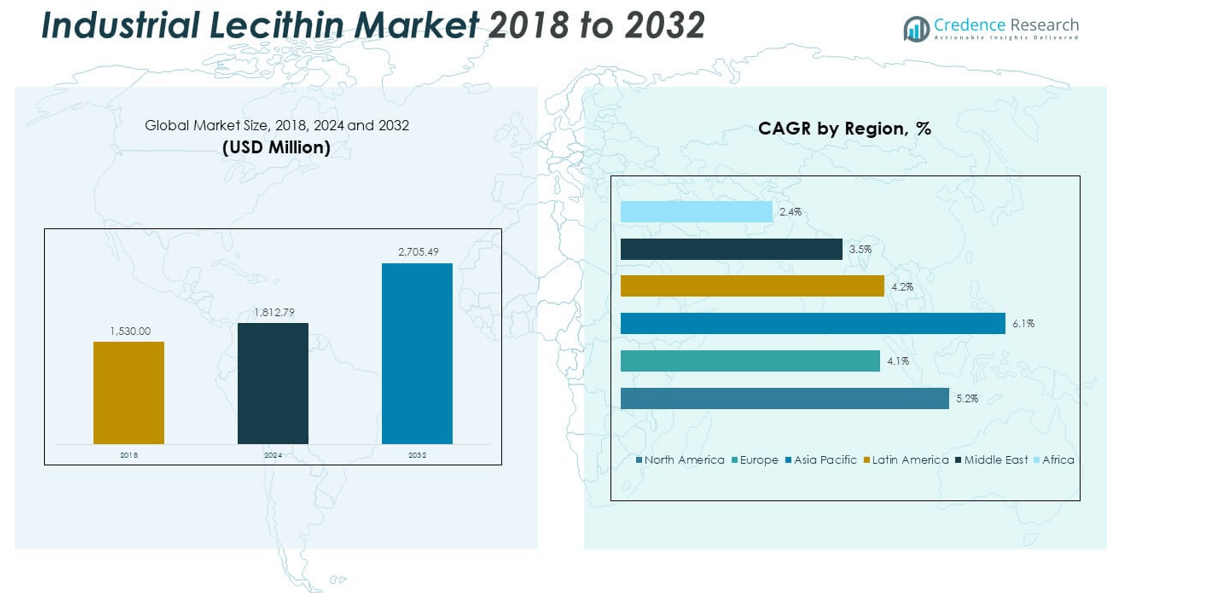
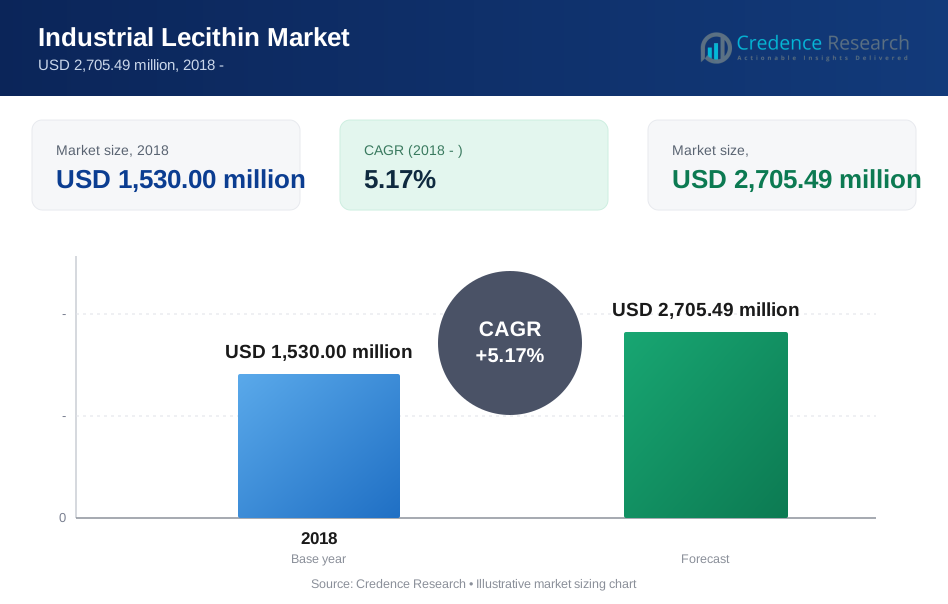
The Global Industrial Lecithin Market size was valued at USD 1,530.00 million in 2018, increased to USD 1,812.79 million in 2024, and is anticipated to reach USD 2,705.49 million by 2032, at a CAGR of 5.17% during the forecast period.
| REPORT ATTRIBUTE | DETAILS |
|---|---|
| Historical Period | 2020-2023 |
| Base Year | 2024 |
| Forecast Period | 2025-2032 |
| Industrial Lecithin Market Size 2024 | USD 1,812.79 million |
| Industrial Lecithin Market, CAGR | 5.17% |
| Industrial Lecithin Market Size 2032 | USD 2,705.49 million |
Growth in the market is driven by rising demand for natural emulsifiers across food, pharmaceutical, and personal care industries. Increasing consumer preference for clean-label and plant-based ingredients enhances lecithin adoption. Expanding use in bakery, confectionery, and dietary supplements further supports demand. Industrial lecithin also finds growing utility in paints, coatings, and animal feed formulations, where it improves stability and texture performance.
Regionally, North America and Europe lead the market due to high awareness and established food and pharmaceutical industries. Asia-Pacific is emerging rapidly, driven by industrial expansion in China, India, and Japan. Rising urbanization and consumer health focus stimulate regional demand. Latin America and the Middle East are also seeing gradual adoption, supported by growing food processing and cosmetic manufacturing sectors.
Market Insights:
- The Global Industrial Lecithin Market was valued at USD 1,530.00 million in 2018, reached USD 1,812.79 million in 2024, and is projected to reach USD 2,705.49 million by 2032, expanding at a CAGR of 5.17%.
- Asia Pacific (39.6%), North America (25.9%), and Europe (15.3%) accounted for the top three regional shares due to strong industrial capacity, advanced processing technologies, and consumer preference for natural ingredients.
- Asia Pacific is the fastest-growing region, supported by expanding food manufacturing, increasing use in pharmaceuticals, and cost-efficient production capabilities across China, India, and Japan.
- Direct Sales held the dominant share in 2024, driven by long-term supply contracts with large food processors and industrial buyers ensuring consistent product flow.
- Online Platforms represented the fastest-growing distribution channel, gaining traction among small manufacturers and exporters due to broader accessibility and cost-effective procurement.
Market Drivers:
Rising Demand for Natural Emulsifiers in Food and Beverage Applications
The Global Industrial Lecithin Market is witnessing steady growth driven by the shift toward natural and multifunctional emulsifiers. Lecithin enhances texture, stability, and moisture retention in bakery, confectionery, and dairy products. It replaces synthetic additives, aligning with consumer preference for clean-label and organic food. Growing consumption of processed and convenience foods strengthens its adoption. Manufacturers prefer lecithin for its cost-effectiveness and nutritional properties. The ingredient also improves the sensory appeal of end products. Its broad functional range makes it valuable across various formulations. Increasing regulatory support for natural ingredients reinforces its use in global food chains.
- For instance, Cargill launched a new lecithin production process at its Antwerp site in 2024 to upgrade the value of its lecithin byproduct. This marked a significant expansion in capacity and quality assurance for the Antwerp facility, which has processed rapeseed since at least 2012. The upgrade involved the installation of seven new stainless steel tanks, including four for processing and three for storage.
Expanding Applications in Pharmaceuticals and Nutraceuticals
Pharmaceutical manufacturers use lecithin as a stabilizer and dispersing agent in drug delivery systems. It enhances bioavailability and supports lipid-based formulations for controlled release. The Global Industrial Lecithin Market benefits from rising demand for nutraceuticals such as dietary supplements and functional foods. Growing awareness of lecithin’s role in liver health and cholesterol reduction accelerates its use in capsules and powders. It supports emulsification in ointments and creams for topical formulations. The ingredient’s natural origin and safety profile attract formulators seeking biocompatible excipients. Increasing investments in health-focused products continue to expand the pharmaceutical application base.
- For instance, Lipoid GmbH offers high-purity phosphatidylcholine products with concentrations up to 94%—such as PHOSPHOLIPON® 90 G and LIPOID H 100—used for specialized pharmaceutical and cosmetic applications, with verified ingredient purity levels according to company documentation.
Industrial Expansion in Non-Food Sectors and Surface Applications
Lecithin is increasingly used in paints, coatings, leather treatments, and textile processing. It improves pigment dispersion, surface wetting, and anti-static properties. The Global Industrial Lecithin Market gains from industrial diversification where lecithin acts as a sustainable alternative to petrochemical-based additives. Its biodegradability and low toxicity make it suitable for eco-friendly formulations. Demand from lubricants and agricultural applications further supports market expansion. It contributes to better processability and reduced material waste. Continuous innovation in manufacturing techniques enhances lecithin’s industrial-grade performance. Industrial end users adopt lecithin for improved quality and compliance with environmental regulations.
Rising Consumer Preference for Plant-Based Ingredients and Sustainable Sourcing
Plant-derived lecithin from soy, sunflower, and rapeseed drives the market due to sustainability concerns. Consumers favor plant-based emulsifiers over animal-sourced alternatives. The Global Industrial Lecithin Market benefits from this preference, prompting companies to reformulate with renewable raw materials. Growing environmental awareness encourages sourcing transparency across the supply chain. Manufacturers invest in sustainable extraction technologies that lower carbon footprint. Expansion of non-GMO lecithin production also aligns with clean-label demand. Increasing government support for plant-based ingredients reinforces market stability. These factors collectively create long-term growth opportunities for industrial lecithin.
Market Trends:
Growing Shift Toward Non-GMO and Allergen-Free Lecithin Sources
The Global Industrial Lecithin Market is witnessing a strong shift toward non-GMO and allergen-free ingredients. Consumers are becoming cautious about food safety and ingredient transparency. Manufacturers now favor sunflower and rapeseed lecithin as alternatives to soy-based products. These options help brands appeal to health-conscious and allergen-sensitive consumers. Non-GMO lecithin aligns with the clean-label trend driving global food reformulation. It also supports compliance with strict labeling regulations across developed markets. This transition promotes broader acceptance among European and North American consumers. The demand for certified, traceable, and ethically sourced lecithin continues to expand across industries.
- For instance, ADM opened a new extrusion facility in Serbia in September 2022 to increase its output of non-GMO soy proteins for European markets and support allergen-free product lines, leveraging local production for traceability and compliance with stringent EU regulations.
Technological Advancements in Extraction and Processing Methods
Ongoing innovation in lecithin extraction and refining enhances product purity and efficiency. The Global Industrial Lecithin Market benefits from enzyme-assisted and solvent-free extraction technologies. These methods reduce chemical residues and improve functional properties in end-use applications. Manufacturers integrate advanced separation techniques to maintain nutrient integrity. Automation in production lines ensures consistent quality and high yield. Energy-efficient processing reduces operational costs and environmental impact. This technological progress supports scalability for both food and industrial grades. Continuous R&D investments strengthen the market’s ability to meet sustainability and performance expectations.
Rising Adoption of Lecithin in Personal Care and Cosmetic Formulations
The cosmetic sector increasingly incorporates lecithin for its moisturizing and stabilizing properties. It enhances emulsification in lotions, creams, and haircare products. The Global Industrial Lecithin Market benefits from consumer preference for plant-derived and biodegradable ingredients. Lecithin improves texture and skin absorption while maintaining a natural formulation profile. It functions as a conditioning agent, enhancing softness and spreadability. The growing clean beauty movement further fuels its adoption in skincare lines. Brands emphasize natural emulsifiers to replace synthetic agents without compromising performance. Expanding cosmetic manufacturing in Asia and Europe strengthens the demand for lecithin-based formulations.
Increased Focus on Circular Economy and Sustainable Manufacturing Practices
Sustainability remains a central trend shaping industrial lecithin production. Manufacturers in the Global Industrial Lecithin Market are adopting circular economy principles. They utilize by-products from oilseed processing to minimize waste. Eco-friendly extraction and recycling of solvents reduce environmental footprint. Companies invest in renewable energy to power processing facilities. Certification programs promote sustainable supply chains and traceable sourcing. Market players collaborate with agricultural sectors to ensure ethical procurement. Such initiatives strengthen brand reputation and customer trust globally. The trend toward green manufacturing enhances long-term competitiveness across regional markets.
Market Challenges Analysis:
Fluctuating Raw Material Supply and Price Instability in Oilseeds
The Global Industrial Lecithin Market faces volatility due to fluctuating soybean, sunflower, and rapeseed prices. Supply instability from major producing nations impacts manufacturing costs. Seasonal variations, trade restrictions, and climate events disrupt availability. Price fluctuations influence the profit margins of processors and end users. Manufacturers often struggle to maintain consistent sourcing quality and cost efficiency. Limited alternative raw materials intensify dependence on oilseed crops. The market requires better supply chain resilience through diversified sourcing networks. Strategic collaborations and long-term contracts help mitigate the effects of price instability.
Regulatory Compliance and Product Standardization Challenges
Stringent global food and pharmaceutical regulations pose compliance challenges for producers. The Global Industrial Lecithin Market must adhere to purity, labeling, and safety standards across multiple regions. Variations in regional certification increase operational complexity. Manufacturers face difficulties aligning processes with evolving sustainability and non-GMO norms. Small and mid-sized firms find it costly to upgrade facilities and testing infrastructure. Inconsistent product specifications across markets lead to trade barriers. Ongoing investments in R&D and traceability systems are essential to ensure global compliance. Harmonizing international standards could enhance market fluidity and manufacturer confidence.
Market Opportunities:
Expansion of Lecithin Use in Emerging Industrial Applications
The Global Industrial Lecithin Market holds significant potential in new industrial domains. Its role in bio-lubricants, agrochemicals, and biodegradable polymers is expanding. Lecithin’s emulsifying and anti-static properties enable performance in diverse chemical formulations. Growth in green manufacturing drives the replacement of petroleum-based additives. It also finds use in coatings, inks, and adhesives for improved dispersion. Manufacturers can leverage its natural profile to serve eco-sensitive markets. Increasing research into industrial-grade lecithin opens new revenue opportunities worldwide.
Rising Investment in Sustainable and Functional Ingredient Development
Sustainability-driven investments create opportunities for innovation in lecithin production. The Global Industrial Lecithin Market benefits from advancements in enzymatic modification and hybrid formulations. These innovations enhance functionality and reduce processing costs. Growing collaboration between food tech companies and ingredient producers supports tailored solutions. Companies focusing on non-GMO, organic, and traceable sourcing gain a competitive edge. Demand from clean-label and vegan markets continues to expand rapidly. These opportunities position lecithin producers favorably in the evolving global ingredient landscape.
Market Segmentation Analysis:
Product Type
The Global Industrial Lecithin Market includes soy lecithin, sunflower lecithin, and rapeseed lecithin as primary product types. Soy lecithin holds the major share due to its cost efficiency and wide availability. Sunflower lecithin is gaining traction for its non-GMO and allergen-free properties, appealing to clean-label product manufacturers. Rapeseed lecithin remains a niche segment, offering sustainability and unique emulsification benefits. Each type serves diverse industries with specific functionality needs, driving formulation flexibility and innovation across end-use sectors.
- For instance, Soy lecithin is cost-effective and widely available, while sunflower lecithin—such as LIPOID H 100, containing ≥94% phosphatidylcholine from non-GMO sunflower—is favored for allergen-free applications, and rapeseed lecithin finds niche use. These verified concentrations and sources are reported directly by manufacturers for specific food, nutraceutical, and cosmetic product standards.
Application
Key application areas include food and beverages, animal feed, cosmetics and personal care, and pharmaceuticals. Food and beverages dominate due to lecithin’s emulsifying and stabilizing properties. The animal feed segment benefits from lecithin’s digestibility improvement and nutrient absorption. Cosmetics and personal care applications expand with demand for natural emulsifiers in skincare. Pharmaceutical use continues to grow due to lecithin’s compatibility in drug delivery and lipid formulations.
- For instance, ADM’s Serbia plant increases supply of non-GMO soy protein with advanced extrusion for use in food reformulations, while Lipoid’s sunflower-based phospholipids support premium, non-GMO cosmetic creams for sensitive skin, and Cargill’s lecithin products are utilized in global food supply chains for their verified emulsification properties.
End-User and Form
Major end users include food processing industries, feed manufacturers, and pharmaceutical companies. Food processors lead adoption due to high consumption in bakery and confectionery applications. Lecithin is available in liquid, powder, and granule forms. Liquid lecithin dominates due to ease of incorporation in industrial formulations, while powder and granules find growing use in encapsulated or dry mix applications.
Distribution Channel
Distribution primarily occurs through direct sales, distributors, and online platforms. Direct sales dominate bulk transactions, while distributors ensure regional reach. Online channels are expanding rapidly, supporting smaller-scale and customized procurement across global markets.
Segmentation:
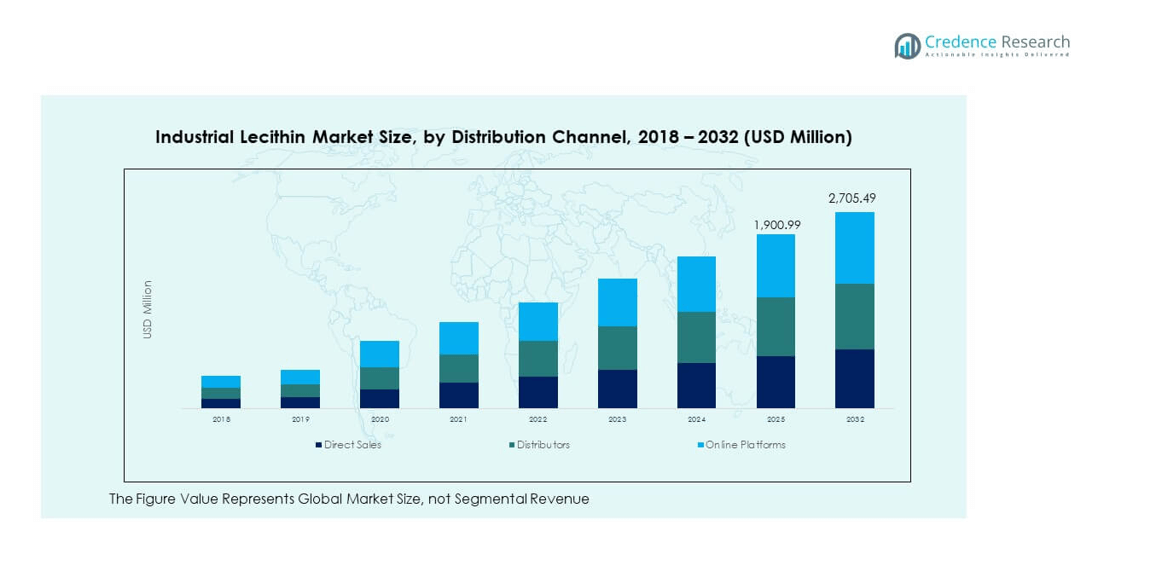
By Product Type:
- Soy Lecithin
- Sunflower Lecithin
- Rapeseed Lecithin
By Application:
- Food & Beverages
- Animal Feed
- Cosmetics & Personal Care
- Pharmaceuticals
By End-User:
- Food Processing Industries
- Feed Manufacturers
- Pharmaceutical Companies
By Form:
- Liquid
- Powder
- Granules
By Distribution Channel:
- Direct Sales
- Distributors
- Online Platforms
By Region:
- North America
- U.S.
- Canada
- Europe
- Germany
- France
- Italy
- U.K.
- Russia
- Rest of Europe
- Asia-Pacific
- India
- China
- Japan
- Rest of Asia-Pacific
- Latin America
- Brazil
- Mexico
- Rest of Latin America
- Middle East and Africa
- GCC Countries
- South Africa
- Rest of Middle East and Africa
Regional Analysis:
North America
The North America Global Industrial Lecithin Market size was valued at USD 523.26 million in 2018, increased to USD 611.99 million in 2024, and is anticipated to reach USD 912.03 million by 2032, at a CAGR of 5.2% during the forecast period. North America holds around 25.9% market share, driven by strong demand from food processing, pharmaceutical, and personal care sectors. It benefits from advanced production technology and high adoption of clean-label products. The region’s established supply chain and consumer awareness of natural ingredients support continued growth. Rising health consciousness and regulatory support for non-GMO and allergen-free products fuel lecithin demand. The U.S. dominates the regional market, supported by robust industrial capacity and innovation in formulations. Canada and Mexico contribute through expanding food manufacturing sectors and increased lecithin imports for functional foods.
Europe
The Europe Global Industrial Lecithin Market size was valued at USD 282.29 million in 2018, grew to USD 315.92 million in 2024, and is expected to reach USD 433.56 million by 2032, at a CAGR of 4.1% during the forecast period. Europe accounts for approximately 15.3% market share, driven by strict quality regulations and consumer preference for non-GMO, allergen-free products. Demand from bakery, confectionery, and nutraceutical segments remains steady. Countries like Germany, France, and the U.K. lead in lecithin innovation and sustainable sourcing practices. Stringent EU policies encourage manufacturers to focus on traceability and clean-label compliance. Growth in cosmetic and pharmaceutical sectors enhances usage across various formulations. The region’s mature market structure ensures stable consumption and long-term demand consistency.
Asia Pacific
The Asia Pacific Global Industrial Lecithin Market size was valued at USD 558.45 million in 2018, rose to USD 681.33 million in 2024, and is projected to reach USD 1,088.42 million by 2032, at a CAGR of 6.1% during the forecast period. Asia Pacific holds the largest share at around 39.6%, driven by rapid industrialization and expansion in food processing and pharmaceuticals. China, India, and Japan lead production and consumption due to large populations and growing dietary awareness. Rising demand for plant-based and fortified foods supports lecithin growth. Investments in manufacturing capacity and favorable government initiatives boost regional competitiveness. The market benefits from cost-efficient production and export potential to Western economies. Expanding use in cosmetics and personal care further strengthens regional performance.
Latin America
The Latin America Global Industrial Lecithin Market size was valued at USD 91.49 million in 2018, grew to USD 107.30 million in 2024, and is projected to reach USD 147.91 million by 2032, at a CAGR of 4.2% during the forecast period. Latin America represents around 5.4% of the global market share, supported by growing food and beverage production. Brazil and Argentina dominate due to abundant soybean resources and strong export capacity. Increasing adoption of lecithin in animal feed and bakery products drives market momentum. Regional manufacturers are focusing on expanding production capabilities and improving quality standards. The market benefits from rising awareness of plant-based ingredients. Economic stability and foreign investment in food technology support long-term development.
Middle East
The Middle East Global Industrial Lecithin Market size was valued at USD 47.43 million in 2018, increased to USD 51.83 million in 2024, and is anticipated to reach USD 67.92 million by 2032, at a CAGR of 3.5% during the forecast period. The region accounts for roughly 2.5% market share, driven by growing demand in food manufacturing and personal care applications. GCC countries lead the market with expanding processing industries and higher imports of lecithin-based ingredients. Rising consumer awareness of clean-label and natural emulsifiers encourages adoption. Food diversification programs in Saudi Arabia and the UAE create new opportunities. Pharmaceutical and cosmetic industries continue to expand, strengthening lecithin’s industrial role.
Africa
The Africa Global Industrial Lecithin Market size was valued at USD 27.08 million in 2018, increased to USD 44.42 million in 2024, and is anticipated to reach USD 55.65 million by 2032, at a CAGR of 2.4% during the forecast period. Africa holds around 1.3% of the global market share, with gradual growth supported by expanding food processing and livestock industries. South Africa leads regional consumption, followed by Egypt and Nigeria. Increasing investments in agricultural processing and industrial applications strengthen the market outlook. The demand for cost-effective emulsifiers and feed ingredients continues to rise. Infrastructure improvements and import partnerships are expanding market accessibility. Africa’s potential lies in the modernization of food production and regional manufacturing initiatives.
Key Player Analysis:
- Cargill, Inc.
- ADM (Archer Daniels Midland)
- Lecico GmbH
- Lipoid GmbH
- American Lecithin Company
- Lasenor Emul
- Bunge Limited
- DowDuPont
- Wilmar International
- Soya International
- Stern-Wywiol Gruppe
- Avalec BV
- Lecital Corporation
Competitive Analysis:
The Global Industrial Lecithin Market is highly competitive, characterized by the presence of multinational and regional players offering diverse lecithin-based solutions. It is driven by continuous innovation, mergers, and partnerships to enhance supply chain efficiency and product performance. Leading companies focus on sustainable sourcing, non-GMO certification, and functional versatility to strengthen their market positioning. Firms such as Cargill, ADM, and Bunge dominate due to extensive production networks and advanced refining capabilities. Smaller manufacturers compete through niche offerings in organic and allergen-free categories, targeting premium customer segments and regional markets.
Recent Developments:
- In September 2025, Cargill launched a sunflower-based lecithin product line aimed at allergen-free, clean-label applications in chocolate and confectionery, responding to global food industry trends for non-GMO and “free-from” ingredients.
- In 2025, ADM introduced a new enzyme-modified lecithin series designed for enhanced performance in bakery and confectionery applications, providing improved texture and clean-label benefits to manufacturers.
- In 2025, American Lecithin Company expanded its non-GMO and organic lecithin portfolio for food, beverage, and plant-based sectors, with a focus on clean-label sourcing and advanced emulsification solutions.
- In August 2025, Bunge announced the acquisition of International Flavors & Fragrances Inc’s (IFF) soy lecithin and concentrates business, expected to close by end of 2025, adding $240 million in annual revenue and boosting their global ingredient portfolio.
- In September 2025, Lasenor Brasil (subsidiary of Lasenor Emul) commenced local production of synthetic esters and expanded its soy and sunflower lecithin capabilities, further supporting food industry innovation in Latin America.
Report Coverage:
The research report offers an in-depth analysis based on product type, application, end user, form, and distribution channel. It details leading market players, providing an overview of their business, product offerings, investments, revenue streams, and key applications. Additionally, the report includes insights into the competitive environment, SWOT analysis, current market trends, as well as the primary drivers and constraints. Furthermore, it discusses various factors that have driven market expansion in recent years. The report also explores market dynamics, regulatory scenarios, and technological advancements that are shaping the industry. It assesses the impact of external factors and global economic changes on market growth. Lastly, it provides strategic recommendations for new entrants and established companies to navigate the complexities of the market.
Future Outlook:
- Rising preference for natural emulsifiers will sustain long-term market demand.
- Expansion in non-GMO and allergen-free products will attract health-conscious consumers.
- Advancements in enzymatic extraction will improve efficiency and product quality.
- Increasing food processing investments in Asia-Pacific will boost regional growth.
- Pharmaceutical applications will expand due to lecithin’s functional versatility.
- Sustainable sourcing initiatives will strengthen supply chain transparency.
- Online sales channels will gain traction among small manufacturers and exporters.
- Strategic mergers will help global players strengthen market dominance.
- R&D in bio-based applications will create new industrial opportunities.
- Clean-label awareness will drive continued innovation across end-use industries.
Request a Free Sample
Fill in your details and we'll send you a free sample report.
- Sample data tables & charts
- Research methodology
Need a Custom Version of This Report?
Tailor the scope, geography, or segments to your exact requirements.
- Custom geography or segment scope
- Direct access to our analyst team
Frequently Asked Questions
What is the current market size for Global Industrial Lecithin Market, and what is its projected size in 2032?
At what Compound Annual Growth Rate is the Global Industrial Lecithin Market projected to grow between 2025 and 2032?
Which Global Industrial Lecithin Market segment held the largest share in 2024?
What is the major growth driving factors for global Industrial Lecithin market?
Which is major segment in Industrial Lecithin market by Source?
Which is major segment in Industrial Lecithin market by application?
Who are the leading companies in the Global Industrial Lecithin Market?
Table of Content
Chapter 1. Report Introduction
- 1.1 Report Description & Purpose
- 1.1.1 Report Title & Market Definition
- 1.1.2 Unique Selling Propositions (USP) & Key Differentiators
- 1.1.3 Value Proposition for Stakeholders
- 1.2 Research Objectives
- 1.2.1 Market Sizing Objectives (Volume & Revenue)
- 1.2.2 Segmentation Objectives
- 1.2.3 Competitive Intelligence Objectives
- 1.2.4 Forecast & Scenario Objectives
- 1.3 Report Scope
- 1.3.1 Industrial Lecithin Scope – Types & Subtypes Covered
- 1.3.2 Geographic Scope – Regions & Countries Covered
- 1.3.3 Historical Period, Base Year & Forecast Period (2018; forecast to the forecast period)
- 1.3.4 Inclusions & Exclusions
- 1.4 HS Code & Classification Framework
- 1.5 Currency, Units & Pricing Basis
- 1.6 Target Stakeholders
- 1.7 Limitations & Assumptions
Chapter 2. Executive Summary
- 2.1 Global Industrial Lecithin Market Snapshot
- 2.1.1 Market Size – Historical (2018) & Forecast (the forecast period) (2018: USD 1,530.00 million → forecast year: USD 2,705.49 million)
- 2.1.2 Volume & Revenue – Global Totals
- 2.1.3 Key Market Highlights – Top Five Facts
- 2.2 Industrial Lecithin Market Segmentation Snapshot
- 2.2.1 Market Split by Region – 2018 vs.
- 2.3 Competitive Snapshot
- 2.3.1 Top 10 Players by Revenue Share – 2018
- 2.3.2 Top 10 Players by Volume Share – 2018
- 2.3.3 Recent Strategic Developments (18-Month Summary)
- 2.4 Key Investment Highlights & Strategic Conclusions
Chapter 3. Industrial Lecithin Market Dynamics & Industry Analysis
- 3.1 Market Overview & Context
- 3.1.1 Industrial Lecithin Market Position in the Broader Automotive Value Chain
- 3.1.2 OEM vs. Replacement Market Dynamics
- 3.1.3 Market Maturity & Development Stage by Region
- 3.2 Industrial Lecithin Market Drivers
- 3.3 Industrial Lecithin Market Restraints & Challenges
- 3.4 Industrial Lecithin Market Opportunities
- 3.5 Porter's Five Forces Analysis
- 3.5.1 Threat of New Entrants
- 3.5.2 Bargaining Power of Suppliers
- 3.5.3 Bargaining Power of Buyers
- 3.5.4 Threat of Substitutes
- 3.5.5 Competitive Rivalry – Intensity Assessment
- 3.6 Industrial Lecithin Value Chain Analysis
- 3.6.1 Upstream – Raw Material/Input Suppliers
- 3.6.1.1 Raw Material/Input 1
- 3.6.1.2 Raw Material/Input 2
- 3.6.1.3 Raw Material/Input 3
- 3.6.2 Midstream – Production/Manufacturing/Service Delivery
- 3.6.2.1 Production/Process Overview
- 3.6.2.2 Key Facility Locations & Capacity by Manufacturer
- 3.6.3 Downstream – Distribution & End Consumer
- 3.6.3.1 Primary Channel – B2B/OEM
- 3.6.3.2 Secondary Channels – Dealer, Retail, Online, Direct
- 3.6.4 Value Chain Profitability Analysis
- 3.6.1 Upstream – Raw Material/Input Suppliers
- 3.7 PESTEL Analysis
- 3.7.1 Political Factors
- 3.7.2 Economic Factors
- 3.7.3 Social Factors
- 3.7.4 Technological Factors
- 3.7.5 Environmental Factors
- 3.7.6 Legal Factors
- 3.8 Industrial Lecithin Supply Chain Analysis
- 3.8.1 Raw Material/Input Supply Risk Assessment
- 3.8.2 Manufacturing Concentration Risk (Geographic Exposure)
- 3.8.3 Trade Disruption Impact Analysis
- 3.9 Regulatory & Policy Landscape
Note: The regulatory and policy landscape section covers regulations based on their applicability to the market, Industrial Lecithin category, geography, and scope of the study. Only regulatory frameworks with a material impact on operations, compliance, trade, sustainability, or market access are analyzed in detail.
Chapter 4. Key Investment Pockets & Opportunity Analysis
- 4.1 Industrial Lecithin Market Attractiveness Analysis
- 4.1.1 By Region – Investment Attractiveness Matrix (Volume × CAGR)
- 4.2 Absolute Revenue Growth Opportunity
- 4.2.1 By Region – Absolute USD Growth Through the forecast period
- 4.3 Incremental Volume Opportunity
- 4.3.1 By Region – Incremental Volume Through the forecast period
- 4.3.2 Segment – Incremental Volume
- 4.4 Emerging Submarket Opportunity Deep Dive (Subject to Applicability)
- 4.5 Emerging Market Opportunity Scorecards
- 4.5.1 United States
- 4.5.2 Europe
- 4.5.3 Asia
- 4.5.4 Middle East & Africa
Note: Emerging Market Opportunity Scorecards will be included based on relevance and strategic importance. Regions listed are indicative and may vary depending on data availability and market dynamics.
Chapter 5. Industrial Lecithin Import-Export Analysis & Trade Flows
- 5.1 Global Trade Overview
- 5.1.1 Global Export Value by Country (2018)
- 5.1.2 Global Export Volume by Country (2018)
- 5.1.3 Global Import Value by Country (2018)
- 5.1.4 Global Import Volume by Country (2018)
- 5.1.5 Net Trade Balance by Country (2018)
- 5.2 Export Analysis – Segment
- 5.2.1 Type 1 (HS Code)
- 5.2.2 Type 2 (HS Code)
- 5.2.3 Type 3 (HS Code)
- 5.2.4 Type 4 (HS Code)
- 5.2.5 Type 5 (HS Code)
- 5.3 Import Analysis – Segment
- 5.3.1 Type 1 (HS Code)
- 5.3.2 Type 2 (HS Code)
- 5.3.3 Type 3 (HS Code)
- 5.3.4 Type 4 (HS Code)
- 5.3.5 Type 5 (HS Code)
- 5.4 Average Unit Trade Prices
- 5.4.1 Average Export Price – Segment & Country
- 5.4.2 Average Import Price – Segment & Source Country
- 5.4.3 Price Trends (2018)
- 5.5 Key Trade Route Analysis
- 5.5.1 Trade Route 1
- 5.5.2 Trade Route 2
- 5.5.3 Trade Route 3
- 5.5.4 Trade Route 4
- 5.5.5 Trade Route 5
- 5.6 Trade Policy Impact Assessment
- 5.6.1 US Anti-Dumping & Section 301 Tariffs
- 5.6.2 EU Customs Union Impact
- 5.6.3 Major Free Trade Agreements
- 5.6.4 USMCA Rules of Origin
Note: Trade policy analysis will be included only where relevant to the Industrial Lecithin market.
Chapter 6. Competitive Landscape & Company Benchmarking
- 6.1 Industrial Lecithin Market Concentration & Structure
- 6.1.1 Herfindahl-Hirschman Index (HHI) – vs. 2018
- 6.1.2 Tier 1, Tier 2 & Tier 3 Market Structure
- 6.1.3 Global, Regional & Local Player Dynamics
- 6.2 Industrial Lecithin Market Share Analysis – 2018
- 6.2.1 Global Revenue Share by Company
- 6.2.2 Global Volume Share by Company
- 6.2.3 Regional Revenue Share
- 6.2.4 Market Share Evolution ( vs. 2018)
- 6.2.5 OEM Segment Share by Company
- 6.2.6 Replacement Segment Share by Company
- 6.3 Production/Delivery Capacity & Facility Analysis
- 6.3.1 Global Installed Capacity
- 6.3.2 Capacity Utilization Rates
- 6.3.3 Production/Output Volume
- 6.3.4 Facility Locations & Capacity Map
- 6.3.5 Planned Capacity Additions
- 6.4 Industrial Lecithin Competitive Benchmarking Matrix
- 6.4.1 Revenue, Volume, CAGR & Profitability Comparison
- 6.4.2 Channel Revenue Mix
- 6.4.3 Geographic Revenue Exposure
- 6.4.4 R&D Intensity
- 6.4.5 Sustainability Maturity
- 6.5 Strategic Developments in Industrial Lecithin (Last 24 Months)
- 6.5.1 Mergers, Acquisitions & Divestments
- 6.5.2 New Industrial Lecithin Launches
- 6.5.3 Facility Expansions
- 6.5.4 Strategic Alliances, Joint Ventures & Partnerships
- 6.5.5 Distribution Expansion & Market Entry
- 6.5.6 Sustainability & ESG Initiatives
- 6.6 Competitive Strategy Mapping
- 6.6.1 Leader, Challenger, Follower & Niche Classification
- 6.6.2 Pricing Strategy Comparison
- 6.6.3 Channel Strategy Matrix
Note: Strategic developments are included based on their materiality and the availability of reliable information.
Chapter 7. Global Industrial Lecithin Market – By Distribution Channel
- 7.1 Segment Overview
- 7.1.1 Volume & Revenue Split by Channel (2018 & )
- 7.1.2 Channel Mix Evolution (the forecast period)
Chapter 8. Regional Market Analysis – Global Overview
- 8.1 Global Regional Overview
- 8.1.1 Regional Volume Share
- 8.1.2 Regional Revenue Share
- 8.1.3 Regional Volume by Region
- 8.1.4 Regional Revenue by Region
- 8.1.5 Regional Forecast Through the forecast period
- 8.2 Cross-Regional Segment Analysis
- 8.2.1 By Distribution Channel
- 8.2.2 By Brand/Price Tier
Chapter 9. North America Industrial Lecithin Market
- 9.1 United States
- 9.2 Canada
- 9.3 Mexico
Chapter 10. Europe Industrial Lecithin Market
- 10.1 Germany
- 10.2 France
- 10.3 Italy
- 10.4 United Kingdom
- 10.5 Spain
- 10.6 Poland
- 10.7 Russia
- 10.8 Netherlands
- 10.9 Belgium
- 10.10 Sweden
- 10.11 Denmark
- 10.12 Norway
- 10.13 Rest of Europe
Chapter 11. Asia Pacific Industrial Lecithin Market
- 11.1 China
- 11.2 India
- 11.3 Japan
- 11.4 South Korea
- 11.5 Thailand
- 11.6 Indonesia
- 11.7 Vietnam
- 11.8 Malaysia
- 11.9 Australia
- 11.10 Rest of Asia Pacific
Chapter 12. Latin America Industrial Lecithin Market
- 12.1 Brazil
- 12.2 Argentina
- 12.3 Colombia
- 12.4 Chile
- 12.5 Rest of Latin America
Chapter 13. Middle East Industrial Lecithin Market
- 13.1 Saudi Arabia
- 13.2 United Arab Emirates
- 13.3 Turkey
- 13.4 Israel
- 13.5 Iran
- 13.6 Rest of the Middle East
Chapter 14. Africa Industrial Lecithin Market
- 14.1 South Africa
- 14.2 Egypt
- 14.3 Nigeria
- 14.4 Morocco
- 14.5 Rest of Africa
Chapter 15. Industrial Lecithin Company Profiles
- 15.1 [Company 01]
- 15.1.1 Company Overview
- 15.1.2 Key Management Personnel
- 15.1.3 Products & Services Portfolio
- 15.1.4 Financial Performance
- 15.1.5 Key Market Focus & Geographic Presence
- 15.1.6 Recent Developments & Strategic Initiatives
Note: The company profile list is preliminary and may change based on research findings, market developments, data availability, and client requirements.
Chapter 16. Appendices
- Appendix A – List of Abbreviations & Acronyms
- Appendix B – Industry Classification Code Reference – Full Series
- Appendix C – Production & Capacity Data Tables
- Appendix D – End-Use & Demand Base Tables
- Appendix E – Consumption & Replacement Rate Assumptions
- Appendix F – ASP Reference Tables
- Appendix G – Manufacturing & Facility Database
- Appendix H – Import-Export Data Tables
- Appendix I – Regulatory Summary Tables
- Appendix J – Primary Research Participant List (Anonymized)
- Appendix K – Primary Research Questionnaire Framework
- Appendix L – Data Sources & Bibliography
- Appendix M – Market Size Divergence & Source Comparison
Chapter 17. Research Methodology
- 17.1 Research Framework & Philosophy
- 17.2 Secondary Research – Sources, Hierarchy & Data Extraction
- 17.3 Data Modeling – Bottom-Up & Top-Down Market Sizing
- 17.4 Primary Research – Stakeholder Framework, LOI & Sample Sizes
- 17.5 Forecast Methodology – Regression, Scenario & Sensitivity Analysis
- 17.6 Quality Control – Four-Layer Validation Framework
- 17.7 Limitations & Standard Assumptions
- 17.8 Disclaimer
