
| REPORT ATTRIBUTE | DETAILS |
|---|---|
| Historical Period | 2020-2023 |
| Base Year | 2024 |
| Forecast Period | 2025-2032 |
| India Polishing Grade Alumina Market Size 2024 | USD 199.87 million |
| India Polishing Grade Alumina Market CAGR | 6.34% |
| India Polishing Grade Alumina Market Size 2032 | USD 326.96 million |
Market Overview
The India Polishing Grade Alumina Market is projected to grow from USD 199.87 million in 2024 to USD 326.96 million by 2032, with a compound annual growth rate (CAGR) of 6.34% from 2025 to 2032. Demand surges as manufacturers prioritize high-precision surface finishing in automotive, electronics, and optics.
Key market drivers include growth in automotive and electronics manufacturing, strong government initiatives promoting domestic production, and heightened quality standards in precision engineering. Adoption of advanced polishing methods like chemical-mechanical polishing (CMP) enhances throughput and reduces defects. Technological advancements, such as nano-alumina abrasives and sustainable production techniques, improve surface finish while minimizing environmental impact. Moreover, global supply-chain shifts encourage local sourcing, boosting market growth.
Regionally, Western India leads demand due to major automotive and electronics hubs in Maharashtra and Gujarat. Southern states, notably Karnataka and Tamil Nadu, exhibit robust growth from semiconductor and optical-component facilities. Emerging markets in Eastern India, including West Bengal and Odisha, show rising adoption in steel fabrication applications. Key players include Nippon Light Metal Company, Baikowski Performance Materials, Almatis GmbH, and Searles Valley Minerals. Domestic producers like National Aluminium Company (NALCO) and Hindalco Industries leverage integrated operations and capacity expansions to strengthen their position in the India Polishing Grade Alumina Market.
Market Insights
- The India Polishing Grade Alumina Market will expand from USD 199.87 million in 2024 to USD 326.96 million by 2032, growing at a 6.34% CAGR.
- Rising automotive and electronics production drives demand for high-purity alumina abrasives to achieve precision surface finishes.
- Strong government support under “Make in India” and Atmanirbhar Bharat fuels investment in domestic polishing-grade alumina capacities.
- High capital requirements for CMP equipment and clean-room infrastructure limit new entrants and constrain capacity expansion.
- Fluctuations in bauxite feedstock prices and supply-chain disruptions increase production costs and pressure profit margins.
- Western India leads consumption with major automotive hubs in Maharashtra and electronics clusters in Gujarat driving steady offtake.
- Southern India’s semiconductor fabs and aerospace facilities in Karnataka and Tamil Nadu sustain demand for specialized alumina slurries.
Report Scope
This report segments the India Polishing Grade Alumina Market as follows:
Market Drivers
Expansion of Automotive and Electronics Manufacturing Facilities
The India Polishing Grade Alumina Market benefits from robust growth in vehicle and device production. Major automakers increase their in-house finishing operations and require high-precision abrasives for paint and metal polishing. Electronics firms adopt stricter surface smoothness standards for components and screens. It supports quality control in semiconductor wafer preparation and lens fabrication. Domestic producers invest in facility upgrades to meet rising demand. Strong procurement from OEMs cements alumina’s role in manufacturing workflows.
- For instance, India's passenger vehicle production crossed 5.5 million units in FY 2023-24, reinforcing the need for high-performance polishing materials.
Government Support for “Make in India” and Local Sourcing
The government promotes domestic manufacturing through fiscal incentives and lower import duties. It encourages project investments in critical sectors that use polishing-grade alumina. Policy measures reduce lead times and logistical costs for local suppliers. State-level bodies offer land and infrastructure benefits to abrasive manufacturers. Stakeholders leverage these advantages to expand capacity quickly. Such support strengthens competitive positioning against global imports.
- For instance, India’s Production Linked Incentive (PLI) scheme achieved 12.5 lakh crore in production, boosting domestic manufacturing across multiple sectors.
Advances in Nano-Alumina and Chemical-Mechanical Polishing Technologies
High-purity nano-alumina variants deliver finer surface finishes and extend tool life. It enables fabricators to achieve micron-level tolerances in metal, glass, and ceramic components. Chemical-mechanical polishing equipment integrates with existing production lines and boosts throughput. Engineers adopt hybrid techniques that combine mechanical abrasion and chemical etchants for superior flatness. Research collaborations with technical institutes accelerate new product development. These advances make polishing operations more cost-effective and precise.
Localization of Supply Chains and Raw-Material Integration
Regional sourcing of bauxite and energy resources reduces raw-material expenses and ensures stable output. It gives manufacturers greater control over input quality and consistency. Integrated operations from refining to final abrasive synthesis cut production timelines. Local partnerships with transportation providers streamline inbound and outbound logistics. Companies maintain buffer inventories at key hubs in Maharashtra and Tamil Nadu. Steady supply chains bolster resilience against international market fluctuations.
Market Trends
Surging Demand from Semiconductor and Precision Polishing Segments
The India Polishing Grade Alumina Market witnesses robust growth from increased semiconductor wafer planarization requirements. Demand from electronics manufacturers drives investments in high-purity alumina supplies. It supports stricter surface finish standards in automotive and optical industries. Growth in solar photovoltaic wafer production further expands consumption of fine alumina powders. Domestic polishing tool producers strengthen partnerships with alumina suppliers to secure stable supplies. Government policy incentives boost local refining capacity and reduce import dependencies. Export opportunities grow as neighboring markets seek quality-assured alumina products.
- For instance, over 1,500 metric tons of high-purity alumina were supplied to semiconductor manufacturers in India last year, supporting the growing demand for precision wafer polishing.
Strategic Expansion and Technological Advancements Drive Industry Growth
The India Polishing Grade Alumina Market benefits from investments in advanced milling and classification technologies to deliver uniform particle size distribution. It enhances efficiency in polishing operations and reduces waste generation. Research collaborations between processing plants and universities accelerate development of novel alumina formulations. Companies adopt lean manufacturing methods and digital monitoring tools to optimize throughput. Environmental regulations prompt usage of green production techniques and wastewater recycling systems. Strategic capacity expansions in western India increase resilience against global supply shocks. Market players pursue mergers and acquisitions to diversify product portfolios and strengthen market position.
- For instance, a recent technological initiative led to the installation of advanced milling systems in three major alumina processing plants, improving production efficiency by 20%.
Market Challenges
High Capital Intensity of Precision Polishing Facilities
The India Polishing Grade Alumina Market faces high entry barriers due to capital intensity of advanced polishing facilities. It demands significant investment in CMP equipment, rotary lapping machines, and clean-room environments. It struggles to absorb costs for quality-control systems and waste-treatment infrastructure. It must maintain strict purity standards that require frequent calibration and specialized maintenance. It encounters pressure from customers who expect lower unit prices despite rising overhead. It risks margin erosion when production volumes fall short of economies of scale.
- For instance, recent industry reports indicate that India produced approximately 130 million metric tons of alumina in 2022, with a significant portion allocated to high-purity grades used in polishing applications
Volatile Raw Material Supply Chains and Cost Fluctuations
The industry contends with unstable supply of bauxite and alumina feedstocks in global markets. It faces sudden price swings that undermine budgeting and contract fulfillment. It depends on importers in regions affected by trade restrictions and shipping delays. It absorbs higher logistics costs when ports experience congestion or regulatory changes. It finds it hard to secure long-term agreements at fixed rates. It copes with supplier consolidation that strengthens bargaining power against buyers.
Market Opportunities
Leverage Government Incentives and Domestic Production Initiatives
The India Polishing Grade Alumina Market can benefit from renewed focus on “Make in India” and Atmanirbhar Bharat schemes that support local manufacturing. It can secure grants and tax breaks for facility upgrades and process standardization. Domestic producers gain from reduced import duties when they scale alumina refining capacities. It will attract investments in downstream polishing operations near automotive and electronics clusters. Companies find opportunities in public–private partnerships for advanced polishing lines. It can shorten lead times and strengthen supply chains by clustering production hubs. Stakeholders achieve cost savings when they integrate production and finishing stages within regional industrial corridors.
Pursue Technological Partnerships to Diversify High-Purity Alumina Applications
The India Polishing Grade Alumina Market stands to expand through alliances with research institutions and equipment makers. It can adopt novel formulations for nano-scale abrasives that unlock precision in semiconductor and medical-device manufacturing. Firms can test collaborative prototypes in pilot plants under shared-risk models. It will open new revenue streams by tailoring alumina grades for EV battery components and aerospace composites. Corporations secure competitive edge when they co-develop eco-friendly polishing slurries with sustainable binders. It can explore export markets by demonstrating reliable quality and process repeatability.
Market Segmentation Analysis
By Type
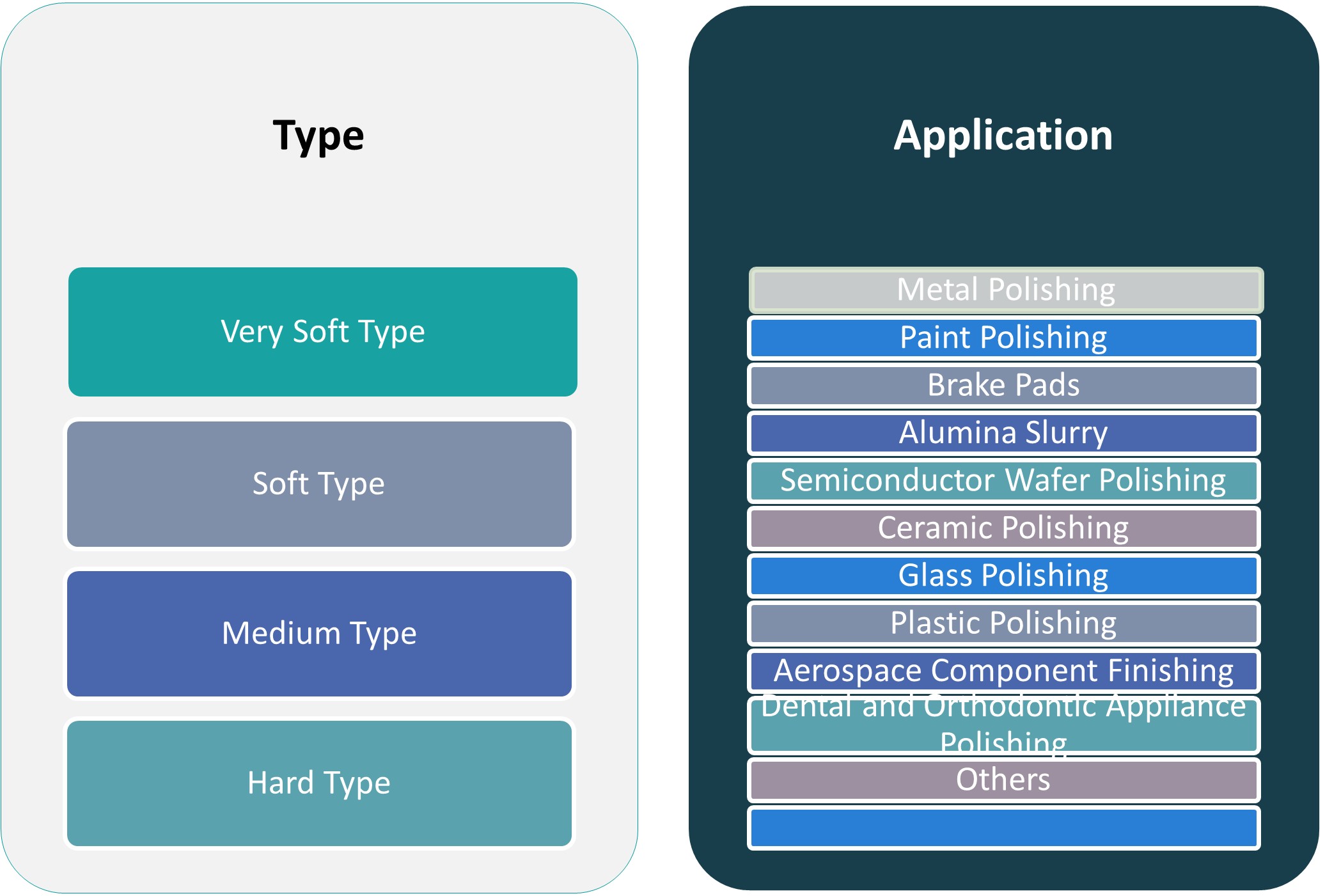
The India Polishing Grade Alumina Market is segmented into Very Soft Type, Soft Type, Paint Polishing, and Hard Type. The Hard Type segment holds a substantial share due to its durability and widespread usage in heavy-duty metal and ceramic polishing. It meets the requirements of industrial applications that demand consistent material removal rates. Paint Polishing alumina grades support automotive refinishing and detailing services, where fine finish is critical. Very Soft and Soft Types cater to electronics and optical applications where surface integrity and defect-free results are essential.
By Application
The market spans Metal Polishing, Paint Polishing, Brake Pads, Alumina Slurry, Semiconductor Wafer Polishing, Ceramic Polishing, Glass Polishing, Plastic Polishing, Aerospace Component Finishing, Dental and Orthodontic Appliance Polishing, and Others. Metal Polishing dominates due to high demand from automotive, tooling, and industrial manufacturing. Semiconductor Wafer Polishing and Alumina Slurry segments are growing due to the expanding electronics and IT hardware sectors. Aerospace and dental polishing segments are niche but display rising adoption of precision abrasives.
Segments
Based on Type
- Very Soft Type
- Soft Type
- Paint Polishing
- Hard Type
Based on Application
- Metal Polishing
- Paint Polishing
- Brake Pads
- Alumina Slurry
- Semiconductor Wafer Polishing
- Ceramic Polishing
- Glass Polishing
- Plastic Polishing
- Aerospace Component Finishing
- Dental and Orthodontic Appliance Polishing
- Others
Based on Region
- North India
- South India
- West India
- East India
- Central India
Regional Analysis
Regional Strength of Western India Anchored by Automotive and Electronics Clusters
The India Polishing Grade Alumina Market finds its strongest base in Western India, where automotive and electronics clusters drive demand. Manufacturers located in Maharashtra and Gujarat require high-purity alumina abrasives for component finishing. Major OEMs in Pune and Mumbai source local alumina suppliers to reduce lead times and logistics overhead. Local producers meet quality standards through onsite testing and rapid delivery schedules. Production increases of precision parts in this region sustain steady consumption levels. Competitive pricing from nearby refineries strengthens supplier relationships with OEMs. Regional infrastructure supports streamlined supply chains and warehousing facilities.
Southern India Growth Fueled by Semiconductor and Aerospace Production Hubs
In Southern India, the India Polishing Grade Alumina Market benefits from semiconductor and aerospace production hubs. Bangalore and Chennai host major wafer fabrication plants that require fine alumina slurries. Aircraft component manufacturers in Telangana and Tamil Nadu depend on hard-type alumina grades. Local government policies encourage establishment of tech parks that include polishing facilities. Factories maintain consistent output through regional supplier partnerships. It secures competitive advantage by aligning with state-driven industrial corridors. Strong port connectivity enables efficient export of finished goods.
Emerging Opportunities in Eastern and Northern India’s Industrial Corridors
The India Polishing Grade Alumina Market sees emerging opportunities in Eastern and Northern India’s industrial corridors. West Bengal and Odisha attract steel and heavy machinery manufacturers that use alumina abrasives. Delhi NCR and Uttar Pradesh host metal fabrication units that demand precise polishing solutions. Local refiners plan capacity additions to serve these growing clusters. It reduces production costs by sourcing raw alumina from nearby mining regions. Regional development plans include upgrades to road and rail networks that improve material flow. These initiatives expand market access and support new client acquisitions.
Key players
- Metkorp Equipments Pvt.
- Naisha Enterprises
- Laksh Enterprises
- Gujarat Credo Alumina Chemicals Ltd.
- Orient Ceratech
Competitive Analysis
The India Polishing Grade Alumina Market features intense rivalry among established domestic producers and international suppliers. It competes on product purity, particle-size consistency, and delivery reliability. Leading firms differentiate through investments in R\&D and proprietary formulations that yield higher removal rates and superior surface finishes. It faces pressure to reduce turnaround times by locating processing facilities near major industrial hubs. Price competition remains fierce, yet premium segments reward suppliers that guarantee defect-free polishing for semiconductor and optical applications. It contends with emerging entrants leveraging low-cost production in secondary regions. Strategic partnerships with OEMs and equipment manufacturers strengthen customer relationships and secure long-term contracts. Continuous capacity expansions and technology collaborations serve as key tactics to maintain market share.
Recent Developments
- In November 2024, GCACL projected a 40% year-on-year revenue growth for fiscal 2025, driven by healthy volume growth and steady order flow for both aluminum trihydrate (ATH) and zeolite products. The company also reported an EBITDA per metric ton growth of 25% to 30% in the first half of FY 2025 compared to fiscal 2024, indicating strong operational performance.
- On February 6, 2025, Orient Ceratech Ltd. held a board meeting to discuss financial results and strategic initiatives. The company continues to focus on expanding its production capacities and enhancing its market presence in the alumina sector.
Market Concentration and Characteristics
The India Polishing Grade Alumina Market exhibits moderate concentration, with a few major players controlling roughly 60 percent of total capacity while numerous regional suppliers serve niche segments. It relies on high-purity production facilities that require significant capital investment and rigorous quality controls. Leading firms leverage integrated supply chains and advanced testing capabilities to ensure particle-size uniformity and chemical stability. Smaller producers maintain flexibility by specializing in custom formulations for local automotive and electronics customers. Price competition remains intense in commodity grades, whereas premium segments reward suppliers that deliver defect-free finishes for semiconductor and optics applications. Market entrants face high entry barriers due to equipment costs and strict regulatory standards, reinforcing the dominance of established manufacturers.
Report Coverage
The research report offers an in-depth analysis based on Type, Application and Region. It details leading market players, providing an overview of their business, product offerings, investments, revenue streams, and key applications. Additionally, the report includes insights into the competitive environment, SWOT analysis, current market trends, as well as the primary drivers and constraints. Furthermore, it discusses various factors that have driven market expansion in recent years. The report also explores market dynamics, regulatory scenarios, and technological advancements that are shaping the industry. It assesses the impact of external factors and global economic changes on market growth. Lastly, it provides strategic recommendations for new entrants and established companies to navigate the complexities of the market.
Future Outlook
- The emergence of electric vehicle battery fabrication plants will drive demand for specialized alumina grades tailored to electrode and casing polishing. Manufacturers will invest in refining processes to achieve higher throughput and consistent surface finishes within strict quality-assurance frameworks.
- India’s expansion of semiconductor fabrication capacity will increase need for high-purity alumina slurries and pads used in wafer polishing. Producers will collaborate with chip manufacturers to customize particle distributions and slurry chemistries under tight process controls.
- Industry adoption of nano-alumina abrasives will intensify precision finishing requirements for optics, sensors, and microelectromechanical systems. Suppliers will develop advanced synthesis techniques to deliver uniform particle morphologies and minimize surface defects during chemical-mechanical polish operations.
- Growing emphasis on sustainability will prompt producers to pursue certifications for green alumina production and eco-friendly polishing slurries. It will encourage investment in closed-loop water systems, renewable energy sources, and biodegradable binder alternatives to reduce environmental footprint.
- Integration of smart monitoring and data analytics will enable real-time control over polishing parameters and predictive maintenance of equipment. It will improve yield consistency, reduce scrap rates, and support remote diagnostics across multiple polishing facilities.
- Emergence of dedicated polishing hubs near automotive and electronics clusters will shorten supply chains and cut logistical costs. Manufacturers will co-locate finishing units within industrial corridors to leverage shared infrastructure and accelerate product delivery timelines.
- Indian producers will target export markets by demonstrating compliance with international standards for particle purity and surface quality. It will drive expansion of NMCC and ISO certifications and encourage partnerships with global distributors to access new geographic segments.
- Demand for alumina solutions tailored to complex geometries in aerospace components and EV powertrain elements will grow rapidly. Suppliers will co-develop application-specific grades that balance hardness, fracture toughness, and environmental compatibility.
- Market consolidation will accelerate through mergers, acquisitions, and strategic alliances aimed at expanding capacity and technology portfolios. Firms will seek joint ventures with equipment manufacturers and research institutes to fast-track innovation and market penetration.
- Rising technical complexity in polishing processes will drive demand for skilled operators and application engineers. It will encourage companies to establish training centers and certification programs to enhance workforce competencies in high-precision finishing.

Request a Free Sample
Fill in your details and we'll send you a free sample report.
- Sample data tables & charts
- Research methodology
Market Dynamics
Expansion of Automotive and Electronics Manufacturing
Rapid growth in India's automotive and electronics sectors is increasing demand for high-purity alumina abrasives, which are essential for achieving precision surface finishes in components, screens, and assemblies.
Government Support for Domestic Production
Initiatives like 'Make in India' and the Production Linked Incentive (PLI) scheme incentivize local manufacturing of polishing-grade alumina, reducing import dependence and encouraging capacity expansion among domestic producers.
Technological Advancements in Polishing Methods
Adoption of advanced technologies such as chemical-mechanical polishing (CMP) and nano-alumina abrasives enables manufacturers to achieve finer finishes, higher throughput, and reduced defect rates, driving market growth.
Localization of Supply Chains
Regional sourcing of bauxite and integrated operations from refining to abrasive synthesis help manufacturers control input quality, reduce costs, and ensure stable supply, making the market more resilient to global disruptions.
Rising Quality Standards in Precision Engineering
Increasingly stringent quality requirements in sectors like semiconductors, optics, and aerospace are driving demand for specialized alumina grades that deliver defect-free, high-precision finishes.
Need a Custom Version of This Report?
Tailor the scope, geography, or segments to your exact requirements.
- Custom geography or segment scope
- Direct access to our analyst team
Frequently Asked Questions
What was the market size in 2023, what will it be in 2032, and what is the CAGR?
Which factors drive growth in the India Polishing Grade Alumina Market?
Who are the key players in this market?
What emerging trend will shape the market’s future?
Table of Content
Chapter 1 Market Segmentation
- 1.1 Segmentation Framework
- 1.1.1 Product and Service Classification
- 1.1.2 Application and End-Use Classification
- 1.1.3 Technology and Solution Classification
- 1.1.4 Customer and Distribution Channel Classification
- 1.1.5 Geographic Segmentation
- 1.1.6 Market Segment Definitions and Boundaries
- 1.2 By Type
- 1.2.1 Very Soft Type
- 1.2.2 Soft Type
- 1.2.3 Paint Polishing
- 1.2.4 Hard Type
- 1.3 By Application
- 1.3.1 Metal Polishing
- 1.3.2 Paint Polishing
- 1.3.3 Brake Pads
- 1.3.4 Alumina Slurry
- 1.3.5 Semiconductor Wafer Polishing
- 1.3.6 Ceramic Polishing
- 1.3.7 Glass Polishing
- 1.3.8 Plastic Polishing
- 1.3.9 Aerospace Component Finishing
- 1.3.10 Dental and Orthodontic Appliance Polishing
- 1.3.11 Others
Chapter 2 Introduction
- 2.1 Report Objectives and Scope
- 2.2 Product Definition and Industry Terminology
- 2.3 Market Inclusions and Exclusions
- 2.4 Research Process
- 2.4.1 Primary Research and Expert Interviews
- 2.4.2 Secondary Research and Source Review
- 2.4.3 Top-Down and Bottom-Up Estimation
- 2.4.4 Data Triangulation and Verification
- 2.5 Market Size Measurement Basis
- 2.5.1 2024: USD 199.87 million → 2032: USD 326.96 million
- 2.6 Historical and Forecast Reference Periods
- 2.6.1 Base Year: 2024
- 2.6.2 Forecast Period: 2024-2032
- 2.7 Research Assumptions and Limitations
Chapter 3 Executive Summary
- 3.1 Market Snapshot and Key Findings
- 3.2 Base-Year Market Size, 2024
- 3.3 Forecast Market Size, 2032
- 3.4 Revenue and Volume Growth Outlook
- 3.5 Key Demand and Supply Indicators
- 3.6 Leading Market Segments
- 3.7 Fastest-Growing Market Opportunities
- 3.8 Regional Performance Highlights
- 3.9 Technology and Industry Transformation
- 3.10 Competitive Landscape Summary
- 3.11 Analyst View and Strategic Implications
Chapter 4 India Polishing Grade Alumina Market Trends and Developments
- 4.1 Historical Industry Development
- 4.2 Recent Market Trends and Developments
- 4.3 Demand and Customer Behavior Trends
- 4.4 Technology and Product Innovation
- 4.5 Artificial Intelligence, Automation and Digitalization
- 4.6 Local Manufacturing and Supply Chain Realignment
- 4.7 Industry Partnerships, Mergers and Acquisitions
- 4.8 Sustainability and Circular Economy Developments
- 4.9 Government and Private Sector Investment Trends
- 4.10 Emerging Business Models and Commercialization
- 4.11 Industry Developments and Announcements
Chapter 5 India Polishing Grade Alumina Market Production, Supply and Demand Analysis
- 5.1 Demand Trend and Consumption Analysis
- 5.2 Demand Forecast, 2024-2032
- 5.3 Production and Output Trend
- 5.4 Production and Output Forecast, 2024-2032
- 5.5 Installed Capacity and Capacity Utilization
- 5.6 Company-Wise Production Plants and Statistics
- 5.6.1 Installed Production Capacity
- 5.6.2 Actual Production
- 5.6.3 Planned Capacity and Expansion Targets
- 5.7 Supply Chain Structure and Procurement Trends
- 5.8 Supply-Demand Gap and Bottlenecks
- 5.9 Import Dependence and Sourcing Structure
- 5.10 Contract Manufacturing and Outsourcing
- 5.11 Regional Supply and Demand Concentration
Chapter 6 India Polishing Grade Alumina Market Pricing Analysis
- 6.1 Pricing Structure and Measurement
- 6.2 Historical Pricing Trends
- 6.3 Pricing Outlook, 2024-2032
- 6.4 Average Selling Price and Unit Economics
- 6.5 Pricing by Product and Market Segment
- 6.6 Geographic Pricing Differences
- 6.7 Key Input, Energy, Labor and Logistics Costs
- 6.8 Contract Pricing and Purchasing Models
- 6.9 Pricing Sensitivity and Competitive Positioning
- 6.10 Price, Margin and Profitability Implications
Chapter 7 India Polishing Grade Alumina Market Dynamics
- 7.1 Market Growth Drivers
- 7.1.1 Demand-Side Drivers
- 7.1.2 Technology and Innovation Drivers
- 7.1.3 Infrastructure and Investment Drivers
- 7.1.4 Regulatory and Policy Drivers
- 7.2 Market Restraints
- 7.2.1 Cost and Affordability Constraints
- 7.2.2 Technology and Adoption Barriers
- 7.2.3 Supply Chain and Operational Constraints
- 7.3 Market Challenges
- 7.3.1 Competitive Pressure and Margin Erosion
- 7.3.2 Skills, Infrastructure and Implementation Gaps
- 7.4 Emerging Market Opportunities
- 7.5 Market Dynamics Impact and Time-Horizon Assessment
Chapter 8 India Polishing Grade Alumina Value Chain Analysis
- 8.1 Industry Value Chain Overview
- 8.2 Upstream Suppliers and Critical Inputs
- 8.3 Technology and Component Providers
- 8.4 Manufacturing or Service Delivery
- 8.5 Distribution, Channel Partners and Integrators
- 8.6 Downstream Applications and End Users
- 8.7 Value Addition and Profit Pools
- 8.8 Vertical Integration and Outsourcing
- 8.9 Supplier Concentration and Risk
- 8.10 Supply Chain Localization and Resilience
Chapter 9 India Polishing Grade Alumina Market Regulations and Policies
- 9.1 Relevant Laws, Standards and Compliance Frameworks
- 9.2 Product, Service, Safety and Quality Requirements
- 9.3 Government Policies, Incentives and Subsidies
- 9.4 Imports, Exports and Trade Barriers
- 9.5 Public Procurement and Local Content Requirements
- 9.6 Environmental and Sustainability Compliance
- 9.7 Upcoming Policy Changes and Market Implications
Chapter 10 India Polishing Grade Alumina Market Hotspots and Opportunities
- 10.1 Market Opportunity Mapping and Growth Hotspots
- 10.2 High-Growth Applications and Customer Groups
- 10.3 Underserved Markets and White-Space Opportunities
- 10.4 Emerging Technology and Product Opportunities
- 10.5 New Capacity and Investment Hotspots
- 10.6 Market Entry and Expansion Opportunities
- 10.7 Distribution and Partnership Opportunities
- 10.8 Near-Term and Long-Term Commercial Potential
- 10.9 Opportunity Attractiveness and Execution Risks
Chapter 11 India Polishing Grade Alumina Market Outlook, 2024-2032
- 11.1 Market Size and Analysis
- 11.1.1 Revenue (Market Measurement: 2024: USD 199.87 million → 2032: USD 326.96 million)
- 11.1.2 Market Volume and Quantity Sold
- 11.1.3 Historical Market Size
- 11.1.4 Base-Year Market Size, 2024
- 11.2 Market Forecast, 2024-2032
- 11.2.1 Revenue Forecast to 2032
- 11.2.2 Volume Forecast to 2032
- 11.2.3 CAGR and Year-on-Year Growth
- 11.2.4 Incremental Revenue Opportunity
- 11.3 Forecast Assumptions and Scenario Analysis
- 11.3.1 Base-Case Forecast
- 11.3.2 Optimistic and Conservative Scenarios
- 11.3.3 Technology, Pricing and Policy Sensitivities
- 11.4 Market Attractiveness and Growth Outlook
Chapter 12 India Polishing Grade Alumina Market Segmentation and Outlook
- 12.1 Segmentation Summary and Market Shares, 2024
- 12.2 Largest and Fastest-Growing Segments
- 12.3 By Type - Market Size and Forecast, 2024-2032
- 12.3.1 Segment Definition and Scope
- 12.3.2 Historical Market Size
- 12.3.3 Revenue Forecast, 2024-2032
- 12.3.4 Volume Forecast, 2024-2032
- 12.3.5 Base-Year Market Share, 2024
- 12.3.6 Segment CAGR and Growth Drivers
- 12.3.7 Subsegment Market Size and Forecast
- 12.3.7.1 Very Soft Type
- 12.3.7.2 Soft Type
- 12.3.7.3 Paint Polishing
- 12.3.7.4 Hard Type
- 12.3.8 Subsegment Pricing and Adoption Trends
- 12.3.9 Leading Suppliers and Competition
- 12.3.10 Regional Demand and Opportunities
- 12.4 By Application - Market Size and Forecast, 2024-2032
- 12.4.1 Segment Definition and Scope
- 12.4.2 Historical Market Size
- 12.4.3 Revenue Forecast, 2024-2032
- 12.4.4 Volume Forecast, 2024-2032
- 12.4.5 Base-Year Market Share, 2024
- 12.4.6 Segment CAGR and Growth Drivers
- 12.4.7 Subsegment Market Size and Forecast
- 12.4.7.1 Metal Polishing
- 12.4.7.2 Paint Polishing
- 12.4.7.3 Brake Pads
- 12.4.7.4 Alumina Slurry
- 12.4.7.5 Semiconductor Wafer Polishing
- 12.4.7.6 Ceramic Polishing
- 12.4.7.7 Glass Polishing
- 12.4.7.8 Plastic Polishing
- 12.4.7.9 Aerospace Component Finishing
- 12.4.7.10 Dental and Orthodontic Appliance Polishing
- 12.4.7.11 Others
- 12.4.8 Subsegment Pricing and Adoption Trends
- 12.4.9 Leading Suppliers and Competition
- 12.4.10 Regional Demand and Opportunities
- 12.5 Segment Growth Comparison
- 12.6 Segment Attractiveness and Priority Matrix
Chapter 13 India Polishing Grade Alumina End-Use and Application Market Outlook
- 13.1 End-Use Industry and Customer Demand Structure
- 13.2 Leading Applications and Customer Groups
- 13.3 End-Use Market Size, Share and Forecast
- 13.4 Major End-Use Industry Deep Dives
- 13.4.1 Customer Requirements and Use Cases
- 13.4.2 Demand and Replacement Cycles
- 13.4.3 Technical and Regulatory Considerations
- 13.4.4 Purchasing and Procurement Models
- 13.4.5 Leading Vendors and Distribution Channels
- 13.4.6 Forecast and Commercial Opportunities
- 13.5 Emerging Applications and Cross-Segment Demand
- 13.6 End-Use Industry Investment Priorities
Chapter 14 India Polishing Grade Alumina Geographic Market Outlook, 2024-2032
- 14.1 Domestic Market Distribution and Demand Clusters
- 14.2 State- or Province-Wise Market Size and Forecast, 2024-2032
- 14.3 City and Metropolitan Market Outlook
- 14.4 Industrial, Manufacturing and Commercial Clusters
- 14.5 Geographic Concentration of Key End Users
- 14.6 Local Pricing and Purchasing Differences
- 14.7 Domestic Production Facilities and Capacity Map
- 14.8 Local Infrastructure and Project Pipeline
- 14.9 State-Level Policy and Incentive Differences
- 14.10 Subnational Investment Hotspots and Opportunities
- 14.11 Distribution and Logistics Networks
- 14.12 Domestic Competitive Footprint
Chapter 15 India Polishing Grade Alumina Technology, Innovation and Sustainability Outlook
- 15.1 Technology Landscape and Maturity
- 15.2 Product, Process and Service Innovation
- 15.3 AI, Automation and Digital Tools in the Industry
- 15.4 Technology Adoption and Performance Benchmarking
- 15.5 Innovation Pipeline and R&D Investment
- 15.6 Patent and Intellectual Property Trends
- 15.7 Energy Efficiency and Resource Management
- 15.8 Sustainability, Recycling and Circularity
- 15.9 Technology Roadmap, 2024-2032
- 15.10 Risks of Obsolescence and Technology Substitution
Chapter 16 India Polishing Grade Alumina Market Key Strategic Imperatives
- 16.1 Growth and Market Entry Priorities
- 16.2 High-Return Products and Segments
- 16.3 Pricing, Profitability and Cost Optimization
- 16.4 Technology Investment and Product Differentiation
- 16.5 Supply Chain Localization and Resilience
- 16.6 Distribution and Customer Acquisition
- 16.7 Partnership, Acquisition and Capacity Strategy
- 16.8 Regional Expansion Priorities
- 16.9 Short-, Medium- and Long-Term Actions
Chapter 17 Competition Outlook
- 17.1 Industry Competition Characteristics
- 17.2 Market Structure and Concentration
- 17.3 Market Share and Competitive Positioning, 2024
- 17.4 Company-Wise Revenue and Product Benchmarking
- 17.5 Production and Service Capacity Benchmarking
- 17.6 Technology, Pricing and Differentiation
- 17.7 Regional Footprint and Distribution Strength
- 17.8 Mergers, Acquisitions and Strategic Alliances
- 17.9 New Entrants and Competitive Threats
- 17.10 Porter's Five Forces and Industry Attractiveness
- 17.11 Competitive Outlook, 2024-2032
Chapter 18 Company Profiles
- 18.1 Company Coverage and Selection Criteria
- 18.2 Nippon Light Metal Company
- 18.2.1 Business Description
- 18.2.2 Company Ownership and Geographic Presence
- 18.2.3 Product and Service Portfolio
- 18.2.4 Manufacturing and Operating Footprint
- 18.2.5 Production Capacity and Expansion Plans
- 18.2.6 Financial Performance and Investment
- 18.2.7 Market Share and Competitive Position
- 18.2.8 Technology and Innovation Capabilities
- 18.2.9 Strategic Alliances or Partnerships
- 18.2.10 Recent Developments
- 18.2.11 Growth Strategy and Outlook
- 18.3 Baikowski Performance Materials
- 18.4 Almatis GmbH
- 18.5 Searles Valley Minerals
- 18.6 National Aluminium Company (NALCO)
- 18.7 Hindalco Industries
- 18.8 Gujarat Credo Alumina Chemicals Ltd.
- 18.9 Orient Ceratech
- 18.10 Metkorp Equipments Pvt.
- 18.11 Naisha Enterprises
- 18.12 Other Relevant Market Participants
Note: Every listed company is profiled on the structure shown under the first company. The company list is preliminary and may change based on research findings, market developments, data availability and client requirements.
Chapter 19 Disclaimer
- 19.1 Research and Forecast Disclaimer
- 19.2 Data Source and Estimation Limitations
Note: The depth of individual sections depends on data availability for this market. Volume, capacity, trade and other unit-based metrics are included where applicable.

