Market Insights
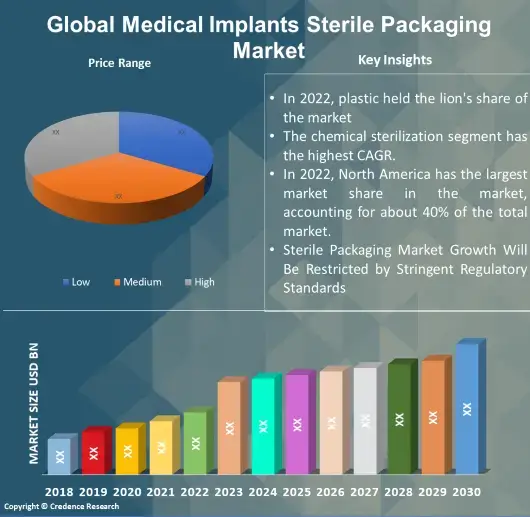
- The global demand for medical implants sterile packaging was valued at USD XX million in 2022 and is expected to reach USD XX Million in 2030, growing at a CAGR of 6.90% between 2023 and 2030
- The orthopedic implants category dominates the medical implants sterile packaging market, with cardiovascular implants coming in second.
- In 2022, plastic held the lion's share of the industry, and the paper/paperboard sector is expected to be the fastest growing.
- Trays led the market due to their light weight, while the blister packs section is the market's second most important segment.
- The chemical sterilization sector has the highest CAGR during the projected period, while radiation sterilization is the second most popular approach, with gamma radiation accounting for the largest sub-segment.
- The medical device manufacturers sector dominates the medical implants sterile packaging market, with hospitals and clinics playing a significant role.
- The implant packaging for surgical procedures sector is the fastest growing segment of the medical implants sterile packaging industry, and the implant packaging for research and development industry is extremely popular.
- In 2022, North America will have the largest market share in the medical implants sterile packaging market, accounting for almost 40% of the whole market, with Asia Pacific being the fastest growing region.
- The rising need for sterile packaging systems in the healthcare industry promotes market expansion.
- Strict regulations governing the sale and use of sterile medical supplies stifle market growth.
Executive Summary
Market Definition
The medical implants sterile packaging market is a market for packaging solutions intended exclusively for medical implants. These packaging methods are used to protect and keep medical implants sterile, such as orthopedic implants, cardiac implants, dental implants, and others. The packaging guarantees that the implants remain sterile during storage, transit, and handling until they are ready for use in surgical procedures. The growing demand for implantable medical devices, as well as the requirement for tight infection control measures in healthcare settings, are driving the market for medical implants sterile packaging.
Market Overview
The global medical implants sterile packaging market has been steadily growing in recent years and is predicted to grow at a 6.90% CAGR between 2023 and 2030. The market is anticipated to be worth USD XX million by 2030, up from USD XX million in 2022.
Globally, the medical implants sterile packaging market is expanding rapidly. The market is being driven by a number of reasons, such as the ageing population and the occurrence of chronic illnesses. Rising demand for medical implants such as orthopedic and cardiovascular implants is also propelling the market forward.
However, the market is constrained by several factors. Stringent laws and standards for sterile packaging, for example, can raise the cost and complexity of packaging procedures. Furthermore, producers may face difficulties due to a lack of standardized packaging solutions for various types of implants.
Nonetheless, the market offers numerous opportunities. Implant technology improvements, such as the creation of bioresorbable implants and smart implants, open up new growth opportunities. The demand for innovative and efficient sterile packaging solutions is also being fueled by the increased focus on patient safety and infection control.
Segmentation by Types of Implants
- The orthopedic implants category dominates the medical implants sterile packaging market. Because of the increasing demand for orthopedic implants, such as joint replacements, spinal implants, and trauma implants, this category commands a substantial market share. The increased prevalence of orthopedic problems, as well as the aging population, contribute to this segment's market domination.
- The cardiovascular implants category is the second largest section of the medical implants sterile packaging market, accounting for a major market share due to the high demand for cardiovascular implants such as pacemakers, stents, and heart valves.
Segmentation by Packaging Material
- Plastic held the lion's share of the market in 2022. Because of the various characteristics of plastic, it can be used in a wide range of medical End-Users. Plastic is easily moldable, inexpensive, and has a wide temperature-pressure range, a high tolerance for humidity, and considerable durability against UV-cleanliness and bioburden.
- The paper/paperboard market is predicted to be the fastest expanding. It is related to plastics' fluctuating nominal value.
Segmentation by Packaging Type
- Trays dominated the market due to their small weight. They are lightweight and portable. Plastic thermoformed trays come in a wide range of shapes and sizes. They are exclusively intended for internal usage. Plastic trays have a highly variable package design style because the plastics used in trays may be thermoformed to make a range of shapes.
- The Blister Packs segment is the second important segment in the medical implants sterile packaging market.
Segmentation by Sterilization Method
- The chemical sterilization sector has the highest CAGR during the forecast period. Chemical sterilization is commonly employed for equipment that are sensitive to the extreme heat used in steam sterilization and those that may be impacted by irradiation.
- The second most popular method is radiation sterilization, with gamma radiation accounting for the largest sub-segment. For sterilization and disinfection, cobalt-60 is used as a radiation source that decomposes to produce high-energy gamma rays.
Segmentation by End-User
- The medical device manufacturers segment dominates the medical implants sterile packaging market. This market includes manufacturers who create a wide range of medical devices, including implants, and require sterile packaging solutions for their products.
- Hospitals and clinics are a vital part of the medical implants sterile packaging market.
Segmentation by Application
- The implant packaging for surgical procedures sector is the fastest growing section in the medical implants sterile packaging market. This market is rapidly expanding as the number of surgical procedures increases and the demand for sterile packaging solutions for surgical implants rises.
- The implant packaging for research and development market is truly in high demand.
Segmentation by Region
- With about 40% of the market, North America will have the largest market share in 2022 for sterile packaging for medical implants.
- The market for sterile packaging of medical implants is increasing most quickly in Asia Pacific.
- The remainder of the world's supply of sterile packaging for medical implants comes from Latin America, the Middle East, and Africa.
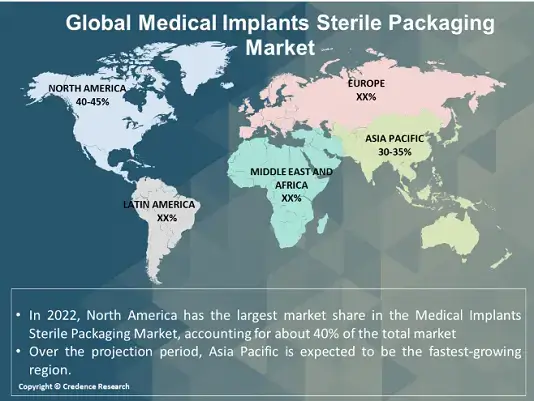
North America holds over 40% of the entire market share in the medical implants sterile packaging market. This dominance can be attributed to a number of factors, including enhanced healthcare infrastructure, stringent regulatory standards, and a high demand for high-quality healthcare products. The region's emphasis on infection control and patient safety encourages the use of medical implants sterile packaging solutions even more.
Asia Pacific is the fastest growing region in the medical implants sterile packaging market. The region is experiencing great growth as a result of factors such as the rising healthcare business, increased investments in healthcare infrastructure, and improved knowledge about infection control and patient safety. Furthermore, the region's growing population, rising disposable incomes, and developments in medical technology are driving demand for medical implants sterile packaging solutions. As a result, Asia Pacific is seeing enormous market boom and is expected to continue on its upward trajectory in the coming years.
Key Highlights of the Report
The global medical implants sterile packaging market is segmented by Types of Implants, Packaging Material, Packaging Type, Sterilization Method, Application and region. In 2022, plastic held the lion's share of the market. Furthermore, the medical implants sterile packaging market is dominated by the category Medical Device Manufacturers and Trays, and the chemical sterilization segment has the highest CAGR., with North Amerca leading the market growth.
The market's primary drivers include the growing emphasis on infection control and patient safety, advancements in medical technology, and the rising prevalence of chronic illnesses. Furthermore, there is a desire for customized packaging options for personalized medication and biologics, as well as opportunities for healthcare sector development in emerging regions and innovative and environmentally friendly packaging materials.
Nonetheless, North America will have the greatest market share in the medical implants sterile packaging market in 2022, accounting for almost 40% of the total market. This dominance can be due to a variety of causes, such as improved healthcare infrastructure, stringent regulatory standards, and a high demand for high-quality healthcare products. Additionally, Asia Pacific is the fastest expanding region in the medical implants sterile packaging market. The region is seeing tremendous expansion as a consequence of factors such as expanding healthcare business, increased investments in healthcare infrastructure, and enhanced knowledge about infection control and patient safety..
What Factors Are Fueling The Growth Of The Global Medical Implants Sterile Packaging Market?
The primary drivers of the market are the increasing emphasis on infection control and patient safety, advancements in medical technology, and the rising prevalence of chronic diseases.
What Are The Key Challenges Encountered By The Global Medical Implants Sterile Packaging Market?
The market is confronted with constraints such as stringent laws and standards, high initial investment costs, and a scarcity of trained people.
What Opportunities For Growth Exist In The Global Medical Implants Sterile Packaging Market?
Demand for customized packaging options for personalized medicine and biologics, healthcare industry expansion in emerging areas and opportunities for innovative and eco-friendly packaging materials
Market Drivers
The global medical implants sterile packaging market is driven by several factors. The following are the key drivers of the global medical implants sterile packaging market:
Increasing Acceptance Of Single-Use Hospital Items
Single-use healthcare items have previously encountered a number of obstacles due to waste disposal issues. Regardless of the circumstances, several medical practitioners are now actively encouraging the use of single-use hospital goods due to their lower risk of spreading illnesses, particularly among the elderly. HAIs, or Healthcare Acquired illnesses, are illnesses that people contract while receiving treatment for another medical disease. According to CDC estimates, HAI cause around 1.7 million infections every year, resulting in roughly 99,000 deaths. Because of the unacceptably high death rate, practitioners are forced to utilize single-use sterile medical products. Finally, surgical infections cost the United States over $10 billion.
Sterile Packaging Systems Are In High Demand In The Healthcare Industry
Some of the main factors influencing the rise of the healthcare sector are the growing population, rising illness prevalence, and the implementation of new laws by the government to stop the spread of dangerous diseases. Medical implant sterile packaging's growth in the healthcare industry has been facilitated by its excellent microbiological barrier and durability features. These packaging solutions maintain the sterility of pharmaceutical and medical goods up until the package is opened for use. Furthermore, it is crucial to utilize the proper sterile packaging materials since they enable the safe extraction of wrapped articles. As a result, the market for sterile packaging for medical implants will grow as a result of rising demand for packaging solutions in the healthcare sector.
Market Restraints
The global medical implants sterile packaging market faces some challenges that may hinder its growth. These include the following:
Sterile Packaging Market Growth
Sterile packaging systems must be designed to keep packaged materials sterile until they are used. As a result, strict regulatory criteria are developed and implemented during the manufacturing process.
These requirements guarantee that the packaged instruments or equipment won't be negatively impacted by the packaging materials or other external factors. The validation criteria for medical packaging systems used for sterilized medical equipment or instruments are established by the international standard EN ISO 11607 (parts 1 and 2). Several phases of the creation of packaging products use these validation needs, including material selection, design testing and control, design qualification, and process validation. The complicated criteria serve as a market restriction.
Opportunities
The global medical implants sterile packaging market offers significant growth opportunities. These include the following:
Material Advances In The Plastics Industry
Plastics are increasingly being employed in medical and dental End-Users to replace metal, glass, and other traditional materials in single-use and reusable medical equipment. They provide sturdy and lightweight performance, design freedom, ease of manufacture, and the opportunity to differentiate products and brands through colour, durability, and cost-effectiveness when compared to traditional materials.
High-performance plastics provide various advantages over normal plastics, including greater friction reduction, good malleability, flame and shock resistance, faster production times, reduced weight, and resistance to high impact and chemicals. The development of legislation and standards mandating high-quality plastics used in medical End-Users (high-performance polymers) has resulted in a substantial market size for HPPs.
The Chemistry Department at Colorado State University discovered a polymer that has the ability to revert to its original molecular state. This polymer is completely recyclable and possesses properties similar to traditional plastics, such as lightweight and heat resistant. Such advancements are expected to increase the market's potential for growth.
Competitive Landscape
Key Players
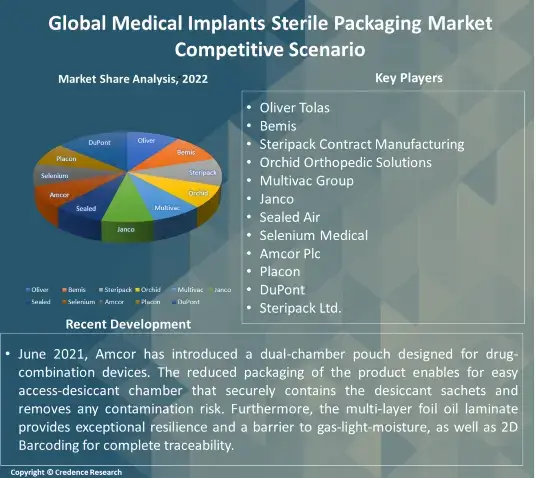
The global medical implants sterile packaging market is highly competitive, with several key players. Some of the major players in the market and their market share are as follows:
- Oliver Tolas
- Bemis
- Steripack Contract Manufacturing
- Orchid Orthopedic Solutions
- Multivac Group
- Janco
- Sealed Air
- Selenium Medical
- Amcor Plc
- Placon
- DuPont
- Steripack Ltd.
- Wipak Group
- Nelipak Healthcare
- Tekni-Plex
These organizations prioritize Types of Implants innovation, Disease Area expansion, and mergers and acquisitions to stay competitive.
The global medical implants sterile packaging market's key players continually seek to stay ahead by offering new Types of Implants and developments.
April 2021, Sonoco's subsidiary collaborated with the Healthcare Plastics Recycling Council, or HPRC. Members of HPRC Europe are currently involved in a number of initiatives aimed at enabling the recycling of healthcare plastics, such as mapping hospital barriers to recycling clinical plastics, recruiting advisory board members from European healthcare organizations, and engaging with other plastics and recycling organizations in Europe to identify areas of synergy and collaboration.
January 2020, Sonoco finalized the $145 million acquisition of TEQ (Thermoform Engineered Quality), an Illinois-based company, and Plastique Holdings (UK). TEQ reported $87 million in sales in the third quarter of 2019. The company also manufactures recyclable-molded pulp fibre packaging and thermoformed plastic packaging. The acquisition business also stated that healthcare packaging is an important area of expansion for the company, and that they intend to become a much larger provider of medical items.
Summary of Key Findings
- Sterile packaging systems are in great demand in the healthcare industry, which supports market growth.
- Market divided by implant type, packaging material, packaging type, sterilization method, end-user, application, and region.
- The medical device manufacturers segment dominates the medical implants sterile packaging market
- Trays led the market due to their light weight
- North America leads market growth; the market is highly competitive, with key players such as Oliver Tolas, Bemis, Steripack Contract Manufacturing, Orchid Orthopedic Solutions, Multivac Group, Janco, Sealed Air, and Selenium Medical.
Future Outlook
- Growing demand for medical implants
- Increasing focus on infection control and patient safety
- Advances in packaging materials and technology
- Strict rules and standards
- Rising prevalence of chronic diseases
- Aging population
- Opportunities for innovation in sterile packaging solutions
Segmentation
- By Type of Implants:
- Orthopedic Implants
- Cardiovascular Implants
- Neurological Implants
- Dental Implants
- Ophthalmic Implants
- Cosmetic Implants
- Others
- By Packaging Material:
- Plastic
- Glass
- Metal
- Combination Materials
- By Packaging Type:
- Trays
- Pouches
- Boxes and Containers
- Blister Packs
- Others
- By Sterilization Method:
- Radiation Sterilization
- Ethylene Oxide (EtO) Sterilization
- Steam Sterilization
- Chemical Sterilization
- Other Sterilization Methods
- By End-User:
- Medical Device Manufacturers
- Hospitals and Clinics
- Ambulatory Surgical Centers
- Research Institutes
- By Application:
- Implant Packaging for Surgical Procedures
- Implant Packaging for Research and Development
- By Region
- North America
- U.S
- Canada
- Mexico
- Europe
- Germany
- France
- U.K.
- Italy
- Spain
- Rest of Europe
- Asia Pacific
- China
- Japan
- India
- South Korea
- South-east Asia
- Rest of Asia Pacific
- Latin America
- Brazil
- Argentina
- Rest of Latin America
- Middle East & Africa
- GCC Countries
- South Africa
- Rest of Middle East and Africa
- North America
Adjacent Markets
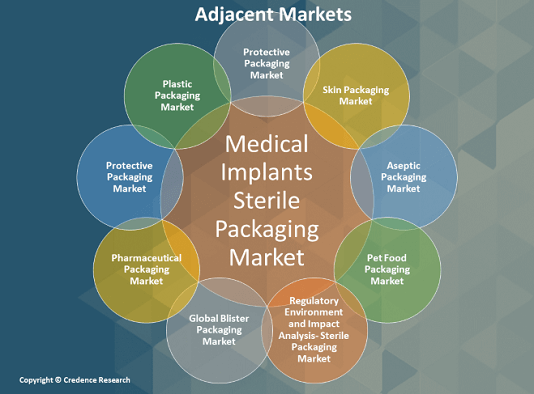
In the medical implants sterile packaging market, there are several adjacent markets which has high revenue growth opportunities. The key adjacent markets for medical implants sterile packaging market-

Request a Free Sample
Fill in your details and we'll send you a free sample report.
- Sample data tables & charts
- Research methodology
Market Dynamics
Emphasis on Infection Control and Patient Safety
The increasing focus on reducing healthcare-associated infections and ensuring patient safety is driving demand for sterile packaging solutions that maintain implant sterility until use, especially in surgical settings.
Rising Prevalence of Chronic Diseases and Aging Population
The growing incidence of chronic conditions and an aging global population are leading to higher rates of implant surgeries, particularly orthopedic and cardiovascular, which in turn boosts the need for sterile packaging.
Advancements in Implant and Packaging Technology
Innovations such as bioresorbable and smart implants, along with new high-performance and recyclable packaging materials, are creating opportunities for more effective and sustainable sterile packaging solutions.
Stringent Regulatory Standards
Tightening regulations around the sterility and safety of medical devices are compelling manufacturers to adopt advanced sterile packaging systems, increasing market demand despite adding complexity and cost.
Need a Custom Version of This Report?
Tailor the scope, geography, or segments to your exact requirements.
- Custom geography or segment scope
- Direct access to our analyst team
Frequently Asked Questions
What is the current size of the worldwide medical implants sterile packaging market?
What is the predicted growth rate of the medical implants sterile packaging market between 2023 and 2030?
Which segment has the most market share in terms of Packaging Material?
Which sterilization Method segment governs the market demand for medical implants sterile packaging?
Which Packaging Type segment is predicted to grow at the highest rate over the forecast period?
Which region is driving the medical implants sterile packaging industry forward?
Who are the major players in the global medical implants sterile packaging market?
What are the major market drivers of the medical implants sterile packaging industry?
What are the major market restraints of the medical implants sterile packaging industry?
What are the major market opportunities of the medical implants sterile packaging industry?
Table of Content
Chapter 1 Market Segmentation
- 1.1 Segmentation Framework
- 1.1.1 Product and Service Classification
- 1.1.2 Application and End-Use Classification
- 1.1.3 Technology and Solution Classification
- 1.1.4 Customer and Distribution Channel Classification
- 1.1.5 Geographic Segmentation
- 1.1.6 Market Segment Definitions and Boundaries
- 1.2 By Packaging Type
- 1.2.1 Trays
- 1.2.2 Blister Packs
- 1.2.3 Pouches
- 1.2.4 Boxes and Containers
- 1.3 By Type of Implants
- 1.3.1 Orthopedic Implants
- 1.3.2 Cardiovascular Implants
- 1.3.3 Dental Implants
- 1.3.4 Neurological Implants
- 1.3.5 Ophthalmic Implants
- 1.3.6 Cosmetic Implants
- 1.4 By Packaging Material
- 1.4.1 Plastic
- 1.4.2 Paper/Paperboard
- 1.4.3 Glass
- 1.4.4 Metal
- 1.4.5 Combination Materials
- 1.5 By Sterilization Method
- 1.5.1 Chemical Sterilization
- 1.5.2 Radiation Sterilization
- 1.5.3 Ethylene Oxide (EtO) Sterilization
- 1.5.4 Steam Sterilization
Chapter 2 Introduction
- 2.1 Report Objectives and Scope
- 2.2 Product Definition and Industry Terminology
- 2.3 Market Inclusions and Exclusions
- 2.4 Research Process
- 2.4.1 Primary Research and Expert Interviews
- 2.4.2 Secondary Research and Source Review
- 2.4.3 Top-Down and Bottom-Up Estimation
- 2.4.4 Data Triangulation and Verification
- 2.5 Research Assumptions and Limitations
Chapter 3 Executive Summary
- 3.1 Market Snapshot and Key Findings
- 3.2 Base-Year Market Size
- 3.3 Forecast Market Size
- 3.4 Revenue and Volume Growth Outlook
- 3.5 Key Demand and Supply Indicators
- 3.6 Leading Market Segments
- 3.7 Fastest-Growing Market Opportunities
- 3.8 Regional Performance Highlights
- 3.9 Technology and Industry Transformation
- 3.10 Competitive Landscape Summary
- 3.11 Analyst View and Strategic Implications
Chapter 4 Global Medical Implants Sterile Packaging Market Trends and Developments
- 4.1 Historical Industry Development
- 4.2 Recent Market Trends and Developments
- 4.3 Demand and Customer Behavior Trends
- 4.4 Technology and Product Innovation
- 4.5 Artificial Intelligence, Automation and Digitalization
- 4.6 Local Manufacturing and Supply Chain Realignment
- 4.7 Industry Partnerships, Mergers and Acquisitions
- 4.8 Sustainability and Circular Economy Developments
- 4.9 Government and Private Sector Investment Trends
- 4.10 Emerging Business Models and Commercialization
- 4.11 Industry Developments and Announcements
Chapter 5 Global Medical Implants Sterile Packaging Market Production, Supply and Demand Analysis
- 5.1 Demand Trend and Consumption Analysis
- 5.2 Demand Forecast
- 5.3 Production and Output Trend
- 5.4 Production and Output Forecast
- 5.5 Installed Capacity and Capacity Utilization
- 5.6 Company-Wise Production Plants and Statistics
- 5.6.1 Installed Production Capacity
- 5.6.2 Actual Production
- 5.6.3 Planned Capacity and Expansion Targets
- 5.7 Supply Chain Structure and Procurement Trends
- 5.8 Supply-Demand Gap and Bottlenecks
- 5.9 Import Dependence and Sourcing Structure
- 5.10 Contract Manufacturing and Outsourcing
- 5.11 Regional Supply and Demand Concentration
Chapter 6 Global Medical Implants Sterile Packaging Market Pricing Analysis
- 6.1 Pricing Structure and Measurement
- 6.2 Historical Pricing Trends
- 6.3 Pricing Outlook
- 6.4 Average Selling Price and Unit Economics
- 6.5 Pricing by Product and Market Segment
- 6.6 Geographic Pricing Differences
- 6.7 Key Input, Energy, Labor and Logistics Costs
- 6.8 Contract Pricing and Purchasing Models
- 6.9 Pricing Sensitivity and Competitive Positioning
- 6.10 Price, Margin and Profitability Implications
Chapter 7 Global Medical Implants Sterile Packaging Market Dynamics
- 7.1 Market Growth Drivers
- 7.1.1 Demand-Side Drivers
- 7.1.2 Technology and Innovation Drivers
- 7.1.3 Infrastructure and Investment Drivers
- 7.1.4 Regulatory and Policy Drivers
- 7.2 Market Restraints
- 7.2.1 Cost and Affordability Constraints
- 7.2.2 Technology and Adoption Barriers
- 7.2.3 Supply Chain and Operational Constraints
- 7.3 Market Challenges
- 7.3.1 Competitive Pressure and Margin Erosion
- 7.3.2 Skills, Infrastructure and Implementation Gaps
- 7.4 Emerging Market Opportunities
- 7.5 Market Dynamics Impact and Time-Horizon Assessment
Chapter 8 Global Medical Implants Sterile Packaging Value Chain Analysis
- 8.1 Industry Value Chain Overview
- 8.2 Upstream Suppliers and Critical Inputs
- 8.3 Technology and Component Providers
- 8.4 Manufacturing or Service Delivery
- 8.5 Distribution, Channel Partners and Integrators
- 8.6 Downstream Applications and End Users
- 8.7 Value Addition and Profit Pools
- 8.8 Vertical Integration and Outsourcing
- 8.9 Supplier Concentration and Risk
- 8.10 Supply Chain Localization and Resilience
Chapter 9 Global Medical Implants Sterile Packaging Market Regulations and Policies
- 9.1 Relevant Laws, Standards and Compliance Frameworks
- 9.2 Product, Service, Safety and Quality Requirements
- 9.3 Government Policies, Incentives and Subsidies
- 9.4 Imports, Exports and Trade Barriers
- 9.5 Public Procurement and Local Content Requirements
- 9.6 Environmental and Sustainability Compliance
- 9.7 Upcoming Policy Changes and Market Implications
Chapter 10 Global Medical Implants Sterile Packaging Market Hotspots and Opportunities
- 10.1 Market Opportunity Mapping and Growth Hotspots
- 10.2 High-Growth Applications and Customer Groups
- 10.3 Underserved Markets and White-Space Opportunities
- 10.4 Emerging Technology and Product Opportunities
- 10.5 New Capacity and Investment Hotspots
- 10.6 Market Entry and Expansion Opportunities
- 10.7 Distribution and Partnership Opportunities
- 10.8 Near-Term and Long-Term Commercial Potential
- 10.9 Opportunity Attractiveness and Execution Risks
Chapter 11 Global Medical Implants Sterile Packaging Market Outlook
- 11.1 Market Size and Analysis
- 11.1.1 Revenue
- 11.1.2 Market Volume and Quantity Sold
- 11.1.3 Historical Market Size
- 11.1.4 Base-Year Market Size
- 11.2 Market Forecast
- 11.2.1 Revenue Forecast
- 11.2.2 Volume Forecast
- 11.2.3 CAGR and Year-on-Year Growth
- 11.2.4 Incremental Revenue Opportunity
- 11.3 Forecast Assumptions and Scenario Analysis
- 11.3.1 Base-Case Forecast
- 11.3.2 Optimistic and Conservative Scenarios
- 11.3.3 Technology, Pricing and Policy Sensitivities
- 11.4 Market Attractiveness and Growth Outlook
Chapter 12 Global Medical Implants Sterile Packaging Market Segmentation and Outlook
- 12.1 Segmentation Summary and Market Shares
- 12.2 Largest and Fastest-Growing Segments
- 12.3 By Packaging Type - Market Size and Forecast
- 12.3.1 Segment Definition and Scope
- 12.3.2 Historical Market Size
- 12.3.3 Revenue Forecast
- 12.3.4 Volume Forecast
- 12.3.5 Base-Year Market Share
- 12.3.6 Segment CAGR and Growth Drivers
- 12.3.7 Subsegment Market Size and Forecast
- 12.3.7.1 Trays
- 12.3.7.2 Blister Packs
- 12.3.7.3 Pouches
- 12.3.7.4 Boxes and Containers
- 12.3.8 Subsegment Pricing and Adoption Trends
- 12.3.9 Leading Suppliers and Competition
- 12.3.10 Regional Demand and Opportunities
- 12.4 By Type of Implants - Market Size and Forecast
- 12.4.1 Segment Definition and Scope
- 12.4.2 Historical Market Size
- 12.4.3 Revenue Forecast
- 12.4.4 Volume Forecast
- 12.4.5 Base-Year Market Share
- 12.4.6 Segment CAGR and Growth Drivers
- 12.4.7 Subsegment Market Size and Forecast
- 12.4.7.1 Orthopedic Implants
- 12.4.7.2 Cardiovascular Implants
- 12.4.7.3 Dental Implants
- 12.4.7.4 Neurological Implants
- 12.4.7.5 Ophthalmic Implants
- 12.4.7.6 Cosmetic Implants
- 12.4.8 Subsegment Pricing and Adoption Trends
- 12.4.9 Leading Suppliers and Competition
- 12.4.10 Regional Demand and Opportunities
- 12.5 By Packaging Material - Market Size and Forecast
- 12.5.1 Segment Definition and Scope
- 12.5.2 Historical Market Size
- 12.5.3 Revenue Forecast
- 12.5.4 Volume Forecast
- 12.5.5 Base-Year Market Share
- 12.5.6 Segment CAGR and Growth Drivers
- 12.5.7 Subsegment Market Size and Forecast
- 12.5.7.1 Plastic
- 12.5.7.2 Paper/Paperboard
- 12.5.7.3 Glass
- 12.5.7.4 Metal
- 12.5.7.5 Combination Materials
- 12.5.8 Subsegment Pricing and Adoption Trends
- 12.5.9 Leading Suppliers and Competition
- 12.5.10 Regional Demand and Opportunities
- 12.6 By Sterilization Method - Market Size and Forecast
- 12.6.1 Segment Definition and Scope
- 12.6.2 Historical Market Size
- 12.6.3 Revenue Forecast
- 12.6.4 Volume Forecast
- 12.6.5 Base-Year Market Share
- 12.6.6 Segment CAGR and Growth Drivers
- 12.6.7 Subsegment Market Size and Forecast
- 12.6.7.1 Chemical Sterilization
- 12.6.7.2 Radiation Sterilization
- 12.6.7.3 Ethylene Oxide (EtO) Sterilization
- 12.6.7.4 Steam Sterilization
- 12.6.8 Subsegment Pricing and Adoption Trends
- 12.6.9 Leading Suppliers and Competition
- 12.6.10 Regional Demand and Opportunities
- 12.7 Segment Growth Comparison
- 12.8 Segment Attractiveness and Priority Matrix
Chapter 13 Global Medical Implants Sterile Packaging Geographic Market Outlook
- 13.1 Regional Market Size and Share
- 13.2 Regional Market Forecast
- 13.3 Regional Pricing, Production and Demand Differences
- 13.4 North America
- 13.4.1 United States
- 13.4.2 Canada
- 13.4.3 Mexico
- 13.5 Europe
- 13.5.1 Germany
- 13.5.2 France
- 13.5.3 Italy
- 13.5.4 United Kingdom
- 13.5.5 Spain
- 13.5.6 Poland
- 13.5.7 Russia
- 13.5.8 Netherlands
- 13.5.9 Belgium
- 13.5.10 Sweden
- 13.5.11 Denmark
- 13.5.12 Norway
- 13.5.13 Rest of Europe
- 13.6 Asia Pacific
- 13.6.1 China
- 13.6.2 India
- 13.6.3 Japan
- 13.6.4 South Korea
- 13.6.5 Thailand
- 13.6.6 Indonesia
- 13.6.7 Vietnam
- 13.6.8 Malaysia
- 13.6.9 Australia
- 13.6.10 Rest of Asia Pacific
- 13.7 Latin America
- 13.7.1 Brazil
- 13.7.2 Argentina
- 13.7.3 Colombia
- 13.7.4 Chile
- 13.7.5 Rest of Latin America
- 13.8 Middle East
- 13.8.1 Saudi Arabia
- 13.8.2 United Arab Emirates
- 13.8.3 Turkey
- 13.8.4 Israel
- 13.8.5 Iran
- 13.8.6 Rest of the Middle East
- 13.9 Africa
- 13.9.1 South Africa
- 13.9.2 Egypt
- 13.9.3 Nigeria
- 13.9.4 Morocco
- 13.9.5 Rest of Africa
- 13.10 Regional Investment, Policy and Supply Chain Differences
- 13.11 Regional Competitive Landscape
- 13.12 Geographic Growth Hotspots
Chapter 14 Global Medical Implants Sterile Packaging Technology, Innovation and Sustainability Outlook
- 14.1 Technology Landscape and Maturity
- 14.2 Product, Process and Service Innovation
- 14.3 AI, Automation and Digital Tools in the Industry
- 14.4 Technology Adoption and Performance Benchmarking
- 14.5 Innovation Pipeline and R&D Investment
- 14.6 Patent and Intellectual Property Trends
- 14.7 Energy Efficiency and Resource Management
- 14.8 Sustainability, Recycling and Circularity
- 14.9 Technology Roadmap
- 14.10 Risks of Obsolescence and Technology Substitution
Chapter 15 Global Medical Implants Sterile Packaging Market Key Strategic Imperatives
- 15.1 Growth and Market Entry Priorities
- 15.2 High-Return Products and Segments
- 15.3 Pricing, Profitability and Cost Optimization
- 15.4 Technology Investment and Product Differentiation
- 15.5 Supply Chain Localization and Resilience
- 15.6 Distribution and Customer Acquisition
- 15.7 Partnership, Acquisition and Capacity Strategy
- 15.8 Regional Expansion Priorities
- 15.9 Short-, Medium- and Long-Term Actions
Chapter 16 Competition Outlook
- 16.1 Industry Competition Characteristics
- 16.2 Market Structure and Concentration
- 16.3 Market Share and Competitive Positioning
- 16.4 Company-Wise Revenue and Product Benchmarking
- 16.5 Production and Service Capacity Benchmarking
- 16.6 Technology, Pricing and Differentiation
- 16.7 Regional Footprint and Distribution Strength
- 16.8 Mergers, Acquisitions and Strategic Alliances
- 16.9 New Entrants and Competitive Threats
- 16.10 Porter's Five Forces and Industry Attractiveness
- 16.11 Competitive Outlook
Chapter 17 Company Profiles
- 17.1 Company Coverage and Selection Criteria
- 17.2 Oliver Tolas
- 17.2.1 Business Description
- 17.2.2 Company Ownership and Geographic Presence
- 17.2.3 Product and Service Portfolio
- 17.2.4 Manufacturing and Operating Footprint
- 17.2.5 Production Capacity and Expansion Plans
- 17.2.6 Financial Performance and Investment
- 17.2.7 Market Share and Competitive Position
- 17.2.8 Technology and Innovation Capabilities
- 17.2.9 Strategic Alliances or Partnerships
- 17.2.10 Recent Developments
- 17.2.11 Growth Strategy and Outlook
- 17.3 Bemis
- 17.4 Steripack Contract Manufacturing
- 17.5 Orchid Orthopedic Solutions
- 17.6 Multivac Group
- 17.7 Janco
- 17.8 Sealed Air
- 17.9 Selenium Medical
- 17.10 Amcor Plc
- 17.11 DuPont
- 17.12 Other Relevant Market Participants
Note: Every listed company is profiled on the structure shown under the first company. The company list is preliminary and may change based on research findings, market developments, data availability and client requirements.
Chapter 18 Disclaimer
- 18.1 Research and Forecast Disclaimer
- 18.2 Data Source and Estimation Limitations
Note: The depth of individual sections depends on data availability for this market. Volume, capacity, trade and other unit-based metrics are included where applicable.