
Key Highlights of the Report
The global carbon-neutral lubricants market is segmented by base type, application, end use and region. The animal fat segment will dominate the carbon-neutral lubricants market over the projection period. It has a high viscosity, a beneficial physical property for a lubricant. As a result of its wide range of uses across several industries, particularly in the tire industry, the processed oil segment will dominate the market over the forecast period, with Asia Pacific leading the market growth.
Due to their significantly lower environmental effect, lack of toxicity, and low operating and maintenance costs throughout the product life cycle, carbon-neutral lubricants are expected to experience a significant increase in demand over the projected period. Due to factors like rising oil prices, the world's declining crude oil reserves, and the need to safeguard the environment from pollution brought on by conventional lubricating oils and their uncontrolled spills, the industry is expected to expand even more.
Nonetheless, the global carbon-neutral lubricants market offers significant growth opportunities, including huge growth potential in the Asia Pacific region, and the increasing new developments in wollastonite applications will further promote the market.
Market Overview
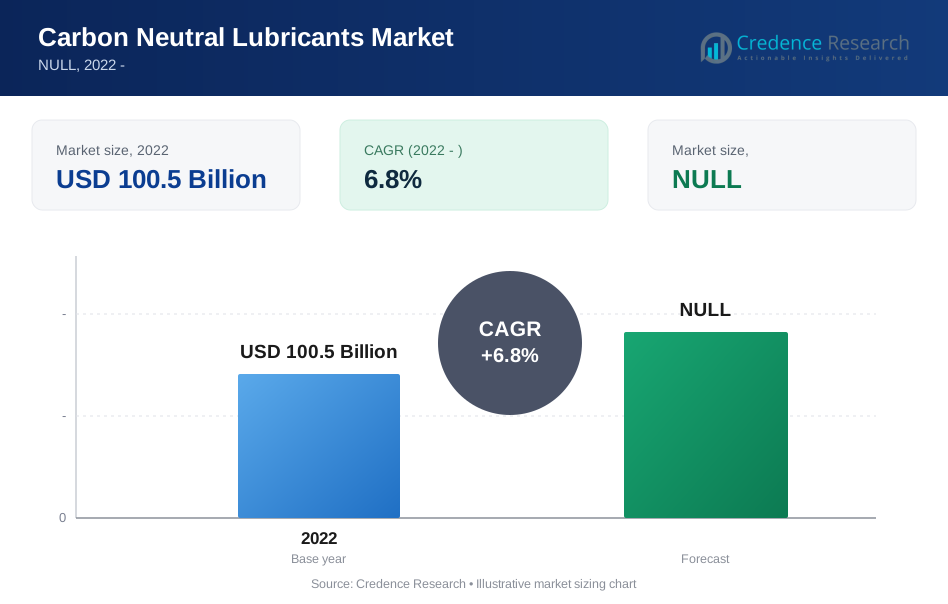
The global carbon-neutral lubricants market has witnessed steady growth in recent years and is expected to grow at a CAGR of 6.8% between 2023 and 2030. The market was valued at USD 100.5 billion in 2022 and is expected to reach USD 159.3 billion in 2030.
What Are The Main Drivers Of The Global Carbon Neutral Lubricants Market?
Carbon-neutral lubricants are anticipated to have a considerable growth in demand during the forecasted period due to their significantly lower environmental impact, lack of toxicity, and low operating and maintenance costs throughout the product life cycle. The sector is anticipated to grow even further due to factors like growing oil prices, dwindling global crude oil reserves, and the need to protect the environment from pollution caused by conventional lubricating oils and their uncontrolled spills.
What Are The Major Challenges Faced By The Global Carbon Neutral Lubricants Market?
The high viscosity and poor oxidative stability at high temperatures of carbon-neutral lubricants are projected to restrict their growth in important industrial applications. Lubricants that are carbon-neutral cost more than regular oils. As a result, the relatively high price of carbon-neutral lubricants throughout the forecast period might limit the growth of the global lubricant market.
What Are The Growth Opportunities In The Global Carbon Neutral Lubricants Market?
Lubricants can help reduce fuel use even though the transportation sector's fuel use still makes up the majority of the carbon footprint. So, starting with basic oils, lubricant manufacturers are looking into high-performance, environmentally friendly options for their raw materials.
Executive Summary
Overview of the Global Carbon Neutral Lubricants Market
A smaller carbon footprint is necessary for sustainability. A variety of basic oils are available to assist in producing sustainable finished lubricants. The urgency to address climate concerns has never been more urgent. The need for significant decarbonization is essential, given that the transport sector has increased emissions more quickly than any other industry over the past 50 years.
Market Definition
Carbon-neutral lubricants are better for the environment since they produce less carbon dioxide. A lubricant's most common application is to reduce interference between two surfaces. However, each lubricant has a unique composition. Oil, grease, penetrating, and dry lubricants are the four different types. Oil and grease are the two lubricants you'll come into touch with the most frequently daily.
Market Insights
- The global demand for carbon-neutral lubricants was valued at USD 100.5 Billion in 2022 and is expected to reach USD 159.3 million in 2030, growing at a CAGR of 6.8% between 2023 and 2030.
- The animal fat segment is the leading segment by base type. It will hold over 60% share in value in 2022, while the binders segment will likely exhibit a significant CAGR during the forecast period.
- The processed oil segment governs the global demand for carbon-neutral lubricants, holding a massive share of over 30% in 2022, and is expected to grow at a rapid CAGR.
- The automotive segment will post the highest CAGR during the forecast period.
- Asia Pacific is fueling the growth of the carbon-neutral lubricants industry with an over one-third share in 2022, while North America and Europe collectively accounted for just under 50% share in 2022. Europe held over 22% share in 2022.
- The huge growth potential in Asia Pacific is creating major opportunities in the market.
Segmentation by Base Type
- In 2022, the animal fat category dominated the carbon-neutral lubricants market growth.
- Animal fat is cost-efficient, and it is convenient for manufacturing carbon-neutral lubricants.
- The vegetable oil market is also anticipated to experience rapid expansion globally.
Segmentation by Application
- The processed oil segment dominated the carbon-neutral lubricants market revenue in 2022 and is anticipated to increase quickly over 2022–2030.
- Due to its extensive range of applications across numerous industries, particularly in the tire business, processed oil climbed to the top in the industrial application segment in 2022.
- Automotive and industrial are the two primary application industries. The desire for high-performance engines is one of the key factors affecting product demand in the vehicle industry.
Segmentation by Region
- Asia Pacific is fuelling the growth of the carbon-neutral lubricants industry with over one-third share in 2022.
- North America and Europe collectively account for just under 50% share in 2022, with Europe holding over 22% share in the same year.
- The rest of the world, including Latin America, The Middle East, and Africa, contributes the remainder to the demand for water-based barrier coatings.
Due to factors like rising oil prices, the world's declining crude oil reserves, and the need to safeguard the environment from pollution brought on by conventional lubricating oils and their uncontrolled spills, it is anticipated that the market for carbon-neutral lubricants will expand during the forecasted period.
The demand for industrial lubricants is expected to increase throughout the projection period due to expanding industrial production in developing nations in the Asia Pacific and Latin America.
The mining, unconventional energy, and chemical industries are predicted to be among the largest markets for industrial lubricants.
The Asia Pacific area is anticipated to grow at the highest CAGR over the years due to various vehicle manufacturing enterprises in China, India, and Japan. Industrialized nations have seen a considerable increase in the usage of carbon-neutral lubricants due to the implementation of various tax incentives, and developing nations like China and India are likely to follow suit.
Advantages Of Carbon-Neutral Lubricants Will Promote Market Expansion
Carbon-neutral lubricants are significantly more biodegradable, safer for the environment, less likely to harm employees' skin, and require less upkeep than mineral oil or petroleum-based lubricants. They thus play a bigger role in a wider range of businesses.
Using carbon-neutral lubricants can significantly decrease stormwater pollution from brake lines, engine leaks, and hydraulic system leaks. Carbon-neutral lubricants perform better and last longer than petroleum-based lubricants because they evaporate more slowly and adhere to metal surfaces better. Compared to petroleum-based lubricants, the penalties placed on the operator in the event of spills or leaks into the environment are far lower. These factors have been impacting the use of carbon-neutral lubricants in various industries, such as oil and gas, mining, metallurgy, power generation, and metalworking.
Increasing Investments In The Market
Even though the transportation sector still accounts for most of the carbon footprint, lubricants can assist in cutting fuel consumption. Thus, lubricant producers are investigating high-performance, sustainable choices for their raw materials, starting with basic oils.
High Cost
It is anticipated that carbon-neutral lubricants' high viscosity and poor oxidative stability at high temperatures will limit their growth in significant industrial applications. Carbon-neutral lubricants are more expensive than conventional oils. Therefore, the relatively high cost of carbon-neutral lubricants throughout the forecast period may be a barrier to expanding the worldwide market share for lubricants.
Competitive Landscape
Key Players
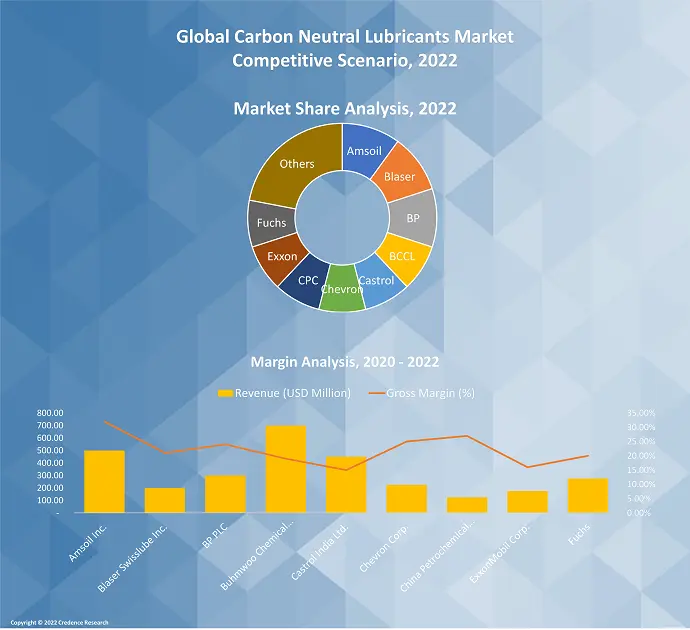
The global carbon-neutral lubricants market is highly competitive, with several key players. Some of the major players in the market and their market share are as follows:
- Amsoil Inc.
- Blaser Swisslube Inc.
- BP PLC
- Buhmwoo Chemical Co. Ltd.
- Castrol India Ltd.
- Chevron Corp.
- China Petrochemical Corp
- ExxonMobil Corp.
- Fuchs
- Idemitsu Kosan Co. Ltd.
- JX Nippon Oil & Gas Exploration Corp.
- Lukoil
- Petrobras
- PetroChina Company Ltd.
- Others
These companies focus on product innovation, expanding their distribution channels, and mergers and acquisitions to stay ahead.
The major players in the global carbon-neutral lubricants market constantly strive to stay ahead by introducing new products and innovations.
Summary of Key Findings
- The growing application of carbon-neutral lubricants is driving market growth.
- Growing demand for sustainable oil and lubricants
- Development of carbon-neutral lubricants
- Growing automotive industry and demand for sustainable lubricants
Future Outlook
- Positive outlook for the global carbon-neutral lubricants market with significant growth potential in the Asia Pacific region
- Increasing adoption of carbon-neutral lubricants in the automotive industry to drive growth
- Key players to focus on product innovation, expanding market reach and maintaining competitive pricing to stay ahead.
Segmentation
- By Base Type
- Animal Fat
- Vegetable Oil
- By Application
- Industrial
- General Industrial Oils
- Greases
- Industrial Engine Oils
- Metalworking Fluids
- Process Oils
- Others
- Automotive
- Engine Oil
- Brake Fluids
- Coolants
- Gear Oil
- Greases
- Transmission Fluids
- Marine
- Engine Oil
- Gear Oil
- Greases
- Hydraulic Oil
- Turbine Oil
- Others
- Aerospace
- Gas Turbine Oil
- Hydraulic Fluids
- Piston Engine Oil
- Others
- Industrial
- By Region
- North America
- The US
- Canada
- Mexico
- Europe
- Germany
- France
- The UKUK.
- Italy
- Spain
- Rest of Europe
- Asia Pacific
- China
- Japan
- India
- South Korea
- South-east Asia
- Rest of Asia Pacific
- Latin America
- Brazil
- Argentina
- Rest of Latin America
- Middle East & Africa
- GCC Countries
- South Africa
- Rest of the Middle East and Africa
Request a Free Sample
Fill in your details and we'll send you a free sample report.
- Sample data tables & charts
- Research methodology
Need a Custom Version of This Report?
Tailor the scope, geography, or segments to your exact requirements.
- Custom geography or segment scope
- Direct access to our analyst team
Frequently Asked Questions
What is the current size of the global carbon-neutral lubricants market?
What is the expected growth rate of the carbon-neutral lubricants market between 2023 and 2030?
Which segment is leading the market share in terms of base type?
Which application segment governs the world's demand for carbon-neutral lubricants?
Which segment is expected to post the highest CAGR during the forecast period?
Which region is fueling the growth of the carbon-neutral lubricants industry?
Who are the major players in the global carbon-neutral lubricants market?
What are the major market drivers of the carbon-neutral lubricants industry?
What are the major market restraints of the carbon-neutral lubricants industry?
What are the major market opportunities in the carbon-neutral lubricants industry?
Table of Content
Chapter 1. Report Introduction
- 1.1 Report Description & Purpose
- 1.1.1 Report Title & Market Definition
- 1.1.2 Unique Selling Propositions (USP) & Key Differentiators
- 1.1.3 Value Proposition for Stakeholders
- 1.2 Research Objectives
- 1.2.1 Market Sizing Objectives (Volume & Revenue)
- 1.2.2 Segmentation Objectives
- 1.2.3 Competitive Intelligence Objectives
- 1.2.4 Forecast & Scenario Objectives
- 1.3 Report Scope
- 1.3.1 Carbon Neutral Lubricants Scope – Types & Subtypes Covered
- 1.3.2 Geographic Scope – Regions & Countries Covered
- 1.3.3 Historical Period, Base Year & Forecast Period (2022; forecast to the forecast period)
- 1.3.4 Inclusions & Exclusions
- 1.4 HS Code & Classification Framework
- 1.5 Currency, Units & Pricing Basis
- 1.6 Target Stakeholders
- 1.7 Limitations & Assumptions
Chapter 2. Executive Summary
- 2.1 Global Carbon Neutral Lubricants Market Snapshot
- 2.1.1 Market Size – Historical (2022) & Forecast (the forecast period) (2022: USD 100.5 Billion → forecast year: NULL)
- 2.1.2 Volume & Revenue – Global Totals
- 2.1.3 Key Market Highlights – Top Five Facts
- 2.2 Carbon Neutral Lubricants Market Segmentation Snapshot
- 2.2.1 Market Split by Region – 2022 vs.
- 2.3 Competitive Snapshot
- 2.3.1 Top 10 Players by Revenue Share – 2022
- 2.3.2 Top 10 Players by Volume Share – 2022
- 2.3.3 Recent Strategic Developments (18-Month Summary)
- 2.4 Key Investment Highlights & Strategic Conclusions
Chapter 3. Carbon Neutral Lubricants Market Dynamics & Industry Analysis
- 3.1 Market Overview & Context
- 3.1.1 Carbon Neutral Lubricants Market Position in the Broader Automotive Value Chain
- 3.1.2 OEM vs. Replacement Market Dynamics
- 3.1.3 Market Maturity & Development Stage by Region
- 3.2 Carbon Neutral Lubricants Market Drivers
- 3.3 Carbon Neutral Lubricants Market Restraints & Challenges
- 3.4 Carbon Neutral Lubricants Market Opportunities
- 3.5 Porter's Five Forces Analysis
- 3.5.1 Threat of New Entrants
- 3.5.2 Bargaining Power of Suppliers
- 3.5.3 Bargaining Power of Buyers
- 3.5.4 Threat of Substitutes
- 3.5.5 Competitive Rivalry – Intensity Assessment
- 3.6 Carbon Neutral Lubricants Value Chain Analysis
- 3.6.1 Upstream – Raw Material/Input Suppliers
- 3.6.1.1 Raw Material/Input 1
- 3.6.1.2 Raw Material/Input 2
- 3.6.1.3 Raw Material/Input 3
- 3.6.2 Midstream – Production/Manufacturing/Service Delivery
- 3.6.2.1 Production/Process Overview
- 3.6.2.2 Key Facility Locations & Capacity by Manufacturer
- 3.6.3 Downstream – Distribution & End Consumer
- 3.6.3.1 Primary Channel – B2B/OEM
- 3.6.3.2 Secondary Channels – Dealer, Retail, Online, Direct
- 3.6.4 Value Chain Profitability Analysis
- 3.6.1 Upstream – Raw Material/Input Suppliers
- 3.7 PESTEL Analysis
- 3.7.1 Political Factors
- 3.7.2 Economic Factors
- 3.7.3 Social Factors
- 3.7.4 Technological Factors
- 3.7.5 Environmental Factors
- 3.7.6 Legal Factors
- 3.8 Carbon Neutral Lubricants Supply Chain Analysis
- 3.8.1 Raw Material/Input Supply Risk Assessment
- 3.8.2 Manufacturing Concentration Risk (Geographic Exposure)
- 3.8.3 Trade Disruption Impact Analysis
- 3.9 Regulatory & Policy Landscape
Note: The regulatory and policy landscape section covers regulations based on their applicability to the market, Carbon Neutral Lubricants category, geography, and scope of the study. Only regulatory frameworks with a material impact on operations, compliance, trade, sustainability, or market access are analyzed in detail.
Chapter 4. Key Investment Pockets & Opportunity Analysis
- 4.1 Carbon Neutral Lubricants Market Attractiveness Analysis
- 4.1.1 By Region – Investment Attractiveness Matrix (Volume × CAGR)
- 4.2 Absolute Revenue Growth Opportunity
- 4.2.1 By Region – Absolute USD Growth Through the forecast period
- 4.3 Incremental Volume Opportunity
- 4.3.1 By Region – Incremental Volume Through the forecast period
- 4.3.2 Segment – Incremental Volume
- 4.4 Emerging Submarket Opportunity Deep Dive (Subject to Applicability)
- 4.5 Emerging Market Opportunity Scorecards
- 4.5.1 United States
- 4.5.2 Europe
- 4.5.3 Asia
- 4.5.4 Middle East & Africa
Note: Emerging Market Opportunity Scorecards will be included based on relevance and strategic importance. Regions listed are indicative and may vary depending on data availability and market dynamics.
Chapter 5. Carbon Neutral Lubricants Import-Export Analysis & Trade Flows
- 5.1 Global Trade Overview
- 5.1.1 Global Export Value by Country (2022)
- 5.1.2 Global Export Volume by Country (2022)
- 5.1.3 Global Import Value by Country (2022)
- 5.1.4 Global Import Volume by Country (2022)
- 5.1.5 Net Trade Balance by Country (2022)
- 5.2 Export Analysis – Segment
- 5.2.1 Type 1 (HS Code)
- 5.2.2 Type 2 (HS Code)
- 5.2.3 Type 3 (HS Code)
- 5.2.4 Type 4 (HS Code)
- 5.2.5 Type 5 (HS Code)
- 5.3 Import Analysis – Segment
- 5.3.1 Type 1 (HS Code)
- 5.3.2 Type 2 (HS Code)
- 5.3.3 Type 3 (HS Code)
- 5.3.4 Type 4 (HS Code)
- 5.3.5 Type 5 (HS Code)
- 5.4 Average Unit Trade Prices
- 5.4.1 Average Export Price – Segment & Country
- 5.4.2 Average Import Price – Segment & Source Country
- 5.4.3 Price Trends (2022)
- 5.5 Key Trade Route Analysis
- 5.5.1 Trade Route 1
- 5.5.2 Trade Route 2
- 5.5.3 Trade Route 3
- 5.5.4 Trade Route 4
- 5.5.5 Trade Route 5
- 5.6 Trade Policy Impact Assessment
- 5.6.1 US Anti-Dumping & Section 301 Tariffs
- 5.6.2 EU Customs Union Impact
- 5.6.3 Major Free Trade Agreements
- 5.6.4 USMCA Rules of Origin
Note: Trade policy analysis will be included only where relevant to the Carbon Neutral Lubricants market.
Chapter 6. Competitive Landscape & Company Benchmarking
- 6.1 Carbon Neutral Lubricants Market Concentration & Structure
- 6.1.1 Herfindahl-Hirschman Index (HHI) – vs. 2022
- 6.1.2 Tier 1, Tier 2 & Tier 3 Market Structure
- 6.1.3 Global, Regional & Local Player Dynamics
- 6.2 Carbon Neutral Lubricants Market Share Analysis – 2022
- 6.2.1 Global Revenue Share by Company
- 6.2.2 Global Volume Share by Company
- 6.2.3 Regional Revenue Share
- 6.2.4 Market Share Evolution ( vs. 2022)
- 6.2.5 OEM Segment Share by Company
- 6.2.6 Replacement Segment Share by Company
- 6.3 Production/Delivery Capacity & Facility Analysis
- 6.3.1 Global Installed Capacity
- 6.3.2 Capacity Utilization Rates
- 6.3.3 Production/Output Volume
- 6.3.4 Facility Locations & Capacity Map
- 6.3.5 Planned Capacity Additions
- 6.4 Carbon Neutral Lubricants Competitive Benchmarking Matrix
- 6.4.1 Revenue, Volume, CAGR & Profitability Comparison
- 6.4.2 Channel Revenue Mix
- 6.4.3 Geographic Revenue Exposure
- 6.4.4 R&D Intensity
- 6.4.5 Sustainability Maturity
- 6.5 Strategic Developments in Carbon Neutral Lubricants (Last 24 Months)
- 6.5.1 Mergers, Acquisitions & Divestments
- 6.5.2 New Carbon Neutral Lubricants Launches
- 6.5.3 Facility Expansions
- 6.5.4 Strategic Alliances, Joint Ventures & Partnerships
- 6.5.5 Distribution Expansion & Market Entry
- 6.5.6 Sustainability & ESG Initiatives
- 6.6 Competitive Strategy Mapping
- 6.6.1 Leader, Challenger, Follower & Niche Classification
- 6.6.2 Pricing Strategy Comparison
- 6.6.3 Channel Strategy Matrix
Note: Strategic developments are included based on their materiality and the availability of reliable information.
Chapter 7. Global Carbon Neutral Lubricants Market – By Distribution Channel
- 7.1 Segment Overview
- 7.1.1 Volume & Revenue Split by Channel (2022 & )
- 7.1.2 Channel Mix Evolution (the forecast period)
Chapter 8. Regional Market Analysis – Global Overview
- 8.1 Global Regional Overview
- 8.1.1 Regional Volume Share
- 8.1.2 Regional Revenue Share
- 8.1.3 Regional Volume by Region
- 8.1.4 Regional Revenue by Region
- 8.1.5 Regional Forecast Through the forecast period
- 8.2 Cross-Regional Segment Analysis
- 8.2.1 By Distribution Channel
- 8.2.2 By Brand/Price Tier
Chapter 9. North America Carbon Neutral Lubricants Market
- 9.1 United States
- 9.2 Canada
- 9.3 Mexico
Chapter 10. Europe Carbon Neutral Lubricants Market
- 10.1 Germany
- 10.2 France
- 10.3 Italy
- 10.4 United Kingdom
- 10.5 Spain
- 10.6 Poland
- 10.7 Russia
- 10.8 Netherlands
- 10.9 Belgium
- 10.10 Sweden
- 10.11 Denmark
- 10.12 Norway
- 10.13 Rest of Europe
Chapter 11. Asia Pacific Carbon Neutral Lubricants Market
- 11.1 China
- 11.2 India
- 11.3 Japan
- 11.4 South Korea
- 11.5 Thailand
- 11.6 Indonesia
- 11.7 Vietnam
- 11.8 Malaysia
- 11.9 Australia
- 11.10 Rest of Asia Pacific
Chapter 12. Latin America Carbon Neutral Lubricants Market
- 12.1 Brazil
- 12.2 Argentina
- 12.3 Colombia
- 12.4 Chile
- 12.5 Rest of Latin America
Chapter 13. Middle East Carbon Neutral Lubricants Market
- 13.1 Saudi Arabia
- 13.2 United Arab Emirates
- 13.3 Turkey
- 13.4 Israel
- 13.5 Iran
- 13.6 Rest of the Middle East
Chapter 14. Africa Carbon Neutral Lubricants Market
- 14.1 South Africa
- 14.2 Egypt
- 14.3 Nigeria
- 14.4 Morocco
- 14.5 Rest of Africa
Chapter 15. Carbon Neutral Lubricants Company Profiles
- 15.1 [Company 01]
- 15.1.1 Company Overview
- 15.1.2 Key Management Personnel
- 15.1.3 Products & Services Portfolio
- 15.1.4 Financial Performance
- 15.1.5 Key Market Focus & Geographic Presence
- 15.1.6 Recent Developments & Strategic Initiatives
Note: The company profile list is preliminary and may change based on research findings, market developments, data availability, and client requirements.
Chapter 16. Appendices
- Appendix A – List of Abbreviations & Acronyms
- Appendix B – Industry Classification Code Reference – Full Series
- Appendix C – Production & Capacity Data Tables
- Appendix D – End-Use & Demand Base Tables
- Appendix E – Consumption & Replacement Rate Assumptions
- Appendix F – ASP Reference Tables
- Appendix G – Manufacturing & Facility Database
- Appendix H – Import-Export Data Tables
- Appendix I – Regulatory Summary Tables
- Appendix J – Primary Research Participant List (Anonymized)
- Appendix K – Primary Research Questionnaire Framework
- Appendix L – Data Sources & Bibliography
- Appendix M – Market Size Divergence & Source Comparison
Chapter 17. Research Methodology
- 17.1 Research Framework & Philosophy
- 17.2 Secondary Research – Sources, Hierarchy & Data Extraction
- 17.3 Data Modeling – Bottom-Up & Top-Down Market Sizing
- 17.4 Primary Research – Stakeholder Framework, LOI & Sample Sizes
- 17.5 Forecast Methodology – Regression, Scenario & Sensitivity Analysis
- 17.6 Quality Control – Four-Layer Validation Framework
- 17.7 Limitations & Standard Assumptions
- 17.8 Disclaimer
